Development and validation of an analytical method to quantify baphicacanthin A by LC-MS/MS and its application to pharmacokinetic studies in mice
Development and validation of an analytical method to quantify baphicacanthin A by LC-MS/MS and its application to pharmacokinetic studies in mice
분석과학 / Analytical Science and Technology, (P)1225-0163; (E)2288-8985
2022, v.35 no.2, pp.60-68
https://doi.org/10.5806/ast.2022.35.2.60
JeonSo Yeon(So Yeon Jeon)
(College of Pharmacy, Dankook University)
 KimSan(San Kim)
(College of Pharmacy, Dankook University)
ParkJin-Hyang(Jin-Hyang Park)
(BK21 FOUR Community-Based Intelligent Novel Drug Discovery Education Unit, Vessel-Organ Interaction Research Center (VOICE), College of Pharmacy and Research Institute of Pharmaceutical Sciences, Kyungpook National University)
SongIm-Sook(Im-Sook Song)
(BK21 FOUR Community-Based Intelligent Novel Drug Discovery Education Unit, Vessel-Organ Interaction Research Center (VOICE), College of Pharmacy and Research Institute of Pharmaceutical Sciences, Kyungpook National University)
HanYoung Taek(Young Taek Han)
(College of Pharmacy, Dankook University)
ChoiMin-Koo(Min-Koo Choi)
(College of Pharmacy, Dankook University)
JeonSo Yeon,
KimSan,
ParkJin-Hyang,
SongIm-Sook,
HanYoung Taek,
&
ChoiMin-Koo.
(2022). Development and validation of an analytical method to quantify baphicacanthin A by LC-MS/MS and its application to pharmacokinetic studies in mice, 35(2), 60-68, https://doi.org/10.5806/ast.2022.35.2.60
Abstract
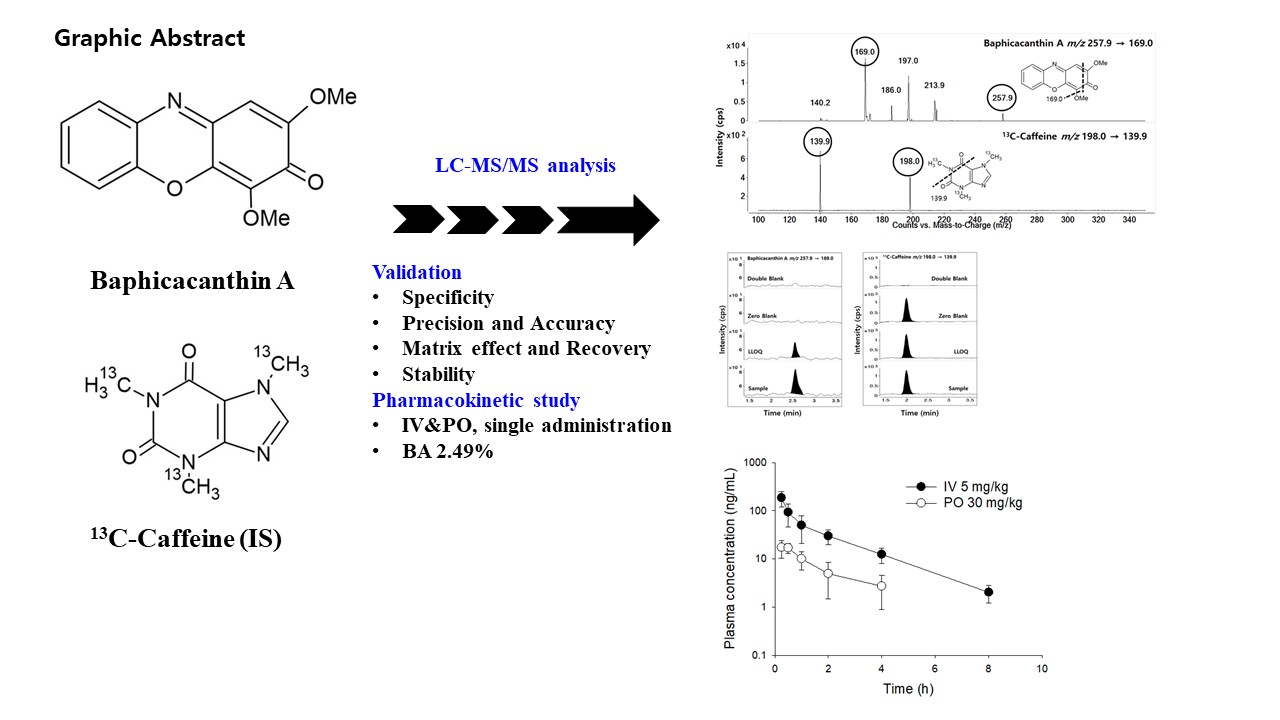
In this study, we developed and validated a sensitive analytical method to quantify baphicacanthin A in mouse plasma using liquid chromatography-tandem mass spectrometry (LC-MS/MS). The standard calibration curves for baphicacanthin A ranged from 0.5 to 200 ng/mL and were linear, with an r2 of 0.985. The inter- and intra-day accuracy and precision and the stability fell within the acceptance criteria. Besides, we investigated the pharmacokinetics of baphicacanthin A following its intravenous (5 mg/kg) and oral administration (30 mg/kg). Intravenously injected baphicacanthin A showed biphasic elimination kinetics with high clearance and volume of distribution values. Furthermore, baphicacanthin A showed a rapid absorption but low aqueous solubility (182.51±0.20 mg/mL), resulting in low plasma concentrations and low oral bioavailability (2.49 %). Thus, we successfully documented the pharmacokinetic properties of baphicacanthin A using this newly developed sensitive LC-MS/MS quantification method, which could be used in future lead optimization and biopharmaceutic studies.
- keywords
-
baphicacanthin A,
analytical method validation,
LC-MS/MS,
bioavailability
- 투고일Received
- 2022-02-15
- 수정일Revised
- 2022-03-15
- 게재확정일Accepted
- 2022-04-01
- 출판일Published
- 2022-04-25