Author
Dr Mohammad Jahangir Alam was Professor and former Chairman of the Department of World Religions and Culture at the University of Dhaka, where he earned his MPhil and PhD. An expert on the Bahá'í Faith and Caodaism, he authored The Concept of Unity in Bahá'í Faith and Caodaism: A Comparative Study (2010) and edited World Religions and Culture: Interfaith Education in Bangladesh (2022). His research advanced the comparative study of new religious movements (NRMs) in Asia and promoted interreligious dialogue and peacebuilding.
Limpa Das holds BA and MA degrees in World Religions and Culture from the University of Dhaka. Her master's monograph, Social Engagements of Daesoon Jinrihoe in Modern Korea: A Socio-Cultural Perspective (2024), shaped her interest in Korean NRMs and culture. Her research explores how Daesoon Jinrihoe and other movements engage with contemporary Korean society and contribute to identity and community formation.
JDTREA 2025,5(1): 121–146
Introduction
To extent, with particular reference to the concept of modern religion—characterized by institutional specialization, including the standardization of religious worldviews, doctrines, rituals, religious roles, propagation of teachings, and organizational programs ( McGuire 1997 )—Daesoon Jinrihoe can also be regarded as a modern religious movement. The reason appears to lie in its ability to maintain a well-structured organizational framework that extends into multiple social dimensions, both within and beyond the Daesoon community. Religious teachings, by broadening human consciousness, fostering a sense of universal brotherhood, and nurturing a deep commitment to humanitarian service, play a critical role in shaping socially responsible behavior ( Chatterji 1970 ). When considering the characteristics of modern religions, Daesoon Jinrihoe's organizational structure stands out for its capacity to inspire adherents toward active social engagement. Again, we see the remarkable contributions of Jo Jeongsan and Park Wudang who formalized the movement's teachings and institutional structure, establishing education and healthcare organizations that extended Daesoon Jinrihoe's social impact. Since its official founding in April 1969, the movement has actively contributed to Korean society through its commitment to charitable aid, social welfare, and education, drawing recognition both domestically and internationally from intellectuals and advocates of peace ( Kim 2020 ). The scheme of the current paper is organized around a number of centrally located and connected issues as mentioned above. However, before addressing the subject matter of the current study, we first focus on the principle of reciprocity and mutual beneficence, which fosters followers' engagement in humanitarian services.
Reciprocity and Mutual Beneficence
The followers of Daesoon Jinrihoe uphold the principle of Mutual Beneficence (Sangsaeng), which involves benefiting others and repaying benevolence. This ethical ideal is more than a social value—it is a spiritual imperative rooted in the broader theological framework of the movement. While biology uses the concept of mutualism or symbiosis to describe interspecies interactions where both organisms benefit—such as the relationship between honeybees and flowering plants during pollination—Daesoon Jinrihoe extends this concept into the realm of intentional moral action (Soryte 2022, 106). In natural mutualism, the exchange of benefits is largely automatic and driven by instinct; however, in Daesoon Thought, Mutual Beneficence must be motivated by conscious intention and a sincere desire to bring well-being to others (Soryte 2022, 108–109).
According to the teachings of Daesoon Jinrihoe, the world can be transformed into a paradise if humanity commits itself to the dual principles of “Resolving Grievances” (Haewon) and “Gratefully Reciprocating Favors” (Boeun)—foundational values that lead to the realization of Mutual Beneficence ( Cha 2018 , 68). Followers believe that gratitude for divine blessings must be expressed through acts of kindness and service to others. Consequently, contributing to the welfare of society becomes not only a moral duty but a spiritual practice. This belief strongly motivates members of Daesoon Jinrihoe to engage in charitable and social welfare activities, viewing such acts as essential expressions of their faith and gratitude ( Soryte 2018 , 81).
Creation of a New Cosmic Harmony
Health Care Support and Food SecurityHealth Care Support and Food SecurityWelfare EnterpriseWelfare EnterpriseOverseas BusinessOverseas BusinessBundang Jesaeng HospitalBundang Jesaeng HospitalDomestic BusinessDomestic BusinessMedical EnterpriseMedical EnterpriseDaesoon YouthTraining CentreDaesoon YouthTraining CentreVolunteering and Charitable ActivitiesVolunteering and Charitable ActivitiesCommunity BusinessCommunity BusinessDaejin UniversityDaejin UniversityDaejinInternational Volunteers AssociationDaejinInternational Volunteers AssociationOrganizationalStructure andHistorica TimelinesOrganizationalStructure andHistorica TimelinesDaesoon Scholarship FoundationDaesoon Scholarship FoundationThree Major WorksThree Major WorksEducationEducationSocial Welfareand Health CareSocial Welfareand Health CareCharity AidCharity AidDaesoon Jinrihoe envisions the realization of an ideal world—one free from injustice, suffering, and conflict. Social engagement is understood as a vital means to achieving this transformation by healing societal divisions and promoting mutual cooperation. Central to this vision is Kang Jeungsan's (also rendered as Kang Jeung-san) “Reordering Work of Heaven and Earth” (Cheonji-Gongsa), which is believed to have rectified the cosmic disorder and opened the path toward an everlasting earthly paradise ( Introvigne 2018 , 35). Within this theological framework, followers of Daesoon Jinrihoe perceive their religious mission as one of disseminating divine teachings and actively contributing to the rectification of the world order through a wide range of social welfare initiatives ( Dinh 2025 , 27).
Social works in Daesoon Thought are regarded as tangible expressions of divine will, aiming to create a more just, peaceful, and compassionate society. Rooted in its core doctrinal principles, the movement emphasizes two fundamental concepts: Haewon-Sangsaeng (resolution of grievances for mutual beneficence) and Boeun-Sangsaeng (grateful reciprocation for mutual beneficence) ( Kim 2025 , 188). The principle of Haewon stresses the necessity of resolving accumulated grievances, injustices, and conflicts—both personal and collective—in order to restore cosmic and social harmony. Conversely, Boeun underscores the ethical imperative to repay kindness and blessings received from deities, ancestors, society, and nature (Baker 2016, 9). These two interlinked principles aim to promote gratitude, ethical reciprocity, and harmonious coexistence, which are foundational to the movement's vision of cosmic renewal.
The practice of these principles is embodied in Daesoon Jinrihoe's social engagement, particularly since the 1970s. We now proceed to examine in detail Daesoon Jinrihoe's social engagement, focusing on its three primary areas of activity: education, social welfare, and charitable aid. Before dealing with the issue in detail, we present the distinctive features of Daesoon Jinrihoe's holistic approach through the following chart, which outlines its core functionaries aimed at contributing to Creation of a new cosmic harmony.
Education
To begin with Daesoon Jinrihoe established its first educational foundation in 1984. The followers maintain the instruction of Park Dojeon. As Dojeon noted:
It is our goal to provide a well-rounded education characterised by the cultivation of morality and a law-abiding spirit and additionally enable students to develop sound minds and bodies. Thus, we should put much effort into raising talented people who will meet the demands of this age and make contributions to the public and to national interests (AADDJ 2017, 83).
The implication of the instruction in its usage is undoubtedly to distinguish the organizational base of Daesoon Jinrihoe's educational movement from that of the surrounding social institutions. It is important to note that Dojeon's instruction seems to have served as a source of inspiration from which Daesoon followers were primarily concerned with the way in which Daesoon organization is attached to works that started during the early days of the anti- illiteracy movement. As part of its ongoing success in recent years, Daesoon Jinrihoe has established an accredited university and six high schools, which include Daejin University, Daejin high school, Ilsan Daejin high school and Busan Daejin high school of Electronics and Telecommunications. Indeed, university seeks to nurture a new generation of creative and proactive individuals who embody both intelligence and wisdom, and who are committed to the advancement of humanity and the betterment of society. To this extent, proponents of Daesoon Jinrihoe assert that its educational vision has the potential to cultivate young leaders both locally and globally, guided by a spirit of mutual benefit and win-win growth (Daesoon Jinrihoe 2025a).
Daejin University
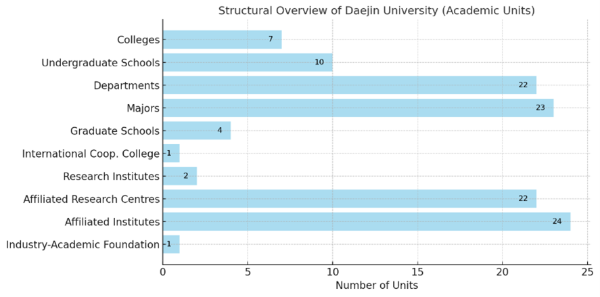
Daejin University is a private university which is located in Pocheon, Gyeonggi province, South Korea. It was founded by Daesoon Jinrihoe in November 1991 and inaugurated in 1992. Initially Daejin university was named Daejin Academy and changed to Daejin University in 1992. It is one of the top private universities in South Korea. It is ranked 364 in Asian University Rankings- Eastern Asia 2004. Daejin Jinrihoe has two campuses in China, in Harbin and Suzhou, where some Korean students also study, supported by Daejin University Scholarships. It includes 4 graduate schools, 7 colleges, 22 departments, 10 undergraduates' schools, 23 majors, 1 international co-operation college, 24 affiliated institutes, 1 industry-academic cooperation foundation, 2 research institutes and 22 affiliated research centres ( Daejin University 2025 , as of 2003).
Structural Overview of Daejin University (Academic Units)
Daejin Jinrihoe has two campuses in China, in Harbin and Suzhou, where some Korean students also study, supported by Daejin University Scholarships. It includes 4 graduate schools, 7 colleges, 22 departments, 10 undergraduate schools, 23 majors, 1 international co-operation college, 24 affiliated institutes, 1 industry-academic cooperation foundation, 2 research institutes, and 22 affiliated research centres.
Daejin University aims to nurture innovative and self-reliant individuals who can make meaningful contributions to the advancement of both the nation and humanity (Daejin University, 2020). In pursuit of this mission, the university is committed to the pursuit of truth through sincere, respectful, and faithful teaching and research across a wide range of academic disciplines. These educational endeavors are guided not only by the broader educational philosophy of the Republic of Korea but also by the unique spiritual tenets of Daesoon Thought, particularly the principle of the Resolution of Grievances for Mutual Beneficence (Haewon-Sangsaeng). Central to Daejin University's vision is the cultivation of leaders who embody the ideal of mutual beneficence—those who strive to improve the world through ethical scholarship and moral integrity. Students are encouraged to engage in their studies with sincerity (seongsil), respectfulness (gyeonggeon), and conviction (sinyeom), while practicing the values of great benevolence and great justice—key virtues drawn from the religious ethos of its founding body. As stated by the university's founder, Park Woodang: “The objective of Daejin University is to foster creative, talented people with outstanding knowledge and character to contribute to the development of society with the spirit of faithfulness (seongsil), piety (gyeonggeon), and conviction” (Daejin University 2025b).
By integrating ethical and spiritual dimensions into its academic mission, Daejin University continues to serve as an institution where the ideals of Daesoon Thought are realized through education and global engagement ( Soryte 2018 , 92). Daejin Jinrihoe defines its strategies through slogans. One is “humanities education based on benevolence and righteousness,” which is strictly connected with the principles of Daesoon Thought. The second, which is self-explanatory, and alludes to the fact that today many college graduates remain unemployed, is “Practical education with focusing on employment”. The third is “Creating smart campus,” which doesn't forget the importance of ecology in Daesoon Jinrihoe and calls for an eco-friendly environment. In fact, one of the most important international events was co-organized by Daejin University on October 3–5 2019 in Yeouju city. Lastly the fourth is “strengthening the brand of global Daejin” and alludes to the DUCC (Daejin University China Campus) project in mainland China. Daejin University is solidifying its image and expanding its global brand image by exchange programs with many countries.
Daesoon Scholarship Foundation
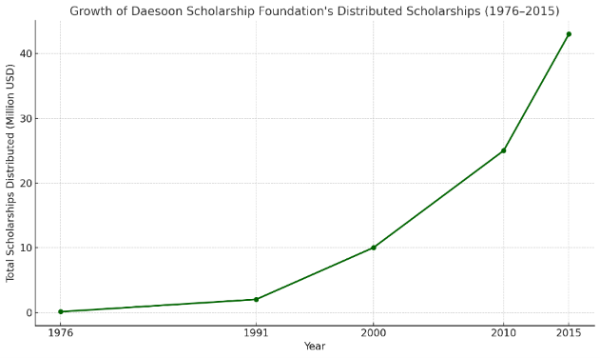
In 1976—fifteen years prior to the founding of Daejin University—the Daesoon Scholarship Foundation was established in accordance with the directive of the Dojeon (the religious title given to the successor of Doju Jo Jeongsan, the successor of Kang Jeungsan), who proclaimed: “Expand the amount of scholarship on a yearly basis in order to cultivate talented individuals for the benefit of the nation as well as for our religious body” (AADDJ 2017, 84). This foundation was created to support academically excellent students, particularly those from economically disadvantaged backgrounds. The Scholarship Foundation, in its current scope of activities, operates on a remarkably extensive scale.
To better understand the scope of its activities, we may examine the Foundation's current initiatives. The Scholarships are awarded biannually under various categories, including the Scholarship for Exemplary Students, Scholarship for Honor Students, Scholarship for Junior and High School Children of Daesoon Jinrihoe Members, and Scholarship for Students of Daejin University. These initiatives reflect the movement's commitment to both educational development and social contribution, inspired by the principle of Boeun-Sangsaeng—repaying benevolence and promoting mutual beneficence. By 2015, the total value of scholarships distributed through the foundation had reached approximately 43 million USD, demonstrating Daesoon Jinrihoe' extensive investment in education as a means of fostering societal well-being and cultivating future leaders (AADDJ 2017, 85).
Daejin Youth Training Center
Daejin Youth Training Center was built to realise a well-rounded education. The facility is a four-story building with a basement and it can accommodate 200 people. For the purpose of raising truthful future generations, the centre has run various educational programs since its opening in March of 2013. The religious programs include `Daesoon Youth Campus', `Lectures for University Students', `Religious Cultural Field Trips' and `Truth Forums for Branch Members' (AADDJ 2017, 85).
There are two certified training courses for adolescents as well. One is a volunteering program called `Empathy and Sharing' and the other one is called `Daejin Futsal (Indoor Soccer) Class.' The “Empathy and Sharing” program cooperates with other Daesoon Jinrihoe institutions. For example, participants can learn how to take care of the elderly and help them with wheelchairs. Meanwhile, the Daejin Futsal class provides local elementary students with basic futsal skills while improving their physical health. The DYTC facility includes accommodation, lecture rooms, a hall, an indoor sports centre, a field and an outdoor concert hall. The Daesoon youth camp is held twice annually for elementary, middle and high school students in relation to the primary doctrine, mortality and ethics for the personality and character of children. Furthermore, the centre is preparing new programs for families of Daesoon Jinrihoe and the local adolescents (AADDJ 2017, 85).
Diversity, Culture and Art
The purpose of the diversity, culture and art is to provide a safe space and resources for people of all walks of life to pursue self-realisation, evolve understanding, and give back to their communities. Their mission is to focus on providing resources, safe spaces, education and allyship. They also focus on providing a safe space for creatives to collaborate, inspire, give back to humanities and to evolve emotionally, spiritually through their prospective mediums (Daesoon Foundation 2025a).
Social Welfare and Health Care
The commitment of Daesoon Jinrihoe to social welfare and healthcare is deeply rooted in the teachings of Park Wudang, who emphasized the moral responsibility of individuals toward their nation and society. One of his most influential exhortations declares:
We are indebted to our nation and society for our security and comfort. So you should promote the development of society through earnestly fulfilling your duties as a citizen. (AADDJ 2017, 79)
Guided by these ethical imperatives, Daesoon Jinrihoe views Social Welfare Work as a form of spiritual cultivation. This approach is grounded in the organization's central religious principles: Mutual Beneficence, the Resolution of Grievances, and the Grateful Reciprocation of Favors, as revealed by Sangje. These values are not merely abstract ideals but are enacted through a wide range of initiatives designed to enhance societal well-being and promote harmonious coexistence.
Daesoon Jinrihoe conducts its annual social welfare and healthcare activities through various affiliated bodies, including the Women's Association, Youth Association, Daesoon International Volunteer Association (DIVA), Daesoon Jinrihoe Welfare Foundation, and Daejin Medical Foundation with its associated hospitals. These institutions together form a cohesive structure supporting the religious organization's commitment to public service and humanitarian outreach. In short, all major institutional establishments of Daesoon Jinrihoe from 1972 to 2018 are illustrated in the following timeline graph.
Table. 1. Timeline of Institutional Establishments in Daesoon Jinrihoe (1972–2018)
(Source: Daesoon Jinrihoe 2025b)
Table 1.
Table 1.
(Table 1. Table 1.)
| Year | Institutional Establishment |
|---|---|
| 1972 | Three Major Works Organized |
| 1980 | Youth and Women's Associations Established |
| 1992 | Daejin Medical Foundation Established |
| 1996 | Bundang Jesaeng General Hospital Opened |
| 2007 | Daesoon Jinrihoe Welfare Foundation Established |
| 2009 | Daejin Nursing Facilities Opened |
| 2010 | Daejin Youth Training Center Inaugurated |
| 2015 | Daejin Nursing Facilities Recognized |
| 2018 | Facilities Recognized |
Community Business
For the purpose of welfare, Daesoon Jinrihoe established the Daesoon Men's Association and Women's Association in 1981. These two organisations have taken leading roles in promoting social welfare through their continuous activities such as: Saemaeul (New Community) movement, Nature conservation campaign, Traffic safety campaign, Street cleaning, Crime prevention, helping farmers, finding missing children and a movement for respecting the elderly (AADDJ 2017 ,75).
Medical Enterprises
As the nation of Korea has worked towards a welfare society in the 1990s-2010s, there have been efforts not just to promote continued economic growth but also to systematically improve the national medical service. Medical enterprises are aimed at realizing the religious ideologies of Daesoon Jinrihoe. With the establishment of its medical foundation, Daesoon Jinrihoe is committed to improving people's health through research and the development of healthcare treatment as well as human resource training (AADDJ 2017, 79).
Bundang Jesaeng Hospital
Bundang Jesaeng Hospital, also known as Daejin Medical Center, is a major general hospital located in Seohyeon-dong, Bundang-gu, Seongnam, South Korea. It was established on January 15, 1995, by the Daejin Medical Foundation, which is affiliated with the religious organization Daesoon Jinrihoe. Certified by Korean medical authorities as a reliable and innovative healthcare provider, the hospital is equipped with advanced diagnostic and treatment technologies and has become a key medical institution in the region. The hospital integrates a volunteer system to extend its outreach and improve patient care. The institution features state-of-the-art equipment, including 3D angiography devices, dental panoramic CT, and other cutting-edge diagnostic tools (AADDJ 2017, 79).
As of recent data, Bundang Jesaeng Hospital operates with a capacity of 760 beds and comprises 31 medical departments and 11 specialized centers. The hospital staff includes approximately 1,550 members, and over a span of 15 years, more than 9.32 million patients received treatment, with over 170,000 surgical procedures performed (Daejin Medical Center, n.d.). The hospital has also developed advanced treatment systems for four major cancers: gastric, colorectal, breast, and lung cancer. In addition to departments such as general surgery, orthopaedic surgery, neurosurgery, chest surgery, plastic surgery, obstetrics and gynecology, pediatrics and adolescent medicine, ophthalmology, otolaryngology, and dermatology, the hospital also leads in medical informatization. It pioneered Korea's first integrated information system combining Order Communication Systems (OCS), Picture Archiving and Communication Systems (PACS), and Electronic Medical Records (EMR), enabling fast, paperless, and accurate patient care (Daejin Medical Center, n.d.).
Table 2. Key Statistics of Bundang Jesaeng Hospital (Daejin Medical Center) (Source: Daejin Medical Center 2021)
Table 2.
Table 2.
(Table 2. Table 2.)
| Category | Count / Total | Description |
|---|---|---|
| Patients Treated (15 years) | 9,320,000 | Total number of patients treated over 15 years |
| Surgical Procedures (15 years) | 170,000 | Number of surgeries performed in 15 years |
| Staff Members | 1,550 | Total medical and administrative staff |
| Departments | 31 | Clinical and administrative departments |
| Specialized Centers | 11 | Centers focusing on specific medical areas |
| Bed Capacity | 760 | Number of available hospital beds |
Bundang Jesaeng Hospital operates under a strong philanthropic philosophy that aligns with the teachings of Daesoon Jinrihoe, including principles such as “Save people from hardship and unfortunate situations” and “Strive to live together and untangle resentment” The institution aims to promote national health and contribute to a welfare society through treatment, research, medical technology development, and the training of medical professionals. Trainees are taught to uphold the dignity of human life and to serve with benevolence and compassion. Reflecting Daesoon Jinrihoe's broader ethos of humanitarian outreach, the hospital has extended its services internationally. In August 2015, the International Medical Volunteer Corps was launched to provide medical care to ethnic Koreans and others in underserved regions of Kyrgyzstan. More recently, during the COVID-19 outbreak in March 2020, Bundang Jesaeng Hospital played a crucial role in the treatment of infected patients within South Korea (AADDJ 2017).
Welfare Enterprises
The Daesoon Jinrihoe established the Daesoon Jinrihoe Welfare Foundation in June 2007 with the aim of realizing social well-being through its core doctrine of Mutual Beneficence. This foundation was created to uphold the intentions of Park Wudang, the founder of Daesoon Jinrihoe, and to implement the organization's social welfare ideology based on the principle of Mutual Beneficence. The foundation seeks to enhance the quality of life by quantitatively expanding social welfare services and improving their overall quality. These efforts are carried out through systematically planned and implemented annual social welfare projects. Daesoon Jinrihoe's welfare enterprises are generally categorized into three divisions: the Medical Care Institute, the Medical Care Hospital, and the Senior Welfare Centre. With deep roots in Korean cultural traditions, elderly welfare is a particular priority for Daesoon Jinrihoe. In October 2009, to better meet the needs of the elderly population, Daesoon Jinrihoe established a welfare complex in Yeoju. This facility includes a Geriatric Hospital, Elderly Nursing Facilities, and an Elderly Welfare Center, which accommodate 140, 170, and 30 individuals respectively (AADDJ 2017, 80).
The Daejin Medical Care Institute is well known for treating its residents with dignity and respect, fostering a family-like atmosphere. The Institute offers seven major programs: leisure and dementia prevention, medical treatment and rehabilitation, cultural services, counseling services, nutritional support, family support, and sanitation services. Leisure programs include activities such as film appreciation and production, singing, music, origami, pottery, games, outings, and birthday celebrations. Dementia prevention programs involve physical exercise, laughter therapy, block building, puzzles, and drawing. Cultural services include celebrations for feast days, Parents' Day, spring and autumn picnics, and performances by volunteers. Nutritional services provide functional diets, refreshments, seasonal meals, and hygiene-focused food management (Soryte 2022, 93–94).
The concept of a “homelike atmosphere” is a significant expression of Daesoon Thought. In alignment with this philosophy, Daesoon Jinrihoe has constructed hospitals and nursing homes designed to resemble ordinary homes rather than institutional facilities (AADDJ 2017, 80). One notable example is the Daejin Elderly Nursing Facility, which employs a Unit Care System—an arrangement consisting of eight to twelve single-occupancy rooms per unit and a communal living room that offers a warm and domestic environment. This facility has consistently received an A-grade rating from the National Health Insurance Corporation for service and facility quality for three consecutive years starting in 2013. Due to its innovative approach to elderly care, the Daejin Elderly Nursing Facility has garnered significant international attention. Visitors from countries such as China and Vietnam have shown interest in the Unit Care System and its effectiveness in elderly welfare.
Charitable Aid
The followers of Daesoon Jinrihoe carried out charity works based on the teaching: “Do the best to give love and hope to people neglected by society, by helping them to stand up and begin new lives on their own”. Followers consider charity aid as an activity which supports the victims of natural disasters and helps people in need. Park Wudang founded the foundation of the Daesoon Men's Association and Daesoon Women's Association in1981, they have been continuously providing aid to orphans, the disabled, and neglected children while giving out daily necessities to low-income neighbourhoods and participating in campaigns to support the flood victims (AADDJ 2017, 75). In 2009, they began overseas charity aids in Kenya and Ethiopia (Africa) through the projects of digging wells and relief supplies. There are also services where they offer volunteers from the general populace, elderly citizens, individuals or youth groups. In regards to doing charity work, they founded two foundations which are The Daejin International Volunteers Association (DIVA) and Daesoon Foundation. (AADDJ 2017, 76)
Daesoon Foundation
Daesoon Foundation is a Korean Daoist organization based in the Washington D.C. metropolitan area. It was founded in 2010 and officially recognized as a nonprofit organization in 2017. (Daesoon Foundation, n.d.b.) The foundation provides spiritual counseling, therapeutic services, interfaith dialogue initiatives, conflict resolution programs, and peacebuilding activities rooted in Daoist principles. As a nonprofit Daoist charity organization, it is committed to fostering equity, equality, and humanitarian cooperation between the United States and Korea (Daesoon Foundation, n.d.c.). The foundation engages in various charitable endeavors, including local, national, and international grantmaking, as well as community-based services aimed at supporting marginalized and underserved populations. It provides spiritual guidance through educational seminars, meditation practices, and Daoist ceremonial observances, thereby promoting well-being and intercultural understanding. The foundation's charitable philosophy is grounded in the Daoist concept of “Sangsaeng” (mutual life-giving). “Sang” signifies mutual complementarity and interconnection among all beings, while “Saeng” literally means life, representing how individuals give life to each other through relationships based on mutual respect. This understanding of interdependence is central to Daoist ethics and encourages the cultivation of compassion and non-judgmental awareness (Daesoon Foundation, n.d.d.).
Sangsaeng is further structured around two foundational principles of Dao: Haewon Sangsaeng and Boeun Sangsaeng. Haewon refers to the resolution of grievances, emphasizing the importance of healing historical and interpersonal resentments. Boeun signifies the return of grace or repaying benevolence, which reflects gratitude and the moral responsibility to honor the support one has received from deities, ancestors, nature, and fellow human beings. Through the integration of these two principles, the Daesoon Foundation promotes Sangsaeng as a pathway to communal harmony and lasting peace (Daesoon Foundation 2025d). Daesoon Foundation is engaged with many charity works such as Environment Stewardship, Children in Need, Healthcare Support, and Food Security.
Environment Stewardship
In the context of Korean new religions, Daesoon Jinrihoe also advances a vision of environmental stewardship that resonates with the environmental ethics found in many of the world's religious traditions. According to the Daesoon Foundation (2025e), co-existence with nature through environmental care not only ensures health and security but also guarantees a lasting legacy for future generations—thus preserving the “beauty of the biotic community.” The Foundation actively participates in environmental volunteerism to support ecological restoration and sustainability. For example, it collaborates with local park authorities to remove invasive plant species that endanger native ecosystems and migratory bird habitats. Volunteers help clear invasive flora and prepare the land for reseeding native plants. Additionally, the Foundation organizes annual community cleanup days aimed at preventing litter from entering waterways. Volunteers are assigned to polluted watersheds and provided with tools such as trash pickers, recycling bags, gloves, and reflective vests to assist in cleaning up the urban environment (Daesoon Foundation 2025e). Through these actions, Daesoon Jinrihoe reflects a global religious ethic of environmental stewardship—one rooted in reverence for the Earth and a commitment to its well-being for all living beings.
Children in Need
Millions of children around the world are reportedly experiencing separation from their families, a crisis with far-reaching intergenerational, physical, and psychological consequences. This issue transcends economic boundaries, affecting low-, middle-, and high-income countries alike. South Korea is no exception, facing similar challenges regarding the welfare of children in need of alternative care solutions. In response to this growing concern, the Daesoon Foundation, as a volunteer organization affiliated with Daesoon Jinrihoe, has prioritized initiatives aimed at supporting children in foster care and those separated from their families. As part of its comprehensive volunteer efforts, the foundation not only supports children in the foster care system but also collaborates with both local and national organizations to provide in-kind donations and holistic care (Daesoon Foundation 2025f). Such efforts reflect a growing global movement that recognizes the importance of community-based alternative care and psychosocial support for children who are deprived of parental care. Scholars have emphasized that stable, nurturing environments and consistent social support can significantly mitigate the long-term impacts of familial separation. The Daesoon Foundation's work in this area not only addresses immediate material needs but also contributes to the long-term resilience and wellbeing of affected children.
Healthcare Support
Daesoon Foundation focuses on providing resources and aid to the community through partnerships with the local government and healthcare agencies. The volunteers have been trained in mental health first aid, CPR, and victim advocacy to educate and connect resources for those in need. During COVID pandemic, their major project was the mask making project as well as meditation to promote mental health. They also have a partnership with VITAS healthcare and made posters and decorated cars to show support and thanks to the workers during COVID pandemic. The organisation has a program called BRAW (Bringing Resource to Aid Women's Shelter) which provides menstrual supplies and undergarments to women and children in crisis, who do not have the access to basic needs. The organisation raises funds and in-kind donations to support the women and girls in our community and abroad. BRAWS also provides aid to earthquake victims in Haiti, Afghan and Ukrainian refugees, women and girls in shelters and schools, and those affected by the Pandemic (Daesoon Foundation 2025g).
Food Security
Daesoon foundation focuses on partnerships with local organisations to provide food and assistance to neighbours in need. Their one of the main programs is the sandwiches for neighbours in need. They make more than 30,000 sandwiches each year. Another program is Food and Friends who provide fresh meals and groceries at no cost to people with AIDS and other life-challenging illnesses living in the metro area. The volunteers made soups and salads as well as a wide range of homemade products and packed foods for distribution ( Daesoon Foundation 2025 ).
Daejin International Volunteers Association (DIVA)
The Daejin International Volunteers Association (DIVA) was officially established on August 1, 2013, as a humanitarian affiliate of Daesoon Jinrihoe, with the purpose of engaging in systematic, sustained charity and relief work. Rooted in the religious tenet that salvation through faith must be actualized through compassionate and concrete action, DIVA exemplifies the practical application of Daesoon Jinrihoe's core value of Mutual Beneficence—a principle emphasizing mutual support and harmony as a pathway to societal and spiritual advancement. DIVA's mission is to support and rehabilitate underprivileged populations both within South Korea and internationally. The timeline graph below presents the successive initiatives of the Daejin International Volunteers Association (DIVA) from 2013 to 2016, with each milestone reflecting the organization's expanding role in structured, faith-based humanitarian engagement.
Table 3. Successive Initiatives of Daejin International Volunteers Association (DIVA 2016b)
Table 3.
Table 3.
(Table 3. Table 3.)
| Year | Initiative / Achievement | Description |
|---|---|---|
| 2013 | Establishment of DIVA | Official founding of the Daejin International Volunteers Association (Aug. 1, 2013) |
| 2014 | Recognized as Outstanding Volunteering Organization | Designated for excellence in volunteer service (2014) |
| 2015 | Designated as Official Donation Body | Approved as an official donation organization (2015) |
| 2016 | Registered as NGO for International Relief | Acquired NGO status for international relief activities (2016) |
In addition to successive initiatives of Daejin International Association (DIVA), we can, for example, glance at its some important volunteering and charitable activities such as throug the following timeline table.
Moreover, through its evolving scope and consistent dedication, DIVA exemplifies Daesoon Jinrihoe's efforts to realize religious teachings through concrete actions that address the needs of marginalized communities. It reflects a religious commitment to not only spiritual development but also practical humanitarian engagement through its commitment “service is the practice of coexistence and a conduit of empathy.” There are two further main areas of engagement run by DIVA such as Domestic Business and Overseas Business.
Table 4. Key milestones in Daesoon Jinrihoe’s charitable and volunteer efforts from 1972–2019.(
Table 4.
Table 4.
(Table 4. Table 4.)
| Year / Period | Activity / Initiative | Description |
|---|---|---|
| 1972 | Three Major Works organized | 70% of budget allocated to charity, welfare, and education. |
| 1973–1985 | Formation of Youth and Women's Associations | Organized to promote volunteerism and social service. |
| 1979–1984 | Student Council Activities | Engaged in environmental and social service efforts. |
| 2004–2009 | Kenya and Ethiopia Aid Projects | International aid activities supporting education and welfare. |
| 2012 | Emergency Snow Removal | Volunteer response to severe winter weather conditions. |
| 2013–2015 | International Volunteer Corps | Launched volunteer teams for domestic and international missions. |
| 2014 | Taean Oil Spill Volunteer Support | Organized volunteers for environmental recovery efforts. |
| 2016 | School Supplies and Support for Underprivileged | Donations and educational aid provided to children in need. |
| 2018–2019 | NGO Status in Vietnam and School Construction | Established formal NGO presence and built schools abroad. |
| 2019 | Holiday Donations and COVID-19 Early Relief | Massive donation campaigns for pandemic support and holiday aid. |
Domestic Business
Since its inception, the Daejin International Volunteers Association (DIVA) has demonstrated a consistent commitment to comprehensive social welfare, particularly for vulnerable populations in Yeoju City and beyond. One of its earliest domestic initiatives, the heating oil and coal support program, began in 2013 and continues to provide essential heating aid to elderly individuals living alone in inadequately insulated homes during severe winter months (DIVA 2016c). This initiative mitigates health and safety risks associated with cold weather, such as hypothermia and isolation, which are especially prevalent among low-income elderly populations. In addition to thermal assistance, DIVA conducts monthly home repair services to address structural hazards and unsanitary conditions found in older residential units. These services include electrical safety upgrades, flooring replacement, wall and ceiling repair, painting, and general sanitation efforts. Such interventions promote housing safety, which is a critical determinant of public health and well-being ( World Health Organization [WHO] 2018 ).
Recognizing the importance of consistent nutrition and human interaction, DIVA operates the Love Side Dish Sharing program, delivering homemade meals to 25 households twice a month. This effort not only alleviates food insecurity but also ensures regular wellness check-ins for elderly residents, thereby reducing social isolation. Complementary programs such as kimchi sharing, seasonal food donations (including rice, ramen, and beef), and holiday gift assistance further support marginalized families and individuals, especially during culturally significant seasons. DIVA also facilitates the distribution of essential goods, including school supplies, diapers, blankets, televisions, and direct financial aid. These contributions serve to enhance recipients' quality of life and provide vital resources for daily living. To foster cultural vitality and lifelong learning, DIVA offers traditional arts training in Samulnori and Nanta for residents and senior citizens. Educational programs in Korean traditional music are also provided to children participating in rural immersion experiences in Yeoju. Furthermore, the Youth Futsal Training program, conducted by certified coaches, promotes physical health, confidence, and social integration among local youth.
Table 5. Distribution of DIVA’s Charitable and Cultural Activities (DIVA 2016d)
Cultural engagement is further enhanced through DIVA's organization of performances, including Pungmul and modern fusion Nanta, which encourage community participation and improve emotional well-being. DIVA also supports large-scale events by providing meal services for youth camps and managing parking operations for public gatherings. In times of national crisis, DIVA swiftly mobilizes for disaster relief efforts, having contributed aid during the Taean Peninsula oil spill, Cheonan floods, Sokcho wildfires, and various heavy snowstorms. These responses highlight the organization's capacity for emergency intervention and its commitment to nationwide humanitarian support (DIVA 2016d).
Overseas Business
The Daejin International Volunteers Association (DIVA) extends its mission of humanitarian service beyond South Korea through a wide range of impact-driven projects designed to enhance the well-being of individuals and communities in underserved and disaster-affected regions worldwide. Following its previous humanitarian efforts in Ethiopia, DIVA has increasingly concentrated on Vietnam, where it is constructing cultural centers and residential facilities aimed at assisting victims of Agent Orange and orphaned children. These initiatives contribute to the long-term improvement of living standards, psychosocial support, and education within impoverished communities, aligning with global frameworks on post-conflict rehabilitation. In Vietnam, DIVA provides continuous humanitarian assistance to families affected by Agent Orange, a toxic herbicide used during the Vietnam War, which continues to cause multigenerational health issues. This support includes daily necessities, financial aid, and assistive devices, directly targeting the compounded vulnerabilities faced by these populations. Sustained foreign aid plays a vital role in alleviating the long-term consequences of Agent Orange exposure in rural Vietnamese provinces. DIVA also supplies medical equipment and essential medicines to healthcare facilities experiencing chronic shortages. Furthermore, it delivers school supplies and wheelchairs to special needs institutions and offers scholarships to academically promising students from low-income backgrounds—efforts that promote educational equity and social mobility.
Table 6. DIVA’s Overseas Humanitarian Activities
In response to global disasters, DIVA mobilizes rapidly to deliver relief supplies in person, ensuring both material aid and emotional support. This hands-on model reflects a humanitarian ethos rooted in compassionate presence and sustained engagement, traits that enhance the psychological resilience of beneficiaries during post-disaster recovery. One of DIVA's most distinctive initiatives is its annual international medical mission, conducted in partnership with the Daejin Medical Foundation and Bundang Jesaeng Hospital. These missions deploy specialized medical teams from diverse departments—such as family medicine, neurosurgery, ophthalmology, otolaryngology, radiology, rehabilitation, pharmacy, nursing, and social work—to regions where access to advanced healthcare remains limited or nonexistent. Equipped with state-of-the-art diagnostic and treatment devices, these teams provide free health check-ups, diagnoses, and treatments, often for individuals receiving professional care for the first time (DIVA, n.d.d). Recipients have reported a profound sense of gratitude, with many describing the care as life-altering and dignifying. In addition to its medical and relief operations, DIVA places strong emphasis on cultural diplomacy and mutual understanding. Its Vietnam-based cultural exchange programs are designed to foster interpersonal connection and cross-cultural appreciation. These include:
1.Signing MOUs with organizations such as the Korea-Vietnam Friendship Association.
2.Visiting schools, orphanages, nursing homes, and universities to build connections.
3.Hosting interactive events like balloon art, nail art, one-act plays, picture frame making, and temporary tattoos.
4.Sharing and enjoying traditional performances from the host country to create genuine moments of cross-cultural dialogue and connection.
Conclusion
In sum, the current study takes the significant role of the principle of “Reciprocity and Mutual Beneficence” into a serious consideration in order to understand how it motivates and shapes the mindset of the followers of Daesoon Jinrihoe in connection with their social engagements in terms of humanitarian services within and beyond their community. Indeed, this principle appears in the current study as a motivational force that mentally prepares followers to produce all positive, constructive and integrating outcomes through their social engagements such as education, social welfare and charitable aid. Theologically speaking, this reflects the function of practical theology in world religions. Similarly, the practical theology of Daesoon Jinrihoe, grounded in its principle of “Reciprocity and Mutual Beneficence” seems to have served the same purpose. Additionally, the followers are motivated by Kang Jeungsan's “Reordering Work of Heaven and Earth,” which inspires them to contribute to the creation of a new cosmic harmony through their aforementioned societal engagements. Thus understood, their active engagement in these fields is deeply rooted in the practical theological principles of Reciprocity and Mutual Beneficence, and the Reordering Work of Heaven and Earth.
These doctrines not only shape their worldview but also inspire morally grounded volunteerism and service, reflecting the lived expression of Daesoon theology in contemporary social contexts. The synthesis of belief and practice within Daesoon Jinrihoe exemplifies how religion, when holistically integrated, can generate meaningful social outcomes. In this framework we can argue that aforementioned religious beliefs of Daesoon Jinrihoe are not isolated from action but are intimately connected to concrete practices, including charitable initiatives, educational programs, and welfare services towards building a better world. This aspiration aligns with the vision of creating an earthly paradise, akin to the Christian concept of the Kingdom of God. The underlying message of Daesoon Jinrihoe's teachings offers a compelling call to all world religions: to reawaken their commitment to the common good. This imperative, deeply embedded in the theological traditions of diverse faiths, is vital for fostering global cooperation, peace, and mutual upliftment in today's pluralistic world.
Acknowledgement
Dr. Mohammad Jahangir Alam, Professor and former Chairman of the Department of World Religions and Culture at the University of Dhaka, passed away before the publication of this article. Dr. Alam was a distinguished scholar of comparative religion whose academic career was marked by his dedication to interfaith understanding, peacebuilding, and the study of new religious movements (NRMs) in Asia. The Journal of Daesoon Thought and the Religions of East Asia is deeply honored to have published his final work, Exploring Daesoon Jinrihoe's Social Responsibility and Humanitarian Service, and expresses its profound respect and gratitude for his contributions to the study of Daesoon Thought and to the broader field of comparative religion.
Figure 1. Daesoon Jinrihoe’s Holistic Approach towards Creating a New Cosmic Harmony.
Figure 1. Daesoon Jinrihoe’s Holistic Approach towards Creating a New Cosmic Harmony.