- P-ISSN 2799-3949
- E-ISSN 2799-4252



Religious art symbolically expresses the belief and worldview of the religion through the cultural tradition. Daesoon Jinrihoe, a Korean native religion that was born in the late 19th and early 20th centuries, contains Korean traditions which appear through the thoughts, rituals, and temple architecture and arts. Among them, the Sashindo or the Four Deities Pictures in Yeoju Headquarters temple show a creative inheritance of the ancient tomb mural art, Sashindo, of the Goguryeo dynasty (BCE 37—CE 668) of Korea. There are two distinct versions of the Sashindo in Daesoon Jinrihoe Yeoju Headquarters temple. One is a relief engraved in Cheonggye-top Tower, which shows the Four Deities as part of the cosmic structure of the Three Realms of heaven, earth, and humanity. The other is a set of four colored mural paintings inside Jeonggak-won building, in which one can see the detailed expressions of the mystical animal deities painted in vivid colors. Like Goguryeo Sashindo, Cheonggye-top Tower's Sashindo pictures symbolize the astronomical four-way system and the principle of Yin and Yang and Five Elements. But it also represents the Shindo (Divine way) system of Daesoon Jinrihoe. Shindo is the divine principle of operating the Three Realms. Daesoon Jinrihoe's Sashindo pictures inherited the religious tradition of Goguryeo. At the same time, it reveals their unique aspects in their symbolic meanings and expressions. It would be meaningful to find an ancient Korean traditional culture re-created in a Korean new religion in modern times.
Joo Soyeon earned a master's degree with a dissertation titled Educational View of Daesoon Thought in 2017 and her Ph.D with a dissertation, Virtue Ethics of Daesoon Thought from Daejin University in 2024.
She is currently working as a researcher at the Department of Religious Research and Edification of Daesoon Jinrihoe Yeoju headquarters, and is an affiliated researcher at Daesoon Academy of Sciences at Daejin Universtiy. Her interest of research includes virtue ethics, education, and religious culture, focusing on the view of Daesoon thought.
JDTREA 2025,5(1): 171–197
The Sashindo (四神圖, Kr. 사신도) or Four Deities Pictures of four mysterious animal gods: Cheongryong (blue dragon), Baekho (white tiger), Jujak (red bird), and Hyeonmu (black tortoise) represent the four ways: four directions and four seasons. The Sashindo as tomb art is related to East Asian astronomy and the concept of Yin and Yang and Five Elements. The pictures were originally found in ancient Korean religious culture expressed in tomb arts during the Goguryeo dynasty when the national culture developed through active interconnections with neighboring countries like China and countries in Eurasian continent.
The pictures are also found in the temples of a Korean new religion, Daesoon Jinrihoe. Among the many of Korean native and new religions that emerged during the early 20th century, Daesoon Jinrihoe, which originated from Kang Jeungsan's religious works, may be said to be outstanding with regard to having Korean traditional culture in tangible cultural assets.
Previous studies on Sashindo include not only artistic studies, but also studies focusing on its astronomical, historical, and religious background (Kim 2019). This article would be meaningful as it tries to find out how Goguryeo's representative tomb art, Sashindo is inherited and re-created as a culture of Korean new religion in modern times.
Sashindo paintings are only found in Korea, China, and Japan, and can be seen as a unique cultural style of ancient Northeast Asia. In China, it appeared throughout the Han and Tang periods (approximately 2nd century BCE–6th century CE). In Korea, they developed during the Goguryeo Dynasty in the 5th to 7th centuries. Goguryeo's Sashindo style was spread to Baekje (one of the Three States of Korea) and Japan. (Park 1992,765; Jeon 2000, 342–361)
Historically, in the prehistoric era, before the Sashindo, there was the Ishindo (二神圖, Two Deities Pictures), which consists of Cheongryong (blue dragon) and Baekho (white tiger). They were first found in the Neolithic tomb, the 45th tomb in Xishuipo, Puyang City, Henan Province. Later, the images of the blue dragon and the white tiger appeared in the tomb of Emperor Eul of the Qin Dynasty in the Warring States period (770–403 BCE) along with the names of twenty-eight constellations, indicating that the pictures are related to astronomy. Ishindo developed into Sashindo (Four Deities Pictures) with Joojak (red bird) and Hyeonmu (black tortoise) added during the Warring States period.
Since ancient tombs are spaces for the dead, murals of ancient tombs are decorated in funeral arts in religious styles that reflect the view of a life after death. Mural paintings of ancient Goguryeo are usually divided into three stages. Each stage shows a different theme. The 1st period (4th– 5th centuries CE) murals depict person characters and living customs. The 2nd period (mid 5th to mid 6th centuries) murals are drawn on the themes of living customs, decorative patterns, and Four Deties. And the 3rd period (mid-6th to 7th centuries) murals mainly depict the theme of the Four Deities.
The fact that, in the late third period, the Four Deities became a major theme and the Sashindo become Oshindo (Five Deities Pictures), in which a yellow dragon is added in the center to the Four Deities (Kim 2018, 90) shows the development of astronomy and the five elements of yin and yang, as well as the tendency to idealize religious thinking accordingly. Since Hwangryong (yellow dragon) symbolizes the cosmic center or the king in charge of the four directions, it is believed that it represents the space view centered on the Goguryeo dynasty, which dominated the hegemony of Northeast Asia at the time.
The Four Deities are also known for guiding the souls of the dead by specifying the burial directions according to feng shui geography ( Kang 2006 , 162–164). Gwak Park (郭璞, 276–324)'s Sasepyeon(四勢編) describes burial methods as the following.
For the burial method, a blue dragon is placed on the left, a white tiger on the right, a red bird in the front, and a black tortoise in the back. The blue dragon's body should be expressed as it moves in a winding motion, the white tiger to curl up as if roaring, the red bird to spread its wings wide as if dancing, and the black tortoise to raise its head. If the space situation is the other way around, it will break down the burial space for the dead. (Kim 2007, 188)
As mentioned before, Sashindo arts are only found in Korea, China, and Japan, as a unique cultural style of ancient Northeast Asia. They first appeared in China, and then, developed in a distinctive style in Goguryeo of Korea. Among the three nations, it is generally mentioned that Goguryeo of Korea shows the most sophisticated development of Sashindo mural paintings.
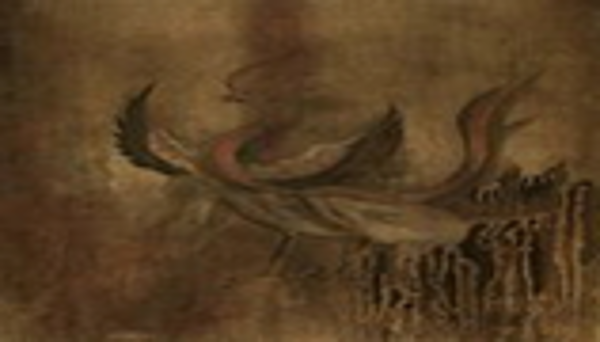
Chinese Sashindo of the Han-Tang period emphasized the function of decoration and chasing out evil spirits. It contrasts with Goguryeo Sashindo, which is drawn in four directions following a systematic astronomical structure. (Kim 2000, 16) In addition, the Sashinchong Tomb (Four Deities Tomb), which is made up only of the Four Deities is a unique style of Goguryeo Sashindo that cannot be found in China. Also, the expression of the Four Deities of Goguryeo shows an original aspect. For example, the Jujak (red phoenix) of Goguryeo Sashindo is characterized by its wide-open wing shape, three tails expressed like fish fins, and a head like a chicken. In contrast, the bird of the Chinese Sashindo is sometimes expressed like a natural animal bird with folded wings. In the case of the Hyeonmu (black tortoise), the expression of the two tails of turtles meeting each other in an X shape is not found in Chinese Sashindo. ( Min 2015 , 429; Jeon 2000, 326; Kim Jin-Soon 2009 , 35)
While Sashindo in China declined from the Tang dynasty, Goguryeo's Sashindo was inherited by Baekje and Japan in the same style, highlighting their independent position. ( Park 2003 , 139–177, 140–141, 167) Baekje's Songsan-ri tomb and Japan's Takamatsu-chong tomb murals are seen as an extension of the Goguryeo tomb murals. (Park 1992, 765)
Although the Sashindo, as an ancient tomb mural art, disappeared, its signs of the four directions related to the Yin and Yang and Five Elements and their function as the four guardian deities have been inherited in various cultures afterwards. Individual drawings were used as defense markers of four directions and as pictorial themes for arts in later dynasties, Goryeo and Joseon. For example, the armies in the four directions surrounding and protecting the center area of Korea had flags with the colored drawings of animal deities to indicate their directions in charge. And the four animal gods of the Sashindo remain as stone statues, which guard the four gates of Gyeongbokgung Palace. Individual drawings were used for decorations of roof tiles and found in Buddhist temples' Dancheong wall painting. Recently, they have been used as Korean traditional characters or subjects in artistic paintings and commercial designs.
Cosmic Four-Way
The four gods of Cheongryong, Baekho, Jujak, and Hyeonmu in Goguryeo tombs are the main members who symbolize the celestial four-way cosmology. (Kim 2007, 160) They become the gods in charge of the four directions of east, west, north, and south, and the four seasons of spring, summer, autumn, and winter.
The concept of cosmic four-way originated from the four cosmic pillars of the summer solstice, the winter solstice, the spring equinox, and the autumn equinox in relation to the movement of the sun. The opposite movement between yin and yang of the winter solstice and the summer solstice changes all things through a mutual sympathetic movement through the spring and the autumn equinox. (Park 1990, 97)
According to Lee Seong-Gu, the prototype of Jujak (red phoenix) and Hyeonmu (black tortoise) are bird and fish, which symbolize the balance of the binary world of yin and yang, sun and moon, earth and underground, etc. (Lee 2001, 1) In this sense, the four-way concept reflects a cyclical view of the universe that expresses the eternal cycle and regeneration of the universe that occurs in the intersection of yin and yang.
In East Asia, the four-way concept is very strong, and it is regarded as the original principle for the creation of the universe and all beings. In Confucianism, the cosmic principle of four-way, Won(元, begining), Hyeong(亨, growth), Ii(利, maturity), and Jeong(貞, completion) corresponds to the four seasons of spring, summer, autumn, and winter, and the four virtues of In(仁, benevolence), Eui(義, righteousness), Ye(禮, propriety), and Ji(智, wisdom). In a timely sense, the four seasons constitute a year and 12 months of the earth. Furthermore, all things are born, grow, and mature through the changes of the four seasons. In this way, the four directions and the four seasons become the principles of cosmic circulation and regeneration. Referring to these ideas, it can be guessed that the Sashindo is an important example that contains a cosmological and universal four-way symbol in East Asia.
Astronomical View of the Ancient Times
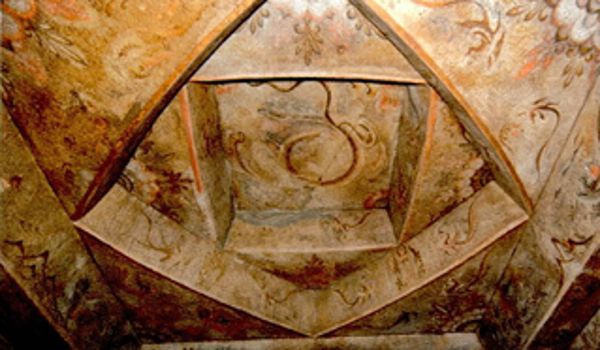
Mircea Eliade said that one of the spiritual characteristics of ancient people is to see reality as an imitation of a celestial prototype. In other words, the reality is acquired by placing an object in a place corresponding to the constellation system. In this sense, ancient architectural behavior was an imitation of the `celestial prototype'. ( Eliade 1976 , 17) Goguryeo tombs with Four Deities mural paintings often assume a sky space in the form of a dome with sky constellations drawn there. This shows an architectural style that imitates celestical space.
The Sashindo, as a symbolic representation of the four-way astronomical system, reflected astronomical ideas that can be traced back to prehistoric times. It is a characteristic of ancient Korean astronomical thoughts. The evidences are found in numerous dolmens in Korea, which have constellation drawings engraved on them. The petroglyphs show the constellations near the North Star in a form that is inverted from the actual sky. (Park 2007 , 26 ) The dolmens were used as altars for rituals. Dolmens with constellations are usually found in mountains near rivers or seas. It shows that dolmens were used as altars for rituals to pray for abundant fishing and agriculture. (Kim 2018 , 50) In addition, the astronomical thought of Sashindo can be found in Yutnori, a Korean traditional game. 2 Kim Il-Gwon saw that Yutnori is a symbol of the four directions of the Big Dipper and the constellation movement in the four seasons. (Kim 2018 , 35–36, 44–45)
The prehistoric Korean traditional astronomy feature was inherited by Goguryeo during the Three States Era. It made the so-called Age of Mural Astronomy. (Kim 2018, 85) Sashindo is the one that expresses the Mural Astronomy of Goguryeo culture.
The four gods of Cheongryong, Baekho, Jujak, and Hyeonmu in Goguryeo tombs represent a cosmic four-way axis to form an astronomical system with seven stars of the north (Big Dipper) and 28 constellations, which are formed by the four groups of seven stars in the four directions. The four animal deities are usually painted together with four groups of Big Dipper stars and sometimes with unique drawings such as the Twin Three stars, a three-legged bird, and a toad or rabbit, which also represent certain cosmic directions. ( Kim 1996 , 3–4)
“Cheongryong (blue dragon)” is a deity who protects the seven stars of the East among the 28 constellation stars, symbolizing spring in the season and the energy of the wood in the Five Elements, and expressing it in blue. “Baekho (white tiger) ” protects the seven stars of the West, symbolizing the autumn season, energy of gold, and expresses it in white. “Jujak (red phoenix)” is a god in charge of the Southern seven stars, which symbolize summer and the energy of fire, and expresses it in red. “Hyeonmu (black tortoise)” protects the Northern seven stars, symbolizing winter and water energy, and expresses it in black. ( Jeon and Eo, 1998 , 97–101)
As the Four Deities became the main theme of the ancient Goguryeo murals in later generations, unique mural styles, such as in the Sashinchong (Four Deities Tomb), were created. Here, the four-way astronomical view appears in the spatial structure of the tombs, where a dome-shaped ceiling symbolizes the sky and four-sided walls indicate the four directions. ( Kim, Il-Gwon 1996 , 23)
Thought of Yin and Yang and Five Elements
In around the 5th century, when Goguryeo's national power strengthened, the Sashindo developed in the form of Oshindo (Five Deities Pictures), in which a yellow dragon was added to the center. The yellow dragon symbolizes the king or the center of the world. The development from Sashindo (Four Deities Pictures) into Oshindo (Five Deities Pictures) shows that the cosmic four-way idea expands into five-way with the establishment of the thought of Yin and Yang and Five Elements.
The thought developed together when the concept of astronomy was systematized during the Spring and Autumn Warring States Period. Yin and Yang are concepts related to the movement of the Sun and Moon and the change of sunlight and seasons. It became the basis of the Iching (易) theory. The five elements originate from the five planets: Mokseong (木星, wood planet, Jupiter), Hwaseong (火星, fire planet, Mars), Toseong (土星, earth planet, Saturn), Geumseong (金星, gold planet, Venus), and Suseong (水星, water planet, Mercury) based on astronomical observation.
The Five Elements that make up all things are: wood, fire, earth, gold, and water, and explain the relationship in which all things interact through mutual beneficence and conflict. They are closely connected with the concept of the four elements in that they serve as the theoretical basis for explaining the four-way position on the ground and the cyclical order of four-season changes.
Gangseo-daemyo Tomb is an example of the later murals of Goguryeo Sashindo that emphasize the five-way system. It has a drawing of Hwangryong (yellow dragon) in the center of the ceiling in addition to four deities on the four sides.
The five-way idea based on Yin and Yang and Five Elements contained in Gogugyeo Sashindo also appears in politics and society at the time in various ways in Korean architecture and arts. During the Joseon dynasty, the Dongdaemun gate in the east, Seodaemun gate in the west, Namaemun gate in the south, and Bukdaemun gate in the north were installed around Hanyang capital city. The four gates were to protect the capital center from the four directions.
The five-way idea is also shown in some discussions of ethical virtues. The previous Four Virtues of Confuciansm by Mencius—In (仁, benevolence), Eui (義,righteousness), Ye (禮, propriety), Ji (智, wisdom), which corresponds to four directions and four seasons, expands into Five Virtues with the virtue of Shin (信, faithfulness) added by Dong Zhongshu (董仲舒, 179–104 BCE). They are also applied to five emotions, organs, tastes, and colors, and their relations, which have two opposite movements of mutual conflict and mutual benefit, are used to explain many aspects of human life, such as health, relationships, ethics, etc.
The Goguryeo dynasty holds a special significance in Korean history and culture. As the most powerful nation in Korean history, it once claimed hegemony over the East Asian continent. It developed an international and multicultural civilization by encompassing and interacting with various ethnic groups. It is also said that Goguryeo inherited its history and culture from its predecessor, Gojoseon (2300th BCE), the first Korean nation, and Balhae, an ancient dynasty established after Gojoseon.
Goguryeo's culture and ethnicity are characterized by its independent identity, strong spirit, grandeur and international culture. It is known that the Goguryeo people were good at dancing and singing, and faithful in worshipping the sky. Studies on Goguryeo ancient tombs and murals started during the Japanese colonization era. In the 1990s, the studies became active, especially by Korean researchers, after a diplomatic relationship was established between Korea and China. Then, various studies were published afterwards. The Gogureyo murals occupy a special place in East Asian ancient tomb art as they show how they creatively digested a new culture from outside and developed it on its cultural foundation. (Kim 2007, 173)
In particular, Sashindo may be the highlight of Goguryeo's tomb murals, and it is the main icon of the four-way astronomical system in the tomb murals that reflect Korea's traditional view of astronomy. Individual drawings of Sashindo accepted the styles of the Han Dynasty, but they created Goguryeo's style of the Four Deities by creatively accepting different cultures, such as Erasian nations, when interacting with countries in the north and west regions. Its original composition and sophisticated expression show Goguryeo's cultural excellence.
Today, Sashindo images are being reinterpreted in the field of painting arts and design as Korean cultural content. Representatively, in the 1980s, painter Baek Sun-nam was recognized worldwide by publishing seveal works that focused on Goguryeo Sashindo as a prototype of the Korean character. ( Chae 2019 , 563–564) In the 2000s, painter Jo Bong-Seok modernized the Sashindo and reflected the spirit of Goguryeo in his works ( Lee 1987 , 6). Shin Yun-Ho (2010) presented various prospects for the use of Goguryeo Sashindo in folk paintings, calligraphy, and Chinese character arts.
Concerning religions of today, the Sashindo arts are found in the temple of a Korean new religion, Daesoon Jinrihoe. The order developed based on the teachings and works of Kang Jeungsan (1871–1909) and Jo Jeongsan (1895–1958), and was established by Park Wudang (1917–1996) as a religious foundation in 1969. Since Daesoon Jinrihoe's Sashindo arts symbolize cosmology based on Korean traditional astronomy and the idea of Yin and Yang and Five Elements, it can be said that Daesoon Sashindo inherits the spiritual and cultural prototype of the Goguryeo Sashindo more genuinely. In addition, it is worth paying attention to the fact that it is not a simple imitation, but it features creative aspects.
Background Thoughts
All ethnic groups in the world have established their indigenous cultures on the basis of their unique forms of thought derived from living traditions, but when these cultures spread beyond internal usage, great conflicts occurred. Therefore, Sangje has now made the foundation of a civilization which will be achieved in the Later World by absorbing the essence of each culture. (Dharma 3:23)
In the past, the ground was small and affairs were simple, so it was possible to clear confusion away with just one method. However, today, as the improved contact between the East and the West has broadened the ground and complicated the affairs, it is not possible to redress chaos unless all methods are integrated and used. (Prophetic Elucidations 73)
In the above, we can see that Jeungsan takes the essence of all ideas of previous traditions formed in different cultures according to their living conditions. And he would use all methods that have existed and been used for the development of human civilization. However, the way Jeungsan integrates their essences for Cheonji-gongsa can be explained by the principles of `Wonsi-banbon (原始返本, go back to the origin and restore the root)' and `Shindo (divine way).'
Wonsi-banbon is not just to return to the beginning in time, but it means that everything is found of its root and everything of all Three Realms will be opened into a new level by Cheonji-gongsa performed by Kang Jeungsan as Sangje. (Cha 2017, 194) It is like arriving at the starting point of a circle after going all the way through the circle, so the beginning point would be different in a whole new way, containing everything that humans have been through. In this view, Sashindo, as a religious art, can be seen as a cultural restoration, to be reminded of the Korean religious spirit and thought.
Shindo (神道, divine way) means a way of divine beings and divine law by which all matters and affairs unfold. The Shindo is not a new concept. Shindo or Shingyo (divine teachings or divine religion) is known as the first religious practice in ancient Korea when the national leaders made decisions by reading the way of divine beings and keeping faith in God and gods by performing rituals. But in Daesoon thought, it is added with a new way for divine beings because Jeungsan's Cheonji-gongsa rectified and reorganized all Shindo system.
In Daesoon, Shindo indicates the way of divine beings of heaven and earth, which operates by the Dosu (cosmic program) set by Cheonji-gongsa. Divine beings manifest Sangje's Cheonji-gonsa in all aspects of the world, as they are in charge of operating natural phenomena and of guiding and helping human affairs. The Four Deties in charge of the four directions and four seasons are one of thousands of divine beings enshrined in 15 divine altars of Yeongdae shrine of the temples.
According to Eliade, religious architecture is a representation of the celestial dome and is thus a sacred space at the center of the world. And what humans do in this space becomes a sacred activity that seeks to conform to the truth of God and heaven. Each ethnic group and religious culture have a different understanding of the truth of God and heaven. Such variety of worldviews are reflected in the religious building. In such a manner, all the pictorial subjects and expressions of Daesoon Jinrihoe temple arts are the symbolic representations of its religious ideas.
There are two versions of Sashindo in Yeoju Headquarters, one engraved in Cheonggye-top tower and the other as colored paintings in Jeonggak-won building. The Four Deities embrace the Goguryeo style while revealing their unique aspects in their symbolic meaning and expression.
Sashindo of Cheong-gye Top Tower
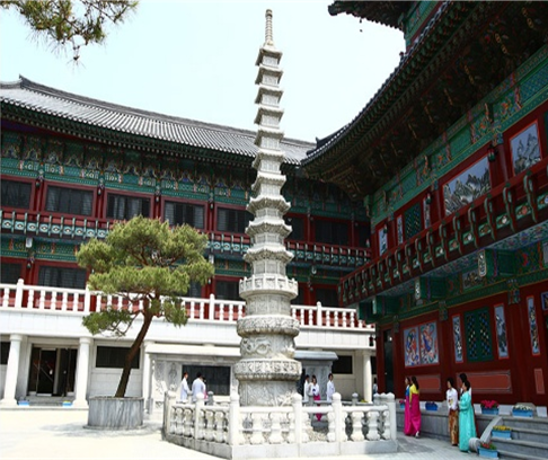
The Daesoon cosmology of the Three Realms of heaven, earth, and humanity, which is operated by divine beings with the principle of Shindo under Sangje's order, is beautifully expressed in the Cheonggye-top tower. The tower was built in 1987 to commemorate the completion of the Yeoju headquarters temple in 1986. The tower is placed along with a stone folding screen, which has engraved writings of Kang Jeungsan's teachings.
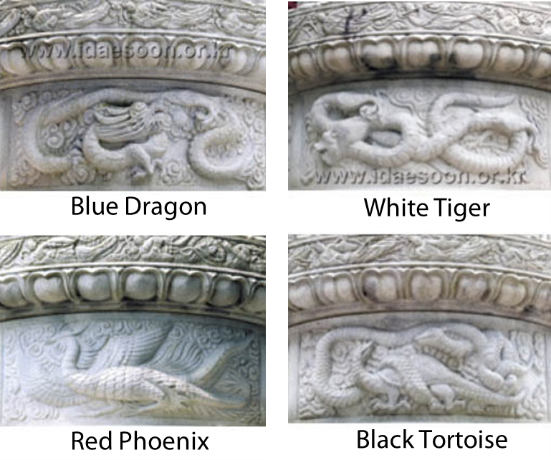
Cheonggye-top tower is a 10-story pagoda with a height of 1,350 cm. Like the Buddhist tower structure, it consists of three parts: upper part, pagoda body, and stylobate. The upper part of nine round layers symbolizes the Ninth Heaven, where Sangje presides over the universe. In the body, the seven layers of four-sided faces symbolize 28 constellations, and the three layers of eight-sided faces symbolize 24 seasons. Each face has an engraving of the divine being in charge. The lower stylobate has three layers: upper layer represents 12 directions and 12 seasons and their divine beings. The mid layer is where the Four Deities are engraved as the divine beings in charge of 4 directions and 4 seasons.
The biggest feature of Cheonggye-top tower is that it represents the universe made up of the Three Realms (Samgye) of heaven, earth, and humanity. In general, the Three Realm are known as Samgye (三界) or Samje (三才) in Korean tradition. Although the meanings of the term differ in different thoughts, Samegye of Daesoon seems to emphasize more of a universe in which the three domains of existence act in close relations to one another.
Through the process of opening up a new heaven and earth according to Jeungsan's Cheonji-gongsa, the Three Realms, which were dominated by confrontation and conflict, will transform into the worlds of Sangsaeng (mutual beneficence) and harmony. And here, humans play an independent role in realizing the ideal world.
The Cheonggye-top tower symbolizes the universe operated by the harmonious work by `Shindo', the divine system centered on Sangje God. The harmony between divine world and human world is crucial for the realization of Shindo in the world and the opening of an earthly paradise of peace and harmony.
The Sashindo is on the second layer of the stylobate. However, in the folding screen, it indicates Sashindo as the name `Hyeonmudo' (black tortoise picture). The reason why it was named Hyeonmudo is described in Daesoon Guideline (DIRC 2020b, 21), “Since the principle of heaven and earth was based on 1·6 water.” The 1·6 water indicates one of the four energies assigned to the four directions according to the principle of the Book of Change. From the phrase, it can be understood that the northern Hyeonmu, which symbolizes the energy of water, is the most fundamental and representative one among the other three directions.
In East Asian astronomy, the north is home to the north pole, the center of the universe. So the northern direction has a sacred meaning. This can explain why, in Buddhist temples, the main sanctuary building is located in the north. In the same way, Yeongdae, the most sacred and main building of Daesoon temple, is located in the north, which is in the innermost area that visitors will reach in their final step of the tour. Also, the water energy of the north has an important meaning. Water is the source of all things in their birth and growth. Jeungsan said that the earth's energy was exhausted of water energy. And said that there will be a sound like an earthquake in the future when the water energy begins to circulate to let the earth energy. (Reordering Works 3: 20–21; Prophetic Elucidations 51)
The Cheonggye-top tower's Sashindo seems to be almost identical to the actual directions. The tower stands in the same direction as Yeongdae to the north. In this position, Hyeonmu points to the north, Cheongryong to the east, Baekho to the west, and Jujak to the south.
The layer of Sashindo is located right above the layer of Ox-seeking pictures that represents the human world. It can be said that the four directions and four seasons are the most closely related divine system to humans. The four-way systems may be the most basic natural principles that humans perceive and should follow in their daily lives. So there is a saying in Korean tradition when indicating a morally mature person, “He or she has earned the seasonal energy.” Similarly, there is a phrase in Jeon-gyeong.
One day, Sangje said to His disciples, “People do not know what a precious incantation the Verse of the Seasonal Divisions is. There is a saying that the seasonal-subdivisions are called `cheol' and that a child of indiscretion is called a cheol-buji (not knowing cheol). This means that a child with good sense is believed to know cheol no matter how young the child is, while an elderly person who is unsensible is said to act as a cheol-buji child, no matter how old that person is. (Reordering Works 3: 34)
In Daesoon thought, the Dao has the concept of time of one year and 12 months, and one year goes through changes in four seasons. In this context, the state of human perfection, “Unification with Dao”, means that humans are in perfect tune with the seasonal energies and their changes.
If Goguryeo Sashindo emphasized the aspects of heaven as the center of the world, Cheonggye-top tower's Sashindo shows close interactions between the divine beings' four-way system and humans' endeavor to act according to the divine way. The expression of the Four Deities is also very similar to that of Goguryeo, and I would like to talk about the detailed expressions in Jeonggakwon's Sashindo, which will be discussed below.
Sashindo of Jeonggak-won Building
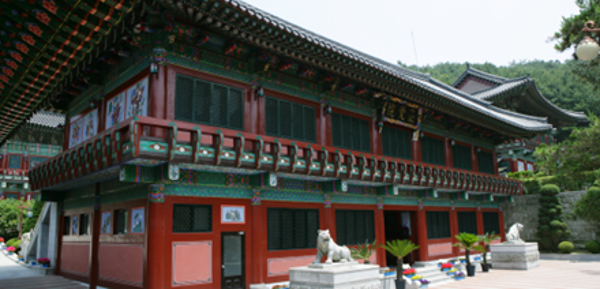
Jeonggak-won is the first building visible from the inside of Jeongnae, the innermost area of the Yeoju headquarters temple. Jeonggak-won is used as a place for followers to practice mantra reciting before ceremonies such as Gongbu (mantra reciting ritual) and Gangsik (gathering ceremony followed by Gongbu).
On the outer wall of Jeonggakwon, there are Sacheonwangdo pictures (Four Heavenly Kings pictures, which are traditionally found in Korean Buddhist temples in a gate before entering the innermost area of the temple). So, together with the Four Deities Pictures inside, the building itself seems to signify the importance of the four-way principle. As the name of the building, `Jeonggk (正覺)' means `to be rightfully enlightened of Dao', those murals may be there to guide the practitioners of their way of cultivation. It can be said that while the Four Heavenly Kings in the outside murals protect the practitioners from four sides against evil energy or distracting thoughts, the Sashindo inside murals remind the practitioners about what it means to be rightfully minded or get enlightened by showing the natural principle of the four seasons and four directions.
The pictures of the Four Deities in Jeonggak-won are large, painted in vivid colors, and the expressions are very unique. So the pictures would catch the eyes of the viewer when entering the second-floor room.
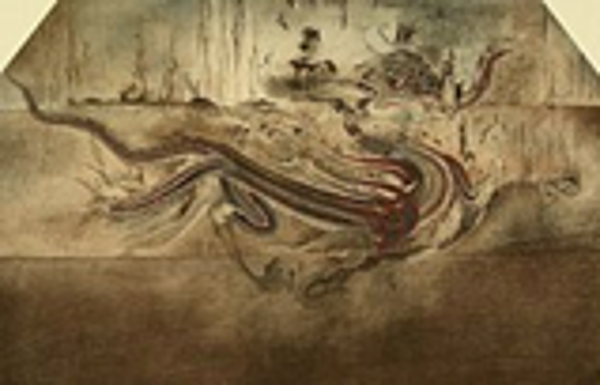
Here, I tried to look into Sashindo pictures in Jeonggakwon in comparison with those of Gogureyo Sashindo pictures found in Gangseo-daemyo tomb and Oh-hee-bun no. 4 tomb in the 7th century. The murals of the two tombs are known to show the most sophisticated styles among the Sashindo pictures of Goguryeo. But in the cases of Jujak (red phoenix in the south) and Hyeonmu (black tortoise in the north), the images are unclear due to their damaged shape, one might refer to the images of Jujak of the Ssanyongchong tomb and Hyeonmu of the Tongu Sashingchong tomb.
Gangseo-daemyo Sashindo is known as a masterpiece that shows the unique beauty of southern painting style (Jeon 2018, 136), while Oh-hee-bun No.4 tomb shows a strong and powerful touch influenced by the northern painting style. ( Lim 2019 ) Tonggu Sashinchong tomb is known to express the Hyeonmu image most dynamically.
1) Cheongryong (blue dragon) and Baekho (white tiger)
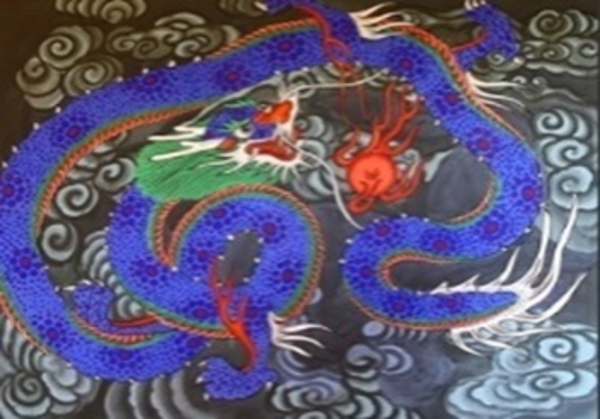
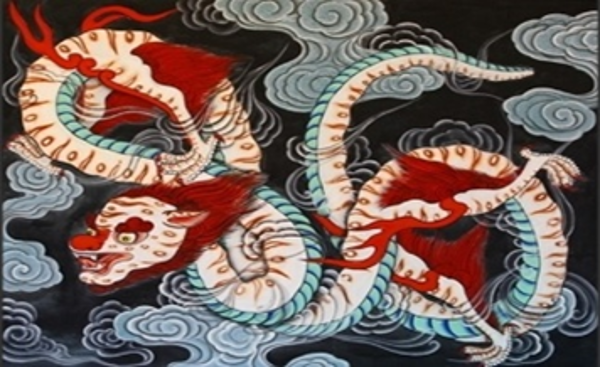
There are certain rules regarding the positions and shapes of the deities. Blue dragon's body should be curved like wriggling, and white tiger's body should crouch as if it roars. Their heads positioned to the south (lower) and tails to the north (upper) direction are consistently expressed in Goguryeo Sashindo. It is said to be a generalized posture in the process of depicting twenty-eight constellations in the images of the Four Deities. (Kim 2007, 188–190)
In general, it is said that the blue dragon symbolizes an increase in Yang energy during the spring equinox, and the white tiger symbolizes the entering into Yin energy during the autumn equinox. It seems that the rise and fall of Yin and Yang energy appear more clearly in the pictures of Jeonggakwon. In addition, the colors are painted in vivid blue and white, clearly expressing the characteristics of the East and the West.
The trunks of the blue dragon and the white tiger are like snakes or dragons. Snake represents cosmic energy or the ever-changing and regenerating vitality. Dragon is known as the head of all animals and has scales on its body. It rises to the sky during the spring equinox and submerges during the autumn equinox. ( Jeon and Eo 1998 , 97–101)
The blue dragon and the white tiger in Jeonggak-won murals are very dynamic in their wiggling or crouching. The wiggling of the blue dragon is almost circular, which can be compared to the appearance of a yellow dragon drawn on the central ceiling of Gangseo-daemyo tomb and Oh-hee-bun no. 4 tomb murals.
The clouds in the background create a mysterious heavenly atmosphere with patterns that appear a lot in the late Goguryeo Sashindo. Gangseo-daemyo Sashindo has no background pattern, while Oh-hee-bun No. 4 Sashindo has various lotus patterns. Lotus in Egyptian and Greek cultures and Buddhist culture symbolizes religious enlightenment (Park 1990, 47), showing a religious view that combines the influences of Western and Buddhist culture. In Jeonggak-won pictures, the clouds may do a similar function as the lotuses do.
2) Jujak (red phoenix) and Hyeonmu (black tortoise)
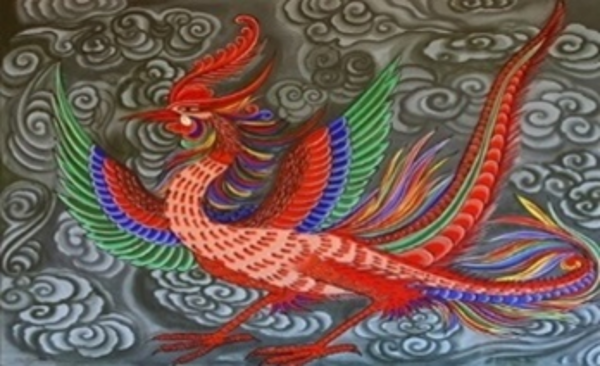
In Goguryeo's Sashindo, the Jujak is characterized by the head of a chicken, a tail like a fish fin, and wide wings. It differs from Chinese murals, where the phoenix is similar to a chicken with wings folded. The Jujak of Goguryeo looks as if it would fly with wings wide open. ( Min 2015 , 34, 429) Jeonggak-won's Jujak depicts such characteristics very similar to those of Goguryeo. However, it seems that the five colors of the bird, which symbolize the five virtues, are emphasized, and the feathers on the neck and tail are more splendidly expressed.
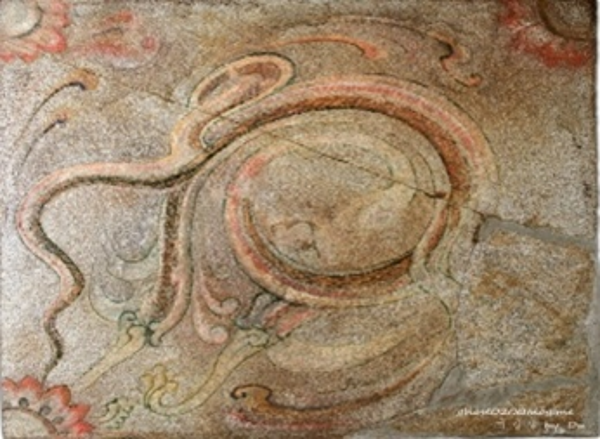
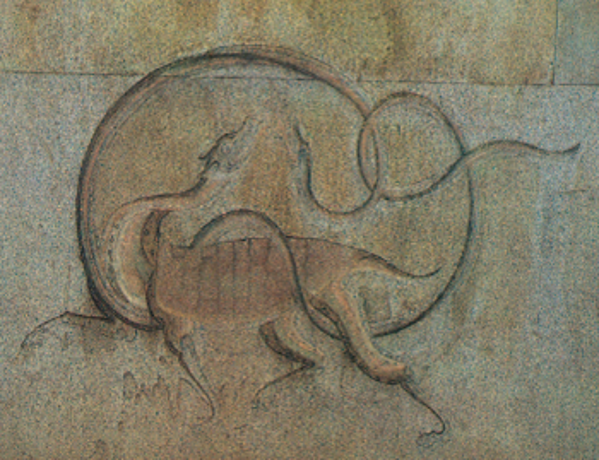
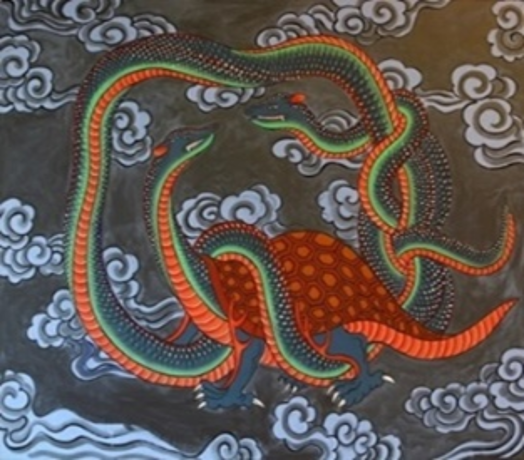
Black tortoise is a mystical animal that has both images of tortoise and snake. Hyeonmu of Jeonggak-won is similar to that of the Tonggu Sashinchong tomb, which is known to have the most dynamic expression of the black tortoise. The snake's body twisted like a Möbius band and wrapped around it on the right.
In this way, when looking at the specific expression style of Jeonggak-won Sashindo compared to the Goguryeo Sashindo, we can see that it creatively inherits the Goguryeo style. However, their meanings to viewers would be different. Goguryeo Sashindo was an underground tomb mural art that expressed the heavenly world through the Four Deities as images formed in accordance with the astronomical system. Their grandeur was to honor the tomb owner, probably loyal persons related to the dynasty, or to emphasize Goguryeo's national position as the center of the world. On the other hand, Daesoon Jinrihoe Sashindo is rather a way of teaching for the practitioners. The Four Deities in the murals are there maybe to remind and request their ethical and spiritual cultivation to be tuned into the Dao that appear as four seasons and four directions.
Religious art symbolically expresses the beliefs and worldview of the religion through the cultural traditional styles of each country. Daesoon Jinrihoe is a native Korean religion that originated from a historical figure, Kang Jeungsan, who was active in the late 19th and early 20th centuries. Korean traditions appear through the doctrinal thoughts, rituals, and architectural style of the order. Among the material arts in the temple, the Sashindo shows how they creatively inherited the style of the ancient Goguryeo's representative tomb mural arts. The Four Deities are mysterious animal gods: Cheongryong (blue dragon), Baekho (white tiger), Jujak (red phoenix), and Hyeonmu (black tortoise), representing the four directions and four seasons.
There are two versions of Sashindo in the Yeoju headquarters temple. One is the relief structures of Cheonggye-top tower, and the other is the colored murals inside Jeonggak-won building. Through the overall composition and layout of the Cheonggy-top tower, the Four Deities as part of world view of Daesoon thought can be examined, and the murals of the Four Deities of Jeonggakwon can be examined in detail.
Just like Goguryeo Sashindo, Cheonggye-top Tower's Sashindo symbolizes the four energies of the astronomical four-way system. But in Daesoon, it is a part of the Shindo system (or divine world and its system) newly set by Kang Jeungsan's Cheonji-gongsa (Reordering of Universe). The Shindo, as the operating principle of the new Three Realms of heaven, earth, and human, is based on the idea of Haewon-Sangsaneng (resolution of grievances for mutual beneficence). Shindo of Haewon-Sangsaeng is the principle of nature that humans must learn and follow to open a new world of peace and harmony.
The expressions of the Four Deities are also very similar to those of Goguryeo, and the detailed expressions are well represented in Jeonggak-won Sashindo murals. Jeonggak-won's Sashindo has a symbolic meaning, `to be enlightened of Dao correctly' through the principle of the four-ways. When examining the specific expression style in comparison to the Gangseo-daemyo and Oh-hee-bun No. 4 tombs in the 6th century, it can be said that Daseoon Sashindo is not just an imitation of Goguryeo but shows an original aspect by highlighting the characteristics of each deity through different coloring and expressions uniquely and dynamically.
The Goguryeo Sashindo were to honor the tomb owner, probably loyal persons related to the dynasty, or to emphasize Goguryeo's national position as the center of the world. On the other hand, Daesoon Jinrihoe Sashindos is rather a way of teaching for the practitioners. The Four Deities in the murals are there maybe to remind and request their ethical and spiritual cultivation to be tuned into the Dao that appears as the four seasons and four directions.
In this way, Daesoon Sashindo creatively inherited the Goguryeo style in their unique religious meanings and expressions. It would be meaningful to find an ancient Korean religious culture in a new Korean religion of modern times.
Chae, Hyon-Yong 2019 “Genealogy of Postcoloniality in Traditional Perception of Minjoong Art-focused on Four Gods of Goguryeo-period and its Succession in Baek Su-Nam's Works”, Basic Sculpture Studies 20: 555–566. [Korean Language Text] 채효영 「민중미술의 전통 인식 에 나타난 탈식민성 계보–백수남의 고구려 사신도 계승을 중심으로」, 『기초 조형학 연구』. https://doi.org/ 10.47294/KSBDA.20.4.40
National Research Institute of Cultural Heritage (NRICH) 2006 Goguryeo Tomb Murals Reserve State Research Report v.1, Paju: Jungang Culture Press. [Korean Language Text]국립문화재연구소, 『고구려 벽화고분 보존실태 조사보고서』, 파주: 중앙문화인쇄. https://www.khs.go.kr/cop/bbs/selectBoardArticle.do?nttId=20788&bbsId=BBSMSTR_1021&pageIndex=1&mn=NS_03_08_01








This website recommended the use the Chrome browser for journal website.