INTRODUCTION
Coffin-Lowry syndrome (CLS) is a rare X-linked genetic syndrome causing severe intellectual disability. Other slow physical growth, distinctive facial appearance, large soft hands, and minor skeletal changes with general muscular hypotonia [1]. Early diagnosis of CLS is essential for proper management, including survey of some specific complications, and for genetic counselling. Establishing the diagnosis in very young children is often much more difficult than in older patients since clinical manifestations are milder or not specific [2]. We describe here a case of CLS diagnosed by whole exome sequencing (WES).
PATIENT REPORT
An 18-year-old boy was referred to our genetic, metabolic disease clinic for genetic evaluation due to intellectual disability and facial dysmorphism.
He was born full term with normal birth weight of 3 kg. His growth was normal, but his development was delayed. When he was about 1 year old, he visited other hospital due to developmental delay. But no definite diagnosis was obtained, and he received physical therapy with no more investigation.
At the age of 18, he developed orthopnea and visited pediatric cardiology clinic. On Echocardiography mitral regurgitation, grade III was observed, and enalapril, furosemide, spironolactone and digooxin were prescribed. And he was referred to genetic, metabolic disease clinic for evaluation for genetic disease.
On physical examination, his height and weight were normal range with 172 cm, 62 kg. He had malar hypoplasia, hypertelorism, thick lips, irregular teeth, long face, and low set ear. He had severe intellectual disability and mild hearing difficulty.
Laboratory findings showed increased uric acid level (9.4 mg/dL), and other tests including thyroid function test, liver function test, glucose and lipid were normal. Chromosome study was normal. Further evaluation such as array comparative genomic hybridization (CGH) was recommended, but he was lost to follow up.
After 4 years, symptoms of heart failure aggravated, and he received operation (open heart annuloplasty of mitral valve, tricuspid annuloplasty). At that time, he was again referred to our clinic. Laboratory findings showed increased uric acid level (8.0 mg/dL). His liver function test (AST 115 IU/L, ALT 25 IU/L) and lipid profile (total cholesterol 244 mg/dL, triglyceride 219 mg/dL, HDL 40 mg/dL, LDL 119 mg/dL) were also abnormal.
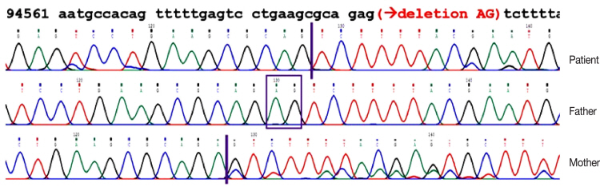
On X-ray exam, diffuse thickened cranial vault, enlarged frontal sinus, and protruded mandible were observed (Fig. 1). Liver ultrasonography findings suggested mild fatty liver. WES was performed to identify underlying genetic cause in the patient. Informed consent was obtained from patients and their family. The average coverage for WES was 100X. Variants in the db-SNP135 and TIARA databases for Koreans and the variants with minor allele frequencies > 0.5% of the 1000 Genomes database were excluded. We selected only the functional variants. WES revealed a novel mutation in RPS6KA3 gene (likely pathogenic, PM2+PM4+PP3+PP4), which was confirmed by direct sequencing, resulting in hemizygous frameshift mutation (c.889_890delAG, p.Leu298Phefs*21) (Fig. 2). Trio testing showed that this mutation was derived from his mother. He had one sister, and his parents and sister had no symptoms associated with CLS.
Fig. 1.
Skull X-ray showed diffuse thickened cranial vault, enlarged frontal sinus, and protruded mandible.
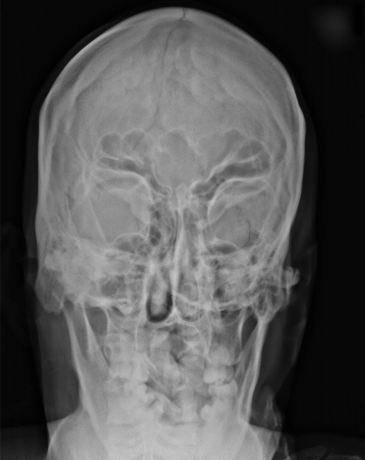
Fig. 2.
Sanger sequencing from the patient and parents revealed a variant with 2 bp deletion in exon11 (NM_004586.2), c.889_890delAG (p.Leu298Phefs*21), which caused frameshifts starting from codon 298 with a premature stop codon.
He is now on regular follow up with anti-hypertensive agents (cancesartan, amlodipine), diuretics (furosemide), and gout medication (colchicine, febuxostat).
DISCUSSION
CLS is a rare genetic disease, with a prevalence of 1 in 50,000 to 1 in 100,000 in males [3]. It is caused by loss-of-function mutations of the RPS6KA3 gene, which encodes RSK2 (ribosomal S6 kinase 2) [4]. RSK2 is highly expressed in neocortex, the hippocampus, and Purkinje cells, which are important cognitive function and learning [5]. Over 140 inactivating mutations of RPS6KA3 gene have been reported [3]. In Korea, clinically suspected CLS case was first reported in 2007 [6], and our case is the first report of Korean patients with genetically confirmed CLS. Newborn males often show hypotonia and hyperlaxity of joints, whereas growth parameters are usually within normal range. Facial abnormalities such as hypertelorism, frontal bossing are usually apparent by the second year of life and show progressive coarsening [3]. Common musculoskeletal findings include kyphoscoliosis, sclerosis of skull, and distal tufting of hands [7]. Variable enlargement or hypoplasia of the frontal sinuses also can be observed, like in our case. Most patients show severe cognitive deficiencies. Our patient showed abnormal facial, skeletal findings and intellectual disability. And interestingly, he developed dyslipidemia and fatty liver at young age, though he was not obese. The chronic health conditions in adult CLS patients including metabolic/endocrine disorders remains to be further investigated.
Patients with CLS can usually be diagnosed on the basis of clinical presentation and radiological findings. But patients with this syndrome do not show growth restriction or severe physical abnormal findings in prenatal or neonatal period. Also, clinical presentations are markedly variable. So significant portion of patients seem to remain undiagnosed or misdiagnosed for a long time, like our case. Usual screening test for developmental delay is conventional chromosome study and array CGH. But CLS cannot be diagnose with these tests, which is another reason of delayed diagnosis in our case. For diagnosis of CLS, suspicion with careful history taking and physical examination is most important. And evaluation with WES can be useful, like in our case.
Our study is the first report of genetically confirmed CLS in Korea. Clinical suspicion of physicians and advanced diagnostic tools such as WES will reduce undiagnosed or misdiagnosed cases. More patients with CLS are reaching adulthood due to improved medical care, and concerns for chronic medical conditions will be required to improve quality of life.