INTRODUCTION
ABO blood group typing is a crucial test for ensuring safe transfusion and transplantation. Currently, most laboratories are conducting phenotypic tests utilizing antigen-antibody reactions. ABO phenotyping, in use for over a century, is recognized as a very accurate test with an error probability of less than 1 in 500,000 [1]. ABO phenotypic testing assesses both cell and serum typing to identify blood type, with variations in results commonly arising from many sources. ABO discrepancies between cell and serum typing in ABO phenotyping can be caused by technical reasons, alterations in antigenicity, and decreased antibody titers due to the patient’s underlying disease or immune status, inappropriate transfusions, bone marrow transplantation, auto and allogeneic antibodies, acquired B, ABO variants, and other issues. Therefore, we should conduct different supplementary tests depending on the specific circumstances to address this inconsistency. Even with additional tests, there are situations where conclusive proof of the blood type is not possible. Consequently, there has been a rise in cases where ABO genotyping is used to accurately determine the blood type for safe transfusion recommendations [2-5].
ABO genotyping is more expensive than phenotype testing; the testing procedure is complicated, and it requires special equipment and specialized personnel to perform, so it has been difficult to use as a routine test in general laboratories so far. However, recently there have been reports of cases where various cases of blood type and serum type discrepancies have been resolved through analysis of the ABO gene [2,6], and it is also being used effectively in the discovery of chimerism [6-10]. The ABO gene located at 9q34 of the long arm of chromosome 9 is known to express A, B type glycosyltransferase, and exons 6 and 7 account for 77.5% of the total base [11], so this area is mainly used for genotyping analysis. Methods of ABO genotyping include direct sequencing, polymerase chain reaction (PCR)-restriction fragment length polymorphism, allele-specific PCR, single-strand conformation polymorphism analysis, DNA microarray hybridization, and next-generation sequencing [12,13]. There were reviews about ABO genotyping for the Korean population, but these data were mainly from the Seoul capital area and the southwestern part of Korea [2,14-16]. We need to analyze the genotyping results from Southeastern Korea and gather information on the uncommon alleles that cause ABO discrepancies.
This study aims to present the present state of ABO genotyping by retrospectively examining the outcomes of direct sequencing and supplementary genotyping techniques conducted for cases referred for ABO genotype testing due to ABO discrepancies in the last decade.
METHODS
We conducted a retrospective analysis of ABO genotyping results on 108 samples that were requested to resolve discrepancies between cell and serum type in ABO typing at two major university hospitals in Busan from June 2010 to December 2019. The study was conducted with the approval of the Institutional Bioethics Committee at Haeundae Paik Hospital under the IRB number 2020-09-008-001.
Routine phenotypic ABO blood grouping test was performed by standard methods and automated analysis using blood bank system IH-500 (Bio-rad, Cressier FR, Switzerland). DNA was extracted using the QIAamp DNA Blood Mini kit (Qiagen GmbH, Hilden, Germany), and direct sequencing was performed by amplifying exons 6 and 7 by PCR, and additional analysis was conducted using previously published primers [17] when the exact genotype was not confirmed. After PCR amplification, sequencing was conducted using the ABI3130 or 3500 genetic analyzer (Applied Biosystems, Foster City, CA, USA), and the results were interpreted by comparing the information of ABO alleles in the blood group antigen gene mutation database (dbRBC) of the National Center for Biotechnology Information (NCBI) [18], ISBT nomenclature (v.1.1), and Erythrogene ( https://www.erythrogene.com/) [19].
If a definitive genotype was not identified by direct sequencing in existing databases, TA cloning was performed to isolate and redefine the alleles. The new alleles discovered in this study were submitted to the public nucleotide sequence repository NCBI/GenBank. When chimerism was suspected, it was decided to confirm it by short tandem repeat (STR) analysis.
RESULTS
ABO genotypes according to serologic phenotypes
The total number of specimens submitted for ABO genotyping was 108. The most prevalent ABO discrepant phenotype was A1Bw, with 29 cases (26.9%), followed by A2Bw with 26 cases (24.1%), Aw with 17 cases (15.9%), Bw with 15 cases (13.9%), AwB with 9 cases (8.3%), AwBw with 5 cases (4.6%), A2B with 3 cases (2.8%), and A2 with 2 cases (1.9%) in descending order (Table 1). Two cases, one with A1 (cell type A, serum type AB) and another with B (cell type B, serum type O), were part of the investigation, but their genotypes (A101/O02, B101/O02) were not distinct.
Table 1.
ABO genotypes according to serologic phenotypes
| Phenotype | Genotype (No. of cases) | Total No. (%, N=108) |
|---|---|---|
| A1Bw | A102/B101 (9), cis-AB01/O01 (4), A102/B306 (3), A102/B309 (3), A102/B316 (3), A102/Bw29 (2), cis-AB01/O02 (2), cis-AB01/A102 (1), A102/B102 (1), A102/Bnew1 (1) | 29 (26.85) |
| A2Bw | cis-AB01/O02 (10), cis-AB01/O01 (9), A102/B101 (4), cis-AB01/O04 (1), cis-AB01/B101 (1), cis-ABnew/O02 (1) | 26 (24.07) |
| Aw | A102/O01 (7), A101/O01 (3), A101/O02 (2), Ax01/O01 (1), Anew/O01 (1), Anew/O02 (1), A101/O01/O02 (1), A102/O01/O02 (1) | 17 (15.74) |
| Bw | B101/O01 (7), B101/O02 (4), B309/O01 (2), B309/B101 (1), Bnew2/O02 (1) | 15 (13.89) |
| AwB | Anew/B101 (5), B101/B101 (2), A102/B101 (1), A102/B101/O02 (1) | 9 (8.33) |
| AwBw | A101/B101 (1), A102/A102 (1), A102/B101 (1), A102/B101/O01 (2) | 5 (4.63) |
| A2B | A204/B101 (2), A102/B101 (1) | 3 (2.78) |
| A2 | A101/O01 (1), A102/O01 (1) | 2 (1.85) |
| A1 | A101/O02 (1) | 1 (0.93) |
| B | B101/O02 (1) | 1 (0.93) |
Underlined, causative uncommon alleles and chimerism.
The two most frequently encountered phenotypes, A1Bw and A2Bw, were attributed to the presence of cis-AB alleles (cis-AB01, cis-ABnew) with frequencies of 24.1% (7/29) and 84.6% (22/26), respectively. Twelve A1Bw phenotypes (41.4%, 12/29) and four Bw phenotypes were induced by rare and novel B alleles (B306, B309, B316, Bw29, Bnew1, and Bnew2). 17.6% of Aw and 55.5% of AwB phenotypes were attributed to rare and novel A alleles (Ax01 and Anew) in the case of weak A. One A204 allele was found among three A2B phenotypes and two A2 phenotypes. Blood chimerism were confirmed in 2 cases of Aw, 1 case of AwB, and 2 cases of AwBw phenotype.
Uncommon alleles leading to ABO discrepancy
The most common causative allele among 108 ABO discrepant instances was cis-AB01, found in 28 cases (Table 2). In this investigation, the unusual ABO alleles that caused ABO differences were B309, B306, A204, Bw29, and Ax01, listed in descending order.
Table 2.
Uncommon alleles and combination causing ABO discrepancies
| Allelic designation (dbRBC) | ISBT v.1.1 | No. of cases | Nucleotide changes | Protein changes | References | Genbank Accession No. | |||
|---|---|---|---|---|---|---|---|---|---|
| Rare alleles | |||||||||
| cis-AB01 | cisAB.01 | 28 | c.467C>T; c.803G>C | p.Pro156Leu; p.Gly268Ala | |||||
| B309 | NA | 6 | c.255C>T; c.297A>G; | p.Arg176Gly; p.Gly235Ser; | |||||
| c.526C>G; c.657C>T; c.703G>A; c.796C>A; c803G>C; c.930G>A |
p.Leu266Met; p.Gly268Ala | ||||||||
| B306 | B3.06 | 3 | 297A>G; 526C>G; | p.Arg176Gly; p.Asp183Asn; | |||||
| 547G>A; 657C>T; 703G>A; 796C>A; 803G>C; 930G>A |
p.Gly235Ser; p.Leu266Met; p.Gly268Ala |
||||||||
| A204 | A2.04 | 2 | c.297A>G; c.526C>G; | p.Arg176Gly; p.Gly235Ser; | |||||
| c.657C>T; c.703G>A; c.771C>T; c.829G>A |
p.Val277Met | ||||||||
| Bw29 | NA | 2 | c.297A>G; c.503G>A*; | p.Arg168Gln*; p.Arg176Gly; | |||||
| c.526C>G; c.657C>T; c.703G>A; c.796C>A; c.803G>C; c.930G>A |
p.Gly235Ser; p.Leu266Met; p.Gly268Ala |
||||||||
| Ax01 | AW.30.01 | 1 | c.646T>A | p.Phe216Ile | |||||
| New alleles | |||||||||
| Anew | NA* | 7 | c.467C>T; c.784G>A | p.Pro156Leu; p.Asp262Asn | [20] | KU961549.2 | |||
| B316 | NA | 3 | c.297A>G; c.526C>G; | p.Arg176Gly; p.Gly235Ser; | [25] | KR057958.1 | |||
| c.657C>T; c.703G>A; c.721C>G; c.796C>A; c.803G>C; c.930G>A |
p.Arg241Gly; p.Leu266Met; p.Gly268Ala |
||||||||
| Bnew1 | NA | 1 | c.297A>G; c.526C>G; | p.Arg176Gly; p.Arg180Cys; | This study | KX018509.1 | |||
| c.538C>T; c.657C>T; c.703G>A; c.796C>A; c.803G>C; c.930G>A |
p.Gly235Ser; p.Leu266Met; p.Gly268Ala |
||||||||
| Bnew2 | B3.02 | 1 | c.297A>G; c.526C>G; | p.Arg176Gly; p.Phe216Ile; | This study | NA | |||
| c.646T>A; c.657C>T#; c.703G>A; c.796C>A; c.803G>C; c.930G>A |
p.Gly235Ser; p.Leu266Met; p.Gly268Ala |
||||||||
| cis-ABnew | NA | 1 | c.467C>T; c.803G>C; | p.Pro156Leu; p.Gly268Ala | This study | KR870035.1 | |||
| c.930G>A; c.1096G>A | |||||||||
| Blood chimerism | |||||||||
| A102/B101/O01 | A1.02/B.01/O.01.1 | 2 | |||||||
| A102/B101/O02 | A1.02/B.01/O.01.02 | 1 | |||||||
| A101/O01/O02 | A1.01/O.01.1/O.01.02 | 1 | |||||||
| A102/O01/O02 | A1.02/O.01.1/O.01.02 | 1 | [6] | ||||||
NA, not applicable; Underlined, differences from common alleles (A101, B101, and O01); *, erroneously designated Aw.10; #, absent in ABO*B302 (dbRBC).
Investigations of novel alleles
A novel Aw allele (Anew)
We discovered a new Aw allele in seven people. The group consists of four related family members and three unrelated people who exhibited weak A antigens with variable antigenic reactions based on antibody clones. This novel Aw allele differs from the Aw10 (ISBT designation, Aw.10) allele by a single nucleotide at position 467. This A novel allele was published in an official new allele report section of Transfusion journal [20]. After publication, submitters of Aw10 acknowledged their error of omitting the c.467C>T nucleotide alterations during registration [21-24]. Thus, this new variant is identical to the Aw10 alleles previously identified in Korea.
A novel Bw allele (B316)
We found the novel Bw allele in a family of individuals showing mixed-field (B3 phenotype) or weak hemagglutination with anti-B reagent. Serologic tests on the proband, his wife, and two sons showed A1Bw, O, and Bw phenotypes, respectively. After separating the allele through TA cloning, this new allele that differs from the B101 allele by a single c.721C>G missense mutation, was officially named B316 and documented in Transfusion journal [25].
A novel Bw allele (Bnew1)
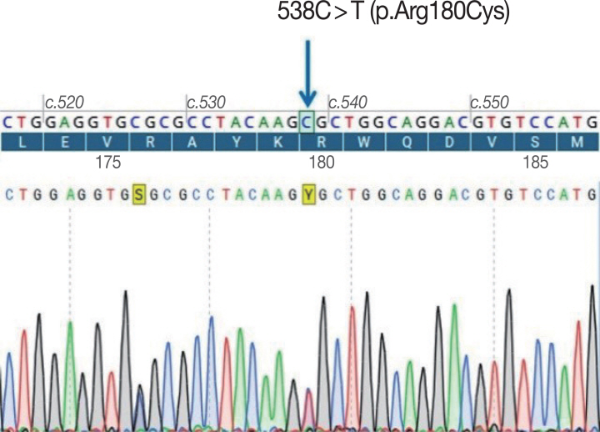
A case with A1Bw demonstrating a weakened hemagglutination with anti-B reagents, was referred for further evaluation. Direct sequencing of ABO exons 6 and 7 revealed a A102/Bnew genotype. This novel B allele has the mutation at position 538, where C was substituted with T, resulting in an amino acid change from arginine to cysteine. This novel B allele differs from the B101 allele by a single nucleotide at position 538 (Fig. 1).
A novel Bw allele (Bnew2)
A case was identified with Bw phenotype demonstrating mixed field agglutinations with anti-B reagents and double populations on a typing gel column (Fig. 2A). Direct sequencing of ABO exons 6 and 7 revealed an O02/Bnew2 genotype. This novel B allele has the mutation at position 646, where T was substituted with A, resulting in an amino acid change from phenylalanine to isoleucine in the background of B101 allele. This new B allele differs from the ABO*B302 registered in Gen-bank/dbRBC by a single nucleotide at position 657 (c.657C>T) (Fig. 2B). This new allele can be categorized into ABO*B3.02 in ISBT designation because 657C>T is a synonymous variation.
Fig. 2.
Phenotype and genotype of a new B allele (Bnew2). (A) Serologic ABO typing result showing Bw phenotype using micro-column agglutination (Red arrows, double cell populations with anti-B antisera). (B) Sequencing analysis of an individual with a new B allele (Bnew2). Blue arrows denote sequence variations at the nucleotide 526, 646, and 657 positions.

A novel cis-AB allele (cis-ABnew)
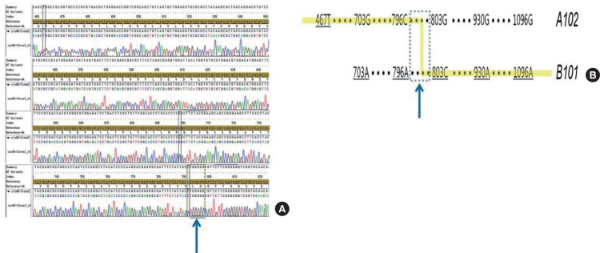
We found a novel cis-AB variant allele characterized by additional 930G>A and 1096G>A polymorphisms at exon 7 on the background of cis-AB01. Following allele separation by TA cloning, one of the two alleles displayed a point deletion at position 261 in exon 6 and point mutations at position 297 (A>G) in exon 6 and at position 646 (T>A), 681 (G>A), 771 (C>T) and 829 (G>A) in exon 7, defining O02 allele. The second allele displayed a distinct point mutation at positions 467, 803, 930, and 1096 in exon 7, indicating a gene fusion between A102 (467C>T) and B101 (803G>C, 930G>A, and 1096G>A) at locations 796 and 803 (Fig. 3A). The 5’ sequence of the new allele starting from nucleotide 796 in exon 7 matched the A102 allele, whereas the sequence after nucleotide 803 in exon 7 corresponded to the B101 allele, indicating the formation of a hybrid gene (Fig. 3B). The patient exhibited an AwBw phenotype.
Fig. 3.
A novel cis-AB allele (cis-ABnew). (A) Sequence analysis of a novel cis-AB allele (c.467C>T; c.803G>C; c.930G>A; c.1096G>A). A novel cis-AB allele was isolated by TA cloning. The arrow indicates the probable site of the fusion breakpoint. (B) Putative structure of the hybrid gene sequence between A102 and B101 on exon 7. The probable fusion breakpoint (arrow) is between the nucleotide positions 796 and 803. The underlined position denotes different nucleotides from the reference allele (A101).
Blood chimerism
A total of five cases of blood chimeras were discovered. Blood chimerism and a tri-allelic ABO genotype (A102/O01/O02) were identified in a subject with the Aw phenotype using TA cloning sequencing and STR analysis. This case was documented in publication [6].
Two of them were dizygotic brothers in triplets. The proband is one of the triplets and has two dizygotic twins. He did not have any history of transfusions or transplantations. The red blood cells showed double cell populations in a gel column with anti-A and anti-B, suggesting AwBw phenotype in the serologic test (Fig. 4A). In sequencing analysis, small consecutive phase-shifted peaks were shown before and after the site of the deletion (c.261delG) and we found that two major allele and one minor allele were present with polymorphisms c.467C>T, c.297A>G, c.526C>G, c.703G>A, c.796C>A, c.803G>C, c.930G>A, c.261delG. Further evaluation of chimera, short tandem repeat (STR) analysis, cloning and sequencing analysis including blood, buccal swab samples were performed. We isolated the A102, B101 and O01 alleles, respectively, in blood sample verifying tri-allelic ABO genotype. Additionally, eleven loci (D8S1179, D21S11, D7S820, CSF1PO, TH01, D13S317, D16S539, D19S433, D18S51, D5S818, and FGA) revealed more than one additional allele in the blood sample, apart from those in the buccal swabs in STR analysis (Fig. 4B). We also carried out ABO serologic testing, ABO genotyping, and STR marker analysis in his family members. Among the triplet, identical blood chimerism was demonstrated in the patient and his dizygotic brother (Table 3). They both showed AwBw phenotype and tri-allelic ABO genotypes in the blood, A102/B101/O01. However, in buccal swabs analysis, the proband showed A102/O01 and his brother showed B101/O01. Other members of the family (father, mother, and dizygotic sister) had regular ABO blood types in serological test, normal peaks in the STR analysis.
Fig. 4.
Blood chimerism causing an ABO discrepancy (AwBw). (A) Serologic test using micro-column agglutination showing double cell population (red arrows). (B) STR analysis of the proband showing triple peaks (two major alleles and one minor allele (blue arrow) on D21S11.
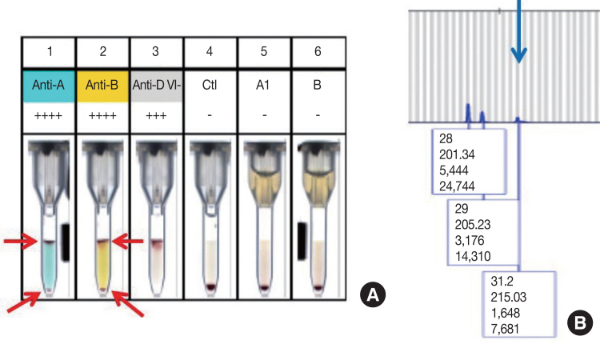
Table 3.
ABO phenotype and genotype in triplets with blood chimerism
| Subject | ABO phenotype | ABO genotype | STR marker (D21S11) | ||
|---|---|---|---|---|---|
| Blood | Buccal swab | Blood | Buccal swab | ||
| Proband | AwBw | A102/B101/O01 | A102/O01 | 28 29 31.2 chimeric |
28 maternal 29 paternal |
| Dizygotic brother | AwBw | A102/B101/O01 | B101/O01 | 28 29 chimeric 31.2 |
28 maternal 31.2 paternal |
| Dizygotic sister | A1 | A102/O01 | A102/O01 | 29 29 |
29 maternal 29 paternal |
DISCUSSION
The implementation of ABO genotype has resolved inconsistencies in ABO phenotypic testing, leading to the identification of rare and new alleles and the verification of uncommon occurrences like chimerism. Recently, cases have been reported where the all coding sequence of the ABO gene is analyzed through next-generation sequencing to discover new alleles and microchimerism [12], or to understand the frequency of ABO alleles [13].
In this study, the frequently referring phenotypes for ABO genotyping were A1Bw (26.9%) and A2Bw (24.1%). These two most frequently encountered phenotypes were caused by the presence of cis-AB alleles with frequencies of 24.1% and 84.6%. The cis-AB allele is the primary cause of ABO differences in Southeastern Korea, as in other regions of Korea [14,16,21,26-29].
ABO genotyping is a valuable tool in resolving ABO blood grouping discrepancies in the reference laboratory. However, it is essential to consider clinical information on individuals and regional allele data due to the complex genetic nature of the ABO gene and ambiguities related to cis/trans interactions. [11]. This study offers rare allele data for ABO genotyping on a regional level. The main causative allele responsible for ABO differences was cis-AB01, followed by rare ABO alleles including B309, B306, A204, Bw29, and Ax01 in decreasing order of occurrence. When examining ABO genotypes, having data on rare alleles can aid in distinguishing common and rare alleles within clinical information.
Five new alleles (1 Aw variant, 3 Bw variants, and 1 cis-AB variant) were identified during the investigation. The sequence data of these new alleles were deposited in a publicly accessible database. Two of them were published in the Transfusion journal [20,25]. Before closing of NCBI/dbRBC, we designated one Bw allele as B316 from NCBI/dbRBC.
One novel cis-AB was cloned and sequenced in this study, revealing that its structure would originate from hybrid gene formation between A102 and B101. The previous cis-AB alleles, including the most prevalent cis-AB01, did not originate from hybrid gene formation but from point mutations in the background of common A or B alleles. The structure of cis-AB01 (c.803G>C in the background of A102) is different from what the researchers expected before the sequencing era [30].
The NCBI/dbRBC database was terminated several years ago. We believe it is crucial to provide an alternative allele database for ABO genotyping to precisely identify ABO alleles. Currently, the only database available is ISBT (v.1.1), which offers less detailed ABO allele information and is updated less frequently compared to the previous NCBI/dbRBC. ISBT designations seem to recognize nonsynonymous variations, however, it is important to also consider nucleotide alterations, such as synonymous or intronic variations, when analyzing sequencing data. For example, B309 has one synonymous variant affecting antigenic responses, which cannot be categorized using the ISBT nomenclature system. If we do not update the database often, we will not be able to genotype recently discovered alleles. For example, Bw29, which were updated in the last stage of NCBI/dbRBC and the new alleles included in this study, cannot be named by ISBT nomenclature.
We require the authoritative database for ABO genotyping and the official naming organization such as IMGT/HLA for HLA polymorphisms. Meeting the criteria for official novel allele designations is advised to create a high-quality database for ABO genotyping. Initially, separate or create a clone of the novel allele from the second allele prior to sequencing to prevent confusion regarding cis/trans orientation. Secondly, thoroughly describe the sequences of a new allele, highlighting any differences from the reference allele, and then upload them to a publicly accessible database like NCBI/GenBank to offer crucial and detailed genotyping data.
During the investigation, we found five blood chimeras. Automatic blood typing analyzers have been introduced in recent years. It is commonly known to be more sensitive than the manual method, so it can be more useful to detect chimerism [31]. In our cases, we could suspect blood chimerism for the first time by the ABO discrepancy (double cell populations in cell typing), which is generated from an automated ABO phenotyping test. We could also find more than three alleles in STR analysis and confirmed blood chimerism by cloning-sequencing. Additionally, tissue chimerism can be excluded by sequencing using buccal swabs.
In conclusion. this study reaffirms that cis-AB is the most common cause of inherited ABO discrepancies, and cis-AB01 is the most prevalent cis-AB allele in the Korean population, also in the southeastern region. In addition, we discovered five new alleles (two of them reported in the official new allele report) and five blood chimeras by adopting sequencing analysis and additional molecular techniques to resolve ABO discrepancies, which provide regional rare allele data. This study presents rare and new ABO alleles and blood chimeras identified over a ten-year period at two major university hospitals in Southeastern Korea.