INTRODUCTION
A study identified a 4.78 Mb familial heterozygous microdeletion at 9q31.2-q31.3, segregating across three generations. This deletion, encompassing 26 genes, is associated with delayed puberty in both sexes between ages 13 and 16. Through genomic analysis, the critical region for delayed puberty was refined to a 3.7 Mb spanning 9q31.3 to 9q32 [1]. Taking advantage of an overlooked de novo balanced translocation in a Kallmann syndrome patient [2]—where delayed puberty is a hallmark feature—we further narrowed the candidate region to 9q31.3 and identified two potential Kallmann syndrome genes based on gene expression patterns.
SEARCHING FOR THE MISSING KALLMANN SYNDROME GENE
Positional cloning is a powerful method for identifying disease genes, particularly when it capitalizes on chromosomal rearrangements such as deletions and balanced translocations. These rearrangements serve as invaluable tools to pinpoint the exact location of disease-causing genes. By providing clues about the chromosomal position where the gene resides, it enables researchers to focus on a specific genomic area and use it as a starting point to clone and identify the gene.
Deletions, which involve the loss of a specific chromosomal segment, are particularly informative. When a deletion is associated with a particular disease or phenotype, it strongly suggests that the missing genomic region contains the disease-causing gene(s).
Balanced translocations, on the other hand, involve the exchange of segments between two different chromosomes without any loss or gain of genetic material. Despite this genomic balance, about six percent of carriers of balanced translocations exhibit abnormal phenotypes due to gene disruption at the breakpoints or dysregulation caused by position effects [3]. This dysregulation occurs when the separation of a gene from its cis-regulatory elements results in reduced gene expression [4]. By mapping these breakpoints, researchers can precisely identify candidate genes implicated in the disorder.
Contiguous deletion syndrome represents a genetic condition caused by a deletion of a segment of DNA that spans multiple genes located next to each other on a specific chromosome. The loss of these genes can lead to a variety of symptoms, depending on which genes are affected. Because multiple genes are involved, the resulting clinical features can be complex and variable, often including developmental delays, intellectual disabilities, congenital anomalies, and other distinctive phenotypes.
Comparative genomic mapping analyzes the chromosomal regions where microdeletions occur in different individuals who share a specific phenotype. By comparing these microdeletions, it is possible to identify overlapping genomic regions that are consistently missing across multiple cases. This overlapping region is considered critical because it likely contains the gene or genes responsible for the shared phenotype [5].
The process typically starts with identifying individuals who have similar clinical features or diseases and then performing detailed genetic analyses to map the precise locations of their chromosomal deletions. By narrowing down to the smallest common region deleted across these individuals, candidate genes within this region that might be causing the phenotype can be identified. This method has been successfully utilized to identify disease genes associated with various genetic syndromes, particularly by complementing next-generation sequencing, where interpreting the pathogenicity of variants of uncertain significance (VUS) remains challenging.
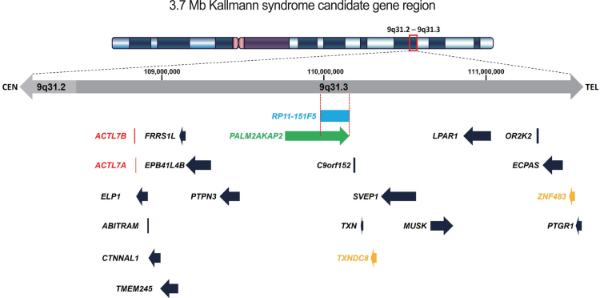
A novel 4.78 Mb familial heterozygous microdeletion segregating with the phenotype in three generation and encompassing distal end of 9q31.2 and entire 9q31.3 has been published in 2019. It contains 26 genes and is characterized by fatigue, muscle cramps, short stature, delayed puberty, sensorineural hearing loss (SNHL), and mild developmental delay. Male patients showed small testes, low testosterone levels and patients of both sexes showed delayed puberty from age 13 to 16 years old. Among the 25 genes within this genomic region, the authors proposed two candidate genes that may be associated with delayed puberty. They suggested that UGCG, located at 9q31.3, could be significant due to its role in the maturation of sperm-specific glycosphingolipids. Deletion of UGCG in mouse germ cells led to an age-dependent reduction in testicular mass, tubular atrophy, and arrested spermatogenesis. Additionally, they highlighted ZNF483 at 9q31.3 as another potential candidate (Fig. 1), noting its association with the age at menarche in women [1].
Through comparative genomic mapping with another microdeletion case, a critical overlapping region of 3.7 Mb, spanning 9q31.3 to 9q32 (chr9: 107,909,771-111,605,520, hg38/chr9: 109,711,873-113,407,621, hg18), has been identified (Fig. 1). This region, which contains 20 genes, is expected to be associated with short stature, SNHL, pubertal delay, and developmental delay [1].
Fig. 1.
The 3.7 Mb candidate gene region for Kallmann syndrome. This genomic region, refined by two heterozygous deletions, spans 20 genes located from 9q31.2 to 9q31.3 (GRCh38/hg38). Arrows indicate the transcriptional direction of each gene. The blue box represents the BAC clone RP11-151F5, identified by FISH to span the genomic breakpoint. This clone overlaps with a single gene PALM2AKAP2, shown in green, indicating that this gene is directly disrupted by the genomic breakpoint at 9q31.3 in a Kallmann syndrome patient with t(7;9)(p14.1;q31.3)dn. Two prime candidate genes for Kallmann syndrome are highlighted in red, while two additional genes discussed in this review and in the literature are shown in yellow.
However, a de novo balanced translocation t(7;9)(p14.1;q31. 3) in a patient with Kallmann syndrome, published in 2007, could significantly narrow down the candidate gene region at 9q31.3 for delayed puberty [2]. Kallmann syndrome is a genetic condition characterized by delayed or absent puberty and an impaired sense of smell (anosmia). It results from a failure in the development or migration of neurons responsible for producing gonadotropin-releasing hormone (GnRH), leading to insufficient production of gonadotropins and sex hormones with resultant delayed puberty [6]. In the cytogenetic characterization of a patient with KS and bone anomalies, demonstrating a balanced de novo translocation between chromosome 7 and chromosome 9, the authors hypothesized that the disease gene is located either 7p14.1 or 9q31.3 genomic breakpoints. Based on the delayed puberty found in two heterozygous deletions and its refined region 3.7 Mb, spanning 9q31.3 to 9q32, which encompasses 9q31.3, it is highly likely the disease gene for Kallmann syndrome should be at or in the vicinity of 9q31.3 breakpoint [1,7].
Using Bacterial Artificial Chromosomes (BACs) in a Fluorescent In Situ Hybridization (FISH) experiment, they found a176 kb BAC clone, RP11-151F5, located at 9q31.3. This clone resides within the extended and renamed gene PALM2AKAP2 (previously annotated as separate genes, PALM2 and AKAP2) [2]. The BAC spans exons 7 to 10 of PALM2AKAP2 (NM_007 203), indicating that the genomic breakpoint disrupts this gene (Fig. 1). Mutation screening in 98 Kallmann syndrome patients revealed no mutations, only two rare polymorphisms. This gene is expressed in olfactory epithelium and olfactory bulb [2], which are critical for the sense of smell and the migration of GnRH neurons during embryonic development. The olfactory epithelium contains sensory neurons that detect odors, and these neurons send signals to the olfactory bulb. During development, GnRH neurons originate in the olfactory epithelium and migrate to the hypothalamus via the olfactory bulb. Disruption in this pathway can lead to anosmia (loss of smell) and hypogonadotropic hypogonadism, the key features of Kallmann syndrome.
However, neither PALM2 nor AKAP2 is expressed in the testis, which is not necessarily incompatible with Kallmann syndrome, the genes of which are mostly expressed in the hypothalamus and/or pituitary, and the expression pattern of PALM2AKAP2 is not available in the GTEx database ( https://gtexportal.org/home/). Among the genes in the vicinity of PALM2AKAP2 at 9q31.3, three genes-TXNDC8, ACTL7A, and ACTL7B-are notably predominantly expressed in the testis. TXNDC8 is located 131 kb distal to PALM2AKAP2, while ACTL7A (Actin-like 7A) and ACTL7B (Actin-like 7B) are 777 kb and 785 kb proximal, respectively (Fig. 1). In GTEx, the median Transcripts Per Million (TPM) for TXNDC8 is 12.57, ACTL7A is 543.2, and ACTL7B is 301.5. In a Northern blot analysis, ACTL7A is expressed across various adult tissues, with the highest expression observed in testis. In contrast, the ACTL7B transcript was detected exclusively in the testis, with a lesser extent in the prostate [8].
The protein encoded by this gene is a member of the actin-related proteins (ARPs) family, which shares significant amino acid sequence similarity with conventional actins [9]. Both actins and ARPs feature an actin fold, an ATP-binding cleft, which is highly conserved in ACTL7A and ACTL7B, suggesting potential ATPase activity. ARPs are involved in various cellular processes, including vesicular transport, spindle orientation, nuclear migration and chromatin remodeling [8]. ACTL7A and ACTL7B are intronless genes located approximately 6 kb apart at 9q31.3, in a head-to-head orientation with opposite transcription directions.
A homozygous missense mutation (p.Ala245Thr in NP_006678.1) in ACTL7A has been linked to infertility and early embryonic arrest in two consanguineous brothers [10], while compound heterozygous mutations (Arg155Ter and Gly362 Arg) have been found in a non-consanguineous male with infertility [11]. Additional cases include a homozygous (Arg373Cys) and compound heterozygous mutations (Arg373His and Gly402Ser) identified in both consanguineous and non-consanguineous males with infertility [12]. Furthermore, a nonsense homozygous (Ser49Ter) and a missense homozygous mutations (Asp75Ala) were identified in two independent consanguineous males [13,14]. In a consanguineous Pakistani family with eight infertile men, a frameshift homozygous mutation (Glu50Alafs*6) was identified [15]. To date, no mutations in ACTL7B have been reported in humans with reproductive phenotype.
Collectively, therefore, dysregulation of ACTL7A or ACTL7B due to position effect in a balanced translocation patient [4] or its haploinsufficiency in two heterozygous deletion patients may contribute to Kallmann syndrome. If either of these two genes is dysregulated due to a position effect, qRT-PCR analysis using blood RNA from a Kallmann syndrome patient with a balanced translocation would show a reduced transcript level compared to a control family member without chromosomal anomalies, assuming that these genes are expressed in blood.
Given that bi-allelic mutations in ACTL7A cause male infertility, it is unlikely that a heterozygous deletion or dysregulation of this gene in balanced translocation would lead to Kallmann syndrome. If this were the case, the parents of infertile males with bi-allelic mutations, who should be obligate carriers of the heterozygous mutations, would themselves exhibit delayed puberty or Kallmann syndrome, which was not observed. Moreover, due to their reproductive phenotype, they would likely face challenges in having children. This further suggests that a heterozygous deletion or dysregulation of the ACTL7A gene is unlikely to cause Kallmann syndrome. Screening for mutations in these two genes in Kallmann syndrome patients would help confirm their pathogenic roles in this reproductive phenotype.
CONCLUSION
By comparing the genomic positions of genes within the refined 3.7 Mb heterozygous region at 9q31.3 to 9q32 with those at the 9q31.3 breakpoint of a balanced translocation t(7;9) (p14.1;q31.3), we identified two candidate genes for Kallmann syndrome, ACTL7A and ACTL7B, at 9q31.3 based on their expression patterns.