1. INTRODUCTION
The rapid advancement of digital technologies, including the internet of things and artificial intelligence (AI), has significantly reshaped the roles and functions of libraries (Bi et al., 2022; Mondal, 2021; Ozeer et al., 2019). AI has seen explosive growth across various sectors as a tool for estimation, prediction, and decision-making (Effendy et al., 2022a; 2022b; Kurniawan et al., 2023; Nafisah & Effendy, 2019). This digital transformation has compelled libraries to innovate by adopting online and automated services, enabling them to remain relevant and enhance public access to information (Lin et al., 2023; Okunlaya et al., 2022; Shiri, 2024).
Among the innovations adopted, library automation systems have become essential for improving service efficiency, streamlining collection management, and expanding access to digital resources. One such system is Senayan Library Management System (SLiMS), an open-source platform developed in Indonesia that has been adopted in at least 24 countries worldwide (Mathar & Ismaya, 2024). SLiMS integrates cataloguing, circulation, user services, and digital content management functions. However, the successful implementation of such systems hinges on the availability of technological infrastructure and human resource competencies in metadata, public service, and information and communication technology (ICT) literacy (Shah & Bano, 2020).
Despite their potential, library automation systems remain underutilized in elementary school libraries, particularly in developing countries such as Indonesia. This low utilization is alarming given Indonesia’s unique context: The country has over 160,000 libraries (Selatan, 2020). According to a dataset from https://data.go.id/dataset, this significant number is primarily dominated by school libraries, which account for approximately 67% of all registered libraries. In contrast, public, special, and university libraries account for approximately 10%, 7%, and 16%, respectively (One Data Indonesia Portal, 2024). This large number of school libraries contrasts with the low quality of reading culture: Indonesia ranks 62nd out of 70 countries in the Organization for Economic Co-operation and Development’s Programme for International Student Assessment reading assessment (Sulfemi, 2023). To address this paradox, the government launched the School Literacy Movement to foster a reading culture among students (Srirahayu et al., 2021). Despite the crucial nature of this initiative, its implementation encountered significant challenges. Many school libraries, particularly in rural areas, still rely on print collections and lack the necessary digital infrastructure to fully support this national initiative (Kurnia, 2021).
Several studies have examined the factors that support and hinder the implementation of the School Literacy Movement. While community involvement and funding are supporting factors, the lack of age-appropriate collections and limited access to engaging materials are significant barriers to success (Kartikasari & Nuryasana, 2022). Interestingly, research findings indicate that the barriers to implementing the School Literacy Movement lie not in the number of libraries or resource collections but in distribution and format, as most collections are still in print. This contrasts with the reading preferences of Generation Alpha, who are more drawn to digital formats. In fact, one study reported that approximately 63% of school-age children prefer reading books on smartphones or laptops (Miranda et al., 2023). Furthermore, digital books can increase students’ reading interest by 5,573 points compared to printed books (Santoso et al., 2018). These findings highlight the growing need for libraries to adapt their services to digital learning environments by implementing integrated library system (ILS).
Many libraries have adopted ILS to optimise services and tailor them to user characteristics (Nafisah, 2022). Beyond efficiency benefits, such systems also have the potential to create inclusive social spaces for learning and interaction (Nafisah, 2023). However, data from the national statistics portal shows that only 10,794 libraries in Indonesia are accredited. This data indicates that less than 10% of the total libraries in Indonesia have been accredited (Rachman et al., 2022). Library accreditation in Indonesia requires libraries to comply with the Indonesian National Standard (SNI) ISO/IEC 20000-1:2018 for information technology-based service management and the SNI ISO/IEC 27001:2013 for information security. These statistics indicate that one of the primary obstacles to accreditation is the limited implementation and utilization of information technology-based ILS (Lathifah et al., 2023).
2. NEED FOR STUDY
Digital transformation is a global imperative now reaching the education sector, requiring school libraries to adopt ILS to improve efficiency and service quality. However, implementing information technology at the elementary level is often hampered by limited resources and infrastructure, creating an urgent need to understand the technology adaptation process in the school environment.
2.1. Literature Gaps on Integrated Library System Implementation in Elementary Schools
The small number of accredited libraries in Indonesia reflects the standard of SLiMS implementation in schools, thus encouraging much research related to this system. Previous studies on SLiMS have focused on its implementation in universities and public libraries, cataloging efficiency, circulation management, and reducing operational costs (Ahmedani et al., 2022; Alam & Mezbah-ul-Islam, 2023; Bwalya, 2021). While these studies have highlighted the potential of SLiMS, research on its implementation in elementary school libraries remains limited. Furthermore, previous studies have tended to emphasize the technical functionality of SLiMS. A more comprehensive assessment of SLiMS implementation from a human, organizational, and technological-fit (HOT-FIT) perspective, as well as a broader contextual perspective, especially at the elementary education level, remains scarce in the literature.
2.2. Contextual Challenges and Research Site Justification
Elementary school libraries encounter challenges in adopting automation, including limited infrastructure, inadequate technical support, and varying levels of digital literacy. This situation requires in-depth research to understand the specific opportunities and barriers elementary school libraries face in implementing open-source SLiMS. Therefore, this study aims to explore the implementation of SLiMS in elementary school libraries in Indonesia, conducted in Bengkulu Province. Bengkulu Province, located on the west coast of Sumatra, Indonesia, is an appropriate region to study the digital transformation of school libraries because the region faces diverse infrastructure and resource challenges, spanning both urban centers and remote rural areas. This location selection ensures that the study’s findings will provide insights applicable to similar educational contexts in other developing regions that face resource constraints and digital transformation.
2.3. Research Objectives
This study aims to investigate the role of open-source SLiMS in transforming school libraries at the elementary education level, examine the challenges and opportunities that emerged during the implementation of SLiMS, and explore how this digital transformation effort can support the broader goals of improving digital literacy and educational innovation.
3. LITERATURE REVIEW
3.1. Operational Constraints of Resource-Limited Elementary School Libraries
Operational limitations obstruct the ability of school libraries to achieve educational goals in many developing countries, including Indonesia. Studies consistently report that these libraries encounter ongoing challenges related to inadequate infrastructure and human resources. Funding constraints also hinder elementary school libraries from updating their collections and adopting modern technology (Hakim & Siddiqui, 2024). This situation highlights a significant gap between global service standards and on-the-ground practices, which are generally limited to textbook collections and basic circulation services (Jinendran Jain & Kumar Behera, 2023). Limited budget allocations have an impact on library automation. This obstruction to services makes it difficult for schools to assess the effectiveness of their libraries and formulate development policies (Syafitri & Abidin, 2024). Challenges in Indonesian elementary schools, such as those in Bengkulu, reflect the global service gap caused by budget constraints—underscoring the need for robust and cost-effective modernization.
3.2. The Rise of Open-Source Integrated Library Systems
The constraints of high licensing costs on proprietary library management software have catalyzed the global adoption of open-source ILS. These systems, collaboratively developed and freely distributed, offer a critical path to automation for libraries with limited budgets (Hassan et al., 2022). Studies of library management systems in Indonesia consistently prioritize SLiMS. The scholarly literature describes SLiMS as a software with a community-driven, open-source architecture that rivals the features of commercial ILS systems. Its high domestic adoption rate, driven by its multilingual support and web architecture, indicates its success in addressing accessibility and cost challenges in the Indonesian library context (Rahyadi et al., 2021). This development reflects the system’s efforts to achieve broader suitability, particularly in meeting functionality and accessibility standards in specific educational settings, such as elementary schools. However, the validity of the implementation and effectiveness of these new features in the operational context of specific library environments remains to be explored further.
3.3. Research Gap and Contribution of the Present Study
The current literature provides strong evidence for library modernization and the technical feasibility of open-source ILS systems such as SLiMS. However, significant gaps exist in technology, organizational structure, and human capacity, particularly in resource-constrained elementary schools. Most previous studies have focused on ILS adoption without considering the structural and operational impacts of SLiMS implementation in schools. This study addresses this gap by presenting an in-depth empirical analysis of the relationship between SLiMS adoption and the operational efficacy of librarians performing administrative functions in Indonesian elementary schools. By examining the challenges elementary school libraries encounter in adopting SLiMS, this research provides strategic insights for policymakers and school administrators in designing sustainable, adaptable, and contextually relevant library transformations.
4. METHOD
This study uses a descriptive qualitative approach to explore the challenges of implementing SLiMS in elementary school libraries. Although libraries have widely adopted SLiMS in at least 24 countries, including Indonesia, Malaysia, the United States, Korea, and Colombia, its implementation in elementary schools, particularly in rural areas with limited resources, remains underexplored. Thus, this study contributes to the body of knowledge by contextualising SLiMS adoption within the realities of elementary education environments.
This study uses the HOT-FIT model to analyze the digital transformation process through SLiMS in elementary school libraries. HOT-FIT provides a more holistic framework by integrating HOT dimensions (Cahyono & Suryani, 2020; Hapsari et al., 2021; Widiastuti & Partiwi, 2021). This multidimensionality is particularly relevant for implementation in resource-constrained schools, where user acceptance, infrastructure limitations, and institutional support all impact the transformation. Furthermore, the model has been empirically validated in various contexts, including digital libraries and education systems, strengthening its applicability in this study.
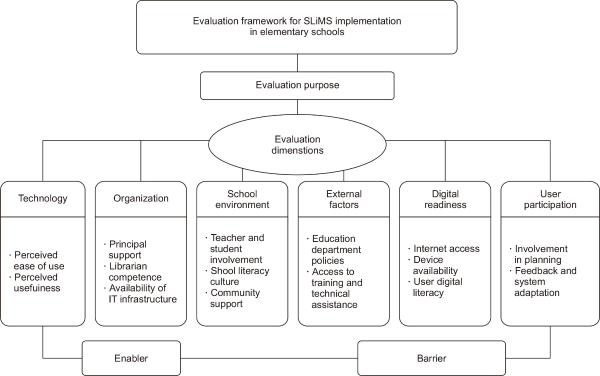
This study presents the proposed framework model, as shown in Fig. 1. Within this framework, the human dimension focuses on system use and user satisfaction. This dimension includes examining user experience, the frequency and duration of SLiMS use, the availability and effectiveness of training, and user resilience in the face of system-related challenges. The organisational dimension highlights strategic planning, managerial autonomy, internal communication, and leadership. It also encompasses environmental influences, particularly the availability of financial resources, the impact of government policies, and the broader socio-political landscape that may support or hinder the adoption of digital library systems. Meanwhile, the technological dimension assesses the system’s quality, the relevance and reliability of the information it provides, and the overall quality of the service offered to users (Sala & Subriadi, 2022; Xu & Lu, 2022). The purpose of using the framework in this study is to determine the extent to which SLiMS meets the functional demands of library management in an educational context. Using this integrated conceptual perspective, this study provides a comprehensive understanding of how HOT factors interact to shape the effectiveness and sustainability of SLiMS adoption in school libraries.
Fig. 1
Proposed framework in Senayan Library Management System implementation. IT, information technology.
This qualitative research was conducted in accordance with the ethical principles applicable to human participant studies. Although formal institutional review board approval was not granted, all participants received a clear explanation of the study’s purpose, the voluntary nature of their participation, and their right to withdraw at any time without consequence. Written informed consent was obtained before each interview. To maintain confidentiality and privacy, participant identities were anonymized using pseudonyms, and identifiable information was removed in transcripts, data analysis, and reporting. All recordings and documents were securely stored and accessible only to the research team.
4.1. Profile of Participating School Libraries
To provide a robust context for the research findings, particularly concerning the influence of library infrastructure and staffing on data management practices, the six participating school libraries (S1-S6) were thoroughly profiled (see Appendix 1). Table 1 summarizes the key characteristics of these libraries, detailing their location, staff structure, nature of their collections, service provision, and degree of automation. This contextual information is critical, as it highlights the disparity in resources and infrastructure that may impact the adoption and implementation of modern data management roles.
Table 1
Profile of participating elementary school libraries
| School code | Location | Library staff | Nature of collection | Extent of automation | Description |
|---|---|---|---|---|---|
| S1 | Rural | Librarian | Textbook | Automated system | Public schools often have limited infrastructure and sporadic Internet connectivity |
| S2 | Rural | Librarian | Textbook | Manual | Public schools often have limited infrastructure and sporadic Internet connectivity |
| S3 | Rural | Teachers with additional duties | Textbook | Manual | Public schools, minimal infrastructure, and a lack of library and HR staff |
| S4 | Urban | Librarian | Textbook and learning support collection | Hybrid (manual and automated system) | Public schools, adequate infrastructure, and a lack of library and HR staff |
| S5 | Rural | Librarian with additional duties (data operator) | Textbook | Manual | Public schools often have limited infrastructure and sporadic Internet connectivity |
| S6 | Urban | Librarian | Textbook and learning support collection | Manual | Integrated private schools have slightly better internal support |
Staffing profiles vary significantly across schools. Libraries in S1, S2, S4, and S6 are each staffed by a full-time librarian, reflecting the typical staffing model in regional public schools. In contrast, S3 employs a classroom teacher with additional library management duties, indicating a reliance on non-specialized, part-time personnel. School S5 employs a librarian and data systems manager, a specialized dual role that combines traditional library functions with institutional data management and reporting responsibilities. This dual role in S5 is anticipated to be a potentially key variable in the analysis of data integration efficiency.
Regarding operations, most libraries (S1, S2, S3, and S5) are in rural areas, often described as having minimal infrastructure and intermittent Internet connectivity (as noted in the Description column). Services at all locations are classified as ‘basic services with open systems,’ primarily including standard circulation (borrowing and returning) and simple reference support, with physical, open-shelf access to materials. Most of the libraries listed above primarily contain required subject textbooks. In contrast, S4 and S6 additionally maintain learning support collections, comprising supplementary non-fiction materials in both physical and digital formats to enrich the curriculum.
4.2. Data Collection
This study employed purposive sampling to recruit eight key informants (n=8) from six elementary schools in Bengkulu Province (see Appendix 1). The sample consisted of librarians (n=5), teachers (n=2), and a principal (n=1). To ensure methodological transparency and provide rich context, a detailed profile of each participant is presented in Table 2. This table summarizes the participants’ anonymized code, role, type of school, and level of SLiMS experience. The sample was heterogeneous to maximize the informative power of the data. The main selection criteria were: 1) participants’ practical understanding of SLiMS, 2) willingness from both the school and the participants, and 3) the relevance of the participants’ roles in SLiMS implementation. Despite the limited sample size (n=8), data collection was discontinued once thematic saturation was achieved. This saturation was strictly defined as: (1) the absence of significant new codes or concepts emerging in the final three interviews, and (2) the full development of all core themes across the sample, confirming the adequacy of the data collected (Guest et al., 2020). To ensure ethical compliance, participants were informed of the study’s purpose, and their participation was voluntary. Their identities were kept confidential in all reports (see the 4. METHOD section).
Table 2
Profile of research participants
| Participant code | Role | School type | SLiMS experience |
|---|---|---|---|
| P1 | Librarian | Rural | High |
| P2 | Librarian | Rural | Intermediate |
| P3 | Teachers with additional duties | Rural | Basic |
| P4 | Librarian | Urban | Intermediate |
| P5 | Librarian and data systems operator | Rural | High |
| P6 | Librarian | Rural | Intermediate |
| P7 | Teachers with additional duties | Urban | Basic |
| P8 | Principals | Rural | Basic |
4.3. Proposed Analytical Framework
This study adopts a participatory, qualitative approach to analyse the implementation of SLiMS in Indonesian primary school libraries. Grounded in the principles of Participatory Design, the research emphasises the active involvement of school librarians as co-creators in the knowledge-building process. Their insights—collected through interviews, observations, and documentation—served as a critical data source for understanding the locally rooted challenges and opportunities in the digital transformation process in elementary school libraries.
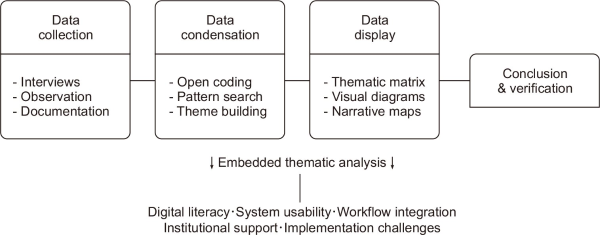
This study employed a thematic analysis framework to interpret the qualitative data in a meaningful manner. The process began with open coding, which allowed for the identification of meaningful patterns and statements related to SLiMS use, technological barriers, and perceived benefits. These initial codes were then consolidated into broader themes, including digital literacy, system usability, workflow integration, and institutional support. The study examined these themes through interpretive synthesis to uncover sociotechnical factors influencing the success of the digital transformation process in school libraries.
This analysis follows the structure outlined in Miles and Huberman’s framework, which consists of four coherent and interrelated stages: data collection, data condensation, data presentation, and conclusion drawing. This study collected data through field observations and grouped them into themes related to the research questions, presenting the findings in both visual and textual displays to facilitate comparison and inference. Conclusions were drawn through iterative validation and reflection, guided by the criteria of credibility, transferability, dependability, and confirmability. This analytical framework allowed the study to explore the empirical experiences of librarians and library managers during the digital transformation process in the elementary school libraries they manage. The framework documents how libraries can digitally transform through SLiMS. The resulting insights contribute to a transferable methodology for exploring digital transformation in comparable educational settings, advancing library science and ICT research in a developing regional context. Fig. 2 presents the proposed analytical framework.
This study utilized ChatGPT (OpenAI, San Francisco, CA, USA), Copilot (Microsoft, Redmond, WA, USA), and Grammarly (Superhuman Platform Inc., San Francisco, CA, USA) solely as aids to enhance the clarity and grammar of the manuscript, without altering the conceptual framework, data analysis, or interpretation of the results.
5. RESULT AND DISCUSSION
Implementing SLiMS in elementary schools is a strategic step to advance digital transformation in educational environments with limited infrastructure. As a web-based, open-source ILS, SLiMS provides a practical solution for automating services and efficiently managing collections, particularly in schools with limited infrastructure.
Bengkulu Province is one of Indonesia’s regions facing significant infrastructure limitations. According to data from the official SLiMS website ( https://slims.web.id/web/news/daftar-pengguna-slims), Bengkulu has the fewest registered SLiMS users in Indonesia (SLiMS, 2019). This low digital adoption rate is due to inadequate infrastructure, which impacts the province’s general education services and library development (Samosir et al., 2024; Tomimi & Prasetyo, 2024). To understand these adoption challenges, it is important to review what SLiMS fundamentally offers.
5.1. Senayan Library Management System Overview
SLiMS is an open-source ILS developed initially in Indonesia in 2006 by the Ministry of National Education Library Development Team. Designed to support library automation, SLiMS provides cataloging, circulation, membership management, serials control, and reporting modules. Its flexibility, multilingual support, and low cost have led to the adoption of SLiMS. Data on Indonesian adoption were obtained from SLiMS Community Indonesia, whereas international figures are based on voluntary community reporting, which may not capture the full extent of usage. Based on these data, over 1,900 institutions have adopted SLiMS in Indonesia. Although international adoption spans at least 24 countries, reliable aggregated figures outside Indonesia are not comprehensively documented (SLiMS, 2019). Community-driven, SLiMS continues to evolve through active contributions from librarians, developers, and educators, making it one of the most prominent examples of open-source solutions in the library space.
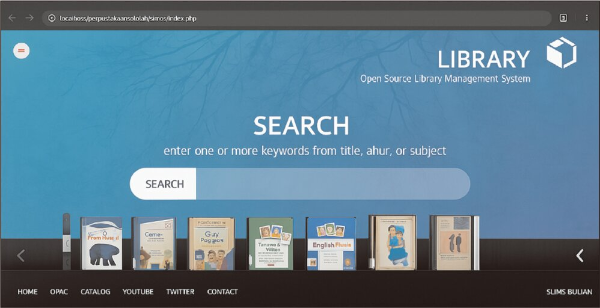
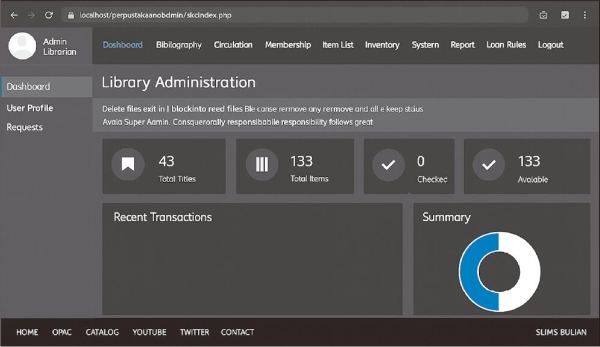
SLiMS is particularly well-suited for elementary school libraries due to its robust features, including MAchine-Readable Cataloging (MARC)-based cataloging, circulation and archives management, online public access catalog (OPAC) support, automated statistical reporting, integration of digital and multimedia formats (*.pdf, *.mp3, *.flv), and infographic-based visitor analytics with a user-friendly interface. These capabilities support the implementation of hybrid and fully digital library models, enhancing operational resilience and pedagogical effectiveness in elementary education. The evolution of SLiMS—from its initial stable release to the latest version 9.6.1—demonstrates the dynamic role of the open-source community in driving iterative improvements. Key enhancements in version 9.6.1 include security mechanisms against cross-site scripting and structured query language injection, MARC search/retrieval via URL-based copy cataloging, Elasticsearch indexing, automatic metadata acquisition, and text-to-speech features to enhance the system’s accessibility and inclusiveness. Figs. 3 and 4 display the OPAC interface and SLiMS features.
Like many other regions with limited resources, elementary school libraries in Bengkulu Province face challenges such as minimal digitization, restricted collections, and inadequate support for information literacy. These conditions reflect broader global issues in developing areas, where libraries struggle to modernize due to financial and infrastructural constraints. Addressing these challenges through open-source solutions has significant potential for Bengkulu and similar regions worldwide.
SLiMS offers a promising response to these challenges. As an open-source, free-to-use ILS, SLiMS enables schools with limited budgets to implement library automation without licensing costs. Its web-based nature supports access across multiple devices within the school network, encouraging collaboration among staff and enabling flexible, decentralized services. In addition, its multilingual interface enhances usability in diverse educational contexts, making it particularly relevant for elementary school environments in Indonesia.
To assess the potential of SLiMS to drive digital transformation in elementary school libraries, this study employed a strengths, weaknesses, opportunities, and threats-oriented analysis based on the HOT-FIT Model, which examines the human, organizational, and technology dimensions. Within this framework, the ‘human’ dimension specifically considers the diverse perspectives offered by librarians, teachers, and principals, recognizing that varying levels of responsibility, experience, and familiarity with SLiMS shape their views. This approach, rather than treating participants as a single, homogeneous group, captures the strengths and opportunities of SLiMS while identifying barriers that may impact its adoption and long-term sustainability. Field findings emphasize the system’s strategic potential in advancing digital literacy and service efficiency, while highlighting critical factors necessary to ensure successful implementation in resource-constrained school settings.
5.2. Human Infrastructure in Senayan Library Management System Implementation
Transforming digital elementary school libraries in a developing country like Indonesia is not simply a technical issue, but a multidimensional challenge rooted in systemic inequalities. National data shows that only 0.42% of professional librarian positions are filled (Statistics Indonesia, 2025), reflecting weak institutional capacity to manage technology-based systems such as SLiMS. This data is supported by interviews with principals and a teacher assigned additional duties as library managers. They stated that the main challenge in implementing SLiMS lies not with the technology, but with the readiness of human resources. Most schools, including their own, lack competent librarians, which hampers library management due to limited knowledge and skills. Although they regularly attend training from the National Library and relevant ministries, their educational background, which is not in library science, presents a barrier, particularly in operating SLiMS to manage library collections and services (interviews with P3 and P8, July 12, 2025).
Furthermore, interviews with librarians revealed that many schools do not prioritize library development. This is reflected in the librarian recruitment process, as one librarian stated that she was the first librarian hired by the school since its founding in 2010. This statement is further reinforced by the fact that a teacher at her school was given additional duties as a member of the library staff (interviews with P6 and P7, July 17, 2025). Another librarian added that recruiting staff with a library science background often comes with the additional responsibility of managing school data (interview with librarian P5, July 19, 2025). Lack of support from top management was also cited as a major inhibiting factor; without strong policies from the highest decision-making level, SLiMS implementation tends to stall. This situation suggests that library services are not yet a top priority. On the other hand, the presence of librarians increasingly demonstrates awareness that professional staffs are a crucial infrastructure for supporting digital transformation.
These fundamental human resource challenges are also evident in technical competencies. Many existing librarians lack adequate information technology competencies, while SLiMS training remains limited, and resistance to change is common. Interviews indicate that strengthening the SLiMS system depends on the capacity of human resources to manage and develop the system, which requires specific competencies. First, web design skills are necessary; several librarians emphasized the importance of a more user-friendly SLiMS interface aligned with the institution’s identity (interview with librarian P1, July 15, 2025). Second, technical challenges such as slow access and server outages are common. However, librarians have a limited understanding of computer networks, despite the high demand for network-savvy staff (interviews with P1, P2, P4, P5, and P6, July 15, 2025). Third, interviews highlighted the importance of mastering media technology and AI to support SLiMS services (such as recommendation features, catalog automation, and user analytics). However, these competencies are also still lacking (interviews with librarians P1, P2, and P4, July 27, 2025).
In addition to human resources and institutional issues, this study identified low student interest in visiting the library as another challenge. Librarians stated that this low interest is caused by the dominance of open-access library materials, which are less engaging and not suitable for the characteristics of the students’ ages (interview with P1, P2, P4, P5, and P6, July 27, 2025). Ironically, this lack of student enthusiasm is then used by policymakers as an excuse to adopt manual systems or simple spreadsheet applications, because SLiMS is considered unnecessary for limited collections and low attendance (interviews with librarians P1, P2, P4, and P5, July 17, 2025). These findings confirm that SLiMS implementation ultimately depends heavily on investment in human resource development, ongoing training, and—most importantly—strong institutional support. Therefore, intervention policies focused on enhancing librarians’ technical and digital competencies are considered key strategies in implementing the system, as summarized in Table 3.
Table 3
Identified competency gaps and needs for SLiMS implementation
| HR dimension | Empirical challenges | Reference to findings in text (empirical grounding) | Implications | |||
|---|---|---|---|---|---|---|
| Subheading | Paragraph | Participant code | Page | |||
| Librarian competency | Limitations of professional librarians | 5.2 | 2-3 | P3, P5, P6, P7, P8 | 9 | Library science, cataloging, classification, and information literacy |
| Basic technical skills | HR Readiness, not technical operability | 5.2 | 2-3 | P3, P5 | 9 | SLiMS operation, catalog input, circulation, catalog search |
| Policy advocacy | Policy makers perceive the manual system as adequate | 5.2 | 4 | P1, P2, P4, P5 | 9 | Policy communication, digital literacy, and advocacy skills |
| System interface & design | Staff lack web design expertise | 5.2 | 6 | P1, P2, P4, P5 | 9 | Web design, UI/UX, institutional branding |
| Network infrastructure | Limited staff expertise in computer networking | 5.2 | 7 | P1, P2, P4, P5, P6 | 9-10 | Basic networking, server configuration, and troubleshooting |
| Integration & innovation | Staff lack advanced technology knowledge (AI/analytics) | 5.2 | 8 | P1, P2, P4 | 10 | Programming, API integration, data analytics, and AI literacy |
| Child-friendly services | Unattractive collection and unengaging SLiMS interface for children | 5.2 | 9 | P1, P2, P4, P5, P6 | 10 | Collection curation, children’s literacy, and age-appropriate design |
5.3. Organizational Dimension: Leadership, Policy, Operational Structure, and Institutional Support in Senayan Library Management System Implementation
Implementing SLiMS in elementary schools is not merely a software installation process, but rather a comprehensive digital transformation that requires substantial organizational support and commitment. The system risks not functioning optimally without a clear work structure, supportive policies, and adequate resource allocation.
The primary challenge identified was a lack of leadership, resulting from the absence of a professional librarian or library coordinator. Furthermore, SLiMS was not integrated with the primary school’s educational vision. Teachers stated that there was no school policy explicitly linking SLiMS to literacy targets or academic achievement. Consequently, the system operated in isolation and was not integrated with the school’s educational strategy (interview with P3 and P7, July 15, 2025).
This lack of strategic vision has a direct impact on resource allocation. Budget constraints exacerbate the situation, despite the government’s stipulation of a 5% allocation for this purpose (REGULASIP, 2007); implementation is uneven, as schools prioritize basic learning needs over other areas. The initial cost of implementing SLiMS, estimated at USD 200-300 millions, poses a significant burden (Mathar & Ismaya, 2024). This lack of budget prioritization is evident in the field, where the primary obstacle is the limited availability of facilities, such as computers and printers. Proposals for facility procurement have been issued, but have not yet received budget allocation (interviews with P1, P2, P3, P4, P5, and P6, July 27, 2025).
The combination of a lack of leadership, limited budgets, and inadequate facilities has resulted in a stagnant digitalization process. This has led to unstandardized procedures and hampered staff capacity development, resulting in sporadic training, delayed system updates, and inconsistent data quality. Librarians explained that their schools’ SLiMS is used solely for collection input, with no clear direction for supporting literacy programs. This situation prevents libraries from providing engaging activities to foster students’ interest in reading (interviews P1 and P4, July 17, 2025).
The analysis of SLiMS effectiveness revealed deep-rooted organizational and strategic barriers, as summarized in Table 4. Within the information systems success model (ISSM) framework, this situation reflects the low quality of systems and services, as well as minimal organizational support, resulting in ineffective utilization of the systems (Jebril et al., 2024). Meanwhile, within the technology-organization-environment (TOE) framework, the weak integration of SLiMS with the school’s educational vision reflects a low level of organizational readiness. Therefore, these findings underscore the importance of positioning SLiMS as an integral part of school governance, supported by ongoing staff capacity development and equitable funding allocation. This crucial step aims to ensure that the digital library system is not merely a token implementation, but a true catalyst for inclusive educational transformation.
Table 4
Challenges and intervention strategies based on organizational dimensions in SLiMS implementation
| Organizational dimension | Empirical challenges | Reference to findings in text | Intervention strategies | |||
|---|---|---|---|---|---|---|
| Subheading | Paragraph | Participant code | Page | |||
| Leadership & management | Lack of organizational leadership due to the absence of professional librarians or coordinators | 5.3 | 2 | P1, P2, P3, P4, P5, P6 | 11 | Appoint professional librarians or library coordinators in every school to provide clear leadership |
| Operational structure | Non-standardized procedures and SLiMS are being used solely for collection input, failing to support literacy programs | 5.3 | 2 | P1, P4 | 11 | Develop standardized standard operating procedures for SLiMS management and ensure its full utilization to support literacy activities |
| Policy & integration | SLiMS is not integrated with the school’s educational vision, literacy targets, or academic strategy | 5.3 | 3 | P3, P7 | 11 | Integrate SLiMS with educational performance and literacy indicators at the school-level policy |
| Funding & infrastructure | Limited facilities (computers, printers) and budget proposals not yet allocated, indicating low management support | 5.3 | 1 | P1, P2, P3, P4, P5, P6 | 11 | Strengthen planning and budgeting mechanisms to monitor library budget allocation and secure funding for facilities |
| Funding & equity | Uneven policy implementation of the 5% budget mandate (Law No. 43/2007) and high initial costs for schools in disadvantaged regions | 5.3 and 5.4 | 4 | P1, P2, P3, P4, P5, P6 and P7 | 11, 13 | Provide affirmative funding schemes for schools in disadvantaged areas and enhance coordination between central and local governments to support educational initiatives |
5.4. Technology as Critical Infrastructure in Digital Library Transformation
The implementation of SLiMS in elementary school libraries in Bengkulu Province, Indonesia, has revealed critical challenges that extend beyond technical limitations, encompassing structural and policy issues.
Field data indicates a significant mismatch between the technical requirements of SLiMS software and the available infrastructure. For example, many libraries operate with only 4 GB of random access memory—far below the 8 GB recommended for optimal performance of SLiMS version 9. These hardware limitations directly impact system stability, causing frequent interruptions, slow indexing, and data retrieval failures. Several librarians reported that their computers frequently crashed while running SLiMS, took a long time to load data, and sometimes required a complete restart (interviews with P1, P2, and P4, July 23, 2025).
Within the technology acceptance model (TAM) framework, these limitations reduce the perceived usefulness and ease of use of SLiMS, hindering adoption (Musa et al., 2024). In addition to computing power, the limitations of supporting devices—such as barcode scanners and radio frequency identification readers—further limit the potential for circulation automation and inventory tracking. As a result, many library processes remain manual, inefficient, and prone to error. Librarians noted that loan transactions had to be recorded manually due to the lack of scanning, increasing their workload (interviews with P1, P2, and P4, July 23, 2025).
Connectivity issues provide this solution. The schools in this study are in geographically inadequately connected areas, reflecting the national reality where approximately 12,000 villages still lack 4G access (Ministry of Communication and Digital Affairs of Indonesia [KOMDIGI], 2022). Unstable Internet connections hamper the use of cloud-based features, prevent software updates, and limit access to technical support. Librarians reported frequent disconnections resulting in data loss, while system updates were infrequent (interviews with P1, P2, and P4, July 26, 2025). Viewed through the lens of digital divide theory, this situation illustrates how technological access is shaped by device availability, affordability, and access to support services (Ragnedda & Muschert, 2013).
These technical barriers are attributed to structural inequalities and weak policy implementation. The absence of well-targeted subsidy infrastructure limited digital procurement programs, and the lack of locally appropriate technology distribution models contributes to the uneven implementation of SLiMS. Librarians emphasized that although regulations require a 5% budget allocation for libraries, this policy has not been enforced. Most operational funds are allocated to classroom needs, making SLiMS development a low priority (interviews with P1, P2, P3, P4, P5, P6, and P7, July 23, 2025).
From a policy implementation theory perspective, this failure reflects weak intergovernmental coordination and weak adaptive mechanisms. This study’s primary contribution is the proposal of a contextualized and equity-oriented strategic framework. Recommended strategies include developing a lightweight version of SLiMS that is compatible with low-spec devices and offline environments, implementing decentralized connectivity models (such as mesh networks or subsidized satellites), and promoting inclusive technology through targeted hardware procurement and mobile-friendly asynchronous training. These recommendations underscore the importance of positioning SLiMS not merely as a management tool, but as a strategic instrument for democratizing access to information. Therefore, the digital transformation of elementary school libraries must be realized as a systemic agenda—integrating technological innovation, policy governance, and social justice. Table 5 lists the main challenges in implementing SLiMS in remote schools, including limited infrastructure, weak supporting devices, weak connectivity, and policy implementation.
Table 5
Strategic contributions to overcoming technological barriers in SLiMS implementation in remote elementary schools
| Technology dimension | Empirical challenges | Reference to findings in text | Intervention strategies | |||
|---|---|---|---|---|---|---|
| Sub heading | Paragraph | Participant code | Page | |||
| Technical infrastructure | Development of a lightweight or modular version of SLiMS compatible with low-spec devices | 5.4. | 1 | P1, P2, P4 | 12 | Ensures inclusivity by enabling under-resourced schools to adopt SLiMS, reducing the digital divide |
| Supporting devices | National procurement programs for basic digital library devices to enhance efficiency and scalability | 5.4. | 2 | P1, P2, P4 | 12-13 | Improves operational efficiency and provides a scalable foundation for future library automation |
| Connectivity | Subsidized satellite or community-based mesh networks as decentralized connectivity solutions | 5.4. | 3 | P1, P2, P4 | 13 | Strengthens digital equity by connecting remote schools to national digital library ecosystems |
The long-term sustainability of SLiMS implementation in elementary schools requires alignment of technical capacity, infrastructure readiness, and a supportive policy framework. Identified challenges include the development of integrated and context-sensitive interventions, such as creating a lightweight version of SLiMS compatible with low-spec devices, providing subsidized hardware and affordable connectivity solutions, and strengthening budget allocations and monitoring mechanisms at the local level. These steps are crucial for ensuring the operational effectiveness of SLiMS and repositioning it as a strategic instrument in promoting inclusive and equitable digital education. Without such systemic support, SLiMS risks remaining a symbolic or fragmented response to digital organization, rather than serving as a catalyst for meaningful transformation. Table 6 presents empirical findings derived from interviews and field observations, organized according to the HOT-FIT framework, which highlights the interrelated dimensions of human, organization, and technology.
Table 6
Integrated summary of SLiMS implementation challenges and strategic interventions based on the HOT-FIT framework
| HOT-FIT dimension | Identified challenges | Strategic interventions |
|---|---|---|
| Human resources | Multi-layered competency crisis | Proposing a holistic competency development framework 1. Functional competency: Mastery of SLiMS operations 2. Strategic competency: Skills in policy advocacy, interface design, and content curation 3. Innovative competency: Readiness for future technology adoption (artificial intelligence, analytics) |
| Organization | Systemic integration failure | Designing an integrated governance model 1. Designing an integrated governance model integrates SLiMS into academic and literacy performance targets 2. Standardizes standard operating procedures for SLiMS utilization 3. Promotes affirmative funding policies for schools in disadvantaged areas |
| Technology | Acute digital infrastructure gap | Formulating an inclusive and adaptive technology implementation strategy 1. Development of a lightweight SLiMS version: To be compatible with low-spec devices 2. Centralized procurement of supporting devices: Through a national program 3. Decentralized connectivity models: Such as mesh networks or subsidized satellite Internet |
As shown in Table 6, the dynamic interplay among human (capacity gaps), organizational (policy inconsistencies), and technological (infrastructure limitations) factors emerges as a persistent barrier to the sustainability of digital libraries. However, these findings simultaneously present opportunities for structured digital transformation, more vigorous policy enforcement, and adaptive technological innovation. These two dimensions—barriers and opportunities—form the analytical foundation for Table 7. The following framework synthesizes the study’s insights, demonstrating how targeted interventions can transform systemic weaknesses into actionable drivers for advancing inclusive digital transformation in elementary school libraries.
Table 7
Analysis of barriers and enablers of SLiMS digital transformation
| Dimension | Barriers | Enablers |
|---|---|---|
| Human resources | Competency crisis: The absence of professional librarians, low technical skills among staff, and a lack of expertise in policy advocacy and innovation | Holistic capacity development: Implementing a human resource development framework that includes functional, strategic, and innovative competencies for library staff |
| Organization | Systemic integration failure: SLiMS operates in isolation from the school’s educational vision, supported by weak and uneven funding policies, and is hindered by a resistant work culture | Integrated governance: Designing a governance model that aligns SLiMS with academic targets, standardizes operating procedures, and enforces affirmative funding policies |
| Technology | Digital infrastructure gap: A mismatch between available hardware and SLiMS’s system requirements, along with a lack of supporting devices and reliable connectivity | Adaptive technology strategy: Adopting inclusive technology solutions, such as developing a lightweight version of SLiMS, a centralized device procurement program, and decentralized connectivity models |
5.5. Synthesis of Challenges and Opportunities of Digital Transformation in Elementary School Libraries
Based on the synthesis of empirical findings, the implementation of SLiMS in elementary schools faces complex, interrelated, and multidimensional challenges stemming from the HOT-FIT approach. In the ‘human’ aspect, constraints arise from limited technical staff capacity; however, this creates opportunities for capacity building through locally based structured training and professional certification. In the Organizational aspect, the biggest challenge is the policy-practice gap, particularly related to the unclear role of librarians and weak budget oversight. For SLiMS to become a strategic literacy instrument, the formalization of librarian roles and the implementation of supportive budget policies are crucial. Finally, technological challenges such as limited devices and unstable connectivity actually open up opportunities for technical adaptations, such as the development of lightweight versions of SLiMS and contextually relevant hybrid support models. These findings demonstrate that digital transformation through SLiMS is a systemic issue that demands synergy between human capacity building, institutional reform, and complex, inclusive, and multidimensional technological innovation.
5.6. Intervention Strategies for Local Contexts
This study develops intervention strategies to ensure the long-term feasibility and sustainability of SLiMS, specifically in elementary school libraries in Bengkulu Province. The sustainability of SLiMS in elementary school libraries depends on the implementation of three strategic pillars. First, human resource strengthening focuses on providing structured SLiMS technical training and encouraging certification of library professional staff. Second, governance reform demands the formalization of the library’s role and enforcement of a 5% library budget allocation, as well as the integration of SLiMS into school curriculum development plans. Third, technology adaptation prioritizes the development of a lightweight/offline version of SLiMS compatible with low-spec devices and provides hybrid technical support and affordable device procurement schemes. By implementing this integrated approach, elementary schools in Bengkulu Province and relevant stakeholders can ensure that SLiMS becomes a catalyst for expanding access to information and improving the quality of education in the region.
5.7. Theoretical Implications and Global Significance
Although this research was conducted in Bengkulu, the issues identified using the HOT framework are also relevant to other countries. The findings of this study make a concrete contribution to the international discourse on school library automation and digital equity, as the identified barriers represent local manifestations of universal patterns faced by transitioning education systems worldwide.
This study offers three primary contributions to the global discourse on digital transformation in resource-constrained settings. First, it reinforces the global debate indicating that digital equity encompasses not only access but also the capacity for effective utilization. The human resource capacity gap highlights that without formal and sustained investment in training, open-source technologies will remain reliant on informal networks, confirming the human element as a universal determinant of success. Second, by examining the highly localized SLiMS open-source product against global ILS, the findings suggest that long-term public sector success depends more on formal institutional commitment—such as policy enforcement and sustained funding—than on code quality alone. This is critical guidance for global policymakers: The low initial cost of open-source solutions must be balanced with a strong, formally defined institutional support structure. Third, theoretically, the study extends the HOT-FIT framework by emphasizing that transparent and sustainable institutional support is a crucial prerequisite for system success. Findings from Bengkulu confirm that organizational aspects are the key determinant of sustainability, prompting the conclusion that global development strategies should shift focus from technology implementation to formal governance reforms.
6. CONCLUSION
This study contributes to the international discourse on elementary school library automation in resource-constrained settings. It concludes that digital transformation—through SLiMS in Bengkulu elementary schools—is a systemic and complex process. Key barriers, such as inadequate infrastructure and insufficient training of human resources, as well as weak policy coordination, suggest that failure lies not in technical aspects, but rather in weaknesses in institutional support and human capacity. These findings represent a local manifestation of challenges within transitioning education systems, suggesting that patterns observed globally may also be present within this specific regional context.
The study identifies integrated interventions using the HOT-FIT framework to enhance the viability of SLiMS. It demands modular, on-demand training (human resource) and a consistent annual budget (organizational) to ensure formal commitment. Technology requires cluster mentoring and a lightweight SLiMS version. This highlights the need for a shift to evidence-based implementation.
This study reaffirms that clear and sustained institutional support is a crucial prerequisite for the success of the SLiMS open-source system within this institutional context, suggesting its relevance for similar open-source library systems. The findings for SLiMS are relevant for global policymakers seeking to leverage technology to advance digital equity and literacy. The study concludes that the focus must shift from technology implementation itself to formal governance reforms that can ensure the continuity of human resources and budgetary support. While this intervention is actionable, the study acknowledges methodological limitations, such as the predominance of data on participants’ subjective perceptions. Therefore, future research is recommended to use a mixed-methods approach (qualitative and quantitative, including technical audits) to validate these findings and further investigate the impact of institutional support on information system sustainability in a global context.
ACKNOWLEDGEMENTS
The authors gratefully acknowledge the Department of Library and Information Science at UIN Sunan Kalijaga Yogyakarta for its academic guidance and institutional support. Appreciation is also extended to Universitas Gadjah Mada for its enriching scholarly environment and interdisciplinary contributions to this study. The collaboration between the two institutions has been instrumental in shaping the research direction and its relevance. The authors also acknowledge the use of language assistance tools, including ChatGPT, Copilot, and Grammarly, which helped ensure clarity and grammatical accuracy during manuscript preparation. All interpretations and conclusions remain the sole responsibility of the author.
REFERENCES
, , , (2022) Comparative study for assessment of Koha and SLIMS features in public sector college libraries of Sindh Library Philosophy and Practice (e-Journal), 6862 https://digitalcommons.unl.edu/libphilprac/6862.
, (2023) Impact of service quality on user satisfaction in public university libraries of Bangladesh using structural equation modeling Performance Measurement and Metrics, 24, 12-30 https://doi.org/10.1108/pmm-06-2021-0033.
, , , , , , (2022) A survey on artificial intelligence aided internet-of-things technologies in emerging smart libraries Sensors (Basel), 22, 2991 https://doi.org/10.3390/s22082991. Article Id (pmcid)
, (2020) The suitability evaluation of procurement information systems to the needs of users and management using human, organization, technology-fit (HOT-FIT) framework IPTEK: The Journal for Technology and Science, 31, 101-110 https://doi.org/10.12962/j20882033.v31i1.6326.
, , , , (2022a) The prediction of the oxygen content of the flue gas in a gas-fired boiler system using neural networks and random forest IAES International Journal of Artificial Intelligence, 11, 923-929 https://doi.org/10.11591/ijai.v11.i3.pp923-929.
, , , , , (2022b) Forest quality assessment based on bird sound recognition using convolutional neural networks International Journal of Electrical and Computer Engineerin, 12, 4235-4242 https://doi.org/10.11591/ijece.v12i4.pp4235-4242.
, , (2020) A simple method to assess and report thematic saturation in qualitative research PLoS One, 15, e0232076 https://doi.org/10.1371/journal.pone.0232076. Article Id (pmcid)
, (2024) The effectiveness of leadership policies in creating a digital library system Development: Studies in Educational Management and Leadership, 3, 65-78 https://doi.org/10.47766/development.v3i1.3378.
, , , (2021) A literature review of human, organization, technology (HOT) - fit evaluation model Proceedings of the 6th International Seminar on Science Education (ISSE 2020), 541, 876-883 https://doi.org/10.2991/assehr.k.210326.126.
, , (2022) Open-source and proprietary library automation software: A comparative academic librarian's perspective Journal of Information Management and Practices, 2 https://doi.org/10.52461/jimp.v2i2.1407.
, , (2024) Exploring the application of ISSM and TTF theories: A literature review International Journal on Advanced Science, Engineering and Information Technology, 14, 1589-1595 https://doi.org/10.18517/ijaseit.14.5.10955.
, (2023) Visualizing the academic library of the future based on collections, spaces, technologies, and services International Journal of Information Science and Management, 21, 217-241 https://doi.org/10.22034/ijism.2023.700794.
, (2022) School literacy movement program in elementary school, Indonesia: Literature review Journal of Education and Learning, 16, 336-341 https://doi.org/10.11591/edulearn.v16i3.20383.
(2021) The philosophical foundation of the school literacy movement in Indonesia Jurnal Pendidikan, 22, 91-101 https://doi.org/10.33830/jp.v22i2.1891.2021.
, , , , (2023) Soft sensor for the prediction of oxygen content in boiler flue gas using neural networks and extreme gradient boosting Neural Computing and Applications, 35, 345-352 https://doi.org/10.1007/s00521-022-07771-8.
, , (2023) The identification of library management procedure in the school with C accreditation status Didaktika Tauhidi: Jurnal Pendidikan Guru Sekolah Dasar, 10, 157-167 https://doi.org/10.30997/dt.v10i2.10603.
(2024) Overview of the library automation system in South Sulawesi libraries Information Technology and Libraries, 43 https://doi.org/10.5860/ital.v43i1.15853.
Ministry of Communication and Digital Affairs of Indonesia (KOMDIGI) (2022) [Minister of communication and information: Ensure 4G service disruptions in 3T regions] Indonesian. https://www.komdigi.go.id/berita/pengumuman/detail/siaran-pers-no-25-hm-kominfo-01-2022-tentang-menkominfo-jangan-sampai-ada-gangguan-layanan-4g-di-wilayah-3t
, , (2023) Reading habits in the digital age: Changes in trend and behavior among alpha generation Esteem Journal of English Education Study Programme, 6, 100-110 https://doi.org/10.31851/esteem.v6i1.10222.
(2021) Application of IOT in the library International Journal of Research Publication and Reviews, 2, 5-11 https://ijrpr.com/uploads/V2ISSUE3/IJRPR208.pdf.
, , , (2024) Marketing research trends using technology acceptance model (TAM): A comprehensive review of researches (2002-2022) Cogent Business & Management, 11, 2329375 https://doi.org/10.1080/23311975.2024.2329375.
(2022) Urgency of digitizing school libraries in Indonesia's post-truth era: A cross-perspective review Jurnal Kajian Informasi & Perpustakaan, 10, 157-172 https://doi.org/10.24198/jkip.v10i2.35702.
(2023) Building a social space through a digital library Librarianship in Muslim Societies, 2, 1-16 https://doi.org/10.15408/lims.v2i1.31755.
, (2019) Voice biometric system: The identification of the severity of cerebral palsy using Mel-frequencies stochastics approach International Journal of Integrated Engineering, 11, 194-206 https://doi.org/10.30880/ijie.2019.11.03.020.
, , (2022) Artificial intelligence (AI) library services provide an innovative conceptual framework for the digital transformation of university education Library Hi Tech, 40, 1869-1892 https://doi.org/10.1108/LHT-07-2021-0242.
One Data Indonesia Portal (Portal Satu Data Indonesia) (2024) [Number of registered libraries in Indonesia OneSearch by library type per year] Indonesian. https://data.go.id/dataset/dataset/jumlah-perpustakaan-terdaftar-di-indonesia-onesearch-berdasarkan-jenis-perpustakaan-per-tahun
, , , (2022) Effectiveness of instruction-based information literacy training on the readiness of lifelong learning and the students' information literacy ability Cypriot Journal of Educational Sciences, 17, 3354-3366 https://doi.org/10.18844/cjes.v17i9.7726.
, , , , , (2021) Paper presented at 2021 7th International Conference on Electrical, Electronics and Information Engineering (ICEEIE) Malang, Indonesia Evaluating a library automation system application in the Senayan library management system (SLiMS): The human organization technology (HOT) FIT model in Indonesia,
REGULASIP (2007) [Law of the Republic of Indonesia number 43 of 2007 concerning libraries with the grace of god almighty] Indonesian. https://www.regulasip.id/ebooks/1331-undang-undang-republik-indonesia-nomor-43-tahun-2007-tentang-perpustakaan-dengan-rahmat-tuhan-yang-maha-esa-47ad953d
, (2022) HOT-FIT model to measure the effectiveness and efficiency of information systems in the public sector Journal The Winners, 23, 131-141 https://doi.org/10.21512/tw.v23i2.7423.
, , , , , , (2024) Library transformation based on social inclusion in the Balai Buntar village library, Central Bengkulu The 6th Open Society Conference (OSC) 2024, 2, 26-36 https://doi.org/10.33830/osc.v2i1.2538.
, , (2018) The effectiveness of eBooks versus printed books in the rural schools in Indonesia in the modern learning era International Journal of Educational Research Review, 3, 77-84 https://doi.org/10.24331/ijere.453512.
(2020) [Optimizing libraries for educational activities] Indonesian. https://perpusnas.go.id/berita/optimalkan-perpustakaan-untuk-aktivitas-pendidikan
, (2020) Smart library: A need of the 21st century Library Progress (International), 40, 1-11 https://doi.org/10.5958/2320-317X.2020.00001.X.
(2024) Artificial intelligence literacy: A proposed faceted taxonomy Digital Library Perspectives, 40, 681-699 https://doi.org/10.1108/dlp-04-2024-0067.
SLiMS (2019) SLiMS user list https://slims.web.id/web/news/daftar-pengguna-slims/
, , (2021) Gerakan Literasi Sekolah Library Philosophy and Practice, 4757 https://digitalcommons.unl.edu/libphilprac/4757/.
Statistics Indonesia (2025) [Number of librarian and library assistant functional officials by province and position, 2024] Indonesian. https://www.bps.go.id/en/statistics-table/3/ZWpBd1JGWTRMM2szVlhacGJ6RjJjRm8wYW1sR1p6MDkjMw==/Number of Librarian and Library Assistant Functional Officials by Province and Position, 2024 - Statistical Data.html?year=2024
(2023) Management of school literacy with students' interest in reading Education & Learning in Developing Nations, 1, 62-67 https://doi.org/10.26480/eldn.02.2023.62.67.
, (2024) Implementation of the electronic licensing service program in public service at Bengkulu Province Journal of Transformative Governance and Social Justice, 2, 130-145 https://doi.org/10.26905/j-tragos.v2i2.13331.
, (2021) Evaluation of human resource information system by using the HOT-FIT model IPTEK Journal of Proceedings Series, 3, 31-37 https://doi.org/10.12962/j23546026.y2020i3.11073.
, (2022) Developing a human-organization-technology fit model for information technology adoption in organizations Technology in Society, 70, 102010 https://doi.org/10.1016/j.techsoc.2022.102010.