1. INTRODUCTION
Internships are widely recognized as an important bridge between education and employment because they help students develop work-relevant skills, build realistic career expectations, and experience professional socialization. In Indonesia, this emphasis is reflected in the Merdeka Belajar–Kampus Merdeka program, which encourages students to learn not only in formal classroom settings but also in authentic work environments (CNN Indonesia, 2021). Demand for internship opportunities remains high. In the fourth cohort of Magang Merdeka, 25,952 participants were selected from 79,769 applicants, indicating that many students still needed access to relevant opportunities and reliable placement information (Yunita, 2023).
At the same time, Generation Z increasingly encounters career information through digital and mobile environments, rather than relying only on formal university channels. Social media platforms now function not merely as spaces for entertainment and interaction, but also as everyday information environments where users discover opportunities, interpret requirements, compare advice, and decide whether to act. This shift is important because internship discovery depends not only on exposure to vacancy information. It also depends on whether users perceive the information as understandable, useful, credible, and actionable enough to adopt.
Short-form video (SFV) platforms, including TikTok, Instagram Reels, and YouTube Shorts, have become particularly relevant in this context. Their combination of visual narration, algorithmic distribution, comment-based interaction, and rapid circulation allows practical information to be presented in concise and engaging forms. During and after the COVID-19 period, video-based information practices also became increasingly normalized in learning, support, and community settings (Hiebert & Kortes-Miller, 2023). On TikTok, this broader shift has enabled the emergence of internship-oriented creators who package deadlines, eligibility requirements, application tips, and motivational messages in formats that are faster, more accessible, and more affectively engaging than conventional vacancy boards.
To explain why some SFV content may move users from exposure to adoption intention, this study draws on self-determination theory (SDT) and the affordance perspective. SDT argues that autonomy, competence, and relatedness are basic psychological needs that support motivated engagement (Deci & Ryan, 1985; 1987; Ryan & Deci, 2020). In an information context, autonomy refers to users’ sense of self-directed choice, competence refers to their perceived ability to understand and act on information, and relatedness refers to their sense of being socially connected, supported, or acknowledged. The affordance perspective, meanwhile, focuses on the action possibilities that a technological environment makes available to users (Gibson, 1979; Norman, 1988; Zhao et al., 2013). In SFV environments, these affordances may include enjoyable presentation, practical usability, and opportunities for social interaction.
This study is directly informed by Song et al. (2021; 2022)’s TikTok-based health-information research, which integrated SDT and the affordance perspective. Their work suggests that SFV affordances may support psychological need satisfaction, which is then associated with information adoption. This model provides a useful theoretical foundation for examining internship information because users do not simply encounter career-related content. They must also decide whether the information is worth saving, sharing, discussing, or acting upon. However, internship information differs from health information in its institutional, temporal, and career-related stakes. Users often need to evaluate deadlines, eligibility, application procedures, and perceived fit. This makes the career-information context a meaningful setting in which to examine whether the SDT-affordance pattern remains visible.
The present article examines this issue through one specific empirical case: the internship-focused TikTok account @Baihaqi Hamman | Info Magang. Because the data are drawn from a convenience sample within one creator community, this study is positioned as an exploratory application of the SDT-affordance framework rather than as a confirmatory test of universal mechanisms. The single-account setting is therefore treated as a contextual boundary, not as a basis for broad generalization. The objective is to assess whether the pattern observed in prior SFV health-information studies is also observable in a career-information context and to clarify the limits of that pattern.
Accordingly, this study addresses two research questions: RQ1: How are SFV affordances associated with autonomy, competence, and relatedness satisfaction in the context of internship information? and RQ2: How are these psychological needs associated with Gen Z’s intention to adopt internship information encountered on TikTok?
Consistent with these questions, the article makes three contributions. First, it adapts Song et al.’s SDT-affordance framework to the study of internship-information adoption. Second, it offers exploratory evidence from a single TikTok creator community that is consistent with the theorized relationship between affordances, psychological need satisfaction, and information-adoption intention (IAI). Third, it develops context-sensitive implications and future research propositions for multi-creator, multi-platform, longitudinal, and cross-national studies of career information in platform environments.
2. LITERATURE REVIEW
Generation Z is commonly described as a cohort whose everyday information practices are strongly embedded in mobile connectivity and platform-based media use (Bencsik et al., 2016; Francis & Hoefel, 2018). This pattern is important for career discovery because internship and job-search information no longer reaches young users only through formal university channels. It also circulates through feeds, reposts, creator recommendations, peer sharing, and algorithmically distributed content. In Indonesia and elsewhere, TikTok’s major user segments overlap with late-teen and young-adult groups, making the platform particularly relevant for early-career information communication (Rakhmah, 2021).
Prior studies show that TikTok and other SFV platforms are used for more than entertainment. Research on educational, lifestyle, and branded content suggests that users often treat short videos as informational resources, especially when the content is concise, vivid, easily circulated, and socially engaging (Liu, 2024; Rizomyliotis et al., 2024; Youn et al., 2024). In the context of internship information, this format may be especially attractive because deadlines, eligibility criteria, application procedures, and practical advice can be compressed into short and accessible micro-content.
Career information seeking is also sensitive to clarity, perceived usefulness, and social reassurance. Users who search for internship opportunities often face uncertainty about eligibility, deadlines, required documents, application procedures, selection processes, and expected outcomes. In this setting, SFV may reduce information friction by presenting opportunities in concise, visually accessible, and socially interactive formats. However, the same platform features may also blur the boundaries between entertainment, advice, promotion, and actionable career guidance. This makes it important to examine how users perceive SFV affordances and how these perceptions are associated with their intention to adopt internship information.
This study draws on SDT to explain the motivational dimension of information adoption. SDT argues that motivated engagement is strengthened when people experience autonomy, competence, and relatedness (Deci & Ryan, 1985; 1987; Ryan & Deci, 2020). In information contexts, autonomy refers to users’ sense of volition or self-endorsed choice when using information. Competence refers to users’ feelings that they are capable of understanding and acting on the information. Relatedness refers to users’ sense of being socially connected, supported, or acknowledged while engaging with an information environment. Need satisfaction has been associated with adaptive outcomes across learning, health, and exercise contexts (Ng et al., 2012; Standage & Ryan, 2020).
The present study also draws on the affordance perspective. Affordances describe the action possibilities that environments and technologies make available to users (Gibson, 1979; Norman, 1988). Information systems research has further refined this concept by showing that technological features, user practices, and sociocultural contexts jointly shape what users can do and how they interpret those possibilities (Volkoff & Strong, 2013; Zhao et al., 2020). Motivational affordances focus more specifically on how technological features may support or frustrate psychological needs (Zhang, 2008). Within SFV environments, three affordance families are particularly relevant: hedonic affordances (HA), utilitarian affordances (UA), and connective affordances (CA) (Scheepers & Middleton, 2013; Wu & Lu, 2013; Zhao & Tang, 2016).
HA refer to the enjoyable, entertaining, and affectively engaging qualities of SFV content. UA refer to the usefulness, clarity, and practical value of information that helps users understand what to do. CA refer to the interactional and relational possibilities created through comments, replies, sharing, visibility of other users’ responses, and perceived access to a creator community. In internship-information settings, these three affordances may matter because users need not only attractive content but also actionable guidance and social reassurance before deciding whether to save, share, discuss, or act on the information.
The present study is most directly grounded in Song et al.’s TikTok-based health-information research. Song et al. (2021) showed that affordances can shape user experience and continued information use in short-video health contexts. Song et al. (2022) further developed an SDT-affordance model in which HA support autonomy satisfaction, UA support competence satisfaction, CA support relatedness satisfaction, and all three psychological needs are associated with information adoption. The current study treats this model as its primary theoretical and methodological foundation, while examining whether a similar pattern is observable when the informational object is internship information rather than health information.
Recent studies on SFV platforms indicate that users engage with TikTok, Instagram Reels, and YouTube Shorts not only for entertainment, but also for information discovery, learning, social validation, and decision support. This is relevant for internship information because users must evaluate not only whether a post is attractive, but also whether it is understandable, credible, socially reinforced, and actionable. The present study therefore positions internship-information adoption as a platform-mediated information behavior shaped by the interaction between perceived content affordances and psychological need satisfaction.
Following Song et al. (2022), this study expects competence, autonomy, and relatedness satisfaction to be positively associated with IAI. It also expects UA to be positively associated with competence satisfaction, HA with autonomy satisfaction, and CA with relatedness satisfaction. However, because the study uses a single-account convenience sample and a cross-sectional design, these expectations are treated as theory-informed exploratory propositions rather than confirmatory hypotheses.
P1a: Competence satisfaction is positively associated with IAI.
P1b: Autonomy satisfaction is positively associated with IAI.
P1c: Relatedness satisfaction is positively associated with IAI.
P2: UA are positively associated with competence satisfaction.
P3: HA are positively associated with autonomy satisfaction.
P4: CA are positively associated with relatedness satisfaction.
3. RESEARCH METHODS
This study used a cross-sectional online survey and is best understood as an exploratory single-account case. The empirical context was the TikTok account @Baihaqi Hamman | Info Magang, which regularly posted internship-oriented SFV and had approximately 10,900 followers as of 1 March 2023. The study does not aim to estimate population prevalence or establish universal causal mechanisms. Instead, it examines whether the observed relationships within a one internship-focused creator community are consistent with the SDT-affordance framework.
Participants were recruited through non-probability purposive and convenience sampling procedures. Recruitment focused on followers of the focal account and adjacent audiences reached through TikTok and Instagram direct messages. Data collection was conducted from 13 March to 13 April 2023. The original dataset consisted of 729 entries. After incomplete, patterned, and ineligible responses were removed, 422 valid responses remained for analysis. Because the sample was follower-based and convenience-recruited, the findings should be interpreted as context-bound associations rather than representative estimates of all TikTok users, all internship-information audiences, or Gen Z more broadly.
The questionnaire consisted of 39 items and was administered in Indonesian. Twenty-one reflective items measured seven latent constructs: HA, UA, CA, autonomy need satisfaction (ANS), competence need satisfaction (CNS), relatedness need satisfaction (RNS), and IAI. Each latent construct was measured using three indicators on a five-point Likert scale, ranging from 1=strongly disagree to 5=strongly agree. The remaining 18 items captured participant profile and platform-use characteristics. The reflective measures were adapted from Song et al. (2021; 2022), with the content domain changed from health information to internship information. Appendix A presents the reflective measurement items, while Appendix B summarizes the non-latent profiling and platform-use variables.
Data were collected through SurveyMonkey (SurveyMonkey Inc., San Mateo, CA, USA), cleaned using IBM SPSS Statistics version 23 (IBM Corp., Armonk, NY, USA), and analyzed using SmartPLS (SmartPLS GmbH, Monheim am Rhein, Germany). Internal consistency was assessed using Cronbach’s alpha and composite reliability. Convergent validity was assessed through average variance extracted (AVE) and outer loadings. Discriminant validity was assessed using the Fornell-Larcker criterion, cross-loadings, and the heterotrait-monotrait ratio (HTMT) (Fornell & Larcker, 1981; Henseler et al., 2015; Voorhees et al., 2016). Variance inflation factors were also examined to screen for problematic collinearity, using 3.3 as a conservative benchmark (Kock, 2015). Structural relationships were estimated using partial least squares structural equation modelling (PLS-SEM) with non-parametric bootstrapping based on 5,000 resamples (Hair Jr et al., 2014; Henseler et al., 2016).
Because the study is exploratory and cross-sectional, the estimated coefficients are interpreted as associations rather than evidence of causality. The SDT-affordance model is theoretically process-oriented because it assumes that platform affordances may support psychological need satisfaction, which is then associated with IAI. However, the present design observes all variables at one point in time and therefore cannot establish temporal ordering or rule out reverse relationships. The results should consequently be read as theory-consistent patterns within one creator community, not as causal evidence.
The model is also specified as an indirect-only model. Hedonic, utilitarian, and CA are linked to IAI through autonomy, competence, and relatedness satisfaction rather than through direct affordance-to-intention paths. As a result, the study can describe whether the observed pattern is consistent with the theorized SDT-affordance pathway, but it cannot assess partial mediation. Future studies should compare indirect-only and partial-mediation specifications, ideally using longitudinal, multi-account, or behavioral data designs.
4. RESEARCH RESULTS
4.1. Sample Profile
A total of 422 valid responses from followers of @Baihaqi Hamman | Info Magang were analysed. The sample was predominantly female (64.9%), and most respondents were in the late-teen to early-twenties age range. Senior high school or equivalent was the most common highest educational level (52.8%), followed by bachelor’s degree (30.6%) and diploma (16.6%). In terms of follower tenure, 38.2% of respondents had followed the account for less than three months.
The most frequently reported information need was internship vacancies (38.2%), while the most common reported action after seeing the creator’s posts was applying to fewer than three opportunities (53.1%). Respondents most often sought career advice from peers (29.9%) and social media (27.5%). These descriptive patterns suggest that the sample represents an active internship-information audience, although not necessarily an audience with high application conversion. The profile is therefore useful for understanding the focal creator community, but it should not be interpreted as representative of all Gen Z TikTok users or all internship seekers.
4.2. Measurement Model
The measurement model showed acceptable internal consistency and convergent validity for an exploratory study. Cronbach’s alpha values ranged from 0.643 to 0.845, composite reliability values ranged from 0.803 to 0.907, and all AVE values exceeded the recommended 0.50 threshold. In addition, each intended indicator loaded more strongly on its assigned construct than on alternative constructs, supporting cross-loading adequacy (Tables 1, 2).
Table 1
Correlations and psychometric characteristics (Fornell-Larcker matrix)
|
Construct |
HA |
CA |
UA |
ANS |
RNS |
CNS |
IAI |
α |
CR |
AVE |
|
Hedonic affordances (HA) |
0.780 |
0.580 |
0.569 |
0.592 |
0.689 |
0.559 |
0.620 |
0.679 |
0.823 |
0.609 |
|
Connective affordances (CA) |
0.580 |
0.762 |
0.538 |
0.563 |
0.655 |
0.617 |
0.613 |
0.643 |
0.803 |
0.580 |
|
Utilitarian affordances (UA) |
0.569 |
0.538 |
0.777 |
0.610 |
0.551 |
0.596 |
0.568 |
0.680 |
0.819 |
0.604 |
|
Autonomy satisfaction (ANS) |
0.592 |
0.563 |
0.610 |
0.778 |
0.576 |
0.602 |
0.605 |
0.677 |
0.821 |
0.606 |
|
Relatedness satisfaction (RNS) |
0.689 |
0.655 |
0.551 |
0.576 |
0.874 |
0.636 |
0.634 |
0.845 |
0.907 |
0.764 |
|
Competence satisfaction (CNS) |
0.559 |
0.617 |
0.596 |
0.602 |
0.636 |
0.796 |
0.616 |
0.714 |
0.838 |
0.633 |
|
Information-adoption intention (IAI) |
0.620 |
0.613 |
0.568 |
0.605 |
0.634 |
0.616 |
0.801 |
0.722 |
0.843 |
0.642 |
Diagonal values in the correlation block are the square roots of AVE. Off-diagonal values are inter-construct correlations. The composite reliability value for information-adoption intention is reported as 0.843 based on the indicator loadings.
CR, composite reliability; AVE, average variance extracted.
Table 2
Indicator loadings and cross-loadings
|
Construct |
Item |
HA |
CA |
UA |
ANS |
RNS |
CNS |
IAI |
|
Hedonic affordances (HA) |
HA1 |
0.827 |
0.404 |
0.356 |
0.496 |
0.575 |
0.466 |
0.502 |
|
HA2 |
0.724 |
0.450 |
0.444 |
0.425 |
0.468 |
0.418 |
0.418 |
|
|
HA3 |
0.787 |
0.402 |
0.336 |
0.404 |
0.525 |
0.409 |
0.483 |
|
|
Connective affordances (CA) |
CA1 |
0.278 |
0.639 |
0.290 |
0.353 |
0.322 |
0.380 |
0.349 |
|
CA2 |
0.381 |
0.769 |
0.380 |
0.427 |
0.408 |
0.434 |
0.440 |
|
|
CA3 |
0.518 |
0.861 |
0.412 |
0.492 |
0.573 |
0.509 |
0.464 |
|
|
Utilitarian affordances (UA) |
UA1 |
0.382 |
0.380 |
0.845 |
0.419 |
0.363 |
0.365 |
0.400 |
|
UA2 |
0.242 |
0.213 |
0.640 |
0.314 |
0.157 |
0.245 |
0.311 |
|
|
UA3 |
0.460 |
0.466 |
0.830 |
0.493 |
0.472 |
0.455 |
0.472 |
|
|
Autonomy satisfaction (ANS) |
ANS1 |
0.378 |
0.424 |
0.411 |
0.703 |
0.350 |
0.413 |
0.357 |
|
ANS2 |
0.408 |
0.383 |
0.393 |
0.774 |
0.370 |
0.349 |
0.379 |
|
|
ANS3 |
0.523 |
0.499 |
0.455 |
0.851 |
0.494 |
0.514 |
0.546 |
|
|
Relatedness satisfaction (RNS) |
RNS1 |
0.608 |
0.564 |
0.419 |
0.508 |
0.898 |
0.515 |
0.537 |
|
RNS2 |
0.638 |
0.534 |
0.435 |
0.476 |
0.910 |
0.517 |
0.536 |
|
|
RNS3 |
0.510 |
0.445 |
0.340 |
0.394 |
0.811 |
0.444 |
0.458 |
|
|
Competence satisfaction (CNS) |
CNS1 |
0.495 |
0.525 |
0.394 |
0.464 |
0.498 |
0.826 |
0.481 |
|
CNS2 |
0.316 |
0.395 |
0.272 |
0.359 |
0.347 |
0.729 |
0.337 |
|
|
CNS3 |
0.481 |
0.462 |
0.440 |
0.481 |
0.478 |
0.827 |
0.483 |
|
|
Information-adoption intention (IAI) |
IAI1 |
0.558 |
0.488 |
0.422 |
0.463 |
0.537 |
0.459 |
0.809 |
|
IAI2 |
0.453 |
0.420 |
0.411 |
0.453 |
0.435 |
0.465 |
0.818 |
|
|
IAI3 |
0.424 |
0.411 |
0.413 |
0.433 |
0.428 |
0.408 |
0.776 |
For each row, the highest loading appears on the intended construct.
Discriminant validity was acceptable overall, although some values require cautious interpretation. Most HTMT values were below the stricter 0.85 guideline. However, HA-RNS (0.881) and HA-IAI (0.851) exceeded this stricter threshold while remaining below the more liberal 0.90 benchmark. The HA-RNS value suggests conceptual proximity between enjoyment-oriented perceptions of SFV content and feelings of social connectedness. The HA-IAI value is also important because it involves constructs that are not adjacent in the structural sequence, indicating that hedonic perceptions may overlap with users’ intention to save, share, or act on internship information.
Because the Fornell-Larcker criterion was satisfied and the cross-loading pattern remained appropriate, the constructs were retained. Nevertheless, these borderline HTMT values indicate that future studies should refine the measurement scales, especially by distinguishing more clearly between entertainment, social bonding, and adoption-oriented responses (Table 3).
Table 3
Heterotrait-monotrait ratio (HTMT)
|
Construct |
ANS |
CNS |
CA |
HA |
IAI |
RNS |
UA |
|
Autonomy satisfaction (ANS) |
1 |
||||||
|
Competence satisfaction (CNS) |
0.774 |
1 |
|||||
|
Connective affordances (CA) |
0.835 |
0.846 |
1 |
||||
|
Hedonic affordances (HA) |
0.822 |
0.773 |
0.781 |
1 |
|||
|
Information-adoption intention (IAI) |
0.782 |
0.755 |
0.800 |
0.851 |
1 |
||
|
Relatedness satisfaction (RNS) |
0.682 |
0.711 |
0.768 |
0.881 |
0.743 |
1 |
|
|
Utilitarian affordances (UA) |
0.770 |
0.635 |
0.679 |
0.682 |
0.721 |
0.556 |
1 |
Most HTMT values are below 0.85. HA-RNS (0.881) and HA-IAI (0.851) exceed the stricter 0.85 guideline but remain below the more liberal 0.90 benchmark.
The measurement results also point to areas for future refinement. The borderline HTMT values for HA-RNS and HA-IAI suggest some conceptual overlap between enjoyment, social connection, and adoption intention in SFV environments. In addition, UA2 and CNS2 showed comparatively weaker loadings than other indicators, although they remained within an acceptable exploratory range. These findings suggest that future scale development should sharpen the distinction between usability, perceived competence, entertainment, and socially embedded motivation.
4.3. Structural Model
Fig. 1 and Table 4 summarize the structural model. All six theorized paths were positive and statistically significant. IAI was positively associated with autonomy satisfaction (ANS: β=0.269, p<0.001), competence satisfaction (CNS: β=0.229, p<0.001), and relatedness satisfaction (RNS: β=0.314, p<0.001). Together, these three psychological needs explained 46.2% of the variance in IAI (R2=0.462).
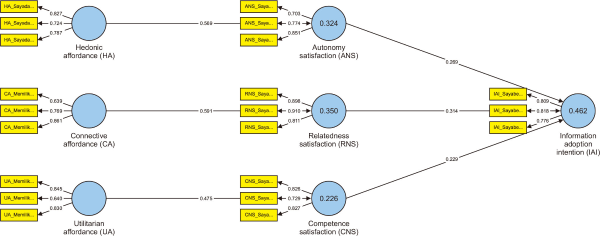
Table 4
Structural path estimates
|
Path |
β |
p-value |
Result |
|
CNS→IAI |
0.229 |
<0.001 |
Consistent with proposition |
|
ANS→IAI |
0.269 |
<0.001 |
Consistent with proposition |
|
RNS→IAI |
0.314 |
<0.001 |
Consistent with proposition |
|
UA→CNS |
0.475 |
<0.001 |
Consistent with proposition |
|
HA→ANS |
0.569 |
<0.001 |
Consistent with proposition |
|
CA→RNS |
0.591 |
<0.001 |
Consistent with proposition |
Bootstrapped significance tests were estimated in SmartPLS (SmartPLS GmbH, Monheim am Rhein, Germany) using 5,000 resamples. Because the study is exploratory and cross-sectional, the results are interpreted as theory-consistent associations rather than causal effects.
Upstream relationships also followed the expected direction. HA were positively associated with autonomy satisfaction (HA→ANS: β=0.569, p<0.001; R2 ANS=0.324), UA were positively associated with competence satisfaction (UA→CNS: β=0.475, p<0.001; R2 CNS=0.226), and CA were positively associated with relatedness satisfaction (CA→RNS: β=0.591, p<0.001; R2 RNS=0.350). In this exploratory single-account case, the observed relationships are therefore consistent with the theorized SDT-affordance pattern.
4.4. Descriptive Indirect-Effect Estimates
The conceptual model is mediational in structure because the affordances are linked to IAI through psychological need satisfaction rather than through direct affordance-to-intention paths. Using the reported standardized coefficients, the descriptive specific indirect estimates were HA→ANS→IAI=0.153, UA→CNS→IAI=0.109, and CA→RNS→IAI=0.186. The largest descriptive indirect estimate was therefore the connective-relatedness pathway.
These estimates should be interpreted cautiously. They are coefficient products calculated from the reported standardized direct paths, not fully bootstrapped mediation tests. In addition, the model should be read as an indirect-only specification. Because direct paths from hedonic, utilitarian, and CA to IAI were not estimated or compared with the indirect paths, partial mediation cannot be empirically assessed in the present study. Future research should compare indirect-only and partial-mediation models to determine whether affordances also have direct associations with adoption intention beyond psychological need satisfaction (Table 5).
Table 5
Descriptive specific indirect estimates
|
Specific indirect pathway |
Coefficient <br>product |
Interpretation |
|
HA→ANS→IAI |
0.153 |
Positive descriptive indirect estimate |
|
UA→CNS→IAI |
0.109 |
Positive descriptive indirect estimate |
|
CA→RNS→IAI |
0.186 |
Largest descriptive indirect estimate |
Coefficient products are calculated from the reported standardized direct paths and are presented descriptively. They should not be interpreted as fully bootstrapped mediation tests.
5. DISCUSSION
This study examined whether the SDT-affordance framework developed in prior SFV health-information research can help explain internship-IAI in a career-information context. The findings provide theory-consistent evidence within one internship-focused TikTok creator community. However, because the study used a cross-sectional, single-account, and convenience-sample design, the results should be interpreted as exploratory associations rather than causal effects or generalizable evidence.
RQ1 asked how SFV affordances are associated with autonomy, competence, and relatedness satisfaction in the context of internship information. The findings indicate that the three affordance-need relationships followed the expected direction. HA were positively associated with autonomy satisfaction, UA were positively associated with competence satisfaction, and CA were positively associated with relatedness satisfaction. This pattern suggests that internship-related TikTok content may support different psychological needs through different perceived action possibilities. Enjoyable presentation may help users feel more self-directed in engaging with information, clear and useful content may support their sense of competence, and interactive features may strengthen feelings of social connection within the creator community.
RQ2 asked how these psychological needs are associated with Gen Z’s intention to adopt internship information encountered on TikTok. The results show that autonomy, competence, and relatedness satisfaction were all positively associated with IAI. Relatedness satisfaction showed the strongest association with adoption intention. This suggests that users may be more willing to save, share, discuss, or act on internship information when they feel socially connected, acknowledged, or reassured. In the context of internship information, this pattern is plausible because students may face uncertainty about eligibility, deadlines, application procedures, and selection expectations. Social interaction, visible clarification, and community-based reassurance may therefore reduce uncertainty and increase users’ willingness to treat the information as actionable.
These findings suggest that the SDT-affordance framework is a useful interpretive lens for understanding internship-information adoption on TikTok. Consistent with Song et al. (2022), psychological need satisfaction was positively associated with IAI, and the three affordance families were positively associated with their theorized psychological needs. The model therefore appears to travel meaningfully from the health-information domain to a career-information domain, at least within the present creator community. Nevertheless, this should not be read as a general validation of the model. Rather, the study shows that the framework provides a coherent way to interpret one context-bound case of internship-information adoption.
The strongest downstream association was the path from relatedness satisfaction to IAI. This finding is important because internship information is not only informational, but also social and evaluative. Users may not act on internship information simply because it is available or clearly presented. They may also need reassurance that the information is credible, that others are engaging with it, and that the creator or community can help clarify uncertainty. In practical terms, comment replies, public clarification, pinned explanations, and visible peer engagement may matter as much as the vacancy information itself. These interactional cues can make internship information feel less isolated and more socially trustworthy.
The findings also provide conditional practical implications for internship-information creators and university career services. Internship communication should not focus only on posting vacancy information. It should also combine three elements: engaging presentation to sustain attention, clear and action-oriented details to support users’ sense of competence, and responsive interaction to provide social reassurance. For example, creators and career services can improve content by explaining eligibility criteria, application steps, deadlines, required documents, and common mistakes in a concise format. They can also strengthen relatedness by responding to questions, clarifying confusion in the comments, and showing that users’ concerns are recognized. However, these implications remain provisional because the study measured intention rather than verified application behavior.
The intention-behavior gap reinforces the need for caution. Although intention is an important proximal outcome, it does not always translate directly into actual behavior. Meta-analytic work shows that intention-behavior relationships are often weaker than assumed, and even meaningful changes in intention may lead to more modest behavioral change (Sheeran, 2002; Webb & Sheeran, 2006). Accordingly, the present findings suggest what may help users move toward action, but they do not demonstrate actual internship applications, interviews, selections, or placements. Future studies should therefore connect survey responses with behavioral indicators such as link clicks, saved posts, completed applications, interview invitations, or placement outcomes.
The cross-platform implications should also be treated carefully. The observed pattern may plausibly apply to adjacent SFV environments such as Instagram Reels or YouTube Shorts because these platforms also combine visual presentation, information compression, algorithmic distribution, and social interaction. However, this remains a proposition rather than an empirical conclusion. Platform norms, discoverability systems, creator credibility, institutional involvement, and cultural expectations may influence which psychological need pathway becomes most important. For example, a university career-service account may generate competence and credibility differently from an individual creator, while a peer-based creator community may generate stronger relatedness through informal interaction.
The results also raise a measurement issue that is theoretically meaningful. The borderline HTMT values for HA-RNS and HA-IAI suggest that enjoyment, social connection, and adoption intention may overlap in SFV environments. This does not invalidate the measurement model, because the Fornell-Larcker criterion and cross-loading results remained acceptable. However, it indicates that users may experience entertaining content, social bonding, and willingness to adopt information as closely connected responses. Future scale development should therefore sharpen the distinction between entertainment, social reassurance, perceived usefulness, and adoption-oriented responses. Alternative model specifications, including higher-order constructs or partial-mediation models, may also help clarify the relationship among these concepts.
Several methodological limitations should be considered when interpreting the findings. First, the cross-sectional design limits causal inference. Although the SDT-affordance framework is process-oriented, the present data were collected at one point in time and cannot establish temporal ordering or rule out reverse relationships. Second, the model is an indirect-only specification. Because direct paths from hedonic, utilitarian, and CA to IAI were not estimated, partial mediation cannot be empirically assessed. Third, all latent constructs were measured using self-report items in a single survey, creating a risk of common method variance. The VIF results provide a useful collinearity check, but they are insufficient to rule out method bias. Fourth, the PLS-SEM model did not include demographic and platform-use variables as controls, even though 18 profiling and usage items were collected for descriptive purposes. This omission may introduce omitted-variable bias if age, education, follower tenure, viewing frequency, or prior internship-seeking behavior is associated with both perceived affordances and adoption intention.
The single-account setting is the most important boundary condition of the study. The observed pattern may reflect the specific communication style, audience composition, interaction norms, and trust relationship within the @Baihaqi Hamman | Info Magang creator community. Although the account provides a relevant and information-rich setting for exploratory analysis, the findings should not be interpreted as representing all internship-information creators, all TikTok users, or Gen Z more broadly. Replication across multiple creators, platforms, and institutional career-information channels is necessary before broader conclusions can be drawn.
The practitioner-researcher context also requires caution. The focal account was both the empirical setting and the source from which respondents were recruited. This design can be valuable for exploratory and action-oriented inquiry, but it may also create risks of expectancy, selection, and interpretation bias. To reduce these risks, the survey was anonymous, the reflective measures were adapted from established prior scales rather than created ad hoc, and data-cleaning decisions followed consistent rules. Even so, future research should strengthen independence through third-party recruitment, multi-account sampling, external validation, and the use of behavioral or administrative outcomes.
Future research should extend this study in several directions. First, studies should recruit respondents across multiple creators and platforms to test whether the observed pattern remains stable beyond one creator community. Second, longitudinal designs are needed to examine whether affordances influence psychological need satisfaction over time and whether adoption intention leads to actual application behavior. Third, future studies should incorporate behavioral data, such as click-throughs, saved posts, completed applications, or application outcomes. Fourth, experimental research could test whether specific design cues, such as verified source badges, pinned clarifications, creator replies, or direct application links, strengthen competence satisfaction or relatedness satisfaction. Finally, future research should include theoretically justified control variables or multi-group analyses to examine whether the relationships differ by age, education, follower tenure, viewing frequency, or prior internship-seeking experience.
Finally, the explanatory value of this study should not be overstated through direct comparison of R2 values across studies. Cross-study R2 comparisons depend on sample composition, measurement design, model specification, platform context, and informational domain. The appropriate interpretation is not that this study outperforms earlier work, but that it shows a theoretically coherent pattern in a new career-information context. In this sense, the study contributes exploratory, context-bound evidence that can support a broader program of research on career information, SFV platforms, and motivated information adoption.
6. CONCLUSION
This study explored whether the SDT-affordance framework developed in prior TikTok health-information research can help explain internship-IAI in a career-information context. Based on one internship-focused TikTok creator community, the findings were consistent with the expected pattern. HA were positively associated with autonomy satisfaction, UA with competence satisfaction, and CA with relatedness satisfaction. Autonomy, competence, and relatedness satisfaction were also positively associated with IAI, with relatedness showing the strongest association.
This study contributes to information science by adapting the SDT-affordance framework to internship information on SFV platforms. This contribution should be understood as exploratory and context-bound rather than confirmatory. This study does not validate the framework in a general sense or establish causal relationships. Instead, it shows that the framework offers a useful interpretive lens for understanding how perceived platform affordances and psychological need satisfaction may be associated with users’ intention to adopt internship information within one creator community.
The findings also provide a starting point for broader research on career information in platform environments. This study suggests that internship information may be more adoptable when it is engaging enough to attract attention, clear enough to support users’ sense of competence, and interactive enough to provide social reassurance. Future studies should test these propositions across multiple creators, platforms, institutions, and national contexts and connect intention measures with behavioral outcomes such as saved posts, link clicks, completed applications, interviews, or internship placements. Such work would clarify whether the theory-consistent patterns observed in this exploratory case also hold in broader and more varied career-information settings.
ACKNOWLEDGMENTS
The authors would like to thank the editor-in-chief of Journal of Information Science Theory and Practice and the anonymous reviewers for their constructive and detailed feedback, which helped improve the clarity, methodological transparency, and theoretical positioning of this manuscript. The authors also gratefully acknowledge the support of the Department of Library and Information Science, Universitas Indonesia, in the development of this study. This work was supported by Universitas Indonesia under Contract No. PKS-90/UN2.RST/HKP.05.00/2025.
Appendices
APPENDIX A. REFLECTIVE MEASUREMENT ITEMS
The survey was administered in Indonesian. English glosses are provided for review transparency. All reflective items used a five-point Likert response scale, where 1=strongly disagree and 5=strongly agree.
Appendix Table A1
Reflective items
|
Construct |
Code |
Indonesian wording used in the survey |
English gloss |
|
Hedonic affordances (HA) |
HA1 |
Video informasi magang di akun ini menyenangkan untuk ditonton |
The internship-information videos on this account are enjoyable to watch |
|
HA2 |
Saya menikmati menonton video informasi magang di akun ini |
I enjoy watching internship-information videos on this account |
|
|
HA3 |
Konten akun ini membuat saya tertarik untuk terus mengikuti informasi magang |
The content on this account keeps me interested in following internship information |
|
|
Utilitarian affordances (UA) |
UA1 |
Akun ini membantu saya menemukan informasi magang yang saya butuhkan |
This account helps me find the internship information that I need |
|
UA2 |
Informasi magang di akun ini jelas dan mudah dipahami |
The internship information on this account is clear and easy to understand |
|
|
UA3 |
Konten akun ini membantu saya mempelajari detail yang penting untuk mengambil keputusan |
The content on this account helps me learn details that matter for making decisions |
|
|
Connective affordances (CA) |
CA1 |
Fitur di akun ini memudahkan saya berkomunikasi dengan kreator atau pengguna lain |
The features on this account make it easy for me to communicate with the creator or other users |
|
CA2 |
Komentar, balasan, atau pesan membantu saya meminta pendapat orang lain tentang informasi magang |
Comments, replies, or messages help me ask other people’s opinions about internship information |
|
|
CA3 |
Interaksi di akun ini membantu saya memperoleh klarifikasi atau tambahan informasi magang |
Interaction on this account helps me obtain clarification or additional internship information |
|
|
Autonomy need satisfaction (ANS) |
ANS1 |
Saya merasa bebas memilih informasi magang mana yang ingin saya baca atau tonton |
I feel free to choose which internship information I want to read or watch |
|
ANS2 |
Saya merasa keputusan untuk menggunakan informasi magang dari akun ini adalah pilihan saya sendiri |
I feel that using internship information from this account is my own choice |
|
|
ANS3 |
Saya merasa tidak terpaksa ketika menggunakan informasi magang dari akun ini |
I do not feel pressured when I use internship information from this account |
|
|
Competence need satisfaction (CNS) |
CNS1 |
Saya merasa mampu memahami informasi magang yang disampaikan akun ini |
I feel capable of understanding the internship information provided by this account |
|
CNS2 |
Saya merasa yakin dapat menggunakan informasi dari akun ini untuk mengambil keputusan |
I feel confident that I can use information from this account to make decisions |
|
|
CNS3 |
Informasi dari akun ini membuat saya merasa lebih siap untuk bertindak |
Information from this account makes me feel more prepared to act |
|
|
Relatedness need satisfaction (RNS) |
RNS1 |
Saya merasa dekat dengan orang-orang yang berinteraksi di akun ini |
I feel close to the people who interact on this account |
|
RNS2 |
Saya merasa dipedulikan oleh kreator atau pengguna lain di akun ini |
I feel cared for by the creator or other users on this account |
|
|
RNS3 |
Saya merasa menjadi bagian dari komunitas yang saling membantu di akun ini |
I feel that I am part of a community that helps one another on this account |
|
|
Information-adoption intention (IAI) |
IAI1 |
Saya berniat menggunakan informasi magang dari akun ini ketika mencari peluang magang |
I intend to use internship information from this account when looking for opportunities |
|
IAI2 |
Saya berniat menyimpan atau membagikan informasi magang dari akun ini |
I intend to save or share internship information from this account |
|
|
IAI3 |
Saya berniat melamar peluang magang yang saya temukan melalui akun ini |
I intend to apply for internship opportunities that I find through this account |
APPENDIX B. PROFILING AND PLATFORM-USE ITEMS
The remaining non-latent items were used for descriptive profiling rather than as reflective indicators in the structural equation modeling (SEM) model. They are reported here to improve transparency regarding the questionnaire structure and to clarify that these variables were not included as control variables in the PLS-SEM analysis.
Appendix Table B1
Profiling and platform-use domains
|
Item |
Profiling or usage domain |
Response format |
Purpose |
|
P1 |
Age |
Open numeric or year-based |
Demographic profile |
|
P2 |
Gender |
Categorical |
Demographic profile |
|
P3 |
Highest educational attainment |
Categorical |
Demographic profile |
|
P4 |
Current study or work status |
Categorical |
Profile of respondent context |
|
P5 |
Province or city of residence |
Categorical or open field |
Geographic description |
|
P6 |
Main current career stage |
Categorical |
Profile of respondent context |
|
P7 |
Whether currently seeking an internship |
Yes or no |
Screening and context |
|
P8 |
Whether also seeking jobs or freelance opportunities |
Yes or no or multiple choice |
Search context |
|
P9 |
Length of following the focal account |
Categorical |
Follower tenure |
|
P10 |
Frequency of viewing the creator’s posts |
Ordinal |
Exposure level |
|
P11 |
Main type of information sought from the account |
Multiple choice |
Information need |
|
P12 |
Whether the respondent has saved posts from the account |
Yes or no |
Engagement behavior |
|
P13 |
Whether the respondent has shared posts from the account |
Yes or no |
Engagement behavior |
|
P14 |
Whether the respondent has clicked external links or link-in-bio resources |
Yes or no |
Action-oriented engagement |
|
P15 |
Number of internship applications made from the creator’s posts |
Categorical count |
Behavioral self-report |
|
P16 |
Whether any application led to follow-up contact or interview |
Yes or no |
Behavioral self-report |
|
P17 |
Primary source of career advice |
Multiple choice |
Comparison with other sources |
|
P18 |
Other platforms used for career or internship information |
Multiple choice or open field |
Media ecology context |
REFERENCES
, , (2016) Y and Z generations at workplaces Journal of Competitiveness, 6(3), 90-106, https://doi.org/10.7441/joc.2016.03.06 .
CNN Indonesia Nadiem encourages students to intern at companies and community organizations, 2021, https://www.cnnindonesia.com/nasional/20210122160750-20-597259/nadiem-dorong-mahasiswa-magang-di-perusahaan-hingga-ormas, Indoneisan
, (1987) The support of autonomy and the control of behavior Journal of personality and social psychology, 53(6), 1024-1037, https://doi.org/10.1037//0022-3514.53.6.1024 .
, (1981) Evaluating structural equation models with unobservable variables and measurement error Journal of Marketing Research, 18(1), 39-50, https://doi.org/10.2307/3151312 .
, ‘True gen’: Generation Z and its implications for companies, 2018, https://www.mckinsey.com/industries/consumer-packaged-goods/our-insights/true-gen-generation-z-and-its-implications-for-companies
, , , (2014) Partial least squares structural equation modeling (PLS-SEM): An emerging tool in business research European Business Review, 26(2), 106-121, https://doi.org/10.1108/ebr-10-2013-0128 .
, , (2016) Using PLS path modeling in new technology research: Updated guidelines Industrial Management & Data Systems, 116(1), 2-20, https://doi.org/10.1108/imds-09-2015-0382 .
, , (2015) A new criterion for assessing discriminant validity in variance-based structural equation modeling Journal of the Academy of Marketing Science, 43(1), 115-135, https://doi.org/10.1007/s11747-014-0403-8 .
, (2023) Finding home in online community: Exploring TikTok as a support for gender and sexual minority youth throughout COVID-19 Journal of LGBT Youth, 20(4), 800-817, https://doi.org/10.1080/19361653.2021.2009953 .
(2015) Common method bias in PLS-SEM: A full collinearity assessment approach International Journal of e-Collaboration, 11(4), 1-10, https://doi.org/10.4018/ijec.2015100101 .
(2024) Research on “uses and gratifications” of TikTok users Communications in Humanities Research, 38(1), 46-49, https://doi.org/10.54254/2753-7064/38/20240147 .
, , , , , , (2012) Self-determination theory applied to health contexts: A meta-analysis Perspectives on Psychological Science, 7(4), 325-340, https://doi.org/10.1177/1745691612447309 .
Gen Z is dominant, what does it mean for our education?, 2021, https://pskp.kemendikdasmen.go.id/gagasan/detail/gen-z-dominan-apa-maknanya-bagi-pendidikan-kita, Indonesian
, , , (2024) TikTok short video marketing and Gen Z’s purchase intention: Evidence from the cosmetics industry in Singapore Journal of Asia Business Studies, 18(4), 930-945, https://doi.org/10.1108/jabs-04-2023-0138 .
, (2020) Intrinsic and extrinsic motivation from a self-determination theory perspective: Definitions, theory, practices, and future directions Contemporary Educational Psychology, 61, 101860, https://doi.org/10.1016/j.cedpsych.2020.101860 .
, (2013) Personal ICT ensembles and ubiquitous information systems environments: Key issues and research implications Communications of the Association for Information Systems, 33(1), 381-392, https://doi.org/10.17705/1CAIS.03322 .
(2002) Intention—behavior relations: A conceptual and empirical review European Review of Social Psychology, 12(1), 1-36, https://doi.org/10.1080/14792772143000003 .
, , , , (2021) Short video apps as a health information source: An investigation of affordances, user experience and users’ intention to continue the use of TikTok Internet Research, 31(6), 2120-2142, https://doi.org/10.1108/intr-10-2020-0593 .
, , , , (2022) Serious information in hedonic social applications: Affordances, self-determination and health information adoption in TikTok Journal of Documentation, 78(4), 890-911, https://doi.org/10.1108/jd-08-2021-0158 .
, (2013) Critical realism and affordances: Theorizing IT-associated organizational change processes MIS Quarterly, 37(3), 819-834, https://doi.org/10.25300/misq/2013/37.3.07 .
, , , (2016) Discriminant validity testing in marketing: An analysis, causes for concern, and proposed remedies Journal of the Academy of Marketing Science, 44(1), 119-134, https://doi.org/10.1007/s11747-015-0455-4 .
, (2006) Does changing behavioral intentions engender behavior change? A meta-analysis of the experimental evidence Psychological Bulletin, 132(2), 249-268, https://doi.org/10.1037/0033-2909.132.2.249 .
, (2013) Effects of extrinsic and intrinsic motivators on using utilitarian, hedonic, and dual-purposed information systems: A meta-analysis Journal of the Association for Information Systems, 14(3), 153-191, https://doi.org/10.17705/1jais.00325 .
, , (2024) Engaging with branded content on short-video sharing apps: How motivations affect attitude toward branded content, brand experience, and relationship quality Journal of Interactive Advertising, 24(3), 215-237, https://doi.org/10.1080/15252019.2024.2325410 .
25,952 Students joined certified internships & independent study batch 4, here are the benefits, 2023, https://www.detik.com/edu/perguruan-tinggi/d-6577233/25952-mahasiswa-ikut-magang--studi-independen-bersertifikat-4-ini-manfaatnya, Indonesian
(2008) Technical opinion: Motivational affordances: Reasons for ICT design and use Communications of the ACM, 51(11), 145-147, https://doi.org/10.1145/1400214.1400244 .
, , , (2013) Conceptualizing perceived affordances in social media interaction design Aslib Proceedings, 65(3), 289-303, https://doi.org/10.1108/00012531311330656 .
, , , (2020) Affordances for information practices: Theorizing engagement among people, technology, and sociocultural environments Journal of Documentation, 77(1), 229-250, https://doi.org/10.1108/JD-05-2020-0078 .