1. INTRODUCTION
Indonesia, as a country with high religious diversity, faces complex challenges in maintaining social harmony amid the threat of terrorism targeting places of worship. The suicide bombing that occurred at Makassar Cathedral on Palm Sunday, March 28, 2021, was a form of violence that shocked the Indonesian public and sparked intense public discourse in various mass media. The tragedy, which killed the two perpetrators and injured dozens of churchgoers and security officers, became the primary focus of national and international news coverage. In the context of a religiously diverse country such as Indonesia, a terrorist act targeting a place of worship not only has security implications but also has the potential to affect the dynamics of interfaith relations that have been carefully built up over time.
The mass media, as the primary agent in the distribution of information, have a strategic role in framing and narrating these events to the public. The way the media frames violent events related to religious issues can influence how the public interprets, understands, and responds to these events. However, the practice of framing terrorism news is often caught in a dilemma between commercial interests, news value, and ethical responsibility. This phenomenon becomes more complicated when the media must balance transparency of information with the potential negative impact on public perception of certain religious groups.
In the context of the attack on the Makassar Cathedral Church, the Indonesian media faced a particular challenge because this event targeted a place of worship for a minority in a Muslim-majority country. The way the media frames this event not only influences public perceptions of terrorism but can also have an impact on interfaith relations and long-term social stability.
Although there have been studies on the framing analysis of the bomb explosion at Makassar Cathedral Church (Anipar & Rachmaria, 2022), no study has yet compared the framing of popular media in Indonesia. Previous studies have only analyzed framing in one popular Indonesian press outlet and used a different model, namely Robert N. Entman’s. This gap is essential to fill, considering that the Makassar Cathedral incident is not an isolated case in the history of terrorism in Indonesia.
Based on this background, the main issues of this study are how the popular Indonesian media outlets Detik.com and Kompas.com framed the Makassar Cathedral bombing and what the potential social impacts of these framing strategies are on public perception and interfaith relations. This study examines two crucial dimensions: first, the framing patterns used by the media in presenting the incident, and second, the social consequences of these framing choices on the harmony of diversity in Indonesia. This research is also necessary considering the sensitivity of issues involving religious dimensions in the context of Indonesia’s multicultural society. An in-depth study of how the media frames this incident can reveal possible biases in news presentation.
This study aims to understand how news media framing in Indonesia operates in the context of sensitive issues such as terrorism and religion. Furthermore, this study is expected to provide an understanding of how Indonesian journalism practices deal with sensitive religious problems and reveal the potential impact of various framing strategies on public perceptions and social stability.
From an academic perspective, this study contributes to understanding the role of the media in situations of conflict and violence within contemporary Indonesian society. While much research on media framing has been conducted in Western contexts (Ahmed & Matthes, 2017; Lewis & de Masi, 2007; McGarry et al., 2023; Norris et al., 2004; Powell, 2018), there is still a knowledge gap regarding how media in a Muslim-majority country with high religious diversity such as Indonesia frames terrorist events targeting religious minorities.
2. LITERATURE REVIEW
2.1. Media Bias
Media bias is defined as favoritism and unfair reporting toward specific points of view. We can see media bias through information that is deliberately selected in news reports that have the potential to influence public opinion. In addition, media bias can also take the form of labeling certain entities with ambiguous terms in concepts that carry positive or negative associations (Domke et al., 1999; Fan et al., 2019).
Media bias can spread through framing that emphasizes certain aspects and ignores others, which then influences public perception and understanding of an issue (Fiveable Content Team, 2025). The impact of media bias on public opinion goes far beyond mere division. When news media consistently present biased narratives, they reinforce the pre-existing beliefs and ideologies held by their audience. This divisive climate makes it even more challenging to find common ground and collectively address pressing issues, ultimately perpetuating social divisions.
In the news, we can see media bias through the information chosen for reporting. The media chooses topics to frame with a bias toward events that attract attention (Price et al., 1997). Studies in the United States have identified that when perpetrators of violence are Muslims, it will be framed as an act of terrorism (Mitnik et al., 2020; Powell, 2011). In contrast, when the perpetrators of violence are white, the United States government refuses to label it as an act of terrorism, and this affects how the media reports it (Betus et al., 2021). This bias can shape public sentiment about Muslims and public perceptions of terrorism (Betus et al., 2021).
In some literature, media bias is conceptualized as intentional (Hamborg et al., 2019), but there is also unintentional and unavoidable media bias because bias is a natural human condition (Elejalde et al., 2017; Kang & Yang, 2022). Unintentional media bias usually depends on the background of journalists who do not make a concerted effort to understand other points of view, thus constantly involving personal views that influence news reports (Bozell & Baker, 1990).
2.2. Media Construction of Reality
Today, the media plays an essential role in distributing information and shaping public opinion, acting as a link between facts and the perceptions of the wider community. This role requires a more comprehensive examination. The urgency of examining the media stems from its remarkable capacity to shape our thinking and understanding of the world, as well as its role as the primary reference for concepts and perspectives. The media is also capable of influencing a person’s conduct and perspective. This power is even more evident when the media is used for various agendas. The media is often used as a means of propaganda to shape public opinion according to the will of political rulers. Therefore, media analysis is essential to expose the tendencies and forces that drive the production of news and information (Burton, 1993; Herman & Chomsky, 1988).
The media presents an incomplete, biased picture of reality that often contradicts the issues faced by modern society. Therefore, news is more accurately understood as a product of social construction rather than an objective reflection of reality (Nišić & Plavšić, 2017; Yan, 2020). The media functions as a forum for discourse that contributes to the development of a collective understanding of life and essential values, while also determining standards for what is considered right or wrong, constructive or destructive (Kellner, 2020). The influence of the media on a person’s perspective begins with the reality constructed by the media into journalistic products. The journalistic products presented do not fully describe empirical truth or the actual situation as it is (Tuchman, 1978).
Previous studies have found that negative news coverage against certain religious groups, especially Islam, is widespread in the media. They found that the steering of public opinion was caused by negative news construction, which can reinforce stereotypes that lead to discrimination and social injustice (Ahmed, 2012; Ahmed & Matthes, 2017; Bleich & Van der Veen, 2022; Norris et al., 2004; Saeed, 2003; 2007). News coverage of Islam and Muslims often uses inaccurate terms, such as jihadists, terrorism, and Islamic extremism, which are usually applied without a proper explanation of their meaning.
Academic studies in the West confirm similar findings by investigating the sources of Islamophobia through studies of the representation of Islam and Muslim communities in the news media. The media in Western countries tends to highlight Islam and create stereotypes of Muslims associated with terrorism and violence (Moore et al., 2008; Saeed, 2007; Törnberg & Törnberg, 2016; Yusof et al., 2013).
2.3. Media and Terrorism
In the context of covering terrorist acts, the media is in a vital but dilemma-filled situation. The media has an obligation to disseminate information to the public. However, the way the media constructs reality often creates narratives that contain Islamophobia and prejudice, which can then influence public perception of Muslims. The media’s attention to the link between terrorism and Muslims appears to be unbalanced. The media has correctly reported that acts of terrorism committed in the name of Islam by extremists stem from a distorted understanding of jihad and Islamic teachings. However, this coverage often leads to the creation of stories that generalize Muslims as a whole.
Negative representations of Islam and Muslims in Western media are not a new phenomenon. Negative reporting on Islam and Muslims existed before the events of September 11, 2001 (9/11) (Manning, 2003; Norris et al., 2004). However, this issue resurfaced after 9/11, where several studies have revealed that Western media coverage of Islam and Muslims tends to be negative and emphasizes stereotypes, discrimination, and portrayals of violence as religiously justified, and consistently associates Islam and Muslims with terrorism, placing them in an unfavorable position. The Western media’s efforts initially focused on Muslim groups accused of being responsible for the September 11 attacks, and ultimately hurt the entire Muslim community worldwide (Alghamdi, 2015; Aly, 2007; Gerges, 2003; Richardson, 2001; Semati, 2010; Shahin, 2015; Tama & Sulistyaningrum, 2023; Winegar, 2008).
Media and terrorism have a symbiotic relationship (Akbarzadeh & Smith, 2005). Terrorism can become news with an appeal to the media that cannot be ignored or denied (Amanda Gelgel, 2020; Miller, 1982). Terrorists in turn use the media to showcase their acts of terror (Douai & Lauricella, 2014).
In relation to Indonesia, it is essential to examine how the media reports on terrorism issues, given the impact this can have on shaping public perceptions of group and national identity. A series of bombings has occurred in Indonesia, both large and small, such as the Bali bombings (2002), the JW Marriot Hotel bombing (2003), the Australian Embassy bombing (2004), the Jimbaran/Bali II bombing (2005), the JW Marriot II and Ritz Carlton bombing (2009), and the Sarinah bombing (2016), which have made Indonesia the subject of media coverage around the world. The Australian media, namely the Herald Sun and The Age, have shown how Islam has become synonymous with terrorism. The global narrative about Islam after 9/11 was promoted and reinforced by the Bali bombings. Negative views of Islam were reinforced when the Australian media explicitly linked the bombings to Islam as a monolithic entity. The linking of the attacks in New York and Bali was based on the belief in a worldwide Muslim fundamentalist conspiracy against the “West.” The Bali bombings, as portrayed in the Australian media, became a signal for Australia to support the American discursive strategy of the “War on Terror” (Hirst & Schutze, 2004; Lewis & de Masi, 2007).
Several media outlets in Indonesia used different perspectives in reporting on the terrorist attacks. Some of these studies focused on positive framing, namely building a discourse against terrorism but emphasizing the use of non-provocative words, while others assessed the attacks from a religious perspective and associated Muslims and Islam with these acts (Amanda Gelgel, 2020; Istriyani, 2016; Krissa, 2016).
In relation to Indonesia, studies on how the media communicates the issue of terrorism are of high urgency, given the effect it can have on influencing the public’s view of religious communities and national identity. Indonesia, as a country with great religious diversity, offers a unique context for exploring these dynamics.
3. RESEARCH METHODOLOGY
In the landscape of contemporary communication and media research, choosing the correct analytical method is fundamental to producing valid and meaningful findings. Gamson and Modigliani’s framing analysis model has emerged as indispensable for understanding how the media constructs social and political reality through the process of framing news and information.
The fundamental advantage of Gamson and Modigliani’s model lies in its conceptualization of frames as “central organizing ideas for making sense of relevant events, suggesting what is at issue” (Gamson & Modigliani, 1989). This definition provides operational clarity that allows researchers to identify with precision how the media organizes narratives around specific issues. This model provides a concrete and systematically applicable analytical structure.
In a methodological context, Gamson and Modigliani’s model offers a holistic framework by integrating various elements of framing, including metaphors, exemplars, catchphrases, depictions, and visual images (Eriyanto, 2002). This comprehensive approach allows researchers to capture the complexity of the framing process, which cannot be reduced to mere textual analysis. Each element in this model is interrelated and contributes to the formation of a complete interpretive package, providing a more comprehensive picture of how the media constructs meaning.
The objects of this study are the top two Indonesian online media outlets with the most readers in 2024 (Similarweb, 2025). We collected news articles through the search pages on both news portals using the category “suicide bombing of Makassar Cathedral.” A total of 55 news articles were collected: 30 from Detik.com and 25 from Kompas.com. The news articles were collected from within five days, from March 28 to April 1, 2021, because news from that period became repetitive, with different headlines but duplicate content from earlier reports.
After collecting the news articles, the authors analyzed them using the Gamson and Modigliani model, which consists of two types of devices: framing devices (metaphors, exemplars, catchphrases, depictions, and visual images) and reasoning devices (roots and appeals to principle). The news articles were then classified according to device category. This study did not involve multiple coders because the data collected was on a small scale and relied solely on detailed documentation of each news article. In addition, peer debriefing was conducted with the supervisor.
This study used several screenshots from news articles on Detik.com and Kompas.com as primary data. The use of this visual material is based on the principle of fair use in the context of academic research, with several considerations: The material is used solely for academic research purposes, not for commercial purposes, and the screenshots are taken from news content published openly for public consumption. Only the relevant and necessary parts for analysis are used, not the entire content.
4. RESULTS AND DISCUSSION
According to an in-depth analysis of all the framing elements used by the two online media outlets studied, it was revealed that both outlets had a particular and structured framing focus.
4.1. Detik.com
4.1.1. Metaphors
Detik.com uses various powerful metaphors to dramatize the explosion at the Makassar Cathedral. The metaphor “honeymoon” suggests that the husband and wife who carried out the suicide bombing considered the suicide bombing to be their honeymoon as newlyweds, which was then used as the headline for the March 31, 2021 edition.
In addition, metaphors can also be seen in the statement made in the March 29, 2021 edition, which stated that the propaganda of the terrorist network obtained by the perpetrators of the explosion was like a “Batman trap” whose doctrine was imperceptible and invisible, but could change a person’s character and behavior of tolerance.
The phrase “damages tolerance” describes the implications of attacks on religious harmony, providing a visual impression of damage to the social order, particularly the established religious harmony. This can be seen in the statement by the United States Embassy reported in the article in the March 29, 2021 edition.
4.1.2. Catchphrases
The phrase “Becoming an International Spotlight” can attract readers’ attention because the event was covered not only by national media but also by several international outlets, making it a concern for people in other countries. This can be seen in the title of the Detik article published on March 29, 2021, entitled “Suicide Bombing in Makassar Becomes International Spotlight.”
In addition, the phrase “522nd Terrorist Attack in Indonesia” is also interesting because it creates a dramatic image that terrorist incidents have occurred frequently and repeatedly in Indonesia. The phrase can be seen in the headline “Deputy V KSP Calls Makassar Bombing the 522nd Terrorist Attack in Indonesia Since 2000” in the March 29, 2021 edition. The phrase “Female Bomber Was Pregnant” also attracts readers’ attention because it reveals the fact that the female perpetrator was pregnant when she carried out the suicide bombing. This phrase can be seen in the headline “New Facts Revealed About Makassar’s Female Bomber Who Was Pregnant,” published on March 31, 2021.
4.1.3. Exemplars
Detik.com linked this incident to similar events that had occurred previously, such as the 2002 Bali bombings and the 2018 church bombings in Surabaya. Detik.com compared the Makassar bombing to the Bali bombings, which were carried out by members of the Jamaah Islamiyah organization, which did not allow children and women to be involved in the bombings. This is in contrast to the Makassar and Surabaya bombings, which were initiated by Jamaah Ansharut Daulah (JAD) and involved children and women. This is evident in the statement by terrorism expert Ridwan Habib from the University of Indonesia, as reported in the article published on March 31, 2021.
Detik.com also linked this incident to several other bombings carried out by other married couples. This link created a narrative pattern of terrorism as a recurring threat. This can be seen in the March 30, 2021 edition with the headline “A Series of Suicide Bombings Carried Out by Married Couples.”
In addition, another reference is the statement by the Head of National Counterterrorism Agency (Badan Nasional Penanggulangan Terorisme; BNPT), Komjen Boy Rafli Amar, in the March 29, 2021 edition, which stated that the virus of radicalism often targets young people in the millennial category. This was identified from the birth dates of the two bombers, who were born in 1995 and belong to the millennial generation, which has become a characteristic of victims of terrorist networks propaganda. This feature is also reinforced by a statement from the Deputy Chairman of the National Awakening Party, Jazilul Fawaid, in an article published on March 30, 2021, titled “The Makassar Bombers are Millennials, We Often Miss Them,” which states that an evaluation is needed regarding counterterrorism efforts, particularly among millennials, who are the primary targets for infiltration by deviant doctrines.
4.1.4. Depictions
In its depiction of the parties involved, Detik.com has a clear pattern. The perpetrators are described with negative words such as “bomber couple” in every news report because, as is known, the perpetrators were indeed a married couple who had only been married for six months and were exposed to radical ideology and became part of the JAD group. In addition, Detik.com also labeled the perpetrators of the bombing as “millennial bombers.” This can be seen in the March 30, 2021 edition with the headline “Millennial Makassar Bombers.” This explains that both perpetrators were born in 1995 and fall into the millennial category.
In addition, Detik.com also gave a positive portrayal of the police, who were considered quick to handle the case. This is evidenced by several news articles revealing the arrest of several suspected terrorists involved in the suicide bombing in Makassar, only three days after the incident occurred. This can be seen from several news headlines, such as “Densus 88 Arrests Another Person, Bringing the Total to 8 Suspected Terrorists Arrested in Makassar” on March 31, 2021, “16 Suspected Terrorists Arrested in Makassar, All Helped the Bomber Couple” published on April 1, 2021, and “After the Makassar Bombing, Police Arrest 32 Terrorist Suspects in Several Areas,” which was published on April 1, 2021.
Another positive portrayal was the emphasis on the human side of the Indonesian National Armed Forces (Tentara Nasional Indonesia, TNI)-Indonesian National Police (Polri) security forces. The positive portrayal can be seen in the news article “TNI Commander and National Police Chief Visit Victims of Makassar Suicide Bombing.” In addition, there was news of an offer from the National Police Chief to the child of a victim who tried to stop the suicide bomber to become a police officer in the news article “National Police Chief Offers Kosmas’ Child, Who Stopped the Makassar Bomber, a Position in the Police Force,” published on March 31, 2021.
4.1.5. Visual Images
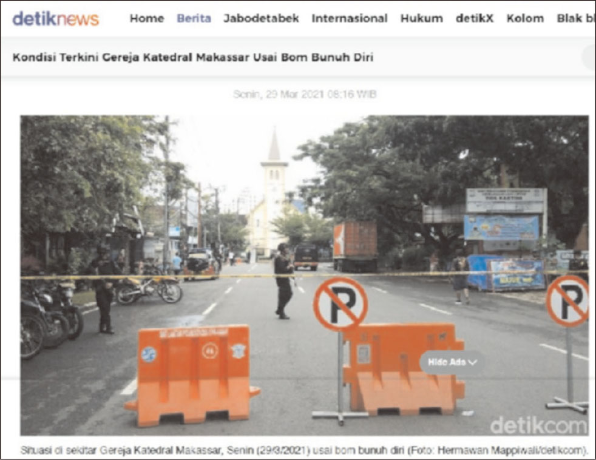
Detik.com utilizes visual power to reinforce framing. The article “Current Condition of the Cathedral Church After the Suicide Bombing” is accompanied by photos of damage to the church gate with police tape, emphasizing the reality and physical impact of the attack (Fig. 1) (Mappiwali, 2021b).
Fig. 1
Situation around Makassar Cathedral Church. Reused from Mappiwali (2021b) with permission of detikcom.
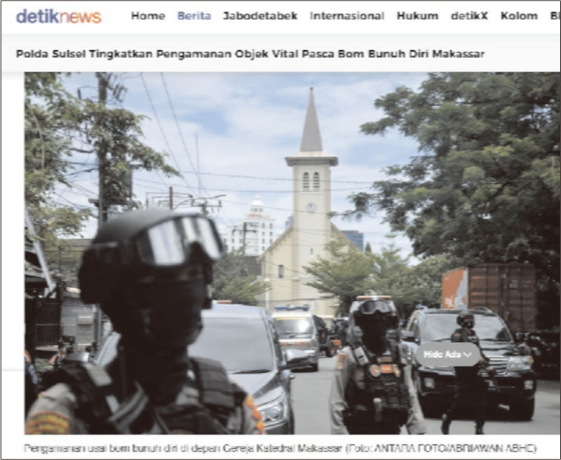
The article “South Sulawesi Regional Police Increase Security at Vital Objects After Makassar Suicide Bombing” shows fully armed Brimob personnel on standby, conveying a message about the state’s serious response to the incident (Fig. 2) (Mappiwali, 2021a).
Fig. 2
Security after the suicide bombing at Makassar Cathedral Church. Reused from Mappiwali (2021a) with permission of detikcom.
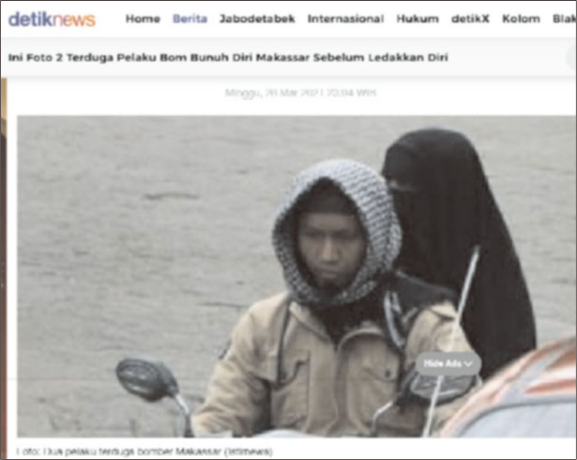
Interestingly, Detik.com displays photos of the two perpetrators riding a motorcycle wearing distinctive clothing. The man wears a cap and turban, while the woman wears a veil and an ample hijab that covers her entire body. This indicates the religious identity of the two perpetrators, who were Muslims in the CCTV images (Fig. 3) (Mappiwali, 2021c).
Fig. 3
Visual image of the perpetrator of the Makassar Cathedral Church Bombing. Reused from Mappiwali (2021c) with permission of detikcom.
4.1.6. Roots
Detik.com consistently points to the root causes of extremist ideology and terrorist networks. Detik explains that the reckless actions of the perpetrators of the bombing at Makassar Cathedral Church were due to their jihadist doctrine and belief that they would die as martyrs by carrying out suicide bombings. This can be seen from the news about the suicide note left by one of the perpetrators of the bombing, which was reported in the March 29, 2021 edition at 15:14 Waktu Indonesia Barat-West Indonesian Time with the title “Makassar Suicide Bomber Leaves Suicide Note Ready to Die as Shahid” and the news on March 30, 2021, which reported the arguments of former terrorist convicts regarding the motives of the Makassar bombers.
Another cause raised is online radicalization, as in the article “BNPT Suspects Makassar Bomber Couple Learned to Make Bombs Online.” The article explains that the two perpetrators participated in online bomb-making training organized by a radical group whose members had been trained in various countries.
4.1.7. Appeals to Principle
Detik.com emphasizes moral values such as unity and tolerance. In the article “Majelis Ulama Indonesia (The Indonesian Ulema Council) Central Java on the Attack in Makassar-Police Headquarters: Terrorism Destroys Ukhuwah,” Detik quotes a statement from the Chairman of the Indonesian Ulema Council of Central Java, Ahmad Darodji: “The Prophet taught Islam in a peaceful manner, how to be tolerant of Jews, Christians, and other religions. The Prophet set an example, so why not follow the Prophet?” In addition, another moral claim explained is that acts of terrorism are not related to any religion, as in the article “Vice President Ma’ruf Amin: Terrorism Has Nothing to Do with Religion.” This is also reinforced in an excerpt from a news article published on March 29, 2021: “Jokowi said that terrorism is a crime against humanity that is not related to any religion.” This statement separates acts of terror from religion and prevents stigmatization.
4.1.8. Consequences
Detik.com describes the various consequences of the attack. One of them is strengthening security in several regions of Indonesia to prevent a recurrence. In the articles “Bali Police Tighten Port Security After Suicide Bombing in Makassar” and “After Makassar Suicide Bombing, Semarang Airport Tightens Security,” the national impact of a local event is shown.
The international impact is also highlighted in the articles “US Embassy Warns Citizens Due to Makassar Bombing in Indonesia” and “Foreign Media Highlights Suicide Bombing in Makassar, Manila Lockdown.” This emphasizes the consequences of a country’s damaged image in the eyes of the international community due to terrorism (Table 1).
Table 1
Framing analysis results (Detik.com)
|
Framing devices |
Reasoning devices |
||
|
Metaphors |
Blasting action as the month of honey; radicalism like a Batman’s trap |
Roots |
Terrorism network, extremist ideology, and radicalism online |
|
Catchphrases |
International attention, 522nd terrorist act, young pregnant female bomber |
Appeals to principle |
Terrorism destroys ukhuwah (unity), and terrorism is not related to any religion |
|
Exemplars |
The Bali bombing was carried out by members of Jamaah Islamiyah, who did not involve women and children; there were several suicide bombings carried out by married couples; Makassar bombers were millennials |
Consequences |
Strengthening security in several regions in Indonesia is in the international spotlight |
|
Depictions |
The perpetrator(s) as a married millennial couple, and the police as a swift and humane party |
||
|
Visual images |
Church building with tight security by police officers, and a photo of the faces of the two perpetrators in typical Muslim clothing |
||
4.2. Kompas.com
4.2.1. Metaphors
The metaphor that can be seen in the issue of the bomb explosion at the Makassar Cathedral Church reported by Kompas.com is the phrase “selling paradise.” The phrase is a statement from Jusuf Kalla, the Chairman of the Indonesian Mosque Council, in a news article published on March 29, 2021. The article revealed that the suicide bombing at the Makassar Cathedral Church occurred because there were people who “sold paradise” through the doctrine that suicide bombing was an act of jihad, whereby death guaranteed entry into paradise. In addition, there was also the metaphorical phrase “angkara murka” (wrathful anger). In the March 29, 2021 edition, the suicide bombing was likened to wrath because suicide bombing is an act of violence in the form of killing fellow human beings. This occurred in a statement from Jaya Suprana, founder of the Humanitarian Learning Center, with the news headline “Stop the Wrath of Suicide Bombings.”
4.2.2. Catchphrases
The prominent sentence or phrase in Kompas’ news about the bombing of the Makassar Cathedral Church is found in the news headline “Grief on Palm Sunday,” in the March 29, 2021 edition. This refers to the timing of the incident, which coincided with Palm Sunday celebrations for Christians, which turned into grief due to the suicide bombing at the cathedral church.
4.2.3. Exemplars
In an effort to provide historical context and build a more comprehensive narrative, Kompas.com linked this incident to similar events such as the bombing on the island of Jolo, Philippines, in 2018. That bombing was also carried out by a married couple, as was the case at the Makassar Cathedral Church. The Makassar perpetrators were suspected of being affiliated with a group that had previously carried out the operations in Jolo. This can be seen in the March 28, 2021 edition with the headline “Suicide Bombers at Cathedral Church Affiliated with Terrorist Actions in the Philippines,” and the March 29, 2021 edition, with the headline “Makassar Suicide Bombers Linked to JAD Network that Previously Operated in Jolo, Philippines.”
4.2.4. Depictions
Kompas.com has a clear pattern in describing the various parties involved in the incident. The perpetrators are consistently described as “terrorists affiliated with a certain network,” which creates the impression that the attack was organized and had a specific ideological motive. This can be seen in the March 28, 2021 edition with the headline “Suicide Bomber at Cathedral Church Affiliated with Terrorist Action in the Philippines,” the March 29, 2021 edition with the headline “Makassar Suicide Bombers Belong to JAD Network that Previously Carried Out Attacks in Jolo, Philippines,” and the March 29, 2021 edition with the headline “Makassar Suicide Bombers Were Married by Terrorist Suspect Who Died Last January.”
Kompas.com also gave a positive portrayal of church security as “heroes” for their heroic actions in preventing a greater number of casualties. The security personnel attempted to stop the suicide bomber. This can be seen in the March 29, 2021, edition with the headline “Becoming a Hero: The Story of Kosmas, the Makassar Cathedral Church Security Guard Who Stopped the Suicide Bomber.”
4.2.5. Visual Images
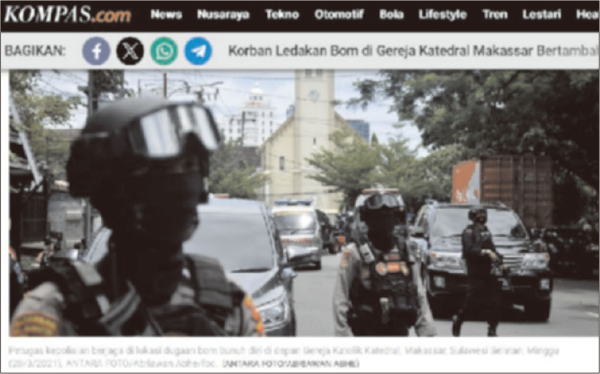
Visual components are an important element in the framing done by Kompas.com. The photos displayed generally show the damage to the church, providing visual evidence of the physical impact of the attack. Images of security forces on standby around the location are also often displayed, showing the state’s response to the threat (Figs. 4 and 5) (Himawan & Gabrillin, 2021; Kamil & Krisiandi, 2021).
Fig. 4
Photographs of the church site and damage. Reused from Kamil and Krisiandi (2021) with permission of KOMPAS.com.
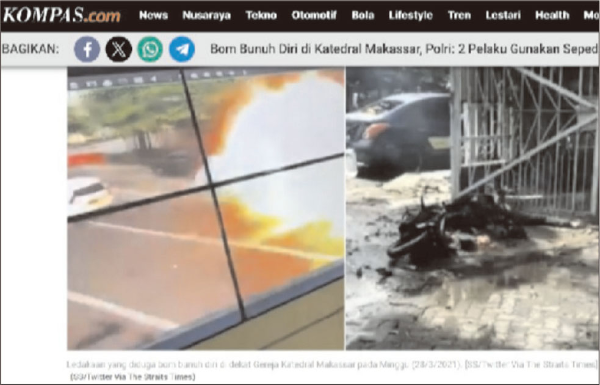
Fig. 5
Photograph of security forces on standby near Makassar Cathedral Church. Reused from Himawan and Gabrillin (2021) with permission of KOMPAS.com.
Interestingly, Kompas.com has a policy of not displaying photos of victims and perpetrators, demonstrating journalistic ethics that respect the privacy and dignity of those involved and affected by traumatic events. This is reinforced by the news report in the March 28, 2021 edition, which advises against disseminating photos or videos of the perpetrators and victims under the headline “Explosion at Makassar Cathedral Church—Mayor Danny: Do Not Upload Photos and Videos.” Additionally, this can also be seen in the news article published on March 28, 2021, titled “Ministry of Communication and Information Technology Urges Netizens Not to Upload Videos of Suicide Bombing in Makassar.”
4.2.6. Roots
In analyzing the root causes of the incident, Kompas.com consistently emphasized radicalism and intolerance as the leading root causes of the suicide bombing. Their reporting often linked the incident to acts of terrorism on Jolo Island in the Philippines, which is part of the JAD network. In addition, this media outlet highlights aspects of security and surveillance systems that need improvement, implying there are gaps in the prevention system that need addressing. This can be seen in a news article published on March 29, 2021, which reported that the TNI and the Polri were conducting security patrols at several crowded locations and places of worship.
4.2.7. Appeals to Principle
Kompas’ reporting is permeated by strong moral claims, particularly emphasizing that religious tolerance is the foundation of the nation, which must not be shaken by acts of terrorism. This media source consistently voices calls to maintain unity and combat acts of terrorism. This was expressed by Zulkifli Hasan, Chairman of the National Mandate Party’s Central Executive Board, as reported in the March 29, 2021 edition.
The principle of humanity is also often used as a basis for condemning these acts, emphasizing that violence in the name of anything is not justified by any religion and is contrary to the fundamental values upheld by civilized societies. The phrase “terrorist acts are not related to any religion” is emphasized in every news report. The phrase is similar to the statement by President Joko Widodo reported in the March 28, 2021 edition, which stated that “terrorism is a crime against humanity and is not related to any religion.” This statement seems to emphasize that no religion justifies the actions of suicide bombers, including Islam, even though the perpetrators’ motive was known to be jihad and they were prepared to die as martyrs. This is reinforced by the argument of the Chairman of the Democratic Party, Agus Harimurti Yudhoyono, in the March 29, 2021 edition, which emphasizes that “terrorism is the enemy of all religions, including Islam, which opposes the ideology and actions of terrorism.” This emphasizes that the presence of Islam actually brings blessings to all and teaches the values of tolerance and respect for differences among fellow human beings.
4.2.8. Consequences
Kompas.com pays special attention to the various consequences arising from the Makassar incident. This media platform discusses its impact on government programs, particularly vaccination, as the incident coincided with the government’s program to combat the COVID-19 pandemic and stabilize the economy. This can be seen in the March 29, 2021 edition with the headline “Erick Thohir Says Makassar Cathedral Bombing Could Disrupt Vaccination Program.”
The consequences for worship activities were also highlighted, with concerns that similar incidents could occur at other places of worship, potentially causing tension between religious communities if not appropriately managed. This was stated by Jakarta Deputy Governor Ahmad Riza Patria in the March 28, 2021 edition of the news, urging the public not to panic and to continue their worship activities as usual. He added that places of worship, including churches and other locations, would be guarded by joint personnel (Table 2).
Table 2
Framing analysis results (Kompas.com)
|
Framing devices |
Reasoning devices |
||
|
Metaphors |
Terrorism occurs because there are those who “sell heaven”; suicide bombings are “wrath” |
Roots |
Radicalism and intolerance; weak security and surveillance systems |
|
Catchphrases |
Grief on Palm Sunday |
Appeals to principle |
Maintaining unity and fighting acts of terrorism; violence is not justified by any religion, including Islam |
|
Exemplars |
The Makassar suicide bombing is similar to the bombing in Jolo, Philippines, which was carried out by a couple affiliated with JAD |
Consequences |
Disrupting the vaccination program to fight COVID-19 pandemic and concerns about carrying out worship activities |
|
Depictions |
Perpetrators as terrorists affiliated with JAD; church security as heroes |
||
|
Visual images |
Photos of the location of the damage near the church and the authorities on standby near the church |
||
JAD, Jamaah Ansharut Daulah.
Analysis of the framing strategies employed by Detik.com and Kompas.com in reporting the suicide bombing at Makassar Cathedral on March 28, 2021 reveals the complexity of the process of constructing social reality through the mass media. The results of this study show that the two media sites applied different but complementary framing strategies in shaping public understanding of the terrorist incident.
Based on Gamson and Modigliani’s analytical framework, the construction of social reality by both media outlets shows how news does not merely reflect objective facts but involves complex processes of selection, interpretation, and representation. This is in line with the constructivist perspective put forward by Berger and Luckmann (1966), which states that social reality is the result of social construction involving processes of externalization, objectification, and internalization. The mass media, in this context, acts as the primary agent in the process of objectification, which is the process of transforming subjective views into widely accepted ‘facts.’ For example, in the Makassar Cathedral bombing, when the media consistently used a particular framing of the perpetrators’ identity, this view was gradually accepted by the public as objective truth, rather than as the result of editorial choice.
The framing strategy applied by Detik.com shows a tendency to construct reality through dramatization and sensationalization. The use of metaphors such as “honeymoon” to describe the suicide bombing carried out by a married couple reflects the media’s attempt to create a narrative that is easy to understand but has the potential to simplify the complexity of terrorist motivations. The concept of the “Batman trap” used to describe the radicalization process also shows how the media uses popular cultural references to make complex issues more accessible to mainstream audiences. Striking catchphrases such as “Terrorist Act No. 522” are also used to attract audience attention.
In contrast, Kompas.com adopts a more conservative approach in its construction of reality. The use of the metaphor “selling paradise” shows an effort to construct a reality that focuses more on the moral and spiritual dimensions of terrorism. This metaphor touches explicitly on the theological dimension by criticizing the misuse of religious concepts. This phrase constructs the reality that terrorism is the result of the distortion of spiritual teachings, not a representation of religion itself. The metaphor “angkara murka” (wrathful anger) also shows a more philosophical approach to understanding violence. This term comes from the Javanese tradition, which describes violence as a manifestation of moral and spiritual imbalance. By using this terminology, Kompas constructs terrorism not only as a criminal act but as a more fundamental moral crisis. The use of the catchphrase “Grief on Palm Sunday” shows Kompas’ sensitivity to the sacred dimension of the event. This framing shows that terrorism not only destroys physical life but also destroys holy spaces and spiritual moments that are meaningful to the community.
Detik.com shows ambivalence in its representation of religious identity. On the one hand, this media site explicitly displays visual images that show the spiritual identity of the perpetrators through typical Muslim clothing such as skullcaps, turbans, veils, and headscarves. This visual representation has the potential to reinforce the association between Islamic religious symbols and acts of terrorism, which can contribute to the formation of negative stereotypes. On the other hand, in its reasoning devices Detik.com consistently emphasizes that “terrorism is not related to any religion,” reflecting an effort to separate extremist acts from the representation of religion as a whole.
Kompas.com shows a more consistent approach in avoiding visual representations that could trigger religious stereotypes. The editorial decision to not show photos of perpetrators and victims reflects journalistic ethics that are more sensitive to the potential negative impact of visual representations. This approach reflects a more careful framing strategy in avoiding religious stereotypes while still criticizing extremist ideologies. This strategy aligns with the principles of peace journalism put forward by Galtung (2003), which emphasize the media’s importance in promoting peace and avoiding representations that could exacerbate social conflict. This explains that the two media outlets use different legitimation strategies to construct the authority and credibility of their narratives.
Critically, we interpret that the media’s construction of reality regarding the suicide bombing at the Makassar Cathedral has the potential to create “violence” against the Muslim community, especially Muslim women, in the context of the representation and social stigmatization that is developing in Indonesian society. The visual representation displayed by Detik.com, which explicitly shows the female perpetrator wearing a veil and an ample hijab covering her entire body, creates a visual association that has the potential to harm veiled Muslim women as a whole.
These findings can be analyzed through the lens of media bias, specifically the concept of visual framing bias (Fiveable Content Team, 2025). Although the media textually attempts to deconstruct narratives that link terrorism to a particular religion, the visual selection that shows the perpetrator wearing clothing that indicates her religious identity can create implicit bias that contradicts the textual narrative. Media bias in this case is also reflected in the inconsistency between the visual and narrative levels in the construction of news. The media faces a dilemma in balancing informative interests with ethical responsibilities, which ultimately results in contradictory messages.
This visual framing bias not only represents the perpetrators as individuals but also indirectly creates opportunities that can influence public perception of Muslims, especially the Muslim female community. Muslim women are considered more vulnerable to stigmatization, increased suspicion, discrimination, or even intimidation in public spaces because their religious identity is easily identifiable from their visual appearance, namely the use of the hijab and niqab (Iner & McManus, 2022).
Hefner (2011), in his study of civil Islam in Indonesia, explains that unbalanced media representation can threaten the traditions of tolerance and pluralism that have long developed in Indonesian society. Muslim women can become victims of this tension, experiencing alienation not only from non-Muslim communities but also from fellow Muslims who seek to distance themselves from the stigma of terrorism.
The temporal construction in the news coverage, which links the events to “Palm Sunday” and the Christian religious context, also creates a binary opposition between “innocent Christian victims” and “extremist Muslim perpetrators.” This representation can reinforce the narrative of religious conflict, which has the potential to affect interfaith relations and place Muslim women in a position where they must constantly prove their commitment to tolerance and peace.
Therefore, the framing analysis of the reporting on the suicide bombing at the Makassar Cathedral reveals that media framing strategies have consequences that go far beyond the mere delivery of information, but can potentially influence perceptions and negative stigma towards specific religious communities and lead to the victimization of Muslim women in particular in Indonesia’s plural and complex society. This is due to framing bias that displays photos of the perpetrator wearing religious identifiers such as a hijab and niqab.
Overall, the two media outlets studied were more careful in constructing news on sensitive issues, especially those related to religion, considering that Indonesia is a country with great religious diversity. Although one of the media sites showed bias in its reporting, both still attempted to create a framing pattern that separated “Islam” from “terrorism,” a narrative that is rarely found with the same intensity in Western media. This characteristic shows that news framing in Indonesia still considers the specific local context, especially in harmonizing religious diversity.
5. CONCLUSION
The two media platforms apply different but complementary framing strategies. Detik.com uses a dramatization approach with sensational metaphors (“honeymoon,” “Batman trap”), attention-grabbing catchphrases (“522nd Terrorist Attack,” “Pregnant Female Bomber”), and visual images that display the religious identity of the perpetrators (niqab, hijab, peci, turban). In contrast, Kompas.com adopts a conservative approach with moral-spiritual metaphors (“selling paradise,” “wrathful anger”), more sensitive framing (“Grief on Palm Sunday”), and an editorial policy of avoiding photos of perpetrators and victims. Despite their different strategies, both media sites consistently emphasize the deconstructive narrative that “terrorism is not related to any religion,” a unique characteristic of Indonesian media that differs from Western media practices. However, there is a paradox in Detik’s framing, which textually separates Islam from terrorism but visually reinforces the association through the representation of the perpetrators’ religious identities.
The findings in this study also offer an important perspective on how the media in a Muslim-majority country with high religious diversity respond to terrorist events, which contrasts with the patterns found in Western media studies. Previous research shows that Western media tend to associate terrorism with a monolithic Muslim identity (Ahmed & Matthes, 2017; Powell, 2011). This contrasts with the findings of this study, which reveal that both Indonesian media outlets attempted to deconstruct narratives linking Islam with terrorism through their framing. Furthermore, this study can contribute to the international communication literature by showing that media in non-Western contexts can develop unique framing practices, such as explicit disclosures between terrorism and religion, which are not only locally relevant but also offer alternative models for global media ethics discussions on how to cover ideology-based events in religiously sensitive multicultural societies.
Based on the findings and discussion, this study indeed has limitations. The authors propose recommendations for further research that need to be considered, namely exploring the experiences of Muslim women as a manifestation of the narrative construction of terrorism in the media, especially in countries with Muslim-majority populations, which have so far been underrepresented in literature.
REFERENCES
(2012) Media portrayals of Muslims and Islam and their influence on adolescent attitude: An empirical study from India Journal of Arab & Muslim Media Research, 5(3), 279-306, https://doi.org/10.1386/jammr.5.3.279_1 .
, (2017) Media representation of Muslims and Islam from 2000 to 2015: A meta-analysis International Communication Gazette, 79(3), 219-244, https://doi.org/10.1177/1748048516656305 .
(2015) The representation of Islam in Western media: The coverage of Norway terrorist attacks [media discourse analysis, Norway terrorist attacks, Islam, Western media] International Jorunal of Applied Linguistics & English Literature, 4(3), 198-204, https://doi.org/10.7575/aiac.ijalel.v.4n.3p.198 .
(2007) Australian Muslim responses to the discourse on terrorism in the Australian popular media Australian Journal of Social Issues, 42(1), 27-40, https://doi.org/10.1002/j.1839-4655.2007.tb00037.x .
(2020) Peace journalism in framing radical Islamic issues in Bali ADDIN, 14(1), 51-74, https://doi.org/10.21043/addin.v14i1.7177 .
, , (2021) How perpetrator identity (sometimes) influences media framing attacks as “terrorism” or “mental illness” Communication Research, 48(8), 1133-1156, https://doi.org/10.1177/0093650220971142 .
(1993) More than meets the eye: An introduction to media studies Canadian Journal of Communication,, 18(1), https://doi.org/10.22230/cjc.1993v18n1a73 .
, , (1999) News media, racial perceptions, and political cognition Communication Research, 26(5), 570-607, https://doi.org/10.1177/009365099026005003 .
, (2014) The ‘terrorism’ frame in ‘neo-Orientalism’: Western news and the Sunni–Shia Muslim sectarian relations after 9/11 International Journal of Media & Cultural Politics, 10(1), 7-24, https://doi.org/10.1386/macp.10.1.7_1 .
, , , , , , , , , (2019, November) Proceedings of the 2019 Conference on Empirical Methods in Natural Language Processing and the 9th International Joint Conference on Natural Language Processing (EMNLP-IJCNLP) Association for Computational Linguistics In plain sight: Media bias through the lens of factual reporting, pp. 6343-6349
Fiveable Content Team 14.2 Public opinion formation and the news media, 2025, https://library.fiveable.me/history-and-principles-of-journalism/unit-14/public-opinion-formation-news-media/study-guide/I80eNGCqz6u5d21g
(2003) Peace journalism Media Asia, 30(3), 177-180, https://doi.org/10.1080/01296612.2003.11726720 .
, (1989) Media discourse and public opinion on nuclear power: A constructionist approach American Journal of Sociology, 95(1), 1-37, http://www.jstor.org/stable/2780405 .
(2003) Islam and Muslims in the mind of America The Annals of the American Academy of Political and Social Science, 588, 73-89, http://www.jstor.org/stable/1049855 .
, , (2019) Automated identification of media bias in news articles: An interdisciplinary literature review International Journal on Digital Libraries, 20(4), 391-415, https://doi.org/10.1007/s00799-018-0261-y .
, (2021) The number of victims of the bomb explosion at Makassar Cathedral Church has risen to 20 https://regional.kompas.com/read/2021/03/28/191238078/korban-ledakan-bom-di-gereja-katedral-makassar-bertambah-jadi-20-orang, Indonesian
(2016) Media: Causes and strategies to overcome Islamophobia (psychological and sociological study) QIJIS (Qudus International Journal of Islamic Studies), 4(2), 201, https://doi.org/10.21043/qijis.v4i2.1759 .
, (2021) Police: 2 suicide bombers used automatic motorcycles in Makassar Cathedral bombing https://nasional.kompas.com/read/2021/03/28/12542881/bom-bunuh-diri-di-katedral-makassar-polri-2-pelaku-gunakan-sepeda-motor, Indonesian
, (2022) Quantifying perceived political bias of newspapers through a document classification technique Journal of Quantitative Linguistics, 29(2), 127-150, https://doi.org/10.1080/09296174.2020.1771136 .
, (2007) Unholy wars: Media representations of the first Bali bombings and their aftermath Media International Australia, 122(1), 59-72, https://doi.org/10.1177/1329878X0712200111 .
(2003) Arabic and Muslim people in Sydney’s daily newspapers, before and after September 11 Media International Australia, 109(1), 50-70, https://doi.org/10.1177/1329878X0310900108 .
(2021a) South Sulawesi police increase security at vital objects following Makassar suicide bombing https://news.detik.com/berita/d-5511476/polda-sulsel-tingkatkan-pengamanan-objek-vital-pasca-bom-bunuh-diri-makassar, Indonesian
(2021b) The current condition of Makassar Cathedral Church following the suicide bombing https://news.detik.com/berita/d-5511744/kondisi-terkini-gereja-katedral-makassar-usai-bom-bunuh-diri, Indonesian
(2021c) These are photos of the two suspected Makassar suicide bombers before they detonated themselves https://news.detik.com/berita/d-5511598/ini-foto-2-terduga-pelaku-bom-bunuh-diri-makassar-sebelum-ledakkan-diri, Indonesian
, , (2023) Framing Islam and Islamism in the Australian news media: A content analysis of the Australian Broadcasting Corporation and The Australian Australian Journalism Review, 45(2), 233-255, https://doi.org/10.1386/ajr_00134_7 .
, , (2020) Post-9/11 coverage of terrorism in the New York Times Justice Quarterly, 37(1), 161-185, https://doi.org/10.1080/07418825.2018.1488985 .
, (2017) The role of media in the construction of social reality Sociological Discourse, 4(7), 73-81, https://doi.org/10.7251/SOCEN1407073N .
(2011) Framing Islam: An analysis of U.S. media coverage of terrorism since 9/11 Communication Studies, 62(1), 90-112, https://doi.org/10.1080/10510974.2011.533599 .
(2018) Framing Islam/creating fear: An analysis of U.S. media coverage of terrorism from 2011–2016 Religions, 9(9), 257, https://www.mdpi.com/2077-1444/9/9/257 .
, , (1997) Switching trains of thought: The impact of news frames on readers’ cognitive responses Communication Research, 24(5), 481-506, https://doi.org/10.1177/009365097024005002 .
(2001) British Muslims in the broadsheet press: A challenge to cultural hegemony? Journalism Studies, 2(2), 221-242, https://doi.org/10.1080/14616700120042097 .
(2007) Media, racism and Islamophobia: The representation of Islam and Muslims in the media Sociology Compass, 1(2), 443-462, https://doi.org/10.1111/j.1751-9020.2007.00039.x .
(2010) Islamophobia, culture and race in the age of empire Cultural Studies, 24(2), 256-275, https://doi.org/10.1080/09502380903541696 .
(2015) News framing as identity performance: Religion versus race in the American-Muslim press Journal of Communication Inquiry, 39(4), 338-356, https://doi.org/10.1177/0196859915575740 .
Similarweb Top news & media publishers websites in Indonesia ranking analysis for March 2025, 2025, https://www.similarweb.com/top-websites/indonesia/news-and-media
, (2023) A systematic literature review of Islamophobia on media: Trends, factors, and stereotypes Indonesian Journal of Religion and Society, 5(1), 13-23, https://doi.org/10.36256/ijrs.v5i1.288 .
, (2016) Muslims in social media discourse: Combining topic modeling and critical discourse analysis Discourse, Context & Media, 13, 132-142, https://doi.org/10.1016/j.dcm.2016.04.003 .
(2008) The humanity game: Art, Islam, and the war on terror Anthropological Quarterly, 81(3), 651-681, http://www.jstor.org/stable/25488228 .
(2020) Image, reality and media construction: A frame analysis of German media representations of China Springer Singapore https://doi.org/10.1007/978-981-32-9076-1