1. INTRODUCTION
Since the public release of ChatGPT in November 2022, generative artificial intelligence chatbots (hereafter AI chatbots) have emerged as a transformative force within contemporary information environments (OpenAI, 2022). Unlike conventional information systems that rely on keyword-based retrieval, AI chatbots enables users to engage with information through natural language interaction. This transition reconfigures the processes of information seeking, processing, and management. Such a shift represents not only a technological advancement but also a structural transformation in how individuals interact with and make sense of information.
More broadly, the integration of AI chatbots into everyday contexts reflects an ongoing transition from traditional computer-mediated communication (CMC) toward human–machine interaction (HMC), in which intelligent systems assume an increasingly active role in mediating information practices (Guzman & Lewis, 2020). Within this paradigm, information technologies are no longer passive intermediaries but interactive agents that participate in and shape users’ cognitive and informational activities. Accordingly, understanding the adoption and use of AI chatbots has become a critical concern within information science.
1.1. Generative AI Chatbots
Generative AI chatbots constitute a distinct class of computational systems grounded in large language models (LLMs), which are trained on extensive textual corpora to capture linguistic patterns and generate human-like responses. Unlike rule-based or retrieval-based systems that depend on predefined scripts or database queries, AI chatbots leverage advanced deep learning architectures to produce adaptive and coherent outputs in real time (see Ray, 2023 for the technical background).
These systems demonstrate increasing capability across a wide range of functions, including information retrieval, text generation, summarization, translation, and analytical reasoning (OpenAI, 2026). Their ability to sustain multi-turn interactions distinguishes them from traditional search engines, enabling more iterative and dialogic forms of engagement. As cognitive support systems, they lower technical barriers and facilitate complex, multi-step tasks across various professional and personal contexts (Baber et al., 2024; Dwivedi et al., 2023; Kasneci et al., 2023; Noy & Zhang, 2023).
1.2. Research Objectives
While research on AI chatbots is rapidly expanding, much of the literature has focused on application outcomes in specific domains such as education, healthcare, and business (Baber et al., 2024; Baig & Yadegaridehkordi, 2024; Basulo-Ribeiro & Teixeira, 2024; Ray, 2023). Across these contexts, scholars have highlighted both the practical utilities and ethical challenges associated with embedding AI chatbots into institutional practices, including issues of information quality, epistemic trust, and algorithmic bias.
Despite these advancements, limited understanding remains of who adopts these systems and what informational motivations underlie their adoption. Existing empirical studies have predominantly relied on student samples or specific contexts (Bouteraa et al., 2024; Hadi Mogavi et al., 2024; Lee et al., 2025; Raman et al., 2024). Although valuable, these studies offer only a partial account of how AI chatbots diffuse within the general population and become embedded in everyday information-seeking practices. This limitation is particularly important for information science because AI chatbot adoption reflects a fundamental shift in how individuals seek, evaluate, produce, and manage information.
To address this gap, this study examines the adoption patterns of AI chatbots at the population level using data from the 2024 Korean Media Panel Survey, a nationally representative dataset. South Korea provides a particularly relevant context for this investigation, given its high digital connectivity and rapid diffusion of emerging technologies.
Guided by the Diffusion of Innovations (DOI) theory, the Motivated Consumer Innovativeness (MCI) framework, and the Unified Theory of Acceptance and Use of Technology (UTAUT), this study examines four factors: media repertoire, media literacy, individual innovativeness, and technology acceptance (Rogers, 2003; Vandecasteele & Geuens, 2010; Venkatesh et al., 2003). Together, these factors capture both users’ existing information practices and their dispositional and perceptual orientations toward technological innovation.
Specifically, this study addresses the following research questions:
-
RQ1: How does media repertoire diversity predict the early adoption of AI chatbots?
-
RQ2: How do different dimensions of media literacy predict the early adoption of AI chatbots?
-
RQ3: How do different dimensions of individual innovativeness predict the early adoption of AI chatbots?
-
RQ4: How do technology acceptance factors predict the early adoption of AI chatbots?
By addressing these questions, this study contributes to a deeper understanding of technological diffusion in contemporary information ecosystems.
2. Theory
2.1. Literature Review on the Adoption of AI Chatbots
A dominant stream of research utilizes the UTAUT framework to explain the adoption of AI chatbots. Park et al. (2023) provided a foundational study of South Korean users in their 20s to 40s, finding that performance expectancy, social influence, and hedonic motivation were significant predictors of the intention to use ChatGPT. Jhee and Kim (2025) further extended this framework by incorporating psychological mediators; their results showed that performance expectancy and social influence positively affected flow (immersion), which subsequently influenced satisfaction and acceptance intention. Bouteraa et al. (2024) examined ChatGPT adoption in higher education across six ASEAN countries by integrating UTAUT and Social Cognitive Theory (SCT), showing that performance expectancy, social influence, self-efficacy, and personal anxiety positively influenced its usage, whereas academic integrity had a negative effect. Alarefi and Alharbi (2025) built upon this line of research by examining educational AI tool adoption among Saudi university students, incorporating the Technology Acceptance Model (TAM), UTAUT, and SCT.
Alongside UTAUT-based approaches, researchers have leveraged DOI theory to understand the adoption of AI chatbots as emerging innovations within social systems. Raman et al. (2024) applied DOI to university students’ ChatGPT adoption and showed that relative advantage, compatibility, ease of use, observability, and trialability influenced students’ adoption and perceptions. The concept of MCI complements DOI by specifying the motivational dimensions of individual innovativeness that may drive innovation adoption. Liao (2026) used MCI to examine AI adoption across several AI devices, including chatbots, and found that functional, hedonic, cognitive, and social innovativeness were positively associated with AI usage experiences and consumer commitment.
Empirical studies on AI chatbot adoption have been especially concentrated in higher education. Hadi Mogavi et al. (2024) qualitatively examined early adopters’ use and perceptions of ChatGPT in educational contexts, showing that productivity, efficiency, and ethics were central themes, alongside concerns about overdependence and weakened critical thinking. Lee et al. (2025) examined college students’ motivations and perceived affordances of ChatGPT, finding that using the tool as a study guide and for active interaction predicted actual usage levels; students also recognized its usefulness for organizing ideas and clarifying concepts, while noting limitations related to reliability, accuracy, and critical thinking.
Despite these contributions, several limitations remain. First, because many studies focus on students or higher education, they provide limited evidence on how AI chatbots diffuse within the general population (Alarefi & Alharbi, 2025; Bouteraa et al., 2024; Hadi Mogavi et al., 2024; Lee et al., 2025; Raman et al., 2024). Second, much of the literature examines usage intentions or acceptance intentions rather than actual adoption behavior (Jhee & Kim, 2025; Park et al., 2023; Raman et al., 2024). Third, prior research has paid relatively little attention to users’ pre-existing information environments, including media-use patterns or media repertoire diversity. Yet, AI chatbots are adopted within existing media and information practices, not in isolation. Fourth, the role of media literacy in AI chatbot adoption remains underexamined. Using AI chatbots requires not only access but also the ability to formulate prompts, interpret outputs, evaluate information credibility, and integrate AI-generated content into one’s own practices.
Addressing these gaps, the present study examines early AI chatbot adoption at the population level using nationally representative survey data. By focusing on actual use and incorporating media repertoire diversity, media literacy, innovativeness, and technology acceptance factors, this study conceptualizes AI chatbot adoption not only as a form of technology acceptance but also as a socio-technological information behavior shaped by users’ existing media environments, literacy, innovation-related motivations, and evaluations of new technologies.
2.2. Theoretical Framework
To explain the early adoption of AI chatbots, this study integrates perspectives from DOI theory, the MCI framework, and UTAUT (Rogers, 2003; Vandecasteele & Geuens, 2010; Venkatesh et al., 2003). This integrated framework is necessary because AI chatbot adoption involves both users’ existing information practices and their evaluations of a novel technological system. From an information behavior perspective, AI chatbots function as emerging information tools that may reshape how individuals seek, evaluate, produce, and manage information (Dwivedi et al., 2023; Kasneci et al., 2023; Ray, 2023). Therefore, their adoption should be examined in relation to users’ pre-existing media environments, including the diversity of media channels they use and their ability to access, evaluate, and create information (Lin et al., 2013; Livingstone, 2004; Taneja & Webster, 2016).
DOI theory provides a macro-level explanation of how innovations spread across social systems and why early adopters play a critical role in reducing uncertainty surrounding new technologies (Rogers, 2003). In this study, DOI is used to conceptualize AI chatbot users in the current diffusion stage as early adopters and to explain how informational exposure and readiness may facilitate early uptake (Li, 2015; Rogers, 2003). However, DOI alone provides limited explanation of the specific motivations and system-level evaluations that drive adoption. Therefore, this study supplements DOI with the MCI framework, which captures individual motivational dispositions toward innovation, and UTAUT, which explains technology-specific acceptance through perceived performance, ease of use, social influence, and facilitating conditions (Vandecasteele & Geuens, 2010; Venkatesh et al., 2003).
Together, these perspectives allow this study to examine AI chatbot adoption through three complementary dimensions: informational conditions, dispositional motivations, and technology-specific evaluations. Media repertoire and media literacy represent users’ informational conditions, reflecting their existing patterns of media use and competencies for navigating information environments (Lin et al., 2013; Livingstone, 2004; Swart et al., 2017; Taneja & Webster, 2016). MCI captures dispositional motivations for engaging with new technologies (Liao, 2026; Vandecasteele & Geuens, 2010). UTAUT factors represent users’ cognitive evaluations of new technologies as useful, easy to use, socially supported, and technically accessible (Bouteraa et al., 2024; Jhee & Kim, 2025; Park et al., 2023; Venkatesh et al., 2003). This framework therefore addresses both who adopts AI chatbots and why they do so.
2.3. Informational Conditions of Early Adoption: Media Repertoire and Media Literacy
Rogers’ (2003) DOI framework provides a foundational explanation of how new information technologies spread within social systems. Within this framework, early adopters are conceptualized as individuals who adopt an innovation before it becomes widely normalized, thereby playing an important role in reducing uncertainty and shaping broader usage norms (Rogers, 2003). This conceptualization is particularly appropriate in the Korean context, where national survey data indicate that 13.7% of South Koreans reported using AI chatbots in 2024, with ChatGPT accounting for the majority of reported use (Korea Information Society Development Institute [KISDI], 2024). Given that Rogers (2003) categorizes the first 2.5% of a population as innovators and the subsequent 13.5% as early adopters—cumulatively representing the initial 16% of adopters—current AI chatbot users in this dataset can be analytically classified as early adopters. Consequently, in this study, early adoption refers to the use of AI chatbots during the initial stage of their diffusion into the general population.
A key characteristic of early adopters is their greater exposure to information and stronger tendency to seek knowledge about emerging innovations (Rogers, 2003). Compared with later adopters, early adopters are typically more cosmopolitan, more connected to diverse information sources, and more likely to scan their environments for new technologies (Li, 2015; Rogers, 2003). In contemporary digital environments, these characteristics can be examined through media repertoire diversity, which refers to the range of media and information channels an individual regularly uses (Taneja & Webster, 2016). Individuals with more diverse media repertoires are likely to have broader exposure to digital platforms, information formats, and technological trends (Swart et al., 2017), thereby increasing their chances of encountering and experimenting with AI chatbots.
Beyond exposure to diverse information sources, early adoption may also depend on users’ ability to navigate, evaluate, and integrate new information technologies into their existing practices. Early adopters typically possess strong cognitive and informational capacities that enable them to interpret and evaluate new technologies more effectively than later adopters (Rogers, 2003). From this perspective, media literacy—defined as the ability to access, analyze, evaluate, and create messages in various forms (Livingstone, 2004)—functions as a critical competence that lowers the cognitive and technical barriers associated with unfamiliar systems. This literacy is a multidimensional construct encompassing operational, participatory, and critical competencies (Livingstone, 2004; Lin et al., 2013).
First, operational literacy refers to the technical proficiency required to navigate digital interfaces and manage software effectively. It serves as a foundational skill that reduces technical friction; users with high operational literacy are more likely to perceive AI chatbots as easy to use, a key predictor of early adoption (Raman et al., 2024). Second, participatory literacy reflects engagement in digital content creation and social interaction. Because AI chatbots can serve as cognitive scaffolds for drafting, brainstorming, and refining ideas, they may be particularly attractive to users who already maintain active participatory practices (Kasneci et al., 2023; Lee et al., 2025). Third, critical literacy involves evaluating the credibility and implications of digital information. While critically literate users may be more aware of AI-related risks, such as algorithmic bias, this awareness may also enable them to manage uncertainty and integrate the technology in a more informed and controlled manner (Ashley et al., 2013; Shin, 2021).
Taken together, media repertoire diversity and media literacy constitute important informational conditions for early adoption. Individuals who are exposed to diverse media environments and possess stronger multidimensional literacy competencies are better positioned to encounter, evaluate, and incorporate generative AI chatbots into their everyday information practices.
-
H1: Individuals with a more diverse media repertoire are more likely to be early adopters of AI chatbots.
-
H2a: Individuals with higher operational literacy are more likely to be early adopters of AI chatbots.
-
H2b: Individuals with higher participatory literacy are more likely to be early adopters of AI chatbots.
-
H2c: Individuals with higher critical literacy are more likely to be early adopters of AI chatbots.
2.4. Dispositional Motivations for Early Adoption: Motivated Consumer Innovativeness
While media repertoire and media literacy capture users’ informational conditions, they do not fully explain the motivational orientations that drive individuals to try new technologies. To address this dimension, this study draws on the MCI framework, which identifies four motivational drivers of innovation adoption: functional, hedonic, social, and cognitive innovativeness (Vandecasteele & Geuens, 2010).
Functional innovativeness refers to the tendency to adopt innovations for practical benefits, such as efficiency, convenience, and performance improvement (Vandecasteele & Geuens, 2010). In the context of AI chatbots, functionally motivated users may adopt these systems because they support information search, summarization, writing, planning, and productivity (Kasneci et al., 2023; Lee et al., 2025; Noy & Zhang, 2023).
Hedonic innovativeness refers to the tendency to adopt innovations for enjoyment, excitement, and emotional gratification (Vandecasteele & Geuens, 2010). Because AI chatbots provide interactive, conversational, and often novel experiences, users with higher hedonic innovativeness may be more likely to experiment with them (Jhee & Kim, 2025; Lee et al., 2025).
Social innovativeness refers to the tendency to adopt innovations to gain social recognition, express uniqueness, or enhance one’s social identity (Vandecasteele & Geuens, 2010). Given the public visibility and cultural salience of AI chatbots, socially motivated users may adopt them to signal technological sophistication or remain aligned with emerging social norms (Raman et al., 2024; Rogers, 2003).
Cognitive innovativeness refers to the tendency to adopt innovations for intellectual stimulation and curiosity (Vandecasteele & Geuens, 2010). AI chatbots can satisfy this motivation by allowing users to explore ideas, ask complex questions, test system capabilities, and engage in interactive knowledge discovery (Kasneci et al., 2023; Lee et al., 2025; Liao, 2026).
-
H3a: Individuals with higher functional innovativeness are more likely to be early adopters of AI chatbots.
-
H3b: Individuals with higher hedonic innovativeness are more likely to be early adopters of AI chatbots.
-
H3c: Individuals with higher social innovativeness are more likely to be early adopters of AI chatbots.
-
H3d: Individuals with higher cognitive innovativeness are more likely to be early adopters of AI chatbots.
2.5. Technology-Specific Evaluations: Technology Acceptance Factors
Although innovativeness captures relatively stable motivational dispositions, early adoption also depends on users’ evaluations of new media and technologies. UTAUT explains adoption through four core determinants: performance expectancy, effort expectancy, social influence, and facilitating conditions (Venkatesh et al., 2003). These constructs have been widely applied in recent studies of AI chatbot adoption, showing that users’ perceptions of usefulness, ease of use, social endorsement, and available support are important predictors of adoption intention and acceptance (Bouteraa et al., 2024; Jhee & Kim, 2025; Park et al., 2023). Accordingly, users who hold more favorable evaluations of new media and technologies may be more likely to adopt emerging tools, including AI chatbots, during the early stage of diffusion.
Performance expectancy refers to the extent to which individuals believe that using a system will help them accomplish tasks more effectively (Venkatesh et al., 2003). Prior ChatGPT adoption research has identified performance-related expectations as important predictors of intention to use, and related studies suggest that users perceive AI chatbots as useful for learning, information search, writing, productivity, and task support (Lee et al., 2025; Noy & Zhang, 2023; Park et al., 2023). In the context of new media and technologies, individuals with stronger performance expectancy may therefore be more likely to adopt AI chatbots early because they generally expect emerging technologies to enhance informational and everyday task performance.
Effort expectancy refers to the perceived ease of using a technology (Venkatesh et al., 2003). Existing studies on ChatGPT adoption have shown that ease of use remains an important factor in users’ acceptance of AI chatbot services, especially because intuitive interaction can lower barriers to experimentation with unfamiliar technologies (Jhee & Kim, 2025; Park et al., 2023; Raman et al., 2024). Since many new media technologies require users to learn unfamiliar interfaces, functions, and interaction patterns, individuals who generally perceive new technologies as easy to understand and operate may be better positioned to try AI chatbots at an early stage.
Social influence refers to the extent to which individuals perceive that important others expect or encourage them to use a technology (Venkatesh et al., 2003). Prior studies have applied this construct to AI chatbot adoption and found that social expectations, peer influence, and surrounding usage norms can shape users’ willingness to adopt AI chatbots (Bouteraa et al., 2024; Park et al., 2023; Raman et al., 2024). As AI chatbots become increasingly visible in workplaces, schools, and social networks, individuals who are more responsive to social influence regarding new media and technologies may be more likely to adopt AI chatbots early.
Facilitating conditions refer to the perceived availability of resources and support necessary to use a technology (Venkatesh et al., 2003). In AI chatbot adoption research, facilitating conditions have been used to explain users’ perceived access to the knowledge, infrastructure, and support needed to use AI chatbots (Bouteraa et al., 2024; Park et al., 2023). Reliable Internet access, digital devices, platform accessibility, and knowledge of how to use new media services may lower practical barriers to adoption. In this sense, users who perceive stronger facilitating conditions for new media and technologies may be more likely to incorporate AI chatbots into their information practices during the early diffusion stage.
-
H4a: Individuals with higher performance expectancy are more likely to be early adopters of AI chatbots.
-
H4b: Individuals with higher effort expectancy are more likely to be early adopters of AI chatbots.
-
H4c: Individuals who perceive stronger social influence are more likely to be early adopters of AI chatbots.
-
H4d: Individuals who perceive better facilitating conditions are more likely to be early adopters of AI chatbots.
2.6. Research Model
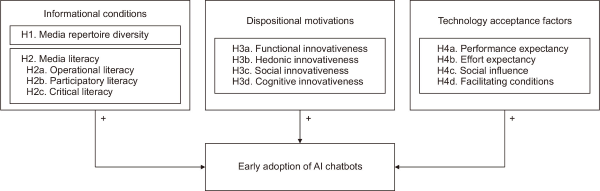
Fig. 1 presents the proposed research model. Building on the preceding theoretical discussion, this study examines the early adoption of AI chatbots as being determined by three complementary dimensions: informational conditions, dispositional motivations, and technology acceptance factors. First, informational conditions comprise media repertoire diversity (H1) and three dimensions of media literacy: operational, participatory, and critical (H2a-H2c). Second, dispositional motivations are captured through four dimensions of individual innovativeness: functional, hedonic, social, and cognitive (H3a-H3d). Finally, technology acceptance factors, grounded in the UTAUT framework, include performance expectancy, effort expectancy, social influence, and facilitating conditions (H4a-H4d). Collectively, the model explains early AI chatbot adoption by integrating users’ existing media environments, literacy competencies, innovation-related motivations, and perceptual evaluations of new technologies.
3. METHODS
3.1. Data and Sample
This study used data from the 2024 wave of the Korea Media Panel Survey (KMPS), a nationally representative longitudinal survey administered by the KISDI (2024). The KMPS began in 2010 in the capital region and five major metropolitan cities in South Korea and expanded to a nationwide probability sample in 2011. The 2024 survey, the 15th wave, was based on an integrated panel of 4,537 households, including 3,510 households recruited in 2011 using the 2005 Population and Housing Census sampling frame (KMPS11) and 1,027 households added in 2019 using the 2017 Census frame (KMPS19). Data were collected between May 27 and August 23, 2024, from all household members aged six or older. Because the panel is based on census-derived probability samples and periodically updated to reflect demographic changes, the KMPS provides nationally representative data on the Korean population.
The final analytic sample consisted of 8,690 respondents, of whom 4,377 (50.4%) were female. Ages ranged from 6 to 102 years (M=46.8, standard deviation [SD]=20.0). The age distribution was: under 20 (11.3%), 20-29 (11.7%), 30-39 (13.8%), 40-49 (16.2%), 50-59 (17.9%), 60-69 (15.8%), 70-79 (8.1%), and 80 or older (5.2%). In terms of education, 45.2% held a university degree, followed by high school graduates (32.3%), elementary school graduates (11.1%), middle school graduates (9.8%), and graduate degree holders (1.5%); 0.1% reported preschool education or below. The average monthly income was 1.98 million KRW (SD=1.71). Regarding economic activity, 62.46% of the respondents were employed. Among the working population, the majority were wage workers (81.57%), followed by self-employed individuals without employees (14.35%), employers (2.05%), and unpaid family workers (2.03%). Geographically, the sample covered all 17 administrative regions of South Korea, with 49.37% residing in the Seoul Metropolitan Area (Seoul, Gyeonggi, and Incheon) and the remainder distributed across major regions such as Busan (6.55%), Gyeongnam (6.55%), Gyeongbuk (5.48%), and Daegu (4.29%).
3.2. Measurements
3.2.1. Dependent Variable: Early Adoption of AI Chatbots
Early adoption was operationalized as the reported use of generative AI chatbots within the three months preceding the survey. Out of 8,690 respondents, 1,187 (13.7%) were identified as users (e.g., ChatGPT, Adot, Copilot, and Clova X), while 7,503 (86.3%) reported no usage. To maintain a strict focus on chatbots, three individuals who primarily used image-generation services (e.g., Midjourney and DALL·E) were excluded from the initial count of 1,190 generative AI users.
3.2.2. Independent Variables
3.2.2.1. Media Repertoire.
Media repertoire diversity was assessed based on respondents’ usage of seven digital media platforms: social networking services (SNS), instant messaging (IM), over-the-top streaming services (OTT), online news/magazines/e-books, blogs, email, and metaverse platforms. Each medium was dichotomously coded (0=not used, 1=used). Television broadcasting was excluded from this index because all respondents reported having used it in the past three months, thereby providing no variation for the analysis. The resulting scores were summed to create a media repertoire index (ranging from 0 to 7), which represents the total number of media types used in the past three months.
3.2.2.2. Media Literacy.
The KMPS measured media literacy across three dimensions: operational, participatory, and critical literacy (Lin et al., 2013; Livingstone, 2004). Operational literacy captures the basic functional skills required to use mobile and digital media (KISDI, 2024). Respondents assessed their ability to perform tasks such as sending text and instant messages, transferring files, configuring device settings, conducting online searches, using mobile banking and online shopping services, and managing applications. These 13 items were measured on a 5-point Likert scale ranging from 1 (strongly disagree) to 5 (strongly agree). The scale demonstrated high internal reliability (α=0.97, M=3.84, SD=1.20).
Participatory literacy reflects the frequency of engagement in online interaction and content creation over the past three months (KISDI, 2024). Seven types of activities were assessed, including posting, sharing, and commenting in online communities; reacting to content (e.g., ‘likes’); submitting comments on news or discussion boards; providing ratings and recommendations; and contributing useful information. Responses were coded on a 9-point behavioral frequency scale (0=not a member, 1=almost never, 2=once in 3 months, 3=1-3 times per month, 4=1-2 times per week, 5=3-4 times per week, 6=5-6 times per week, 7=once per day, 8=several times per day). The scale showed high internal reliability (α=0.94, M=1.28, SD=1.09).
Critical literacy assesses the evaluative competence involved in verifying information credibility and detecting persuasive or manipulative intent (KISDI, 2024). Six items asked respondents how often they examined factual accuracy and supporting evidence, identified political or commercial biases, sought additional information from different perspectives, and recognized or avoided malicious messages such as phishing or spam attempts. Responses were recorded on a 5-point frequency scale ranging from 1 (never) to 5 (always). The scale demonstrated high internal reliability (α=0.90, M=3.05, SD=0.98).
3.2.2.3. Innovativeness.
Innovativeness was measured using the four dimensions of the MCI scale: functional, hedonic, social, and cognitive innovativeness (Vandecasteele & Geuens, 2010). Each dimension consisted of four items, rated on a 5-point Likert scale (1=strongly disagree to 5=strongly agree). Functional innovativeness assessed the extent to which respondents tend to adopt new products that offer new features, save time, improve convenience, or simplify tasks (α=0.92). Hedonic innovativeness measured the excitement, enjoyment, and sense of stimulation experienced when discovering or using novel products (α=0.91). Social innovativeness reflected consumers’ tendency to adopt new products to distinguish themselves from others, impress peers, and project an image of superiority or distinctiveness through early adoption (α=0.91). Cognitive innovativeness captured the desire to engage with products that stimulate logical or analytical thinking and intellectual curiosity (α=0.94).
3.2.2.4. Technology Acceptance.
Technology acceptance was assessed using four dimensions from the UTAUT: performance expectancy, effort expectancy, social influence, and facilitating conditions (Venkatesh et al., 2003). Each dimension was measured with two sub-items: perceived usefulness and productivity benefits of adopting new digital media services (performance expectancy), the ease of learning and becoming familiar with such services (effort expectancy), the perceived expectations of important others (social influence), and the availability of support and resources needed for use (facilitating conditions). All items were rated on a 5-point Likert scale (1=strongly disagree to 5=strongly agree). Each subscale demonstrated satisfactory internal reliability: performance expectancy (α=0.88), effort expectancy (α=0.87), social influence (α=0.85), and facilitating conditions (α=0.88).
3.2.3. Control Variables
Four demographic variables—gender, age, income, and education—were included as control variables. Gender was coded as a binary variable (0=male, 1=female). Age was treated as a continuous variable. Income level was measured in the KMPS using 0.5 million KRW intervals comprising 18 ordered response options, ranging from ‘none’ and ‘less than 0.5 million KRW’ to ‘8 million KRW or more.’ For regression analyses, income categories were converted into continuous values by assigning the midpoint of each interval; the open-ended top category was adjusted by adding a constant increment to the midpoint of the preceding interval to preserve interval consistency. Educational attainment was measured using six categories: preschool, elementary school, middle school, high school, university, and graduate school. Table 1 shows descriptive statistics for all variables.
Table 1
Descriptive statistics for all variables (n=8,690)
|
Category |
Variable |
Range |
Meana) |
SD |
|
Dependent variable |
AI chatbot adopterb) |
0-1 |
0.137 |
0.343 |
|
Independent variables |
Media repertoire |
0-7 |
3.350 |
1.479 |
|
Operational literacy |
1-5 |
3.839 |
1.196 |
|
|
Participatory literacy |
0.43-8.00 |
1.278 |
1.090 |
|
|
Critical literacy |
1-5 |
3.055 |
0.976 |
|
|
Functional innovativeness |
1-5 |
2.578 |
0.980 |
|
|
Hedonic innovativeness |
1-5 |
2.878 |
0.955 |
|
|
Social innovativeness |
1-5 |
2.716 |
0.970 |
|
|
Cognitive innovativeness |
1-5 |
2.544 |
0.971 |
|
|
Performance expectancy |
1-5 |
3.159 |
0.972 |
|
|
Effort expectancy |
1-5 |
3.062 |
1.051 |
|
|
Social influence |
1-5 |
2.850 |
1.002 |
|
|
Facilitating conditions |
1-5 |
2.838 |
0.985 |
|
|
Control variables |
Genderc) |
0-1 |
0.504 |
0.500 |
|
Age |
6-102 |
46.830 |
19.981 |
|
|
Incomed) |
0-8.25 |
1.977 |
1.711 |
|
|
Educatione) |
1-6 |
4.158 |
1.019 |
SD, standard deviation.
a)For categorical variables, values represent proportions: AI adoption (1=adopter)=13.7%; gender (1=female)=50.4%. b)AI adoption coded as 0=non-adopter, 1=adopter. c)Gender coded as 0=male, 1=female. d)Income converted from ordinal response categories using midpoint values (unit=million KRW). e)Education: 1=preschool, 2=elementary school, 3=middle school, 4=high school, 5=undergraduate, 6=graduate degree.
3.3. Analytical Strategy
To empirically test the proposed hypotheses (H1-H4), a hierarchical binary logistic regression analysis was employed. This statistical method is appropriate given that the dependent variable, AI chatbot adoption, is dichotomous (coded as 0=non-adopter, 1=adopter). The hierarchical approach allows for the assessment of the incremental predictive power of the key independent variables after accounting for the variance explained by demographic controls.
The regression model was constructed in two steps. In Block 1, demographic control variables—gender, age, income, and education level—were entered to establish a baseline model. In Block 2, the theoretical predictors were introduced to test the main hypotheses. These predictors included media repertoire diversity, the three dimensions of media literacy (operational, participatory, and critical), the four dimensions of innovativeness (functional, hedonic, social, and cognitive), and the four constructs of technology acceptance (performance expectancy, effort expectancy, social influence, and facilitating conditions).
Prior to the main analysis, variance inflation factors (VIFs) were examined to ensure that multicollinearity did not pose analytical concerns; all values ranged from 1.17 to 4.80, which are well below the commonly accepted threshold of 10. Therefore, multicollinearity was not considered a concern in the regression model. The overall model fit was evaluated using the likelihood ratio chi-square (χ2) test, -2 log likelihood (-2LL), the Hosmer-Lemeshow goodness-of-fit test, and Nagelkerke’s pseudo-R2. The statistical significance and magnitude of the predictor effects were interpreted using adjusted odds ratios (AOR) with 95% confidence intervals (CI). All statistical analyses were conducted using IBM SPSS Statistics (version 31.0; IBM Corp., Armonk, NY, USA).
4. RESULTS
As shown in Table 2, a hierarchical binary logistic regression was conducted to examine the effect of media repertoire diversity, media and information literacy, innovativeness, and technology acceptance constructs on the likelihood of being an early adopter of AI chatbots (0=non-adopter, 1=adopter). The baseline model (Block 1), which included only demographic control variables (gender, age, income, and education), was statistically significant (χ2=1,495.731, p<0.001) and accounted for 28.8% of the variance (Nagelkerke R2=0.288). The inclusion of the main independent variables in Block 2 significantly improved the model fit (Δχ2=547.084, p<0.001). The final model was highly significant (χ2=2,042.816, p<0.001), explaining 38.1% of the total variance (Nagelkerke R2=0.381) with a classification accuracy increasing from 86.5% to 88.1%.
Table 2
Hierarchical binary logistic regression predicting early adoption of AI chatbots (n=8,690)
|
Variable |
Model 1 |
Model 2 |
|||||||
|
B |
SE |
AOR |
95% CI |
B |
SE |
AOR |
95% CI |
||
|
Constant |
-3.933 |
0.247 |
0.020*** |
-7.654 |
0.419 |
0.000*** |
|||
|
Gender |
-0.421 |
0.073 |
0.656*** |
[0.569, 0.757] |
-0.504 |
0.078 |
0.604*** |
[0.519, 0.704] |
|
|
Age |
-0.073 |
0.003 |
0.930*** |
[0.924, 0.936] |
-0.048 |
0.004 |
0.953*** |
[0.946, 0.960] |
|
|
Income |
0.166 |
0.025 |
1.181*** |
[1.124, 1.240] |
0.104 |
0.027 |
1.109*** |
[1.052, 1.170] |
|
|
Education |
1.046 |
0.055 |
2.846*** |
[2.557, 3.169] |
0.648 |
0.065 |
1.911*** |
[1.683, 2.170] |
|
|
Media repertoire |
0.574 |
0.042 |
1.775*** |
[1.633, 1.929] |
|||||
|
Operational literacy |
0.038 |
0.074 |
1.039 |
[0.898, 1.201] |
|||||
|
Participatory literacy |
0.212 |
0.032 |
1.236*** |
[1.161, 1.317] |
|||||
|
Critical literacy |
0.082 |
0.053 |
1.086 |
[0.978, 1.205] |
|||||
|
Functional innovativeness |
0.064 |
0.068 |
1.066 |
[0.932, 1.219] |
|||||
|
Hedonic innovativeness |
0.125 |
0.070 |
1.133† |
[0.988, 1.299] |
|||||
|
Social innovativeness |
-0.097 |
0.066 |
0.907 |
[0.796, 1.033] |
|||||
|
Cognitive innovativeness |
-0.187 |
0.078 |
0.830*** |
[0.712, 0.966] |
|||||
|
Performance expectancy |
-0.024 |
0.071 |
0.976 |
[0.849, 1.122] |
|||||
|
Effort expectancy |
0.546 |
0.065 |
1.726*** |
[1.521, 1.960] |
|||||
|
Social influence |
0.096 |
0.067 |
1.101 |
[0.964, 1.256] |
|||||
|
Facilitating conditions |
-0.102 |
0.067 |
0.903 |
[0.793, 1.030] |
|||||
|
Model fit statistics |
|||||||||
|
-2 Log Likelihood |
5,433.421 |
4,886.337 |
|||||||
|
Model χ2 |
1,495.731*** |
2,042.816*** |
|||||||
|
Δχ2 |
547.084*** |
||||||||
|
Nagelkerke R2 |
0.288 |
0.381 |
|||||||
|
Hosmer-Lemeshow test χ2 |
19.998* |
28.791*** |
|||||||
|
Overall accuracy (%) |
86.50 |
88.10 |
|||||||
B, unstandardized coefficient; SE, standard error. AOR, adjusted odds ratio; CI, confidence interval.
†p<0.10, *p<0.05, **p<0.01, ***p<0.001.
Although the Hosmer-Lemeshow test indicated a lack of fit (χ2=28.791, p<0.001), this result is frequently observed in large samples (n=8,690) due to the test’s high sensitivity to minor discrepancies. Thus, model adequacy was evaluated using alternative indices. Nagelkerke R² improved from 0.288 to 0.381 and -2LL decreased substantially from 5,433.421 to 4,886.337, indicating that the extended predictors significantly enhanced the model fit (Δx²=547.084, p<0.001). Furthermore, the receiver operating characteristic (ROC) curve analysis demonstrated the satisfactory discrimination ability of the final model (area under the curve=0.861, 95% CI [0.848, 0.874], p< 0.001), suggesting that the classifier effectively distinguishes adopters from non-adopters.
The results of the logistic regression analysis regarding the proposed hypotheses are as follows. First, regarding H1, the results supported the hypothesis that individuals with a more diverse media repertoire are more likely to be early adopters. Media repertoire diversity emerged as the strongest positive predictor among all main variables (AOR=1.775, p<0.001). Specifically, for every one-unit increase in media repertoire diversity, the odds of being an AI chatbot adopter increased by 77.5%, holding other variables constant.
Among the sub-dimensions of media literacy, only participatory literacy (H2b) showed a significant positive effect on adoption (AOR=1.236, p<0.001), indicating that a one-unit increase raises the odds of adoption by 23.6%. However, operational (H2a) and critical literacy (H2c) did not demonstrate statistically significant effects.
Contrary to expectations, the hypotheses regarding motivational drivers (H3a-H3d) were not supported in the anticipated direction. While cognitive innovativeness (H3d) emerged as a statistically significant predictor, it exhibited a negative relationship with adoption (AOR=0.830, p=0.016), suggesting that a one-unit increase is associated with a 17.0% decrease in the odds of adoption. Hedonic innovativeness (H3b) was marginally significant (AOR=1.133, p=0.070), suggesting a weak but notable relationship. Although this result did not reach the conventional significance level (p<0.05), it indicates a potential trend. Functional (H3a) and social innovativeness (H3c) were not statistically significant.
Within the technology acceptance variables, only effort expectancy (H4b) was a significant positive predictor (AOR=1.726, p<0.001); a one-unit increase in effort expectancy led to a 72.6% increase in the odds of adoption. Performance expectancy (H4a), social influence (H4c), and facilitating conditions (H4d) were not statistically significant predictors.
Regarding the control variables, all demographic factors—gender, age, income, and education—emerged as significant predictors of AI chatbot adoption (p<0.001). Female respondents were approximately 39.6% less likely to be early adopters compared to their male counterparts (AOR=0.604). Age showed a negative association with adoption (AOR=0.953), indicating that younger individuals are more likely to adopt AI chatbots. Education level exhibited a strong positive effect, with higher educational attainment nearly doubling the odds of adoption (AOR=1.911). Finally, income demonstrated a positive effect on the likelihood of adoption (AOR=1.109).
5. DISCUSSION
5.1. Who Adopts? Media Repertoire Diversity and Participatory Literacy
This study identifies a socio-technological profile of early AI chatbot adopters that both aligns with and extends classical diffusion theory. Consistent with Rogers’ (2003) characterization of early adopters as more information-oriented and externally connected, media repertoire diversity emerged as the strongest predictor of early adoption. This finding suggests that structural exposure to heterogeneous information environments remains a foundational precondition for encountering, evaluating, and experimenting with emerging technologies (Rogers, 2003).
However, exposure alone appears insufficient in the context of AI chatbots. The significant predictive role of participatory literacy indicates that early adopters are characterized not merely by broad media exposure but also by active engagement in digital production, interaction, and content-related practices. AI chatbots increasingly function as infrastructural tools that support such activities, including drafting, brainstorming, summarizing, synthesizing, and transforming information (Kasneci et al., 2023; Lee et al., 2025; Pavlik, 2023). Consequently, early adoption of AI chatbots appears to be rooted in the combination of information openness and participatory readiness. In this sense, these tools may be especially attractive to individuals who are already engaged in active digital creation and interaction practices.
5.2. Why Adopt? Cognitive Innovativeness and Effort Expectancy
Two notable findings of this study require theoretical explanation: the unexpected negative association between cognitive innovativeness and the early adoption of AI chatbots, and the strong positive association between effort expectancy and adoption. At first glance, the former appears inconsistent with classical diffusion theory. Rogers’ (2003) diffusion theory generally characterizes early adopters as individuals who are open to experimentation, attentive to new information, and capable of evaluating emerging innovations. From this perspective, cognitively innovative individuals—those motivated by intellectual stimulation, exploration, and problem-solving—would be expected to adopt AI chatbots earlier than others. However, the findings suggest that early adoption may be less closely related to a desire for cognitive challenge than to the perceived ability of these systems to reduce the cognitive burden of information-related tasks.
This interpretation can be further developed through the concept of cognitive economy. Drawing on Rescher (1989)’s account of cognitive economy as the cost-effective use of intellectual resources, this study understands the concept as a tendency to conserve cognitive resources while still achieving useful outcomes. In contemporary information environments, where users often face information abundance and limited attention, technologies may become attractive not only because they provide new capabilities but also because they reduce the effort required to complete familiar tasks. AI chatbots are relevant in this regard because they can support routine information work, such as drafting, summarizing, and organizing information. Thus, early adoption may be understood less as simple enthusiasm for technological novelty than as a pragmatic response to information overload and task complexity.
The positive effect of effort expectancy offers empirical support for this interpretation. In the UTAUT framework, effort expectancy refers to the perceived ease of using a technology, whereas performance expectancy refers to expected improvements in task performance (Venkatesh et al., 2003). In this study, effort expectancy was positively associated with early adoption, while performance expectancy was not statistically significant. This pattern suggests that, at the early diffusion stage, adoption may be more closely related to the perceived ease of initial engagement than to established expectations about long-term performance gains. Early users may not yet have fully formed judgments about the broader productivity benefits of AI chatbots, but they may be able to recognize the low effort required to engage with them.
This dynamic is closely related to the interface characteristics of AI chatbots. Unlike previous digital tools that required specialized procedures or platform-specific navigation, AI chatbots operate through natural language interaction. This lowers the threshold for experimentation and reduces cognitive friction (Raman et al., 2024). Consequently, early adopters may be drawn not merely by what AI chatbots can ultimately accomplish, but by how easily they can be applied to routine tasks such as drafting and summarizing, offering immediate relief from cognitive burden.
The negative association between cognitive innovativeness can be understood from the same perspective. Cognitively innovative individuals may value intellectual exploration, analytical effort, and independent problem-solving. For these users, the value of a new technology may depend on whether it expands their cognitive capabilities or enables deeper forms of inquiry. If AI chatbots are perceived mainly as tools that simplify, automate, or substitute for parts of the cognitive process, their relative advantage may be less apparent. This does not necessarily imply that cognitively innovative users are opposed to AI technologies in general. Rather, they may be less likely to adopt early when the technology is experienced primarily as a means of reducing cognitive labor rather than extending cognitive engagement.
Epistemic concerns may further reinforce this pattern. AI chatbots can produce outputs that are fluent but inaccurate, incomplete, or difficult to verify, and prior research has noted issues such as hallucinations, factual errors, and limited transparency (Dwivedi et al., 2023). Cognitively innovative individuals may be particularly attentive to these limitations because they tend to value rigorous reasoning, independent judgment, and epistemic control. Their lower likelihood of early adoption may therefore reflect skepticism toward the reliability and verifiability of AI-generated information, rather than a lack of openness to innovation. This explanation is especially relevant to information science, where information quality, credibility, and verification are central concerns.
Taken together, these findings suggest a possible refinement of diffusion theory in the context of AI chatbots. While classical diffusion theory generally treats innovativeness as a positive predictor of early adoption, its effect may depend on whether an innovation is perceived as expanding or substituting for users’ cognitive activity. Technologies perceived as cognitive-expanding may appeal to those seeking intellectual exploration and mastery, whereas technologies perceived as cognitive-substituting may be more attractive to users who prioritize efficiency and reduced mental effort. In the early adoption stage examined in this study, AI chatbots appear to be associated more closely with cognitive economy than with cognitive intensification. This interpretation connects the negative effect of cognitive innovativeness and the positive effect of effort expectancy: Early adopters may be drawn to AI chatbots less because they provide greater intellectual challenge than because they make information work easier and less cognitively demanding.
6. CONCLUSION
This study provides empirical evidence on the early adoption of AI chatbots by considering both who adopts these tools and why they do so. The findings reveal a distinct socio-technological profile of early adopters: Individuals with diverse media repertoires and higher participatory literacy are more likely to adopt, while effort expectancy emerges as a strong positive predictor and cognitive innovativeness shows a negative association. Together, these results suggest that early adoption is shaped not only by users’ information environments and digital engagement but also by the perceived ease of reducing cognitive effort in routine information tasks.
From a policy perspective, if early adoption is partly shaped by participatory literacy and perceived ease of use, then unequal levels of digital skills may influence who benefits from AI chatbots. Policies aimed at promoting AI literacy should go beyond technical access and include support for critical, creative, and responsible use. Educational and public initiatives may need to help users understand not only how to use AI chatbots efficiently but also how to evaluate, verify, and contextualize AI-generated information. In this sense, reducing adoption barriers should be accompanied by efforts to strengthen users’ capacity for informed and reflective engagement with AI systems.
Several limitations should be acknowledged. First, because this study relies on cross-sectional data, causal relationships and potential endogeneity cannot be fully established. Second, the binary measure of adoption does not capture differences in frequency, purpose, or depth of use, and cognitively innovative individuals may use AI chatbots selectively rather than reject them entirely. Third, the constructs of innovativeness and technology acceptance were operationalized using the MCI and UTAUT items from the KMPS. Although AI chatbots represented a newly emerging digital media service at the time of the survey, the items incorporated in the KMPS were intended to capture general attitudes toward new digital media products and services rather than AI chatbots specifically. Accordingly, these measures may not fully reflect AI chatbot-specific perceptions and behaviors, which should be considered when interpreting the findings. Fourth, proposed mechanisms such as cognitive substitution and epistemic risk were not directly tested. Fifth, although the model demonstrates satisfactory explanatory power and discrimination, model fit should be interpreted with caution. Finally, because the study was conducted in South Korea, the broader generalizability of the findings across different cultural and institutional contexts remains uncertain.
Future research should therefore employ longitudinal and cross-cultural designs, develop more nuanced measures of AI chatbot use, and directly examine the mechanisms linking user characteristics to adoption. Such work would help clarify how patterns of AI chatbot adoption evolve as generative AI becomes more integrated into everyday life.
REFERENCES
, (2025) From intention to impact: Predictors and learning outcomes of AI tool adoption among Saudi University Students Journal of Information Science Theory and Practice, 13(4), 69-82, https://doi.org/10.1633/JISTaP.2025.13.4.5 .
, , (2013) Developing a news media literacy scale Journalism & Mass Communication Educator, 68(1), 7-21, https://doi.org/10.1177/1077695812469802 .
, , , (2024) The beginning of ChatGPT – a systematic and bibliometric review of the literature Information and Learning Sciences, 125(7/8), 587-614, https://doi.org/10.1108/ils-04-2023-0035 .
, (2024) ChatGPT in the higher education: A systematic literature review and research challenges International Journal of Educational Research, 127, 102411, https://doi.org/10.1016/j.ijer.2024.102411 .
, (2024) Is ChatGPT an ally or an enemy? Its impact on society based on a systematic literature review Journal of Information Science Theory and Practice, 12(2), 79-95, https://doi.org/10.1633/JISTaP.2024.12.2.6 .
, , , , , , , , , , (2024) Understanding the diffusion of AI-generative (ChatGPT) in higher education: Does students’ integrity matter? Computers in Human Behavior Reports, 14, 100402, https://doi.org/10.1016/j.chbr.2024.100402 .
, , , , , , , , , , , , , , , , , , , (2023) Opinion paper: “So what if ChatGPT wrote it?” Multidisciplinary perspectives on opportunities, challenges and implications of generative conversational AI for research, practice and policy International Journal of Information Management, 71, 102642, https://doi.org/10.1016/j.ijinfomgt.2023.102642 .
, (2020) Artificial intelligence and communication: A human–machine communication research agenda New Media & Society, 22(1), 70-86, https://doi.org/10.1177/1461444819858691 .
, , , , , , , , , , , (2024) ChatGPT in education: A blessing or a curse? A qualitative study exploring early adopters’ utilization and perceptions Computers in Human Behavior: Artificial Humans, 2(1), 100027, https://doi.org/10.1016/j.chbah.2023.100027 .
, (2025) The influence relationship between flow, satisfaction, and acceptance intention of ChatGPT –based on UTAUT model Journal of the Korea Contents Association, 25(3), 193-204, https://doi.org/10.5392/jkca.2025.25.03.193 .
, , , , , , , , , , , , , , , , , , , (2023) ChatGPT for good? On opportunities and challenges of large language models for education Learning and Individual Differences, 103, 102274, https://doi.org/10.1016/j.lindif.2023.102274 .
Korea Information Society Development Institute (KISDI) The Korean media panel survey [dataset]. Household member data, v2024, 2024, https://stat.kisdi.re.kr/kor/contents/ContentsList.html?subject=MICRO10&sub_div=D
, , , (2025) Motivations and affordances of ChatGPT usage for college students’ learning Media and Communication, 13, 9508, https://doi.org/10.17645/mac.9508 .
(2015) Lifestyles and the adoption of information versus entertainment technologies: An examination on the adoption of six new technologies in Taiwan New Media & Society, 17(10), 1696-1714, https://doi.org/10.1177/1461444814531874 .
(2026) Relationships between motivated consumer innovativeness, consumer AI usage experience, and consumer commitment: A comparative analysis across four artificial intelligence devices International Journal of Human–Computer Interaction, 42(3), 1597-1614, https://doi.org/10.1080/10447318.2025.2526567 .
, , , (2013) Understanding new media literacy: An explorative theoretical framework Journal of Educational Technology & Society, 16(4), 160-170, http://www.jstor.org/stable/jeductechsoci.16.4.160 .
(2004) Media literacy and the challenge of new information and communication technologies The Communication Review, 7(1), 3-14, https://doi.org/10.1080/10714420490280152 .
, (2023) Experimental evidence on the productivity effects of generative artificial intelligence Science, 381(6654), 187-192, https://doi.org/10.1126/science.adh2586 .
OpenAI Introducing ChatGPT, 2022, 30, November, https://openai.com/index/chatgpt
OpenAI Introducing GPT‑5.5, 2026, 23, April, https://openai.com/index/introducing-gpt-5-5
, , (2023) A study on the intention to use Chat GPT service using Unified Theory of Acceptance and Use of Technology (UTAUT): Focusing on the age group 20-40s Korean Journal of Broadcasting and Telecommunication Studies, 37(5), 52-97, https://doi.org/10.22876/kab.2023.37.5.002 .
(2023) Collaborating with ChatGPT: Considering the implications of generative artificial intelligence for journalism and media education Journalism & Mass Communication Educator, 78(1), 84-93, https://doi.org/10.1177/10776958221149577 .
, , , , , (2024) Exploring university students’ adoption of ChatGPT using the diffusion of innovation theory and sentiment analysis with gender dimension Human Behavior and Emerging Technologies, 2024(1), 3085910, https://doi.org/10.1155/2024/3085910 .
(2023) ChatGPT: A comprehensive review on background, applications, key challenges, bias, ethics, limitations and future scope Internet of Things and Cyber-Physical Systems, 3, 121-154, https://doi.org/10.1016/j.iotcps.2023.04.003 .
(2021) The effects of explainability and causability on perception, trust, and acceptance: Implications for explainable AI International Journal of Human-Computer Studies, 146, 102551, https://doi.org/10.1016/j.ijhcs.2020.102551 .
, , (2017) Navigating cross-media news use Journalism Studies, 18(11), 1343-1362, https://doi.org/10.1080/1461670x.2015.1129285 .
, (2016) How do global audiences take shape? The role of institutions and culture in patterns of web use Journal of Communication, 66(1), 161-182, https://doi.org/10.1111/jcom.12200 .
, (2010) Motivated consumer innovativeness: Concept, measurement, and validation International Journal of Research in Marketing, 27(4), 308-318, https://doi.org/10.1016/j.ijresmar.2010.08.004 .
, , , (2003) User acceptance of information technology: Toward a unified view MIS Quarterly, 27(3), 425-478, https://doi.org/10.2307/30036540 .