

_3200-704_투명.png)
- ENGLISH
- E-ISSN3058-311X
#DHmakes: Baking Craft into DH Discourse
#DHmakes: Baking Craft into DH Discourse

Quinn Dombrowski (Stanford University)

Claudia Berger (Sarah Lawrence College)

초록
This paper traces the history and development of the collaborative #DHmakes initiative to bring crafts into the mainstream of Anglophone digital humanities, starting in 2022 but building upon earlier calls to bridge the maker / craft divide. It argues for the importance of this work within digital humanities as a way of reconnecting technology with its textile roots, while also recognizing the creative and intellectual potential found in feminine-coded craft praxis. The history of different phases within digital humanities is often poorly documented. By recording the development of this recent movement – already a challenge following a mass exodus from Twitter, where much of these conversations initially took place – this paper captures the origins of an important moment in the field, as “digital humanities” was coming to understand itself more capaciously than the “digital” alone would imply.
- keywords
- data visualization, craft, textiles, digital humanities
Abstract
This paper traces the history and development of the collaborative #DHmakes initiative to bring crafts into the mainstream of Anglophone digital humanities, starting in 2022 but building upon earlier calls to bridge the maker / craft divide. It argues for the importance of this work within digital humanities as a way of reconnecting technology with its textile roots, while also recognizing the creative and intellectual potential found in feminine-coded craft praxis. The history of different phases within digital humanities is often poorly documented. By recording the development of this recent movement – already a challenge following a mass exodus from Twitter, where much of these conversations initially took place – this paper captures the origins of an important moment in the field, as “digital humanities” was coming to understand itself more capaciously than the “digital” alone would imply.
- keywords
- data visualization, craft, textiles, digital humanities
1. Introduction
The shape of digital humanities scholarship has never been static, which confounds attempts to define the field by its methods, objects, infrastructure, or thematic preoccupations. Computer punchcards from the middle of the 20th century and CD-ROMs in the 1990’s have overlapped with database and website interface-heavy work that has persisted through today. The ongoing difficulties facing a relatively small number of well-staffed centers form another locus of digital humanities discourse, as do the concerns of flagship conferences, journals, and major grant programs. However, digital humanities has also benefited from pushback against discourse that veers towards the hegemonic, be it critiques of the Anglophone-centricity of the field from Domenico Fiormonte (Fiormonte 2016), Élika Ortega (Ortega 2014), and others, or a challenge to the centrality of the “digital” in digital humanities, coming from analog crafts, tech-driven physical making, and pencil-and-paper DH pedagogy. These approaches acknowledge upfront the inherent ephemerality of the digital, and the fact that maintaining most forms of digital knowledge production – from punchcards to CD-ROMs to databases to websites – requires a great deal of specialized labor, effort, and resources. Digital tools, methods, and data may allow us to answer new questions, or old questions in new ways, but if those answers are manifested as digital objects themselves, there is a steep and endless path to ensure that that knowledge is maintained. In this context, it is little wonder that physical crafted objects would hold some appeal, given their relative durability as a medium compared to the digital. While physical crafting may seem inherently at odds with the “digital” in “digital humanities”, the evolution of the field has destabilized the centrality of the “digital”.
One of the greatest strengths of the digital humanities has been its emergent community practices and values: welcoming an unusual degree of experimentation in methods, communication formats, and community design to achieve our scholarship is the core of some of the best DH. Despite DH work often sitting at the crossroads of culture and technology, this is technology defined capaciously in the spirit of Ursula K. LeGuin1, rather than a scope constrained by the technological solutionism of Silicon Valley or even its better open-source alternatives. DH isn't fundamentally digital; it's fundamentally experimental. At some points in space and time, such conscious research experimentation has felt synonymous with the digital—but what a mistake to redefine our motivations as just a few of its past outcomes! DH thrives when practitioners transform their work by setting aside beliefs about who makes scholarship, with what tools and practices, and how we communicate and build on scholarship in community. That radical openness to how we do humanities-relevant work nourished other communities, including methodological conversation and collaboration across disciplines and including the public, GLAM, and industry; attention to infrastructure, community design and upkeep, maintenance work; social justice advocacy2; real-time sharing of in-progress scholarship, including honest documentation of failure; accessibility in many forms; and equitable collaboration.
The #DHmakes movement is an example of those values in practice, framing a DH that affords more ways to both make and read scholarship. This produces a DH open to more practitioners and readers. In addition to other sensory features, craft work often creates tangible objects, with both the strengths and limitations of print monographs: when you put them on a shelf, they stay there (unlike quickly-broken websites), but this limits their audience to one physical location. The growth of a #DHmakes community addresses that limit by connecting craft practitioners and building community habits of sharing both digital documentation of made objects, and tutorials for colleagues in other locales to create their own local, similar work.
This article is a history of #DHmakes’ early origins: how it started, how it has evolved, and future directions for making in DH. At a certain level, the story of #DHmakes is partially a story of using lightweight community organizing, backed by institutional authority, to legitimize work that aligns with the field’s broader goals and values.
Figure 1.
Bluesky post by Association for Computers and the Humanities co-president Quinn Dombrowski

By documenting this history, which has become difficult to recover even after only two years due to the infrastructural upheaval across social media platforms, we hope it can also function as a roadmap for future DH scholars who want to establish and maintain these types of communities within academic spaces.
2. Tracing craft in digital humanities
Long before #DHmakes was first used, or even conceived of, there have been many conservations about the role of making in DH. While this form of “making” looks different than how #DHmakes currently uses it, focusing almost exclusively on digital tools and coding, it contributed to the foundation of the #DHmakes movement. In 2011, Natalia Cecire engaged with the then-heated “hack vs. yack” debate, which drew lines between those who “build” vs. those who “merely critique” (Cecire 2011), noting that
“the epistemology of doing has come to be framed in strangely specific terms, with social consequences for how it plays out in the wider discipline. “Hands-on,” “getting your hands dirty,” “digging,” “mining,” “building”—these terms offer quite a specific vision of what constitutes doing, conjuring up economic productivity (stimulus packages and infrastructure initiatives loom into view) of a distinctly social, distinctly virtuous, distinctly white, male, blue-collar variety. The field might look very different if the dominant metaphors for “doing” digital humanities research included weaving, cooking, knitting, and raising or nurturing.”
This proposal of a counter-vocabulary to masculine, economically-oriented production has remarkable resonance with the evolution of discourse within the field a decade later, where all these actions enjoy a place of visibility, not even as a metaphor but as praxes that meaningfully intersect with and inform our digital humanities work3.
Cecire references Bethany Nowviskie’s “What Do Girls Dig?”, a 25-tweet thread later republished in Debates in the Digital Humanities (Nowviskie 2012) for its discussion of the “masculine” framing of the “Digging into Data” program from the National Endowment for the Humanities, and the gender imbalance among the awardees. Issues around gender and DH were taken up more explicitly over the following years, including through the creation of the Women and Gender Minorities in DH (DH-WoGeM) special interest group within the Alliance of Digital Humanities Organizations (ADHO). About a decade after challenging the “digging” framing for digital humanities, Nowviskie played a key role in shifting the discourse of DH Twitter, which led to the start of the #DHmakes hashtag project as academic workplaces lurched towards re-establishing normal on-campus operations after pandemic shutdowns that were unevenly distributed across institution types and locations in the United States4.
Ashley Reed, when writing about William and Catherine Blake, noted parallels between the Maker movement and digital humanities. Both “celebrate the process and product of creation…[and] at their best, they interrogate both process and product” (Reed 2016). Connecting to ideas around critical making at the time, Reed recognized the potential for focusing on process, and how DH should “live up to the ‘humanities’ part of their name by highlighting the human aspects of making, which are the most difficult to unearth and describe and those most likely to be ignored, forgotten, or glossed over by the fields (engineering, design) whose work is most evident in the finished product” (2016). “Making” continued to have a huge role in DH scholarship with dedicated volumes on the topic such as Making Thing and Drawing Boundaries, a volume in the Debates in the Digital Humanities Series (Sayers 2018). In that book David Staley writes about the “Maker Turn” argues that “creativity is a form of scholarship” even when primarily focusing on digital fabrication methods (Staley 2018). And how is this creatively as scholarship not perfectly exemplified when Deimosa Webber-Bey took data about slavery era quilting and presented it in the form of a quilt (Webber-Bey 2014)?
By taking these previous discussions in DH as a jumping off point, what can DH look like if we expand what we mean by “making,” “hacking,” and “building” to literally include “weaving,” “knitting,” and “stitching”? Information has long been encoded in physical objects, and if a process-oriented DH is one that lends itself to critical making, let’s continue to push expectations around what we consider to be “knowledge objects” and scholarship (Bleeker, Verhoess, and Werning 2020). The previous discourse can serve as an invitation for us to find new ways to challenge ideas of “what counts” in DH.
3. Making during the COVID-19 pandemic
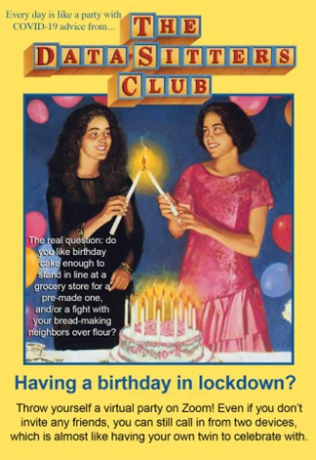
The 2020 lockdowns led to a spike in creative projects, as people were cut off from activities outside their homes. Where previously it was accepted and even somewhat expected that academics would participate in the discourse of being simply too busy for serious hobbies or creative projects, the pandemic lockdowns introduced a dramatic shift in circumstances. One finds traces of this freed-up time in many places, including a visible spike in posting new fanfics to archives around the world, as people grappled with their circumstances through creative writing (Long et al. 2023, Madden 2024). Bread-making suddenly became such a popular activity (Easterbrook-Smith 2022) that bread flour and yeast were hard to come by – and it became the punch line of jokes, including, among digital humanities circles, the following “public health message from the Data-Sitters Club”5:
Figure 2.
Data-Sitters Club public health message referencing fighting over flour at the grocery store during the COVID-19 pandemic
Although some forms of making, like bread-making or (re-)learning to crochet or knit, were largely ways to pass the time, many people with unused sewing machines put them to work in the first few months of the pandemic in order to make cloth face coverings while the US supply chains for producing medical-grade or higher-quality masks caught up to demand. Individuals with at least basic sewing skills took requests from friends and family members, and formed collectives to gather and distribute the necessary materials for face coverings (fabric, elastic or 3D printed bias tape makers, pipe cleaners or metal for nosepieces, various filtration substrate materials if available, etc.) and collect the finished products for use in hospitals and nursing homes. As one example of a workplace-based collaborative effort, Stanford University’s Textile Makerspace, run by Quinn Dombrowski, transformed into a virtual Slack space that served as a hub for the Masquaraders project, where library staff (especially those whose regular duties were difficult to carry out at home) set about sewing filtered face coverings for front-line library staff who were still coming to campus to staff the mail room or engage in other tasks that let the library otherwise run virtually. The Masquaraders project mailed supplies to the volunteer sewists from among the library staff, along with a sewing pattern recommended by the Kaiser Permanente managed care consortium, and offered Zoom sessions for participants to sew together and troubleshoot one another’s problems in constructing the face coverings. Similarly, DH-inflected makerspaces also turned their efforts to helping keep communities safe or supply beleaguered health facilities. For example, the Scholars' Lab Makerspace6 participated in their institution's grassroots pandemic relief effort through researching materials and assembling facial shields for the university hospital, helping prototype and print phone holders to help health workers and family communicate safely with patients in quarantine, and sewing face masks:

There were other early-pandemic DH responses to the pandemic using crafting skills, often including some of the same DH practitioners across different projects. "1000 Little Fires"7 was an effort attempting to tweet "1 small act of creation" daily, using a collaboratively edited spreadsheet where community members were encouraged to add small good things they were making in the face of fear, illness, and isolation. Contributions included photos and videos of felt-tip pen chromatography, repainting a garage (maintenance work!), knitting a vest while in quarantine, baking bread, and textile mourning braids.
While there is a long track record of library staff having their own craft praxis that occasionally intersects with work (e.g. see Kardos 2022), pandemic-era face covering initiatives were noteworthy insofar as they brought craft-making into the realm of activities that were not only sanctioned but lauded in library workspaces. This legitimization of craft during the pandemic raises questions: is craft only a valid activity in academic or library spaces in a crisis, as an emergency stopgap measure to patch holes in public health infrastructure? Or might it be recognized as a legitimate medium for working through understanding ideas, much like computer-generated data visualization, or exploratory data analysis?
While some people were happy to leave sewing (face coverings or anything else), bread-making and other pandemic-era craft practices behind, for others it sparked an interest they continued to cultivate as pre-pandemic life rhythms resumed. While knitting and crochet have held a long-term steady popularity among middle-aged and older women, there has been a marked rise in youth interest in yarn textiles (Stalp et al. 2018) even prior to the pandemic. Student-run market events tend to have multiple vendors of crochet clothing and amigurumi figures, and in 2023 the number of student art grant proposals at Stanford that involved a request for yarn was so large that, rather than funding them individually, the Office of the Vice President for the Arts gave a grant to the Textile Makerspace to ensure a constant yarn supply for student use.
Within the digital humanities community specifically, a 2019 project on “data beyond vision” by Rebecca Sutton-Koeser and colleagues at the Princeton Center for Digital Humanities anticipated the turn towards craft accelerated by the pandemic. While an early version of this work was presented as a poster at the DH 2019 conference (Koeser et al. 2019) and as an installation at ACH 2019, it came into a fuller form during the pandemic, through a piece in the first issue of the Startwords journal (Koeser et al. 2020) that not only described the different data physicalization projects, but also offered step-by-step instructions (e.g. Doroudian 2020) explaining the techniques used and how to implement them.
The pandemic laid the foundation for developing or re-activating crafting practices in people’s lives, and for digital humanities scholars – particularly those working in library contexts – the pandemic brought a degree of legitimization of these crafts within a work context. This confluence of circumstances set the stage for scholars to actively bring craft-making into the discourse of DH, during a transitional period when people across the United States struggled to re-acclimate to pre-pandemic habits, often with hollowed-out support structures and unequal levels of protection, especially for immunocompromised people, or parents with young children for whom there was still not yet a COVID-19 vaccine.
4. Emergence of #DHmakes
On a Sunday morning in January 2022, Bethany Nowviskie started a Twitter thread that would the following day become an ongoing hashtag project highlighting craft-centered making in digital humanities:

The Wayback Machine captured this thread once, and early in its lifespan – with only 9 likes and 3 replies. Still, we see how sharing one textile craft begets others doing the same: Claudia Berger replied with a small quilted mat for their bedside table. Samantha Abrams shared the beginning of a crochet granny stripe blanket. None of these examples had a direct connection to digital humanities scholarship, but the act of sharing something meaningful, joyful, and beautiful struck a chord with several DH scholars – particularly women and non-binary people. By early 2022, supply chains had caught up with demand, and there was no longer a need for people to sew their own dubiously-effective face coverings when high-quality masks were available. However, that pandemic experience of institutionally valorized crafting had narrowed the gap between crafting praxes that had existed in the realm of personal hobbies, and the sphere of topics that one might bring to DH Twitter. Even without, at this point, an explicit tie-in connecting craft with DH work, this thread showed that scholars were more willing to bring their craft work to a space more commonly used for academic topics.
A few hours after this initial message, Jacque Wernimont, Kim Martin and Quinn Dombrowski were exchanging Twitter direct messages about how to turn Nowviskie’s original thread into a community activity that could build towards a crafting hangout at the virtual ACH/CSDH-SCHN DH Unbound conference in summer 2022. While the link between crafting praxis and DH had not yet been articulated at this point, this planned build-up from a hashtag project to a conference submission speaks to a stronger perceived connection between the two. This was not simply meant to be an informal gathering for people to work on a coincidental shared hobby together; by putting the abstract through peer review, it was intended to establish a place for craft making within the context of the academic program of the conference.

The next day, #DHmakes launched as a hashtag project:

The early days #DHmakes included reposts of work that directly engaged with textiles as a medium for data visualization, such as Kristen Briney’s COVID visualization (Briney 2022) using a hexagonal pin loom. In addition, there were medieval manuscripts (“#DHmakes 14th century edition” for an image of a weaver from the Psalter of Queen Isabella of England from 1305), a request from Mar Hicks for talking with sewists for a cultural history of the seam ripper, and a video of noodle knitting. While Nowviskie’s original framing was “something you’ve created or worked on lately that brings you joy”, the embroidery in the original example had – deliberately or not – served as a frame for the posts that followed, and even the hashtag project overall. On January 25th, Amanda Visconti pushed the implicit boundaries of #DHmakes with a post of brioche that was enthusiastically taken up and reposted:

The scope of #DHmakes continued to grow as more examples of craft-making were posted, and were picked up with the new hashtag: a collaboration between Amy Earhart and Julia Flanders, where Flanders had spun yarn out of wool from Earhart’s sheep:

Nancy Sims’s post brought mending into the discussion, connecting with themes of labor and maintenance (Nowviskie 2015) that are a common point of discussion among digital humanists (D'Ignazio and Klein 2020, Boggs 2018).

Julia Flanders was the editor of one of the most longstanding digital humanities journals, DH Quarterly, for close to 20 years. Amy Earhart, likewise, was a well-known and respected scholar at the intersection of digital humanities and African and African-American literature. Nancy Sims was a leading specialist in copyright whose work significantly overlaps with digital humanities. Bethany Nowviskie was a widely respected digital humanities scholar who had served as president of ACH and had keynoted the international conference. The fact that it was these established scholars sharing craft work – which in the case of Nowviskie, amounted to putting into practice a rhetorical pivot she had offered in 2009 – further legitimized the role of craft in DH.
In addition to concrete acts of making, the #DHmakes hashtag became an aggregator for related metaphors for teaching, learning, and doing digital humanities – such as a maypole dance – that one could imagine implementing in reality:

The early #DHmakes posts include at least one example of an AI-generated textile. This foreshadows tensions in the crafting world with the development of large language models and image-generation models that can be used to create pictures of textile work that is simultaneously fuel for the imagination, and a source of frustration for those steeped in actual textile work, who recognize the unfeasibility of realizing these visions in reality:

#DHmakes posts also touched on an ongoing feeling of a lack of control during the protracted recovery from the 2020 pandemic and shutdowns, where the best-laid plans could easily be upended. The dress in this post was itself designed to celebrate the aforementioned Masquaraders project. While “normal” on-campus activity, including in-person teaching and support, had increasingly resumed since fall 2021, there remained a sense that all plans were tentative at best, and subject more to external forces than one’s own intentions or desires:

5. Geopolitical disruption and hiatus
The #DHmakes hashtag was very active for a little over a month, between early January and late February 2022. While a typical set of everyday life disruptions – including closed preschools and sick children that fall squarely within the work of Cecire’s “raising or nurturing” – were incorporated into #DHmakes posts rather than disrupting them, actions on the geopolitical stage had a much larger impact. Russia’s full-scale invasion of Ukraine on February 24, 2022 is visible in the #DHmakes hashtag that same day, with a retweet of Harvard University Slavic librarian Christine Jacobson’s post of costume designs by Ukrainian avant-garde artist Alexandra Ekster from 1924, part of Jacobson’s own wartime social media activism to raise the visibility of Ukrainian cultural heritage. Dylan Lewis’s post, retweeted with #DHmakes, about “rage-printing” in the University of Maryland’s BookLab printing press / makerspace juxtaposed two stories emerging on the same day: the invasion of Ukraine (a sign in Ukrainian, transliterated into Latin script, that reads Putin is a dickhead), and Texas governor Greg Abbott sending a letter to the Texas Department of Family and Protective Services that gender-affirming care for trans youth should be considered child abuse:

It had been Dombrowski’s practice on Twitter – dating back to December 2018 – to post photos of the hand-sewn outfits they would wear to campus with the hashtag #DHsewing. These outfits served as a form of wearable textile storytelling, emphasis, or commentary, usually linked in some way to one or more meetings they were having that day. Often, the accompanying text descriptions would specifically name the tie-in to the day’s planned events; other times, the descriptions were more oblique, referencing a feeling rather than its cause. For Dombrowski, these work dresses formed their own vocabulary, a medium for speaking more openly and honestly than organizational politics permitted, or amplifying joy and delight in a visible way. As the activity in the #DHmakes tapered off with Dombrowski devoting more and more time to the newly-forming Saving Ukrainian Cultural Heritage Online (SUCHO) project (LeBlanc et al. 2022), Dombrowski’s engagement with the emerging SUCHO is most evident in their outfits:


Dombrowski’s last #DHmakes post on Twitter was in April 2022, and speaks to the extent to which SUCHO had become all-consuming:

6. #DHmakes at Conferences
Despite the geopolitical disruptions of 2022, #DHmakes began to transition from being a purely social media based movement to something that exists in more traditional academic spaces, as originally had been intended. While these sessions, beginning in 2022, were primarily virtual in nature, it marked the first synchronous opportunity for these activities and was a key moment in codifying the communal nature of the work. Additionally, these conferences were the first time the work was legitimized in an academic setting.
The first conference appearance of #DHmakes was at DH Unbound, a virtual conference jointly organized by ACH and Canadian DH organization CSDH-SCHN in May 2022. Claudia Berger presented on “Embodied Data Visualizations: Integrating Crafting into Digital Humanities”, arguing for a framing of DH as “using technologies to help us answer and think about humanities questions”, which could include textile creation (Berger 2022). In this talk, Berger cites numerous examples of the intersection of craft and data, arguing for including this kind of work in the lineage of digital humanities, not least as a form of data visualization that can easily surpass the average 5-year lifespan of most digital projects (Meneses and Furuta 2019). This talk also notes that “the #DHMakes (and #DHSewing) tags on Twitter have been very generative for this type of thinking”.
The next major event was at ACH 2023, which saw #DHmakes’ first group session that arose out of the fragmentation of the DH social media space. Twitter had been the indisputable social media home of at least the Anglo-American DH community since the 2000’s, the source that cultivated innumerable collaborations and relationships, if also feuds, disputes, and grudges. However, Elon Musk’s purchase of the network in late October 2022 marked the end of that era. Some DH scholars, including Dombrowski, immediately shifted to the alternate open-source network Mastodon, downloading their archive of Twitter data before deleting it all along with their Twitter account. Kathleen Fitzpatrick started a Mastodon server under the auspices of Humanities Commons, and many former participants in DH Twitter created accounts, but few became active, regular users. While some regular #DHmakes posters, including Dombrowski and Visconti, attempted to recreate the #DHmakes dynamic on Mastodon, the lack of network effect among DH scholars meant it largely failed to take off. The cultural values of Mastodon reflected in the way the platform operates – including its chronological-only feed, lack of searchability, and the deliberate absence of the quote-posting function Dombrowski had been using to amplify relevant posts that had not been tagged with #DHmakes on Twitter – made it an awkward fit for #DHmakes as it had operated on Twitter.
DH social networks have never been a monoculture, despite the overwhelming visibility of Twitter. DH Cloud, a virtual organization that emerged as many former members of DH Russia left that country in the wake of Putin’s full-scale invasion of Ukraine, operates as a Telegram channel; DHARTI, the DH organization based in India, has an active WhatsApp group; and KADH uses KakaoTalk. Still, for close to a year after Musk’s acquisition of Twitter, many DH scholars faced the dilemma of whether to stay on Twitter (rebranded as X) despite Musk’s outspoken anti-LGBTQ posts, antisemitic posts, promotion of conspiracy theories, reinstatement of accounts that had been suspended for hate speech, and other actions on the platform that made clear the disconnect between the values espoused by the DH community (particularly around diversity) and the values of Twitter’s new owner, which he actively used the platform to promote.
It was in this state of fragmentation that a group of DH scholars proposed an "alternate format" contribution that would create a virtual curated collection of making shared across several social media platforms, and also involve a collaborative, distributed making project. Three of the participants (Quinn Dombrowski, Alix Keener, and Anne Ladyem McDivitt) were immediate coworkers at Stanford, but the rest of the group (Claudia Berger, Jojo Karlin, Amanda Visconti, and Jacque Wernimont) each came from different institutions and had become aware of shared making interests through social media, including the #DHmakes hashtag.
The group held a synchronous brainstorming session that led to more ideas than we were ultimately able to implement. The conference submission project coalesced around the idea of "DH Scouts", inspired by Girl Scouts, with multiple making and community-building components.
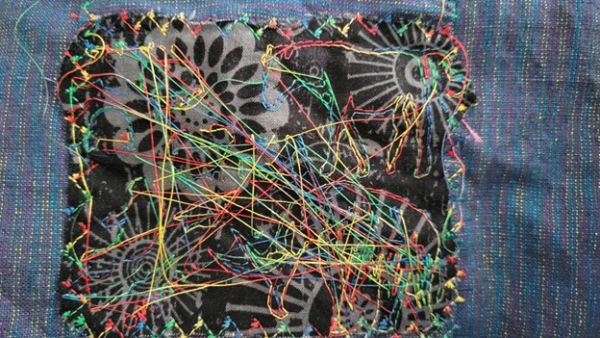
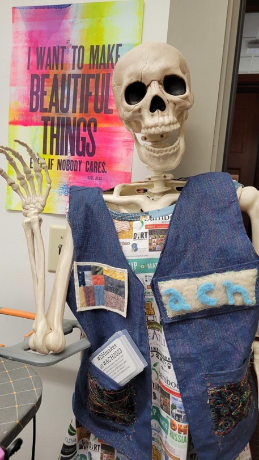
We experimented with how it might work to make a physical object together despite the distance between the participants. Each person in the group created something and mailed or emailed it to Quinn Dombrowski, who assembled it into a vest with badges, as worn by Girl Scouts. The vest had pockets: ideologically, in protest of the widespread absence of functional pockets in “women’s” clothing; in practice, allowing a non-textile making contribution (Visconti’s zine card deck) to be physically part of the overall vest. Karlin’s drawings of “DH animals” (including a Twitter bird, Mastodon, the DH sheep from DH 2014, DH Crow from DHSI, and “digital manatees”, riffing on a longstanding pun on “digital humanities”) were transformed into textile media, both via embroidery (for the pockets) and a digital knitting machine (for the back panel of the vest).

Figure 18.
Embroidery of #DHmakes DH animals drawing by Jojo Karlin with jump stitches left intact for a glitch art effect
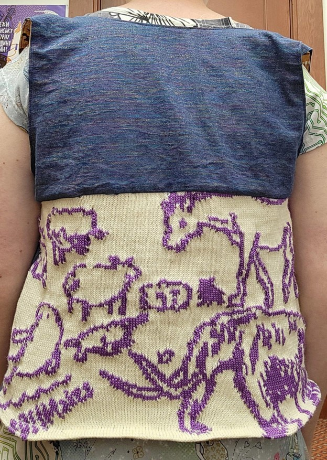
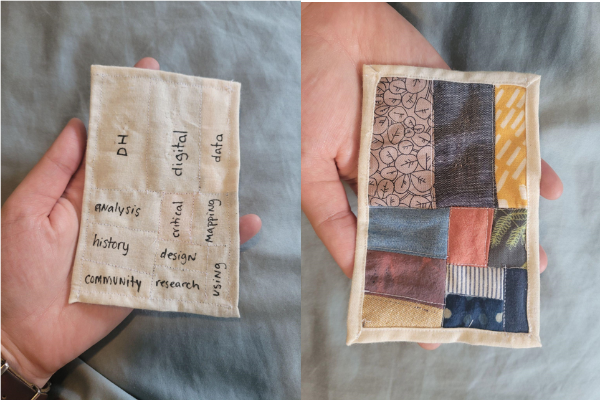
Berger visualized the top terms in ACH 2023 session titles as a quilt patch, and provided metadata for each section on the back.
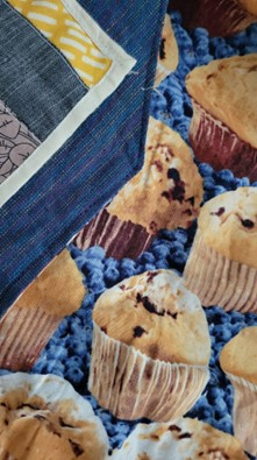
McDivitt used needle felting to create an ACH patch to commemorate the conference the project was created for. For the lining of the vest, Dombrowski used a blueberry muffin print, both as a playful and positive spin on the term “muffin top” and as an homage to the baking-related contributions to #DHmakes.
As an additional layer of community engagement for the project, the team crowdsourced suggestions for logos of “dead” DH projects: including tools/infrastructure that had been shut down, projects that were no longer maintained (and/or whose websites had lapsed), and organizations that were defunct. We printed these logos onto fabric and sewed them into a dress for Dr. Cheese Bones (a plastic skeleton who wore the prize-winning DH-WoGeM poster/dress at DH 2019 and ACH 2019, and who is now the Textile Makerspace mascot) to wear under the vest. What it means for something to be “dead” in DH is complicated and can be disputed. The crowdsourcing activity was of limited utility, with people reluctant to label their or others’ work that way. As a result, the choice of logos to include mostly came down to the discretion of the project team, particularly Dombrowski, who designed the final fabric. While the fabric included several logos of Dombrowski’s projects whose death had been discussed publicly such as Project Bamboo (Dombrowski 2014) and the Digital Research Tools directory (Grant et al. 2020, Dombrowski 2021), the need for more logos to fill the space led them to grapple with their own projects that were officially “on hold”, such as the Animal Crossing: New Digital Humanities talk series with Elizabeth Grumbach, and face the reality that these projects were, in fact, over. The logos on this fabric are not limited to projects where the creators have confirmed the death of the project or organization, and in some cases they are judgement calls or political statements, such as the inclusion of the DH Russia logo since many of the most active scholars had left the country and started a new organization.
The participants wrote up their collaborative project and shared it in advance of the conference, using it to encourage the DH community to attend the synchronous #DHMakes virtual meet-up on the last day of the ACH conference, where attendees could chat and work on their own crafts in the conference’s virtual social platform, WorkAdventure. WorkAdventure allowed attendees to move around as an avatar on a virtual map similar to a 1990’s era video game. When in close proximity to other avatars, attendees could engage in voice/video chat.
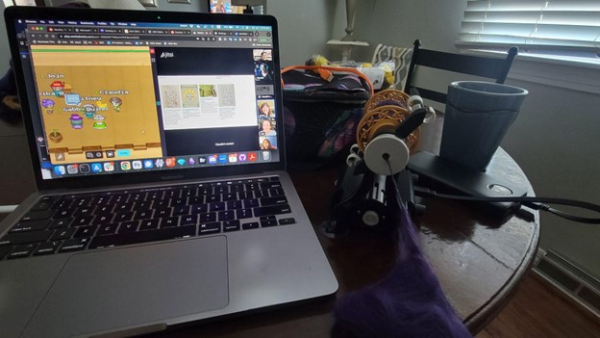
Figure 23.
Spinning wool into yarn while logged into the #DHmakes area of the ACH 2023 virtal conference
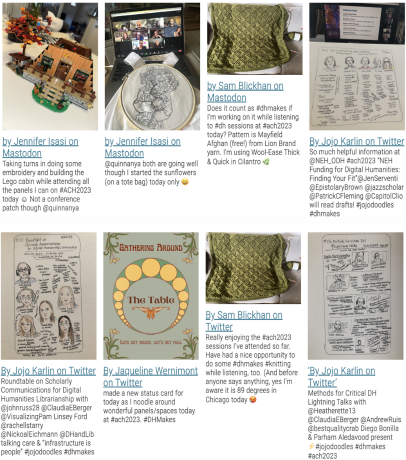
In order to be inclusive of people who could not make the synchronous virtual session, the participants encouraged ACH 2023 attendees to share their own craft projects using the #DHmakes hashtag, monitored several social media platforms for these posts, and assembled them into a webpage with an image grid to allow everyone to see everything, regardless of where they had taken to posting since the ongoing collapse of DH Twitter.
While there was no formal #DHmakes-associated session at DH 2023 in Graz, Dombrowski attended wearing the dress and vest designed as part of ACH 2023 and started an impromptu textile making activity during the conference. Dombrowski approached conference presenters asking for their favorite slide from their presentation, and then reinterpreted it using yarn and plastic mesh later that same day while sitting in conference sessions. Some of these were direct recreations of logos (including TextGrid, DraCor, and DH Cloud); others involved a more elaborate combination of several slides, and simplifying graphics to a point where they could be represented in a fairly widely-spaced mesh.
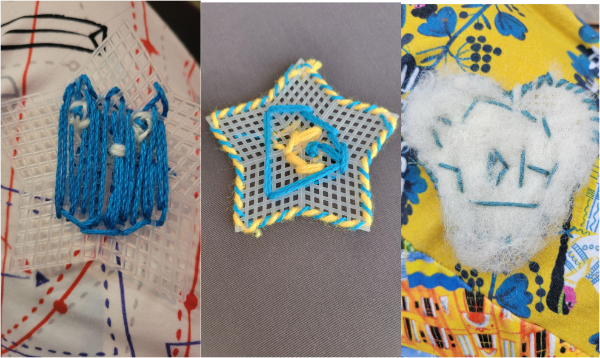

This grassroots initiative to bring textiles into the international DH conference succeeded in raising the visibility of this creative medium, and making textile creations a desirable unique souvenir from the event.
One downside of the approach used at DH 2023, where Dombrowski did all of the hands-on making work, was that it reinforced the idea of textile work as being inherently difficult and best left to specialists. While some textile work, like any other method used in digital humanities or beyond, benefits from training and experience, there are options like sewing yarn into a mesh, or using a circular knitting machine (Dombrowski 2024) that are accessible inroads into a fulfilling and creative expansion to a DH scholar’s toolbox. The organizers of the DH 2024 #DHmakes “mini-conference” (largely the same group of scholars as last year, with the addition of Farrah Cato and Gabriella Evergreen) have aimed to address this experiential gap by structuring the event in a more hands-on way, with a “craft social” where participants can bring their own crafts to work on together (or try a starter craft provided by the organizers); a brainstorming session for #DHmakes activities followed by a group making exercise involving a circular knitting machine, sewing yarn into mesh, or using a rigid heddle loom; and finally, an exhibit of creative craft DH work including a DH fashion show. Through these three components, organizers intend to facilitate community connection, an exploration of data visualization with textiles that bridges the theoretical and hands-on sides of this work, and a celebration that anyone at the conference can participate in, from those who create elaborate handmade work to colleagues who collect vintage DH or other geeky t-shirts.
7. Craft making in DH

To quote Élika Ortega, in a quip that was memorialized as a hand-printed poster at Ryan Cordell’s Skeumorph Press, “There is nothing more ephemeral than a website.” And yet, websites and other fragile, technologically-mediated scholarly products are so often all that digital humanities scholars have to show for years of labor. Physical objects are easier to preserve and pass on, and have an allure that makes them compelling to engage with and study, in a world oversaturated with the digital – but their existence is inherently limited to a specific time and place. As a collaborative, social media-based movement, #DHmakes is an effort to have the best of both craft and digital: taking craft-making and sharing it beyond the physical locations of these individual objects. #DHmakes is an answer to Natalia Cecire’s challenge from 2011: what if we shift the metaphors we use as an anchor for our work from digging to weaving or cooking or knitting? How does this support the often-espoused value of diversity in DH (Spiro 2012), and unsettle the typical answers to questions about who creates and benefits from scholarship, and what knowledges are valued? Just as crafting practices are most commonly learned and shared in community, through networks, and across generations, #DHmakes is a social phenomenon, an effort to build and maintain a community of makers at the intersection of digital humanities and craft, despite the infrastructural tumult of social media platforms over the last few years. Even a lightweight hashtag-based community takes time and care and effort to maintain – and organizing and editing collections such as the 2024 Making Research Tactile: Critical Making and Data Physicalization in Digital Humanities special issue of dh+lib in order to highlight and intellectually certify the legimicacy of this work takes particular effort. All of this, too, is labor, on top of the time-consuming craft-making work of #DHmakes as a scholarly practice.
As demonstrated by DH initiatives like SUCHO, the digital is already tactile: a missile is an imminent threat to everyone’s digital access to cultural heritage if it hits a data center, or severs an internet or power cable. The “cloud” is a poor metaphor for what ultimately amounts to other people’s physical infrastructure, as much in jeopardy in the context of war, disaster, or carelessness as any other tangible object. Representing digital work physically connects us back to the materiality of our digital making and serves as a reminder that the physical is not as distant as we might imagine. Moreover, the digital was born out of textiles: computers emerging from looms, punch cards used for data storage both for computers and knitting machines, fiber-based metaphors of webs and screens infusing the language of technology that has come so far it has forgotten its roots. #DHmakes and the work emerging out of this virtual community hold the promise of recovering those connections, and infusing them into the next generation of digital humanities, shifting both the narrative and the practice of how we do our work.
1. “Technology is the active human interface with the material world. But the world is consistently misused to mean only the enormously complex and specialized technologies of the past few decades… This is not an acceptable use of the word.” (Le Guin 2005)
2. e.g. the Association for Computers and the Humanities' mission states “ACH recognizes that this work is inherently and inextricably sociopolitical, and thus advocates for social change through the use of computers and related technologies in the study of humanistic subjects.” ( https://ach.org)
3. Of the terms Cecire lists, “raising or nurturing” is qualitatively different – an extended process of care, rather than an act of creation with a specific and tangible outcome. As such, it does not take part in the discourse of #DHmakes, but there are examples of writing from this same time period that explicitly engage in the relationship between care work and DH, such as “Missing Threads in a DH Origin Story” (Dombrowski 2023).
4. For more about institutional behavior and worker reactions during the academic year 2021-2022 in the United States, see “Visualizing Campus Reopenings” from the Visionary Futures Collective: https://visionary-futures-collective.github.io/covid19/reopening.
5. The Data-Sitters Club posted humorous daily “public health messages” for over a month starting with the US COVID-19 lockdowns: https://datasittersclub.github.io/site/covid19.html
8. https://web.archive.org/web/20220111164714/https://twitter.com/quinnanya/status/1480943110263689218
9. https://web.archive.org/web/20220114061725/https://twitter.com/quinnanya/status/1481870876417019904
10. https://web.archive.org/web/20220118220350/https://twitter.com/quinnanya/status/1483559503110885376
11. https://web.archive.org/web/20220118012146/https://twitter.com/quinnanya/status/1483246921846190080
12. https://web.archive.org/web/20220224173010/https://twitter.com/quinnanya/status/1496900226438742016
14. There are Wikipedia articles in several languages on this phrase that provide a broader context for its use in Ukraine, Russia, and elsewhere, e.g. https://en.wikipedia.org/wiki/Putin_khuylo!
16. The German-speaking DH community is one exception, as a group that has continued to actively use Mastodon for official purposes and community discussion and has been less enthusiastic about shifting to platforms that have emerged subsequently, such as Bluesky (where much of Anglophone DH Twitter has reconvened) or Meta’s Threads.
18. Body fat visible over the waistline of form-fitting pants or a skirt; for a more in-depth history and explanation, see the article on English Wikipedia: https://en.wikipedia.org/wiki/Muffin_top
19. For more on Animal Crossing: New Digital Humanities see https://digitalhumanities.stanford.edu/acndh/
References
Berger, Claudia. (2022). “Embodied Data Visualizations at DH Unbound 2022”. Blog post. May 31, 2022. https://claudiaeberger.com/embodied-data/embodied-data-visualizations-at-dh-unbound-2022/
Boggs, Jeremy. (2018). "A Carrier Bag Theory for Digital Collections". Arte Público Press / Recovering the US Hispanic Literary Heritage speaker series and workshop on digital humanities and social justice. February 19, 2018. https://www.youtube.com/watch?v=oC4obXYPGEs and https://jeremyboggs.net/carrier-bag-theory-for-dh/.
Briney, Kristin. (2022). “Crafting a COVID Visualization: How I Processed Pandemic Anxiety and Grief with Yarn”. Nightengale: Journal of the Data Visualization Society. January 11, 2022. https://nightingaledvs.com/crafting-a-covid-visualization/
Cecire, Natalia. (2011). “Introduction: Theory and the Virtues of Digital Humanities”. Journal of Digital Humanities, vol. 1, no. 1, winter 2011. https://journalofdigitalhumanities.org/1-1/introduction-theory-and-the-virtues-of-digital-humanities-by-natalia-cecire/
D’Ignazio, Catherine and Lauren Klein. (2020). “Show Your Work” in Data Feminism. March 16, 2020. https://data-feminism.mitpress.mit.edu/pub/0vgzaln4/release/3
Dombrowski, Quinn. (2013). “Missing Threads in a DH Origin Story”. Blog post, June 21, 2013. https://quinndombrowski.com/blog/2023/06/21/missing-threads-dh-origin-story/
Dombrowski, Quinn. (2014). “What Ever Happened to Project Bamboo?” Literary and Linguistic Computing, Volume 29, Issue 3, September 2014, Pages 326–339. https://doi.org/10.1093/llc/fqu026
Dombrowski, Quinn. (2021). “The Directory Paradox”. In People, Practice, Power: Digital Humanities Outside the Center. Ed. Anne B. McGrail, Angel David Nieves, Siobhan Senier. Minneapolis, MN: University of Minnesota Press. 2021. https://dhdebates.gc.cuny.edu/read/people-practice-power/section/ca87ec4c-23a0-452d-8595-7cfd7e8d6f0c
Dombrowski, Quinn. (2024). “Knot Hard: Accessible Textile Data Visualization with a Circular Knitting Machine”. DH+Lib 2024 special issue, ed. Claudia Berger, John Russell, Pamella Lach, and Nickoal Eichmann-Kalwara. April 29, 2024. https://dhandlib.org/2024/04/29/knot-hard-accessible-textile-data-visualization-with-a-circular-knitting-machine/
Doroudian, Gissoo. (2020). “Weave Derrida’s References”. Startwords, issue 1. October 2020. https://startwords.cdh.princeton.edu/issues/1/weaving-howto/
Grant, Kaitlyn et al. (2020). “Absorbing DiRT: Tool Directories in the Digital Age”. Digital Studies / Le champ numérique, vol. 10, issue 1. https://doi.org/10.16995/dscn.325
Koeser et al. (2019). “Data Beyond Vision”. DH 2019 poster. July 11, 2019. https://zenodo.org/records/3261531.
Koeser et al. (2020). “Data Beyond Vision”. Startwords, issue 1. October 2020. https://startwords.cdh.princeton.edu/issues/1/data-beyond-vision/
LeBlanc, Zoe et al. (2022). “A Conversation with the Organizers of Saving Ukrainian Cultural Heritage Online (SUCHO)”. Journal of Library Outreach and Engagement, vol. 2, no. 1. https://iopn.library.illinois.edu/journals/jloe/article/view/969
LeGuin, Ursula K. (2005). “A Rant About Technology”. Blog post. https://www.ursulakleguin.com/a-rant-about-technology
Madden, Áine. (2024). “‘There’s No One to Touch Jane When You’re in a Tight Place’: Pride and Prejudice and the Pandemic”. In: Expanding Austenland. Palgrave Fan Studies. Palgrave Macmillan, Cham. https://doi.org/10.1007/978-3-031-39454-6_7
Meneses, Luis, and Richard Furuta. (2019). “Shelf Life: Identifying the Abandonment of Online Digital Humanities Projects.” Digital Scholarship in the Humanities 34 (Supplement_1): i129–34. https://doi.org/10.1093/llc/fqy079.
Nowviskie, Bethany. (2012). “What Do Girls Dig?” In Debates in the Digital Humanities, ed. Matthew K. Gold. Minneapolis, MN: University of Minnesota Press. https://dhdebates.gc.cuny.edu/read/untitled-88c11800-9446-469b-a3be-3fdb36bfbd1e/section/76729465-02aa-4abb-8f14-90af33e5c340
Nowviskie, Bethany. (2015). “DH in the Anthropocene”. Digital Scholarship in the Humanities, Volume 30, Issue suppl_1, December 2015, Pages i4–i15. https://doi.org/10.1093/llc/fqv015
Ortega, Élika. (2014). “Multilingualism in DH”. Disrupting DH blog. December 31, 2014. https://web.archive.org/web/20150124044426/https:/www.disruptingdh.com/multilingualism-in-dh/
Reed, Ashley. (2016). “Craft and Care: The Maker Movement, Catherine Blake, and the Digital Humanities”. Essays in Romanticism, Volume 23, Number 1. https://doi.org/10.3828/eir.2016.23.1.4.
Smithies, James et al. (2019). “Managing 100 Digital Humanities Projects: Digital Scholarship & Archiving in King’s Digital Lab”. DH Quarterly vol. 13, no. 1. http://www.digitalhumanities.org/dhq/vol/13/1/000411/000411.html
Spiro, Lisa. (2012). “‘This is Why We Fight’: Defining the Values of the Digital Humanities”. In Debates in the Digital Humanities, ed. Matthew K. Gold. Minneapolis, MN: University of Minnesota Press. https://dhdebates.gc.cuny.edu/read/untitled-88c11800-9446-469b-a3be-3fdb36bfbd1e/section/9e014167-c688-43ab-8b12-0f6746095335
Stalp, Marybeth C, Emily A. Gardner, and Ashley Beaird. (2018). “‘I like knowing when the zombies arrive, I won’t be naked’: Young women and leisure handcrafting in the United States”. Craft Research, vol. 9, issue 1, Mar. 2018, p. 41-58. https://doi.org/10.1386/crre.9.1.41_1
Webber-Bey, Deimosa. (2014). “Runaway Quilt Project: Digital Humanities Exploration of Quilting During the Era of Slavery”. JITP 6. https://cuny.manifoldapp.org/read/runaway-quilt-project-digital-humanities-exploration-of-quilting-during-the-era-of-slavery-0f3051c0-9511-4642-9c91-9f47ad761442/section/f7beacd0-44e9-4c22-be61-8c2d5c0e01a0
- 투고일Received
- 2024-04-30
- 수정일Revised
- 2024-05-17
- 게재확정일Accepted
- 2024-05-30
- 출판일Published
- 2024-05-31
- 다운로드 수
- 조회수
- 0KCI 피인용수
- 0WOS 피인용수