

_3200-704_투명.png)
- ENGLISH
- E-ISSN3058-311X
Computational Thematic Analysis of Academic Representations of the Gisaeng in the Korea Citation Index (2000–2024)
Computational Thematic Analysis of Academic Representations of the Gisaeng in the Korea Citation Index (2000–2024)


Aurelia Martín Casares (University of Malaga)
강은경(Eun Kyung Kang) (University of Malaga)

Abstract
This article undertakes a computational thematic analysis of academic discourse on gisaeng (기생, 妓生) in contemporary scientific production in the Republic of Korea. The study draws on a corpus of 613 abstracts published in Korean between 2000 and 2024 in academic journals indexed in the Korea Citation Index (KCI), systematically pre-processed and analysed through the Ko-SRoBERTa model and BERTopic. By combining Korean natural language processing, semantic embeddings, dimensionality reduction, and unsupervised clustering, the analysis identified ten distinct topics, subsequently organized into four macro-themes: 1) Literature, 2) Performing Arts and traditional music, 3) Colonialism, modernity and exotization, and 4) Popular gisaeng The results reveal the predominance of literary and performative representations of these women, with particular emphasis on popular figures such as Hwang Jini and Chunhyang. Simultaneously, the findings underscore lack of academic studies. particularly regarding everyday lives, maternity, and vulnerabilities of gisaeng, which remain largely excluded from academia. The result reveals the interpretive potential of deep learning models in historiographical, cultural and gender analysis, not as a substitute for close reading but as complementary tools capable of mapping discursive patterns, silences, and emerging lines of inquiry. By tracing a thematic cartography of recent Korean academic production, this article contributes both to digital humanities methodology and to a more nuanced understanding of how the gisaeng are constructed in academic discourse, contested, and reconfigured in contemporary scholarship.
- keywords
- Gisaeng, Korean Studies, Digital Humanities, Topic Modelling, BERT
1. Introduction
Gisaeng women have been predominantly represented as both courtesans and professional artists in Korean cultural tradition. They have captured the attention of scholars across disciplines such as literature, history, gender studies, musicology, or performing arts and have been symbolized as active cultural agents during the Joseon dynasty, objects of sexual exploitation or as icons of resistance during the Japanese colonial period. This fragmentation within their representation in academic literature generates discourses that oscillate between aesthetic admiration, feminist critique and ethnographic analysis.
This study proposes a methodological approach centred on computational thematic analysis to explore how the gisaeng have been represented in contemporary Korean academic production. To this end, a corpus was built from academic articles indexed in the Korea Citation Index (KCI) between 2000 and 2024, written in Korean and including the term gisaeng (기생) in the title, keywords, or abstract. A deep learning model based on S-BERT was applied to this corpus, designed to generate contextualized semantic representations and enable thematic clustering of the texts through the BERTopic tool. This technique identified 13 emerging topics, which were subsequently grouped into 4 representative macro-themes through a process of qualitative interpretation: (1) literature and gender; (2) performing arts and traditional music; (3) colonialism, modernity and exotization; and (4) popular gisaeng figures. This article focuses on the critical analysis of these macro-themes, combining automatic semantic segmentation with close reading of the most representative texts in each group. Through this approach, the study examines the structural, conceptual, and rhetorical differences that shape the ways in which gisaeng are represented in current academic production in the Republic of Korea, attending both to dominant discourses and to marginal or emerging narratives. This methodological procedure makes it possible to trace a thematic cartography of recent academic imaginary on gisaeng, while enabling a critical reading of its continuities, ruptures, and silences. Ultimately, this study seeks to appreciate the interpretative potential of deep language models in cultural analysis and to offer a panoramic, nuanced, and relational view of how gisaeng are constructed and reconfigured in current Korean studies.
2. The Pertinence of Using Digital Humanities to Understand Discourses on Gisaeng in Recent Academic Production
Gisaeng occupy an ambiguous and highly symbolic place in Korea's cultural history and have been traditionally defined as women who performed functions of entertainment, with artistic skills, such as playing musical instruments, reciting poetry, and dancing, within the patriarchal context of Confucian Korea. These women operated according to official frameworks and there were several categories, such as the gwangi (官妓), attached to government offices, gunggi (宮妓), linked to palace contexts, or mingi (民妓), linked to private domains1. Over time and across sources, gisaeng have been represented in dual and contradictory ways: on the one hand, idealized as aesthetic symbols of national culture and Korean femininity, and, on the other, objectified as sexual commodities and stigmatized due to their association with sexuality and prostitution. Their role during the Joseon dynasty and the Japanese colonial period has been undeniably studied and the core of these divergent interpretations, oscillating between their recognition as precursors of female emancipation and their association with sexual exploitation2. From a historiographical perspective, several studies have highlighted the terminological richness surrounding the concept of gisaengs, showing how terms such as ginyeo (妓女), changgi (娼妓), or sucheonggi (守廳妓) were used interchangeably at different times to describe similar functions under shifting ideological frameworks, especially with the rise of Neo-Confucianism in mid-Joseon3. These categorizations not only reflect the changing status of these women, but also the social and political discourses that defined their visibility and legitimacy.
Despite growing scholarly interest, significant gaps persist in research on the gisaeng. As Jung Byungsul (2007) has noted, the everyday lives of these women have been little explored, with analyses often privileging exceptional figures such as Hwang Jini or Maejang over the study of their daily experiences. The author also points out the existence of profound childhood traumas among many gisaeng, with multiple references to systematic sexual abuse. Such experiences undoubtedly shaped their life trajectories in lasting ways, as well as their relationships with their environment, bodies, and art. Yet these aspects remain scarcely addressed in academic publications, despite their relevance for a fuller understanding of the agency of these women. This omission is especially significant considering the persistence of the gisaeng as a cultural symbol in present-day Korea, where they continue to evoke tensions between memory, gender, and nation4. A more nuanced understanding of these women therefore requires a methodological approach that combines social history, discourse analysis, and cultural studies, attending both to the material conditions of their existence and to the ways in which they have been represented and reinscribed in the collective imagination. In this respect, the tools and approaches of the digital humanities open new possibilities for systematically tracing the representations, discourses, and silences that have shaped academic knowledge about the gisaengs. To date, no large-scale automated thematic analysis has been carried out that would allow a structured observation of the predominant and emerging discursive lines in the field. This study aims precisely to provide an initial cartography, generated through deep language models, as a starting point for future qualitative research to explore the identified thematic clusters in greater detail and thereby move toward a deeper, more critical, and contextualized understanding of the figure of the gisaengs. In this context, it becomes pertinent to ask how gisaeng have been treated in recent academic production. Beyond studies focused on emblematic cases or on literary and visual representations, there remains a need for a panoramic and systematic perspective that makes it possible to observe the discursive dynamics that have structured scholarly knowledge about these women. In this regard, the quantitative analysis of scientific production offers a suitable methodological avenue for detecting patterns, silences, and shifts in the academic treatment of the subject. In recent years, the quantitative analysis of scholarly output has gained increasing relevance in the Humanities, driven both by the development of specialized databases and by the incorporation of tools from computational linguistics and artificial intelligence. This methodological turn has not only enabled the systematization and visualization of large volumes of scientific literature but has also opened new questions about the ways in which knowledge is constructed, circulates, and is transformed within specific academic communities.
Over the past two decades, digital humanities have become a key interdisciplinary field that integrates traditional humanistic approaches with computational tools, visualization, and quantitative analysis, opening new ways of asking questions and representing knowledge5. In Korea, this expansion has been particularly significant thanks to the early digitization of archives, open-data policies, and institutional support. As Cha and Wall note6, Koreanists now have privileged access to large digital repositories, though Cha78 warns against reducing this research to purely computational analyses. Scholars such as Kim Baro9 have also emphasized the importance of combining technical training with humanistic perspectives.
Within this context, computational approaches such as Latent Dirichlet Allocation10 and deep learning models like BERT11 allow large-scale analyses of academic discourse. These techniques go beyond word counts, revealing thematic clusters, semantic shifts, and emerging lines of meaning, often supported by visualizations such as UMAP. For the case of this study, these tools enabled the mapping of discursive patterns, silences, and transformations about gisaeng in the Korean scholarly discourse between 2000 and 2024. However, it is important to underline that automated analysis cannot replace critical reading. As Moretti12, Jockers13 and Underwood14 stress, distant reading must complement close reading. Similarly, Ricoeur15 and later Braun and Clarke1617 highlight the need to situate interpretation within its social and historical conditions. In this study, BERTopic serves not as a substitute for qualitative work but as a starting point to identify thematic clusters that future research can explore in greater depth.
3. Topic Modelling on the KCI Corpus
This study focuses on the application of BERT, specifically the jhgan/ko-sroberta-multitask18, to analyse South Korean academic discourse on the gisaeng, with the aim of identifying the main thematic frameworks through which they were constructed and problematized. To this end, a methodological process was developed that combines Korean natural language processing with unsupervised machine learning algorithms, integrating tools for morphological tokenization, semantic vector representation, dimensionality reduction, clustering, and topic modelling.
The corpus analysed consists of 632 abstracts of academic articles published in Korean, extracted from the Korea Citation Index (KCI). To build the corpus, a search was conducted in March 2025 through the Journal Search interface (논문 검색) of the Korea Citation Index (KCI) portal19. The term "기생" (gisaeng) was entered in the general keyword field, with the search scope set to all available fields (title, abstract, and keywords). The search was restricted to publications classified under the Humanities (인문학) subject category. This initial search yielded a total of 969 articles. A subsequent manual screening was carried out to refine the results, since a significant number of texts used the term gisaeng not in reference to the historical women so designated, but as a synonym for the biological or metaphorical concept of "parasite" (a homograph in Korean language). This first conceptual filtering added to those whose metadata did not include an abstract, or whose abstract was in a language other than Korean, reduced the corpus to a total of 632 abstracts written in modern Korean.
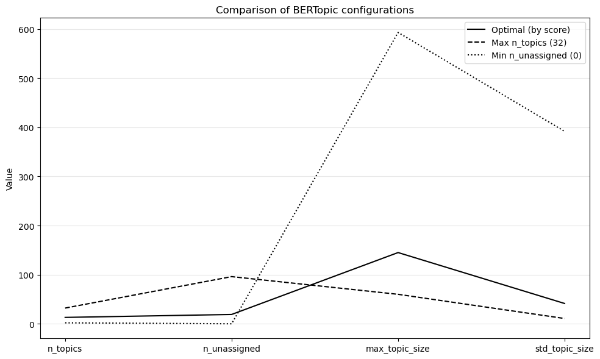
To prepare the texts for computational analysis, morphological tokenization was applied using the Okt (Open Korean Text) analyser, focusing exclusively on nouns with a minimum length of two characters. This decision was based on the consideration that nouns constitute the lexical units with the highest semantic density in academic discourse and are therefore the most suitable candidates for topic modelling tasks. However, this grammatical filtering was complemented by a second level of refinement through an extensive stopword list specifically developed for this study. This list was not limited to standard dictionaries but was instead constructed and refined manually through an iterative inspection of the corpus, evaluating the frequency and informational value of each term. This dual filtering, by word class and by lexical content, is not redundant but complementary: while restricting to nouns excludes particles, generic adjectives, and grammatical verb forms, the stopword filtering removes highly frequent but thematically uninformative nouns in the corpus context. It should be noted that although textual preprocessing was based on grammatical filtering focused exclusively on nouns, the final stopword list also included some words that do not formally belong to this category. This is because certain terms, such as particles, adverbs, or complex grammatical expressions, are occasionally tagged as nouns by the Okt analyser due to contextual ambiguities or imperfect segmentation. The manual inclusion of these cases in the stopword list was intended to remove lexical units of low semantic density which, although not true nouns, recurrently appeared as such in the analyser's output. This methodological decision optimized the quality of the final corpus without contradicting the principle of focusing on informative nouns, thereby enhancing the accuracy of topic modelling and the interpretability of the results, in line with previous studies on Korean lexical analysis for NLP tasks in the digital humanities20. Once the texts were pre-processed and their embeddings generated using the Ko-SROBERTa model, the next step was to determine the optimal parameter configuration for the BERTopic model by means of a systematic grid search across possible hyperparameter combinations for the UMAP (for dimensionality reduction) and HDBSCAN (for cluster detection) algorithms. A total of 5,460 different BERTopic configurations were evaluated, systematically combining values of the parameters min_cluster_size, min_samples, n_neighbors and min_dist. For each configuration, key metrics were calculated, including the total number of topics detected (n_topics), the number of documents unassigned to any topic (n_unassigned), the size of the largest topic (max_topic_size), and the standard deviation of topic sizes (std_topic_size). Based on these results, the following values were selected as optimal: min_cluster_size =13, min samples =2, n_neighbors =10 and min_dist =0.0, which offered a robust balance between thematic granularity, semantic coherence, and a low rate of unassigned documents. Figure 1 visually compares this optimal configuration with two extreme reference cases: the one that produces the largest number of topics and the one that achieves the smallest number of unassigned documents. The comparative analysis shows that the selected configuration not only maintains a controlled distribution of topic sizes but also maximizes effective document assignment, thereby ensuring meaningful thematic segmentation that can be utilized for subsequent qualitative analysis.
To ensure the full reproducibility of the topic model, a comprehensive system was implemented for saving all intermediate and final products of the analysis. Instead of recalculating the model in each run, which could introduce slight variations due to the non-deterministic nature of the HDBSCAN algorithm and differences across hardware environments, the generated embedding vectors for each text, the fully trained BERTopic model (including UMAP, HDBSCAN, and the vectorizer), and the results with topic assignments for each document were persistently stored. This decision follows current methodological recommendations in reproducible data science, which are particularly relevant in contexts involving morphologically rich or non-segmented writing systems, such as Korean, where tokenization and preprocessing choices have a significant impact on topic modelling outcomes21. By preserving these objects in reusable formats (.npy for embeddings, .csv for results, and a structured folder for the model), the need for recalibration is avoided and external replication of the results by other researchers is facilitated, thereby ensuring methodological transparency and consistency.
Based on this analysis, a final configuration was selected that produced 13 well-differentiated topics, with 613 documents assigned and only 19 unassigned, representing a robust balance between analytical depth and thematic coverage. This strategy of exhaustive parameter evaluation ensured that the results of topic modelling were not only computationally efficient but also analytically interpretable and methodologically sound. In the same vein, special attention was paid to the semantic quality of the pre-processed corpus, particularly with respect to the definition of the stopword list (Table 1), whose impact on topic segmentation is especially significant in morphologically rich corpora such as Korean. The criterion for inclusion in the stopword list was based both on frequency of occurrence and on the low informational value of certain terms for the detection of thematic content. Grammatical particles and discourse connectors that, although occasionally tagged as nouns by the Okt analyser, lacked significant semantic density were removed. Common expressions in academic writing were also excluded, as well as impersonal and collective pronouns or deictics whose presence hindered precise semantic segmentation.
In addition, vague determiners and quantifiers, temporal expressions, and contextual adverbs were removed due to their tendency to appear redundantly without directly contributing to topic detection. Furthermore, the term 'gisaeng', the central theme of the study, was deliberately excluded to prevent its high frequency from artificially dominating the topic modelling results. This exclusion allowed the topics to emerge around the contextual, functional, and symbolic aspects associated with the gisaeng, rather than from their literal mention. The stopword list was progressively refined throughout the modelling process, following iterative evaluations of the results generated through embeddings. This refinement resulted in a more coherent and analysable thematic representation.
Table 1.
Stopword List Categories (Table Title)
| Category | Korean stopwords |
|---|---|
| Grammatical and functional particles | 우리, 자기, 자신, 여러분 |
| Common expressions in research | 문제, 내용, 자료, 의미, 과정, 기준으로, 관련, 기타, 생각한대로, 연구, 분석 |
| Personal and demonstrative pronouns | 우리, 자기, 자신, 여러분 |
| Vague determiners and quantifiers | 무엇, 무슨, 아무도, 약간, 정도 |
| Temporal and contextual expressions | 때문, 때문에, 다시, 시기, 언제, 여기, 이전, 이후, 지금, 우선, 최대한 |
| Other adverbs and discursive expressions | 가까스로, 오히려, 만약, 만일, 가령, 단지, 거나, 거의, 경우, 다른, 여덟 |
| Term filtered by thematic content | 기생 |
Subsequently, the texts were represented in a high-dimensional vector space using semantic embeddings generated by the jhgan/ko-sroberta-multitask model, a variant of SBERT trained for Korean through multiple semantic tasks such as textual inference, classification, and information retrieval. This model, available via the sentence-transformers library, produces dense representations that capture global semantics and enable the detection of latent similarities between documents. These embeddings, like other BERT-base models, have 768 dimensions, a standard size that ensures rich contextual information. To facilitate clustering and visualization, dimensionality reduction was performed with UMAP (Uniform Manifold Approximation and Projection), configured with ten neighbours, five components, and a minimum distance of zero, using cosine similarity. These parameters, selected through grid search optimization, preserved both local coherence and the global structure of the corpus in the reduced space. The resulting distribution is shown in Figure 2, where the documents can be observed in two dimensions prior to the qualitative colouring of clusters.
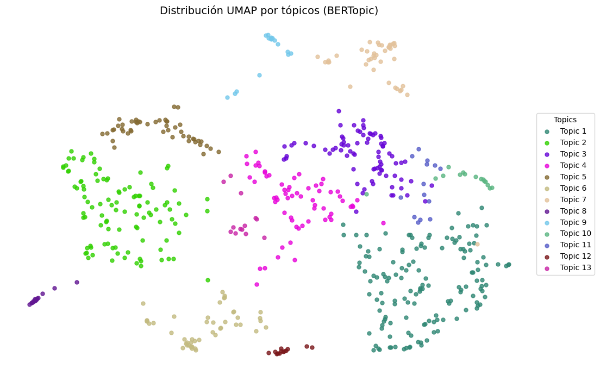
On this reduced semantic space, clustering was performed with HDBSCAN, configured with a minimum cluster size of ten and two samples per cluster. This produced dense groups of semantically related abstracts, while documents without sufficient affinity were classified under the label -1 and erased from the visualization. From this segmentation, the BERTopic model generated thematic groups defined by their most distinctive lexical features. To refine topic assignments, a count-based vectorizer was used with the option calculate_probabilities=True, enabling not only the identification of each document's dominant topic but also its probabilistic distribution across others.
In the following section, these topics are qualitatively categorized, and the resulting thematic map is presented. Beyond the static visualization included in this article, an interactive version of the UMAP is accessible online through Hugging Face Spaces, allowing readers to explore the corpus in greater detail22. All datasets, preprocessing scripts, and the full codebase of the application have been deposited in Zenodo23.
4. Analysis of the Results
Based on the topic model generated with BERTopic, it was possible to identify the keywords that define each of the thematic clusters (Table 2). The title assigned to each topic was the result of an interpretive analysis grounded in the systematic reading of the titles and abstracts of all the articles it comprised, complemented by the keywords generated through the c-TF-IDF (class-based Term Frequency-Inverse Document Frequency) model, which calculates the relative weight of each word within a topic compared to the rest of the corpus. Subsequently, the topics were manually organized into four analytical macro-themes, according to their semantic affinity, object of study, and methodological approach: (1) Literature and gender; (2) performing arts and traditional music; (3) colonialism, modernity and exotization; and (4) popular gisaeng figures. The following table synthesizes this categorization, showing for each topic its identifier number, the interpretive title assigned, the corresponding macro-theme, the most relevant keywords in Korean and in Spanish, the total number of documents grouped in each and the respective percentage. This classification constitutes the basis for the in-depth thematic analysis developed in the following sections.
Table 2.
Thematic Breakdown of BERTopic
| Topic Number | Topic Name | Macro theme | Keywords in Korean | Keywords in English | N° of Doc. | % |
|---|---|---|---|---|---|---|
| Topic 1 | Literary Constructions of Gisaeng and Female Subjectivity in Korea | Literature and gender | 여성, 남성, 사랑, 사회, 욕망, 담론, 주체, 그녀, 근대, 소설, 문화, 활동, 공연, 음악, 권번, 조합, 극장, 전통, 연행, 정재 | woman, man, love, society, desire, discourse, subject, she, modernity, novel | 145 | 23.66% |
| Topic 2 | Associations, Training Houses, and the Performance Practices of Gisaeng | Performing arts and traditional music | 문화, 활동, 공연, 음악, 권번, 조합, 극장, 전통, 연행, 정재 | culture, activity, performance, music, gwonbeon (gisaeng guild), association, theatre, tradition, stage performance, court dance (jeongjae) | 104 | 16.97% |
| Topic 3 | Literature From Classical and Fiction to Colonial Novels: Female Figures, Desire, Gender and Transgression Discourses | Literature and gender | 소설, 작품, 이야기, 인물, 문학, 작가, 창작, 서사, 역사, 한국 | novel, work, story, character, literature, author, creation, narrative, history, Korea | 79 | 12.88% |
| Topic 4 | Premodern Narratives, Historiography, and Self-Representations of Gisaeng | Literature and gender | 기녀, 시인, 한시, 문학, 사대부, 퇴계, 작품, 여성, 남성, 문인 | gisaeng, poet, classical literature, literature, sadaebu (Confucian literati), Toegye, work, femininity, masculinity, literary person | 63 | 10.28% |
| Topic 5 | Anthologies, Performance, and the Musical Legacy of Gisaeng | Performing arts and traditional music | 시조, 가곡, 가집, 작품, 향유, 가사, 편찬, 세기, 노래, 여창 | sijo, gagok (classical Korean song genre), song anthology, work, appreciation/enjoyment, gasa (narrative verse form), compilation/editing, century, song, female singer | 48 | 7.83% |
| Topic 6 | Visualizing and Controlling Gisaeng: Tourism, Print Media, and Colonial Discourse | Colonialism, modernity and exotization | 조선, 관광, 평양, 일본, 경성, 잡지, 학교, 일본인, 발행, 사진 | Joseon, tourism, Pyeongyang, Japan, Gyeongseong (Seoul under Japanese rule), magazine, school, Japanese person, publication, photograph | 47 | 7.66% |
| Topic 7 | Chunhyangjeon and Its Adaptations: From Classical Fiction to Modern Film | Popular gisaeng figures | 춘향전, 도령, 영화, 인물, 사랑, 남원, 서사, 신분, 이몽룡, 옥중 | Chunhyangjeon, Nobleman (Doryeong), film, character, love, Namwon, narrative, social status, Yi Mongryong, in prison | 40 | 6.53% |
| Topic 8 | Revisiting the Archival Files on Gisaeng and Prostitutes: Documentation, Errors, and New Perspectives | Colonialism, modernity and exotization | 창기, 조합, 서류철, 공창제, 통감부, 일제, 대한제국, 성매매, 속령, 오류 | prostitute, association, file, system of public prostitution, Office of the Resident-General, Imperial Japan, Korean Empire, prostitution, ordinance, error | 16 | 2.61% |
| Topic 9 | Pansori, Female Singers, and the Cultural Transmission of Vocal Traditions | Performing arts and traditional music | 판소리, 지역, 소리, 전승, 명창, 대목, 바디, 전주, 통속, 사설 | pansori, region, sound/voice, transmission (heritage), master singer (Myeongchang), passage/section (Daemok), variant/version (Badi), Jeonju, popular/common (Tongsok), lyrics/text (Saseol) | 16 | 2.61% |
| Topic 10 | Hwang Jini and the Cultural Reimagining of Korea's Most Iconic Gisaengs | Popular gisaeng figures | 황진이, 그녀, 인간, 황진, 중력, 자아, 송도, 사랑, 이미지, 작품 | Hwang Jini, she, human being, Hwangjin, gravity, self, Songdo, love, image, work | 15 | 2.45% |
| Topic 11 | Gender, Class, and Narrative Conflicts in Korean Literature from Joseon to Modernity | Literature and gender | 무정, 인물, 사건, 안평대군, 이데올로기, 이광수, 가부장제, 득옥, 진술, 계급 | Mujeong (The Heartless, novel by Yi Gwang-su), character, event/incident, Prince Anpyeong, ideology, Yi Gwang-su, patriarchy, Deuk-ok (character name), statement/testimony, social class | 14 | 2.28% |
| Topic 12 | Gisaeng, Activism, and National Movements in Modern Korean History | Colonialism, modernity and exotization | 운동, 태극기, 활동, 구제, 참여, 고아원, 단체, 수재민, 자원, 김구 | movement, South Korean flag, activity, humanitarian aid, participation, orphanage, organization, flood victims, volunteering, Kim Gu | 13 | 2.12% |
| Topic 13 | Regional Identity and Cultural Imagination in Pyeongyang's Literary and Artistic Representations | Performing arts and traditional music | 평양, 논개, 관서, 지역, 주요, 조선, 작품, 대시, 대동강 이야기 | Pyeongyang, Nongae, Gwanseo (northwestern region of Korea), region, important, Joseon, work (literary/artistic piece), courtship/declaration of love (Daesi), Daedong River, story/narrative | 13 | 2.12% |
Figure 3 presents the distribution of documents in the UMAP space, where each colour represents one of the themes identified by BERTopic. The shades within the red, yellow, blue or purple scales indicate the correspondence of each theme to a common macro theme. Colour intensity corresponds to the number of documents per theme, enabling visualization of their relative density. This visualization makes it possible to more clearly perceive the global organization of the corpus around the major discursive lines that structure academic production on the gisaeng.
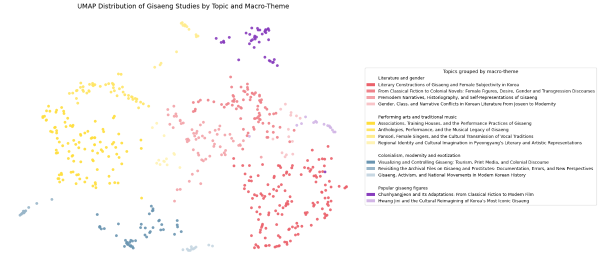
The thematic content analysis shows that, among the 613 documents assigned to a specific theme, the largest macro-theme is Literature and Gender with 301 documents (49.1%). It is followed by Performing arts and traditional music with 181 documents (29.5%), Colonialism, modernity and exotization with 76 (12.4%), and finally Popular gisaeng figures with 55 (9.0%). This distribution indicates that KCI scholarship on gisaeng is primarily anchored in literary and performative perspectives, while studies on colonial discourse, tourism, and visuality, as well as on emblematic individuals such as Hwang Jini and Chunhyang, appear as more specialized but nonetheless significant areas of inquiry. More than half of the corpus is concentrated in three themes: Topic 1 on literary constructions of gisaeng and female subjectivity (145 documents), Topic 2 on associations, training houses, and performance practices (104), and Topic 3 on female figures, desire, and gender in fiction (79). By contrast, the least represented are Topics 11, 12, and 13, with 14 and 13 documents each, focused respectively on the genderized role of gisaeng, class, and narrative conflicts in the context of Korean Literature, on modern activism and national movements, and on regional cultural representations in Pyeongyang. The UMAP visualization of the corpus (Figure 3) reflects this distribution: at the centre lies Literature and gender (red), the largest and most structuring nucleus, from which other clusters radiate; to its left appears Performing arts and traditional music (yellow), forming a relatively autonomous block; Colonialism, modernity and exotization (blue) occupies a transversal position in the lower-left, linked to visual and political discourses; while Popular gisaeng figures (purple) remains more peripheral on the upper and upper-right area, bridging literature and performance through emblematic figures. This cartographic overview provides the structural outline of gisaeng scholarship. To understand how these clusters are constituted, it is necessary to turn to the thematic cores themselves.
The corpus on Literary Constructions of Gisaeng and Female Subjectivity in Korea (Topic 1) demonstrates how these women have been mobilized as a narrative device to interrogate chastity, virtue, desire, and modernity. Premodern studies revisit the "virtuous gisaeng" and the rhetoric of chastity not as fixed categories but as contested fields of symbolic negotiation. For example, Kim Boram's work on the ideology and practice of chastity among Joseon gisaeng reveals virtue as a performative construct rather than a stable moral code, while Cho Hyun Woo reframes the "righteous gisaeng" as a narrative effect oscillating between moral celebration and didactic exploitation. Comparative studies linking Korean legends with sinicized sources, such as Du Shiniang, situate the gisaeng within a broader trans-Asian constellation of loyalty and tragic desire. Modern and contemporary analyses shift the focus toward celebrity, media, and gender politics. Jiyoung Suh's studies on "public intimacy" explain how gisaeng became media celebrities whose erotic and artistic capital was commodified through print and visual culture. Similarly, scholarship on Kim Mal-bong, highlights how female characters were reconfigured as sex workers or precarious youth in postwar fiction, intertwining romantic redemption, stigma, and gendered economies. Even in popular Cold War genres such as thrillers, works like gisaeng spy Kim Sosan reveal the gisaeng figure as a threshold between desire, surveillance, and nationalism. Methodologically, these studies combine discourse analysis, feminist hermeneutics, and media sociology, emphasizing the gisaeng not as a fixed occupation but as a semantic node for social imaginaries. From Classical Fiction to Colonial Novels (Topic 3) traces the transition from Joseon narratives to colonial-era novels, focusing on how female desire and transgression became metaphors for modern subjectivity. Studies of Kim Dong-in's "When the Eyes Barely Open" and works such as The Song of Bu-yong's Longing and Danbalryeong illustrate how inherited conventions were reshaped under colonial conditions. Yi Gwang-su's Mujeong (The Heartless) emerges as a key paradigm, embodying tensions between patriarchy, nationalism, and female subjectivity. Analyses highlight the ambivalence of women as desiring subjects and disciplined bodies, making literature a space of negotiation between tradition and modernity. Keywords such as "novel," "narrative," "woman," "desire," and "modernity" underscore the interdisciplinary orientation of this topic, where female figures serve as metaphors for the dilemmas of modernization.
The theme Premodern Narratives, Historiography, and Self-Representations of Gisaeng (Topic 4) turns to sijo, gasa, and hanmun literary records to show how gisaeng were both objects of literati projection and active poetic voices. Studies of poem exchanges (sujak sijo) and circles like the Samhojeong poetry society reveal gisaeng not only as muses but also as creators who deployed irony and critique within Confucian constraints. Figures such as Hwang Jini and Non Gae appear as "righteous gisaeng," invested with patriotic virtue in contexts of war and crisis. While most sources are male-mediated, attributed sijo and gasa demonstrate moments of female self-representation that articulate desire, loneliness, and aspirations for recognition. These contributions highlight gisaeng as cultural agents whose voices shaped literary memory and challenge a purely masculinized historiography. Finally, Gender, Class, and Narrative Conflicts in Korean Literature from Joseon to Modernity (Topic 11) foregrounds Yi Gwang-su's Mujeong as a crucible for debates on patriarchy, ideology, and class conflict. Feminist readings interpret the female characters as embodying both promises of emancipation and enduring patriarchal constraints, while Marxist critiques underscore class hierarchies and nationalist aspirations embedded in the novel's love plots. References to Prince Anpyeong connect premodern concerns with colonial literature, showing continuity in ideological preoccupations. These studies consistently emphasize that gender and class were constitutive of literary modernity, with female figures functioning as symbolic sites where collective anxieties about nation and modernization were inscribed.
Taken together, the Literature and Gender macro-theme illustrates that gisaeng and other female figures are not static literary types but dynamic discursive constructs. Across premodern, colonial, and modern contexts, they operate as prisms for interrogating morality, desire, class, and national identity. The scholarship demonstrates that female subjectivity emerges less as a historical given than as a contested site shaped by shifting regimes of discourse and cultural production.
The research grouped under the following macro theme on Performing arts and traditional music examines the institutional, repertorial, and performative dimensions of gisaeng as professional artists. Far from treating their work as "remnants of tradition," these studies emphasize the processes of guild organization, professionalization, and repertoire standardization that shaped their role as cultural mediators. One strand highlights the long historical roots of gisaeng performance. Archival sources such as the Mukjae ilgi document the cooperative configurations between gisaeng and musicians as early as the sixteenth century, revealing defined obligations, wages, and hierarchies that positioned performance as regulated labour rather than occasional entertainment. A second axis focuses on the urban performance culture of the early twentieth century, particularly the role of gwõnbeon guilds as institutions that centralized training in singing, dance, and etiquette. Analyses of newspapers, hand programs, and memoirs illustrate how gisaeng ensembles acquired public visibility while becoming dependent on intermediaries and theatre infrastructures. Studies of works like Yet'an ilbaegin portray gisaeng groups of the 1910s as professional collectives embedded in circuits of contracts, auditions, and touring. A further set of contributions addresses the musical repertoire itself, with particular attention to sijo, gagok, and gasa. Anthologies such as Gyobang gayo and early twentieth-century compilations are examined as vehicles for canon formation and cultural preservation. At the same time, research on female vocalists (여창) demonstrates how gagok and sijo were adapted to concert settings, with transformations in vocal projection, staging, and audience reception. These works underscore the reflexive reinvention of "tradition" as part of modern performance culture. Another focus is the role of gisaeng in pansori transmission. Studies highlight their contribution as performers and teachers in regional variants, such as those in Chungcheong, as well as their technical innovations in voice, ornamentation, and declamation. This revaluation challenges male-centred historiography by showing how gisaeng expanded the expressive range of pansori and sustained its pedagogical transmission. Finally, Topic 13 situates gisaeng practices in the cultural geography of Pyeongyang. Here, literature, lyric traditions, and performance converge in articulating regional and national identities. Figures such as Nongae and motifs tied to the Daedong River underscore the symbolic dimension of gisaeng artistry as markers of resistance, loyalty, and local belonging.
Overall, this macro theme demonstrates that gisaeng were not incidental entertainers but key agents in the institutionalization, preservation, and transformation of Korean vocal and performative traditions. By bridging classical repertoires and modern infrastructures, they ensured the continuity of sijo, gagok, gasa, and pansori while situating their work within broader circuits of identity, memory, and cultural modernity.
The third macro theme focusses on colonialism, modernity and exotization of the gisaeng. It examines how these women were redefined under colonial modernity as both cultural emblems and objects of state regulation. The 47 studies grouped in Topic 6 highlight the role of photography, tourism, and print culture in transforming gisaeng into icons of a picturesque "Korean tradition". Postcards and visual media circulated in Gyeongseong and abroad displaced performers from artistic contexts to a colonial showcase, while magazines such as Tourist Korea instrumentalized gisaeng as tourist attractions and symbols of national otherness. At the same time, colonial authorities deployed legal and bureaucratic categories to discipline their bodies, conflating performers with prostitutes within a system of surveillance and economic control. All these processes emphasized Korea as a destination for sexual tourism directed to the Japanese traveller. Topic 8 focuses on the colonial administrative archives that documented gisaeng and registered prostitutes (창기) during the transition from the Korean Empire to the Japanese Residency-General. Studies reveal the artificiality of these records: duplications, misclassifications, and inconsistencies expose the bureaucratic production of categories rather than a reflection of social realities. The research underscores that these files must be read critically, not as neutral sources but as instruments of colonial governance aimed at redefining entertainment and sexuality under Japanese rule. Finally, Topic 12 highlights gisaeng as participants in modern activism and humanitarian work. Articles document their involvement in independence movements, their symbolic appropriation of the Taegeukgi flag, and their participation in relief campaigns such as the 1925 flood response. These accounts challenge reductive views of gisaeng as purely artistic figures or objects of sexual control, instead presenting them as civic agents engaged in community and national projects.
Taken together, this macro theme shows that colonial modernity generated a dual image of the gisaeng: as an exoticized icon marketed through tourism and media, and as a subject of state discipline through regulation and bureaucratic categorization. Yet, simultaneously, gisaeng also emerged as active participants in nationalist and humanitarian movements. This tension between colonial exotization, institutional control, and civic agency illustrates the complexity of their position within Korea's colonial modernity.
Lastly, the macro theme Popular Gisaeng Figures explores how individual gisaeng and related female figures became crystallized in cultural memory as exemplary icons, while also situating them within broader repertoires of narrative, performance, and collective imagination. Although Chunhyang and Hwang Jini remain the most recurrent figures, the corpus reveals that their prominence is neither exclusive nor exhaustive: other characters, voices, and historical personalities emerge as complementary embodiments of female agency, morality, and cultural symbolism.
The 40 studies in Topic 7 focus primarily on Chunhyangjeon, yet their scope extends beyond the heroine herself. Analyses of pansori versions and manuscript traditions emphasize not only the fluidity of Chunhyang's image but also the wider narrative system that sustained the story. Scholars highlight the presence of subsidiary characters, corrupt magistrates, loyal servants, maternal figures, whose roles are crucial to understanding how morality, hierarchy, and social critique are staged in these works. Moreover, comparative studies draw connections between Chunhyangjeon and other premodern narratives, showing that the cultural resonance of gisaeng figures cannot be reduced to a single heroine but is embedded in a larger storytelling tradition where questions of virtue, loyalty, and desire were continually reconfigured. The filmic and theatrical adaptations of the twentieth century reinforce this dual dynamic: while Chunhyang herself is nationalized as an allegory of fidelity and resistance, the broader cast of characters anchors the narrative in social commentary and dramatizes collective tensions around status, law, and justice.
The final 15 studies that are gathered in Topic 10 are largely devoted to Hwang Jini, whose poetry, biography, and modern reinterpretations cement her as a paradigmatic figure of beauty, intellect, and desire. Yet the corpus also includes a significant exception: the figure of Kim Man-deok (김만덕), the philanthropist and entrepreneur from Jeju who, although not canonized as a gisaeng in the same sense as Hwang Jini, has been integrated into the historiography of exemplary women for her economic acumen and charitable acts. Her inclusion signals that the field of "popular gisaeng figures" is porous, accommodating women whose fame derived from distinct forms of public engagement and who came to embody alternative models of female virtue and social recognition. Hwang Jini herself, moreover, is never represented monolithically: studies range from premodern sijo and literati encounters to modern cinematic portrayals, where she appears alternately as tragic lover, intellectual partner, nationalist heroine, or emblem of trauma and desire.
Together, these two topics show that emblematic female figures associated with the gisaeng tradition do not operate solely as isolated icons but as nodes in a broader cultural repertoire. Chunhyang and Hwang Jini, while central, coexist with other figures such as Kim Man-deok and with the numerous secondary characters that populate narrative and performative traditions. Their significance lies precisely in this plasticity: they are mutable cultural symbols through which Korean society has articulated ideals of loyalty, virtue, resistance, and creativity, while negotiating the contradictions of gender, class, and morality. In this way, Popular Gisaeng Figures captures both the enduring power of individual heroines and the wider imaginative field that elevated gisaeng and related women into cultural infrastructures of Korean modernity.
5. Conclusions
The present thematic analysis of 613 articles published between 2000 and 2024 in Korean academic journals indexed in the Korea Citation Index shows both the achievements and the limitations on the field of scientific publications on gisaeng women. Over the past two decades, scholarship has significantly advanced our understanding by recovering emblematic figures such as Hwang Jini and Kim Man-deok, analysing classical narratives like Chunhyangjeon, and documenting gisaeng performance practices in pansori, sijo, and gagok. These contributions have established gisaeng studies as a vibrant area of inquiry at the intersection of literary criticism, performance studies, and gender history.
Yet this breadth contrasts with persistent silences that continue to shape our understanding of the phenomenon. Among the most notable gaps is the scarce attention paid to the everyday lives of gisaeng, maternity and vulnerability. Despite the abundance of studies on their representations, artistic trajectories, and ideological projections, very little has been investigated about their concrete life experiences: the conditions of their training, the social ties they forged, their spaces of intimacy, health, aging, or affectivity. Their maternity, for instance, remains almost completely absent from the discussion, even though this is a crucial issue given the matrilineal inheritance system that defined them. The lack of attention to this dimension prevents a comprehensive understanding of gisaeng as historical subjects with their own agency. Equally absent is any systematic effort to recover the names and surnames of gisaeng to bring them out of oblivion and anonymity to provide then an identity as the existing individuals they were. The fact that a handful of emblematic gisaeng enjoy such centrality also means that many others remain in anonymity, erased from cultural memory. Moreover, the trauma of child abuse and the pervasive sexual exploitation to which many gisaeng were subjected from very early ages are scarcely addressed. This omission is especially troubling, as these were often institutionalized systems of bodily control and artistic exploitation. To neglect these aspects is to obscure one of the most fundamental realities of their lives.
Another constant in academic production is the reproduction, whether implicit or explicit, of the dichotomy between artist and prostitute, a structuring tension in the representation of gisaengs. This duality, which on the one hand legitimizes their cultural value and on the other obscures their exploitation, was also observed in our earlier work analysing the character gi (妓) in the Annals of the Joseon Dynast24. This study on the character gi demonstrated how the associated female figure embodies both institutional recognition and moral subordination, revealing a semantic ambivalence that explicitly exists at least from the beginnings of the Joseon dynasty and remains active in contemporary narratives.
Considering this dispersion of approaches and the persistence of dichotomous frameworks, there is a need to develop holistic analyses that integrate the multiple dimensions already studied while also foregrounding those that remain silenced. Such an approach would generate transversal readings that recognize the complexity and historicity of the gisaeng women, enabling us to move beyond disciplinary compartments toward more nuanced, empathetic, and critical representations. In this context, the computational methodologies employed in this study prove valuable tools for mapping academic knowledge, identifying blind spots, patterns of concentration, recurring thematic threads, and analytical gaps. Far from replacing qualitative reading, this approach complements textual criticism by providing a panoramic view of discourses, allowing us to see the forest without losing sight of the trees.
At the same time, it is worth considering that the thematic distribution identified in this study may also be influenced by patterns of access to different types of primary sources. While the prominence of literary analyses reflects both the richness of textual materials and their centrality in the Korean Humanities, it may also indicate a tendency within scholarship to privilege certain kinds of sources over others that remain less frequently mobilized in the study of gisaeng. These tendencies do not necessarily arise from limitations in data infrastructure, but rather from long-standing academic habits and interpretive traditions that shape how researchers choose and use their sources.
Looking ahead, it would be desirable to expand this exercise by incorporating academic literature in other languages, monographs, dissertations, and non-indexed materials, as well as by periodically updating the analysis as new articles are published. Advances in natural language processing techniques will also enable more fine-grained topic models, with greater capacity to detect subjectivities, silenced voices, and ideological shifts, thus opening new possibilities for digital humanities applied to Korean and gender studies. We also hope that this study will encourage further research using large-scale databases such as the Korea Citation Index, demonstrating the potential of computational methods to build systematic, reproducible, and data-driven state-of-the-art reviews.
This work therefore constitutes a point of departure for reconsidering what has been said, and what remains unsaid, about the gisaeng, as well as an invitation to read them not only as cultural icons but as historical figures shaped by patriarchal ideals of beauty, as well as by coercion, exploitation, resistance, and memory.
1. Jung, B. (n.d.). 나는 기생이다. Retrieved 4 September 2025, from http://library.ltikorea.or.kr/originalworks/410302
2. Pilzer, J. D. (2006). The Twentieth-Century "Disappearance" of the Gisaeng during the Rise of Korea's Modern Sex-and-Entertainment Industry. In M. Feldman & B. Gordon (Eds), The Courtesan's Arts (pp. 295-311). Oxford University PressNew York, NY. https://doi.org/10.1093/oso/9780195170283.003.0018
3. Shin, H. (2022). Nason Kim Dong-wook's History of Gisaeng: Definition of 'Giyeou/Gisaeng/changgi'. The Modern Bibiography Review Society, 26, 617-650. https://doi.org/10.56640/mbr.2022.26.617
4. Wang, Y. (2023). When Camera Encountered 'Choson Beauties' Kisaeng Photographs, Tourism, and Postcards from the 1880s to Colonial-Period Korea: Kisaeng Photographs, Tourism, and Postcards from the 1880s to Colonial-Period Korea. In J.-C. An & A. Perrin, Cultural Exchanges Between Korea and the West Artifacts and Intangible Heritage (p. Chapter_15801). Fondazione Università Ca' Foscari. https://doi.org/10.30687/978-88-6969-717-3/008
6. Cha, J., & Wall, B. (2023).. Introduction to Special Section Digital Korean Studies. Korean Studies, 47(1), 1-7. https://doi.org/10.1353/ks.2023.a908615
7. Cha, J. (2018). Digital Korean studies: Recent advances and new frontiers. Digital Library Perspectives, 34(3), 227-244. https://doi.org/10.1108/DLP-04-2018-0013
8. Cha, J. (2023). Big Data Studies: The Humanities in Uncharted Waters. Korean Studies, 47(1), 274-299. https://doi.org/10.1353/ks.2023.a908625
10. Blei, D. M., Ng, A. Y., & Jordan, M. I. (2003). Latent dirichlet allocation. J. Mach. Learn. Res., 3(null), 993-1022.
11. Devlin, J., Chang, M.-W., Lee, K., & Toutanova, K. (2018). BERT: Pre-training of Deep Bidirectional Transformers for Language Understanding (Version 2). arXiv. https://doi.org/10.48550/ARXIV.1810.04805
12. Moretti, F. (2007). Graphs, maps, trees: Abstract models for literary history (Paperback edition). Verso.
13. Jockers, M. L.. (2013). Macroanalysis: Digital Methods and Literary History. University of Illinois Press. https://www.jstor.org/stable/10.5406/j.ctt2jcc3m
14. Underwood, T. (2019). Distant horizons: Digital evidence and literary change. the University of Chicago press.
15. Ricœur, P. (1976). Interpretation theory: Discourse and the surplus of meaning. Fort Worth: Texas Christian University Press. http://archive.org/details/interpretationth0000ricu
16. Braun, V., & Clarke, V. (2006). Using thematic analysis in psychology. Qualitative Research in Psychology, 3(2), 77-101. https://doi.org/10.1191/1478088706qp063oa
18. Park, Y., & Shin, Y. (2023). Using Multiple Monolingual Models for Efficiently Embedding Korean and English Conversational Sentences. Applied Sciences, 13(9), 5771. https://doi.org/10.3390/app13095771
20. Li, X. (2021). Analysis of Topics of Interdisciplinary Research in the Field of Library Science and Information Science from the Perspective of Altmetrics. OALib, 08(11), 1-9. https://doi.org/10.4236/oalib.1108136
21. Bostrom, K., & Durrett, G. (2020). Byte Pair Encoding is Suboptimal for Language Model Pretraining. Findings of the Association for Computational Linguistics: EMNLP 2020, 4617-4624. https://doi.org/10.18653/v1/2020.findings-emnlp.414
22. Access the interactive UMAP through the following URL: https://huggingface.co/spaces/Cesarhanmun/UMAPGisaengKCI
23. Datasets, preprocessing scripts and codebase app available through DOI: https://doi.org/10.5281/zenodo.17237749
24. Ribas Ramírez, C. A., & Martin Casares, A. (2025). Las mujeres de Corea representadas por el carácter Gi en los Anales de la Dinastía Joseon (1392-1897). In E. K. Kang (Ed.). Estudios sobre mujeres de Corea y Asia Oriental (1ª ed.). Dykinson. https://doi.org/10.14679/4082
References
Jockers, M. L. (2013). Macroanalysis: Digital Methods and Literary History. University of Illinois Press. https://www.jstor.org/stable/10.5406/j.ctt2jcc3m
Jung, B. (n.d.). 나는 기생이다. Retrieved 4 September 2025, from http://library.ltikorea.or.kr/originalworks/410302
Ricœur, P. (1976). Interpretation theory: Discourse and the surplus of meaning. Fort Worth: Texas Christian University Press. http://archive.org/details/interpretationth0000ricu
Wang, Y. (2023). When Camera Encountered 'Choson Beauties' Kisaeng Photographs, Tourism, and Postcards from the 1880s to Colonial-Period Korea: Kisaeng Photographs, Tourism, and Postcards from the 1880s to Colonial-Period Korea. In J.-C. An & A. Perrin, Cultural Exchanges Between Korea and the West Artifacts and Intangible Heritage (p. Chapter_15801). Fondazione Università Ca' Foscari.
- 투고일Received
- 2025-10-02
- 수정일Revised
- 2025-11-21
- 게재확정일Accepted
- 2025-11-22
- 출판일Published
- 2025-11-30
- 다운로드 수
- 조회수
- 0KCI 피인용수
- 0WOS 피인용수