Introduction
Invasive alien species, alongside climate change, represent one of the five primary drivers of global biodiversity loss. Human economic activities have significantly accelerated the introduction of new invasive species, and the estimated annual increase is up to 200 species, according to the Intergovernmental Science-Policy Platform on Biodiversity and Ecosystem Services (Roy et al., 2023). Once introduced, these invasive species infiltrate natural ecosystems and adversely affect biodiversity, thereby leading to changes in genetic diversity, species extinction, and ecosystem transformations (Levin & Crooks, 2011; Strayer, 2010). Notably, biodiversity loss and ecosystem degradation occur at a much faster rate in aquatic ecosystems than in terrestrial or marine environments (Jenkins, 2003; Ricciardi & Rasmussen, 1999).
The freshwater gastropod Mieniplotia scabra, belonging to the family Thiaridae, is also known as the pagoda tiara snail. A total of 43 synonymous scientific names, including Buccinum Scabrum and Thiara scabra, have been recorded in the Global Biodiversity Information Facility (GBIF, 2024). This species is native to Africa, Asia, Australia, tropical America, and many Western Pacific islands (Glaubrecht, 1999; Morrison, 1954; Thompson et al., 2009). The species has also been found in various regions worldwide, from southern China, Japan, the Philippines, and Indonesia in Asia to Europe, North America, and the Mediterranean region (Cianfanelli et al., 2016). To date, there are no records of M. scabra in South Korea. However, a related species, Melanoides tuberculata, was recently reported for the first time in Jukdang Stream, Icheon, Gyeonggi Province (Park et al., 2024).
M. scabra was likely introduced through the aquarium trade due to its small size, decorative shell, and algae and organic matter controlling ability (Thompson et al., 2009). It shares key ecological traits with M. tuberculata in the Thiaridae family, including parthenogenetic reproduction (Thompson et al., 2009) and adaptability to diverse environments ranging from freshwater to brackish water (Maciolek & Ford, 1987; Sri-Aroon et al., 2004).
This study aimed to document the first occurrence of M. scabra in South Korea aquatic ecosystems, discovered in Jukdang Stream (also known as “Guppy Stream”), located in Icheon, Gyeonggi Province. The stream is affected by year-round discharge of heated effluent from a large semiconductor factory that facilitates the survival of tropical ornamental fish and other non-native species.
Materials and Methods
Survey sites and methods
Jukdang Stream is a tributary of the Bokha River in Icheon, Gyeonggi Province, and is 7.8 km long. Its flow is primarily maintained by an average daily discharge of 80,000 tons of effluent from a large upstream semiconductor factory (SKhynix, 2020). The heated effluent keeps the average annual water temperature of the stream at 20°C, which allows tropical fish such as the guppy (Poecilia reticulata) to thrive even in winter. This unique environment has earned Jukdang Stream the nickname Guppy Stream (Kim, 2023). M. scabra was identified at two locations in Jukdang Stream (N37°16’2.31”/E127°29’58.84” and N37°16’48.41”/E127°30’21.16”), where M. tuberculata was previously recorded by Park et al. (2024). Specimens were collected on October 21, 2024, using a hand net with a mesh size of 1 mm (Fig. 1).
DNA analysis
To accurately identify the species, DNA sequence analysis was performed to verify morphological characteristics, conduct genetic cross-validation, and trace the introduction pathway. Samples collected on-site were preserved in 70% ethanol and transported to the laboratory. Tissues were excised from three randomly selected specimens using sterilized surgical scalpels for analysis. DNA was extracted using the DNeasy Blood & Tissue Kit (Qiagen, Hilden, Germany) following the protocol of the manufacturer. The mitochondrial DNA Cytochrome Oxidase I gene was amplified using the primers LCO1490 and HCO2198 (Table 1). Polymerase chain reaction (PCR) conditions were as follows an initial denaturation at 95°C for 5 minutes, followed by 35 cycles of denaturation at 95°C for 30 seconds, annealing at 42°C for 30 seconds, and extension at 72°C for 30 seconds, with a final extension at 72°C for 5 minutes. Sequencing was conducted by Macrogen Inc. (Seoul, Korea).
Results and Discussion
Morphology
A total of five M. scabra specimens were collected in the field and preserved in liquid form at the specimen repository of the National Institute of Ecology’s Invasive Species Division. M. scabra has an oval conical shape, with heights ranging from 10 to 32 mm and with 7-9 helices (Cianfanelli et al., 2016). The shells are characterized by high spires, dark red striped patterns, and prominently developed spines along the ribs (Fig. 2).
The M. scabra specimens collected from Jukdang Stream are morphologically similar to the characteristics described above; however, they are smaller in size, with an average height of 9.6 ± 0.9 mm, width of 4.5 ± 0.5 mm, and 6.2 ± 0.4 ea helices on average (Table 2).
DNA analysis
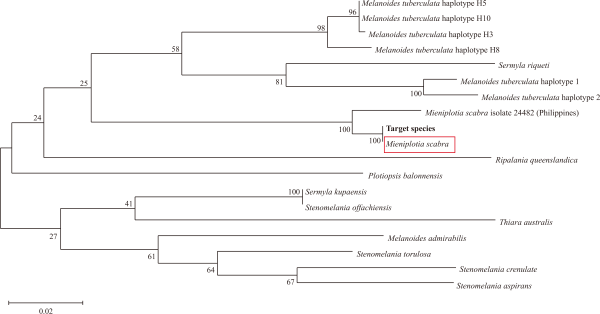
For genetic species identification, the amplified gene obtained via PCR was sequenced, and it resulted in a 601 bp sequence from one of the three samples analyzed. A BLAST search on the National Center for Biotechnology Information (NCBI) database confirmed a 100% match with M. scabra (Accession No. PQ327780). To further validate the result, the top 18 genetic sequences from the BLAST search were used to construct a phylogenetic tree, which confirmed the species as M. scabra (Fig. 3).
Habitat characteristics
M. scabra rarely occurs in habitat environments with fast flowing water. M. scabra individuals are often found in environments with shallow, slow-flowing water and substrates of soft mud or sand, generally preferred by M. tuberculata (Teristiandi, 2018). In Jukdang Stream, M. scabra was found in microhabitats with reduced current flow, such as pools beneath transverse structures and upstream of these structures, where riparian vegetation and sand accumulation provided shelter. These findings align with its preferred habitat characteristics and its co-occurrence with M. tuberculata (Fig. 1).
Like M. tuberculata, M. scabra thrives in tropical aquatic environments with water temperatures between 18°C and 31°C (Park et al., 2024; Teristiandi, 2018). However, M. scabra can survive in modified environments such as Jukdang Stream, where the water temperatures are maintained at elevated levels or even in temperate climates with less favorable conditions (Piechocki et al., 2003). Future research should monitor changes in habitat range and population density in Jukdang Stream and other rivers with similar inflow of heated effluent.
Ecological impact
Climate change such as global warming is a major contributor to the introduction, establishment, and spread of invasive alien species, which have already caused ecological and economic problems in many countries (Huang et al., 2011; Strayer, 2010). M. scabra inhabits both freshwater and brackish water (Maciolek & Ford, 1987; Sri-Aroon et al., 2004) and, like M. tuberculata, exhibits strong reproductive capacity through parthenogenesis and prefers aquatic environments in tropical climates with water temperatures between 18°C and 31°C degrees, but it can also inhabit converted aquatic environments in the condition of warm water temperature even in unsuitable temperate climate regions (Piechocki et al., 2003; Rader et al., 2003). This enables its rapid proliferation in local aquatic ecosystems and helps to potentially suppress native species populations while gaining a competitive advantage (Thompson et al., 2009). Additionally, M. scabra serves as an intermediate host for the intestinal fluke Haplorchis taichui, which can cause symptoms that resemble irritable bowel syndrome in humans upon infection (Watthanakulpanich et al., 2010). Although the occurrence of M. scabra is restricted to specific environments, its confirmed presence in Korean waters necessitates special care to prevent significant health risks by issuing warnings against its consumption, as it can easily be mistaken for native snails.
The recent boom in the ornamental fish industry and the increasing trade in pet species have facilitated the introduction of various invasive species across geographical barriers. Some, like the red swamp crayfish (Procambarus clarkia), have been deliberately released from aquariums into natural environments, consequently emerging as highly invasive alien species (Park & Jeon, 2023). If harmful invasive species spread within domestic aquatic ecosystems, their expansion could disrupt native species communities, disturb ecosystems, cause economic losses, and even trigger allergy-related diseases, among other significant environmental, social, and economic impacts (Kim, 2018). Therefore, this scientific ecological risk assessment of M. scabra, which has been confirmed for the first time in a domestic river, is crucial for the development of effective management plans for imported invasive alien species.
This study documents the first occurrence of M. scabra in South Korea aquatic ecosystems, identified during a nationwide survey on the occurrence and distribution of invasive species. M. scabra individuals were discovered in Jukdang Stream (nicknamed Guppy Stream) in Icheon, Gyeonggi Province, which is influenced by year-round heated effluent discharge from a large semiconductor factory. This environment supports various tropical species, including ornamental fish, due to intentional releases. A total of five specimens were collected, and genetic analysis in the laboratory confirmed them as M. scabra through BLAST searches on the NCBI database. Morphologically, the species is easily distinguishable from native snails by its prominent red-striped pattern and spines protruding from its ribs.
M. scabra typically inhabits tropical aquatic environments but can survive in modified environments with warm water temperatures, such as the Jukdang Stream, or even in temperate climates. Continuous monitoring of Jukdang Stream and expanded nationwide surveys of rivers with similar heated effluent inflows are necessary to confirm the establishment of this species in South Korea. With its strong parthenogenetic reproductive capacity and high environmental adaptability, M. scabra is likely to outcompete native species and may suppress their populations if it spreads further in the aquatic ecosystems of the country. Additionally, the species poses a significant health risk as a known intermediate host of the intestinal fluke H. taichui, which causes symptoms similar to irritable bowel syndrome in humans. Special precautions are needed to prevent its consumption, as it could easily be mistaken for native snails.
Author Contributions
Study design: Youngjun Park, Youngho Cho, Yungchul Jun, Soon Jik Kwon. Data collection: Soon Jik Kwon, Yungchul Jun, InChul Hwang, Hanjoon Bae. Analysis: Youngjun Park, Soon Jae Eum. Manuscript preparation: Youngjun Park, Soon Jae Eum, Youngho Cho, Yungchul Jun.
References
(2024, Retrieved December 9, 2024) Global biodiversity information facility from www.gbif.org
(2023, Retrieved December 9, 2024) A river where tropical fish live enven in winter?. 'Guppy stream' created by human selfishness from www.khan.co.kr/environment/environment-general/article/202311211559001
, , (2003) The introduction of an invasive snail (Melanoides tuberculata) to spring ecosystems of the bonneville basin, Utah Journal of Freshwater Ecology, 18, 647-657 https://doi.org/10.1080/02705060.
, (1999) Extinction rates of North American freshwater fauna Conservation Biology, 13, 1220-1222 https://doi.org/10.1046/j.1523-1739.1999.
SKhynix (2020, Retrieved August 29, 2024) SK Hynix "Otters have come to Jukdangcheon" from https://news.skhynix.co.kr/post/an-otter-has-come-to-jukdangcheon
Figures and Tables
Fig. 1
The first occurrence point and picture of the Mieniplotia scabra captured in South Korea. (A) Occurrence point in Jukdang stream. (B) Captured M. scabra.
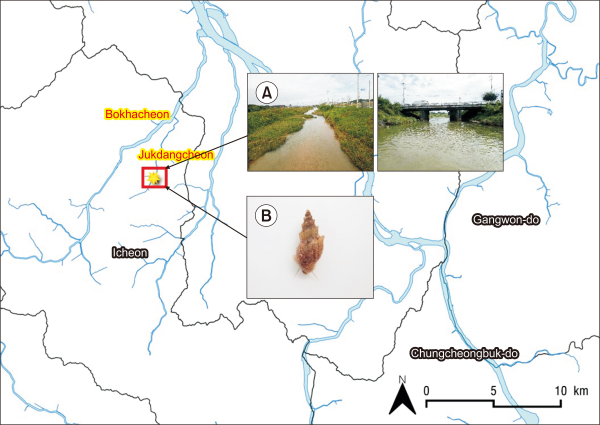
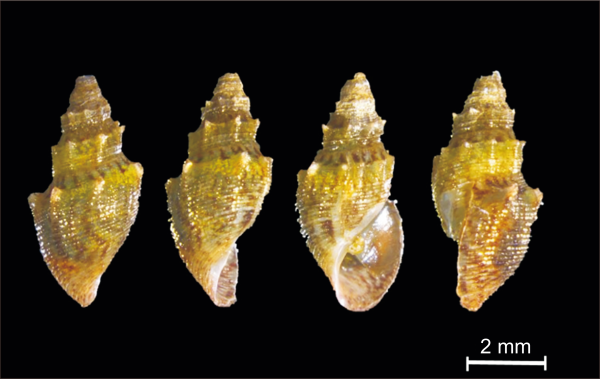
Fig. 3
Phylogenetic tree based on the maximum likelihood method with bootstrap test (1,000 replications).