Introduction
The growth in logistics driven by international trade has increased opportunities for both intentional and unintentional introductions of alien species, and—along with rising trade volumes—the rate of first introductions, and thus the potential for subsequent biological invasions has not reached saturation but has continued to increase (Seebens et al., 2021). Under the Convention on Biological Diversity (CBD) pathway classification adopted by Intergovernmental Science-Policy Platform on Biodiversity and Ecosystem Services (IPBES), Global Biodiversity Information Facility (GBIF), International Union for Conservation of Nature (IUCN), introduction pathways comprise six main categories. Within Transport–Contaminant, the transportation of habitat material subcategory explicitly covers the unintentional movement of organisms—including insects and molluscs—via the transfer of soil, mulch, leaf litter, and other habitat materials (Groom et al., 2019; Harrower et al., 2018; IPBES, 2023).
According to current study, the crown-Orthoptera emerged approximately 355 million years ago, and the crown-Caelifera diverged during the Carboniferous period around 320 million years ago (Song et al., 2020). Most insects within Orthoptera oviposit in soil, and among them, only about 6% of species within the superfamily Acridoidea lay their eggs on or inside host plant tissues (Braker, 1990). Since soil temperature and moisture are key factors determining egg survival and development, acridids have evolved egg pods to support successful reproduction (Braker, 1990; Song et al., 2015). The acridid egg pod is encased in a foam that buffers the eggs against excessive desiccation or flooding, and this adaptive foam has enabled successful hatching across a wide range of habitats—from humid wetlands to arid deserts with minimal soil moisture (Stauffer et al., 2011). Due to these ecological characteristics, grasshoppers have been reported to invade new regions through the unintentional translocation of eggs during soil movement. Stenocatantops splendens, first recorded on Guam in 1984, was suggested to have been unintentionally introduced through the importation of ornamental potted plants (Schreiner, 1991). A direct case of introduction was also identified for Schistocerca nitens (S. nitens), discovered in West Chop, Tisbury, Massachusetts, with its origin presumed to be a Monrovia nursery in Azusa, California (Pelikan, 2022). In addition, a mass introduction of Melanoplus differentialis (M. differentialis) was recorded on Martha’s Vineyard, Massachusetts, in 2017, coinciding with the importation of nursery stock (Pelikan, 2022). Although the precise introduction pathway remains unclear, S. nitens—introduced to Hawaii as early as 1964—has been shown to negatively affect island vegetation. In South Korea, there is also a documented case of Tettigonia jungi, typically found in southern regions such as Jeju Island and Yeoseo Island, being observed in a Miscanthus sinensis habitat in Haneul Park, Sangam-dong, Mapo-gu, Seoul, a relatively recently developed urban park (Kim et al., 2024a).
M. differentialis, native to North America, was first detected in South Korea on August 5, 2018, when an individual was found as a hitchhiker at Onsan Port. In 2020, a high-density population was confirmed within the Onsan National Industrial Complex, and as a result, the species was officially designated as an ecosystem-disturbing species under the Act on the Conservation and Use of Biological Diversity in December 2020 (Kang et al., 2021; Kim et al., 2024b). Since then, the National Institute of Ecology (NIE), in collaboration with the Ulsan Metropolitan Government and the Nakdong River Basin Environmental Office, has conducted habitat distribution monitoring of M. differentialis through the national ecosystem-disturbing species surveillance program. Based on the monitoring results, chemical control measures have been implemented at the identified sites (NIE, 2022; NIE, 2023; NIE, 2024). As a result, M. differentialis has not expanded beyond the original introduction site in the Onsan National Industrial Park, and its occupied habitat area has gradually decreased. However, the risk of artificial dispersal has emerged because soil and rock materials were relocated from the initial outbreak site, where the species had occurred at high densities, to nearby development areas.
In this study, we investigated soil translocation from these previously infested sites and conducted targeted surveys at the Ulsan Municipal Waste Incineration Facility Business Office, where the largest volume of soil had been relocated. Our results confirmed that M. differentialis has not yet established populations at the translocation site. This study highlights the importance of continuous surveillance to prevent further spread and provides critical baseline information for the management of invasive alien species in Korea.
Materials and Methods
Study site
We conducted our survey at the Seongam Municipal Solid Waste Landfill in Ulsan, where a debris flow was reported within the habitat of M. differentialis. The facility comprises a Closed Landfill, which operated from 1994 to 2012, and an Active Landfill, which has been in operation since 2012. The Closed Landfill covers a total area of 143,000 m2, while the Active Landfill covers 2,615,000 m2. The Active Landfill is subdivided into the Fly Ash Landfill and the Expansion Landfill (Phase I and Phase II). The Fly Ash Landfill has a total area of 14,400 m2 with a total capacity of 135,000 m3; the Expansion Landfill has a total area of 260,200 m2 with a total capacity of 5,000,000 m3. As of November 2023, 109,422 m3 of capacity had been used in the Fly Ash Landfill and 1,323,253 m3 in the Expansion Landfill (Fig. 1).
Sampling method
We surveyed the entire Seongam Municipal Solid Waste Landfill. In the Active Landfill, most areas were barren ground with no grassland; however, narrow grassland patches had developed along the edges, and these edge grasslands were included in the survey together with the continuous buffer grasslands along access roads. In the Closed Landfill, which has already undergone succession to a grassland ecosystem, we sampled along established trails; to account for potential additional spread, we also surveyed the Leachate Treatment Facility, Incineration Facility, landscaped beds within parking areas, and unmanaged grasslands. Surveys were conducted on May 22, 2025, when nymphs were in the 1st-3rd instars, and on September 4, 2025, when adults were present. In May, we performed sweep-net sampling (10 sweeps every 50 m) and identified the captured grasshoppers. In September, we repeated the same sweep-net protocol and supplemented it with visual searches targeting fleeing adults (Fig. 2).
Result
Coordinated response
This result describes the process of identifying potential spread pathways and secondary habitats of M. differentialis, an ecosystem-disturbing species, in the course of ongoing distribution surveys and control efforts. Sites 1 and 2 in Fig. 3 are located near the Dalpo Pier area of the Port of Onsan and had remained undeveloped, open spaces owned by LS MnM Co., Ltd. and Hankuk Paper Co., Ltd., respectively. Site 1, in particular, was one of the key locations where M. differentialis had been observed at high density across a wide grassland area and served as critical evidence leading to its designation as an ecosystem-disturbing species in 2020.
However, during a full-scale survey of M. differentialis conducted in May 2024 across the Onsan National Industrial Park, it was confirmed that construction had begun at Site 1, with excavation underway using heavy equipment. In a follow-up adult survey conducted in August 2024, it was further observed that Site 2 had also begun development, including active digging operations.
These developments were reported to Ulsan Metropolitan City and the Nakdong River Basin Environmental Office. The research team emphasized to city officials that such soil displacement could facilitate the spread of M. differentialis, and urged that the movement of soil and debris be traced. In response, Ulsan Metropolitan City provided detailed information on soil relocation on September 4, 2024. According to the data, construction at Site 1 was scheduled from November 2023 to November 2024, and the soil was being transported to the Seongam Municipal Solid Waste Landfill (Fig. 3).
Following this report, the NIE informed Ulsan Metropolitan City of its plan to begin monitoring the Seongam Municipal Solid Waste Landfill starting in 2025. Subsequently, Ulsan Metropolitan City reported back that a specimen suspected to be M. differentialis had been captured during their own preliminary investigation at the landfill site.
Grasshopper survey
On May 22 and September 4, 2025, the Seongam Municipal Solid Waste Landfill was surveyed during both the nymphal (instars 1-3) and adult stages of M. differentialis. Priority was given to the Active Landfill area, as it was presumed to have received translocated debris from the high-density habitat of M. differentialis. However, the area consisted largely of barren ground with no grassland, prompting the inclusion of surrounding unmanaged grass patches and roadside plant beds in the survey. The Closed Landfill, having undergone significant ecological succession into grassland, was considered more suitable for grasshopper habitation and was therefore investigated in full. Additionally, the Incineration Facility and adjacent parking lot at the entrance of the landfill were also surveyed.
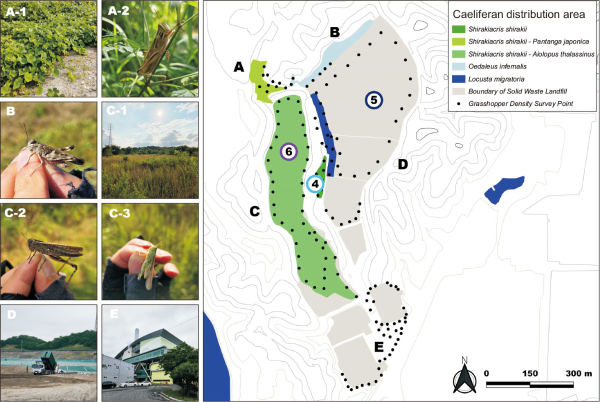
No individuals of M. differentialis, an ecosystem-disturbing species, were detected during either survey. Site A, located at the interface between the landfill and adjacent forested area, was dominated by Pueraria montana, and yielded observations of Shirakiacris shirakii (S. shirakii) and some individuals of Pantanga japonica. Site B, situated along the peripheral edge of the Active Landfill, was a highly disturbed area dominated by Conyza canadensis, where Oedaleus infernalis was the most frequently observed species. Throughout the landfill, S. shirakii was commonly present; notably, Locusta migratoria was found in plant beds adjacent to the Active Landfill. The Closed Landfill, having progressed further in grassland succession, supported a wider range of species including Aiolopus thalassinus and multiple members of the subfamily Conocephalinae, such as Conocephalus exemptus. No Orthopteran species were observed within the Incineration Facility (Fig. 4).
Discussion
Absence & management
The survey of the Seongam Municipal Solid Waste Landfill revealed no presence of M. differentialis. Despite the Active Landfill being the most likely site for the introduction of M. differentialis, no grasshopper species were found in this area, and only native grasshopper species were observed in the surrounding areas, including the Active Landfill perimeter and the Closed Landfill. Based on these findings, three possible reasons for the absence of M. differentialis in the relocated soil were inferred:
1. Egg pods may have been destroyed by mechanical pressure during excavation and compaction, or buried at depths too great for successful hatching.
2. The initial stage of introduction involved a very low population density, or the introduction went unnoticed during the process.
3. Due to the proper handling of the imported waste, it was unlikely that the landfill received M. differentialis compared to other cases, such as those involving fruit trees or horticultural plants.
Given that females of M. differentialis typically oviposit egg pods at a depth of approximately 5 cm below the soil surface (Kim et al., 2024a), the first hypothesis may have contributed to egg mortality to some extent. However, because soil from the entire LS MnM Co., Ltd. site was transported to the Seongam Municipal Solid Waste Landfill, it is reasonable to assume that all egg pods laid within this area were secondarily relocated in a scattered manner. Moreover, numerous other cases of introduction associated with soil translocation have been reported, suggesting that the first hypothesis is unlikely to represent the primary explanation for the absence of M. differentialis at the landfill. This conclusion is based on numerous documented cases of unintentional invasions via soil movement (Kim et al., 2024a; Pelikan, 2022; Schreiner, 1991).The second hypothesis suggests that the first debris relocation occurred in November 2023, and while the process continues, the population density was too low to detect at this time. In fact, M. differentialis hatches in April and the adults are present from June to November in Korea (Kim et al., 2024b; NIE, 2022; NIE, 2023; NIE, 2024). Thus, the debris moved during construction in November 2023 likely contained egg masses in a dormant state, and it is assumed that they hatched in 2024. By the time of the surveys in May and September 2025, the second generation would likely have emerged, but there was insufficient time for the population density to increase. However, previous monitoring of ecosystem-disturbing species has shown that M. differentialis populations can rapidly increase in the following year, even in locations where only a few individuals were found the previous year, making this hypothesis uncertain.
The third hypothesis suggests that the imported waste was appropriately processed, making it difficult for M. differentialis to enter the landfill. The waste management process at the Seongam Municipal Solid Waste Landfill consists of several stages: 1) collection and transportation via waste collection vehicles, 2) weighing of waste through weight registration, 3) inspection for illegal waste, 4) unloading and monitoring for illegal waste, 5) compaction using bulldozers and heavy machinery, 6) daily pest control, and 7) covering with high-quality soil. During the September survey, both the unloading process and pesticide spraying by a pest control vehicle were observed. The compaction process likely destroyed the egg masses of the initially introduced grasshoppers, and any surviving grasshoppers were likely eliminated during the daily pest control measures. Therefore, the second and third hypotheses are considered more plausible. However, since soil relocation from the high-density M. differentialis habitat continues at the landfill, it is essential to continue monitoring for the presence of M. differentialis during future surveys. Additionally, based on another case of grasshopper movement observed at Haneul Park (Tettigonia jungi; Kim et al., 2024a), regular pest control measures should also be considered for projects like street tree planting or large-scale park developments, where soil movement and waste management processes similar to those at the landfill may occur.
Importance of collaboration
To minimize the ecological and economic impacts of invasive alien species, the EDRR strategy is considered essential (Simberloff et al., 2013). Since the initial detection of M. differentialis near the Onsan National Industrial Park in Ulsan in 2020, containment and eradication efforts have been implemented through close collaboration among NIE, Ulsan Metropolitan City, and private-sector companies operating within the industrial complex.
The NIE conducted intensive field surveys to delineate the distribution range of M. differentialis and assessed population densities to establish priority areas for control. Based on these findings, Ulsan Metropolitan City developed a rapid response strategy, designated control zones, secured municipal funding, and coordinated annual control efforts in cooperation with resident private companies.
As a result, the areal extent of M. differentialis occurrence has shown a consistent decline, with seasonal distribution areas decreasing from 81 ha in 2021 to 29 ha in 2022, 13 ha in 2023, and 4 ha in 2024 (NIE, 2024). Furthermore, such outcomes were made possible through the sustained collaborative framework between expert groups and government authorities. This cooperation enabled timely tracking of potential spread resulting from intentional or unintentional soil relocation caused by construction within high-density habitats, as demonstrated in this study. It also facilitated immediate responses to other potential scenarios—such as the inadvertent dispersal of alien species via waste collection activities within invaded habitats.
This outcome exemplifies a successful case of early-stage invasive species containment through coordinated action among governmental agencies, research institutions, and private-sector stakeholders (Bauer et al., 2015; Marchioro & Faccoli, 2021), and serves as a model for effective implementation of the EDRR framework.
Author Contributions
Conceptualization: JS, JA. Formal analysis: JS. Funding acquisition: JA. Investigation: JS, JA. Methodology: JS. Supervision: JA. Visualization: JS. Writing – original draft: JS. Writing – review & editing: JS.
Funding
This study was supported with funds from the National Institute of Ecology (NIE) under project no. NIE-C-2025-23 and the Ministry of Environment of Korea as a part of technology research.
References
Harrower, C.A., Scalera, R., Pagad, S., Schönrogge, K., and Roy, H.E. (2018). Guidance for interpretation of the categories on introduction pathways under the convention on biological diversity. Technical note prepared by IUCN for the European Commission. Retrieved Nov 4, 2025 from https://www.cbd.int/doc/c/9d85/3bc5/d640f059d03acd717602cd76/sbstta-22-inf-09-en.pdf.
Intergovernmental Science-Policy Platform on Biodiversity and Ecosystem Services (IPBES) (2023). Summary for policymakers of the thematic assessment report on invasive alien species and their control. IPBES secretariat. Retrieved Nov 4, 2025 from https://zenodo.org/records/11254974.
Pelikan, M. (2022). Wild side: hitchhiking grasshoppers. MV times. Retrieved May 31, 2022 from https://www.mvtimes.com/2022/05/31/wild-side-hitchhiking-grasshoppers/#:~:text=differential%20grasshopper%2C%20Melanoplus%20differentialis%2C%20is,this%20grasshopper%20on%20the%20Island.
Simberloff, D., Martin, J.L., Genovesi, P., Maris, V., Wardle, D.A., Aronson, J., et al. (2013). Impacts of biological invasions: what's what and the way forward. Trends in Ecology & Evolution, 28, 58-66. https://doi.org/10.1016/j.tree.2012.07.013
Figures
Fig. 1
Layout of Seongam Municipal Solid Waste Landfill. Closed Landfill operated from 1994 to 2012, and Active Landfill has been in operation since 2012. Active Landfill consists of Fly Ash Landfill and Expansion Landfill (Phase I and Phase II). Leachate Treatment Facility is located in the Southern area, along with Incineration Facility and Sewage Sludge Treatment Facility.
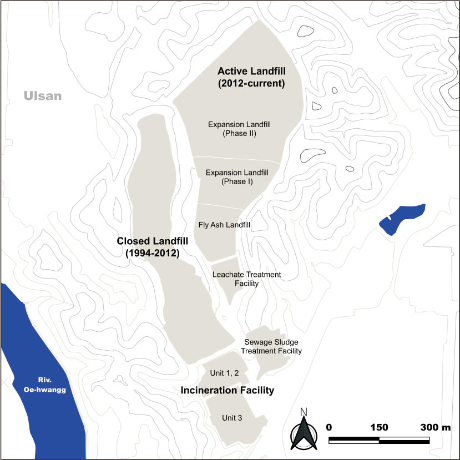
Fig. 2
Field views and sampling at the Seongam Municipal Solid Waste Landfill. (A) Overview of the Active Landfill; (B) overview of the Closed Landfill; (C) sweep-net sampling in edge grassland within the Active Landfill, where partial succession is evident; and (D) grasshopper captured by sweeping (nymph of Shirakiacris shirakii, May).
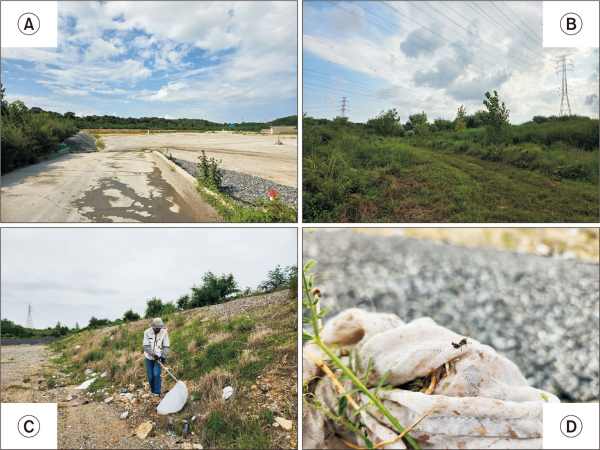
Fig. 3
Coordinated detection and verification process of debris transport within the M. differentialis habitat, with Site locations in the Onsan National Industrial Complex. The left panel illustrates the sequential response process—from expert risk recognition to government engagement and investigation initiation—for identifying potential secondary habitats based on predicted spread. The right panel shows the map of confirmed M. differentialis occurrences (as of August 2023) and the locations of ① and ② debris relocation sites, as well as ③ the site of interagency collaboration. NIE, National Institute of Ecology; MSW, Municipal Solid Waste Landfill; M. differentialis, Melanoplus differentialis.
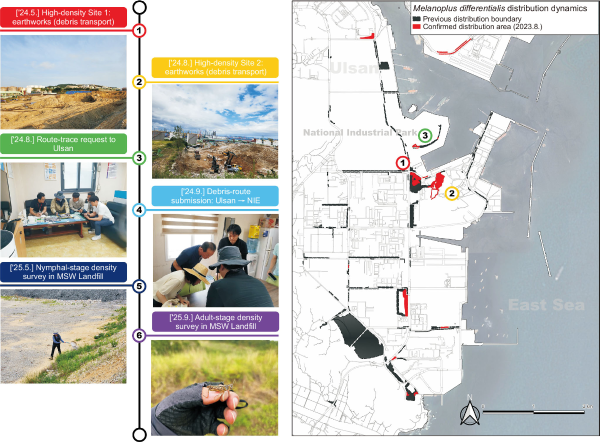
Fig. 4
Survey results of grasshoppers at the Seongam Municipal Solid Waste Landfill. The locations corresponding to ④, ⑤, and ⑥ in Fig. 3 are indicated. Although points ⑤ and ⑥ were surveyed across the entire landfill area, they are labeled under “Active Landfill” and “Closed Landfill” for convenience. Surveys were conducted at each designated Grasshopper Density Survey Point. According to the survey legend, the following species were identified: Sphingonotus shirakii, Pantanga japonica, Aiolopus thalassinus, Oedaleus infernalis, and Locusta migratoria. Site overviews and photographs of the observed grasshopper species are provided on the left side of the map. (A) Shirakiacris shirakii - Pantanga japonica, (B) Oedaleus infernalis, (C) Shirakiacris shirakii - Aiolopus thalassinus, (D) Active Landfill Area, and (E) Incineration Facility Area.