Introduction
Syrphidae, commonly known as flower flies or hoverflies, are the most abundant family of the insect order Diptera, with around 6,300 known species worldwide in 209 genera (Mohammadi-Khoramabadi et al., 2024; Sai Teja & Ganiger, 2023). Syrphid flies provide crucial ecosystem services as pollinators, biological control agents and in environmental assessment (Kevan, 2002; Mengual & Thompson, 2011; Ssymank et al., 2008).
The genus Dideopsis Matsumura, 1917 is a monotypic genus of the tribe Syrphini. Mengual et al. (2008) included Dideopsis aegrota in their molecular analysis, and Dideopsis was resolved as sister group of Erionza syrphoides and Dideoides coquilletti. This species is easily distinguished by body size and morphological characteristics.
In this paper, Dideopsis aegrota (Fabricius, 1805) is reported for the first time from South Korea. Digital image and diagnostic description of this species are provided.
Case Report
The morphological terminology and interpretations used in this study largely follow Thompson (1999) and McAlpine (1981). A photograph were obtained using Nikon D7500 digital camera, processed using Leica Application Suite software (LAS EZ 3.4, Leica Biosystems, Wetzlar, Germany).
Results
Family Syrphidae Latreille, 1802
Subfamily Syrphinae Latreille, 1802
Tribe Syrphini
Genus Dideopsis Matsumura in Matsumura and Adachi, 1917: 142. Type-species: Eristalis aegrotus Fabricius, 1805, orig. des.
Aegrotomyia Frey, 1946: 158. Type-species: Eristalis aegrotus Fabricius, 1805, orig. des.
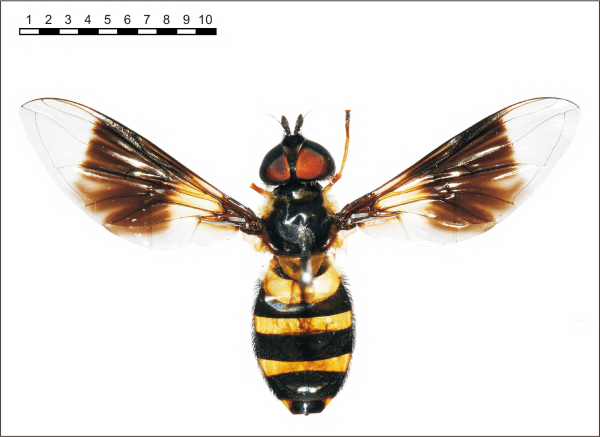
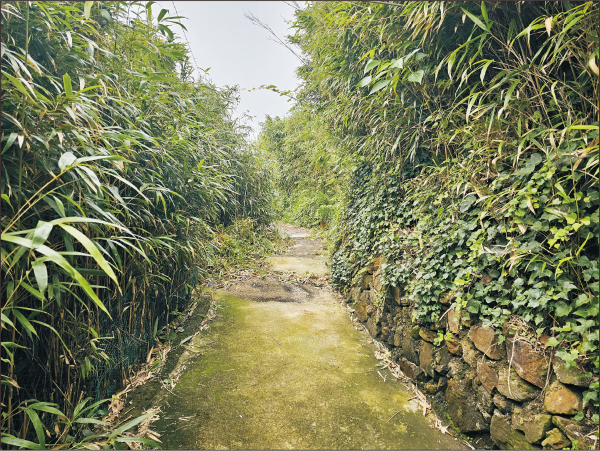
Dideopsis aegrota (Fabricius, 1805) (Figs. 1, 2)
(Korean name: nal-gae-mu-nui-kkot-deung-e)
Eristalis aegrotus Fabricius, 1805: 243. Type-locality: India
Dideopsis hemipennis Hull, 1945
Asarkina pura Curran, 1928
Syrphus infirmus Rondani, 1875
Didea ellenriederi Doleschall, 1857
Syrphus fascipennis Macquart, 1834
Diagnostic description (after Vockeroth, 1969)
Large species with moderately broad abdomen bearing broad yellow fasciae and with very broad brown vitta across middle of wing.
Head: eye bare. Face very slightly receding below, oral opening about 2.5 times as long as broad. Face pale yellow, white pollinose, with rather broad black median stripe extending to antennae. Antenna with basoflagellomere slender, sub oval, 1.3 times as long as broad and 1.3 times as long as first two segments combined (male) or distinctly swollen, tapering slightly to apex, 1.5 times as long as broad and 1.7 times as long as first two segments combined (female).
Thorax: scutum shining black, the notopleural area and sometimes a narrow postsutural margin distinctly whitish-yellow pollinose. Scutellum yellow. Pleura dark brown to black, sub shining, with posterior part of anpisternum, anterior part of anepimeron, and dorsalpart of katepisternum densely white pollinose, sometimes slightly paler in ground colour. Scutum with anterior collar of long erect pile. Dorsal and ventral katepisternal pile patches widely separated throughout. Anterodorsal corner of katepisternum with a tuft of pile. Metasternum with long black pile posteriorly. Posteromedian apical angle of metacoxa with a strong tuft of pile. Wing with broad dark brown vitta across median third or slightly more and with base of wing dark brown or with basal 2/3 of wing dark brown; wing apex beyond brown vitta clear. Vein R4+5 very broadly and indistinctly dipped into cell R4+5.
Abdomen oval, not excessively broad, flattened above, with strong margin from near base of tergum 2 to apex of tergum 5. Tergum 2 with a pair of large, oval, sometimes subconfluent, yellow maculae which reach the anterior and lateral margins broadly; terga 3 and 4 with anterior half or slightly less yellow, otherwise black, the yellow fasciae slightly but distinctly sinuous posteriorly. Sterna yellow, 2 to 5 with broad apical or subapical black fascia which extend over the lateral membrane.
Male genitalia: surstylus broad, short, more strongly broadened and broadly rounded apically, with very abundant setae on inner surface. Sternite 9 slightly narrowed posteriorly, rather strongly produced ventrad below, posteroventrally with a broad deep anteriorly narrowed emargination, laterally with a few short but distinct scattered setae. Superior lobe thick basally and ventrally, semicircular in profile but with posteroventral margin produced dorsad as a strong projecting tooth, ventrolateral margin with a few minute setae. Aedeagal base in the form of a shallow trough with widely divergent, depressed, broadened, dorsal margins and a pair of slender, slightly depressed, subparallel, widely separated, ventrolateral processes. Distal portion of aedeagus. moderately compressed, bent rather strongly ventrad, with depressed sub circular posterodorsal process at the bend, the apex membranous, not inflated, with a few rather stout spicules anteriorly.
Specimens examined
1♀, South Korea: Jeollanam-do, Sinan-gun, Heuksan-myeon, Bi-ri, Jangdo Wetland (34.678686, 125.377948), 7-X-2024, MP.
Distribution
Oriental and Palaearctic region - South Korea (new record), China, India, Indonesia, Nepal, Sri Lanka (Ghorpadé, 2014; 2015a; 2015b; Sengupta et al., 2016; Yang et al., 2020).
Biology
Ghorpadé (1981) recorded this species as a predator of Aphis spiraecola (as A. citricola), A. craccivora, A. gossypii, Pentalonia nigronervosa, Rhopalosiphum maidis, Toxoptera aurantii, T. citricida, T. odinae, aphids on citrus and Artemisia vulgaris.
Discussion
Dideopsis aegrota is mainly distributed in subtropical regions and has never been recorded in temperate regions, including Korea. Only one individual of this species was found on an island in southwestern Korea. Therefore, at the present time, it is difficult to determine whether the species is distributed in Korea, flown by air currents, or expanded distribution due to climate change. Therefore, a more comprehensive collection-based study is needed to confirm actual Korean occurrence of this species.
Author Contributions
Conceptualization: DSC. Data curation: DSC. Formal analysis: DSC, MP. Funding acquisition: DSC, MP. Investigation: MP. Resources: MP. Visualization: MP. Writing – original draft: DSC. Writing – review & editing: DSC, MP.
Funding
This work was supported by a grant from the Honam National Institute of Biological Resources (HNIBR) and Intensive Survey on the Inland Wetland (2024) (NIE-A-2024-19), funded by the Ministry of Environment (MOE) of the Republic of Korea (HNIBR202501211).