

- P-ISSN 1225-0163
- E-ISSN 2288-8985



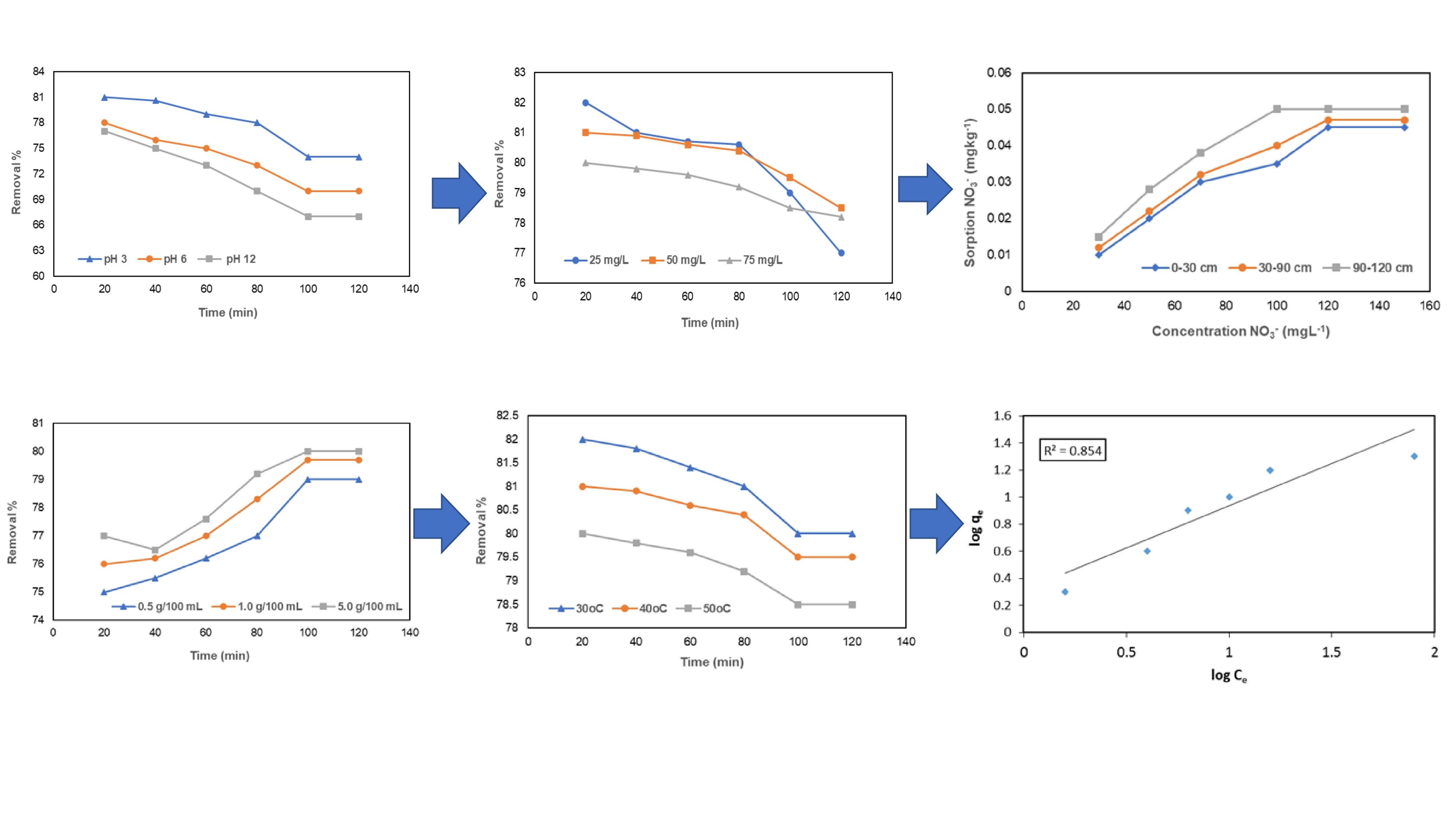
The leaching of nitrate from soil increases the concentration of elements, such as nitrogen, phosphorus, and potassium, in water, causing eutrophication. In this study, the feasibility of using clinoptilolite as an ion-exchange material to reduce nitrate leaching in soil was investigated. Soil samples were collected from three soil depths (0 - 30, 30 - 90, and 90 - 120 cm), and their sorption capacity was determined using batch experiments. The effects of contact time, initial concentration, adsorbent dosage, pH, and temperature on the removal of NO3- were investigated. The results showed that an initial concentration of 25 mg L-1, a contact time of 120 min, an adsorbent dosage of 5.0 g/100 mL, a pH of 3, and a temperature of 30 ℃ are favorable conditions. The kinetic results corresponded well with a pseudo-second-order rate equation. Intra-particle diffusion also played a significant role in the initial stage of the adsorption process. Thermodynamic studies revealed that the adsorption process is spontaneous, random, and endothermic. The results suggest that a modification of clinoptilolite effectively reduces the leaching of nitrate in soil.







학술지 홈페이지 이용 환경은 크롬 브라우저 사용을 권장합니다.