
- P-ISSN 1225-0163
- E-ISSN 2288-8985



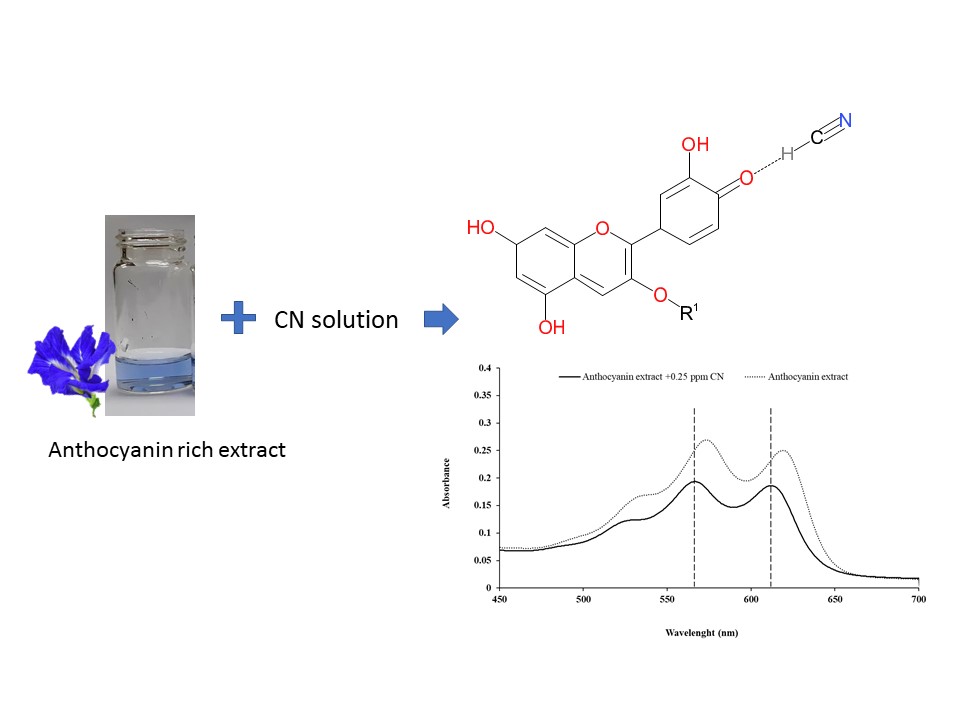
A green spectrophotometric method for the determination of cyanide has been proposed using, a green reagent, aqueous extract of blue butterfly pea. The test tube was filled with anthocyanin rich extract (pH 6) and cyanide solution. The reaction was kept constant for 10 minutes at room temperature. The reaction mixture changed color from blue to green as the amount of CN-ions increased. The 620 nm peak intensity increased with CN concentration. Therefore, this wavelength was used for all cyanide analyses. The cyanide calibration curve had a linear range of 0.25-1.00, 1.00-4.00, and 4.00-10.00 mg/L, with a satisfactory correlation coefficient of 0.99 and a LOD of 0.57 mg/L. The recovery ranged from 8.33 to 76.94 percent, indicating that this method is inaccurate at low cyanide concentrations. The intra-day and intermediate precision relative deviations were 0.391-0.871 % and 1.112-1.583 %. An H-bond forms between the C-4 group of the B-carbonyl ring and the HCN molecule according to the B3LYP/TZVP calculation. The method is convenient for cyanide concentrations above the LOQ of 1.09 mg/L, cost-effective, and capable of reducing toxic solvents with acceptable precision. The method could also be used to detect total cyanide in biological, environmental, and industrial waste samples.






This website recommended the use the Chrome browser for journal website.