
- P-ISSN 1225-0163
- E-ISSN 2288-8985



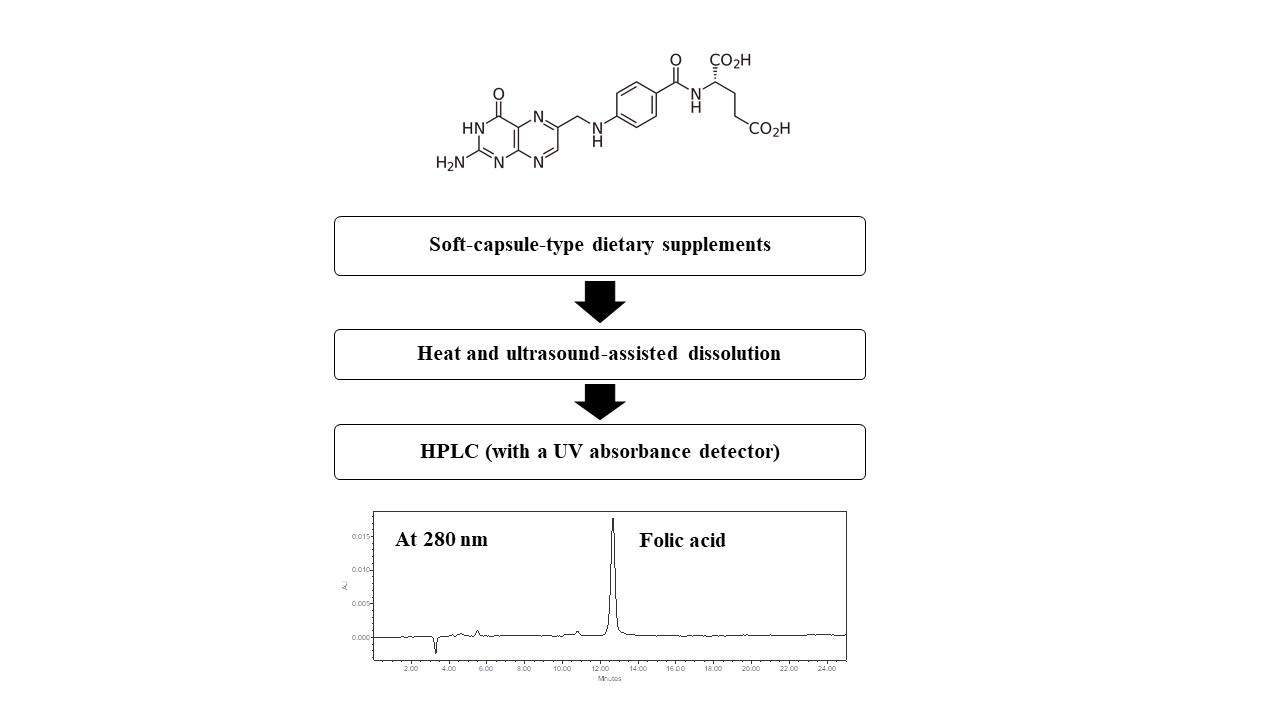
Folic acid, a form of vitamin B9, plays a critical role in producing healthy blood cells, developing the fetal nervous system, and breaking down homocysteine to maintain its optimal blood level. Consequently, a wide variety of dietary supplements containing folic acid are available in the market, including tablets, powders, hard capsules, and soft capsules. However, our research group recently discovered that the folic acid assay (II) specified in the Health Functional Food Code of South Korea is not applicable to soft-capsule-type folic acid dietary supplements. To address this issue, a simple method for determining folic acid content in soft-capsule-type dietary supplements was developed. This approach combines heat and ultrasound-assisted dissolution with liquid chromatography, utilizing a UV absorbance detector. The method underwent validation following the guidelines set by the Ministry of Food and Drug Safety. All validation parameters examined in this study met the acceptable criteria outlined in the guidelines. These parameters include selectivity, linearity (r2 ≥ 0.999), a lower limit of quantification (0.820 ㎍/mL), accuracy (expressed as recovery between 100.36 % and 102.81 %), repeatability (with relative standard deviation (RSD) values for recovery ranging from 0.26 % to 0.45 %), and reproducibility (with an RSD value of 0.09 % for interlaboratory recovery). Furthermore, the practical applicability of the validated method was confirmed by analyzing soft-capsule-type folic acid dietary supplements. The experimental content-to-nominal content ratio ranged from 108.60 to 113.27 %. Therefore, the present method has the potential to enhance the safety management system for dietary supplements in South Korea.







This website recommended the use the Chrome browser for journal website.