
- P-ISSN 1225-0163
- E-ISSN 2288-8985



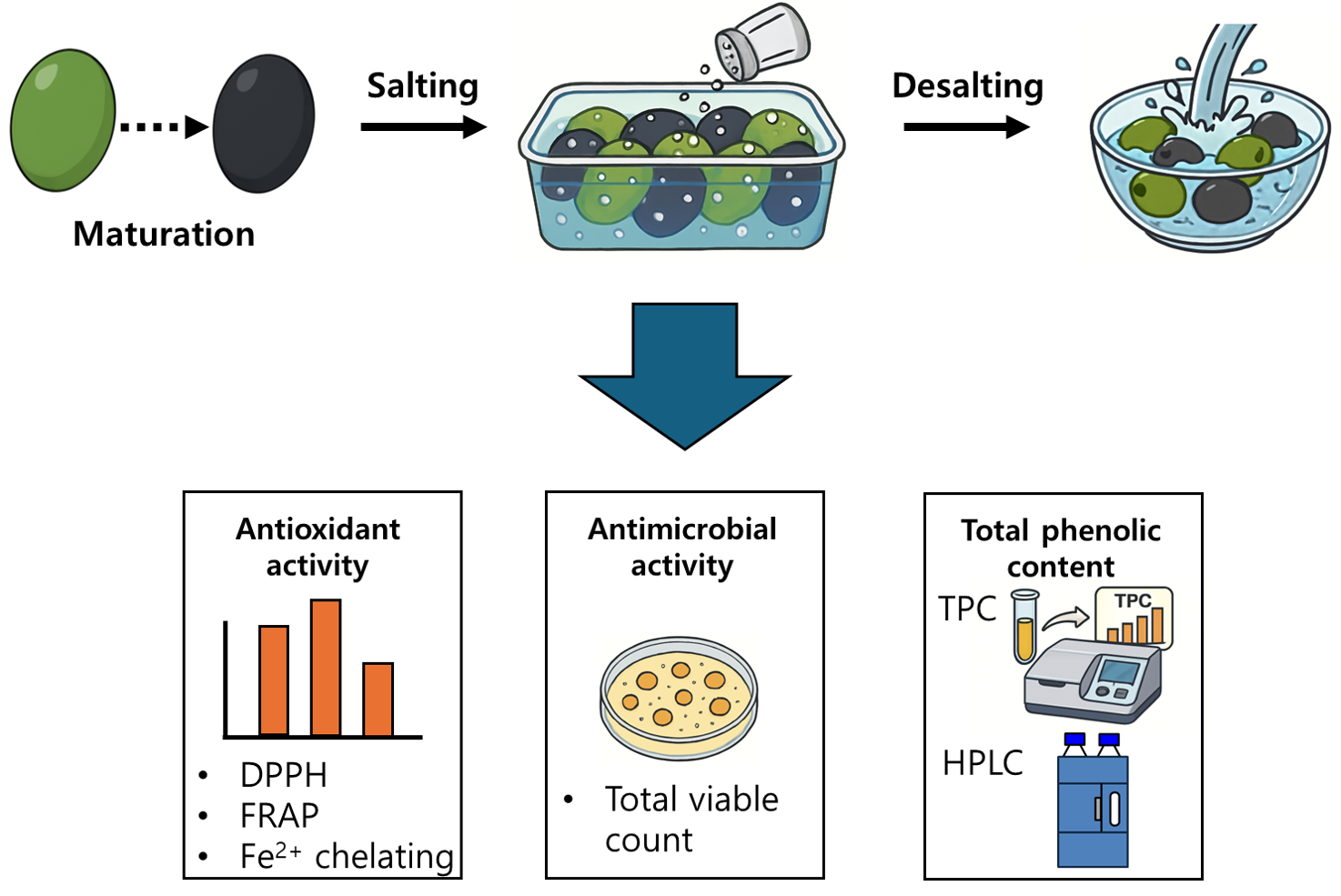
While olives are valued for their bioactive functions that contribute to human health, most olives are salted to facilitate storage, distribution, and sales. As many consumers are concerned about high salt intake from salted olives, a desalting process using pure water is widely applied to reduce sodium content in brined olive products. However, the effect of the desalting process on the bioactive substances in olives remains unclear. Therefore, to assess the impact of the desalting process on salted olives, we examined antioxidant activity, antimicrobial activity, and total phenolic content (TPC). In this study, four samples were analyzed: salted green olive (SGO), desalted green olive (DGO), salted black olive (SBO), and desalted black olive (DBO), to evaluate both the desalting process and olive maturation. Antioxidant activity was measured using the DPPH radical scavenging assay, ferric reducing antioxidant power (FRAP) assay, and ferrous ion chelating activity assay. Antimicrobial activity was assessed based on total viable count. Although desalting and maturation appeared to reduce antioxidant and antimicrobial activities, no statistically significant differences were observed. TPC was determined using the Folin–Ciocalteu method, as antioxidant and antimicrobial activities might be attributed to bioactive phenols. In particular, hydroxytyrosol, tyrosol, and oleuropein, which are well-known major phenolic compounds in olives, were quantified using high-performance liquid chromatography (HPLC). Both desalting and maturation tended to decrease the levels of hydroxytyrosol and tyrosol levels in brined olives; however, only hydroxytyrosol content in DBO was significantly lower compared to SBO. Oleuropein was not detected in any of the samples. Overall, while both desalting and maturation reduced bioactive phenols, these changes did not significantly affect the antioxidant and antimicrobial activities of olives.
The olive tree (Olea europaea L.) is one of the most important fruit trees in Mediterranean countries. Olive oil and table olives are important components of the Mediterranean diet and have been consumed worldwide.1 Olive oil accounts for 90 % of global olive production, with the remainder being used as table olives.2 Olives are well-known sources of compounds that have important biological characteristics. Furthermore, olives are gaining increasing interest because they are known to display antioxidant and antimicrobial activity. The health benefits of olives are typically considered to be related to trace phenolic compounds as well as high monounsaturated fat contents.3 In particular, the relationship between the total phenolic content (TPC) of olives and antioxidant and antimicrobial activities have been reported in various studies.4-6 Furthermore, phenolic compounds in olives are important as they contribute not only the biological activity but also several characteristics such as color, flavor, and texture.7 Despite the nutritional benefits of phenolic compounds, natural olives are hard to eat without processing because of a bitter taste, that is related to the presence of oleuropein.8 As a result, various processes, mostly based on alkaline hydrolysis or diffusion in brine, have been used to decrease the contents of certain phenolic compound in olives, especially oleuropein. However, the concentrations of tyrosol and hydroxytyrosol are increased by the processes. The major phenolic compound found in table olives are tyrosol, hydroxytyrosol, and oleanolic acid, and the concentrations of these compounds rely on the processing method and the ripening degree of olive fruits.9-11 According to some studies, the presence of biocomposites in olive products, such as oleuropein, hydroxytyrosol, and aliphatic aldehyde, can impede the growth of diverse microorganisms including bacteria.12,13
However, during processing, fermentable substrates from the olive flesh enter the fermentated brine, while salt in the fermented brine results in highly salty olives.14 The World Health Organization (WHO) and Food and Agriculture Organization of the United Nations (FAO) (2003) recommend daily sodium intakes less than 2000 mg and 5 g, respectively.15 However, in the fermented brines of green olives, the sodium concentration in the final product was generally up to 50 g/L after passing the packaging process.16 Since excessive salt intake could increase blood pressure, a desalting process, which reduces the salt content in brined olive products, might be essential to decrease blood pressure, resulting in a reduction in various cardiovascular disorders.17,18 Nonetheless, the functional substances and the bioactive effects of desalting brined olives should be determined, as the biocomposites in the olive products could be varied during the desalting process. Thus, in this study, we investigated the TPC of salted green olive (SGO) and salted black olive (SBO), as well as those of the corresponding desalted samples (desalted green olive (DGO) and desalted black olive (DBO). In particular, the altered contents of hydroxytyrosol, tyrosol, and oleuropein were examined using high performance liquid chromatography (HPLC). In addition, the antioxidant activity and antibacterial activity of these samples were investigated using radical scavenging, ferric reducing antioxidant power, ferrous iron chelating activity, and antimicrobial activity tests.
Table olives (green and black, F.J. Sanchez Sucesores, S.A.U.) were purchased from the Korean domestic market. Oleuropein, hydroxytyrosol, tyrosol, Folin–Ciocalteu’s phenol reagent, Na2CO3, 1,1-diphenyl-2-picrylhydrazyl (DPPH), potassium ferricyanide, trichloroacetic acid, ferric chloride, FeCl2, ferrozine, MeOH, 98 % formic acid were obtained from Sigma-Aldrich Chemical Co. (St. Louis, MO, USA). Gallic acid was purchased from Kanto Chemical Co., Inc. (Tokyo, Japan).
The flesh was obtained from the table olives (SGO, SBO, DGO, and DBO) for the analysis. Desalting of the brined samples (SGO and SBO) was conducted by soaking in water for 6 h to obtain the desalted samples (DGO and DBO), since a 6-h soaking period was sufficient to reduce the salinity to approximately 2.5 % NaCl. To facilitate desalting, the olives were cut into several pieces, and the soaking water was replaced every 2 h to maintain the concentration gradient. This treatment substantially reduced the flesh salt level, as confirmed by a salinity meter measurements, although not reaching the full equilibrium value (~2.5 % NaCl).19 After lyophilizing, the samples were ground by a conventional mixer to obtain a powder. Subsequently, 1 g of lyophilized olive flesh powder was added in 10 mL of deionized water, and boiled at 90 ℃ for 45 min, and then the solution was filtered using Whatman No. 4 paper (Cytiva, Marlborough, MA, USA). The solvent loss was considered negligible, as all sample vials were tightly sealed during the boiling process. The test solution obtained from four different types of table olives (SGO, SBO, DGO, and DBO) was used to investigate the total phenolic content (TPC), the bioactivity, and the HPLC analysis.
The DPPH radical scavenging activity was determined using the method reported in the previous study to assess the antioxidant activity of an olive sample.20 Briefly, 1 mL of 0.15 mM DPPH solution was added to 4 mL of the test solution and stirred. The mixture was then incubated at room temperature for 30 min. The absorbance of the mixture was measured at 517 nm using a spectrophotometer.
The FRAP assay was performed following the modified method reported in the previous study.21 Briefly, 1 mL of the test sample was mixed with a 2.5 mL of 0.2 M sodium phosphate buffer (pH 6.6) and 2.5 mL of 1 % potassium ferricyanide (potassium hexacyanoferrate). After incubating the mixture at 50 °C for 20 min, 2.5 mL of 10 % trichloroacetic acid was added, and the mixture was then centrifuged at 4000 rpm for 10 min. The supernatant (2.5 mL) was mixed with 2.5 mL of deionized water and 0.5 mL of 0.1 % FeCl3 (ferric chloride). After allowing the mixture to react for 5 min, the absorbance was measured at 700 nm.
The Fe2+ chelating activity was determined using the method described in a previous study.22 Briefly, 0.5 mL of the test sample was mixed with 2 mL of 1 mM FeCl2 in 95 % ethanol. The reaction was initiated by adding 2.5 mL of 2 mM ferrozine in deionized water. The mixture was vortexed and left at room temperature for 10 min. Subsequently, the absorbance was measured at 562 nm.
Ferrous ion chelating effect (%) = [1 − (absorbance of the test sample/absorbance of the control)] × 100 (1)
The total viable count (TVC) was determined on 3M™ Petrifilm™ Aerobic Count Plates (3M, Korea) incubated at 35 °C for 24 h. Coliforms and Escherichia coli were determined using 3M™ Petrifilm™ E. coli/Coliform Count Plates (3M Microbiology, Seoul, Korea) after incubation at 35 °C for 24 h. Colonies were identified and counted following the manufacturer’s instructions. These three parameters (TVC, coliforms, and E. coli) are widely recognized as basic microbial hygiene indicators in food microbiology, reflecting overall microbial load, hygiene status, and fecal contamination.23
The TPC was determined using the method described in a previous report with slight modifications.24 Briefly, 100 µL of the test solution and 100 µL of Folin–Ciocalteu phenol reagent (1 N) was mixed with and allowed to react at room temperature for 3 min. After adding 300 µL of 1 N Na2CO3 solution, the mixture was incubated at room temperature for 90 min. Then, 1 mL of deionized water was added to the mixture to quench the reaction. The absorbance of the resultant mixture at 725 nm was measured using a spectrophotometer (Optizen 2120UV, Mecasys Co., Ltd., Korea). Using gallic acid as a standard, the TPC in table olives were expressed as milligrams of gallic acid equivalents (GAE) per 100 g of sample.
The HPLC system was modified according to the method described by Vinha et al. (2005).25 The contents of hydroxytyrosol, tyrosol, and oleuropein in the olive extracts were quantified by HPLC (Agilent 1100 series, USA) after filtration through a 0.45 μm PVDF membrane filter (Pall Co., Port Washington, NY, USA). The mobile phase consisted of 5 % formic acid in deionized water (A) and methanol (B), and the following gradient was used: 5 % B (0 min), 15 % B (3 min), 25 % B (13 min), 35 % B (25 min), 45 % B (35 min), 50 % B (40 min), 100 % B (45 min), and 5 % B (46 min), followed by re-equilibration to the initial composition for 4 min. The flow rate was 0.9 mL/min and the injection volume was 10 μL. A Supelcosil LC-ABZ column (250 mm × 4.6 mm, 5 μm) was used for a chromatographic separation of analytes combined with an absorbance detection at 280 nm.
All experiments were performed in triplicate. Statistical analysis, including Kruskal-Wallis, Mann-Whitney, and Spearman correlation tests, was performed using R 4.4.1 software (R Core Team, Vienna, Austria). All experimental results were presented as means with corresponding standard deviations and significant differences were considered at p < 0.05.
Since the bioactivity (including antioxidant and antimicrobial activities) of table olives could be decreased during various manufacturing processes of olives, the decrease of the bioactivity of olives should be minimized during manufacturing processes, such as ripening and desalting. To compare antioxidant activities between olive samples (brining vs. desalting and green vs. black), the DPPH radical scavenging activities, FRAP values, and Fe2+ chelating activities of brined and desalted olives were determined in four different types of table olives (SGO, SBO, DGO, and DBO). As shown in Table 1, the highest DPPH radical scavenging activity was observed in SGO sample (40.23 %), compared to DGO (39.56 %), SBO (38.66 %), and DBO (38.40 %). Although there were significant differences in DPPH radical scavenging activities between olive samples (p = 0.02676), both desalting and maturation did not affect statistically to olives. Similarly, the FRAP value of SGO was the highest, followed by those of DGO, SBO, and DBO (p = 0.01357). SGO also showed the highest Fe2+ chelating activity (8.26 %), compared to those of DGO (7.68 %), SBO (7.24 %), and DBO (6.10 %). However, significant differences of the Fe2+ chelating activity caused by desalting and maturation were not confirmed. Nonetheless, DBO sample showed lowest antioxidant activity in all assays. It was speculated that antioxidant substances in DBO might be highly reduced by multiplicative process of ripening and desalting. In accordance with the results of this study, it was reported that after brining, green olives had a trolox equivalent antioxidant capacity (TEAC) of 37 μM, whereas that of black olives was 29 μM TEAC, indicating that green olives have a better antioxidant activity.26 Based on the results of the antioxidant activity tests, it was demonstrated that the desalting process did not significantly reduce the antioxidant activities of the desalted and ripened olives. It was well known that the antioxidant activity of olives and olive byproducts could be related to the phenolic compounds as the principal dietary antioxidant and the phenolic compounds are abundant in table olives.27,28 The phenolic compounds in olives could inhibit oxidation by reactive oxygen species (ROS) via various mechanisms.29 It was reported that the primary antioxidant mechanism of phenolic compounds is related to free radical elimination.30 As the phenolic compounds in olives can offer hydrogen atoms to ROS via reduction and stabilization of the chemical structure, neutralized free radical species can lose their activity.31
The antimicrobial activities of the brined and desalted olives were assessed by the TVC, coliforms, and E. coli. As shown in Fig. 1, the TVC values decreased in the order of DBO, DGO, SBO, and SGO. Although SGO showed the highest antimicrobial activity, no colonies were detected on the coliform or E. coli count plates of all olive samples. The antimicrobial activity of olives could come from the phenolic compounds.1,32 It was reported that the chemical composition of the table olive extract affected the antimicrobial activity, which might result from the ability to denature proteins in microorganisms.33 The protein denaturation ability of the phenolic compounds is essential to protect against the infection of pathogenic microorganisms.1 Furthermore, the antimicrobial activity of the phenolic compounds increased concentration-dependently.34 Therefore, the high phenolic content (TPC) in olives was considered contributing to the antimicrobial properties of olive samples.
To identify alterations in TPC during the desalting process, the TPCs in table olives (SGO, SBO, DGO, and DBO) were analyzed. As shown in Fig. 2, the TPC value was highest in SGO sample (344 mg/100 g), followed by SBO (169 mg/100 g), DGO (161 mg/100 g), and DBO (130 mg/100 g). Since the phenolic content of olives could decrease during the maturing process,35 the TPC values of black olives (SBO and DBO), which have a long maturing process, were significantly lower than those of SGO and DGO. The tendency of the TPC values between green and black olives observed in this study was consistent with the previous report.8 Nonetheless, both desalting and maturation of table olives could cause a loss of antioxidant phenolic compounds, desalted and ripened olive products appeared to still contain abundant amounts of phenolic compounds, offering antioxidant and antimicrobial activities. Furthermore, considering the results for antioxidant and antimicrobial activity tests, it was speculated that phenolic compounds above a certain level might not increase biological activity as much as the concentration increase.
HPLC analysis was performed to quantify hydroxytyrosol, tyrosol, and oleuropein, which are well-known representative phenolic compounds in olives (Table 2). SGO contained the highest levels of hydroxytyrosol (0.76 g/L) and tyrosol (0.09 g/L), compared to other samples. The hydroxytyrosol contents decreased after desalting and maturation. According to the previous study, green olives have a higher content of hydroxytyrosol than black olives, which is consistent with the results observed in this study.8 Although there were significant differences between samples, each desalting or maturation did not reduce hydroxytyrosol levels significantly, except for desalting process for black olive samples. The contents of tyrosol in SGO were also predominant, compared to other olive samples. Likewise, although there were significant differences of tyrosol levels between samples, individual desalting or maturation process did not affect significantly to tyrosol reduction. On the other hand, oleuropein was not detected in all olive samples. It was reported that the concentration of oleuropein decreased continually with the physiological development of fruit during maturation.36-38 Furthermore, since alkali treatment during olive brining process could convert oleuropein into hydroxytyrosol by hydrolysis, it could lead to a reduction of oleuropein in desalted olive samples.39
During the olive brining process, osmosis between the olive flesh and salt water could result in changes to the composition of soluble sugars, salts, and phenolic compounds.2 According to a previous report, a considerable amount of hydroxytyrosol was observed in Throuba Thassos olives, while only trace amounts oleuropein or none at all were detected.40 Therefore, after various manufacturing processes, the hydroxytyrosol levels in olives could increase, whereas the oleuropein levels could decrease. Similarly, oleuropein was not detected in this study.
To investigate which phenolic compounds have the greatest influence on antioxidant and/or antimicrobial activities, a correlation test was performed on all experimental results (Table 3). Among those phenolic compounds, while it seemed that hydroxytyrosol contents in the olive samples might be strongly correlated with the antioxidant activity, tyrosol seemed to affect antimicrobial activity of olives compared to TPC and hydroxytyrosol. Nevertheless, the levels of hydroxytyrosol, tyrosol, and TPC levels in olives were strongly correlated with antioxidant and antimicrobial activities. Nevertheless, after those processes, residual phenolic compounds in olives were still able to provide sufficient antioxidant and antimicrobial activities.
This study examined the effects of the desalting process and maturation on the antioxidant and antimicrobial activities, the TPC values, and the levels of hydroxytyrosol, tyrosol, and oleuropein in four different types of olive samples (SGO, SBO, DGO, and DBO). Using a series of antioxidant activity tests including DPPH radical scavenging activities, FRAP values, and Fe2+ chelating activities, it was discovered that both desalting and maturation of brined olives did not significantly influence antioxidant activity of olives. Although the antioxidant activity results of SGO sample were predominant compared to other samples, there was no significant difference between olive samples with desalting and maturation. For the antimicrobial activity test, the TVC level in SGO was the lowest microorganism level, showing the highest antimicrobial activity. However, no colony was detected on all olive sample plates. Since the antioxidant and antimicrobial activities of olives might be closely related to the phenolic compounds, the TPC values in the olive samples were determined. The TPC value in SGO was significantly higher than other olive samples. As the representative phenolic compounds in olives, hydroxytyrosol, tyrosol, and oleuropein in the olive samples were quantified using HPLC. However, all olive samples did not contain oleuropein, since oleuropein could be decreased by olive brining process and maturation. Although hydroxytyrosol and tyrosol were decreased by desalting and maturation, there was no significant difference for reduction levels after desalting and maturation. Compared to other phenolic contents, while hydroxytyrosol levels were more correlated with antioxidant activity of olives, tyrosol levels were more correlated with antimicrobial activity of olives. Nonetheless, all hydroxytyrosol, tyrosol, and TPC levels in olives might be strongly correlated with antioxidant and antimicrobial activities. In conclusion, although both desalting and maturation could decrease bioactive phenolic compounds in olives, it was speculated that the residual phenolic compounds in desalted olives could provide sufficient antioxidant and antimicrobial activities. This methodology could be utilized to investigate the effects of food processing processes. Further, this study would be helpful to understand the relationship between bioactivity and the substances and to discover potential bioactive compounds in natural products.
J. A. Pereira, A. P. G. Pereira, I. C. F. R. Ferreira, P. Valentão, P. B. Andrade, R. Seabra, L. Estevinho, and A. Bento, J. Agric. Food Chem., 54, 8425-8431 (2006). https://doi.org/10.1021/jf061769j https://doi.org/10.1021/jf061769j
G. Bianchi, Eur. J. Lipid Sci. Technol., 105, 229-242 (2003). https://doi.org/10.1002/ejlt.200390046 https://doi.org/10.1002/ejlt.200390046
A. Sousa, I. C. F. R. Ferreira, R. Calhelha, P. B. Andrade, P. Valentão, R. Seabra, L. Estevinho, A. Bento, and J. A. Pereira, Bioorg. Med. Chem., 14, 8533-8538 (2006). https://doi.org/10.1016/j.bmc.2006.08.027 https://doi.org/10.1016/j.bmc.2006.08.027
B. Gullón, P. Gullón, G. Eibes, C. Cara, A. D. Torres, J. C. López-Linares, E. Ruiz, and E. Castro, Sci. Total Environ., 645, 533-542 (2018). https://doi.org/10.1016/j.scitotenv.2018.07.155 https://doi.org/10.1016/j.scitotenv.2018.07.155
M. Sánchez-Gutiérrez, I. Bascón-Villegas, A. Rodríguez, F. Pérez-Rodríguez, Á. Fernández-Prior, A. Rosal, and E. Carrasco, Foods, 10, 966 (2021). https://doi.org/10.3390/foods10050966 https://doi.org/10.3390/foods10050966
V. Marsilio, C. Campestre, and B. Lanza, Food Chem., 74, 55-60 (2001). https://doi.org/10.1016/S0308-8146(00)00338-1 https://doi.org/10.1016/S0308-8146(00)00338-1
N. B. Othman, D. Roblain, P. Thonart, and M. Hamdi, J. Food Sci., 73, C235-C240 (2008). https://doi.org/10.1111/j.1750-3841.2008.00711.x https://doi.org/10.1111/j.1750-3841.2008.00711.x
G. Blekas, C. Vassilakis, C. Harizanis, M. Tsimidou, and D. Boskou, J. Agric. Food Chem., 50, 3688-3692 (2002). https://doi.org/10.1021/jf0115138 https://doi.org/10.1021/jf0115138
R. W. Owen, R. Haubner, W. Mier, A. Giacosa, W. E. Hull, B. Spiegelhalder, and H. Bartsch, Food Chem. Toxicol., 41, 703-717 (2003). https://doi.org/10.1016/S0278-6915(03)00011-5 https://doi.org/10.1016/S0278-6915(03)00011-5
C. Romero, M. Brenes, K. Yousfi, P. Garcia, A. Garcia, and A. Garrido, J. Agric. Food Chem., 52, 479-484 (2004). https://doi.org/10.1021/jf030525l https://doi.org/10.1021/jf030525l
G. A. Bisignano, R. L. Cascio, G. Crisafi, N. Uccella, and A. Saija, J. Pharm. Pharmacol., 51, 971-974 (1999). https://doi.org/10.1211/0022357991773258 https://doi.org/10.1211/0022357991773258
L. Battinelli, C. Daniele, M. Cristiani, G. Bisignano, A. Saija, and G. Mazzanti, Phytomedicine, 13, 558-563 (2006). https://doi.org/10.1016/j.phymed.2005.09.009 https://doi.org/10.1016/j.phymed.2005.09.009
A. López-López, J. Bautista-Gallego, J. M. Moreno-Baquero, and A. Garrido-Fernández, Food Chem., 211, 415-422 (2016). https://doi.org/10.1016/j.foodchem.2016.05.093 https://doi.org/10.1016/j.foodchem.2016.05.093
F. J. He, J. Li, and G. A. MacGregor, Cochrane Database Syst. Rev., 4, (2013). https://doi.org/10.1002/14651858.CD004937.pub2 https://doi.org/10.1002/14651858.CD004937.pub2
P. Strazzullo, L. D'Elia, N. B. Kandala, and F. P. Cappuccio, BMJ., 339, (2009). https://doi.org/10.1136/bmj.b4567 https://doi.org/10.1136/bmj.b4567
A. López-López, J. M. Moreno-Baquero, and A. Garrido-Fernández, Foods, 12, 2307 (2023). https://doi.org/10.3390/foods12122307 https://doi.org/10.3390/foods12122307
M. S. Blois, Nature, 181, 1199-1200 (1958). https://doi.org/10.1038/1811199a0
T. C. P. Dinis, V. M. C. Madeira, and L. M. Almeida, Arch. Biochem. Biophys., 315, (1994). https://doi.org/10.1006/abbi.1994.1485
X. Wei, M. Luo, L. Xu, Y. Zhang, X. Lin, P. Kong, and H. Liu, J. Agric. Food Chem., 59, 3957-3963 (2011). https://doi.org/10.1021/jf1049535 https://doi.org/10.1021/jf1049535
A. F. Vinha, F. Ferreres, B. M. Silva, P. Valentão, A. Gonçalves, J. A. Pereira, and P. B. Andrade, Food Chem., 89(4), 561-568 (2005). doi:10.1016/j.foodchem.2004.03.012 https://doi.org/10.1016/j.foodchem.2004.03.012
N. B. Othman, D. Roblain, N. Chammen, P. Thonart, and M. Hamdi, Food Chem., 116, 662-669 (2009). https://doi.org/10.1016/j.foodchem.2009.02.084 https://doi.org/10.1016/j.foodchem.2009.02.084
B. Aliakbarian, D. Palmieri, A. A. Casazza, D. Palombo, and P. Perego, Nat. Prod. Res., 26, 2280-2290 (2012). https://doi.org/10.1080/14786419.2012.660692 https://doi.org/10.1080/14786419.2012.660692
F. Saura-Calixto, and I. Goňi, Food Chem., 94, 442-447 (2006). https://doi.org/10.1016/j.foodchem.2004.11.033 https://doi.org/10.1016/j.foodchem.2004.11.033
G. Boskou, F. N. Salta, S. Chrysostomou, A. Mylona, A. Chiou, and N. K. Andrikopoulos, Food Chem., 94, 558-564 (2006). https://doi.org/10.1016/B978-0-12-374420-3.00099-1 https://doi.org/10.1016/B978-0-12-374420-3.00099-1
F. Visioli, G. Bellomo, and C. Galli, Biochem. Biophys. Res. Commun., 247, 60-64 (1998). https://doi.org/10.1006/bbrc.1998.8735 https://doi.org/10.1006/bbrc.1998.8735
S. Charoenprasert and A. Mitchell, J. Agric. Food Chem., 60, 7081-7095 (2012). https://doi.org/10.1021/jf3017699 https://doi.org/10.1021/jf3017699
C. Proestos, N. Chorianopoulos, G-JE. Nychas, and M. Komaitis, J. Agric. Food Chem., 53, 1190-1195 (2005). https://doi.org/10.1021/jf040083t https://doi.org/10.1021/jf040083t
S. P. Denyer and G. S. A. B. Stewart, Int. Biodeterior. Biodegrad., 41, 261-268 (1998). https://doi.org/10.1016/S0964-8305(98)00023-7 https://doi.org/10.1016/S0964-8305(98)00023-7
M. M. Cowan, Clin. Microbiol. Rev., 12, 564-582 (1999). https://doi.org/10.1128/cmr.12.4.564 https://doi.org/10.1128/cmr.12.4.564
J. R. Morello, M. P. Romero, and M. J. Motilva, J. Agric. Food Chem., 52, 6002-6009 (2004). https://doi.org/10.1021/jf035300p https://doi.org/10.1021/jf035300p
M. J. Amiot, A. Fleuriet, and J. J. Macheix, Phytochemistry, 28, 67-69 (1989). https://doi.org/10.1016/0031-9422(89)85009-5 https://doi.org/10.1016/0031-9422(89)85009-5
M. Esti, L. Cinquanta, and E. L. Notte, J. Agric. Food Chem., 46, 32-35 (1998). https://doi.org/10.1021/jf970391+ https://doi.org/10.1021/jf970391
R. Limiroli, R. Consonni, G. Ottolina, V. Marsilio, G. Bianci, and L. Zetta, J. Chem. Soc. Perkin Trans., 1, 1519-1523 (1995). https://doi.org/10.1039/P19950001519 https://doi.org/10.1039/P19950001519
M. Brenes and A. De Castro, J. Sci. Food Agric., 77, 353-358 (1999). https://doi.org/10.1002/(SICI)1097-0010(199807)77:3<353::AID-JSFA50>3.0.CO;2-G https://doi.org/10.1002/(SICI)1097-0010(199807)77:3<
E. Zoidou, E. Melliou, E. Gikas, A. Tsarbopoulos, P. Magiatis, and A. L. Skaltsounis, Agric. Food Chem., 58(1), 46-50 (2010). https://doi.org/10.1021/jf903405e https://doi.org/10.1021/jf903405e







This website recommended the use the Chrome browser for journal website.


