1. INTRODUCTION
The design of inclusive environments that promote equitable access to information and interaction has become an important focus in information science and human-computer interaction. Inclusive design for creating these environments aims to create systems and experiences that can accommodate all human diversity (Sobel et al., 2015). In particular, inclusive environments for children play an essential role in promoting their information accessibility and socialization (Brennan et al., 2016). Play is fundamental to childhood development, serving as a medium for socialization, emotional growth, and learning (Youell, 2008). In the context of play, inclusive environments can foster collaboration and mutual understanding between children with and without disabilities (Lynch et al., 2018). However, children with disabilities often face barriers that limit their participation in traditional play activities. Research has shown that children with disabilities often face challenges in accessing both physical and digital play environments due to design limitations (Kumar & Sanaman, 2013). While existing research continues to show the importance of communication in digital environments and the effectiveness of learning through smart devices, the question remains whether these environments are sufficiently inclusive (Lee, 2016; Stock et al., 2022). Understanding their specific needs and experiences is essential for developing AR systems that foster equitable participation.
As digital environments become more embedded in everyday experiences, access to digital information and knowledge remains a critical factor in ensuring equitable participation. Augmented reality (AR), as a technology that connects physical and digital spaces, offers potential for improving access to digital information, particularly for marginalized user groups, by assisting them to overcome traditional physical barriers (Wu et al., 2013). AR overlays digital content onto the real world, allowing users to experience immersive experiences that can be customized to their needs and preferences (Dick, 2021). These unique characteristics make AR a promising tool for addressing accessibility and inclusion issues, especially for diverse user groups such as children with disabilities (Macdonald & Clayton, 2013). While previous studies have explored AR’s potential for learning and engagement, there remains a gap in understanding how AR can be leveraged to address accessibility and inclusion in digital play environments. Existing research has primarily focused on usability and experience (Koumpouros, 2024), but limited work has examined how AR can bridge social and physical barriers for children with diverse needs. Our study investigates how AR can support information accessibility, collaboration, and equitable interaction for children with diverse needs.
This study examines how AR-based environments can serve as inclusive digital spaces that promote information accessibility and collaborative interaction. Using participatory design methodologies, we engaged children in co-design sessions to explore the affordances and limitations of AR in inclusive play environments. Thematic analysis was employed to analyze insights from these sessions and identify key design considerations for inclusive AR systems. By bringing children’s voices and experiences to the forefront, this research contributes to our understanding of how AR environments can be designed to support diverse user needs, foster collaboration, and enhance participation.
A key issue is how AR may both support and hinder accessibility and collaboration for children with diverse needs, particularly in play-based interactions. Additionally, there is a need to identify design elements that facilitate equitable user engagement and ensure that AR systems promote meaningful interaction rather than reinforcing barriers. Therefore, this study explores how AR can be leveraged to create inclusive play experiences by examining its role in accessibility, engagement, and co-design with children. It addresses the following research questions:
-
How does AR support or hinder accessibility and collaboration in inclusive play environments for children with diverse needs?
-
What are the design elements required to enhance equitable interaction and user engagement in AR-based systems?
-
How can participatory design methodologies involving children inform the development of inclusive AR environments that promote information accessibility?
The findings of this study have broader implications for information science, particularly in the design of digital systems that prioritize accessibility and inclusion. By examining the interplay between technology, user needs, and social interaction, this research provides valuable insights into the development of AR-based environments that support equitable access to information and interaction for diverse user groups. Through a focus on co-design with children, we aim to address the fundamental gap in play experiences for children with diverse needs.
2. RELATED WORK
In this section, we aim to explore what 1) “inclusive play in advancing accessibility” is, 2) how children with and without disabilities have collaborated to co-design together, and lastly 3) the current research in AR and children’s content within AR, in order to understand the possibilities in creating inclusive play with children within an AR environment.
2.1. Inclusive Play in Advancing Accessibility
Inclusive play refers to play programs that allow children with and without disabilities to participate equally and equitably (Sobel et al., 2015). Children’s play environments are often designed for the developing child without much consideration for children who have special needs because of physical and sensory limitations, therefore often leading to a harder time being included in certain activities (Movahedazarhouligh, 2018). Addressing these barriers is a critical issue because play has a profound impact on children’s development, both socially and emotionally (Youell, 2008). Inclusive play builds on this need, ensuring that all children with diverse needs can learn vital social and emotional skills. It also provides a place to learn to recognize, empathize, and respect human diversity and differences (Odom & Diamond, 1998).
Especially within the context of information exploration, inclusive play provides children with opportunities to engage in a wider range of collaborative information seeking (CIS) behaviors (Motti, 2019). CIS is an information seeking process that is clearly defined, interactive, and mutually beneficial among participants, where children work individually and in groups during play to experience a variety of information processing processes (Sangari & Zerehsaz, 2020; Shah & Marchionini, 2010). When children engage in CIS in an inclusive environment, they gain experience in understanding each other’s perspectives and abilities (Talja, 2002). Drawing on CIS behaviors in inclusive play environments, our study focuses on designing AR experiences that promote equitable interactions among children with and without disabilities.
Research on inclusive play has been conducted in diverse academic settings. First, in education, the learning benefits of inclusive play and different approaches to creating inclusive classrooms have been analyzed. Danniels and Pyle (2023) investigated preschool teachers’ perspectives and approaches to inclusive play. They found that teachers adopted a variety of approaches to successful inclusive play, including being visually and socially supportive, child-centered, and respectful of children’s opinions. Scholars in the field of human computer interaction (HCI) have focused on the design of assistive technology to help children with disabilities participate equitably in play (Boyd et al., 2019; Currin, 2022; Sobel et al., 2016). Metatla et al. (2020) designed a robot-based educational game that allows children with visual impairments to participate. Within these studies, many scholars have stated that there is an additional need to investigate children’s perspectives and thoughts about technology. In this study, we aim to investigate how AR-based interactions impact inclusive play principles and make improvements based on children’s perspectives.
2.2. Co-Designs with Diverse User Groups for Inclusive Digital Systems
Children with disabilities have their own unique physical and emotional challenges. As opposed to the mindset of experts of technology design for the user, the co-design method adapts a mindset of including the end-user in the process of design (Druin, 2002; Walsh et al., 2012; Yip et al., 2013). Traditionally, co-design has been often used to include historically marginalized groups in the process of design, and scholars have explored new methods and techniques for their inclusion (Fails et al., 2013; Hiniker et al., 2016; Walsh et al., 2010). Co-design allows end-users the flexibility to participate in the development of a product or technology that they will use as researchers, and their perspectives and opinions can contribute to a more user-centered and inclusive design. Therefore, in designing new technology for children with disabilities, co-design has often been used as a methodology as it actively considers new forms and methods for participation in making design decisions. Frauenberger et al. (2017), for instance, conducted co-design with autistic children for two years to design their own smart objects. During their research, they empowered autistic children to generate ideas, develop prototypes, and select materials. Their visual aid was developed to assist designers with gathering input and to understand the perspectives of children with disabilities. Sobel et al. (2015) identified factors that facilitate and hinder inclusive play through co-design sessions with neurologically disabled children. They found that direct and embedded support, transparency, adaptability, use of new technology, and emphasizing children’s interests and strengths facilitated inclusive play. On the other hand, the effort required for play, children’s preferences, and parents’ lack of experience functioned as barriers to inclusive play.
There have also been attempts to design technology for inclusive education (Pires et al., 2022) and develop technology to facilitate the participation of a broader range of disabled children (Robb et al., 2017). Most of these studies acknowledged that there are still limitations in involving children with disabilities and without disabilities in co-designing. Despite its limitations, the method of co-design still strives to maximize collaboration and participation by understanding the group dynamics and the role of the facilitator. In our study, we focused on participatory design methodologies for co-design, allowing children with diverse needs to directly explore their preferences for AR experiences. In participatory design, engaging children in decision-making processes requires methods that are both interactive and accessible. “Would You Rather” (WYR) has been used to help children express preferences and navigate complex design choices in an intuitive manner (Simko et al., 2021). Similarly, “Comic Boarding” enables children to visualize and narrate their design ideas through storytelling, making it particularly valuable for users with varying communication abilities (Moraveji et al., 2007). In this study, we employ these methods to facilitate meaningful participation from children with diverse needs, ensuring that their voices are effectively captured in the co-design process.
2.3. Augmented Reality as a Tool for Accessibility and Engagement
AR is a technology that augments virtual, digital information onto the real world to create an interactive experience (Craig, 2013). AR has been increasingly recognized as a tool for enhancing access to digital information, particularly for individuals who face barriers in traditional digital environments. Unlike conventional screen-based interfaces, AR integrates digital information into real-world interactions, offering new opportunities for engagement and accessibility (Qiao et al., 2019). Recent market analyses predict that the AR industry will continue its rapid expansion, with projections indicating a market value exceeding US $13 billion by 2024 (Statista, 2024). This growth underscores AR’s increasing integration into various domains, including education, accessibility, and assistive technologies. While the prediction of AR devices replacing all conventional displays did not come as predicted, still there has been active research in creating novel and effective visualization for AR (Maio et al., 2024; Shaghaghian et al., 2024).
However, AR utilizes a variety of sensors and devices, not just digital outputs, and allows users to exist partially in a virtual environment. Prior research with children has shown that blending artificial and real worlds fosters children’s imaginations, providing them with fictional, fantastical experiences beyond what they can experience in the real world (Alali & Al-Barakat, 2024; Dengel et al., 2022) and enabling them to understand abstract concepts easier (Mansor et al., 2023). Research has also shown that virtual reality (VR) and AR-based learning is effective in improving student learning performance (Yoo et al., 2018). These benefits have prompted educational institutions, such as libraries and schools, to adopt a variety of VR devices for their users’ information seeking (Elahi, 2016; Lim, 2021). Based on these positive possibilities, research continues on how to use AR in a more inclusive way. Currently, AR contents for children are being developed in various fields such as school education (Abdullah et al., 2024), content development training (Cash et al., 2020), and media use education (Hiniker et al., 2017).
At the same time, AR for children with disabilities is centered on more specific needs that require more consideration, such as self-assessment (Torrado et al., 2019) and language learning (El Shemy, 2022). For children with disabilities, AR can serve as a bridge between physical and digital spaces, providing interactive and adaptive learning experiences tailored to their needs (Mokmin & Rassy, 2024). This study examines how AR functions within digital environments to promote equitable access to information and knowledge, particularly in play-based learning contexts. Mokmin and Rassy (2024) reviewed studies of AR technology in physical education for children with learning disabilities. In their analysis, they found that AR had a positive impact on children’s physical activity and motivation, and that it was more adaptable for people with and without disabilities to play sports together because it did not require special equipment. This allowed children with disabilities to learn more safely and inclusively without the need for special assistance or technology. We have expanded our discussion to specify how AR’s unique affordances are examined in this study to assess their potential in supporting information accessibility and user engagement.
3. METHODS
To collectively identify children’s views on inclusive play, we used two techniques from the participatory design methodology: WYR (Simko et al., 2021) and “Comic Boarding” (Moraveji et al., 2007). Participatory design methodology is a collaborative design methodology that involves end-users in the design of a product or activity to include their opinions and perspectives (Spinuzzi, 2005). WYR is a technique in participatory design methodology in which two alternatives are presented and participants are asked to choose between them. In the process, the participants’ perspectives and values are revealed (Simko et al., 2021). “Comic Boarding” is another technique in co-design where participants fill in the blanks of a given comic scenario in various settings. Comic boarding allows us to understand the designer’s intent and context through the comic’s organization and elements. This technique is particularly useful because it helps to intuitively illustrate elements that are difficult or ambiguous to express in writing (Walsh et al., 2013). These participatory design techniques aim for children to participate equally with adult designers in the design process and effectively validate their ideas and insights. It can also reveal underlying values and worldviews beyond words (Muller & Kuhn, 1993). Using these techniques, we sought to engage children in the design of an inclusive play process and explore their opinions about AR.
3.1. Participants
The study consisted of one adult researcher and 21 children aged 8-13 years old. We held three sessions, four times between August and September 2023. The first session, WYR was held online with 10 children, and twice with five children each time to ensure active participation, and the second session, “Comic Boarding,” was held offline with 12 children. In the final session, the first author observed children interacting with AR content. Participants were recruited through a church physical education program, ensuring familiarity among participants to facilitate smoother interactions during participatory design sessions. Selection criteria included: (1) age range of 8-13 years to ensure cognitive and social engagement in design discussions, (2) willingness to participate in interactive AR-related activities, and (3) representation of children with and without disabilities to understand diverse perspectives on inclusive play. There were also four pairs of family participants. The families all participated within the same session, and most of them participated in the same group. In the first session, two children who were diagnosed with language disorder participated in the activity. These two children participated in different rounds of the same session (Table 1).
Table 1
Participants’ information
| Child pseudonym | Gender | Age (yr) | Note | Participated session |
|---|---|---|---|---|
| Aiden | Boy | 8 | Diagnosed language disorder | Session 1 |
| Jackson | Boy | 8 | Diagnosed language disorder | Session 1 |
| Lily | Girl | 8 | - | Session 2 |
| Sophia | Girl | 9 | Siblings | Session 2 |
| Olivia | Girl | 12 | Siblings | Session 2 |
| Lucas | Boy | 10 | Siblings | Session 1, 3 |
| Liam | Boy | 12 | Siblings | Session 1, 3 |
| Emma | Girl | 10 | Siblings | Session 1, 3 |
| Ethan | Boy | 12 | Siblings | Session 1, 3 |
| Ava | Girl | 10 | Siblings | Session 2 |
| Mia | Girl | 13 | Siblings | Session 2 |
| Noah | Boy | 10 | - | Session 2 |
| Abigail | Girl | 11 | Siblings (twins) | Session 1, 2 |
| Amelia | Girl | 11 | Siblings (twins) | Session 1, 2 |
| Scarlett | Girl | 11 | - | Session 1 |
| Grace | Girl | 11 | - | Session 2 |
| Chloe | Girl | 11 | - | Session 2 |
| Aria | Girl | 11 | - | Session 2 |
| Harper | Girl | 12 | - | Session 1 |
| Evelyn | Girl | 12 | - | Session 2 |
| Caleb | Boy | 12 | - | Session 3 |
Although the first author had prior relationships with the parents of children with disabilities, the research design and data analysis process were structured to mitigate potential biases. All data collection and coding were conducted following established qualitative research protocols, and findings were validated by independent researchers who had no prior relationship with the participants. The division into online and offline groups was based on logistical constraints and participant availability. While we recognize the uneven distribution, our priority was maintaining a setting where participants had pre-established relationships, as familiarity facilitated more natural discussions and collaboration during the sessions. This study was conducted following ethical guidelines for research with children. Parental consent and child assent were obtained before participation. To ensure participant privacy, all names were anonymized or pseudonymized in transcripts and reports. Children were informed of their right to withdraw from the study at any time without consequences.
3.2. Data Collection
3.2.1. Session 1: Would You Rather?
The first session consisted of two online activities. The online sessions were held via the Zoom meeting program (Zoom Video Communications, San Jose, CA, USA) and lasted about an hour per session. The sessions consisted of an introduction and practice (10 minutes), a WYR activity (45 minutes), and a wrap-up and reflection (5 minutes). The children were asked to answer and discuss 12 questions prepared by the researcher, which were based on their values and preferences for AR and technology. Throughout the activity, the children had to choose between two difficult choices and explain why. They were encouraged to ask each other questions or discuss if they did not understand the reasons, and the researcher’s role was to facilitate the discussion without intervening with opinions. The questions used in the sessions were organized and edited based on prior research (Simko et al., 2021). We aimed to identify children’s value-based preferences regarding AR and inclusive play in this session (Table 2).
Table 2
Would You Rather (WYR) questionnaires
| No. | Topic | Methodological variations | Scenario |
|---|---|---|---|
| 1 | Exploring children’s values | Practice options | WYR choose midsummer or midwinter? |
| 2 | Preferences for group activities | WYR always study alone or study with someone else? | |
| 3 | Perception of competition | WYR be first on the last place team or last on the first-place team? | |
| 4 | Writing and speaking preferences | WYR just call or just text? | |
| 5 | Recognizing and responding to negative situations | WYR be in a situation where no one listens to you, or be in an embarrassing situation where you have to introduce yourself in front of a group of strangers? | |
| 6 | Perceptions of AR technology | Researching VR and AR preferences | WYR be in a fairy tale or have a fairy tale character come out into your world? |
| 7 | Preferences between AR and digital content | WYR play Pokémon Go or Nintendo Pokémon? | |
| 8 | Researching preferences between pre-made characters to self-made characters | WYR have the pictures in the book come to life or the character you drew come to life? | |
| 9 | Preferred content | Preferences for linguistic scaffolding assistants in content | WYR have a friend who says everything you want to say, or a friend who always listens to you when you talk? |
| 10 | Preference for passive and active content | WYR imitate a character or the character imitate you? | |
| 11 | How to solve problems when you encounter them | (If you’re working on a problem and don’t know the answer) WYR work through it with a friend or ask your teacher for the answer right away? | |
| 12 | Preference for presented vs. authorized content | WYR explain your favorite things to your friends or have them explain them to you? |
During the session, the questions were displayed on the screen through PowerPoint slides. Children expressed their decisions by raising one or two fingers. All data, including video, audio, and chat, was recorded online using Zoom (Fig. 1).

3.2.2. Session 2: Comic Boarding
The second session was an in-person activity. The activity lasted about an hour and consisted of an orientation and explanation (15 minutes), a comic boarding activity (30 minutes), and a presentation and wrap-up (15 minutes). We presented the children with an example of a problematic scenario and asked them to generate a solution. They had to fill in the third blank of four comics depicting the problem situation. The cartoons were as follows: First cut, you see your friends being teased because they cannot speak well; second cut, as you are thinking about how to help your friend, your cell phone suddenly glows and something popped up on it; third cut, left blank for children to fill in; final cut, your friend was able to get along with her other friends, but what was it that popped up and helped her (Fig. 2)?
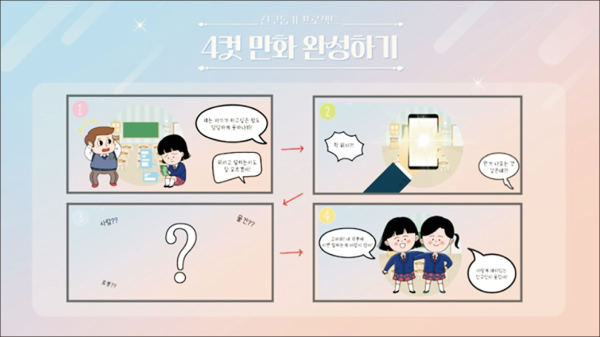
The problem context implies that the participant child is helping a child with a speech impediment. In particular, the setting of something appearing on a phone device implies a use of AR. Therefore, by thinking of a solution that includes the concept of ‘augmentation,’ the children naturally think about the elements necessary for interacting with children with disabilities.
The activity was divided into four groups of three. After identifying the problem situation, the groups were first asked to exchange opinions through the sticky note technique. The sticky note technique is one of the most used techniques in co-design and helps gather and synthesize different ideas from participants (Fails et al., 2013). Each participant was asked to write their opinion on a Post-It note, and then stick it on a large piece of construction paper and write an explanation of their opinion. Next, they were asked to synthesize and discuss the contents shared on the sticky notes and draw cartoons on a large-sized paper sheet. To ensure that no child was left out of the process, the researcher participated in each group’s discussion and tracked time to ensure that everyone had a chance to explain their opinions. The researcher also acted as a mediator, helping the other children understand the content by asking additional questions if they were unable to explain well. All discussions and decisions were made by the children themselves. The process was recorded and captured on camera (Fig. 3).
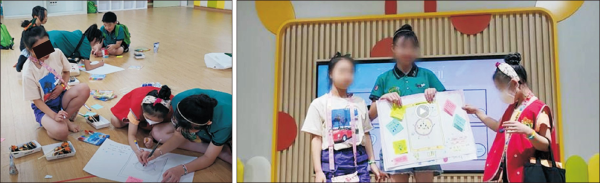
After the discussion and drawing process, they were asked to come forward with their drawings and explain their team’s intentions and meanings. This process allowed us to see the children’s intentions and values that were not evident from the drawings alone. We allowed children to express design ideas for inclusive AR environments and highlighted key considerations for AR-based interactions through a scenario setting.
3.2.3. Session 3: Participant Observation
The third session consisted of one offline activity. The activity lasted about 30 minutes, with each child taking turns to use the AR app for about 5 minutes per person. The activity was conducted using one iPad device (Apple Inc., Cupertino, CA, USA), and only a basic explanation of what AR is and how to use the app was provided beforehand. The children were allowed to use the device autonomously without any order or rules. The researcher’s intervention was limited to mediating excessive conflicts between children or organizing the situation so that the activity could proceed smoothly. The activity was captured and recorded on camera. We wanted to identify how children in different conditions utilize AR and what factors influence their autonomous use of AR. In the process of observing children interacting with AR content, we were able to provide insights into how children interact with AR autonomously, revealing factors that foster or hinder inclusive play.
The used application was Math Ninja AR (Fantamstick, Ltd., Tokyo, Japan), which allows children to view displayed math questions and find the correct answer within the augmented AR content. To find apps for the sessions, the second author searched for AR content in the Google App store (Google LLC., Mountain View, CA, USA) and Apple App store (Apple Inc., Cupertino, CA, USA), and compiled a list of AR apps for children that allowed for actual interaction rather than just viewing. The first and second authors then had a meeting to select the apps based on three criteria: 1) interaction more than just touch; 2) low barrier to entry; and 3) capability for multiple users.
In the end, the Math Ninja AR app was chosen because first, it required children to be physically active, such as squatting or moving around to find answers, as opposed to merely touching the screen. Second, when we did a test run, all the researchers found the concept easy to understand but challenging enough for the children to be engaged. Lastly, the application allowed multiple children to solve problems at the same time. These features were thought to be sufficiently representative of the kinds of problems and situations children might encounter when using AR for inclusive play.
3.3. Data Analysis
The first author of the paper content logged all the recorded videos that totaled approximately 360 minutes for the three sessions. After logging the recorded videos, additional observational and analytical notes were written in a separate document. Codes were developed using a grounded theory approach with constant comparative analysis (Corbin & Strauss, 1990). Initial open coding was conducted to identify recurring patterns related to inclusive play in AR environments. Through iterative discussions, the research team refined the coding scheme based on thematic relevance to the study’s objectives. Criteria for code creation included: (1) relevance to AR’s role in fostering or hindering inclusion, (2) observable behaviors or statements related to engagement and accessibility, and (3) emerging themes that reflected children’s design perspectives. By using the researcher’s analytical memos, discussion notes with parents, and video data, we made sure all data supported each other. We generated the following codes: hinder/foster inclusion, active/disengaged participation, interest and confidence, technological support, facilitator role, and rules. For validity, we presented the findings to two researchers who did not have any prior relationship with the children in the study but had an understanding of “inclusive play” through prior research experience, and refined the final coding scheme.
4. FINDINGS
We sought to discover how children engage in inclusive play with the technology of AR. To achieve this goal, we conducted four sessions. Each session explored children’s AR awareness, content needs, and inclusive play behaviors. From this, we were able to identify several factors that facilitate and hinder inclusive play with AR, which can be summarized into three main categories: 1) interest and confidence; 2) technology in inclusive play; and 3) support and guidelines.
4.1. Interest and Confidence
Children were more engaged in play when they shared a common interest with other children, recognizing each other’s strengths and working together. In this process, children became confident in their abilities and actively participated in play. In our sessions, we observed children focusing on their own interests. Among the codes we generated, the children’s behavior classified and collected through the codes ‘hinder/foster inclusion,’ ‘active/disengaged participation,’ and ‘interest and confidence’ revealed that children’s interest and confidence are key factors in their participation in play activities and information seeking groups. A common theme across all the sessions was that children were engaged in activities once an element that they were interested in was added, despite the fact that the topic itself (mathematics) was not favorable for most children. In Session 3, the participants played a game using AR to solve math problems. Most of the children did not like math and were not confident in their ability to answer the questions. However, they were intrigued by the AR activity and actively participated. The game, which was played on an iPad, required a great deal of physical activity such as walking around, squatting, and standing up. Even the children who were initially confused by the math problems were soon intrigued by the AR graphics and spontaneously moved beyond the initial required physical activity. Liam said that his interest in the physical activity that the technology required led to an interest in math: “It’s fun to do math problems like this!” In addition, there was Caleb, who struggled to socialize with other children outside of the session, but his strength was math. When he showed interest in the AR math game that the other children were playing during the session and tried to join in, they were all reluctant. But as he quickly worked through the problems and found the answers, children from other teams came up to him and asked to play with him. The initially interested but hesitant child gradually gained confidence in his strengths and led the play.
All of the children risked getting frustrated or losing interest during the sessions. This was especially noticeable with the children who were diagnosed with language impairment, which included two children in Session 1. These children showed a lack of confidence, stating that others did not like them or did not play with them because they were speaking slowly, so they were often disengaged during discussions or presentations. Even though the activity required them to answer and explain the reasoning for the alternative questions in the WYR activity, they often answered the questions with short answers or chatted to themselves. This was distinct from the other participants, who provided their own answers and specific rationale for almost every question. Aiden and Jackson, who both have language disorders, were particularly enthusiastic when questions were about topics they were interested in, such as games or friends. However, their interests quickly shifted when another friend asked them additional questions and they either did not answer or gave different answers.
This tendency to engage in interest-driven play also highlighted the importance of proactivity and self-confidence in children. In Session 2, children were asked to consider how they would help a friend who was struggling to socialize with children and had relationship problems due to her inability to speak. Most of the children argued that the cause of the problem was not a disability, but a lack of proactivity, and suggested solutions such as “going back to the beginning of the relationship and rebuilding it with confidence,” or “using assistive technology to find confidence and competence.” The relationship problem that children perceived was less about the fact that the child does not speak well, and more about the fact that they did not feel confident or have not reached out to others first. When asked why they thought approaching first mattered more, the children said they could interpret it as an indicator of interest. They valued participating in the activity rather than the method or format. Some children interpreted others not participating as a lack of interest in the activity, or they were not interested themselves. This suggests that children’s cooperative play requires a high level of activeness, and that children may interpret expressions of interest as a willingness to cooperate. Additionally, the children showed a tendency to be more active in searching for and sharing information when their interest and confidence were fostered. In all sessions, children were observed to demonstrate the most active CIS behavior when discussing topics that aligned with their interests. Conversely, when they lacked interest or confidence, they were hesitant to share information or participate in the information-sharing group. These observations suggest that children’s information accessibility could be primarily influenced by their interests.
4.2. Technology in Inclusive Play
Technology can be used both positively and negatively for inclusive play. In Sessions 1 and 2, the concept of augmentation was presented as “something that pops out of the phone.” Children naturally accepted the concept of augmentation and had no difficulty describing a situation that involved something appearing on their phone. The children’s familiarity with smartphones and tablets was evident, as they were already part of their daily routine, and their wariness was low. When the questions in Session 1 asked for examples of other unfamiliar devices, such as a Nintendo, some children expressed discomfort with the device before applying it to a specific situation: “[a] Nintendo is uncomfortable and heavy to carry around” (Abigail). However, when a device such as a smartphone was presented as an example, there were complaints and suggestions about the augmented content, but no questions about the device itself. In the real-world experience of AR content in Session 3, children were excited to be able to enjoy a completely new virtual environment and activity on a familiar device in a church space where they had limited options for play.
However, in some cases, the limitations of the devices made activities difficult. In Session 3, five children played a multiplayer game using a single tablet device to solve math problems and moved the device around to find the answers. The children quickly adapted to the AR on the tablet screen. Without much instruction, they easily figured out how to play the game and proceeded to play the activity as if they already knew how to utilize the device. However, because there was only one tablet device available, many children had to wait, and some expressed frustration that they could not see the screen well or that they had less opportunity to play. Participants holding their own tablets also complained that the screen was too small, and that the augmented objects were hard to see (Fig. 4).
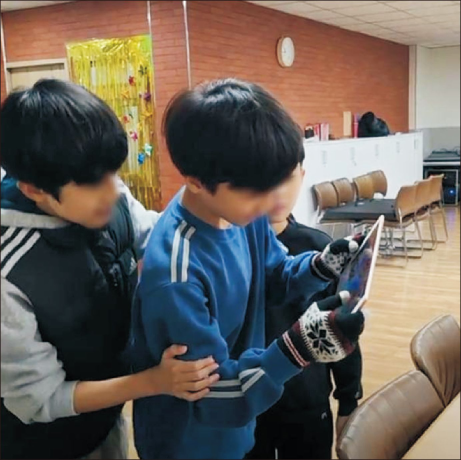
Through the children’s behavior that emerged during the sessions, especially those classified as “technological support,” we observed that AR can play an essential role in creating an “equitable environment.” While children were mostly excited about the question of creating AR content elements, they were less enthusiastic about the idea of seeing someone else’s drawings come to life. The lack of trust in others manifested itself in fear and exclusion. For instance, in response to the question in Session 1, “WYR have the pictures in the book come to life or the character you drew come to life?”, the children worried about poorly drawn pictures coming to life that can threaten the world they live in. However, in the process, who drew the picture and who owns the picture was considered less important. Given that the question refers to the picture as the AR content and the person who drew it as the AR player, we can assume that the user receives relatively little attention in the process of children’s use of AR. Differences and characteristics between users are less important because they are focused on the new and unfamiliar AR content itself.
In this context, in Session 3, children paid less attention to who they were playing with when they focused on the AR activity. Since there was only one device, most of the attention was focused on the child holding the tablet. These children were so focused on enjoying the AR content that they were often unaware of who else was around them. As a result, when using AR, the children frequently found themselves playing with children with whom they were not normally close, and they even reached out to children with whom they were not familiar but who were good at using AR, showing communication that extended beyond their existing relationships. The sessions included children with a variety of characteristics—difference in height, age, children who were more focused or those more easily distracted, children who were talkative or quiet, etc. Regardless of these differences, the children simply found someone to use AR with quickly and did not consider other factors in their interactions. Differences between children were not considered, which automatically created a situation of inclusion. These findings indicate that AR can serve as an accessible tool for children with diverse needs by providing adaptive and interest-driven engagement opportunities. AR’s ability to integrate digital and physical play environments fosters equitable access to information through interactive and immersive experiences. This reinforces the role of AR as an information-accessible medium in digital environments.
4.3. Support and Guidelines
Adult assistance is essential in most inclusive play environments. Classified under the codes ‘Facilitator Role’ and ‘Rules,’ the children’s behavior demonstrated their need for the presence of a facilitator in the play and the way children learn norms and rules through AR experience. In Session 2, children expressed a preference for a facilitator figure, often imagined as a fairy, goddess, or wizard from fairy tales, who would consistently support them within the AR content. They wanted a facilitator who was “familiar and comfortable” and who could provide tangible support for their situation. However, they did not want a facilitator to directly participate in the activity with them or do it for them. For instance, children wanted a fairy from a cartoon to pop up and help them in their adventures or relationships. Children insisted that they were responsible for what happened after the facilitator helped them through the situation. Similarly, they wanted a comforting presence, such as a family member, to give them a boost of courage. In this case, they did not ask for more than comfort, desiring only support for their work and relationship building. When asked about their preference for an active or passive facilitator in Session 1, children also rejected more than a certain amount of intervention, asking why a facilitator should do something for them that they could do themselves. This was contrary to our expectation that in the context of AR or digital content, children would want more active intervention because anything they imagined could appear. Because this was an AR environment rather than a real-world play environment, they wanted more autonomy, and they wanted to be able to control the situation themselves.
Children were able to play autonomously, even when they were actually trying out AR. During the actual AR game in Session 3, most of the gameplay did not require any special explanation or assistance, as the instructions for the activity were already well-described within the AR environment. The children quickly picked up on the inherent activity rules and adapted easily. Problems arose outside of the games. Liam fell while fighting over a device or pushing Ethan to get a better view of the screen. There were also complaints about one child monopolizing the device, but after a few initial teacher interventions, the children established some order, such as answering three questions themselves before passing it to another child. Once the rule was established, the children were able to play relatively fairly. At the same time, however, there were problems such as children who lost interest in the game after their turn and went to other activities, which lowered the interest and morale of the remaining children, or children who did not follow the rules who were unduly criticized by others. When the researcher intervened to encourage the children and set additional rules, the immediate problem was solved, but some children quickly lost interest in the game because they felt they had lost their autonomy. This shows that the AR environment is relatively effective in ensuring children’s autonomy, and the inherent rules can be acquired through technical elements, so that external intervention by adults is less necessary than in real-life play.
Overall, our findings suggest that effective AR design for accessible and inclusive play should incorporate the following elements: (1) interest-driven engagement, (2) intuitive and adaptive interfaces, (3) multi-user collaboration features, and (4) minimal but supportive facilitator intervention. These insights provide concrete guidelines for developing AR technologies that enhance both play and information accessibility for diverse user groups.
5. DISCUSSION
In this study, we investigated the elements within AR for inclusive play that children wanted through co-design sessions. We propose suggestions for developing inclusive play activities within AR.
5.1. Designing for AR Activities: Renewal of Content and Self-Encouraging Features
The children in this study showed considerable interest in the AR activities, but when they lost interest, they quickly left or became uncooperative. This behavior was demoralizing to the other children involved in the activity and made them think that the children who left were not interested in the relationship. As children tend to follow the interests of their peer group, the impact of this behavior extends beyond the play activity and into the relationships between children (Jitsaeng & Chaikhambung, 2022). This also affects the information accessibility that children experience in play, as children may refuse to participate or lose interest in the CIS process (Motti, 2019). In this regard, Kangas et al. (2023) suggests that for inclusive play to occur, the content should provide new activities and interactions on a regular basis to keep children interested. In our observation, children with disabilities often show a rapid change of interest and a lack of response to questions that do not interest them. Therefore, understanding children’s interest cycles and providing new content is an important issue in designing for inclusive play using AR.
AR has many aspects that make it attractive to children. Through AR, children can experience the perspective of another person and have an immersive VR experience (Dick, 2021). Considering that much current AR content is designed to be short and intuitive with educational or therapeutic purposes, there is a need to develop AR content with a wider range of engaging elements. AR allows us to experience traditional play in a completely new perspective through digitally augmented elements. In an unfamiliar and rapidly changing play process, children can feel the necessity of cooperation and learn the sense of teamwork. Especially for children with disabilities, such content can be more comfortable, as everyone is initially unfamiliar with the play process and needs time to adapt to the play process. However, confidence is the necessary precondition for this.
In our observations across the sessions, we found that children commonly interpreted disengagement as a lack of interest in play. Many of the children were disengaged in play due to lack of interest or exhaustion. However, in the sessions it was noticeable that the children with disabilities, before expressing their interest, were afraid that they would delay the play activity or bore everyone else. They showed a lack of confidence in their own abilities, valuing the reactions of other children over their own preferences in play activities. These fears not only prevented them from participating in play but can also have a negative impact on their relationships with other children (Mshali & Al-Azawei, 2022). It can also prevent children with disabilities from taking a leading role in inclusive play, where cooperation is essential. To overcome this, AR’s feature of being able to experience both real and virtual environments simultaneously can help.
AR works by overlaying virtual elements that users want on top of a real-world background, but the ability requirements for activities vary greatly depending on the specific content. AR can be used to provide an inclusive play environment by limiting the required abilities such as physical, educational, and emotional skills, based on the characteristics of the participating children. In the case of the AR app utilized in the activity in Session 3, the physical ability to find answers was important, but the ability to solve math problems quickly was more important. Therefore, the children decided to form teams based on mathematical skills rather than on relationships or personalities, and focused on roles that could utilize their strengths. Children showed the most confidence when their strengths were recognized. As such, inclusive play content using AR should be designed in a way that allows children with a variety of conditions to express their strengths. It should offer a wide range of interaction options so that children who are not confident in some areas can utilize other strengths. This content design approach is better suited to AR, which allows for multiple ways to engage with the same content in a wider range of contexts, compared to other technologies that often restrict users to a limited set of interactions within predetermined contexts. In this process, AR environments can serve as “invisible equalizers,” reducing the salience of physical and social differences among children. Our findings align with prior research on information behavior in digital environments (Dick, 2021), extending these theories to the context of collaborative play. Additionally, our findings suggest that AR facilitates CIS behaviors, reinforcing theories of co-learning and participatory design in HCI.
5.2. Creating Spaces for Children to Play in Equal Basis
Inclusive play is heavily influenced by environmental factors. Children with and without disabilities need to participate in activities together, requiring a wider range of physical and emotional factors to be considered. These environmental factors need to be considered when creating inclusive play content using AR. Children were familiar with devices such as smartphones and tablets but were frustrated with additional devices like Nintendo Switch. In Session 3, when we tried AR in action, we found that the inconvenience of having to share a single device and the technical limitations, such as poor camera recognition, hindered the immersion of the play. These challenges were similar to those encountered in many previous studies using digital devices (Balbin & Dolendo, 2023). Yet at the same time, AR gives children an expanded play space and allows them to try new things they have never experienced before. Our findings indicate that AR enhances information accessibility by providing children with interactive and adaptive ways to engage with content that accommodates diverse needs. By blending physical and digital spaces, AR reduces traditional barriers to information access—such as physical mobility limitations or language constraints—enabling children with disabilities to participate on a more equal footing with their peers.
A major advantage of AR is that it blurs the boundaries between children. When we asked children in Session 1 what elements of AR they wanted, they focused more on the content of the activity rather than the AR user they were interacting with. This suggests that AR experiences should prioritize engagement-driven design, where multi-sensory interaction, adaptive difficulty levels, and dynamic challenges sustain children’s participation and encourage collaboration.
In Session 3, children were even unaware of who was around them because they were so focused on the AR game they were playing. Since they were more concentrated on what they were doing rather than the people around them in the expanded play space, they often played with children they were not familiar with during the session. The AR app used in the Sessions required active physical interaction. Children actively moved their bodies and operated the device to find answers.
At this point, differences between children were not a matter of concern, at least for the participating children. As such, in most AR-related sessions, the researchers noticed the children forgetting the differences between the other children they were playing with as they focused on the activity and collaboration itself. This reflects how AR can influence information behavior by encouraging collaborative activities that prioritize shared problem solving over individual differences. This may have implications for reducing children’s feelings of disjunction and exclusion when physical and neurological differences exist between children. Prior research (Dick, 2021) has argued that AR experiences support equality and inclusion by removing the need to consider differences in conditions between users. In inclusive play, which is heavily influenced by the environment, AR provides a space for everyone to participate on a relatively equal basis by invisibilizing differences, and allows for dynamic experiences with minimal movement. AR also has the potential to enhance information accessibility by allowing children to engage with content in ways that minimize barriers such as physical mobility or language skills (Köse & Güner-Yildiz, 2021). This use of technology in inclusive play has both advantages and disadvantages and needs to be developed carefully. It is important to consider the different personalities and contexts in which children operate the devices they are familiar with. Inclusive play spaces can be designed so that children can focus on the AR environment and rules rather than on their differences.
5.3. Assistance and Norms in AR Content
In this study, children requested the presence of a familiar and comfortable helper. However, they refused to allow the assistant to provide direct assistance, preferring to maintain their autonomy. AR environments make it relatively easy to provide these assistants. While many inclusive plays rely heavily on adults to teach and moderate the play (Danniels & Pyle, 2023), AR environments can automate this through elements such as augmented indicators or direct introductions to activities by the main character of the augmented content. These technological methods can be used to create a play environment that engages children without controlling them directly, and that feels like it respects their autonomy as much as possible. Despite its potential for inclusion, AR still presents challenges such as device availability, usability constraints, and potential disengagement due to technical limitations (Quintero et al., 2019). Therefore, AR environments require careful content moderation and facilitation to prevent excessive autonomy from leading to confusion or conflict. Future research should explore how to balance autonomy with structured guidance in AR-based play settings. Since AR is an extended form of digital content based on reality, it is relatively uninterrupted when children are interacting and learning embedded social norms. Children believe they are exploring a virtual environment through AR, but they are playing within the confines of reality. This illusion allows children to learn the norms and relationships of the real world that are familiar to them in a more enjoyable way. However, this requires that the presence of a human assistant in the AR content be authoritative—someone children can rely on and feel safe around in an unfamiliar virtual environment. Such assistants need to be defined as a guardian or a supportive figure so that they can easily accept the guidelines provided in the AR environment. It is also necessary to define norms to avoid confusion with the hierarchy and rules of the real world that children are accustomed to.
6. CONCLUSION
In the modern world, investments and developments in AR are increasing. AR for children with disabilities is especially challenging. The practicalities of AR for children with disabilities are much more complex than those for children without disabilities. Therefore, when developing AR as a tool for inclusive play, more research is needed to consider cooperation and harmony with other children. Through three participatory design and observation sessions, we identified the necessary elements of AR for children’s inclusive play.
6.1. Enhancing Information Accessibility
We observed that children interacted with each other through AR activities and felt confident in activities that interested them. This sense of confidence and interaction reflects key aspects of children’s information behavior, as it demonstrates how children actively seek, process, and share information. Through AR, children engage in problem-solving, explore digital content, and adapt their interactions based on technological affordances. It also showed how interest-driven engagement enhances knowledge acquisition and collaborative learning. This tendency has a direct impact on how children respond to inclusive play. In addition, AR environments allow children to focus on the unfamiliarity of the virtual environment rather than the real-world barriers of disability. This change in perspective shows how AR can shape children’s information behavior by reducing barriers to information accessibility and promoting collaboration in shared virtual environments. This conclusion emphasizes the inclusivity and equity of inclusive play.
6.2. Collaborative Play in AR Environments
AR can also automate rules by providing augmented indicators that are unfamiliar and interesting to children instead of additional effort from adults to facilitate inclusive play. This expansion of autonomy allows children to learn social norms in a more enjoyable way and provide a sense of self-determination in a safe environment. In conclusion, based on these findings, we propose the necessary elements of AR content for inclusive play. For children to collaborate effectively, it should include a process that promotes confidence and a sense of accomplishment. The technical elements need to be based on media that children are familiar with, blurring boundaries and physical barriers between children. Designers need to consider deploying effective facilitators to help children quickly accept the rules of the AR environment and internalize social norms. The definition and authority of the facilitator can influence the level of engagement.
For practitioners developing AR for inclusive play, we suggest the following:
-
Design for Sustained Engagement: Incorporate dynamic, evolving challenges and interest-driven content to maintain children’s motivation.
-
Prioritize Accessible Interactions: Ensure AR interfaces are intuitive and adaptable, minimizing barriers for children with disabilities.
-
Support Collaborative Play Features: Facilitate multi-user interactions, enabling children to engage in cooperative tasks rather than passive experiences.
-
Define the Role of Facilitators Carefully: AR should provide structured but non-intrusive guidance, allowing children autonomy while maintaining social structure.
Our study used a variety of methodologies and a wide range of participants to get a comprehensive picture of children’s opinions. However, there was a lack of diversity as the participants were children from the same church program, and the number of children with disabilities was low. Furthermore, because we only had one session of direct AR use, future research should include more participants and experiments in a variety of settings. Despite these limitations, our study provides a comprehensive understanding of future design ideas within AR which can utilize children’s inclusive play. Additionally, through the design sessions, we have directly involved children in the development process to identify what elements they prefer and how they perceive inclusive play. Based on this research, we anticipate that future studies can develop more AR content that is child-centered to enhance information accessibility and collaborative play.
REFERENCES
, , , , (2024) Enabling technology integrated learning for autistic children using augmented reality based cognitive rehabilitation SN Computer Science, 5, 151 https://doi.org/10.1007/s42979-023-02495-5.
, (2024) Impact of augmented reality-based learning on preparing children for creative reading skills in childhood education stage Forum for Linguistic Studies, 6, 226-238 https://doi.org/10.30564/fls.v6i5.7161.
Balbin, D. Jr. S., & Dolendo, R. B. (2023). Virtual internship experiences of library and information science students during the pandemic. Journal of Information Science Theory and Practice, 11(3), 58-78. https://doi.org/10.1633/JISTaP.2023.11.3.5
, , , , , , , , , (2019, May 2) Proceedings of the Extended Abstracts of the 2019 CHI Conference on Human Factors in Computing Systems Association for Computing Machinery Paper prototyping comfortable VR play for diverse sensory needs, pp. 1-6, https://doi.org/10.1145/3290607.3313080
, , , , (2016) The need for accessibility in playgrounds for children with disabilities The American Journal of Occupational Therapy, 70, 7011505165p1 https://doi.org/10.5014/ajot.2016.70S1-PO6020.
, , , , , , , (2020, July 21) Proceedings of the 2020 ACM Interaction Design and Children Conference: Extended Abstracts Association for Computing Machinery Exploring children's everyday journeys with user-generated AR, pp. 308-313, https://doi.org/10.1145/3397617.3397847
, (1990) Grounded theory research: Procedures, canons, and evaluative criteria Qualitative Sociology, 13, 3-21 https://doi.org/10.1007/BF00988593.
(2013) Understanding augmented reality: Concepts and applications Morgan Kaufmann http://public.eblib.com/choice/publicfullrecord.aspx?p=1183494Article Id (pmcid)
, , , , (2022, April 28) Extended Abstracts of the 2022 CHI Conference on Human Factors in Computing Systems Association for Computing Machinery Supporting shy & neurodivergent children in social play, pp. 1-6, https://doi.org/10.1145/3491101.3503800
, (2023) Inclusive play-based learning: Approaches from enacting kindergarten teachers Early Childhood Education Journal, 51, 1169-1179 https://doi.org/10.1007/s10643-022-01369-4. Article Id (pmcid)
, , , (2022) A review on augmented reality authoring toolkits for education Frontiers in Virtual Reality, 3, 798032 https://doi.org/10.3389/frvir.2022.798032.
Dick, E. (2021). Current and potential uses of AR/VR for equity and inclusion. https://itif.org/publications/2021/06/01/current-and-potential-uses-arvr-equity-and-inclusion/
(2002) The role of children in the design of new technology Behaviour & Information Technology, 21, 1-25 https://doi.org/10.1080/01449290110108659.
(2016) Designing a mobile based library information and service delivery system: A model plan for libraries of Bangladesh Journal of Information Science Theory and Practice, 4, 57-70 https://doi.org/10.1633/JISTaP.2016.4.3.4.
El Shemy, I. (2022, June 27). Language learning with mobile augmented reality and artificial intelligence for children with autism spectrum disorder. Proceedings of the 21st Annual ACM Interaction Design and Children Conference (pp. 658-661). Association for Computing Machinery. https://doi.org/10.1145/3501712.3538827
, , (2013) Methods and techniques for involving children in the design of new technology for children. Foundations and Trends® in Human- Computer Interaction, 6, 85-166 https://doi.org/10.1561/1100000018.
, , , , (2017, June 27) Proceedings of the 2017 Conference on Interaction Design and Children Association for Computing Machinery Blending methods: Developing participatory design sessions for autistic children, pp. 39-49, https://doi.org/10.1145/3078072.3079727
, , , , , (2017, June 27) Proceedings of the 2017 Conference on Interaction Design and Children Association for Computing Machinery Plan & play: Supporting intentional media use in early childhood, pp. 85-95, https://doi.org/10.1145/3078072.3079752
, , , , , , (2016, February 27) Proceedings of the 19th ACM Conference on Computer-Supported Cooperative Work & Social Computing Association for Computing Machinery Not at the dinner table: Parents' and children's perspectives on family technology rules, pp. 1376-1389, https://doi.org/10.1145/2818048.2819940
, (2022) Factors influencing new media exposure of political news by youths in Isan society Journal of Information Science Theory and Practice, 10, 86-101 https://doi.org/10.1633/JISTaP.2022.10.2.6.
, , (2023) Inclusive play: Defining elements of playful teaching and learning in culturally and linguistically diverse ECEC Education Sciences, 13, 956 https://www.mdpi.com/2227-7102/13/9/956.
(2024) Revealing the true potential and prospects of augmented reality in education Smart Learning Environments, 11, 2 https://doi.org/10.1186/s40561-023-00288-0.
, (2021) Augmented reality (AR) as a learning material in special needs education Education and Information Technologies, 26, 1921-1936 https://doi.org/10.1007/s10639-020-10326-w.
, (2013) Preference and use of electronic information and resources by blind/visually impaired in NCR libraries in India Journal of Information Science Theory and Practice, 1, 69-83 https://doi.org/10.1633/JISTaP.2013.1.2.5.
(2016) A study on the effect of communication functioning of smartphones on information acquisition: The case of South Korea Journal of Information Science Theory and Practice, 4, 28-42 https://doi.org/10.1633/JISTaP.2016.4.3.2.
(2021) Virtual reality-based library user education program development Journal of Information Science Theory and Practice, 9, 63-74 https://doi.org/10.1633/JISTaP.2021.9.4.5.
Lynch, H., Moore, A., & Prellwitz, M. (2018). From policy to play provision: Universal design and the challenges of inclusive play. Children, Youth and Environments, 28(2), 12-34. https://doi.org/10.7721/chilyoutenvi.28.2.0012
, (2013) Back to the future, disability and the digital divide Disability & Society, 28, 702-718 https://doi.org/10.1080/09687599.2012.732538.
, , , , , , , (2024) Pervasive augmented reality to support real-time data monitoring in industrial scenarios: Shop floor visualization evaluation and user study Computers & Graphics, 118, 11-22 https://doi.org/10.1016/j.cag.2023.10.025.
, , , , , (2023) AR-speaking buddy: Designing content and user interface of an augmented reality (AR)-based application for Malaysian children speaking practice Journal of Advanced Research in Applied Sciences and Engineering Technology, 35, 57-68 https://doi.org/10.37934/araset.35.2.5768.
, , , , , , , , (2020, April 23) Proceedings of the 2020 CHI Conference on Human Factors in Computing Systems Association for Computing Machinery Robots for inclusive play: Co-designing an educational game with visually impaired and sighted children, pp. 1-13, https://doi.org/10.1145/3313831.3376270
, (2024) Review of the trends in the use of augmented reality technology for students with disabilities when learning physical education Education and Information Technologies, 29, 1251-1277 https://doi.org/10.1007/s10639-022-11550-2.
, , , , , (2007, April 29) Proceedings of the SIGCHI Conference on Human Factors in Computing Systems Association for Computing Machinery Comicboarding: Using comics as proxies for participatory design with children, pp. 1371-1374, https://doi.org/10.1145/1240624.1240832
, (2019, October 4) Proceedings of the 37th ACM International Conference on the Design of Communication Association for Computing Machinery Designing emerging technologies for and with neurodiverse users, pp. 1-10, https://doi.org/10.1145/3328020.3353946
(2018) Teaching play skills to children with disabilities: Research-based interventions and practices Early Childhood Education Journal, 46, 587-599 https://doi.org/10.1007/s10643-018-0917-7.
, (2022) Predicting online learning adoption: The role of compatibility, self-efficacy, knowledge sharing, and knowledge acquisition Journal of Information Science Theory and Practice, 10, 24-39 https://doi.org/10.1633/JISTaP.2022.10.3.3.
, (1993) Participatory design Communications of the ACM, 36, 24-28 https://doi.org/10.1145/153571.255960.
, (1998) Inclusion of young children with special needs in early childhood education: The research base Early Childhood Research Quarterly, 13, 3-25 https://doi.org/10.1016/S0885-2006(99)80023-4.
Pires, A. C., Neto, I., Brulé, E., Malinverni, L., Metatla, O., & Hourcade, J. P. (2022, June 27). Co-designing with mixed-ability groups of children to promote inclusive education. Proceedings of the 21st Annual ACM Interaction Design and Children Conference (pp. 715-718). Association for Computing Machinery. https://doi.org/10.1145/3501712.3536389
, , , , , (2019) Web AR: A promising future for mobile augmented reality-State of the art, challenges, and insights Proceedings of the IEEE, 107, 651-666 https://doi.org/10.1109/JPROC.2019.2895105.
, , , , (2019) Augmented reality in educational inclusion. A systematic review on the last decade Frontiers in Psychology, 10, 01835 https://doi.org/10.3389/fpsyg.2019.01835. Article Id (pmcid)
, , , , , (2017, June 27) Proceedings of the 2017 Conference on Interaction Design and Children Association for Computing Machinery Multisensory participatory design for children with special educational needs and disabilities, pp. 490-496, https://doi.org/10.1145/3078072.3084314
, (2020) Collaborative information seeking in digital libraries, learning styles, users' experience, and task complexity Journal of Information Science Theory and Practice, 8, 55-66 https://doi.org/10.1633/JISTaP.2020.8.4.5.
, , , (2024) An augmented reality application and experiment for understanding and learning spatial transformation matrices Virtual Reality, 28, 12 https://doi.org/10.1007/s10055-023-00904-x.
, (2010) Awareness in collaborative information seeking Journal of the American Society for Information Science and Technology, 61, 1970-1986 https://doi.org/10.1002/asi.21379.
, , , , , , , , , , (2021, June 24) Proceedings of the 20th Annual ACM Interaction Design and Children Conference Association for Computing Machinery Would you rather: A focus group method for eliciting and discussing formative design insights with children, pp. 131-146, https://doi.org/10.1145/3459990.3460708Article Id (pmcid)
, , , , (2015, June 21) Proceedings of the 14th International Conference on Interaction Design and Children Association for Computing Machinery Maximizing children's opportunities with inclusive play: Considerations for interactive technology design, pp. 39-48, https://doi.org/10.1145/2771839.2771844
Sobel, K., Rector, K., Evans, S., & Kientz, J. A. (2016, May 7). Incloodle: Evaluating an interactive application for young children with mixed abilities. In J. Kaye & A. Druin (Eds.), Proceedings of the 2016 CHI Conference on Human Factors in Computing Systems (pp. 165-176). Association for Computing Machinery. https://doi.org/10.1145/2858036.2858114
(2005) The methodology of participatory design Technical Communication, 52, 163-174 https://scispace.com/papers/the-methodology-of-participatory-design-21m1avtwrl.
Statista. (2024). AR software - Worldwide. https://www.statista.com/outlook/amo/ar-vr/ar-software/worldwide
, , , (2022) Cyber social interactions: Information behavior in between social and parasocial interactions Journal of Information Science Theory and Practice, 10, 15-23 https://doi.org/10.1633/JISTaP.2022.10.3.2.
(2002) Information sharing in academic communities: Types and levels of collaboration in information seeking and use New Review of Information Behavior Research, 3, 143-159 http://mapule276883.pbworks.com/f/Info.%20sharing%20in%20academic%20communites.pdf.
, , , (2019, June 12) Proceedings of the 18th ACM International Conference on Interaction Design and Children Association for Computing Machinery Supporting self-evaluation for children with mental disabilities through augmented reality, pp. 635-641, https://doi.org/10.1145/3311927.3325307
, , , , , , , , , , , , (2012, June 12) Proceedings of the 11th International Conference on Interaction Design and Children Association for Computing Machinery DisCo: A co-design online tool for asynchronous distributed child and adult design partners, pp. 11-19, https://doi.org/10.1145/2307096.2307099 Article Id (pmcid)
, , , , , , , , (2010, April 10) Proceedings of the SIGCHI Conference on Human Factors in Computing Systems Association for Computing Machinery Layered elaboration: A new technique for co-design with children, pp. 1237-1240, https://doi.org/10.1145/1753326.1753512
, , , , (2013, April 27) Proceedings of the SIGCHI Conference on Human Factors in Computing Systems Association for Computing Machinery FACIT PD: A framework for analysis and creation of intergenerational techniques for participatory design, pp. 2893-2902, https://doi.org/10.1145/2470654.2481400
, , , (2013) Current status, opportunities and challenges of augmented reality in education Computers & Education, 62, 41-49 https://doi.org/10.1016/j.compedu.2012.10.024.
, , , , , , (2013, June 24) Proceedings of the 12th International Conference on Interaction Design and Children Association for Computing Machinery Brownies or bags-of-stuff? Domain expertise in cooperative inquiry with children, pp. 201-210, https://doi.org/10.1145/2485760.2485763
, , , (2018) A meta-analysis on effects of VR, AR, MR-based learning in Korea The Journal of Educational Information and Media, 24, 459-488 https://doi.org/10.15833/KAFEIAM.24.3.459.
(2008) The importance of play and playfulness European Journal of Psychotherapy & Counselling, 10, 121-129 https://doi.org/10.1080/13642530802076193.