1. INTRODUCTION
Scholarly publishing plays a crucial role in the global research ecosystem, shaping academic discourse, validating research contributions, and determining institutional prestige. However, the sustainability of non-commercial and regionally based journals remains a significant challenge, particularly given the increasing concentration of publishing power among major commercial entities such as Elsevier, Springer, and Wiley (Matthews, 2018). These publishers not only dominate indexing in Web of Science (WoS) and Scopus but also establish publishing standards that determine journal impact, creating barriers for smaller, independent journals seeking global recognition (Kim, 2024; Pranckutė, 2021; Tennant et al., 2019).
The Journal of Information Science Theory and Practice (JISTaP) offers a compelling case study for examining scholarly publishing dynamics. As Marchionini (2022) reflected at JISTaP’s 10-year milestone, the journal was founded in 2013 with a specific vision to “serve the expanding global information science research community and especially welcome and encourage authors from the Asia-Pacific region” while ensuring that “impact and practice were as welcome as theory” (p. 1). JISTaP represented a strategic development of the Korea Institute of Science and Technology Information (KISTI)’s long-standing commitment to scholarly publishing. Oh (2020) summarized this transformation from a domestic journal into an international one. From its inception, JISTaP was designed as a fully open access (OA) journal without commercial interests or author-facing fees, distinguishing it from many commercial OA models that shifted costs to authors through article processing charges (APCs).
As Choi (2013) documented in JISTaP’s inaugural issue, the journal replaced the Korean-language domestic journal Journal of Information Management, which had been published for over 50 years since 1963. This historical continuity provided JISTaP with an institutional legacy and intellectual foundation, even as it adopted new approaches to meet international publishing standards. However, challenges remain, including limited visibility in WoS, competition from well-established library and information science (LIS) journals, and ongoing financial and operational constraints. These issues reflect broader trends affecting independent journals in the Asia-Pacific region (Kim & Jeong, 2023).
The objective of this paper is to critically examine how JISTaP’s 12-year development illustrates the shifting dynamics between traditional commercial publishing and emerging OA models. By analyzing its strategic decisions, successes, and ongoing challenges, we show how regional journals navigate an increasingly competitive publishing landscape while striving for global relevance. Through a SWOT analysis (strengths–weaknesses–opportunities– threats), we provide insights into JISTaP’s strengths, weaknesses, opportunities, and threats, offering a framework to assess its sustainability and influence in scholarly publishing. The findings underscore both the structural limitations faced by independent journals and the strategic approaches that can enhance their long-term viability (Gasparyan & Kitas, 2021; Kim, 2022; Kim & Atteraya, 2023).
2. METHODOLOGY
This study employs a mixed-methods approach, combining bibliometric analysis with a strategic assessment of JISTaP’s development and position within the Asian LIS publishing landscape.
2.1. Bibliometric Analysis
Data on LIS journals in Asia were gathered from the SCImago Journal & Country Rank (SJR) portal (SCImago, n.d.), which provides Scopus-indexed journal metrics, including H-Index values, publication output, and quartile rankings from 2017 to 2023. The SJR database is publicly accessible and updated annually, allowing for a broad view of publishing trends and journal performance across the region. Filtering for LIS journals from Asian countries resulted in 17 journals for comparative analysis. JISTaP’s development was examined across four publishing periods (2013-2016, 2017-2019, 2020-2022, and 2023-present), each representing key milestones in the journal’s growth.
2.2. SWOT Analysis
To complement the bibliometric analysis, a SWOT analysis was used to evaluate JISTaP’s internal strengths and external challenges (Pickton & Wright, 1998). The SWOT framework is a well-established tool in strategic planning and is particularly useful for assessing a journal’s long-term sustainability and competitive position.
-
Strengths and weaknesses were identified based on internal factors, such as editorial policies, journal indexing, institutional support, and citation trends.
-
Opportunities and threats were assessed based on external factors, including changes in OA publishing, digital innovations, and competition from commercial publishers.
The analysis incorporated bibliometric data alongside qualitative insights from internal institutional reports and editorial strategy assessments, ensuring a well-rounded evaluation of JISTaP’s position in the evolving LIS publishing landscape. By integrating quantitative metrics with qualitative perspectives, this mixed-methods approach provides a balanced assessment of the journal’s trajectory and future outlook.
3. JISTAP’S STABILITY AND STRATEGIC POSITIONING IN ASIAN PUBLISHING
3.1. Scopus-Indexed Asian LIS Journals (Based on SJR Data)
The 2023 list of Scopus-indexed Asian LIS journals, extracted from SJR, represents a snapshot of the current research landscape, offering insights into the evolving scholarly communication in LIS across the region (Table 1). As shown, East Asian countries including China and Taiwan, alongside India, demonstrate dominance with three Scopus-indexed journals each. In contrast, JISTaP is the only journal from South Korea indexed in Scopus under the LIS subject area, while Southeast Asia has a more limited presence, reflecting variations in research infrastructure development across the region. In India, the influence of governmental and institutional backing is evident through publishers like the Defence Scientific Information & Documentation Centre, which publishes the DESIDOC Journal of Library and Information Technology. This suggests how national research priorities shape regional scholarship. Singson et al. (2025) showed that policies and initiatives—such as the University Grants Commission (UGC) guidelines, the National Institutional Ranking Framework (NIRF), the Internal Quality Assurance Cell (IQAC), and UGC-CARE (Consortium for Academic and Research Ethics)—have played a pivotal role in increasing top-tier journal publications and enhancing research productivity.
Table 1
Asian library and information science journals listed in Scopus based on SCImago Journal & Country Rank (2023)
| No. | Title | Country | Publisher | Coverage |
|---|---|---|---|---|
| 1 | Annals of Library and Information Studies | IN | National Institute of Science Communication and Information Resources (NISCAIR) | 2011-2023 |
| 2 | DESIDOC Journal of Library and Information Technology | IN | Defence Scientific Information & Documentation Centre (DESIDOC) | 2012-2023 |
| 3 | Data Analysis and Knowledge Discovery | CN | Chinese Academy of Sciences | 2019-2023 |
| 4 | IAFOR Journal of Literature and Librarianship | JP | International Academic Forum (IAFOR) | 2019-2023 |
| 5 | Journal of Educational Media and Library Sciences | TW | Tamkang University | 2005-2023 |
| 6 | Journal of Information Science Theory and Practice (JISTaP) | KR | Korea Institute of Science and Technology Information | 2017-2023 |
| 7 | Journal of Information Science and Engineering | TW | Institute of Information Science | 1993-1994, 1996-2023 |
| 8 | Journal of Information and Knowledge Management | SG | World Scientific | 2002-2023 |
| 9 | Journal of Library Science in China | CN | Editorial Office of Journal of Library Science in China | 2019-2023 |
| 10 | Journal of Library and Information Science in Agriculture | CN | Chinese Academy of Agricultural Sciences | 2019-2023 |
| 11 | Journal of Library and Information Studies | TW | National Taiwan University, Department of Library and Information Science | 2019-2023 |
| 12 | Journal of Scientometric Research | IN | Phcog.Net | 2019-2023 |
| 13 | Library and Information Science | JP | Mita Society for Library and Information Science | 1980-2023 |
| 14 | Libres | SG | Nanyang Technological University | 1996-2022 |
| 15 | Malaysian Journal of Library and Information Science | MY | Faculty of Computer Science and Information Technology | 1996-2023 |
| 16 | Pakistan Journal of Information Management and Libraries | PK | Department of Information Management, University of the Punjab | 2014-2022 |
| 17 | Wacana | ID | Faculty of Humanities, University of Indonesia | 2015-2023 |
Furthermore, the data in Table 1 confirms that journal longevity varies dramatically across the index—established publications like Library and Information Science (Japan, indexed since 1980) coexist with recent entrants such as Data Analysis and Knowledge Discovery (China, since 2019). Gaps in indexing for journals from Singapore and Pakistan after 2022 demonstrate the tenuous nature of maintaining continuous inclusion in international databases. Perhaps most revealing is the overall coverage trend, where fluctuating indexing periods and occasional gaps (as seen with Taiwan’s Journal of Information Science and Engineering in 1995) confirm that Asian LIS scholarship operates in a dynamic environment. These patterns suggest that academic influence continues to shift and evolve, creating an uneven but gradually expanding footprint in global information science discourse, which is consistent with previous studies such as Oh (2020) that have examined the transformation of Asian LIS journals and their increasing integration into international scholarly communication.
3.2. H-Index Performance of Asian LIS Journals
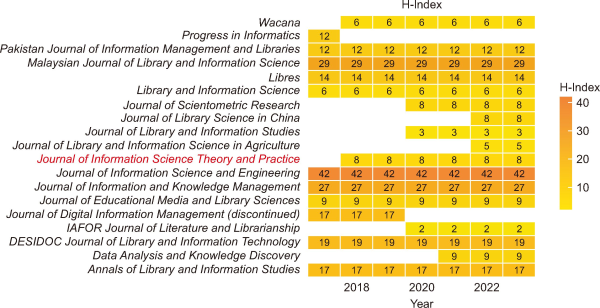
Fig. 1 presents the H-Index trends of Asian LIS journals from 2018 to 2023, indicating distinctions between high-impact, mid-range, and emerging journals. The Journal of Information Science and Engineering consistently leads with an H-Index of 42, reflecting its strong scholarly influence. Other well-established journals, such as the Malaysian Journal of Library and Information Science (H-Index 29) and Journal of Information and Knowledge Management (H-Index 27), maintain relatively high citation impact over time. JISTaP has remained stable at an H-Index of 8 since its Scopus indexing in 2017, positioning it in the mid-range category alongside DESIDOC Journal of Library and Information Technology (H-Index 19) and Annals of Library and Information Studies (H-Index 17). While JISTaP has maintained its standing, it has not shown the upward path seen in some regional counterparts. Meanwhile, emerging journals such as the IAFOR Journal of Literature and Librarianship (H-Index 2) and Journal of Library Science in China (H-Index 3-5) remain at lower citation levels. Fig. 1 illustrates how some journals experience slow but steady growth, while others, including JISTaP, have yet to gain significant citation influence, underscoring the need for increased visibility and stronger citation engagement.
3.3. Publication Output Trends in Asian LIS Journals
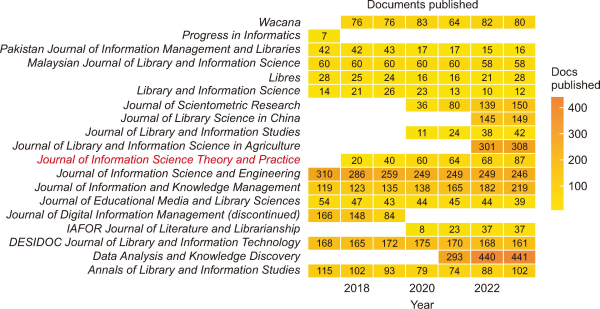
Fig. 2 reveals the distinctive publication dynamics of JISTaP within the landscape of Asian scholarly journals. While some journals show extreme publication patterns, JISTaP occupies a unique middle ground. The journal’s document count varies dramatically from 20 in 2018 to 36 in 2019, surging to 80 in 2020, peaking at 149 in 2021, and then recalibrating to 42 in 2022. In contrast, Data Analysis and Knowledge Discovery exhibits an explosive growth trajectory, rocketing from minimal publications to 441 documents by 2022. The Journal of Scientometric Research follows a similar rapid expansion, increasing to 150 documents. At the other end of the spectrum, journals like Pakistan Journal of Information Management and Libraries have contracted significantly, dropping from 42 to 16 publications. Agricultural and scientometric journals in the dataset display particularly volatile patterns, with extreme fluctuations that dwarf JISTaP’s variations. The Journal of Information Science and Engineering demonstrates a more gradual decline, reducing from 310 to 246 documents. This finding indicates that JISTaP has positioned itself as a moderate performer amidst the diverse and dynamic Asian scholarly communication landscape. In a broader sense, JISTaP’s publication pattern reflects the unpredictable nature of scholarly journal publishing.
3.4. SJR Quartile Rankings and Journal Positioning
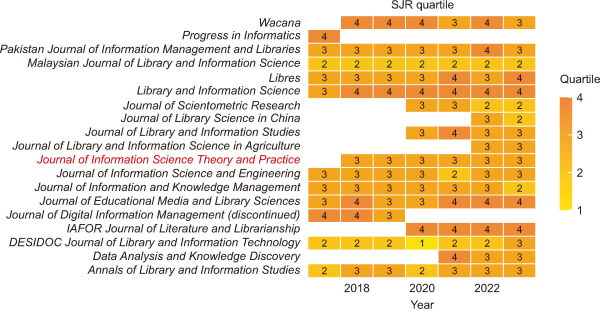
Fig. 3 shows SJR Quartile ranking trends (2017-2023) among Asian LIS journals, with JISTaP maintaining a consistent Q3 position throughout this period. Quartile rankings reflect each journal’s position within its field, where Q1 represents the top 25% of journals and Q4 the bottom 25%. Notably, newer entrants such as the Journal of Library Science in China and Journal of Library and Information Studies emerged around 2020 and secured Q3-Q4 rankings upon entering the index. IAFOR Journal of Literature and Librarianship moved from no ranking to Q4, maintaining this position thereafter. Data Analysis and Knowledge Discovery showed upward mobility by achieving Q3 shortly after appearing in the index. Meanwhile, the Journal of Information Science and Engineering fluctuated between Q3 and occasional Q2 rankings, with Q2 representing higher impact. JISTaP’s steady Q3 position contrasts with these variations among regional peers. Ranking patterns align with the H-Index and publication output trends discussed earlier, illustrating the competitive environment within the Asian LIS publishing ecosystem.
Fig. 3
SCImago Journal & Country Rank (SJR) quartile rankings of Asian library and information science journals (2017-2023).
4. JISTAP’S DEVELOPMENT AND STRATEGIC ADAPTATION IN SCHOLARLY PUBLISHING
JISTaP provides a valuable case study in scholarly publishing dynamics, evolving alongside global shifts in academic communication. Established in 2013, the journal replaced the long-standing Journal of Information Management, leveraging its institutional legacy and adopting international publishing standards. Since its inception, JISTaP has progressed through distinct development epochs, as outlined in Table 2 (Bhavsar et al., 2025; Björk, 2017; 2021; Budzinski et al., 2020; Choi, 2013; Chung et al., 2024; Fiorillo & Mehta, 2024; Gendron et al., 2022; Irawan et al., 2022; JISTaP, 2023; Kim et al., 2021; Kim & Atteraya, 2023; Larivière et al., 2015; Loaiza & Rigobon, 2024; Marchionini, 2022; Miller & Tsai, 2020; Mills & Inouye, 2024; Oh, 2020; Oh et al., 2019; Pavan & Barbosa, 2018; Rhee, 2019; Sharma & Sharma, 2021; Shen & Björk, 2015; Tennant et al., 2019; Vinay, 2023): Foundation & Establishment (2013-2016), focusing on OA expansion and peer review implementation; Global Recognition & Impact (2017-2019), marked by Scopus indexing and increasing international visibility; and Adaptation & Reflection (2020-2022), navigating the disruptions of COVID-19 and expanding its global author base and digital infrastructure. Most established global LIS journals had secured presence in major indexing services during 2013-2016, but JISTaP’s developmental trajectory distinctly shifted in 2017-2019 following its Scopus indexing achievement, creating a different developmental pattern compared to more established journals.
Table 2
JISTaP’s development epochs and shifts in the publishing ecosystem
| Time period | JISTaP development phases | Publishing ecosystem shifts |
|---|---|---|
| 2013-2016 | Foundation & Establishment: Launch as an OA journal replacing the 50-year-old Journal of Information Management; implementation of international peer review system; development of global editorial network (Choi, 2013; Oh et al., 2019; Oh, 2020) | OA Expansion and Market Shifts: Institutional mandates (Björk, 2017); rise of predatory journals raising issues of credibility and exploiting researchers in peripheral academic economies (Mills & Inouye, 2024; Shen & Björk, 2015); publisher consolidation as major firms acquire OA platforms (Larivière et al., 2015); peer review processes streamlined in megajournals while coming under increased scrutiny (Björk, 2021; Tennant et al., 2019); repercussions of APC charges (Budzinski et al., 2020; Pavan & Barbosa, 2018) |
| 2017-2019 | Global Recognition & Impact: Increased visibility through Scopus indexing, quarterly publication, rising international submissions with growing submission stability, and stronger institutional backing from KISTI, expanding infrastructure and reach (Rhee, 2019). Early bibliometric trends in author collaboration and citation patterns signaling academic growth (Sharma & Sharma, 2021) | |
| 2020-2022 | Adaptation & Reflection: Introduction of ACOMS+ submission system; 10-year anniversary milestone; maintaining consistent submission patterns despite pandemic disruptions; expanded international authorship with increasing contributions from previously underrepresented countries; increasing bibliometric visibility through authorship and research topic analysis in the LIS landscape (Chung et al., 2024; Kim et al., 2021; Marchionini, 2022) | Pandemic Transformation: COVID-19 accelerating digital publishing workflows; surge in preprints; open science practices gaining momentum (Irawan et al., 2022); expansion of OA and Non-OA journal output reflecting shifts in publishing models (Kim & Atteraya, 2023). Emphasis on data sharing/data interoperability (Miller & Tsai, 2020) |
| 2023- | Digital Innovation & Strategic Growth in Global Academic Publishing: Addressing AI-driven changes in academic publishing within the context of JISTaP’s policies and ethical governance; examining AI chatbot use, transparency requirements, authorship restrictions, and ethical concerns in scholarly communication; aligning with evolving policies on AI in research, focusing on authorship qualifications, responsibility distribution, and disclosure requirements (JISTaP AI & Authorship Guidelines, JISTaP, 2023); exploring AI-assisted peer review, automation in editorial processes, and governance challenges in LIS research; assessing AI’s impact on scholarly judgment, human agency, and workforce transformation in digital publishing | AI and Next-Gen Publishing: Policies on AI chatbot use in academic publishing, transparency requirements, authorship restrictions, and ethical concerns (Bhavsar et al., 2025); AI-assisted peer review, ChatGPT integration for manuscript evaluation, efficiency improvements, and potential biases (Fiorillo & Mehta, 2024); AI reshaping of digital publishing, automation in editorial processes, and ethical and governance challenges (Vinay, 2023); critical examination of AI’s potential to erode scholarly judgment and human agency in publishing processes (Gendron et al., 2022); human-machine complementarities and workforce transformation (Loaiza & Rigobon, 2024) |
Entering the Digital Innovation & Strategic Growth phase (2023-present), JISTaP is responding to artificial intelligence (AI)-driven transformations in scholarly publishing. As AI increasingly influences scholarly journal article creation, review processes, and distribution methods, JISTaP has implemented policies on AI chatbot use, authorship restrictions, and transparency in manuscript preparation, developed in consultation with its editorial board to ensure alignment with ethical publishing standards (JISTaP AI & Authorship Guidelines, JISTaP, 2023). These policies reflect broader industry discussions on AI’s role in peer review, manuscript evaluation, and editorial automation, as well as addressing concerns about its impact on scholarly judgment and human agency. By actively engaging in governance discussions and enforcing ethical guidelines, JISTaP aims to balance technological innovation with academic integrity.
As reflected in the journal’s decade milestone (Marchionini, 2022; Oh et al., 2024), JISTaP was founded with a vision to support global information science research, particularly fostering contributions from underrepresented regions while maintaining a balance between theoretical and practical impact. Through OA publishing, Scopus indexing, and continuous adaptation to industry trends, JISTaP has strengthened its position in the evolving scholarly communication landscape. By integrating emerging technologies and maintaining ethical standards, the journal continues to shape discussions on digital innovation, ensuring its relevance in the future of academic publishing.
5. SWOT ANALYSIS OF JISTaP
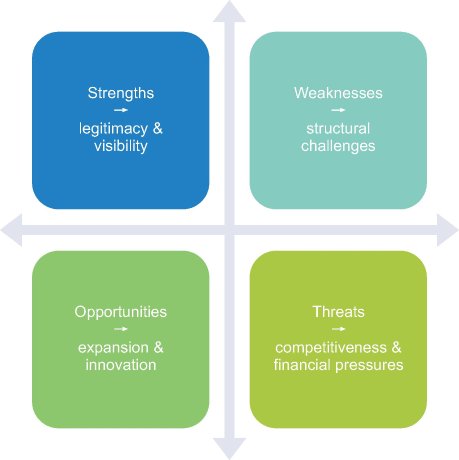
Fig. 4 presents a high-level SWOT framework for JISTaP, indicating its strengths, weaknesses, opportunities, and threats in the academic publishing ecosystem. Fig. 4 categorizes the journal’s legitimacy, structural challenges, potential for expansion, and competitive pressures, providing insight into how JISTaP navigates global scholarly publishing hierarchies. The journal benefits from Scopus indexing, OA, and institutional support, but also faces technical inefficiencies, limited citation impact, and financial uncertainties. Additionally, growing LIS research communities and digital innovations present opportunities, whereas increasing competition and rising operational costs pose ongoing challenges. Building on our SWOT analysis framework, we can now examine each component with greater specificity to understand JISTaP’s strategic position. The following breakdown elaborates on these specific factors in greater detail, providing a comprehensive picture of JISTaP’s current position in the scholarly publishing landscape.
Fig. 4
Strengths–weaknesses–opportunities–threats analysis framework for Journal of Information Science Theory and Practice.
5.1. Strengths: Legitimacy & Visibility
JISTaP possesses significant advantages in international standing, institutional support, and its publishing model that collectively establish its position in the LIS scholarly ecosystem. As summarized in Table 3, its status as Korea’s only Scopus-indexed English-language LIS journal provides a crucial bridge between Asian research and global scholarly communities. The journal’s OA model with free copy-editing services and currently zero APC eliminates financial barriers for authors, promoting accessibility and diverse contributions. Institutional backing from the KISTI provides essential financial stability, technological infrastructure, and networking opportunities that support long-term sustainability. Despite challenges such as the COVID-19 pandemic, shifts in publishing trends, and funding uncertainties, JISTaP has maintained remarkable submission stability, indicating strong author trust and operational resilience.
Table 3
Strengths of JISTaP
| Strengths | Description |
|---|---|
| International recognition | The only Scopus-indexed English LIS journal from Korea, enhancing global credibility |
| OA & free copy editing | Removes financial barriers, ensuring accessibility and attracting submissions |
| No APCs | No APCs required from authors at present, providing a significant advantage over commercial journals with high publication fees |
| Institutional support | Strong backing from KISTI provides financial stability and networking opportunities |
| Editorial leadership | Active participation in international LIS organizations strengthens journal credibility |
| Growing international reach | Increasing submissions from Asia, Europe, and beyond, expanding scholarly influence |
| Diverse editorial board | Enhances credibility, review quality, and potential for higher citation impact |
| Commitment to next-generation publishing | ACOMS+ streamlines workflows, improving accessibility for Korean and global researchers |
| Submission stability | Consistent submission patterns maintained despite external disruptions, demonstrating author trust and operational resilience |
| Ethical governance in AI & publishing standards | Established AI & authorship guidelines in consultation with the editorial board, ensuring responsible AI use, authorship transparency, and alignment with global ethical publishing practices |
Strong editorial leadership and global engagement further enhance JISTaP’s visibility and scholarly influence. The journal actively participates in international LIS networks, academic conferences, and collaborative research initiatives, extending its scholarly reach. Its diverse, internationally engaged editorial board attracts quality submissions from researchers worldwide, strengthening its academic reputation. The growing number of international submissions from across Asia, Europe, and beyond demonstrates JISTaP’s expanding global presence. Though still building its citation impact, the journal’s commitment to next-generation publishing through ACOMS+, an advanced submission management system, streamlines workflows and improves accessibility for both Korean and global researchers, establishing JISTaP as an emerging contributor to the evolving LIS publishing landscape.
5.2. Weaknesses: Structural Challenges
JISTaP encounters fundamental visibility, sustainability, and operational issues that limit its competitive standing in the global LIS publishing ecosystem. As summarized in Table 4, a key limitation is the lack of indexing in Social Sciences Citation Index (SSCI) and WoS, restricting its visibility in high-impact academic circles and reducing its ability to compete with well-established LIS journals. Despite growth in submissions, its citation impact remains modest, which affects its long-term scholarly reputation. Furthermore, JISTaP is often perceived as an institution-driven rather than a commercially independent journal, which may limit its ability to attract a more diverse author base and compete with major LIS journals operated by multinational publishers. The publishing environment is dominated by large commercial players with strong indexing, high-impact metrics, and aggressive marketing strategies, creating significant barriers for JISTaP in gaining broader recognition and legitimacy. These challenges reflect the systematic inequalities in global academic publishing that consistently privilege publications from the Global North and commercial publishers (Collyer, 2016).
Table 4
Weaknesses of JISTaP
| Weaknesses | Description |
|---|---|
| Lack of SSCI & Web of Science indexing | Limits ranking and visibility in high-impact academic circles, reducing competitiveness |
| Low citation impact | Modest citation rates restrict scholarly influence, affecting long-term reputation |
| Institution-driven perception | Seen as reliant on institutional support rather than an independent LIS journal, impacting credibility |
| Challenges competing with commercial publishers | Struggles to compete with established LIS journals backed by large commercial publishers |
| Uncertain long-term funding & staffing | Dependent on KISTI support without independent financial sustainability, limiting expansion |
| Transition to new submission system | ACOMS+ adoption introduces a learning curve, temporarily affecting submission efficiency |
Another challenge is our ability to sustain financial and operational stability. Although KISTI provides crucial institutional support, JISTaP lacks independent revenue streams, unlike commercial journals that secure funding through APCs, subscription models, or sponsorships. This reliance on institutional backing creates uncertainty regarding long-term sustainability and the ability to scale operations, recruit top-tier editorial talent, and expand global outreach. Moreover, JISTaP’s transition to the ACOMS+ submission system, despite being a step forward in modernizing editorial processes, introduces a learning curve for authors and reviewers unfamiliar with non-commercial platforms. This shift may temporarily slow submission processes and peer review efficiency, potentially discouraging new contributors. To strengthen its position in an increasingly competitive LIS publishing landscape, we must address these structural challenges and enhance its visibility and influence within the global academic community.
5.3. Opportunities: Expansion and Innovation
JISTaP can capitalize on several strategic pathways for advancement in the evolving scholarly publishing environment. As supported by Table 1 and Figs. 1Fig. 2-3, the growing number of Scopus-indexed LIS journals in Asia indicates a developing research landscape that could enhance the journal’s global reach. The bibliometric comparisons demonstrate increasing recognition of Scopus-indexed publications, potentially strengthening JISTaP’s competitive position. The journal’s editorial board’s active participation in international LIS conferences and professional networks raises its profile and creates opportunities for collaborations with scholars worldwide. A significant opportunity exists in further internationalizing its editorial leadership—while many LIS journals struggle with editorial diversity (Oh et al., 2019), JISTaP could distinguish itself by pioneering a truly global editorial approach.
The key opportunities for JISTaP, as illustrated in Table 5, include leveraging advancements in digital publishing to enhance operational efficiency and maintain manuscript quality. Implementing enhanced metadata indexing, automated plagiarism detection, and sophisticated digital archiving could further strengthen the journal’s position. JISTaP’s adoption of ACOMS+ (Chung et al., 2024) represents a significant improvement in editorial infrastructure, promising long-term benefits for workflow management and user experience. As Korea’s first system combining open peer review with OA publishing, ACOMS+ positions JISTaP as a potential model for transparency in scholarly communication. The journal’s commitment to balancing theoretical and applied LIS research aligns with emerging global research priorities—including information overload, digital information environments, and the digital exposome (Marchionini, 2022). Here, JISTaP’s coeditor-in-chief, Dr. Marchionini, refers to the digital exposome as the impact of ongoing exposure to digital information on human wellbeing, creating opportunities for the journal to attract submissions addressing these contemporary challenges. Furthermore, by maintaining its no-APC model, JISTaP can leverage its position to attract quality research from regions affected by systematic inequalities in global academic publishing (Collyer, 2016), potentially increasing both submission rates and citation impact.
Table 5
Opportunities for JISTaP
| Opportunities | Description |
|---|---|
| Growing LIS research community | Expanding global pool of authors and readers, particularly in emerging economies facing systematic publishing inequalities (Collyer, 2016), who may benefit from JISTaP’s no-APC model |
| Increased recognition of Scopus-indexed journals | Institutional emphasis on Scopus-indexed publications drives higher submissions |
| Editorial board’s international engagement | Participation in global LIS conferences and networks enhances visibility |
| Editorial leadership diversification | Internationalizing leadership could distinguish JISTaP from regional competitors |
| Advancements in digital publishing | Enhanced metadata indexing, automated plagiarism detection, and digital archiving improve efficiency and quality control |
| Enhanced publishing infrastructure | ACOMS+ streamlines editorial workflows and supports open peer review and OA |
| Alignment with global LIS research trends | JISTaP’s mission aligns with emerging LIS topics like information overload and digital information environments |
5.4. Threats: Competitiveness and Financial Pressure
JISTaP confronts substantial challenges in today’s competitive scholarly publishing environment. As summarized in Table 6, the dominance of major commercial publishers such as Elsevier, Springer, and Wiley in the OA market creates significant competitive pressure. These publishers leverage extensive resources, established reputations, and high-impact indexing advantages, making it difficult for independent journals like JISTaP to compete for author attention, citations, and visibility. The proliferation of OA LIS journals regionally and internationally intensifies competition for indexing positions, readership, and academic influence. As more journals secure Scopus and other database listings, maintaining JISTaP’s distinctive identity and scholarly relevance requires increasingly strategic efforts.
Table 6
Threats to JISTaP’s sustainability
| Threats | Description |
|---|---|
| Intensifying competition from commercial publishers | Major commercial publishers (Elsevier, Springer, Wiley) dominate the LIS OA space, making visibility and recognition more challenging |
| Rise of more OA LIS journals | Increasing competition for indexing, citations, and readership threatens JISTaP’s positioning within the field |
| Financial constraints & rising costs | Growing operational expenses, including editorial management and digital infrastructure, challenge long-term sustainability |
| Difficulty in retaining high-quality reviewers & editors | Increased academic workloads make it harder to secure dedicated reviewers and editorial board members, impacting peer review quality and efficiency |
Financial sustainability remains a substantial challenge for JISTaP. As a non-commercial journal, it lacks the diversified revenue streams that commercial publishers generate through subscription models or APCs. Although institutional backing from KISTI provides critical infrastructure, the long-term financial viability of the journal remains uncertain, particularly as rising costs for editorial management, digital publishing technologies, and manuscript processing place increasing demands on available resources. The continuation of the free APC policy specifically may be at risk. Without alternative funding mechanisms, sustaining high publication standards may become increasingly difficult. Furthermore, maintaining editorial quality presents an ongoing challenge, as many experienced scholars in the LIS field balance substantial institutional responsibilities, potentially limiting their capacity to engage in editorial and peer review processes. This, in turn, may impact review timelines and academic rigor. Addressing these challenges necessitates a strategic approach to strengthening JISTaP’s competitive positioning, securing financial stability, and ensuring the retention of a qualified editorial network to uphold scholarly excellence.
5.5. Strategic Imperatives for JISTaP’s Future
For JISTaP to thrive in the evolving academic publishing landscape, several strategic approaches would strengthen its position and secure its future. Enhancing citation metrics and indexing, particularly through SSCI inclusion, offers pathways to greater credibility, potentially attracting high-impact submissions that could further solidify its standing. The current instability of its manuscript system presents an opportunity for improvement, with AI-driven editorial processes offering promising solutions to workflow efficiency challenges. Expanding international collaborations—through a more diverse editorial board and global research partnerships—would likely widen its reach while reinforcing its authority in LIS scholarship (Oh et al., 2024).
However, financial sustainability remains a significant challenge. To address rising costs and funding uncertainties, JISTaP would benefit from actively pursuing institutional sponsorships, grant-based funding, and alternative financial models that align with its OA mission. Furthermore, the rapid expansion of commercial publishers and LIS journals necessitates developing a clear competitive edge—JISTaP stands to gain from embracing editorial innovation, digital transformation, and strategic networking to maintain influence. Beyond mere adaptation, JISTaP has the opportunity to redefine its role in global scholarly publishing, contributing to a more inclusive, accessible, and forward-thinking academic ecosystem. The question extends beyond whether JISTaP can evolve, to how boldly it will shape the future of LIS publishing.
6. DISCUSSION
We have examined the current strategic development of JISTaP, focusing on how it has navigated global publishing challenges, institutional backing, and bibliometric performance in comparison with other Asian LIS journals. By analyzing publication output, ranking stability, and citation impact, we identified key factors shaping the visibility, sustainability, and influence of independent journals in an evolving scholarly landscape. The trends observed in JISTaP’s development, alongside shifts in the global publishing ecosystem, align with distinct publishing epochs, each marked by changes in scholarly impact, research output, and ranking stability. These epochs reflect broader transformations in the region’s academic publishing environment, where institutional support, indexing strategies, and evolving research priorities play a crucial role. Scholarly influence builds gradually, but journal visibility and impact remain fluid, shaped by both structural and strategic factors, underscoring the need for proactive adaptation in an increasingly competitive publishing landscape.
JISTaP’s trajectory is broadly aligned with the development of other Asian LIS journals, many of which have benefited from institutional support and OA models to enhance their reach. Like the Malaysian Journal of Library & Information Science, JISTaP has leveraged an OA framework and institutional affiliation to improve visibility and attract international contributors. However, key differences in indexing status, impact metrics, and global recognition set these journals apart. Several LIS journals in Asia have successfully attained SSCI indexing, leading to increased visibility and citation impact; however, JISTaP is still in the process of expanding its indexing footprint. This trend underscores the critical role of WoS and SSCI inclusion in shaping a journal’s credibility, as these databases serve as key indicators of research impact in the field. To bridge this gap, JISTaP would benefit from continuing to strengthen editorial policies, foster international collaborations, and invest in digital infrastructure—all areas where it is actively progressing.
Although certain LIS journals in Asia have achieved steady growth in citations and rankings, others have encountered challenges such as fluctuating impact factors, inconsistent publication schedules, and regional visibility constraints. The performance of LIS journals in Asia is diverse, reflecting differences in institutional backing, indexing status, and publishing strategies rather than a uniform pattern of stagnation. JISTaP, for instance, has maintained a stable publication output, growing international author base, and a consistent presence in Scopus, whereas other independent LIS journals have faced periodic declines in citations or difficulty sustaining indexing status. These variations suggest that although some journals successfully navigate the competitive publishing landscape, others struggle with long-term sustainability due to resource constraints and shifting indexing criteria. Unlike LIS journals affiliated with large commercial publishers, independent journals often operate within structural limitations, making targeted strategic investment crucial to their success.
Through our SWOT analysis, we identified both internal and external challenges affecting JISTaP’s sustainability and impact. JISTaP has benefited from strong institutional support, an OA model, and increasing international recognition but also faces significant hurdles, including limited WoS visibility, moderate citation impact, and competition with commercial publishers. Some of these challenges—such as improving indexing status, expanding editorial capacity, and strengthening digital infrastructure—can be addressed through targeted efforts and strategic investment. However, external challenges, such as the dominance of commercial publishers, the financial sustainability of independent journals, and the concentration of high-impact LIS scholarship in Western countries, present structural barriers that are more difficult to overcome. These challenges reflect the systematic inequalities in global academic publishing that privilege established commercial publishers and publications from the Global North (Collyer, 2016).
Even though individual journals can implement strategic improvements, broader academic communities should also play a role in sustaining non-commercial, independent journals that adhere to OA principles. Universities, research organizations, and funding agencies can enhance support by providing stable funding mechanisms, facilitating cross-journal collaborations, and promoting open-access initiatives. Dedicated institutional support for indexing efforts, editorial development, and digital infrastructure would improve visibility and long-term viability. Strengthening these partnerships will help independent journals compete with commercial publishers while maintaining their role in a diverse and inclusive scholarly ecosystem.
JISTaP remains committed to ethical citation practices while recognizing the challenges of increasing its scholarly impact. Although its citation influence is growing, further improvements are needed to enhance visibility and academic reach. To achieve this, the journal utilizes ACOMS+, a platform that optimizes indexing, automates dissemination, and strengthens digital infrastructure, distinguishing it from many Asian LIS journals that rely on landing pages or government-funded initiatives (Shelomi, 2014). Ethical considerations are central to JISTaP’s approach, as it firmly opposes coercive citation requests, excessive self-citation, and citation cartels that distort scholarly metrics. Instead, it fosters organic citation growth by promoting high-quality research, expanding dissemination through ACOMS+, encouraging impactful formats such as review papers and meta-analyses, publishing special issues on emerging LIS topics, diversifying its international editorial board, mentoring authors to improve article quality, forming cross-journal partnerships with higher-ranked LIS publications, and systematically tracking citations to assess impact. JISTaP acknowledges the realities of citation dynamics in academia. However, it remains dedicated to ethical scholarship and is mindful of the skepticism surrounding citation-based metrics, which, despite their widespread use, often fail to reflect true research quality. Expanding ACOMS+ could further support regional journals by enhancing international discoverability and fostering responsible citation practices in the Asian LIS publishing ecosystem.
In sum, this analysis of JISTaP reinforces the importance of sustained institutional backing, digital innovation, and strategic indexing efforts in securing long-term growth for independent journals. Its trajectory through distinct publishing epochs demonstrates how regional journals can adapt to shifting scholarly communication landscapes. JISTaP has benefited from KISTI’s commitment to scholarly publishing and its OA model; yet its continued success depends on leveraging technological solutions like ACOMS+ to enhance global visibility and academic impact. Although inclusion in prestigious databases remains a priority for improving credibility and attracting high-quality submissions, sustainable development requires more than just meeting indexing criteria. The journal’s experience illustrates how independent publications can navigate global publishing hierarchies by balancing institutional support with strategic innovation. These insights provide context for understanding the broader challenges faced by journals from underrepresented regions in the international scholarly ecosystem.
7. CONCLUSION AND FUTURE DIRECTIONS
JISTaP’s 12-year development illustrates how regional journals can build legitimacy in global scholarly publishing amid structural inequalities. Our bibliometric analysis revealed that while JISTaP has maintained stable metrics and consistent Scopus presence, comparable Asian LIS journals with SSCI indexing achieved significantly higher citation impact. The SWOT analysis identified key strengths in institutional backing from KISTI and the OA model, alongside challenges in WoS visibility and competition from commercial publishers. Despite these challenges in non-Western publishing environments, JISTaP has effectively leveraged institutional support and OA frameworks to increase visibility, establishing an international author base and consistent quarterly publication schedule. Its experience demonstrates that successful journals do not simply follow Western publishing models but develop approaches suited to their specific contexts, balancing global accessibility with regional perspectives. For independent OA journals from underrepresented regions, sustainable growth requires both tactical adaptation to evolving scholarly metrics and consistent institutional support for digital infrastructure and editorial development. As scholarly publishing continues to transform, these findings suggest that independent OA journals can establish distinctive value through specialized content, ethical publishing practices, and strategic partnerships that enhance their global reach while maintaining their regional identity.
CONFLICTS OF INTEREST
The first author currently serves as Co-Editor-in-Chief and the second author as Managing Editor of JISTaP. To ensure objectivity and transparency, the peer review process for this article was overseen by an independent editor, and the final editorial decision was made based solely on that editor’s recommendation, without any involvement from the authors.
REFERENCES
, , , , , , , (2025) Policies on artificial intelligence chatbots among academic publishers: A cross-sectional audit Research Integrity and Peer Review, 10, 1 https://doi.org/10.1186/s41073-025-00158-y. Article Id (pmcid)
(2017) Scholarly journal publishing in transition- from restricted to open access Electronic Markets, 27, 101-109 https://doi.org/10.1007/s12525-017-0249-2.
(2021) Publishing speed and acceptance rates of open access megajournals Online Information Review, 45, 270-277 https://doi.org/10.1108/OIR-04-2018-0151.
, , , (2020) Drivers of article processing charges in open access Scientometrics, 124, 2185-2206 https://doi.org/10.1007/s11192-020-03578-3.
(2013) Tracking down on 50-year history of Research about Information Management and Technology in Korea Journal of Information Science Theory and Practice, 1, 83-91 https://doi.org/10.1633/JISTaP.2013.1.1.6.
, , , , , , (2024) Online submission and review system for open science: A case of AccessON Peer Review Management System Plus (ACOMS+) Journal of Information Science Theory and Practice, 12, 87-101 https://doi.org/https://doi.org/10.1633/JISTaP.2024.12.1.6.
(2016) Global patterns in the publishing of academic knowledge: Global North, Global South Current Sociology, 66, 56-73 https://doi.org/10.1177/0011392116680020.
, (2024) Accelerating editorial processes in scientific journals: Leveraging AI for rapid manuscript review Oral Oncology Reports, 10, 100511 https://doi.org/10.1016/j.oor.2024.100511.
, (2021) Editorial strategy to get a scholarly journal indexed by Scopus Mediterranean Journal of Rheumatology, 32, 1-2 https://doi.org/10.31138/mjr.32.1.1. Article Id (pmcid)
, , (2022) The perils of artificial intelligence in academic publishing Critical Perspectives on Accounting, 87, 102411 https://doi.org/https://doi.org/10.1016/j.cpa.2021.102411.
, , (2022) Preprints as a driver of open science: Opportunities for Southeast Asia [policy and practice reviews] Frontiers in Research Metrics and Analytics, 7, 992942 https://doi.org/10.3389/frma.2022.992942. Article Id (pmcid)
Journal of Information Science Theory and Practice (JISTaP) (2023). AI & authorship guidelines. https://accesson.kr/jistap/menu/651/657/
(2022) Publishing international library and information science journals: The changing landscape Journal of Librarianship and Information Science, 55, 478-486 https://doi.org/10.1177/09610006221090958.
(2024) Analyzing AI use policy in LIS: Association with journal metrics and publisher volume Scientometrics, 129, 7623-7644 https://doi.org/10.1007/s11192-024-05189-8.
, (2023) A decade of changes in OA and non-OA journal publication and production Journal of Librarianship and Information Science, 56, 978-987 https://doi.org/10.1177/09610006231179718.
, (2023) Comparison of the open access status and metrics of Scopus journals published in East Asian countries: A descriptive study Science Editing, 10, 57-63 https://doi.org/10.6087/kcse.297.
, , (2015) The oligopoly of academic publishers in the digital era PLoS One, 10, e0127502 https://doi.org/10.1371/journal.pone.0127502. Article Id (pmcid)
Loaiza, I., & Rigobon, R. (2024). The EPOCH of AI: Human-machine complementarities at work. MIT Sloan Research Paper, 7236-7224. https://doi.org/10.2139/ssrn.5028371
(2022) JISTaP at 10 Journal of Information Science Theory and Practice, 10, 1-2 https://doi.org/10.1633/JISTaP.2022.10.4.1.
Matthews, D. (2018). Is it time to nationalise academic publishers? https://www.timeshighereducation.com/blog/it-time-nationalise-academic-publishers
Miller, R. C., & Tsai, C. J. (2020). Scholarly publishing in the wake of COVID-19. International Journal of Radiation Oncology, Biology, Physics, 108(2), 491-495. https://doi.org/10.1016/j.ijrobp.2020.06.048 Article Id (pmcid)
, , , , , (2024) Handbook of Meta-Research Edward Elgar Publishing Research integrity in publishing: Decolonial perspectives, pp. 251-262, https://doi.org/10.4337/9781839105722.00028
(2020) Publishing a new international journal: From the EIC's perspective of a Korean Journal Journal of I-LISS Japan, 2, 3-11 https://jglobal.jst.go.jp/detail?JGLOBAL_ID=202002228322687285.
Oh, D. G., Kim, E., & Yeo, J. (2024, July 19-20). Experiences as an International Open Access Journal in LIS: The case of 11 years of JISTaP. In D. G. Oh, B. R. Babu, P. Rajendran, S. Vivekanandhan & N. Siva (Eds.), Proceedings of the 8th I-LISS International Conference on Exploring Information Services and Library Technologies for the Next Generation (ICEISLT-2024) (pp. 463-473). SRM Institute of Science and Technology. https://srmiliss2024.srmist.edu.in/conference/ resources/files/Vol1.pdf
, , , , (2019) A comparative analysis of editorial leaders' profiles of major and non-western library and information science journals Journal of Information Science Theory and Practice, 7, 20-32 https://doi.org/10.1633/JISTaP.2019.7.4.2.
, (2018) Article processing charge (APC) for publishing open access articles: The Brazilian scenario Scientometrics, 117, 805-823 https://doi.org/10.1007/s11192-018-2896-2.
, (1998) What's SWOT in strategic analysis? Strategic Change, 7, 101-109 https://doi.org/10.1002/(SICI)1099-1697(199803/04)7:2<101::AID-JSC332>3.0.CO;2-6.
(2021) Web of Science (WoS) and Scopus: The titans of bibliographic information in today's academic world Publications, 9, 12 https://doi.org/10.3390/publications9010012.
(2019) Korea Institute of Science and Technology Information's scholarly journal publishing: A case study Learned Publishing, 32, 181-187 https://doi.org/10.1002/leap.1199.
SCImago (n.d.). SCImago Journal & Country Rank. https://www.scimagojr.com
Sharma, B., & Sharma, A. (2021). The Journal of Information Science Theory and Practice (JISTaP): A bibliometric analysis (2013-2017). Library Philosophy and Practice (e-journal), 5198. https://digitalcommons.unl.edu/libphilprac/5198
(2014) Editorial misconduct-Definition, cases, and causes Publications, 2, 51-60 https://doi.org/10.3390/publications2020051.
, (2015) 'Predatory' open access: A longitudinal study of article volumes and market characteristics BMC Medicine, 13, 230 https://doi.org/10.1186/s12916-015-0469-2. Article Id (pmcid)
, , (2025) Analysing the impact of academic policies and interventions on research productivity in Indian library and information science Performance Measurement and Metrics, 26, 17-33 https://doi.org/10.1108/PMM-06-2024-0031.
, , , , , , , , , , , , , , , (2019) Ten hot topics around Scholarly Publishing Publications, 7, 34 https://doi.org/10.3390/publications7020034.
(2023) Application of artificial intelligence (AI) in e-publishing industry in India International Journal of Computer Engineering and Technology (IJCET), 14, 7-12 https://doi.org/10.17605/OSF.IO/4D5M7.