1. INTRODUCTION
Effective human resource management (HRM) is widely recognized as a cornerstone of organizational success, contributing to productivity, employee morale, and sustained competitiveness (DeCenzo et al., 2015). In academic libraries, personnel play a pivotal role in delivering quality services and advancing knowledge (Lakos & Phipps, 2004; Xu & Wang, 2024). As libraries navigate an increasingly dynamic educational environment, promoting workforce engagement and satisfaction has become increasingly important for institutional growth and service excellence.
While job satisfaction and motivation (JSM) are well-established drivers of employee performance, collaboration, and innovation, existing research has predominantly focused on global or general organizational contexts (Adams, 2024). In Myanmar, where higher education is undergoing significant transformation, the specific experiences of academic library personnel remain largely unexplored. Previous studies in Myanmar have examined job satisfaction in various sectors (Khaing, 2019; Perez et al., 2023; Thaung, 2019), but empirical attention has not been devoted to university libraries, despite their central role in academic support.
Addressing this gap is essential for enhancing the operational effectiveness of academic libraries and fostering educational achievement. Therefore, this study investigates how Myanmar’s unique cultural values, institutional norms, and socio-political context influence job satisfaction among university librarians. By examining these factors, the research aims to provide insights that can inform HRM strategies and promote professional development within Myanmar’s academic libraries.
2. STATEMENT OF RESEARCH PROBLEM
Library services are essential for university communities, and librarians play a critical role in providing information for research, teaching, learning, preservation, personal enlightenment, and career development. Librarian professionals in Myanmar manage library services, including collection development, cataloging, and classification (Win et al., 2019). They use software systems such as E-Lib and SOLIB for tasks cataloguing and inventory management. Libraries also offer information literacy and outreach programs, technology services, and user services. Consequently, the performance of librarians and library staff also directly reflects the current state of university library services in Myanmar. Paraprofessional staff typically handle membership registration, reference services, and circulation. Professional librarians are responsible for preserving library materials, and facility management plays a crucial role in this effort. Chief librarians encourage staff to participate in professional development programs and connect with other libraries for knowledge exchange. Nevertheless, management of salary payments, promotions, recognition, compensation, years of service, performance evaluations, passing specific civil service exams, educational attainment, and pensions and benefits adheres to national civil service policies (Win, 2019). Therefore, some librarians express dissatisfaction due to a lack of incentives, poor working conditions and leadership practices, and low salary payments. Such situations can lead to dissatisfaction, absenteeism, and lateness, which in turn hinder the progress of research, scholarship, and institutional development. Hence, this study aims to investigate job satisfaction as a predictor of librarians’ functioning in university libraries in Myanmar, in order to improve librarians’ overall performance. In addition, insights from global literature offer valuable perspectives that not only help us to understand the problems librarians in Myanmar confront but also how academic libraries can foster worker morale and job satisfaction. Thus, the purpose of this study is to evaluate academic librarians’ and staff’s degree of job satisfaction in Myanmar, highlighting the need for decision-makers and accountable authorities to address their issues. This study specifically identifies the following objectives.
2.1. Research Objectives and Questions
The main purpose of the research objectives is to assess the level of job satisfaction among librarians and library staff in Myanmar universities, identify the key factors influencing their satisfaction, and provide evidence-based insights to inform decision-makers in academic libraries. To achieve this purpose, the following research questions are addressed:
1. What is the current level of job satisfaction among librarians and library staff in Myanmar universities?
2. What are the primary factors influencing job satisfaction among these professionals?
3. What strategies or interventions could enhance job satisfaction in Myanmar’s academic libraries?
3. LITERATURE REVIEW
Academic librarians are widely recognized as key contributors to research growth and community success, and many countries believe they are critical to national development. Research on job satisfaction among librarians has become both a global endeavor and a locally focused effort to identify the factors that influence professional well-being and performance. Inevitably, supportive work environments are crucial everywhere. According to research conducted in both established and emerging Association of Southeast Asian Nations (ASEAN) countries, some studies have examined how organizational culture, leadership, work-life balance, career advancement, and pay affect the job satisfaction of academic librarians and staff.
An affective commitment and organizational tenure were key indicators for job satisfaction with Malaysian academic librarians (Abdul Karim, 2017); likewise, meeting users’ expectations, providing constructive knowledge, staff development opportunities, social events, and religion with race were predominant factors for the job satisfaction of Malaysian library staff (Haque et al., 2012); similarly, knowledge, attitudes, and practices are influences for Brunei Darussalam public sector librarians (Tuah et al., 2024).
Cultural intelligence is a strong predictor of job performance, and so knowledge conversion skills lead to a creative work design in Indonesian academic librarians (Masrek et al., 2021; 2024). However, work environment and compensation did not have a significant relationship with Indonesian academic librarians (Kusumaningrum et al., 2016). Conversely, while performance and competency levels remained statistically similar, the knowledge characteristics of work design in Indonesian libraries showed significant variation (Mutia et al., 2024).
Moreover, librarianship is regarded as a lifelong profession that requires continuous skill development and new opportunities (Listor, 2024). Along the same lines, skillful leaders could support affectivity and self-efficacy, promoting positive emotional management and confidence in handling work-related challenges (Abatayo et al., 2023). Besides this, Dorado (2025) also critiqued the financial landscape, salary structures, benefits, and economic challenges required for the library profession’s sustainability. Similarly, orientation, meeting user needs, and building satisfaction are important for Thai professionals’ academic libraries (Tanloet & Tuamsuk, 2011). Tanloet and Tuamsuk (2011) further mentioned the need for ethical and moral competencies, marketing skills, and user interface fulfilment in future careers.
To provide a comprehensive evaluation of job satisfaction, Myanmar library professionals are needed to fill the research gap. Therefore, this study could address the need for localized studies, compared with ASEAN neighbor countries, to explore the particular opportunities and challenges faced by Myanmar university libraries. Pioneering research offers instructive perspectives on proven strategies for academic libraries to enhance employee morale and organizational performance.
3.1. Global and Local Perspectives of Job Satisfaction in Academic Libraries
Globally, academic librarians report higher satisfaction where HRM practices prioritize collaboration, recognition, and personal development (Ranaweera & Li, 2018). Greek academic librarians are most satisfied with their jobs, supervision, and working conditions, whereas they are less satisfied with pay and promotion (Togia et al., 2004). Professional duties account for 86% of all duties, underscoring their importance for efficient management (Mouza & Grigoriadou, 2016). Similarly, extrinsic, intrinsic, and performance characteristics substantially affect job satisfaction among public librarians in Northern Province, Sri Lanka (Shanmugathasan, 2020). In India, 50% of librarians express satisfaction with salary, 48.2% with promotion criteria, 46% with job security, and 69.8% with organizational relationships and recognition (Arumugam & Radha, 2023).
Persistent challenges, such as low salaries, inadequate infrastructure, and limited professional growth opportunities negatively impact morale in developing countries (Fatima & Bhatti, 2014; Ikonne & Onuoha, 2015). These HRM-related issues have direct consequences for service quality and institutional effectiveness. Likewise, remuneration, working conditions, autonomy, and professional relationships influence job satisfaction among Karachi University librarians in Pakistan (Nasrullah & Suhag, 2024). Additionally, librarians’ job satisfaction is influenced by factors like job security, professional relationships, and client interactions. In contrast, dissatisfaction stems from issues like salary, benefits, working conditions, and research opportunities at the Federal University of Agriculture, Makurdi Library in Nigeria (Igbashal et al., 2016).
Within academic libraries, job satisfaction is profoundly shaped by identification with institutional culture, quality of leadership, and a sense of being valued at work (Martin, 2020a). Supportive colleagues, fair compensation, and recognition play pivotal roles in fostering motivation and enhancing performance. Further studies highlight that professional development, access to resources, inclusivity, and flexible working arrangements collectively contribute to a fulfilling work environment, ultimately raising the standard of services provided to students and faculty (Igbashal et al., 2016; Shahzad et al., 2023; Upev & Beetseh, 2017; Yu et al., 2018).
3.2. Distinctive Human Resource Management Challenges and Opportunities in Myanmar
Academic libraries in Myanmar face a range of distinct HRM challenges that directly affect job satisfaction and organizational effectiveness. Key barriers include inadequate compensation, insufficient physical infrastructure, and a shortage of skilled personnel (Kupryte & Nyein, 2018; Pipe & Tuamsuk, 2023). In addition, outdated administrative practices and limited opportunities for professional development persist, compounded by a lack of emphasis on staff well-being (Swe & Yang, 2024; Zar Kyaw et al., 2025). While initiatives such as the e-Library Myanmar project have made some progress in bridging these gaps, ongoing resource limitations, traditional leadership styles, and entrenched cultural norms continue to hinder meaningful advancement (Nyein, 2016; Win et al., 2019). Recent studies show that librarians in Myanmar’s academic libraries often prioritize user needs and the quality of their services provided over their own job satisfaction.
Internationally, the adoption of modern HRM practices such as continuous training, flexible policies, and a supportive workplace culture has been shown to enhance employee well-being and boost overall organizational performance (Kumar & Boddeda, 2024). This trend underscores the importance of professional development and user experience, emphasizing the need for human resource (HR) strategies that strike a balance between service delivery and staff well-being. Factors such as access to career development and user-friendly library systems have a greater impact on service effectiveness than traditional concerns like salary or supervisory style.
However, current challenges, such as low salaries, outdated career progressions, and conventional management approaches, remain widespread and are especially acute in the Myanmar university libraries setting. Overcoming these challenges is essential for motivating staff, enhancing service quality, and supporting the nation’s broader educational objectives. Given these ongoing issues, there is a clear need for empirical research to better understand the determinants of job satisfaction in this area, to inform future HRM strategies, and to foster sustainable institutional growth.
3.3. Job Structure of Myanmar University Libraries
The overall structure of education development in Myanmar includes 164 universities and colleges (Hayden & Martin, 2013), and this number has continued to rise due to increasing student enrolment, government educational reforms, and the growing recognition of higher education as essential to national development. Consequently, college and university libraries have expanded as an integral part of this educational system. Furthermore, the duty allocation in the structure of university libraries is shown in Fig. 1. As well, this sample may be representative of Myanmar university librarians and staff in the evaluation of job satisfaction and was the first exploration in this area. According to previous literature and theoretical findings, many researchers and organizations have conducted studies on employee job satisfaction, as no organization and institution should neglect its HR. Job satisfaction is essential for HRM; it is fundamentally linked to the education system and can influence national development and the government’s standing (Bolatito & Mohamoud, 2024).
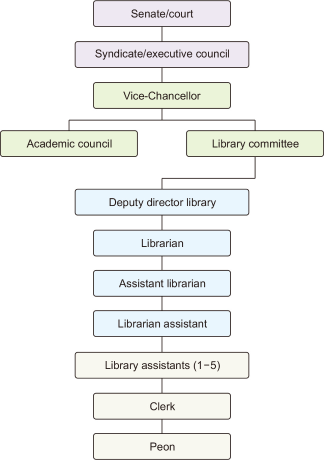
Fig. 1 depicts the organizational structure of the library system. The senate/court and syndicate/executive council offer overarching governance and strategic guidance for the institution. The vice-chancellor functions as the head executive, supervising all academic and administrative activities. The academic council, accountable for academic policy, and the library committee, which supervises library affairs, report to the vice-chancellor. The deputy director of the library oversees operations, supported by the librarian. The librarian oversees the assistant librarian and the library assistants, who may range from one to five in number to denote numerous roles. The supporting staff comprises the clerk, tasked with administrative responsibilities, and the peon, who manages general chores.
3.4. Conceptual Framework for Job Satisfaction
Job satisfaction is a fundamental construct in HRM, directly impacting organizational success, employee engagement, and retention (Ahmad et al., 2021; Karuna Sri et al., 2024; Oloyede & Soyemi, 2022). Conversely, dissatisfaction often arises from inadequate remuneration, outdated management practices, and restricted access to professional development, particularly in resource-constrained environments (Ranaweera et al., 2018; Townsend & Bugg, 2020). Key determinants of job satisfaction include fair compensation, effective leadership, supportive organizational culture, work-life balance, and opportunities for professional development (Adams, 2024; Kumar & Boddeda, 2024; Martin, 2020a; 2020b). These factors are not only vital globally but also prevalent in developing regions, where insufficient salary, limited recognition, and a lack of career advancement opportunities persist (Fatima & Bhatti, 2014; Ikonne & Onuoha, 2015). Many scholars have addressed theories like Herzberg’s Two-Factor Theory, Maslow’s Hierarchy of Needs, Hackman and Oldham’s Job Characteristics Model, and the Job Demands-Resources (JD-R) Model, which have been relevant to job satisfaction factors (Demerouti et al., 2001; Herzberg, 2015; Mohd Rokeman et al., 2024). These theories highlight job design, job demands, and resources in enhancing motivation, productivity, and retention, including both intrinsic and extrinsic motivation. Comprehending these frameworks is crucial for firms to establish a nurturing and stimulating work environment. Therefore, the following hypotheses have been drawn from the above literature review, theories, and cultural conditions, given that there is no prior research in this area.
3.4.1. Hypothesis Development
Competitive compensation remains a foundational determinant of job satisfaction across industries (Karuna Sri et al., 2024). Studies have consistently shown that financial incentives, equitable remuneration, and robust benefits packages are vital for attracting and retaining talent in academic libraries. Dissatisfaction with salaries and inadequate benefits often contribute to higher attrition rates, especially in developing countries (Yaya, 2019). This concept leads to the following hypothesis.
H1. Salary and benefits significantly impact job satisfaction.
Modern HRM emphasizes the importance of work-life balance, flexible work arrangements, and continuous professional development. Access to training, ongoing learning opportunities, and recognition programs are linked to higher motivation and job satisfaction (Kumar & Boddeda, 2024; Ranaweera & Li, 2018; Ranaweera et al., 2018). A healthy balance between professional demands and personal life is essential for long-term employee well-being and productivity (Townsend & Bugg, 2020). Accordingly, the following hypothesis was formulated.
H2. The work environment significantly affects job satisfaction.
Rapid technological advancement and automation are reshaping the HRM landscape. While automation can drive operational efficiency, its successful implementation depends on careful change management and a focus on human needs (Vrontis et al., 2022). Moreover, while automation streamlines processes, its impact on job satisfaction is largely determined by how thoughtfully these technologies are implemented to address employees’ needs and aspirations (Winkelhaus et al., 2022). These insights underscore the fundamental importance of prioritizing employee satisfaction and engagement in highly digitized environments for organizational performance. Therefore, the addressed hypothesis is “H3. Career training (CT) significantly affects job satisfaction.”
Effective leadership and a constructive organizational culture are critical drivers of satisfaction among library staff. Supportive supervisors, transparent communication, and participative management foster trust and motivation (Adams, 2024; Martin, 2020b). Collaborative work environments, a sense of appreciation, and opportunities for staff input into decision-making processes further enhance engagement and morale (Oloyede & Soyemi, 2022). Therefore, the following hypothesis is proposed.
H4. Supervisory management has a strong impact on job satisfaction.
Consequently, librarians are needed to enhance the library’s image and service quality by communicating with users and information materials (Majid & Haider, 2008). Therefore, social capital partially mediates the significant effects of librarians’ subjective well-being (SWB) on job satisfaction. Hence, SWB, job satisfaction, and social capital exhibited moderate levels (Bahrudin & Lawang, 2023). Thus, the following hypothesis was drawn.
H5. A user-friendly interface enhances job satisfaction.
3.5. Construction Factors and Items for Job Satisfaction
This section presents the items from the above section of the literature review, the conceptual framework, and the theories that affect job satisfaction, particularly for academic librarians. The items fit four theories of job satisfaction theoretical frameworks, and the way things work in the local professional world, and were adapted to reflect the flexible nature of Myanmar’s social culture (see Table 1 [Abatayo et al., 2023; Abdul Karim, 2017; Aghaei et al., 2021; Arumugam & Radha, 2023; Dorado, 2025; Fatima & Bhatti, 2014; Igbashal et al., 2016; Ikonne & Onuoha, 2015; Khan & Ahmed, 2013; Kusumaningrum et al., 2016; Listor, 2024; Martin, 2020a; Martin, 2020b; Masrek et al., 2024; Mouza & Grigoriadou, 2016; Muthukumaran, 2014; Mutia et al., 2024; Nasrullah & Suhag, 2024; Oloyede & Soyemi, 2022; Ranaweera & Li, 2018; Ranaweera et al., 2018; Shahzad et al., 2023; Shanmugathasan, 2020; Togia et al., 2004; Unegbu et al., 2020; Upev & Beetseh, 2017; Williamson et al., 2005; Win et al., 2019; Yaya, 2019; Yu et al., 2018] and the Appendix). Furthermore, this study uses four main theories of job satisfaction: Herzberg’s Two-Factor Theory, Maslow’s Hierarchy of Needs, Hackman and Oldham’s Job Characteristics Model, and the JD-R Model, to adapt questions from other studies to make them relevant to librarians at Myanmar universities.
Table 1
Construction factors for job satisfaction
| Construct | Items | Adapted |
|---|---|---|
| Salary benefits | 7 | Muthukumaran (2014); Ikonne & Onuoha (2015); Igbashal et al. (2016); Ranaweera & Li (2018); Ranaweera et al. (2018); Yaya (2019); Martin (2020a); Nasrullah & Suhag (2024); Dorado (2025) |
| Work environment conditions | 6 | Togia et al. (2004); Kusumaningrum et al. (2016); Martin (2020b); Oloyede & Soyemi (2022); Arumugam & Radha (2023) |
| Supervisor management | 6 | Fatima & Bhatti (2014); Mouza & Grigoriadou (2016); Shanmugathasan (2020); Aghaei et al. (2021); Abatayo et al, (2023) |
| Career training | 6 | Williamson et al. (2005); Upev & Beetseh (2017); Win et al. (2019); Yu et al. (2018); Shahzad et al. (2023); Listor (2024) |
| Job satisfaction and motivation | 6 | Abdul Karim (2017); Unegbu et al. (2020); Aghaei et al. (2021); Masrek et al. (2024); Shahzad et al. (2023) |
| User interface friendliness | 6 | Khan & Ahmed (2013); Mouza & Grigoriadou (2016); Mutia et al. (2024) |
4. METHODS
This study employed a quantitative, exploratory research design and an empirical approach to assess job satisfaction among librarians and library staff systematically. There were a total of 38 closed-ended questions in the survey (see Appendix), organized into six thematic dimensions of job satisfaction theories, with the conceptual framework and hypothesis development outlined above. The participants’ opinions were assessed using a 5-point Likert scale, where 1 indicated “strongly disagree,” and 5 indicated “strongly agree.”
After drawing inspiration from other proven surveys, the questionnaire was pilot-tested with a select group of librarians to assess clarity, reliability, and content validity. The researcher conducted a pilot study with 30 people before drafting the final analysis. At that point, she removed one component, such as work-life balance, from the analysis. Therefore, the researcher amended the final instrument using Google Forms (Google LLC., Mountain View, CA, USA) and then sent a link to the Google Form from an individual head librarian to university personnel. Furthermore, the researcher contacted individuals directly by telephone for enhanced involvement. The data collection process lasted roughly three months, commencing in October 2024 and concluding in December. The primary data was collected from 53 universities, including 127 participants.
The study used cluster sampling, chosen for its efficiency in obtaining data from geographically dispersed populations while maintaining representativeness. Probability sampling techniques were employed, with outlier removal and normality testing to enhance the dataset’s robustness. This methodological framework enhances the study’s reliability and validity, leading to well-grounded conclusions. Hence, the final sample consisted of 111 librarians and staff from 49 universities across Myanmar (see Table 2). The data set represented the entire population of Myanmar university librarians and staff because job satisfaction levels were not different across universities. Additionally, the Ministry of Education’s organizational structure for civil staff has led to the relocation of librarians and staff to various local university libraries.
Table 2
Respondents’ institutional affiliation
| No. | Name of university library | Frequency | Percent |
|---|---|---|---|
| 1 | East Yangon University | 2 | 1.8 |
| 2 | Yangon University of Foreign Languages (YUFL) | 3 | 2.7 |
| 3 | Yadanabon University | 8 | 7.2 |
| 4 | Sport Library Yangon (Institute of Sports and Physical Education Yangon) | 2 | 1.8 |
| 5 | University of Computer Studies, Yangon | 2 | 1.8 |
| 6 | Kyauk Se University | 5 | 4.5 |
| 7 | Yangon University of Economic | 1 | 0.9 |
| 8 | University of Co-operative and Management, Sagaing | 1 | 0.9 |
| 9 | University of Yangon | 1 | 0.9 |
| 10 | Other libraries | 1 | 0.9 |
| 11 | Yezin Agricultural University | 2 | 1.8 |
| 12 | Naypyitaw State Academy | 5 | 4.5 |
| 13 | Sagaing Universtiy of Education | 4 | 3.6 |
| 14 | Mandalay Institute of Technology (MIT) | 4 | 3.6 |
| 15 | Sagaing Universtiy | 2 | 1.8 |
| 16 | University of Medicine, Mandalay | 2 | 1.8 |
| 17 | Magaway University | 1 | 0.9 |
| 18 | Ministry of Broder Affair, Education and Training Department, Central Training School, Sagaing | 1 | 0.9 |
| 19 | Information and Communication Technology Training Institute (ICTTI), Yangon | 1 | 0.9 |
| 20 | Mandalay University | 1 | 0.9 |
| 21 | Meiktila University of Economics | 2 | 1.8 |
| 22 | University of Medicine, Yangon | 1 | 0.9 |
| 23 | Meiktila University | 3 | 2.7 |
| 24 | Technological University, Mandalay (TUM) | 2 | 1.8 |
| 25 | Monywa University | 2 | 1.8 |
| 26 | Pathein University | 1 | 0.9 |
| 27 | Department of Medical Research (Pyin Oo Lwin Branch) Departmental Library | 1 | 0.9 |
| 28 | Shwebo University | 1 | 0.9 |
| 29 | Mandalay University of Foreign Language (MUFL) | 3 | 2.7 |
| 30 | Universities’ Central Library | 1 | 0.9 |
| 31 | Mandalar University | 6 | 5.4 |
| 32 | Mawlamyine University | 1 | 0.9 |
| 33 | Dagon University | 2 | 1.8 |
| 34 | Taunggyi University | 2 | 1.8 |
| 35 | Hinthada University | 10 | 9 |
| 36 | Hpa-An University | 3 | 2.7 |
| 37 | Myingyan University | 4 | 3.6 |
| 38 | Panglong University | 1 | 0.9 |
| 39 | Taungoou University | 1 | 0.9 |
| 40 | Pyay University | 1 | 0.9 |
| 41 | Bago University | 1 | 0.9 |
| 42 | University for the Development of the National Races of the Union (UTYCC-Library, Sagaing) | 1 | 0.9 |
| 43 | Mandalay University of Distance Education | 1 | 0.9 |
| 44 | Teachers Training College Mandalay (Mandalay Education College) | 3 | 2.7 |
| 45 | Myanmar Mercantile Marine College, Yangon | 4 | 3.6 |
| 46 | Technology University, Taunggyi | 1 | 0.9 |
| 47 | Technology University, Yamaetheinn | 1 | 0.9 |
| 48 | Government Technological Institute, Mandalay | 1 | 0.9 |
| 49 | Government Technical Institute, Insein | 1 | 0.9 |
| Total | 111 | 100 |
This research strictly adhered to ethical guidelines. All data were obtained with the informed agreement of each participating librarian and library staff member by a request to fill out the Google Forms.
Data were analyzed using IBM SPSS version 25 (IBM Co., Armonk, NY, USA) and IBM SPSS AMOS version 25 (IBM Co.).
5. RESULTS
5.1. Respondent Profile
The majority of respondents are women (92.8%), while men represent only 7.2%. The largest group is aged 41-50 (29.7%). The next age groups are 20-30 (26.1%) and 31-40 (24.3%). A smaller percentage of respondents are in older age brackets: 51-60 (17.1%) and above 60 (2.7%). A significant portion of respondents are single (57.7%). Married individuals make up 36.9%, while a small percentage are separated (0.9%) or widowed (4.5%). The majority hold a master’s degree in library and information science (40.5%). Other qualifications include bachelor’s degrees in library science (5.4%) and various specializations (29.7%). Experience levels vary, with notable concentrations among staff with 1-5 years (22.5%) and 21-25 years (22.5%) of experience. The workforce also includes those with less than one year of experience (6.3%) and those with over 30 years of experience (6.3%), suggesting a mix of both newer and more seasoned professionals. The majority of respondents hold positions as library assistant 2 (26.1%) and librarian (16.2%). Other positions include assistant librarian (15.3%) and various levels of librarian assistants, indicating a hierarchical structure within the library staff. The presence of lower-level positions (such as clerks) suggests a varied staffing structure; see Table 3.
Table 3
Demographics of respondents
| No. | Categories | Types | Frequency | Percent |
|---|---|---|---|---|
| 1. | Gender | Man | 8 | 7.2 |
| Woman | 103 | 92.8 | ||
| 2. | Age (yr) | 20-30 | 29 | 26.1 |
| 31-40 | 27 | 24.3 | ||
| 41-50 | 33 | 29.7 | ||
| 51-60 | 19 | 17.1 | ||
| Above over 60 | 3 | 2.7 | ||
| 3. | Marital status | Single | 64 | 57.7 |
| Married | 41 | 36.9 | ||
| Separated | 1 | 0.9 | ||
| Widowed | 5 | 4.5 | ||
| 4. | Education level | B.A. (LIS) | 6 | 5.4 |
| M.A. (LIS) | 45 | 40.5 | ||
| Diploma (LIS) | 19 | 17.1 | ||
| Ph.D. (LIS) | 3 | 2.7 | ||
| B.A. (Other specialization subject) | 33 | 29.7 | ||
| B.Sc. (Other specialization subject) | 3 | 2.7 | ||
| M.Sc. (Other specialization subject) | 1 | 0.9 | ||
| Diploma (Other specialization subject) | 1 | 0.9 | ||
| 5. | Working experience (yr) | During 1 year | 7 | 6.3 |
| 1-5 | 25 | 22.5 | ||
| 6-10 | 6 | 5.4 | ||
| 11-15 | 14 | 12.6 | ||
| 16-20 | 17 | 15.3 | ||
| 21-25 | 25 | 22.5 | ||
| 26-30 | 10 | 9.0 | ||
| Over 30 years | 7 | 6.3 | ||
| 6. | Position | Deputy director | 3 | 2.7 |
| Librarian | 18 | 16.2 | ||
| Assistant librarian | 17 | 15.3 | ||
| Library assistant 2 | 29 | 26.1 | ||
| Library assistant 3 | 15 | 13.5 | ||
| Library assistant 4 | 14 | 12.6 | ||
| Library assistant 5 | 11 | 9.9 | ||
| Clerk | 4 | 3.6 | ||
| Total | 111 | 100 |
5.2. Kaiser-Meyer-Olkin and Bartlett’s Test for Factor Analysis Suitability
The Kaiser-Meyer-Olkin (KMO) measure assesses the adequacy of the sample for factor analysis, where values closer to 1 reflect greater suitability. Generally, a KMO value above 0.7 is considered acceptable; see Table 4 (Kaiser, 1974; Hair et al., 2019). Moreover, principal component analysis was conducted to identify the underlying structure of the questionnaire items. Six components with eigenvalues greater than 1 were retained based on the Kaiser criterion. These six components together accounted for 73.85% of the total variance, indicating a robust and meaningful factor structure. After rotation, the first component explained 22.09% of the variance, followed by the second (13.78%), third (10.82%), fourth (10.17%), fifth (8.57%), and sixth (8.42%). Additionally, Bartlett’s Test of Sphericity evaluates whether correlations among variables are significant; a p-value of <0.001 confirms that the data is appropriate for factor analysis (Bartlett, 1950). The Rotated Component Matrix presents variable loadings on extracted components after Varimax rotation, where loadings exceeding 0.6 signify strong associations with the factors (Hair et al., 2019). This matrix facilitates the identification of underlying constructs, informing both research and practical applications by elucidating variable clustering and improving measurement strategies. As a result, the researcher conducted additional exploratory factor analysis (EFA) analyses (see Table 5).
Table 4
Value of KMO and Bartlett’s test
| Factor | Value | |
|---|---|---|
| KMO measure of sampling adequacy | 0.866 | |
| Bartlett’s test of sphericity | Approximately Chi-square | 1,873.699 |
| df | 253 | |
| Sig. | <0.001 | |
Table 5
Exploratory factor analysis (EFA) results
| Rotated component matrixa) | ||||||
|---|---|---|---|---|---|---|
| Factors | 1 | 2 | 3 | 4 | 5 | 6 |
| UIF2 | 0.868 | |||||
| UIF3 | 0.861 | |||||
| UIF4 | 0.859 | |||||
| UIF5 | 0.825 | |||||
| UIF6 | 0.816 | |||||
| UIF1 | 0.790 | |||||
| CT2 | 0.866 | |||||
| CT3 | 0.807 | |||||
| CT1 | 0.790 | |||||
| CT5 | 0.642 | |||||
| WEC4 | 0.859 | |||||
| WEC5 | 0.681 | |||||
| WEC2 | 0.656 | |||||
| WEC3 | 0.604 | |||||
| SM2 | 0.876 | |||||
| SM1 | 0.842 | |||||
| SM3 | 0.688 | |||||
| JSM1 | 0.743 | |||||
| JSM4 | 0.683 | |||||
| JSM6 | 0.546 | |||||
| SB3 | 0.838 | |||||
| SB7 | 0.835 | |||||
| SB2 | 0.590 | |||||
5.3. Factor Analysis Results of Reliability and Validity Assessment
The study’s factor analysis revealed moderate satisfaction with salary, positive perceptions of the work environment, strong confidence in supervisory management, favourable views of CT, high overall job satisfaction, and a high level of satisfaction with the user interface. The Cronbach’s alpha values indicated good reliability (>0.7); nevertheless, a value below 0.7 suggests only moderate reliability (Taber, 2018). Therefore, the value of the salary benefit (SB) was moderate. The study also showed high reliability in job satisfaction, with a value above 0.723, and excellent reliability in user interface satisfaction, indicating consistent measurement of satisfaction (Sürücü & Maslakci, 2020); see Table 6.
Table 6
Factor analysis result of reliability and validity
| No. | Variable | Item | Mean | Standard deviation | Cronbach’s alpha |
|---|---|---|---|---|---|
| 1. | Salary benefits | SB2 | 3.39 | 0.844 | 0.658 |
| SB3 | 2.18 | 0.907 | |||
| SB7 | 2.89 | 0.918 | |||
| 2. | Work environment conditions | WEC2 | 3.8 | 0.615 | 0.751 |
| WEC3 | 3.57 | 0.655 | |||
| WEC4 | 3.64 | 0.615 | |||
| WEC5 | 3.73 | 0.587 | |||
| 3. | Supervisor management | SM1 | 3.81 | 0.611 | 0.812 |
| SM2 | 3.76 | 0.664 | |||
| SM3 | 3.59 | 0.694 | |||
| 4. | Career training | CT1 | 3.61 | 0.69 | 0.873 |
| CT2 | 3.68 | 0.753 | |||
| CT3 | 3.72 | 0.677 | |||
| CT5 | 3.64 | 0.685 | |||
| 5. | Job satisfaction and motivation | JSM1 | 3.74 | 0.723 | 0.795 |
| JSM4 | 3.82 | 0.621 | |||
| JSM6 | 3.87 | 0.676 | |||
| 6. | User interface friendliness | UIF1 | 3.94 | 0.717 | 0.912 |
| UIF2 | 4.14 | 0.658 | |||
| UIF3 | 4.03 | 0.667 | |||
| UIF4 | 3.92 | 0.634 | |||
| UIF5 | 3.96 | 0.7 | |||
| UIF6 | 4.21 | 0.74 |
5.4. Convergent Validity Analysis of Composite Reliability, Average Variance Extracted, and Maximum Shared Variance Results
The convergent validity analysis of the study showed that the factors that were measured, SB, work environment conditions (WEC), supervisory management, CT, job satisfaction, and user interface friendliness (UIF), are very similar to each other and only slightly overlap. The items explain over 50% of the variance in SB, indicating adequate convergent validity, as indicated by the average variance extracted (AVE) of 0.511. The composite reliability (CR) (0.783) is acceptable, indicating reasonable internal consistency. The AVE of 0.4458 falls slightly below the threshold of 0.5, suggesting that the items may not fully capture some variance. Nevertheless, the AVE value is below 0.50, and although the CR indices exceed 0.60, the convergent validity of the concept may still be adequate (Fornell & Larcker, 1981; Henseler et al., 2015; Cheung et al., 2024). The CR (0.839) is strong, suggesting excellent internal consistency. Also, this part had maximum shared variance (MSV), which was defined as the strongest link between that construct and any other construct in the model. All constructs have AVE>MSV, indicating that they exhibit good discriminant validity (Leguina, 2015); see Table 7.
Table 7
Results of convergent validity analysis CR, AVE, and MSV
| No. | Variable | Item | Standardized regression weight |
AVE | CR | MSV |
|---|---|---|---|---|---|---|
| 1. | Salary benefits | SB2 | 0.341 | 0.511 | 0.783 | 0.064 |
| SB3 | 0.566 | |||||
| SB7 | 1.047 | |||||
| 2. | Work environment conditions | WEC2 | 0.681 | 0.4458 | 0.839 | 0.210 |
| WEC3 | 0.675 | |||||
| WEC4 | 0.757 | |||||
| WEC5 | 0.54 | |||||
| 3. | Supervisor management | SM1 | 0.874 | 0.6158 | 0.983 | 0.210 |
| SM2 | 0.802 | |||||
| SM3 | 0.663 | |||||
| 4. | Career training | CT1 | 0.763 | 0.6367 | 0.925 | 0.295 |
| CT2 | 0.845 | |||||
| CT3 | 0.836 | |||||
| CT5 | 0.743 | |||||
| 5. | Job satisfaction and motivation | JSM1 | 0.617 | 0.5836 | 0.876 | 0.295 |
| JSM4 | 0.818 | |||||
| JSM6 | 0.837 | |||||
| 6. | User interface friendliness | UIF1 | 0.783 | 0.5803 | 0.948 | 0.295 |
| UIF2 | 0.856 | |||||
| UIF3 | 0.876 | |||||
| UIF4 | 0.762 | |||||
| UIF5 | 0.714 | |||||
| UIF6 | 0.779 |
5.5. Pearson Correlation Matrix of Job Satisfaction Factors
Job satisfaction exhibited a strong correlation with UIF (r=0.652**) and CT (r=0.554**), both significant at the 0.01 level. Improvements in the user interface and CT correlated with increased job satisfaction. There is a moderate correlation with supervisory management (r=0.339**) and WEC (r=0.401**), both significant at the 0.01 level. The SB exhibit a weak positive correlation with job satisfaction (r=0.200*), significant at the 0.05 level, suggesting that SB contribute minimally to job satisfaction. There is a positive correlation with WEC (r=0.220*) and supervisory management (r=0.190*), both significant at the 0.05 level; however, these correlations are relatively weak. In regard to WEC, there is a strong correlation with supervisory management (r=0.418**), and moderate correlations with CT (r=0.339**) and UIF (r=0.363**), all significant at the 0.01 level. Supervisory management is positively correlated with CT (r=0.349**) and UIF (r=0.253**), suggesting that improved HRM practices may enhance training effectiveness and user interface design. CT exhibits a significant correlation with UIF (r=0.472**) at the 0.01 level, indicating that effective training may improve user interface design; see Table 8.
5.6. Discriminant Validity Analysis Results
The study also analyzed the validity of various constructs, including SB, WEC, leadership practices, CT, and user-friendly interfaces. The AVE value above 0.5 indicated adequate convergent validity, and all constructs showed AVE values above 0.5, indicating effective capture of their respective constructs. The correlation values showed varying degrees of validity, with AVE values above 0.5 indicating discriminant validity. The study concluded that all constructs effectively capture their respective constructs; see Table 9.
Table 9
Analysis results of discriminant validity (AVE) and correlation value
| Factor | SB | WEC | SM | CT | UIF |
|---|---|---|---|---|---|
| Salary benefits | 0.714 | ||||
| Work environment conditions | 0.252 | 0.668 | |||
| Supervisor management | 0.228 | 0.459 | 0.785 | ||
| Career training | 0.066 | 0.395 | 0.359 | 0.797 | |
| User interface friendliness | 0.017 | 0.415 | 0.257 | 0.543 | 0.797 |
5.7. Model Fit Indices Analysis Results
The model’s fit is analyzed using various metrics, including Chi-square, the goodness of fit index, the adjusted goodness of fit index, the normal fit index, the incremental fit index, the comparative fit index, the root mean square error of approximation, the probability of close fit, and the Tucker-Lewis index. The results indicate a good fit, but not a close one, as values fall below the recommended threshold of 0.9. The model’s root mean square error of approximation value is 0.075, indicating a moderate fit; see Table 10.
5.8. Path Coefficients and Hypothesis Testing Results for Job Satisfaction
The structural equation model (SEM) depicts the relationships between various factors and JSM among library staff. The results indicate that both CT and UIF have significant positive effects on JSM. This is evidenced by their substantial path coefficients leading to JSM in the model. In contrast, supervisor management (SM), SB, and WEC do not demonstrate statistically significant effects on JSM, as their path coefficients are relatively small and not significant.
The results indicate that while SB, working environment conditions, and leadership practices do not significantly influence job satisfaction, both CT and UIF have a positive and significant impact; see Table 11, and Figs. 2 and 3. Therefore, Fig. 3 illustrates the visual analysis details by SEM.
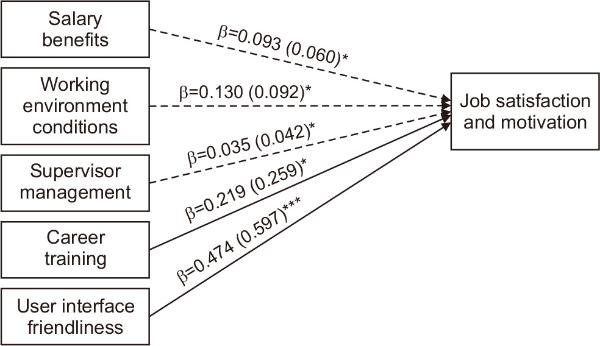
Fig. 3
Visual representation of factors influencing job satisfaction. SB, salary benefits; WEC, work environment conditions; SM, supervisor management; CT, career training; UIF, user interface friendliness; JSM, job satisfaction and motivation.
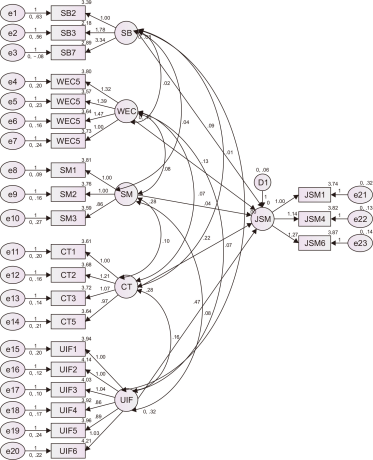
Table 11
Path coefficients and hypothesis testing results
| Path | Path coefficient | CR | p-value | Hypothesis result |
|---|---|---|---|---|
| Salary Benefits → job satisfaction and motivation | 0.093 | 0.825 | 0.409 | Rejected |
| Work environment condition → job satisfaction and motivation | 0.13 | 0.863 | 0.388 | Rejected |
| Supervisor management → job satisfaction and motivation | 0.035 | 0.455 | 0.649 | Rejected |
| Career training → job satisfaction and motivation | 0.219 | 2.456 | 0.014 | Accepted |
| User interface friendly → job satisfaction and motivation | 0.474 | 4.635 | <0.001*** | Accepted |
H1. SB do not significantly affect job satisfaction.
H2. Working environment conditions do not significantly affect job satisfaction.
H3. Supervisory management has no significant effect on job satisfaction.
H4. CT significantly affects job satisfaction (p-value=0.05).
H5. UIF significantly affects job satisfaction (p-value=0.001).
5.9. Analysis of Variance Analysis Result of Job Satisfaction by Participants
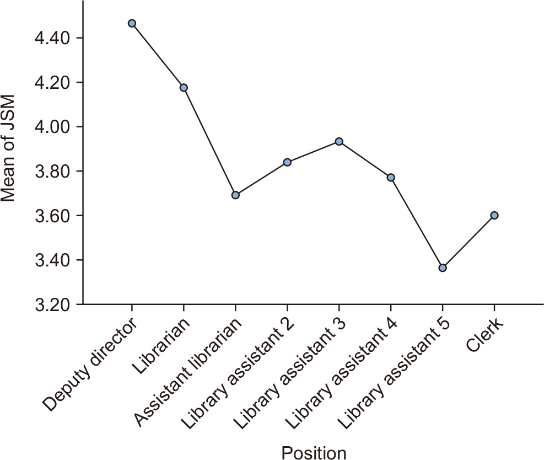
The analysis of variance (ANOVA) results indicate significant differences in job satisfaction across library roles. The overall p-value of 0.002 suggests that at least one group has a different level of satisfaction compared to others. The ANOVA results indicate a statistically significant difference in job satisfaction across different positions (F=3.497, p=0.002); see Table 12. However, post hoc analysis reveals that most positions exhibit relatively similar levels of job satisfaction, except library assistant 5, which shows significantly lower satisfaction compared to the deputy director (p=0.043) and librarian (p=0.003); see Fig. 4.
Fig. 4
Level of job satisfaction by participants. The mean difference is significant at 0.05 level. JSM, job satisfaction and motivation.
6. DISCUSSION
The tabulated data illustrate the respondents’ institutional affiliation with the highest numbers (see Table 2), and the findings provide a realistic overview of job satisfaction among librarians and library staff across various roles and institutional contexts. The analysis reveals that professional development opportunities and user-friendly library systems are the principal drivers of job satisfaction among academic librarians. CT and accessible, well-designed user interfaces were found to significantly enhance satisfaction, whereas salary, general working conditions, and management practices did not show a notable effect. These results align with prior research, which emphasizes the importance of ongoing training and effective communication tools in supporting both satisfaction and service quality in academic library settings (Aghaei et al., 2021; Sare & Edward Bales, 2014; Win, 2019). Correlation analysis confirms strong associations between work satisfaction and these two main components. This shows that the Myanmar university library workers are devoted to their jobs and want to provide the greatest service to users. Given their semi-professional status, most librarians and staff want training and workshops to enhance their capacity to deliver user-centered services. Thus, the study supported the findings of Detlor et al. (2024) and King (2025).
Further statistical analysis revealed significant variation in job satisfaction by occupational role, with librarians generally reporting higher satisfaction than library assistants. This finding suggests that targeted support and tailored development opportunities for specific staff groups could help address disparities and optimize overall workplace satisfaction. The study’s exploratory and confirmatory factor analyses validated the reliability and distinctiveness of the measured constructs. Importantly, the results highlight a shift away from traditional assumptions that salary and leadership practices are central to job satisfaction. Instead, the evidence indicates that skill development and modern training programs exert a stronger influence on employee morale and motivation. These findings are consistent with global trends that underscore the growing significance of professional growth and user experience in the academic library sector (Tella et al., 2007).
The objectives of the study set out to examine whether most positions have similar levels of job satisfaction, except for library assistant 5. ANOVA revealed statistically significant differences in job satisfaction (F=3.497, p=0.002) (see Table 12). Therefore, in response to the first research question, identifying the level of job satisfaction, the results indicate that deputy directors (p=0.043) and librarians (p=0.003) were satisfied in their job (see Fig. 4). Addressing the second research question, which explored the role of professional development and technology, the data reveal that both CT and UIF significantly affect job satisfaction. Specifically, librarians who have access to ongoing training opportunities and work with intuitive, user-friendly library systems report higher levels of satisfaction. These results were confirmed through hypothesis testing with both CT (p=0.05) and user interface usability (p=0.001) emerging as significant predictors (see Table 11). Neither SB, working environment conditions, nor leadership management had a significant impact. These findings are supported by the hypothesis tests, which showed no statistically significant relationships between these traditional workplace factors and overall job satisfaction.
The third objective and research question considered that university senate members and rectors (see Fig. 1) must prioritize library development, librarian professional development, and user service improvement. As mentioned by Oh (2017), library administration should focus on librarian JSM. Hence, university administrators and policymakers should report to the government by improving librarians’ and staff’s compensation benefits, working environments, and leadership practices. Deputy directors (chief librarians) should also engage with policymakers and relevant authorities in initiating collaborations with international library associations, such as library consortia, to form alliances and provide training. Additionally, the library and information science departments of Myanmar universities should actively support training and continuing education. To improve workplace satisfaction, institutions should prioritize CT and user interface design. Policymakers should consider mentorship programs, online training, and tech-driven skill-building seminars. Moreover, policymakers should foster job satisfaction among librarians and staff to ensure high workplace engagement and the future of Myanmar’s universities.
Moreover, this research shows that many Myanmar universities must locate library specialists and staff in the correct places. Therefore, the study aligns with Phinney (2025) in suggesting that administrators and managers should implement organizational improvements, including the employment of permanent equity, diversity, and inclusion (EDI) experts, formalized compensation structures, training programs, dedicated funding for equity-deserving groups, and accountability measures for leaders. Although the results suggest that HR policies should shift away from an exclusive focus on compensation and managerial oversight and instead prioritize professional development and digital resource design, in practical terms, this means investing in robust training programs and ensuring that library systems are easy to use, not only to improve staff satisfaction but also to promote service quality and institutional effectiveness.
In summary, while traditional factors such as salary and supervision are less influential in this research, opportunities for career growth and efficient, user-centered technology are crucial for supporting job satisfaction among librarians in Myanmar’s academic libraries. Addressing these findings through targeted HRM and institutional strategies will be essential for advancing the performance and well-being of university library staff nationwide.
7. CONCLUSION
The current cross-sectional research results enhance the existing literature on job satisfaction among academic librarians in Myanmar by highlighting vocational training and user interface design as significant variables. The two factors enable users to locate information efficiently, navigate digital resources, and access library services with minimal barriers, thereby fostering a more supportive and productive work environment for librarians. Interestingly, the recent political climate in Myanmar has led to the retirement of many library professionals, creating a demand for skilled and qualified staff. This transition has highlighted how working conditions, as well as structural and institutional constraints, affect job satisfaction. The findings provide a comprehensive examination of job satisfaction within national higher education institutions, helping to understand the factors that influence workplace satisfaction by analyzing with EFA and confirmatory factor analysis.
According to the survey, library assistants, particularly at level 5, report lower job satisfaction than senior positions. Myanmar librarians and staff generally have similar levels of job satisfaction influenced by CT and user interface service rather than financial incentives, except for library assistants (level 5). Expanding career development programs at national and international levels is also crucial. According to gender differences and census reports, the results showed that there are more women than men librarians and staff in the workplace. Moreover, this study highlights the dedication and ethical commitment of Myanmar’s predominantly women library workforce, which actively seeks advanced training to enhance its expertise.
Overall, additional research is required to investigate factors such as leadership practices, employee performance, corporate culture, and technology improvements. Researchers should conduct longitudinal studies to track changes in librarians’ job satisfaction over time. The librarians and staff of Myanmar’s universities exhibit robust professional principles, a commitment to user service, and a dedication to lifelong learning. Despite obstacles, they emphasize professional advancement and knowledge dissemination over monetary compensation, underscoring the need for strategic investment in librarianship education and infrastructure. By cultivating a friendly and adequately resourced professional environment, institutions can improve work satisfaction and the overall quality of library services, thereby advancing higher education in Myanmar.
7.1. Contribution
This research advances understanding of job satisfaction for Myanmar’s librarians by highlighting the importance of CT and user-focused systems, and by challenging the traditional emphasis on salary and management. It also underscores the value of considering demographic and cultural factors when developing HR policies. This study found that salary and managerial practices did not contribute to job satisfaction, highlighting the need to prioritize employee motivation and skill development over traditional leadership approaches. This shift emphasizes the growing importance of professional growth and user experience, as illustrated by the research model.
7.2. Implications
For practice and policy, the findings suggest that academic libraries should invest in comprehensive training programs and improved system design to enhance job satisfaction and service quality. Organizations are encouraged to adopt a holistic approach to employee well-being, while policymakers should support initiatives that promote professional growth. Addressing these areas will help build a more motivated library workforce and strengthen the broader educational mission.
7.3. Recommendations
To enhance job satisfaction and efficiency among library staff, it is essential to establish competitive pay structures, improve digital infrastructure, and expand inclusive professional development opportunities. Future research should focus on the qualitative aspects of librarian satisfaction, particularly regarding workplace culture, technological innovations, and career advancement over time.
Based on these findings, it is recommended that university administrators and policymakers prioritize developing and implementing comprehensive training programs, mentorship opportunities, and technology-driven skill-building seminars for library staff. Enhancing the usability of library interfaces and providing more opportunities for career advancement will create a more motivated workforce and further improve the quality of library services.
While this study offers valuable insights, it is important to recognize its limitations. Although the study includes a geographically diverse sample, certain regions faced challenges with Internet access, affecting questionnaire completion. Therefore, future studies should aim for a more representative population by employing interviews or focus groups to increase participation. Besides this, future research should adopt longitudinal and mixed methods to gain a deeper understanding of trends in job satisfaction and to explore the evolving needs of academic librarians in greater detail, considering other influencing factors by structuring a theoretical and practical model. Notably, this study serves as a pioneering effort to examine job satisfaction among academic librarians and library staff in Myanmar.
Additional government exchange programs for librarians and staff, such as job training programs, seminars, workshops, conferences, internships, and study programs, should be coordinated with other developed countries, and, if necessary, continuous assistance should also be sought from international library professionals to strengthen their library skills and user service delivery.
ACKNOWLEDGEMENTS
I also extend my gratitude to the librarians and library staff of those Myanmar university libraries who participated in my data collection process and provided valuable insights and firsthand perspectives on job satisfaction of university libraries in Myanmar, highlighting the collective efforts of all involved.
REFERENCES
, , (2023) Stressors, affectivity, and self - efficacy as predictors of librarians’ thriving at work International Multidisciplinary Research Journal, 5(1), 82-93 https://doi.org/10.54476/ioer-imrj/751772.
(2017) Investigating the correlates and predictors of job satisfaction among Malaysian academic librarians Malaysian Journal of Library and Information Science, 13(2), 69-88 http://jummec.um.edu.my/index.php/MJLIS/article/view/6980.
, , , (2021) Exploring academic library managers communication skills and the effect on librarians job motivation and satisfaction DESIDOC Journal of Library & Information Technology, 41(5), 339-344 https://doi.org/10.14429/djlit.41.5.16551.
, , (2021) Major theories of job satisfaction and their use in the field of Librarianship Library Philosophy and Practice, 6385 https://digitalcommons.unl.edu/libphilprac/6385.
, (2023) Significant factors of job satisfaction among the library professionals in Tamilnadu: A study International Journal of Arts, Science and Humanities, 11(1), 8-13 https://doi.org/10.34293/sijash.v11i1.6239.
, (2023) Investigating the mediating role of social capital in the influence of job satisfaction on subjective well-being among librarians in Java Island, Indonesia International Journal of Research and Innovation in Social Science, VII(VI), 1288-1301 https://doi.org/10.47772/ijriss.2023.7711.
(1950) Tests of significance in factor analysis British Journal of Statistical Psychology, 3(2), 77-85 https://doi.org/10.1111/j.2044-8317.1950.tb00285.x.
, (2024) Reward management and employee performance: A review of job satisfaction in Somalia TWIST, 19(1), 128-137 https://twistjournal.net/twist/article/view/145.
, , , (2024) Reporting reliability, convergent and discriminant validity with structural equation modeling: A review and best-practice recommendations Asia Pacific Journal of Management, 41(2), 745-783 https://doi.org/10.1007/s10490-023-09871-y.
, , , (2001) The job demands-resources model of burnout Journal of Applied Psychology, 86(3), 499-512 https://doi.org/10.1037/0021-9010.86.3.499.
, , , (2024) A survey of public library-led digital literacy training in Canada: Perceptions of administrators and instructors Evidence Based Library and Information Practice, 19(3), 23-41 https://doi.org/10.18438/eblip30553.
(2025) Exploring the landscape of librarianship in the Philippines: Establishing the profession’s population parameter estimates Journal of Librarianship and Information Science, 57(3), 733-745 https://doi.org/10.1177/09610006241240485.
, (2014) Job satisfaction among LIS professionals of universities in the Punjab province Pakistan Journal of Information Management and Libraries, 15, 30-36 https://pjiml.pu.edu.pk/jo/index.php/pjiml/article/view/116.
, (1981) Evaluating structural equation models with unobservable variables and measurement error Journal of Marketing Research, 18(1), 39-50 https://doi.org/10.2307/3151312.
, , , (2019) When to use and how to report the results of PLS-SEM European Business Review, 31(1), 2-24 https://doi.org/10.1108/ebr-11-2018-0203.
, , , (2012) Dimensions of job satisfaction of library professionals: A qualitative exploration International Journal of Business and Social Research, 2(5), 46-62 https://www.researchgate.net/publication/344390829.
, , (2015) A new criterion for assessing discriminant validity in variance-based structural equation modeling Journal of the Academy of Marketing Science, 43(1), 115-135 https://doi.org/10.1007/s11747-014-0403-8.
, , (2016) Factors affecting librarians job satisfaction in federal university of agriculture Makurdi library International Journal of Academic Library and Information Science, 4(9), 264-270 https://www.semanticscholar.org/paper/Factors-Affecting-Librarians-Job-Satisfaction-in-of-Agena-Beetseh/5de9baaafc8ce3e35daa71d0c510ff64c25da2a9.
, (2015) Factors influencing job satisfaction of librarian in federal and state university libraries in Southern Nigeria Open Access Library Journal, 2(2), e1337 https://doi.org/10.4236/oalib.1101337.
(1974) An index of factorial simplicity Psychometrika, 39(1), 31-36 https://doi.org/10.1007/BF02291575.
, , (2024) An overview on employee well-being and job satisfaction: Strategies for organizational success Interantional Journal of Scientific Research in Engineering and Management, 8(7), 1-7 https://doi.org/10.55041/ijsrem36267.
, (2013) The impact of digital library resources on scholarly communication: Challenges and opportunities for university libraries in Pakistan Library Hi Tech News, 30(8), 12-29 https://doi.org/10.1108/lhtn-07-2013-0046.
(2025) Key insights into factors that shape the ideal EDI learning experiences of Canadian academic librarians Evidence Based Library and Information Practice, 20(1), 196-198 https://doi.org/10.18438/eblip30657.
, (2024) Exploring contemporary HRD strategies: Impact on Employee job satisfaction through advanced tools and techniques International Journal of Management and Development Studies, 13(2), 1-9 https://doi.org/10.53983/ijmds.v13n2.001.
, (2004) Creating a culture of assessment: A catalyst for organizational change Portal-Libraries and the Academy, 4(3), 345-361 https://escholarship.org/uc/item/0843106w.
(2015) A primer on partial least squares structural equation modeling (PLS-SEM) International Journal of Research & Method in Education, 38(2), 220-221 https://doi.org/10.1080/1743727X.2015.1005806.
(2024) Career progression as predictor on job satisfaction of academic librarians in the Bicol Region, Philippines JPAIR Institutional Research, 22(1), 43-72 https://doi.org/10.7719/irj.v22i1.892.
, (2008) Image problem even haunts hi‐tech libraries: Stereotypes associated with library and information professionals in Singapore Aslib Proceedings, 60(3), 229-241 https://doi.org/10.1108/00012530810879105.
(2020a) Job satisfaction of professional librarians and library staff Journal of Library Administration, 60(4), 365-382 https://doi.org/10.1080/01930826.2020.1721941.
(2020b) Workplace engagement of librarians and library staff Journal of Library Administration, 60(1), 22-40 https://doi.org/10.1080/01930826.2019.1671037.
, , , , (2024) Knowledge conversion abilities and innovative work behavior of Indonesian academic librarians The International Information & Library Review, 56(2), 150-166 https://doi.org/10.1080/10572317.2024.2331983.
, , , , (2021) Cultural intelligence and job performance of academic librarians in Indonesia The Journal of Academic Librarianship, 47(5), 102394 https://doi.org/10.1016/j.acalib.2021.102394.
, , (2024) A review of the job satisfaction theory for vocational college education perspective International Journal of Modern Education (IJMOE), 6(20), 522-532 https://gaexcellence.com/ijmoe/article/view/1908.
, (2016) Job analysis of academic librarians in Greece: Investigating differences among institutions regarding obligations and responsibilities Library Management, 37(1-2), 29-54 https://doi.org/10.1108/lm-08-2015-0057.
(2014) Job satisfaction of academic librarians: A correlation between job satisfactions and demographic condition of the faculty in selected academic libraries International Journal of Management Research and Review, 4(1), 39-49 https://www.proquest.com/openview/93d7bd2c0ae5b76c4603e5456ddc449b/1?pq-origsite=gscholar&cbl=2028922.
, , , , , (2024) Comparison of Public college librarians’ performance, competence, and work design in Indonesia and Malaysia Journal of Library, Information, and Archival Science, 12(1), 14-24 https://doi.org/10.24252/kah.v12i1a2.
Nasrullah, & Suhag, A. K (2024) Analyzing strategies for improvement of job satisfaction among the university librarians of Karachi: A quantitative study Spry Contemporary Educational Practices, 3(1), 747-769 https://doi.org/10.62681/sprypublishers.scep/3/1/40.
(2016) Transforming libraries in Myanmar: The eLibrary Myanmar project Insights: The UKSG Journal, 29(3), 266-272 https://doi.org/10.1629/uksg.319.
(2017) Analysis of the factors affecting volunteering, satisfaction, continuation will, and loyalty for public library volunteers: An integrated structural equation model Journal of Librarianship and Information Science, 51(4), 894-914 https://doi.org/10.1177/0961000617747338.
, (2022) Influence of work-life balance on turnover intentions of librarians in universities in South-West, Nigeria: Implication and strategies for improvement Library Philosophy and Practice, 7063 https://digitalcommons.unl.edu/libphilprac/7063.
, , , (2023) Job satisfaction gap in international and local non-profit organizations in Myanmar Social Evolution and History, 12(2), 662-680 https://www.researchgate.net/publication/377238146_JOB_SATISFACTION_GAP_IN_INTERNATIONAL_AND_LOCAL_NON-PROFIT_ORGANIZATIONS_IN_MYANMAR.
(2025) EDI and anti-racism work is labour-intensive for racialized academic librarians (and organizations could do more to address this) Evidence Based Library and Information Practice, 20(1), 202-204 https://doi.org/10.18438/eblip30656.
, (2023) Pagoda data management and metadata requirements for libraries in Myanmar Journal of Information Science Theory and Practice, 11(3), 79-91 https://doi.org/10.1633/JISTaP.2023.11.3.6.
, (2018) Job satisfaction of staff in university libraries in Sri Lanka International Journal of Organizational Innovation, 11(1), 0839 https://www.ijoi-online.org/index.php/back-issues-11-20/11-vol-11-num-1-july-2018/78-job-satisfaction-of-staff-in-university-libraries-in-sri-lanka.
, (2014) Professional identity: A grounded theory study of veteran academic librarians Library Review, 63(8-9), 574-589 https://doi.org/10.1108/lr-02-2014-0020.
, , , (2023) E-learning for continuing professional development of university librarians: A systematic review Sustainability, 15(1), 849 https://doi.org/10.3390/su15010849.
(2020) Factors influencing the job satisfaction of librarians of the public libraries in Northern Province, Sri Lanka Sri Lanka Library Review, 34(2), 13-23 https://doi.org/10.4038/sllr.v34i2.31.
, (2024) Factors influencing user satisfaction with university library websites in Myanmar Journal of Information Science Theory and Practice, 12(2), 1-21 https://doi.org/10.1633/JISTaP.2024.12.2.1.
, (2020) Validity and reliability in quantitative research Business & Management Studies: An International Journal, 8(3), 2694-2726 https://doi.org/10.15295/bmij.v8i3.1540.
(2018) The use of Cronbach’s alpha when developing and reporting research instruments in science education Research in Science Education, 48(6), 1273-1296 https://doi.org/10.1007/s11165-016-9602-2.
, (2011) Core competencies for information professionals of Thai academic libraries in the next decade (A.D. 2010-2019) The International Information & Library Review, 43(3), 122-129 https://doi.org/10.1080/10572317.2011.10762889.
, , (2007) Work motivation, job satisfaction, and organisational commitment of library personnel in academic and research libraries in Oyo State, Nigeria Library Philosophy and Practice, 118 https://www.academia.edu/download/86239890/tella2.pdf.
, , (2004) Job satisfaction among Greek academic librarians Library & Information Science Research, 26(3), 373-383 https://doi.org/10.1016/j.lisr.2004.01.004.
, (2020) Perceptions of work-life balance for urban academic librarians: An exploratory study Journal of Library Administration, 60(5), 493-511 https://doi.org/10.1080/01930826.2020.1729624.
, , (2024) Knowledge, attitudes, and practices toward physical activity among public sector librarians in Brunei Darussalam, https://doi.org/10.21203/rs.3.rs-4878236/v1
, , (2020) The role of motivation in librarians’ job performance in public university libraries Journal of Management Information Systems& E-commerce, 7(1), 1-12 https://doi.org/10.15640/jmise.v7n1a1.
, (2017) Job satisfaction and performance of librarians on Benue State University Library International Journal of Academic Library and Information Science, 5(3), 122-127 http://www.academicresearchjournals.org/IJALIS/PDF/2017/May/Upev%20and%20Beetseh.pdf.
, , , , , (2022) Artificial intelligence, robotics, advanced technologies and human resource management: A systematic review The International Journal of Human Resource Management, 33(6), 1237-1266 https://doi.org/10.1080/09585192.2020.1871398.
, , (2005) An investigation of career and job satisfaction in relation to personality traits of information professionals The Library Quarterly, 75(2), 122-141 https://doi.org/10.1086/431330.
, , , (2019) Paper presented at Leadership roles in international librarianship: How can information professionals from Africa Asia & Oceania, Latin America & Caribbean be part of it? Alexandria, Egypt Role of library associations’ and LIS curriculum in uplifting the competencies of librarians, Article Id (other)
, , (2022) Job satisfaction: An explorative study on work characteristics changes of employees in Intralogistics 4.0 Journal of Business Logistics, 43(3), 343-367 https://doi.org/10.1111/jbl.12296.
, (2024) Research on the educational role of university libraries International Education Forum, 2(6), 213-218 https://doi.org/10.26689/ief.v2i6.7926.
(2019) Job satisfaction among librarians in Nigerian public universities Journal of Library Services and Technologies, 1(1), 73-92 https://credence-publishing.com/journal/uploads/archive/201915589465449473560481.pdf.
, , , , , (2018) A study on the effect of continuing education with digital technology on professional growth and job satisfaction of librarians Eurasia Journal of Mathematics, Science and Technology Education, 14(7), 3285-3292 https://doi.org/10.29333/ejmste/91247.
, , (2025) User requirements for research data management services in Myanmar university libraries: A case study of the University of Yangon Library Information Development https://doi.org/10.1177/02666669241309015.