1. INTRODUCTION
The digital era has fundamentally transformed the nature of archival records, creating unprecedented opportunities for information access while introducing complexities that challenge traditional archival management practices (Owens, 2018). The growing reliance on digital systems for creating, managing, and preserving official documents, academic records, and cultural heritage intensifies the need for robust mechanisms to ensure long-term authenticity and integrity (Lin et al., 2020).
Authenticity in digital environments extends beyond purely technical issues, encompassing legal and social dimensions that require interdisciplinary approaches (Lemieux, 2017b). Unlike physical documents, digital objects depend entirely on metadata, management systems, and technological infrastructures to maintain their integrity over time (Bantin, 2016).
Distributed ledger technologies (DLT), particularly blockchain, have emerged as a promising proposal to address some of these challenges, offering features such as immutability, transparency, and verifiability (Lemieux, 2017a). However, the existing literature often neglects critical analyses of technical limitations, operational costs, and practical implementation challenges. This study identifies and addresses four critical gaps: (1) the absence of comprehensive frameworks that integrate technical, organizational, economic, regulatory, and social dimensions; (2) the lack of systematic analyses on the adaptability of DLT solutions to different national and institutional contexts; (3) the scarcity of practical guidance for integrating DLT with established digital preservation infrastructures; and (4) a shortage of critical analyses on the long-term sustainability of DLT implementations.
The main original contribution of this study is the development of the first synthesis, operationalization, and rigorous contextual validation of a socio-technical implementation framework for DLT in archives. While multi-factor models exist in technology adoption literature, such as the technology acceptance model (TAM) (Davis, 1989) and the unified theory of acceptance and use of technology (UTAUT) (Venkatesh et al., 2003), these are primarily focused on predicting user acceptance rather than guiding the systemic implementation of complex infrastructures in an organizational context. This work fills the critical gap between general adoption theories and the practical, multi-faceted requirements of archival digital preservation.
This study adopts an explicitly international perspective, recognizing that digital preservation challenges are global, but solutions must be adapted to specific contexts. The main objective is to develop a critical and comprehensive analysis of the state of the art on DLT applications in digital preservation, culminating in the proposal of a multidimensional framework adaptable to different national and organizational contexts for use by information professionals.
2. LITERATURE REVIEW
Digital preservation as a discipline emerged from the convergence of archival science, computer science, and information studies (Owens, 2018). The Open Archival Information System (OAIS) model (ISO 14721:2012) provides the fundamental conceptual framework for digital preservation systems (Lavoie, 2014). Complementing OAIS, the Digital Curation Centre’s Curation Lifecycle Model expands the preservation perspective to include activities throughout the entire lifecycle of digital objects (Higgins, 2008). The TRUST Principles (Transparency, Responsibility, User focus, Sustainability, Technology) offer an operational framework for evaluating trustworthy digital repositories (Lin et al., 2020), recognizing that technical reliability is necessary but not sufficient for organizational trust.
2.1. Alternative Digital Authenticity Technologies: Beyond Blockchain
Before considering DLT, it is imperative to evaluate established technologies that have long been pillars of digital archival practices. Digital signatures, based on public-key infrastructure (PKI), provide authenticity and non-repudiation but depend on trust in certificate authorities and face challenges in long-term preservation (Blanchette, 2006). Timestamping services, especially those following the RFC 3161 standard, use a trusted third party to attest to the existence of data at a specific time, but this introduces a single point of failure (Sumner, 2025). Hash logs and hash- chaining are simpler methods for integrity monitoring but lack the decentralized consensus of blockchain. Compared to these, blockchain’s proposition is to combine these functionalities into a single, decentralized system, but this comes with challenges in complexity, cost, and scalability.
2.2. Socio-Technical Perspectives on Digital Archives
Socio-technical systems (STS) theory provides a robust lens for understanding the interplay between technology and its social context. Originating from the work of the Tavistock Institute, STS posits that the design and performance of any organization must understand and optimize the interdependence between its social subsystem (people, culture, governance) and its technical subsystem (tools, processes, infrastructure). A central STS principle is “joint optimization,” meaning that optimizing one subsystem in isolation tends to produce suboptimal overall performance (Molleman & Broekhuis, 2001). In the context of digital preservation, a technically perfect DLT solution is doomed to fail if it is incompatible with the organizational culture, workflows, or skills of an archival institution. This study builds on these theoretical foundations by operationalizing socio-technical insights into a concrete, actionable framework for DLT implementation.
2.3. Blockchain in the Literature: Promises, Implementations, and Critiques
The literature on DLT in digital preservation includes theoretical explorations, implementation studies, and critical analyses. Lemieux (2017a) developed a framework for evaluating blockchain as a trustworthy recordkeeping system. However, more recent analyses question some of the initial promises, identifying limitations related to scalability, cost, and complexity (Bralić et al., 2020). The ARCHANGEL project, developed by the University of Surrey and The National Archives of the United Kingdom, is the most documented implementation, using a permissioned blockchain to record cryptographic checksums of archival documents (Collomosse et al., 2018). While a successful proof of concept, its long-term sustainability remains a concern (Currie, 2021). The literature review reveals several gaps, including a scarcity of longitudinal studies, a lack of systematic comparisons with alternative technologies, and limited research on the social and organizational aspects of DLT implementation in library and archival settings.
3. METHODOLOGY
This study adopts a qualitative exploratory approach, structured in three distinct phases: (1) a systematic literature review to map the state of the art on DLT in digital preservation; (2) a comparative case analysis of documented implementations to identify patterns of success and failure; and (3) an analytical synthesis to develop and propose a socio-technical framework. This methodological design ensures that the proposed framework is both grounded in the existing scholarly literature and validated against real-world applications.
3.1. Systematic Literature Review
To ensure transparency and reproducibility, a systematic literature review was conducted following the PRISMA 2020 (Preferred Reporting Items for Systematic Reviews and Meta-Analyses) statement guidelines (Page et al., 2021). The review was designed to answer the following research questions:
- RQ1: What are the primary reported benefits and challenges of using DLT/blockchain for digital preservation in archival contexts?
- RQ2: What technical, organizational, and contextual factors influence the implementation outcomes of DLT projects in archives and libraries?
- RQ3: How does the existing literature address the long-term sustainability and governance of DLT-based preservation systems?
The search strategy involved querying five major academic databases: Web of Science, Scopus, Library and Information Science Abstracts, ACM Digital Library, and IEEE Xplore. This selection ensures comprehensive coverage across information science, computer science, and engineering disciplines. The search was performed for publications between January 2008 and January 2025, using a combination of the following keywords: (“blockchain” OR “distributed ledger technology” OR “DLT”) AND (“digital preservation” OR “archives” OR “recordkeeping” OR “authenticity” OR “integrity”).
The screening process is detailed in the PRISMA flow diagram (Fig. 1). The initial search yielded 742 records. After removing 253 duplicates, titles and abstracts of the remaining 489 records were screened for relevance. This led to the exclusion of 236 articles that did not directly address the use of DLT in a preservation or archival context. The full texts of the remaining 253 articles were assessed for eligibility based on the inclusion and exclusion criteria outlined in Table 1. This final step resulted in the inclusion of 68 studies for qualitative synthesis. The synthesis involved a process of thematic coding to extract key concepts, reported outcomes, and critical factors discussed in the literature, forming the empirical basis for the subsequent framework development.
Fig. 1
Preferred Reporting Items for Systematic Reviews and Meta-Analyses flowchart of the systematic literature review.
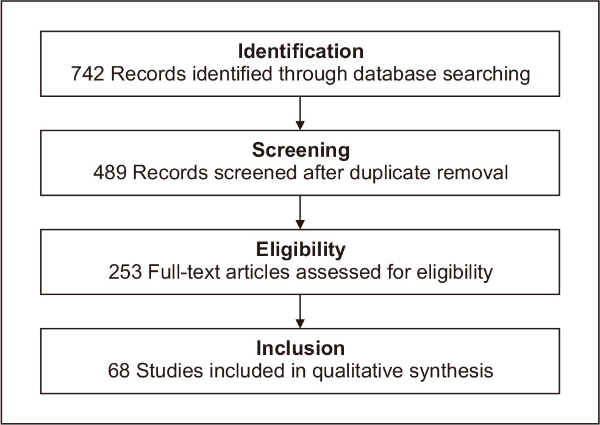
Table 1
Inclusion and exclusion criteria for the systematic review
| Inclusion criteria | Exclusion criteria |
|---|---|
| Studies on blockchain/distributed ledger technology applications in digital preservation | Studies focused exclusively on cryptocurrencies without archival application |
| Documented implementations of blockchain systems for authenticity | Commercial implementations without adequate technical documentation |
| Theoretical analyses on the intersection of blockchain and digital preservation | Publications without peer review or institutional validation |
| Studies in English and Portuguese (2008-2025) | Purely speculative studies without an empirical basis |
| Research in archival repositories and records management | Promotional literature without critical analysis |
3.2. Case Analysis and Framework Development
The case analysis phase aimed to ground the theoretical findings in practical application. The selection of cases was guided by the availability of public documentation and their representativeness of different implementation contexts. The ARCHANGEL project was selected for its status as a well-documented, large-scale, international collaboration involving a national archive. The Brazilian initiatives, including the Hipátia model and judicial archives, were chosen to represent a national-level strategy and a specific domain application within a developing country context. This purposive sampling allows for a richer comparative analysis.
The analysis of each case was systematized using the multidimensional framework presented in Table 2, which was developed from the thematic coding of the literature review. This analytical process involved mapping the documented information for each case against the five dimensions (Technical, Organizational, Economic, Regulatory, Social). This structured approach ensures a consistent and reproducible synthesis, allowing for the identification of cross-case patterns. The framework development was, therefore, an iterative process of analytical induction, where insights from the literature informed the case analysis, and the patterns emerging from the cases were used to refine and validate the final proposed framework (Section 6).
Table 2
Multidimensional analysis framework (tool for case analysis)
| Dimension | Aspects analyzed | Evaluation indicators |
|---|---|---|
| Technical | Architecture, consensus algorithms, integration, scalability, security | Compatibility with standards, processing capacity, robustness |
| Organizational | Alignment with objectives, process changes, training, governance | Available expertise, absorption capacity, institutional culture |
| Economic | Implementation/operation costs, financial sustainability, return on investment | Direct/indirect costs, tangible/intangible benefits |
| Regulatory | Legal compliance, archival standards, privacy, accountability | Adherence to legal frameworks, certification, responsibility |
| Social | User acceptance, professional practices, transparency, access | Satisfaction, behavioral changes, social impact |
3.3. Study Limitations
This study has limitations. The literature on DLT in digital preservation is recent, limiting the availability of longitudinal studies. Many implementations are pilot projects, offering limited evidence on scalability. The analysis is based on public documentation, which may introduce a selection bias. The qualitative nature of the study limits statistical generalization, although it allows for an in-depth understanding of contextual factors.
4. ANALYSIS OF EXISTING IMPLEMENTATIONS AND CRITICAL SUCCESS FACTORS
To provide a concrete basis for the framework, this section analyzes documented DLT implementations. A critical aspect of this analysis is the definition of implementation outcomes. For the purpose of this study, “success” is defined not merely as technical functionality, but as the achievement of the project’s stated preservation goals (e.g., integrity verification), sustained operational use beyond a pilot phase, and alignment with the institution’s long-term strategic and financial resources. Conversely, “failure” is defined as the discontinuation of a project before reaching operational status, significant budget or timeline overruns leading to cancellation, or an inability to transition from a research-funded prototype to a sustainably managed service.
The ARCHANGEL project established an important precedent for DLT applications in official archival contexts (Collomosse et al., 2018). Applying the multidimensional framework (Table 2), its Technical dimension is characterized by a permissioned Ethereum blockchain architecture, which reflects a mature design choice to manage scalability by only recording cryptographic hashes on-chain. From an Organizational perspective, its success as a proof-of-concept was driven by strong leadership from the University of Surrey and The National Archives, demonstrating high technical and organizational expertise (Table 3). However, its Economic dimension reveals a primary limitation: a heavy dependence on research funding, which raises questions about its long-term financial sustainability and classifies it as a successful pilot with uncertain operational longevity (Currie, 2021). The project’s Regulatory and Social dimensions were addressed by design, focusing on integrity for public records and building trust through a decentralized model.
Table 3
Critical success factors in blockchain implementations
| Factor | Successful implementations | Implementations with difficulties |
|---|---|---|
| Scope | Limited and well-defined (e.g., integrity verification) | Broad and ambitious (e.g., complete system replacement) |
| Integration | Complements existing systems | Requires replacement of infrastructure |
| Leadership | Competent technical and organizational expertise | Lack of specialized knowledge |
| Resources | Sustainable and diversified funding | Dependence on a single funding source |
| Expectations | Realistic about capabilities and limitations | Unrealistic expectations about benefits |
| Governance | Clear decision-making structures | Absence of governance models |
In Brazil, the context is different. The Hipátia model, from the Brazilian Institute of Information in Science and Technology (Braga & Arellano, 2022), represents a national-level strategy for Trustworthy Digital Archival Repositories. Here, the interest in DLT is part of a broader Organizational effort to modernize information infrastructure. The analysis of this case shows a focus on integrating DLT with existing systems rather than replacing them, a key success factor identified in Table 3. The authentication of over 156,000 documents in judicial archives (Hong et al., 2011) demonstrates Social acceptance and a clear use case, but a detailed analysis of its Economic sustainability and Technical architecture is not yet publicly available, highlighting a common gap in many DLT projects.
The comparative analysis of these and other cases (Table 4) reveals consistent patterns, which are synthesized into the critical success factors shown in Table 3. Successful projects tend to have a limited and well-defined scope and are managed by teams with competent leadership. In contrast, projects that struggle often suffer from unrealistic expectations and a lack of clear governance. These findings, derived from applying the analytical framework of Table 2 to the cases, strongly suggest that organizational and contextual factors often outweigh purely technical considerations in determining the ultimate success of a DLT implementation.
Table 4
Comparative analysis of blockchain implementations in digital preservation
| Project | Context | Architecture | Scope | Results | Limitations |
|---|---|---|---|---|---|
| ARCHANGEL | United Kingdom (The National Archives) | Permissioned Ethereum, multi-blockchain | Integrity verification of official documents | Successful proof of concept, functional user interfaces | Dependence on research funding, uncertain sustainability |
| Hipátia+blockchain (Instituto Brasileiro de Informação em Ciência e Tecnologia [Brazilian Institute of Information in Science and Technology]) | Brazil | Integration with existing model | Trustworthy digital repositories | Established infrastructure, multiple partnerships | Blockchain implementation still experimental |
| University libraries | Multiple countries | Hybrid solutions | Preservation of theses and dissertations | Specific use cases | Limited scale, restricted resources |
| Judicial archives | Brazil | Public/private blockchain | Authentication of legal documents | 156,000+ documents authenticated | Lack of sustainability analysis |
5. CRITICAL CHALLENGES AND RISKS IN DLT IMPLEMENTATION
The implementation of DLT in digital preservation is not without significant challenges that span all five dimensions of the socio-technical framework. Technical limitations, such as the low transaction throughput of traditional blockchains, present scalability issues for large-scale archival applications (Bralić et al., 2020). The principle of immutability, often cited as a primary benefit, creates a direct conflict with legal and ethical requirements. A key example is the “right to be forgotten” (also known as the right to erasure or Article 17 of the GDPR), which is a cornerstone of the European Union’s General Data Protection Regulation (GDPR) and Brazil’s Lei Geral de Proteção de Dados (LGPD) (Belen-Saglam et al., 2023). These legal concerns are a core component of the framework’s Regulatory dimension and are not treated as separate factors.
Furthermore, challenges related to organizational culture represent a critical aspect of the Organizational dimension. The successful integration of a DLT system requires more than just technical expertise; it demands a shift in workflows, staff training, and a culture that is receptive to change. As identified in the literature, a lack of organizational readiness and resistance to new processes are significant barriers to adoption (Tella et al., 2022). Therefore, these factors are integral to the framework’s analysis, not excluded from it.
To provide a more granular view, the risks identified in the literature can be contextualized by the national and institutional environments in which they are most acute. The claim that risks must be justified by national context is a central tenet of the socio-technical approach advocated in this paper. A specific risk’s probability and impact are not universal; they are weighted by the local regulatory landscape, economic conditions, and organizational maturity. Table 5 (Belen-Saglam et al., 2023; Bralić et al., 2020; Currie, 2021; Kayikci et al., 2022; Tella et al., 2022; Zhou et al., 2020) synthesizes these risks, categorizing them by the context where they are most pronounced. The methodology for this table involved identifying recurring challenges in the systematic literature review and mapping them to the contextual factors observed in the analyzed implementations, with each risk now supported by a specific citation.
Table 5
Primary risks of DLT implementation by national context
| National context | Primary risks | Description | Illustrative source |
|---|---|---|---|
| Developed countries (e.g., United Kingdom, European Union members) | Regulatory & compliance complexity | Navigating complex data protection laws like GDPR, which may conflict with blockchain’s immutability | Belen-Saglam et al. (2023) |
| - | High integration costs | The cost of integrating DLT with sophisticated legacy systems in established national archives can be prohibitive | Currie (2021) |
| Developing countries (e.g., Brazil) | Lack of specialized expertise | A shortage of local professionals with the skills to develop, implement, and maintain DLT systems | Tella et al. (2022) |
| - | Financial sustainability | Dependence on intermittent government funding or short-term grants makes long-term operation uncertain | Zhou et al. (2020) |
| All contexts | Governance & standardization | Lack of clear governance models for decentralized networks and absence of interoperability standards | Bralić et al. (2020) |
| - | Energy consumption & environmental impact | The high energy usage of Proof-of-Work blockchains is a significant environmental and cost concern | Kayikci et al. (2022) |
Further elaborating on the regulatory dimension, the specific legal frameworks in place heavily influence the feasibility and design of any DLT implementation. Table 6 provides concrete examples of national legislation that must be considered, illustrating the practical application of the framework’s Regulatory dimension.
Table 6
Examples of specific national legislation and regulatory frameworks
| Regulatory frameworks |
Geographic context | Example legislation | Relevance to DLT in archives |
|---|---|---|---|
| Data protection & privacy | European Union | General Data Protection Regulation (GDPR) | Governs the right to erasure (Art. 17), data portability, and cross-border data transfers, posing challenges for immutable ledgers |
| Brazil | Lei Geral de Proteção de Dados | Similar to GDPR, establishes rights for data subjects and rules for data processing that must be reconciled with DLT architecture | |
| United States | Privacy Act of 1974, state-level laws (e.g., CCPA/CPRA) | Creates a complex, fragmented compliance landscape for personal data held in government and private archives | |
| Electronic identification & trust services | European Union | eIDAS Regulation (No. 910/2014) | Provides a legal framework for electronic signatures, seals, and timestamps, which can be integrated with or complemented by DLT systems |
| Access to information | Brazil | Lei de Acesso à Informação | Mandates transparency for public records, a goal that DLT can support, but requires careful design to protect sensitive information |
| United States | Freedom of information act | Governs public access to government records, where DLT could potentially provide a verifiable audit trail of access and modifications |
6. A MULTIDIMENSIONAL CONCEPTUAL FRAMEWORK FOR DLT IMPLEMENTATION
Based on the synthesis of the literature and the analysis of existing implementations, this study proposes a multidimensional conceptual framework for DLT implementation in archival repositories. Grounded in STS theory, the framework is designed to facilitate the “joint optimization” of the social and technical subsystems by systematically considering their interdependence. It integrates five critical dimensions: technical, organizational, economic, regulatory, and social.
- Technical dimension: Addresses system architecture, consensus algorithms, integration with existing systems (like OAIS), scalability, and security. Evaluation focuses on compatibility with standards, processing capacity, and robustness.
- Organizational dimension: Examines strategic alignment, necessary changes to workflows and processes, staff training requirements, and governance models for the DLT network.
- Economic dimension: Considers the total cost of ownership, including implementation and long-term operational costs, financial sustainability models, and return on investment, both tangible and intangible.
- Regulatory dimension: Focuses on compliance with relevant legal frameworks (e.g., GDPR, LGPD), archival standards, privacy implications, and accountability mechanisms.
- Social dimension: Addresses user acceptance by archivists and researchers, impacts on professional practices, and the system’s contribution to public transparency and trust.
6.1. Novel Contributions Beyond Existing Frameworks
The principal novelty of this framework lies in its operationalization of STS theory into a context-adaptive planning tool specifically for archival digital preservation (Hong et al., 2011). While other models exist, they serve different purposes. The TAM and the UTAUT are powerful for predicting individual user adoption but are not designed to guide the complex, systemic implementation of an organizational infrastructure (Davis, 1989; Venkatesh et al., 2003). More recent STS-based frameworks, such as the STS for digital heritage model for digital heritage, provide a valuable analytical lens but remain highly theoretical and are not tailored to the specific regulatory and operational realities of archival repositories (Lu et al., 2025). As shown in Table 7 (Davis, 1989; Lu et al., 2025; Venkatesh et al., 2003), the proposed framework fills the critical gap between general theories of user acceptance and broad analytical models, offering a prescriptive, actionable roadmap for institutional decision-making.
Table 7
Comparative analysis of DLT implementation and adoption frameworks
| Framework | Theoretical basis | Target domain | Key differentiator |
|---|---|---|---|
| Proposed framework (this study) | STS theory, empirical case analysis | DLT in archival repositories | Operationalizes STS into a weighable, archive-specific planning tool and implementation roadmap |
| STS-DH framework (Lu et al., 2025) | STS theory | Digital heritage (broad) | Highly theoretical, descriptive rather than prescriptive; not tailored for DLT or the specificities of archives |
| TAM/UTAUT (Davis, 1989; Venkatesh et al., 2003) | Psychology, sociology | Technology adoption by individuals | Focuses on predicting user acceptance, not guiding systemic organizational implementation; lacks archival, regulatory, and economic depth |
6.2. Contextual Weighting Mechanism: A Strategic Planning Tool
To transform the framework from a descriptive model into a strategic planning tool, we introduce a contextual weighting mechanism. This process empowers an institution to assign a numerical weight to each of the five dimensions based on its unique strategic priorities, resources, and environment. It is crucial to note that the weights presented in Table 8 are purely illustrative. Their purpose is to demonstrate the process of contextualization, not to prescribe specific values. The provenance of these weights in a real-world application would be a deliberative process involving key stakeholders (e.g., archivists, IT managers, legal counsel, administrators), and their justification would be documented as part of the initial feasibility assessment. For example, a national archive with strict legal mandates might assign the highest weight to the “Regulatory” dimension, whereas a smaller, community-based archive with limited funding would likely prioritize the “Economic” dimension.
Table 8
Illustrative example of contextual weighting
| Dimension | University archive (limited resources) | National archive (strict regulation) |
|---|---|---|
| Technical | 15% (focus on simple integration) | 20% (focus on scalability and security) |
| Organizational | 25% (focus on staff training and acceptance) | 20% (focus on governance and coordination) |
| Economic | 30% (focus on low total cost of ownership) | 15% (focus on long-term budget sustainability) |
| Regulatory | 15% (focus on basic privacy compliance) | 35% (focus on national laws and standards) |
| Social | 15% (focus on ease of use for researchers) | 10% (focus on public transparency) |
6.3. Phased Implementation Process: A Practical Guide
The framework is complemented by a practical guide for implementation, structured as a five-phase process to mitigate risk and allow for iterative learning. This guide, presented in Table 9, is not a novel invention but rather a synthesis and adaptation of established best practices from technology project management and the digital preservation literature, informed by models such as the OAIS reference model. Its origin lies in structuring the complex task of DLT implementation into manageable stages, each with clear objectives, deliverables, and success criteria.
Table 9
Phased implementation process
| Phase | Duration | Main objectives | Deliverables | Success criteria |
|---|---|---|---|---|
| 1. Assessment | 3-6 months | Multidimensional feasibility analysis; stakeholder weighting | Feasibility report, risk matrix, weighted framework | Informed decision to proceed or halt |
| 2. Pilot | 6-12 months | Limited implementation for concept validation | Functional pilot system, performance data, lessons learned | Concept validated, risks understood |
| 3. Refinement | 3-6 months | Optimization based on pilot results | Refined system, updated documentation, improved metrics | Measurable performance improvements |
| 4. Expansion | 12-24 months | Implementation at operational scale | System in production, trained staff, governance in place | Sustainable operation at scale |
| 5. Operation | Ongoing | Long-term system maintenance and evolution | Periodic audit reports, system updates, sustainability plan | Long-term integrity and accessibility ensured |
6.4. Illustrative Scenario: Applying the Framework at a Municipal Archive
To demonstrate the framework’s applied relevance, we consider the hypothetical case of the “Metropolis Municipal Archive” (MMA), a mid-sized public institution responsible for preserving official city records, including property deeds, council meeting minutes, and historical photographs.
6.4.1. The Challenge
The MMA faces growing pressure to provide verifiable digital versions of its records. Recent incidents of unauthorized alteration of digital files on the city’s central server have eroded public trust. The city council has heard about blockchain and allocated a small exploratory budget to investigate it as a solution for ensuring the integrity of the digital archive.
6.4.2. Step 1: Assessment Phase (Applying the Framework)
The archive director convenes a working group including a senior archivist, the city’s IT department lead, a lawyer from the city’s legal department, and the finance officer. They use the multidimensional framework to structure their feasibility study.
6.4.2.1. Stakeholder Weighting.
The group first debates and assigns weights. Due to a recent, highly publicized data breach, Regulatory (compliance with state-level public records laws) and Social (restoring public trust) dimensions are weighted heavily. As a municipal entity, the Economic dimension is also a major concern due to tight budgets. They arrive at the following illustrative weights: Technical (15%), Organizational (20%), Economic (25%), Regulatory (25%), and Social (15%).
6.4.2.2. Multidimensional Analysis.
Technical: The IT lead determines that their current digital repository (based on OAIS principles) is robust. A full replacement is infeasible. The best approach would be an integration layer—a permissioned DLT that anchors hashes of the archival information packages without storing the records themselves on-chain. This minimizes scalability issues.
-
Organizational: The senior archivist notes that the current staff has no DLT expertise. Significant training would be required. The workflow for ingesting new digital records would need to be modified to include the hashing and registration step. This dimension is identified as a high-effort area.
-
Economic: The finance officer calculates the potential costs. A commercial, off-the-shelf DLT solution is too expensive. An open-source solution would require hiring a specialized consultant for the pilot phase. Ongoing operational costs (node maintenance, cloud hosting) are a major concern and must be factored into future budget requests.
-
Regulatory: The city lawyer confirms that using DLT to enhance the integrity of public records is compliant with state law. However, they caution against storing any personally identifiable information on an immutable ledger due to potential conflicts with state privacy regulations. The design must ensure the DLT component is purely for integrity verification of hashes.
-
Social: The group agrees that a key outcome must be a public-facing verification portal where citizens can check the integrity of a digital record by uploading it or entering its hash. This would directly address the goal of improving public trust.
6.4.3. The Decision
Based on the assessment, the working group concludes that a full-scale implementation is too risky and costly at this stage. However, a limited, focused pilot is feasible and strategically sound. They recommend to the city council a 12-month pilot project (Phase 2) with a clear, limited scope: to build a proof-of-concept for integrity verification of property deeds created in the last five years. Their feasibility report, structured around the five dimensions, provides a clear, evidence-based rationale for this recommendation, justifying the required budget for a consultant and pilot infrastructure. The framework allowed the MMA to move from a vague directive (“investigate blockchain”) to a concrete, risk-mitigated, and strategically aligned project plan.
7. DISCUSSION
The results reveal a significant complexity at the intersection of DLT and digital preservation, challenging simplistic narratives of DLT as a universal solution. The main theoretical contribution is demonstrating that the effectiveness of DLT depends less on its intrinsic technical characteristics and more on a careful alignment with specific organizational needs, regulatory contexts, and implementation capabilities. The proposed multidimensional framework, grounded in STS theory, represents a methodological advancement over existing approaches by promoting an integrated analysis that considers the complex interactions between technical, organizational, economic, regulatory, and social factors.
The comparative analysis of implementations reveals that organizational and project management factors often outweigh technical considerations. This has important practical implications for information professionals, suggesting that investments in organizational capacity building and strategic planning may be more critical than specific technological choices. The illustrative scenario of the MMA demonstrates how the framework can be used as a practical tool to guide decision-making, moving from a vague technological interest to a structured, risk-assessed pilot project.
Directions for future research are plentiful. Longitudinal studies are desperately needed to move beyond the proof-of-concept stage and assess the long-term sustainability and operational challenges of DLT systems in archives. Furthermore, more systematic comparative evaluations, pitting DLT-based solutions against enhanced traditional methods (e.g., advanced PKI and timestamping services) across standardized dimensions of cost, security, and usability, would provide invaluable data for institutional decision-makers.
8. CONCLUSIONS
This study offers a comprehensive critical analysis of DLT applications in digital preservation that provides an evidence-based conceptual framework for decision-making. The main contribution is the first rigorous synthesis, operationalization, and contextual validation of a socio-technical implementation framework for DLT in archives, integrating five critical dimensions. This research demonstrates that the effectiveness of DLT fundamentally depends on the alignment between technology and context.
To create narrative symmetry, we revisit the four research gaps identified in the introduction. The proposed framework directly addresses the (1) absence of comprehensive models and the (2) lack of analysis on adaptability. The study’s focus on integration offers guidance on (3) complementing existing infrastructures. Finally, the economic and organizational dimensions systematically address (4) the scarcity of critical analyses on sustainability. For information science theory, this work operationalizes STS theory into a practical tool. For information science practice, it provides a structured, risk-mitigating roadmap for librarians and archivists navigating the complexities of emerging technologies.
In summary, this study demonstrates that while DLT offers unique capabilities for integrity verification, its effective implementation requires careful consideration of the technical, organizational, economic, regulatory, and social factors specific to each context. The proposed framework offers a practical tool for organizations to make informed decisions, emphasizing that the success of technological implementations in digital preservation depends less on intrinsic technical features and more on the joint optimization of the social and technical subsystems, aligned with organizational needs, national regulatory frameworks, and long-term sustainability.
ACKNOWLEDGEMENTS
The authors thank the anonymous reviewers for their constructive comments and suggestions. We also acknowledge support from Brazil’s National Council for Scientific and Technological Development (CNPq) - Case: 305515/2024-1- and the Brazilian Institute of Information in Science and Technology (IBICT).
REFERENCES
, , , (2023) A systematic literature review of the tension between the GDPR and public blockchain systems Blockchain: Research and Applications, 4(2), 100129 https://doi.org/10.1016/j.bcra.2023.100129.
(2006) The digital signature dilemma Annals of Telecommunications, 61(7-8), 908-923 https://doi.org/10.1007/BF03219871.
, , (2020) A blockchain approach to digital archiving: Digital signature certification chain preservation Records Management Journal, 30(3), 345-362 https://doi.org/10.1108/RMJ-08-2019-0043.
, , , , , , , , (2018) Paper presented at DocEng ‘18: Proceedings of the ACM Symposium on Document Engineering 2018 New York, NY, USA ARCHANGEL: Trusted archives of digital public documents, https://doi.org/10.1145/3209280.3229120
(2021) The FAIR forever study overview of key findings and recommendations, https://www.dpconline.org/docs/technology-watch-reports/2429-dpctw19-02/file
(1989) Perceived usefulness, perceived ease of use, and user acceptance of information technology MIS Quarterly, 13(3), 319-340 https://doi.org/10.2307/249008.
(2008) The DCC curation lifecycle model International Journal of Digital Curation, 3(1), 134-140 https://doi.org/10.2218/ijdc.v3i1.48.
, , , , (2011) Applying the technology acceptance model in a study of the factors affecting usage of the Taiwan digital archives system Computers & Education, 57(3), 2086-2094 https://doi.org/10.1016/j.compedu.2011.04.011.
, , , (2022) Critical success factors for implementing blockchain-based circular supply chain Business Strategy and the Environment, 31(7), 3595-3615 https://doi.org/10.1002/bse.3110.
(2017b) Blockchain recordkeeping: A SWOT analysis, https://magazine.arma.org/wp-content/uploads/simple-file-list/2017_06_IM_blockchain_recordkeeping_SWOT_lemieux.pdf
, , , , , , , , , , , , , , , , , , (2020) The TRUST principles for digital repositories Scientific Data, 7(1), 144 https://doi.org/10.1038/s41597-020-0486-7.
, , (2025) Digital heritage from a socio-technical systems perspective: Integrated case analysis and framework development Heritage, 8(9), 348 https://doi.org/10.3390/heritage8090348.
, (2001) Sociotechnical systems: Towards an organizational learning approach Journal of Engineering and Technology Management, 18(3-4), 271-294 https://doi.org/10.1016/s0923-4748(01)00038-8.
, , , , , , , , , , , , , , , , , , , (2021) The PRISMA 2020 statement: An updated guideline for reporting systematic reviews BMJ, 372, n71 https://doi.org/10.1136/bmj.n71.
(2025) Blockchain vs traditional timestamping methods, https://www.scoredetect.com/blog/posts/blockchain-vs-traditional-timestamping-methods
, , (2022) Relevance of blockchain technology and the management of libraries and archives in the 4IR Digital Library Perspectives, 38(4), 460-475 https://doi.org/10.1108/dlp-08-2021-0065.
, , , (2003) User acceptance of information technology: Toward a unified view MIS Quarterly, 27(3), 425-478 https://doi.org/10.2307/30036540.
, , , (2020) The key challenges and critical success factors of blockchain implementation: Policy implications for Singapore’s maritime industry Marine Policy, 122, 104265 https://doi.org/10.1016/j.marpol.2020.104265.