1. INTRODUCTION
Open science has emerged as a reform-oriented paradigm that addresses systemic challenges in research by promoting greater transparency, reproducibility, and accessibility throughout the entire research lifecycle (Pontika et al., 2015). While open science is widely promoted in policy discourse, its translation into practice varies substantially across research systems and is shaped by governance arrangements, infrastructure readiness, incentive alignment, and cross-actor coordination.
Scholarly communication is a core process through which scientific knowledge is produced, shared, assessed, and preserved over time. It encompasses the processes through which research outputs (journal articles, data, methods, and software) are created, validated, shared, and archived (Codina et al., 2023; Romary, 2011). While digital transformation has expanded dissemination channels and accelerated knowledge exchange, structural problems such as unreliable evaluation mechanisms, predatory publishing, risks of data manipulation, and infrastructural disparities remain embedded in many scholarly systems (Smart, 2022; Šobota, 2024). These challenges undermine trust in research outputs and limit the equitable circulation and reuse of scientific knowledge.
Recent developments in information science and science policy research highlight the importance of coordinated infrastructures and governance arrangements in enabling reliable and transparent scholarly communication. Empirical studies of national science and technology information systems demonstrate that effective scholarly communication depends on integrated data environments, robust research lifecycle management, and interoperable infrastructures (Kim & Hyun, 2025). Qualitative evidence further suggests that open science implementation is shaped not only by individual attitudes but also by institutional capacity, incentive alignment, and cross-actor coordination, particularly in how policies are translated into operational procedures and supported by usable technical systems.
However, while existing scholarship has produced extensive conceptual and policy-oriented discussions of open science, practice-oriented analyses that systematically connect implementation barriers across multiple actor groups and translate them into actionable intervention pathways remain limited. This gap is especially salient in national contexts where scholarly communication infrastructures and governance arrangements are still evolving, such as Indonesia, because adoption bottlenecks often arise from interactions among policy operationalization, infrastructure capacity, and incentive structures rather than from isolated technical or cultural constraints.
To address this gap, the present study examines open science adoption within Indonesia’s scholarly communication system through a multi-actor governance perspective. The study integrates a systematic literature review (SLR) with qualitative interviews and applies the Pentahelix model (Academia, Government, Business, Community, and Media) as an analytical lens. In this study, Pentahelix actors are treated as analytical categories, and their perspectives are empirically captured through interviews with individuals representing each actor category. The scope of analysis is limited to identifying and interpreting implementation barriers and cross-actor solution pathways related to open science practices within the scholarly communication system; it does not evaluate the performance of specific technologies or assess research outcomes.
Accordingly, this study seeks to develop a structured understanding of barriers to implementing open science and potential solutions by integrating evidence from the literature with practitioner perspectives. Three research questions guide the analysis:
RQ1. What challenges to open science implementation are identified in the scholarly literature?
RQ2. How do barriers to open science adoption manifest across Pentahelix actor categories, as reflected in interview evidence?
RQ3. What integrated, cross-actor solutions emerge from the literature and interview data to enhance the sustainability and transparency of scholarly communication systems?
2. CONCEPT OF OPEN SCIENCE
Open science comprises a set of principles and practices intended to enhance transparency, accessibility, and reusability across the research lifecycle. It spans multiple dimensions (open access to publications, open research data, and open methods) while also including related approaches like open peer review and, in some contexts, citizen engagement (Bertram et al., 2023; Klebel et al., 2025; Pontika et al., 2015). In this study, “open science implementation” is understood not as endorsement in principle, but as the practical integration of these dimensions into routine research and institutional workflows.
Within scholarly communication systems, open science reshapes how research outputs are disseminated, evaluated, and preserved. Open access challenges subscription-based dissemination models, while open data and open methods extend scholarly communication beyond articles to include datasets, protocols, and software (Rodés-Bachs et al., 2025). Consequently, repositories, metadata standards, persistent identifiers, licensing practices, and interoperability become central components of implementation that link research production to long-term preservation and reuse (Taşkın, 2026).
Importantly, open science adoption is not solely a technical matter. Prior studies show that implementation depends on institutional policies and governance capacity, including the translation of policy into operational procedures (e.g., deposit requirements, data management guidance, and compliance monitoring), the availability of organizational support (e.g., data stewardship and training), and alignment with incentive structures and legal–ethical constraints (Cuevas Shaw et al., 2022; González-Teruel et al., 2022; Ollé et al., 2023). Likewise, repositories and data infrastructures require sustained funding, human resources, and cross-organizational coordination to remain usable and trusted over time (Armeni et al., 2021; Klebel et al., 2025).
Consistent with this literature, the present study conceptualizes open science as a governance challenge embedded within a broader scholarly communication system rather than as a discrete set of technical practices (Cruz Romero, 2025; Cudennec et al., 2022). The Pentahelix model is used to examine how barriers and responsibilities are distributed across academia, government, business, community, and media actors, and how coordinated interventions across these actor categories can support more sustainable and transparent implementation (González-Teruel et al., 2022).
3. LITERATURE REVIEW
Scholarly communication has long been conceptualized within information science as a socio-technical system through which scientific outputs are created, organized, validated, and made accessible (Garvey, 2014; Lopes et al., 2019). Traditionally governed by formal written conventions, peer-review structures, and disciplinary norms, this system has been constrained by subscription-based business models, limited methodological transparency, and uneven opportunities for participation (O’Sullivan et al., 2021; Sawant, 2012). These constraints align with broader findings in information systems research, which show that fragmented data infrastructures, insufficient interoperability, and uneven institutional capabilities hinder effective knowledge sharing. Analyses of national STI systems, for example, reveal the importance of integrated datasets, standardized metadata, and coordinated information governance to support transparent scientific communication (Kim & Hyun, 2025).
Within this literature, open science has been widely promoted as a corrective paradigm designed to enhance openness, accountability, and inclusivity in research practices. The open science ecosystem includes open access publishing, open data, reproducible methods, open peer review, transparent metrics, supportive policy frameworks, and enabling digital tools (Pontika et al., 2015). Across the reviewed studies, these practices collectively reshape scholarly communication by expanding discoverability, improving verification, and supporting cross-disciplinary collaboration (Hayashi, 2021; Tsakonas, 2021). Empirical evidence consistently links open science with increased citation impact, broader dissemination, reduced redundancy, and more efficient research cycles (Piwowar et al., 2007; Piwowar & Vision, 2013; Rodriguez-Pomeda et al., 2023).
Across the studies synthesized in the SLR, institutional repositories (IRs) emerge as a fundamental component of the open science ecosystem. Prior research demonstrates that improving repository interfaces, automating deposit workflows, and enhancing metadata quality can significantly increase the adoption of green open access. Gualo et al. (2023) highlight that master data repositories require rigorous quality frameworks, certification processes, and adherence to International Organization for Standardization/International Electrotechnical Commission standards to ensure trust, accuracy, and reusability in open science ecosystems. In this study, these issues are analytically coded as infrastructure limitations and technical barriers in the adoption of open science (see Table 1) (Altman et al., 2023; Arthur & Hearn, 2021; Avissar-Whiting et al., 2021; Bornmann et al., 2021; Camkin et al., 2022; Chiware, 2020; Ciriminna et al., 2021; Craft & Harlow, 2020; Delikoura & Kouis, 2021; Fox et al., 2021; Guirlet & Schneider, 2024; Haim & Jungblut, 2023; Hauschke et al., 2021; Hofmann, 2022; Ignat & Ayris, 2020; Ignat et al., 2021; Kwasnicka et al., 2021; Lee & Chung, 2023; Lee et al., 2023; Loureiro Cardoso et al., 2024; Lui et al., 2022; Manghi et al., 2020; Muneja, 2023; Mwangi et al., 2021; Nüst & Eglen, 2021; Peeters, 2021; Ramachandran et al., 2021; Rao et al., 2022; Reiter-Pázmándy, 2021; Rodriguez-Pomeda et al., 2023; Šobota, 2024; Thaldar et al., 2023; Toribio-Flórez et al., 2021; Vuong et al., 2020; Yu et al., 2024; Zarghani et al., 2023).
Table 1
Open science challenges in scholarly communication
The SLR reveals that barriers to open science adoption cluster into several recurring categories, indicating that adoption challenges are widespread and multilayered. These categories include technical barriers (e.g., limited digital infrastructure, insufficient metadata standards, and unclear licensing arrangements), socio-economic constraints (such as high article processing charges, predatory journals, and inadequate institutional funding), and behavioral and cultural barriers (including low digital literacy, resistance to data sharing, and disciplinary norms) (Borges et al., 2021; Ignat & Ayris, 2020; Vuong et al., 2020). Empirical evidence further demonstrates that the presence of formal policy frameworks alone does not guarantee effective implementation. For example, Borrego (2016)’s analysis of Spanish open access mandate compliance shows that only 58.4% of publicly funded articles are available as open access, with minimal use of IRs despite permissive publisher policies. These patterns form the basis for the barrier categories summarized in Table 1 (Altman et al., 2023; Arthur & Hearn, 2021; Avissar-Whiting et al., 2021; Bornmann et al., 2021; Camkin et al., 2022; Chiware, 2020; Ciriminna et al., 2021; Craft & Harlow, 2020; Delikoura & Kouis, 2021; Fox et al., 2021; Guirlet & Schneider, 2024; Haim & Jungblut, 2023; Hauschke et al., 2021; Hofmann, 2022; Ignat & Ayris, 2020; Ignat et al., 2021; Kwasnicka et al., 2021; Lee & Chung, 2023; Lee et al., 2023; Loureiro Cardoso et al., 2024; Lui et al., 2022; Manghi et al., 2020; Muneja, 2023; Mwangi et al., 2021; Nüst & Eglen, 2021; Peeters, 2021; Ramachandran et al., 2021; Rao et al., 2022; Reiter-Pázmándy, 2021; Rodriguez-Pomeda et al., 2023; Šobota, 2024; Thaldar et al., 2023; Toribio-Flórez et al., 2021; Vuong et al., 2020; Yu et al., 2024; Zarghani et al., 2023).
Beyond the direct technical and cultural barriers identified in the literature, institutional dynamics emerge as a critical determinant of open science outcomes. Brinks et al. (2019) argue that institutional weakness (manifested in noncompliance, instability, or weak enforcement) undermines policy effectiveness across many governance systems. When applied to open science, this perspective suggests that policy mandates alone are insufficient without supporting enforcement mechanisms, sustained cross-actor coordination, and resilient information infrastructures. Empirical findings from Journal of Information Science Theory and Practice further indicate that adoption behaviors are shaped by organizational pressures and structural conditions, as demonstrated in studies on environmental compliance and information-intensive workforce ecosystems (Mubdir et al., 2025; Tipsena et al., 2025). In this study, such governance-related constraints are analytically examined as cross-cutting barriers that manifest differently across Pentahelix actors.
Well-known approaches like the Triple Helix and Quadruple Helix models (Carayannis & Campbell, 2010; Etzkowitz & Leydesdorff, 2000) provide foundational perspectives on innovation ecosystems but do not fully address the civic and media dimensions pertinent to open science. The Pentahelix framework extends these models by incorporating academia, government, business, community, and media, providing a more comprehensive analysis of how multi-actor interactions shape knowledge ecosystems (Tonković et al., 2015). Within the open science context, the Pentahelix model is used in this study as an analytical structure to attribute identified barriers and solutions to specific actor roles, highlighting how adoption depends not only on individual researcher behavior but also on coordinated policies, digital infrastructures, societal engagement, and mediating institutions.
Taken together, the literature reveals a fragmented analytical landscape. Although open science principles and individual implementation challenges are well documented, fewer studies systematically integrate infrastructural, cultural, and policy-related dimensions across multiple actor groups using empirical synthesis. This study addresses this gap by synthesizing evidence from a SLR and qualitative interviews to develop a multi-actor, ecosystem-oriented understanding of open science implementation.
4. METHODOLOGY
This study employs a mixed-methods design, integrating SLR and semi-structured interviews. The combination of these methods strengthens methodological rigor by enabling triangulation and enhancing the credibility of findings. The SLR provides a structured overview of the existing knowledge base, highlights recurring challenges, and synthesizes global evidence on open science implementation in scholarly communication. Complementing the SLR, the semi-structured interviews provide contextualized, experience-based insights into how these challenges are encountered and negotiated by actors involved in research, repository management, governance, and science communication. Together, these methods support the development of a multi-actor, empirically grounded understanding of scholarly communication and open science adoption. The overall research design builds upon prior conceptualizations of an end-to-end scholarly communication system (Hidayat et al., 2025).
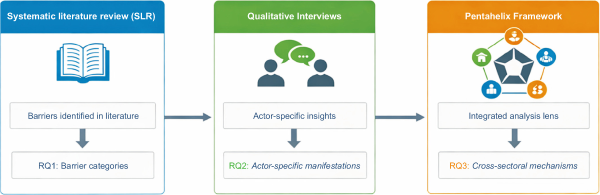
Fig. 1 presents the current study’s analytical flow within a sequential mixed-methods design. The SLR was conducted first to identify recurring barrier categories and evidence patterns (RQ1). These findings informed the interview protocol and guided the subsequent semi-structured interviews, which examined how the identified barriers manifest across Pentahelix actors within the Indonesian scholarly communication system (RQ2). The SLR and interview findings were then integrated through the Pentahelix lens to synthesize cross-sectoral mechanisms and intervention pathways for strengthening open science adoption (RQ3). Arrows indicate the sequence of evidence generation and the points of integration across methods.
The study received ethical approval from the University of Padjadjaran Research Ethics Committee (ethics number: 1058/UN6.KEP/EC/2024). All interview participants provided informed consent, and the interview data were anonymized to safeguard confidentiality.
4.1. Systematic Literature Review Method
The SLR followed established guidelines for evidence synthesis (Kitchenham & Charters, 2007; Xiao & Watson, 2019). The planning phase involved formulating research questions and developing a review protocol to ensure transparency, reproducibility, and minimal bias. The PICOC framework (Population, Intervention, Comparison, Outcome, Context) was applied to guide the construction of search terms and to delimit the scope (Petticrew & Roberts, 2006). “Scholarly communication” served as the population, while “open science” constituted the intervention.
A comprehensive search strategy was developed using Boolean operators and keyword variations to maximize coverage while maintaining relevance (dos Santos et al., 2022). The final search string was constructed iteratively during the planning phase and applied consistently across all databases to ensure comparability of results:
(“scholarly communication” OR “academic communication” OR “intellectual communication” OR “research communication” OR “scientific communication”)
AND
(“open science” OR “open access” OR “open data” OR “open peer review” OR “open reproducible research” OR “open science policies” OR “accessible science” OR “open science ethics” OR “open science evaluation” OR “open science tools” OR “public science”)
Searches were conducted across three digital libraries (Emerald Insight, Scopus, and Taylor & Francis) selected for their broad coverage of scholarly communication, information science, and open science. Together, these databases capture both theoretical and applied studies relevant to the analytical focus of this review.
Explicit inclusion and exclusion criteria were applied. Eligible studies met the following conditions:
1. peer-reviewed journal articles
2. published between 2020 and 2024
3. written in English
4. explicitly addressing both open science and scholarly communication
A quality assessment checklist adapted from Kitchenham & Charters (2007) evaluated each study on relevance, clarity, methodological robustness, and explanatory depth. Articles scoring below 2.1 out of 3 (70%) were excluded to preserve rigor. A structured, piloted extraction form ensured consistent data capture across studies.
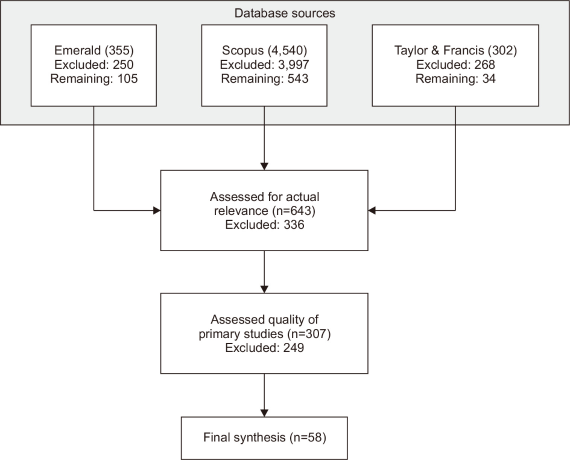
During the conducting phase, the search string was executed across selected databases, followed by title, abstract, and full-text screening. Quality-eligible studies (n=58) were synthesized using thematic aggregation. Challenges were categorized broadly, while contextual variations in barriers were retained to preserve institutional and national specificity. The overall SLR workflow is illustrated in Fig. 2.
4.2. Interview Method
Respondents were recruited through official email invitations and professional networks. All participants provided informed consent before taking part in the study. Twenty participants who met the inclusion criteria were interviewed. Eligibility criteria included (1) prior experience in scholarly publication (journal articles, conference proceedings, or research data outputs), (2) engagement with IRs, and (3) involvement in, or awareness of, open science initiatives.
Table 2 summarizes participants’ roles within the scholarly communication system, including university lecturers and researchers, repository managers, government-affiliated research and information professionals, technology service providers, and open science communication intermediaries. Participants were affiliated with public and private universities, national research institutions, and government-related organizations across both Java and non-Java regions, spanning diverse disciplinary backgrounds.
Table 2
Demographic characteristics of respondents
| No. | Initial | Gender | Actor category | Role | Region |
|---|---|---|---|---|---|
| 1 | WD | M | Academia | Scientist | Banten, Indonesia |
| 2 | RY | W | Academia | Scientist | West Java, Indonesia |
| 3 | AB | M | Academia | Scientist | West Java, Indonesia |
| 4 | RH | W | Academia | Lecturer | West Java, Indonesia |
| 5 | AN | M | Academia | Lecturer | West Java, Indonesia |
| 6 | YM | M | Academia | Scientist | West Java, Indonesia |
| 7 | TK | W | Academia | Lecturer | South Sumatra, Indonesia |
| 8 | IS | W | Academia | Scientist | North Maluku, Indonesia |
| 9 | PR | M | Academia | Lecturer | West Java, Indonesia |
| 10 | SM | W | Government | Government | DKI Jakarta, Indonesia |
| 11 | WR | M | Government | Government | DKI Jakarta, Indonesia |
| 12 | ED | M | Government | Government | DKI Jakarta, Indonesia |
| 13 | CH | M | Government | Government | DKI Jakarta, Indonesia |
| 14 | MD | W | Community | OS communicator | London, United Kingdom |
| 15 | DS | M | Media | OS communicator | West Java, Indonesia |
| 16 | DN | W | Government | Ministry repository manager | DKI Jakarta, Indonesia |
| 17 | AL | M | Government | Ministry repository manager | DKI Jakarta, Indonesia |
| 18 | YD | M | Academia | University repository manager | West Java, Indonesia |
| 19 | SN | M | Academia | University repository manager | DKI Jakarta, Indonesia |
| 20 | DF | M | Business | Tech information technology specialist | Banten, Indonesia |
Sampling followed a purposive maximum-variation strategy to capture heterogeneity across actor roles and institutional contexts. Initial thematic saturation was observed after approximately ten interviews; additional interviews were conducted to broaden actor coverage and confirm the stability of emerging themes. Interviews were conducted either via video conferencing platforms or in person, depending on participant availability, and lasted approximately 40-60 minutes. With participants’ consent, interviews were audio-recorded and transcribed verbatim. All interviews were conducted in Bahasa Indonesia.
Data analysis followed a two-stage coding process. First, transcripts were coded inductively to identify recurring barriers, practices, and implementation challenges. Second, the resulting codes were mapped deductively to Pentahelix actor categories to examine how similar barriers manifested differently depending on institutional role, authority, and proximity to policy implementation and technical infrastructure. The Pentahelix framework therefore served as an interpretive lens for tracing actor-dependent mechanisms and relational dynamics, rather than as a prescriptive governance model.
5. RESULTS
5.1. Challenges in the Implementation of Open Science
The results of the SLR indicate that the most critical challenges in implementing open science within the context of scholarly communication are cultural resistance (28.4%), infrastructure limitations (19.8%), and lack of incentives (18.5%). These findings suggest that barriers to adoption extend beyond technical constraints and are closely associated with academic culture and institutional incentive structures. A detailed overview of the frequency and percentage distribution of the identified challenges is provided in Table 1 (Altman et al., 2023; Arthur & Hearn, 2021; Avissar-Whiting et al., 2021; Bornmann et al., 2021; Camkin et al., 2022; Chiware, 2020; Ciriminna et al., 2021; Craft & Harlow, 2020; Delikoura & Kouis, 2021; Fox et al., 2021; Guirlet & Schneider, 2024; Haim & Jungblut, 2023; Hauschke et al., 2021; Hofmann, 2022; Ignat & Ayris, 2020; Ignat et al., 2021; Kwasnicka et al., 2021; Lee & Chung, 2023; Lee et al., 2023; Loureiro Cardoso et al., 2024; Lui et al., 2022; Manghi et al., 2020; Muneja, 2023; Mwangi et al., 2021; Nüst & Eglen, 2021; Peeters, 2021; Ramachandran et al., 2021; Rao et al., 2022; Reiter-Pázmándy, 2021; Rodriguez-Pomeda et al., 2023; Šobota, 2024; Thaldar et al., 2023; Toribio-Flórez et al., 2021; Vuong et al., 2020; Yu et al., 2024; Zarghani et al., 2023), while their overall distribution is illustrated in Fig. 3.
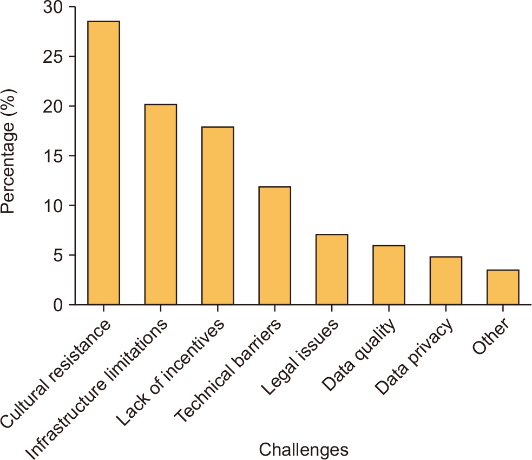
More specifically, cultural resistance emerges as the most frequently identified barrier, accounting for 28.4% of reported challenges. This category encompasses limited awareness, divergent interpretations of openness, and reluctance among researchers and institutions to adopt open practices. Infrastructure limitations represent the second most frequently reported challenge (19.8%), reflecting insufficient technological capacity, weak support systems, and constrained financial resources for sustainable implementation. Lack of incentives (18.5%) constitutes the third major barrier, highlighting the absence of recognition and reward mechanisms that would encourage engagement with open science practices.
In addition to these dominant challenges, several other barriers were identified in the literature. Technical barriers (11.1%) include interoperability issues and limited integration of digital systems. Legal issues (7.4%) reflect uncertainties related to copyright, licensing, and intellectual property rights, while data quality concerns (6.2%) highlight difficulties in ensuring the accuracy, reliability, and reproducibility of research data.
Taken together, these findings illustrate the multidimensional nature of open science adoption challenges identified through the SLR. While this section addresses RQ1 by mapping the distribution of barriers in the literature, the following section advances the analysis by examining how these challenges manifest across specific actor groups within the Pentahelix ecosystem, drawing on interview data (RQ2).
5.2. Barriers Based on the Pentahelix Framework
Building on the barrier categories identified through the SLR (RQ1), the interview findings illuminate how these challenges are experienced and enacted by different actors within the Pentahelix ecosystem. Rather than appearing uniformly, barriers manifest in actor-specific forms shaped by institutional roles, degrees of authority, and proximity to infrastructure and policy implementation. The following sections present these dynamics across the five Pentahelix actor categories: academia, government, business and technology, community, and media.
5.2.1. Academia
Within academia, barriers to open science adoption emerge from a combined dominance of governance and infrastructure constraints, reinforced by cultural norms related to ownership, risk, and trust. Ethical motivations for openness were articulated by several participants (P06:YM5). However, actual engagement often remained conditional and situational, shaped by project requirements, funder expectations, and institutional directives rather than intrinsic commitment (P03:AB10; P02:RY02). Data sharing was frequently described as informal and restricted to trusted circles, reflecting persistent cultural norms around control and reputational risk (P01:WD03).
At the institutional level, governance arrangements strongly mediate academic participation. University lecturers emphasized that rector-level regulations or formal leadership endorsement are often prerequisites for systematic engagement with repositories and open platforms (P05:AN01). Compliance-oriented practices were evident, with some participants indicating that open science activities become salient primarily when clearly embedded in institutional rules or evaluation mechanisms (P04:RH03). Forward-looking views framed open science as a strategy for increasing research visibility and impact, particularly through established platforms perceived as reliable and secure. One participant noted that repositories can enhance access to scholarly literature and increase citation potential (P08:IS11), while another expressed a clear preference for established global platforms, stating, “For manuscripts, I prefer arXiv” (P09:PR09).
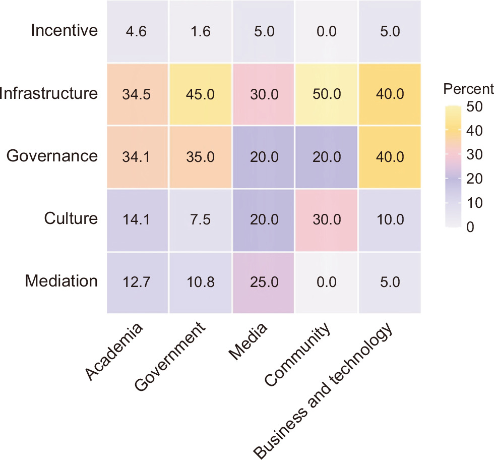
Infrastructure-related barriers further reinforce these governance and cultural dynamics. Academic repository managers highlighted weak interoperability arrangements and the absence of formal agreements with national repositories as major constraints on data flow and reuse (P19:SN5). Unclear institutional regulations were also reported to limit enforcement capacity, generating hesitation in mandating deposits (P18:YD08). Collectively, these findings indicate that academic barriers are not primarily incentive-driven, but are rooted in the interaction between governance mechanisms, infrastructural alignment, and entrenched cultural practices, consistent with the salience patterns shown in Fig. 4.
5.2.2. Government
At the governmental level, barriers are characterized by the co-dominance of governance and infrastructure constraints, particularly in relation to policy operationalization and implementation capacity. Participants involved in national policy formulation and library coordination described ongoing efforts to harmonize institutional practices through working groups and inter-agency forums (P10:SM4), as well as initiatives to formalize repository networks via ministerial regulations (P11:WR08, WR09). However, these policy instruments have yet to translate into consistent compliance across institutions.
Operational challenges were especially salient among repository administrators, who described curation, verification, and long-term maintenance as resource-intensive processes that limit scalability (P12:ED11). Infrastructure fragility was further underscored by accounts of system restrictions or temporary closures due to security concerns and technical limitations (P17:AL8). Although incentive-based mechanisms (linking repository deposit to performance indicators) were reported as emerging, their implementation remains uneven and secondary to structural constraints (P16:DN17).
From a governance perspective, respondents emphasized the absence of a fully integrated national research data management framework. The lack of a consolidated consortium for research data governance was cited as a barrier to standardization, interoperability, and long-term sustainability (P13:CH13, CH19). Overall, governmental barriers reflect not a lack of policy intent, but fragmented execution, limited enforcement capacity, and uneven infrastructural readiness, aligning with the strong governance and infrastructure salience observed in Fig. 4.
5.2.3. Business and Technology Sector
In the business and technology sector, barriers are primarily concentrated around infrastructure sustainability and governance integration, rather than cultural or incentive-related factors. Based on the limited interview evidence from the business and technology sector, the technology service provider involved in this study emphasized that engagement with open science initiatives is largely project-based and contingent on short-term collaboration agreements (P20:DF10, DF19). This limits the sector’s ability to provide sustained technical support, system maintenance, and long-term innovation.
While technological actors possess critical expertise for addressing infrastructure-related challenges, their role within the open science ecosystem remains peripheral and weakly institutionalized. Limited integration into governance structures constrains their capacity to influence standards, interoperability decisions, or long-term platform strategies. As reflected in Fig. 4, the salience of governance and infrastructure barriers in this sector highlights the gap between technical capability and institutional embedding.
5.2.4. Community Actors
Interview evidence from the community actor included in this study suggests that barriers to open science engagement were experienced primarily through infrastructure and cultural constraints, particularly in relation to access, reuse, and the recognition of non-academic knowledge practices. Participants emphasized the practical difficulties of engaging with open science infrastructures, including challenges related to interoperability, reliability, and sustained access to reusable research outputs. These constraints limit communities’ ability to meaningfully reuse data and participate in knowledge production.
Cultural barriers further shape community engagement. Participants highlighted the persistence of expert-centric norms and limited recognition of non-academic knowledge practices, which restrict the integration of community actors into open science workflows. Governance-related gaps (particularly the lack of clear procedural guidance at the implementation level) were noted as contextual constraints that exacerbate infrastructural and cultural barriers (P14:MD4). As visualized in Fig. 4, the community perspective represented in this study was most strongly associated with barriers linked to infrastructure readiness and reuse practices, rather than with mediation capacity itself.
5.2.5. Media Actors
Based on the limited interview evidence from the media actor included in this study, the most salient barriers were located in the domain of mediation, alongside significant infrastructure and governance constraints. Participants emphasized limited operational clarity for dissemination and engagement, noting that existing policies provide little guidance for platform-level communication and public-facing translation of research outputs (P15:DS16, DS18). These gaps constrain media actors’ ability to contextualize research for non-specialist audiences and to sustain trust-building communication around open science.
Infrastructure fragility and governance ambiguity further shape these mediation challenges. Technical vulnerability affects platform reliability and visibility, while unclear institutional responsibilities limit long-term planning and investment. As shown in Fig. 4, the media perspective represented in this study occupies a distinct intermediary position within the Pentahelix, in which mediation barriers appear especially pronounced but remain closely coupled with infrastructural and governance limitations.
Fig. 4 summarizes the actor-specific salience of open science adoption barriers across the Pentahelix framework. Color intensity indicates the relative salience (percentage) of five aggregated barrier categories (incentives, infrastructure, governance, culture, and mediation) derived from thematic coding of interview transcripts. Governance- and infrastructure-related barriers cut across all actors, indicating system-level constraints in policy operationalization and technical readiness. Beyond these shared challenges, barrier configurations vary by actor, underscoring the relational and actor-dependent nature of open science adoption. The following section synthesizes these findings to identify cross-sectoral intervention pathways (RQ3).
5.3. Cross-Sectoral Solutions and Mechanisms for Strengthening Open Science Adoption
Building on the dominant barriers identified through the SLR, particularly lack of incentives, cultural resistance, and infrastructure limitations (RQ1; Table 1 [Altman et al., 2023; Arthur & Hearn, 2021; Avissar-Whiting et al., 2021; Bornmann et al., 2021; Camkin et al., 2022; Chiware, 2020; Ciriminna et al., 2021; Craft & Harlow, 2020; Delikoura & Kouis, 2021; Fox et al., 2021; Guirlet & Schneider, 2024; Haim & Jungblut, 2023; Hauschke et al., 2021; Hofmann, 2022; Ignat & Ayris, 2020; Ignat et al., 2021; Kwasnicka et al., 2021; Lee & Chung, 2023; Lee et al., 2023; Loureiro Cardoso et al., 2024; Lui et al., 2022; Manghi et al., 2020; Muneja, 2023; Mwangi et al., 2021; Nüst & Eglen, 2021; Peeters, 2021; Ramachandran et al., 2021; Rao et al., 2022; Reiter-Pázmándy, 2021; Rodriguez-Pomeda et al., 2023; Šobota, 2024; Thaldar et al., 2023; Toribio-Flórez et al., 2021; Vuong et al., 2020; Yu et al., 2024; Zarghani et al., 2023] and Fig. 3) and their actor-specific manifestations revealed by the interview findings (RQ2), this section synthesizes cross-sectoral mechanisms and intervention pathways that may strengthen the sustainability and transparency of scholarly communication. Rather than introducing new empirical evidence, this analysis integrates patterns observed across the literature and interviews through the analytical lens of the Pentahelix framework. While incentive misalignment remains visible across the literature, the interview findings (RQ2) indicate that governance and infrastructure constraints constitute the most persistent system-level barriers across Pentahelix actors, shaping the conditions under which incentives, mediation, and cultural change can operate.
5.3.1. Incentive Reconfiguration as a Cross-Cutting Mechanism
Misaligned incentive structures emerge as an enabling constraint that conditions engagement with open science, rather than as a standalone determinant of adoption. As shown in the SLR results, the lack of incentives is among the most frequently reported barriers. Interview findings further indicate that, in practice, open science activities are often framed as administrative obligations rather than as integral research practices. This dynamic is reflected in interview accounts in which repository deposit gains priority primarily when linked to formal performance evaluation, as noted by one government-affiliated repository manager: “Deposit data only becomes a priority when it is directly linked to performance indicators” (P16:DN15).
Taken together, these findings suggest that incentive reconfiguration (integrating open science outputs into research assessment, promotion criteria, and institutional performance indicators) functions as a key enabling mechanism across Pentahelix actors. However, the analysis also reveals an important boundary condition: Incentive-based approaches alone may encourage procedural compliance rather than substantive engagement if they are not accompanied by cultural change and adequate institutional support.
5.3.2. Governance Translation and Policy Operationalization
The synthesis of RQ1 and RQ2 highlights a persistent gap between policy articulation and operational implementation. While national and institutional open science policies provide an essential regulatory foundation, interview findings demonstrate that these instruments often lack technical specificity, enforcement mechanisms, and coordinated implementation across institutions. As a result, policy mandates tend to function symbolically rather than operationally.
Effective governance solutions, therefore, require translation mechanisms that connect high-level policy commitments to institutional practices. These include developing clear technical guidelines, standardized definitions of research data, and interoperable workflows between institutional and national repositories. The analysis indicates that enforcement mechanisms (conditional funding, reporting requirements, or audit procedures) are necessary to support implementation. Still, their effectiveness depends on parallel investments in institutional capacity and infrastructural readiness.
5.3.3. Infrastructure Stabilization and Capacity Building
Consistent with both the SLR and interview findings, infrastructural fragility remains a critical constraint on open science adoption. System instability, limited human resources, and uneven metadata practices undermine trust in repositories and discourage sustained engagement. The synthesis suggests that effective solutions in this domain extend beyond short-term technical fixes toward long-term capacity building, including professional training for repository personnel, sustainable funding models, and shared service arrangements across institutions.
The analysis further indicates that business and technology actors possess underutilized potential as contributors to system resilience. However, their involvement remains largely project-based and peripheral. Integrating these actors more systematically through public–private partnerships or service-level agreements may enhance infrastructural stability, while simultaneously introducing governance challenges related to accountability, data ownership, and long-term sustainability.
5.3.4. Mediation, Trust, and the Role of Media and Community Actors
The synthesis of interview findings underscores the importance of mediation and trust-building in addressing cultural resistance to open science. Media and community-based actors play a critical role in translating open science principles into accessible practices, clarifying misconceptions related to data misuse, and enhancing the visibility of open research outputs. However, their effectiveness is constrained by infrastructural vulnerabilities and limited institutional recognition.
The analysis suggests that strengthening mediation capacity (stable platform support, clearer policy mandates, and structured collaboration with academic and governmental actors) can mitigate perceived risks and foster greater trust in open science practices. This highlights a further boundary condition: Mediation efforts are unlikely to succeed in isolation if core governance arrangements and technical infrastructures remain unstable. For media actors, mediation functions as a primary operational role, whereas for community actors, mediation capacity is largely contingent upon infrastructure reliability and the feasibility of reuse practices.
5.3.5. Toward a Coordinated but Differentiated Pentahelix Strategy
Taken together, the integrated findings from RQ1 and RQ2 indicate that open science adoption cannot be achieved through single-actor or single-instrument interventions. Instead, it requires a coordinated but differentiated strategy in which each Pentahelix actor addresses barriers aligned with its institutional role and capacity. Academia plays a central role in normalizing practices and cultural change; government actors are pivotal in translating policy into practice and enforcing it; business and technology actors contribute technical expertise and infrastructural stability; and media and community actors facilitate mediation and trust-building.
To consolidate these mechanisms into a single analytical view of interdependencies and failure pathways, Fig. 5 maps the Pentahelix actors, the four intervention engines, and the two contrasting outcomes.
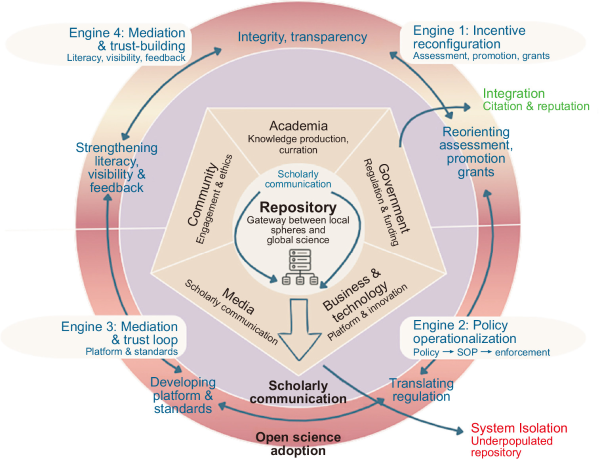
Fig. 5 summarizes the RQ3 findings on why open science adoption through IRs often fails to stabilize, framing scholarly communication as the core operational flow that determines whether an IR becomes a pathway to integration or slips into isolation.
At the center of the diagram is the repository/IR positioned as a gateway between local scholarly practices inside the institution and the global science system. The pentagon represents the Pentahelix actors (Academia, Government, Business & Technology, Media, and Community) whose combined actions shape the socio-technical conditions of adoption. The thick circular arrows emphasize that an IR is not merely a storage site but part of an autopoietic cycle of scholarly communication: knowledge production → dissemination/archiving → discoverability and reuse → citation and recognition → reputational reinforcement. In this view, an IR only becomes meaningful when it is enrolled in a living communication circuit rather than reduced to an administrative document deposit.
The outer ring depicts four intervention “engines” that correspond directly to the barriers highlighted in RQ3. Engine 1 (incentive reconfiguration) addresses the reputational logic: Without changes in assessment, promotion, and funding signals, repository deposition is not perceived as reputation-generating work. Engine 2 (policy operationalization) captures a recurring RQ3 bottleneck: Policies exist but are not translated into workable standard operating procedure, support routines, and enforcement mechanisms. Engine 3 (infrastructure stabilization) reflects technical impediments that produce stagnation (platform instability, weak metadata standards, low interoperability, and poor user experience) making self-archiving difficult to sustain. Engine 4 (mediation & trust-building) highlights socio-cultural constraints: literacy, visibility, communication, and feedback loops that cultivate trust. Without these, repositories remain peripheral to the community’s actual communication practices.
The outcomes displayed on the right articulate two contrasting trajectories that answer RQ3. When repository-mediated communication is reintegrated into global circuits (indexed, discoverable, read, and cited), it produces integration in the form of citation and reputation, and the IR functions as an infrastructure of scientific communication. Conversely, when deposits remain disconnected from that circuit (through sparse content, weak standards, low visibility, and low trust), the IR moves toward ‘system isolation’: an underpopulated repository in which documents exist, but communication does not occur, resulting in a ‘dead archive.’
Fig. 5 also reinforces that interventions must be aligned and sequenced across actors. Incentive reforms without infrastructure support, policies without operational translation, or mediation without technical reliability are unlikely to yield sustained change. Accordingly, the Pentahelix framework is used here as an analytical lens to identify interdependencies and to indicate which interventions should precede others to stabilize open science adoption within the scholarly communication ecosystem.
6. DISCUSSION
Rather than reiterating descriptive patterns, this discussion advances an explanatory account of how systemic misalignment across governance, infrastructure, and incentives conditions actor-specific adoption pathways. This study set out to identify key barriers to open science adoption and to examine how these barriers manifest across actors within the scholarly communication ecosystem using a combined SLR and interview-based analysis framed by the Pentahelix model. By integrating findings from the literature (RQ1), actor-specific interview insights (RQ2), and cross-sectoral synthesis (RQ3), the discussion advances understanding beyond descriptive mapping toward explanatory mechanisms and conditional intervention pathways. Across the three research questions, governance and infrastructure emerge as the most persistent system-level conditions shaping how other mechanisms (incentives, mediation, and cultural change) operate across actors.
6.1. From Isolated Barriers to Systemic Misalignment
A central contribution of this study lies in demonstrating that barriers to open science adoption are not isolated obstacles but manifestations of systemic misalignment across cultural, institutional, and infrastructural dimensions. The SLR results show that cultural resistance, lack of incentives, and infrastructure limitations consistently dominate the literature. Interview findings further reveal that these barriers are mutually reinforcing rather than independent. For example, weak incentive structures amplify cultural resistance, while infrastructural fragility undermines trust and discourages engagement even among actors who are normatively supportive of open science.
This interactional perspective helps explain why policy mandates and technical platforms alone have yielded uneven adoption outcomes, rather than reflecting individual reluctance or technical immaturity; stalled implementation results from misaligned expectations, responsibilities, and capacities across the scholarly communication system.
6.2. Incentives as a Mechanism Rather Than a Solution
The findings refine existing debates on incentives in open science by showing that incentives function as a mechanism rather than a standalone solution. Both literature and interviews indicate that incentive structures shape behavior primarily by redefining priorities within existing institutional logics. When open science practices are formally recognized in evaluation and reporting systems, participation increases; however, this compliance-oriented engagement often remains procedural.
This suggests an important boundary condition: Incentive reforms are most effective when combined with cultural normalization and infrastructural support. Without these complementary elements, incentives risk reinforcing minimal compliance rather than fostering substantive openness. This nuance contributes to ongoing discussions on responsible research assessment by highlighting the limits of metric-driven reforms. Importantly, the interview-based findings indicate that incentive mechanisms do not explain actor-level variation on their own, but instead operate within the constraints imposed by governance arrangements and infrastructural readiness.
6.3. Governance Gaps and the Challenge of Policy Translation
The study also sheds light on the persistent gap between policy articulation and operational implementation. Although open science policies are increasingly in place at both national and institutional levels, their translation into everyday practice remains inconsistent. Interview findings reveal that ambiguity surrounding data definitions, unclear enforcement mechanisms, and fragmented coordination across institutions weaken policy effectiveness.
Importantly, this does not imply policy failure per se. Rather, it points to the absence of intermediary governance mechanisms that connect high-level commitments to technical workflows and organizational routines. The findings suggest that governance effectiveness depends less on mandates’ presence than on their operationalization through clear guidelines, interoperable infrastructure, and institutional capacity-building.
6.4. Infrastructure as a Trust-Building Condition
Consistent with prior research, infrastructure emerges not only as a technical prerequisite but also as a trust-building condition. System instability, limited human resources, and inconsistent metadata practices erode confidence among users and intermediaries alike. Interview findings indicate that infrastructural fragility disproportionately affects actors responsible for implementation and mediation, including repository managers and science communication platforms.
This highlights a critical trade-off: While infrastructure investments are often portrayed as costly, their absence incurs hidden costs, including reduced participation, reputational risk, and reliance on informal or external platforms. Sustainable open science adoption, therefore, requires long-term infrastructural commitments rather than short-term project-based solutions. This finding aligns with the actor-specific salience patterns observed in Fig. 4, where infrastructure-related barriers cut across all Pentahelix actors.
6.5. Repositioning Media and Community Actors in Scholarly Communication
By explicitly incorporating media and community-based actors into the analytical framework, this study extends conventional discussions of scholarly communication beyond academia and government. The findings show that science communication intermediaries play a crucial role in mediating openness, clarifying misconceptions, and enhancing visibility. However, their effectiveness is constrained by limited institutional recognition and infrastructural vulnerability.
This underscores the need to reconceptualize ‘media’ in open science not merely as channels of dissemination but as active intermediaries within the knowledge ecosystem. Strengthening their role requires both technical support and clearer integration into governance and policy frameworks. While mediation constitutes the primary operational barrier for media actors, community actors are constrained more fundamentally by infrastructural access and the feasibility of reuse practices, which condition their ability to engage meaningfully in open science.
6.6. Implications for the Pentahelix Framework
Methodologically, the study demonstrates the value of the Pentahelix framework as an analytical tool rather than a prescriptive model. By mapping barriers and mechanisms across actor roles, the framework enables identification of interdependencies and sequencing challenges that would remain obscured in single-actor analyses. The findings suggest that effective open science strategies must be coordinated yet differentiated, recognizing that each actor operates under distinct constraints and capacities.
At the same time, the uneven representation of actors (business and media) highlights the importance of contextual interpretation when applying the Pentahelix model. Rather than assuming symmetry, the framework is most effective when used to interrogate imbalance and asymmetry within real-world systems. In this sense, the Pentahelix framework enables explanation not by symmetry, but by tracing how asymmetries in capacity, authority, and proximity to infrastructure shape adoption outcomes.
7. CONCLUSION
Open science adoption in Indonesia emerges less as a problem of isolated technical deficiency than as a systemic challenge of governance coordination across a multi-actor research ecosystem. Evidence from the literature and stakeholder interviews shows that barriers are relational rather than independent: They are produced through misalignments among governance execution, incentive structures, infrastructure sustainability, and mediation capacity, and they manifest differently across actor groups. This matters because it shifts the understanding of open science adoption away from a narrow focus on individual compliance or technical readiness toward the broader question of how institutional roles, authority, and inter-actor coordination shape implementation outcomes. In this sense, the study shows that uneven adoption is not simply a sign of weak commitment, but a consequence of uneven capacity to translate policy aspirations into operational practice.
Analytically, the study demonstrates the value of the Pentahelix framework as a lens for identifying interdependencies and sequencing interventions, rather than treating it as a prescriptive governance model. The findings suggest that progress in open science adoption depends on coordinated yet differentiated action across actors, particularly in incentive realignment, policy operationalization, research data governance, infrastructure stabilization, and trust-building mediation. At the same time, these conclusions remain bounded by uneven actor representation and the review’s focus on recent English-language literature. Further comparative and longitudinal research is therefore needed to clarify how collaborative governance arrangements evolve over time and under what conditions they can support sustainable open science implementation.
8. LIMITATIONS AND FUTURE RESEARCH
Several limitations should be acknowledged. First, while the interview sample captures all Pentahelix components, representation across actor categories remains uneven, reflecting the structure of the national scholarly communication system rather than proportional equivalence. Second, the SLR focused on English-language journal articles published between 2020 and 2024, potentially underrepresenting locally grounded or non-indexed perspectives. Future research could extend this analysis through longitudinal designs, comparative national studies, or deeper engagement with industry and media actors.
REFERENCES
, , (2023) Interventions in scholarly communication: Design lessons from public health First Monday, 28(8) https://doi.org/10.5210/fm.v28i8.12941.
, , , , , , , , , , , , , , , , , , , (2021) Towards wide-scale adoption of open science practices: The role of open science communities Science and Public Policy, 48(5), 605-611 https://doi.org/10.1093/scipol/scab039.
, (2021) Reshaping how universities can evaluate the research impact of open humanities for societal benefit The Journal of Electronic Publishing, 24(1) https://doi.org/10.3998/jep.788.
, , , , , , (2021) Addressing disorder in scholarly communication: Strategies from NISO Plus 2021 Information Services & Use, 41(1-2), 107-121 https://doi.org/10.3233/isu-210113.
, , , , , (2023) Open science Current Biology, 33(15), R792-R797 https://doi.org/10.1016/j.cub.2023.05.036.
, , , (2021) Which aspects of the open science agenda are most relevant to scientometric research and publishing? An opinion paper Quantitative Science Studies, 2(2), 438-453 https://doi.org/10.1162/qss_e_00121.
(2016) Measuring compliance with a Spanish Government open access mandate Journal of the Association for Information Science and Technology, 67(4), 757-764 https://doi.org/10.1002/asi.23422.
, , , , , , , , (2022) Open science for accelerating the sustainable development goals: Status and prospects in Asia and the Pacific Frontiers in Political Science, 4, 878761 https://doi.org/10.3389/fpos.2022.878761.
, (2010) Triple Helix, Quadruple Helix and quintuple helix and how do knowledge, innovation and the environment relate to each other? International Journal of Social Ecology and Sustainable Development, 1(1), 41-69 https://doi.org/10.4018/jsesd.2010010105.
(2020) Open research data in African academic and research libraries: A literature analysis Library Management, 41(6-7), 383-399 https://doi.org/10.1108/lm-02-2020-0027.
, , , , (2021) Reaping the benefits of open science in scholarly communication Heliyon, 7(12), e08638 https://doi.org/10.1016/j.heliyon.2021.e08638.
, , , (2023) Scholarly communication: A discipline that should be promoted index.comunicación, 13(1), 13-25 https://doi.org/10.33732/ixc/13/01Schola.
, (2020) Scholarly communications training: Professional development for the next generation of scholars Serials Review, 46(3), 175-183 https://doi.org/10.1080/00987913.2020.1806651.
(2025) Transparency in open science: An actionable principle? Open Information Science, 9(1), 20250016 https://doi.org/10.1515/opis-2025-0016.
, , (2022) Governing open science Hydrological Sciences Journal, 67(16), 2359-2362 https://doi.org/10.1080/02626667.2022.2086462.
, , (2022) Toward open science: Contributing to research culture change Science Editor, 45(1), 14-17 https://doi.org/10.36591/SE-D-4501-14.
, (2021) Open research data and open peer review: Perceptions of a medical and health sciences community in Greece Publications, 9(2), 14 https://doi.org/10.3390/publications9020014.
, , , (2022) Consumer behaviour in relation to food waste: A systematic literature review British Food Journal, 124(12), 4420-4439 https://doi.org/10.1108/bfj-09-2021-1075.
, (2000) The dynamics of innovation: From National Systems and “Mode 2” to a Triple Helix of university-industry-government relations Research Policy, 29(2), 109-123 https://doi.org/10.1016/S0048-7333(99)00055-4.
, , , , , , , , , , , , , , , , (2021) Open science, closed doors? Countering marginalization through an agenda for ethical, inclusive research in communication Journal of Communication, 71(5), 764-784 https://doi.org/10.1093/joc/jqab029.
, , , , , (2022) Drivers and barriers in the transition to open science: The perspective of stakeholders in the Spanish scientific community Profesional de la información, 31(3), e310305 https://doi.org/10.3145/epi.2022.may.05.
, , , (2023) A data quality model for master data repositories Informatica, 34(4), 795-824 https://doi.org/10.15388/23-INFOR534.
, (2024) Developing and improving the capability of scientific communities in open research data: A maturity continuum model: Concepts, elements, and applications Journal of Librarianship and Scholarly Communication, 12(1), eP16320 https://doi.org/10.31274/jlsc.16320.
, (2023) How open is communication science? Open-science principles in the field Annals of the International Communication Association, 47(3), 338-357 https://doi.org/10.1080/23808985.2023.2201601.
, , , (2021) Roadmap to FAIR research information in open infrastructures Journal of Library Metadata, 21(1-2), 45-61 https://doi.org/10.1080/19386389.2021.1999156.
(2021) How could COVID-19 change scholarly communication to a new normal in the open science paradigm? Patterns, 2(1), 100191 https://doi.org/10.1016/j.patter.2020.100191.
, , , (2025) Conceptual model of knowledge management system for scholarly publication cycle in academic institution VINE Journal of Information and Knowledge Management Systems, 55(1), 187-222 https://doi.org/10.1108/vjikms-08-2021-0163.
(2022) Open science knowledge production: Addressing epistemological challenges and ethical implications Publications, 10(3), 24 https://doi.org/10.3390/publications10030024.
, (2020) Built to last! Embedding open science principles and practice into European universities Insights: The UKSG Journal, 33(1), 9 https://doi.org/10.1629/uksg.501.
, , , , , , (2021) Perspectives on open science and the future of scholarly communication: Internet trackers and algorithmic persuasion Frontiers in Research Metrics and Analytics, 6, 748095 https://doi.org/10.3389/frma.2021.748095.
, (2025) Exploring the knowledge structure and thematic evolution of NTIS-related research in South Korea (2008-2024): A bibliometric analysis Journal of Information Science Theory and Practice, 13(3), 85-104 https://doi.org/10.1633/JISTaP.2025.13.3.6.
, (2007) Guidelines for performing systematic literature reviews in software Engineering version 2.3, https://www.researchgate.net/publication/302924724
, , , , (2025) The academic impact of open science: A scoping review Royal Society Open Science, 12(3), 241248 https://doi.org/10.1098/rsos.241248.
, , , , , , , , , , , , , , , (2021) Promoting scientific integrity through open science in health psychology: Results of the Synergy Expert Meeting of the European health psychology society Health Psychology Review, 15(3), 333-349 https://doi.org/10.1080/17437199.2020.1844037.
, (2023) Research information service development plan based on an analysis of the digital scholarship lifecycle experience of humanities scholars in Korea: A qualitative study Science Editing, 10(2), 127-134 https://doi.org/10.6087/kcse.309.
, , (2023) Predicting psychologists’ approach to academic reciprocity and data sharing with a theory of collective action The Electronic Library, 41(23), 223-241 https://doi.org/10.1108/EL-10-2022-0232.
, , (2024) Networked research and open science: The WEIWER® experience Educational Media International, 61(1-2), 16-25 https://doi.org/10.1080/09523987.2024.2357475.
, , , , , (2022) Open science and multicultural research: Some data, considerations, and recommendations Cultural Diversity & Ethnic Minority Psychology, 28(4), 567-586 https://doi.org/10.1037/cdp0000541.
, , , (2020) Entity deduplication in big data graphs for scholarly communication Data Technologies and Applications, 54(4), 409-435 https://doi.org/10.1108/dta-09-2019-0163.
, , , (2025) The effect of institutional pressures on the intention to adopt environmental disposal of electronic waste: Attitude as the mediating variable Journal of Information Science Theory and Practice, 13(3), 55-71 https://doi.org/JISTaP.2025.13.3.4.
(2023) Open science and policy interface: The Tanzania perspective East African Journal of Science, Technology and Innovation, 4(Special Issue2) https://doi.org/10.37425/eajsti.v4i3.771.
, , , , , , , , , , , , , , (2021) Open science in Kenya: Where are we? Frontiers in Research Metrics and Analytics, 6, 669675 https://doi.org/10.3389/frma.2021.669675.
, (2021) CODECHECK: An open science initiative for the independent execution of computations underlying research articles during peer review to improve reproducibility [version 2; peer review: 2 approved] F1000Research, 10, 253 https://doi.org/10.12688/f1000research.51738.2.
, , , , , (2023) Habits and perceptions regarding open science by researchers from Spanish institutions PloS One, 18(7), e0288313 https://doi.org/10.1371/journal.pone.0288313.
, , (2021) An overview of post-publication peer review Scholarly Assessment Reports, 3(1), 6 https://doi.org/10.29024/sar.26.
(2021) Opening doors to discovery: Partnerships are key to advancing open science Information Services and Use, 41(1-2), 171-176 https://doi.org/10.3233/isu-210105.
, , (2007) Sharing detailed research data is associated with increased citation rate PloS One, 2(3), e308 https://doi.org/10.1371/journal.pone.0000308.
, (2013) Data reuse and the open data citation advantage PeerJ, 1, e175 https://doi.org/10.7717/peerj.175.
, , (2021) From open data to open science Earth and Space Science, 8(5), e2020EA001562 https://doi.org/10.1029/2020EA001562.
, , , (2022) The ecosystem of research tools for scholarly communication Library Hi Tech, 42(4), 1132-1151 https://doi.org/10.1108/lht-05-2022-0259.
(2021) Data access for the social sciences in Austria. Open data, closed data, research infrastructures and re-use OZP - Austrian Journal of Political Science, 50(1), 15-20 https://doi.org/10.15203/ozp.3737.vol50iss1.
, , , , (2025) Open science practices in integrated assessment models [version 2; peer review: 3 approved] Open Research Europe, 5, 12 https://doi.org/10.12688/openreseurope.18824.2.
, , (2023) Reflections on the diffusion of management and organization research in the context of open science in Europe European Management Journal, 41(5), 664-672 https://doi.org/10.1016/j.emj.2023.08.006.
(2011) Scholarly communication, https://doi.org/10.48550/arXiv.1105.3287
(2012) Transformation of the scholarly communication cycle Library Hi Tech News, 29(10), 21-24 https://doi.org/10.1108/07419051211294482.
(2022) The evolution, benefits, and challenges of preprints and their interaction with journals Science Editing, 9(1), 79-84 https://doi.org/10.6087/kcse.269.
(2024) Critical open access literacy as a strategy to confront the challenges in scholarly communication Journal of Documentation, 80(7), 168-186 https://doi.org/10.1108/jd-08-2023-0155.
(2026) Sustaining the “frozen footprints” of scholarly communication through open citations: An Annual Review of Information Science and Technology (ARIST) paper Journal of the Association for Information Science and Technology, 77(1), 23-39 https://doi.org/10.1002/asi.24982.
, , (2023) Open science and human genetic data: Recommendations on South Africa’s Draft National Open Science PolicyFrontiers in Genetics, 14, 1248747 https://doi.org/10.3389/fgene.2023.1248747.
, , , (2025) Predicting workforce needs in Thailand’s digital industry: A machine learning approach (2023-2024) Journal of Information Science Theory and Practice, 13(3), 1-16 https://doi.org/10.1633/JISTaP.2025.13.3.1.
, , , , , (2021) Where do early career researchers stand on open science practices? A survey within the max planck society Frontiers in Research Metrics and Analytics, 5, 586992 https://doi.org/10.3389/frma.2020.586992.
(2021) Open science cannot succeed without open peer review LIBER Quarterly: The Journal of the Association of European Research Libraries, 31(1), 1-6 https://doi.org/10.53377/lq.11114.
, , , , , , , (2020) Adopting open access in the social sciences and humanities: Evidence from a developing nation Heliyon, 6(7), e04522 https://doi.org/10.1016/j.heliyon.2020.e04522.
, (2019) Guidance on conducting a systematic literature review Journal of Planning Education and Research, 39(1), 93-112 https://doi.org/10.1177/0739456x17723971.
, , (2024) Open science under debate: Disentangling the interest on Twitter and scholarly research Sage Open, 14(3), 21582440241271300 https://doi.org/10.1177/21582440241271300.
, , , , (2023) The application of open science potentials in research processes: A comprehensive literature review Libri, 73(2), 167-186 https://doi.org/10.1515/libri-2022-0007.