

- P-ISSN0023-3900
- E-ISSN2733-9343
- A&HCI, SCOPUS, KCI
Article Contents
- 2026 (Vol.66)
- 2025 (Vol.65)
- 2024 (Vol.64)
- 2023 (Vol.63)
- 2022 (Vol.62)
- 2021 (Vol.61)
- 2020 (Vol.60)
- 2019 (Vol.59)
- 2018 (Vol.58)
- 2017 (Vol.57)
- 2016 (Vol.56)
- 2015 (Vol.55)
- 2014 (Vol.54)
- 2013 (Vol.53)
- 2012 (Vol.52)
- 2011 (Vol.51)
- 2010 (Vol.50)
- 2009 (Vol.49)
- 2008 (Vol.48)
- 2007 (Vol.47)
- 2006 (Vol.46)
- 2005 (Vol.45)
- 2004 (Vol.44)
- 2003 (Vol.43)
- 2002 (Vol.42)
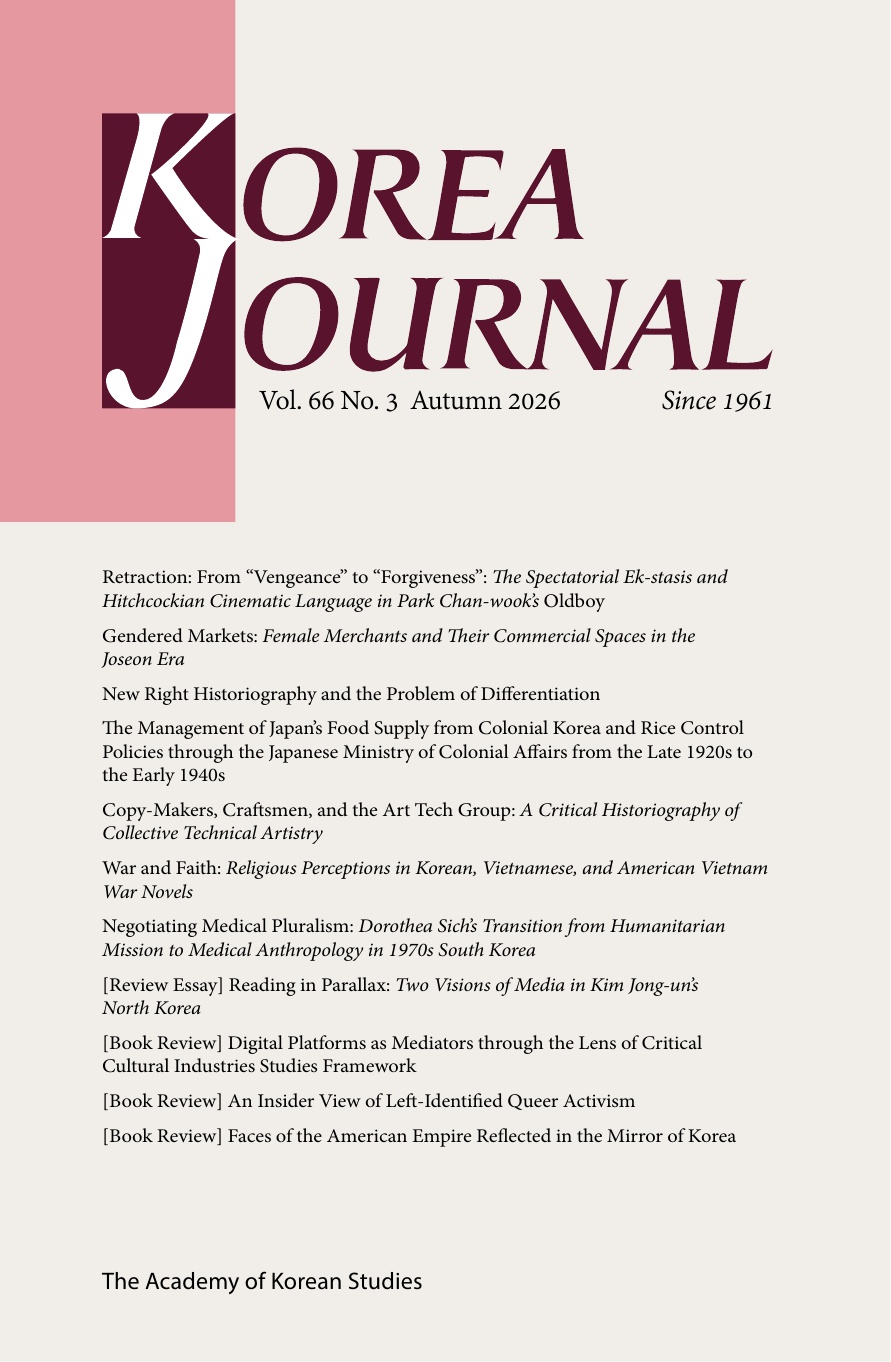
Gendered Markets: Female Merchants and Their Commercial Spaces in the Joseon Era

- dcn608@naver.com

Abstract
The gendered market of the Joseon dynasty reflected the profound influence of Confucian gender norms on commercial spaces. However, practical economic needs and livelihood pressures continually challenged this order, leading to frequent breaches in practice. Women from various social strata—including the yangban (elite class), commoners, and even the mean people—entered the market by leveraging household production skills. Centered on goods such as vegetables, fermented sauces, and other food and beverages, they drove the market-oriented transformation of the kitchen economy. At the ideological level of Confucianism, the participation of women’s shops was consistently stigmatized and restricted. Yet, at the practical economic level, as long as it met livelihood demands and generated profit, gender segregation policies often had to yield or were even temporarily suspended. The commercial activities of women across Joseon’s social classes not only facilitated the circulation of goods but also undermined the “men outside, women inside” gender order, continually reshaping gender identities within commercial spaces. This phenomenon highlights the structural tension between economic rationality and Confucian gender norms during Joseon’s transition from a subsistence agricultural society to one characterized by commodity circulation. While the court and the yangban class endeavored to uphold Confucian gender norms, women’s economic practices persistently disrupted this order, fostering a new dynamic equilibrium between tradition and transformation in Joseon society.
- keywords
- Female merchants, women’s shops, gender order, commercial spaces
- Received
- 2025-06-02
- Revised
- 2025-09-17
- Accepted
- 2025-10-29
- Published
- 2026-09-30
- Downloaded
- Viewed
- 0KCI Citations
- 0WOS Citations