

Korea Journal
- P-ISSN0023-3900
- E-ISSN2733-9343
- A&HCI, SCOPUS, KCI
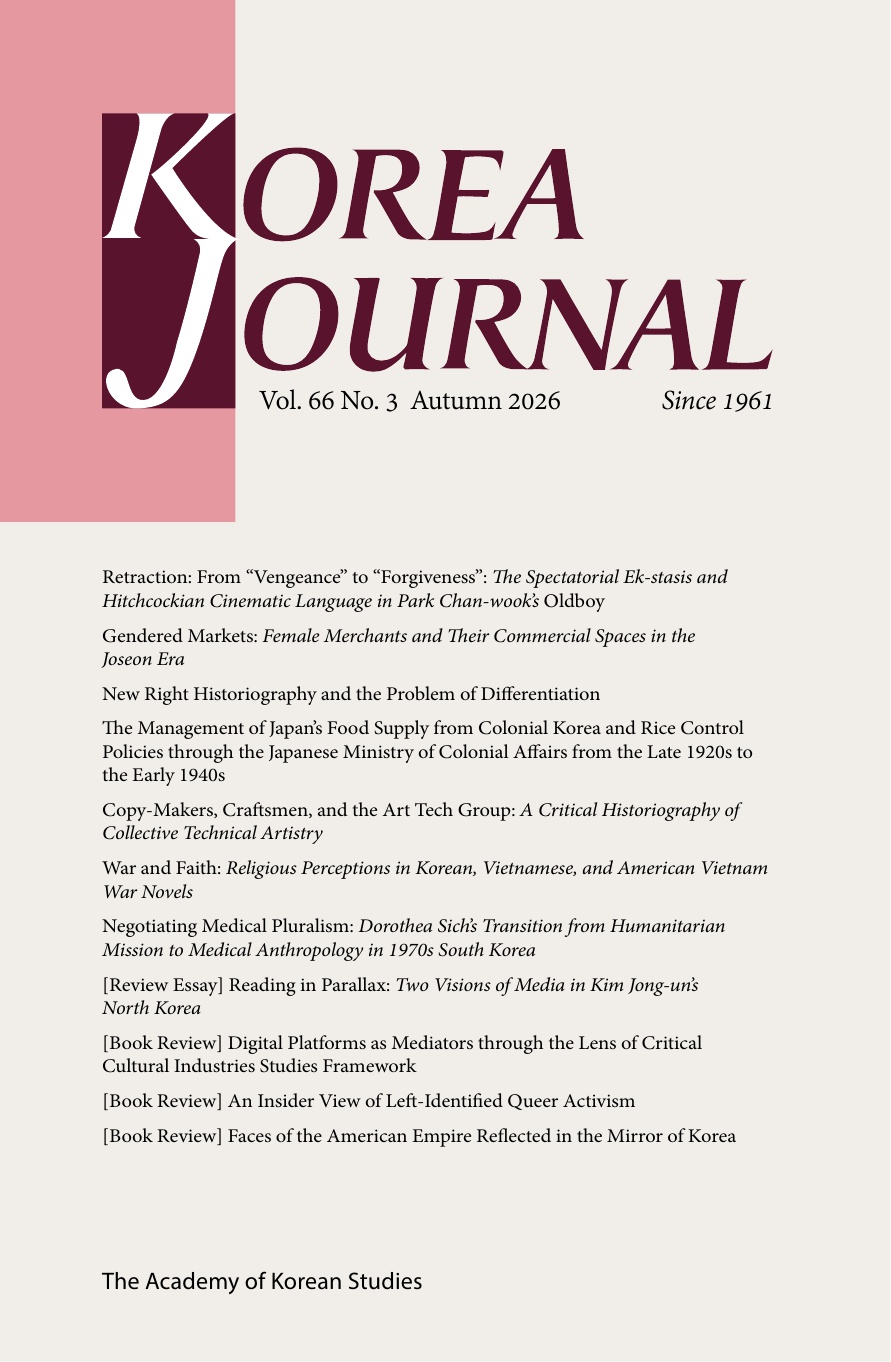
Copy-Makers, Craftsmen, and the Art Tech Group: A Critical Historiography of Collective Technical Artistry
Copy-Makers, Craftsmen, and the Art Tech Group: A Critical Historiography of Collective Technical Artistry

- gjshin@hkbu.edu.hk

초록
This study reexamines the relationship among art, technics, and collective practice in Korean art history, proposing a new historiographical framework grounded in the concept of giye 技藝, or “technics‑art.” By tracing a longue durée genealogy from premodern copy-makers and craftsmen to late 20th‑century experimental groups such as the Art Tech Group, this study reveals how collective technical artistry has persistently shaped Korean aesthetic and cultural production. It argues that practices traditionally dismissed as technical or mechanical embody an alternative epistemology in which art and technics are mutually constitutive, reflecting the relational worldview of Korean cosmotechnics. Premodern practices such as copy-making and apprenticeship sustained networks of embodied and collective knowledge, which later rearticulated through 1990s media experiments that reconceived collaboration and technics within digital contexts. Through the lens of cosmotechnics, the trajectories explored in this study reveal collective technical artistry not as stages in a linear modernization but as recurring reconfigurations of collective making in which human, material, and technical processes intertwine. This study thus challenges Eurocentric and individualist art histories and situates Korean art within a broader philosophical discourse that understands technics as a living, collective practice in the postdigital horizon.
- keywords
- giye, technics-art, art and technology, cosmotechnics, collective technical activity, copy-makers, craftsmen, Art Tech Group
Abstract
This study reexamines the relationship among art, technics, and collective practice in Korean art history, proposing a new historiographical framework grounded in the concept of giye 技藝, or “technics‑art.” By tracing a longue durée genealogy from premodern copy-makers and craftsmen to late 20th‑century experimental groups such as the Art Tech Group, this study reveals how collective technical artistry has persistently shaped Korean aesthetic and cultural production. It argues that practices traditionally dismissed as technical or mechanical embody an alternative epistemology in which art and technics are mutually constitutive, reflecting the relational worldview of Korean cosmotechnics. Premodern practices such as copy-making and apprenticeship sustained networks of embodied and collective knowledge, which later rearticulated through 1990s media experiments that reconceived collaboration and technics within digital contexts. Through the lens of cosmotechnics, the trajectories explored in this study reveal collective technical artistry not as stages in a linear modernization but as recurring reconfigurations of collective making in which human, material, and technical processes intertwine. This study thus challenges Eurocentric and individualist art histories and situates Korean art within a broader philosophical discourse that understands technics as a living, collective practice in the postdigital horizon.
- keywords
- giye, technics-art, art and technology, cosmotechnics, collective technical activity, copy-makers, craftsmen, Art Tech Group
- 투고일Received
- 2025-06-06
- 수정일Revised
- 2025-10-29
- 게재확정일Accepted
- 2025-11-30
- 출판일Published
- 2026-09-30
- 다운로드 수
- 조회수
- 0KCI 피인용수
- 0WOS 피인용수