Introduction
The International Union for Conservation of Nature Red List calculates the number of species every year based on the latest research by taxonomists. It is reported that there are 2.16 million species on Earth in 2022, and among them, insects are known to have the largest number of species at 1.05 million (Richie, 2022). In South Korea, a total of 60,010 species of living organisms are known to live in 2023 (NIBR, 2024). Of these, a total of 20,710 species of insects are found in the country. On the other hand, 282 species are known to be designated as endangered species under protection (NIE, 2023). Among them, a total of 29 species are designated as endangered species (eight and 21 species in Class I and II, respectively) and are protected in South Korea.
Insects are important living organisms in terms of biodiversity, ecological roles, agriculture, human health, and natural resources (Robbins & Opler, 1997). Among them, butterflies with diverse morphologies between species have been a target of continuous interest from a number of people globally due to their attractive appearance. Butterflies are the most actively studied taxonomically and ecologically among insects, and are known to play an important role in the pollination and evolution of plants (Kasambe, 2018). It is, therefore, necessary to understand the diversity of plants in various habitats to understand the diversity of butterflies (Nimbalkar et al., 2011; Paek et al., 2024). Butterflies are additionally frequently used as indicators of environmental change, habitat fragmentation, habitat land use changes, agricultural activities, and environmental pollution in fields related to ecology (Kim et al., 2020; Nakamura, 2011; Paek et al., 2024; Samways, 2005). Recently, their distribution and abundance have been seriously affected by habitat destruction and climate change caused by humans (Fox et al., 2011). Considering the importance of ecological information of butterflies for their conservation and management, review studies have rarely been conducted for the endangered butterfly species on a domestic scale in South Korea (Paek, 2011).
This study aimed to review the ecological characteristics of endangered butterflies in South Korea. For this review, we first collected information on their morphology, distribution, and wintering from previous studies. Based on these references, we summarized the three parameters for each butterfly and then analyzed the pattern of the three traits for the all species.
List of Korean Endangered Butterflies
Among the 29 species of insects designated as endangered wild animals, butterflies account for 10 species by the Korea Ministry of Environment (Fig. 1). The four species designated as Class I are Parnassius bremeri, Hipparchia autonoe, Aporia crataegi, and Sinia divina. The species designated as Class II are Protantigius superans, Cigaritis takanonis, Melitaea ambigua, Argynnis nerippe, Leptalina unicolor, and Chalinga pratti. In addition, Phengaris kurentzovi, Phengaris teleius, Plebejus subsolanus, and Melitaea latefascia are designated as candidate species for endangered wild animals (Fig. 1).
Literature Review of the Ecological Characteristics of Endangered Butterflies
A total of 14 works of literature (books, papers, etc.) were used to gather information on the ecological characteristics of endangered butterflies. We investigated the size of wingspan, habitat type, and developmental stage of wintering for each butterfly species from the 14 references. It is to be noted that we could not collect any information on the developmental stage of wintering for M. ambigua. Using the fundamental data, we sequentially analyzed patterns of the three traits. We successfully figured out the difference of the three traits among species or between groups of butterflies.
Morphological Characteristics of Butterflies
We selected the wingspan of 14 butterfly species, including four candidate species, as a morphological trait available for all the species and analyzed them (Table 1; NIBR, 2022; Paek & Ok, 2018; Paek et al., 2019). In general, the wingspan of butterflies belonging to the family Lycaenidae (S. divina, P. superans, C. takanonis, P. kurentzovi, P. teleius, and P. subsolanus) was shorter than that of the other butterflies, excluding L. unicolor, which had a mean of 27.0 mm and 32.5 mm for male and female, respectively. Both A. crataegi (male: 56.0 mm, female: 66.5 mm) and A. nerippe (62.5 mm) had the longest wingspan. In contrast, C. takanonis had the shortest wingspan (29.0 mm). In the case of A. crataegi, the male was slightly shorter than the female. Similarly, in the case of L. unicolor, the male (27.0 mm) presented a shorter wingspan than the female (32.5 mm).
Distributional Characteristics of Butterflies
In terms of distributional traits, the type of habitats of 14 butterfly species, including four candidate species, was analyzed (Table 2; NIBR, 2022; Paek & Shin, 2010). A total of five species (H. autonoe, S. divina, P. superans, C. pratti, and P. subsolanus) used the highland forest center habitat. The remaining nine species were found to use the lowland forest boundary habitat. A. nerippe is locally distributed in inland areas and primarily distributed in habitats on the west coast islands and along the coast. It is known that endangered butterfly species using the lowland forest boundary habitat are significantly affected by habitat environmental changes, development, cultivation, and afforestation. A total of 14 butterfly species are threatened with extinction but among them, the Class I A. crataegi and three candidate species in Lycaenidae (P. kurentzove, P. subsolanus, and M. latefascia) are rarely found in South Korea and are known to be in danger of extinction. The four species are all known to inhabit the lowland forest bourdary habitat.
Wintering Characteristics of Butterflies
The developmental stage of wintering for 14 butterfly species, including four candidate species, was analyzed as a trait for wintering (Table 3; Baek et al., 2007; Joo et al., 1997; Kim, 1973; 2002; 2005; 2010; Kim & Seo, 2012; Kim et al., 2012; NIBR, 2022; Park & Kim, 1997; Paek & Shin, 2010; Paek et al., 2024). Ten species are known to spend the winter as larvae. Among them, P. bremeri are known to spend the winter as first-instar larvae in eggs. However, it was determined that both P. superans and P. subsolanus spend the winter as eggs. As an exception, S. divina has been known to spend the winter as a pupa. However, the wintering stage of M. ambigua is still unknown.
Conclusion
In recent years, habitat destruction and loss due to large-scale development and the effects of rapid climate change have led to a decrease in biodiversity, posing a great threat to the stability of the ecosystem on the Earth, where Korea is also no exception. In particular, butterflies, among insects with very high species diversity and large populations, are frequently exposed to these factors, which have led to several extinctions. For example, large-scale residential development (e.g., apartment complex, industrial complex, etc.) has led to significant degradation and loss of butterfly habitats in lowland forest boundary areas. In such a situation, several local governments are creating alternative habitats for disturbed butterfly populations, especially butterfly species (P. bremeri, A. crataegi, etc.) inhabiting lowland forest border areas mixed with various types of habitats, including grasslands, forests, and wetlands adjacent to human residential facilities. Therefore, understanding the ecological characteristics of each endangered butterfly species is essential along with their food. This review paper provides scientific information on the size of wingspan, type of habitat, and developmental stage of wintering for the establishment of restoration plants for endangered butterfly species (10 endangered species and four candidate species), and for conducting restoration projects. This review will additionally help understand the fundamental ecology of endangered butterfly species in South Korea.
Acknowledgments
This work was supported by the National Institute of Ecology (NIE), funded by the Ministry of Environment (MOE) of the Republic of Korea (No. NIE-B-2025-18). We thank two peer reviewers for providing critical comments on this review paper. We also thank H.Y. Oh, H.K. Ahn, H.C. Choo, and H.K. Jang for providing photos of endangered butterfly species.
Author Contributions
Munki Paek: study conception and design, analysis and interpretation of results, and draft manuscript preparation (in Korean); Youngho Cho: study conception and design, and scientific name confirmation of butterflies; Ji Yeong Kim: reference writing and manuscript editing; Baek-Jun Kim: analysis and interpretation of results, manuscript editing, draft manuscript preparation (in English), and correspondence.
References
Kasambe, R. (2018). Butterflies of Western ghats. Internet Archive. Retrieved October 26, 2024 from https://archive.org/details/ButterfliesOfWesternGhatsSecondEdition20183/page/n1/mode/2up..
Ritchie, H. (2022). How many species are there?: how many species do we share our planet with? how many of these species have we found and identified? Our World in Data. Retrieved October 26, 2024 from https://ourworldindata.org/how-many-species-are-there..
Figure and Tables
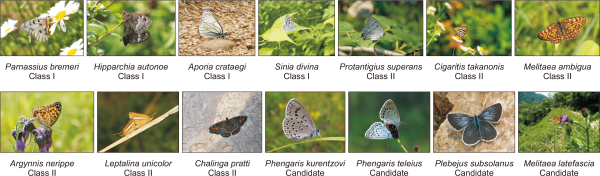
Table 1
Morphological characteristics (wingspan) of endangered butterflies
| Class | Species | Sex | Minimum (mm) |
Maximum (mm) |
Mean (mm) |
|---|---|---|---|---|---|
| I | Parnassius bremeri | Male/female | 36 | 75 | 55.5 |
| Hipparchia autonoe | Male/female | 49 | 60 | 54.5 | |
| Aporia crataegi | Male | 53 | 59 | 56.0 | |
| A. crataegi | Female | 65 | 68 | 66.5 | |
| Sinia divina | Male/female | 28 | 36 | 32.0 | |
| II | Protantigius superans | Male/female | 30 | 38 | 34.0 |
| Cigaritis takanonis | Male/female | 26 | 32 | 29.0 | |
| Melitaea ambigua | Male/female | 34 | 50 | 42.0 | |
| Argynnis nerippe | Male/female | 53 | 72 | 62.5 | |
| Leptalina unicolor | Male | 26 | 28 | 27.0 | |
| L. unicolor | Female | 30 | 35 | 32.5 | |
| Chalinga pratti | Male/female | 57 | 60 | 58.5 | |
| Candidate | Phengaris kurentzovi | Male/female | 31 | 37 | 34.0 |
| Phengaris teleius | Male/female | 33 | 41 | 37.0 | |
| Plebejus subsolanus | Male/female | 32 | 35 | 33.5 | |
| Melitaea latefascia | Male/female | 34 | 41 | 37.5 |
Table 2
Distributional characteristics (habitat type) of endangered butterflies
| Class | Species | Habitat type |
|---|---|---|
| I | Parnassius bremeri | Lowland forest boundary |
| Hipparchia autonoe | Highland forest center | |
| Aporia crataegi | Lowland forest boundary | |
| Sinia divina | Highland forest center | |
| II | Protantigius superans | Highland forest center |
| Cigaritis takanonis | Lowland forest boundary | |
| Melitaea ambigua | Lowland forest boundary | |
| Argynnis nerippe | Lowland forest boundary (island and coast) | |
| Leptalina unicolor | Lowland forest boundary | |
| Chalinga pratti | Highland forest center | |
| Candidate | Phengaris kurentzovi | Lowland forest boundary |
| Phengaris teleius | Lowland forest boundary | |
| Plebejus subsolanus | Highland forest center | |
| Melitaea latefascia | Lowland forest boundary |
Table 3
Wintering characteristics (developmental stage of wintering) of endangered butterflies
| Class | Species | Developmental statge of wintering |
|---|---|---|
| I | Parnassius bremeri | Larva |
| Hipparchia autonoe | Larva | |
| Aporia crataegi | Larva | |
| Sinia divina | Pupa | |
| II | Protantigius superans | Egg |
| Cigaritis takanonis | Larva | |
| Melitaea ambigua | Unknown | |
| Argynnis nerippe | Larva | |
| Leptalina unicolor | Larva | |
| Chalinga pratti | Larva | |
| Candidate | Phengaris kurentzovi | Larva |
| Phengaris teleius | Larva | |
| Plebejus subsolanus | Egg | |
| Melitaea latefascia | Larva |
Source: Baek et al. (2007), Joo et al. (1997), Kim (1973; 2002; 2005; 2010), Kim and Seo (2012), Kim et al. (2012), NIBR (2022), Paek and Shin (2010), Paek et al. (2024), Park and Kim (1997).