Introduction
With the rise in global trade and logistics, the transboundary movement of alien species has become more frequent (Montgomery et al., 2023). These biological invasions occur through both intentional and unintentional introductions, often allowing species to establish themselves in new regions unnoticed (Przybylski et al., 2022). For example, the red imported fire ant (Solenopsis invicta), originally from South America, has spread to countries such as the United States, Australia, and China, causing ecological and economic disruptions (Ascunce et al., 2011; Zhang et al., 2007).
A key route for the unintentional spread of alien insects is international cargo transport, including both maritime and airborne shipments. Hitchhiker ants, in particular, pose a challenge due to their ability to travel unnoticed in various packaging materials. Previously reported cases include the yellow crazy ant (Anoplolepis gracilipes), which has been documented spreading through cargo and impacting agricultural systems (Hasin et al., 2021).
Tetraponera rufonigra is an arboreal ant species widely distributed across tropical and subtropical Asia. Although less well known than other invasive ants, its sting and aggressive behavior can cause allergic reactions in humans (Fernando et al., 2015). While its threat level is lower than that of some other invasive species, the introduction of T. rufonigra still necessitates rapid identification and containment to prevent establishment.
This study documents the first detection of T. rufonigra in South Korea, discovered during a cargo inspection in August 2024. The findings aim to provide biological information to strengthen early detection and response systems.
Materials and Methods
Discovery and reporting
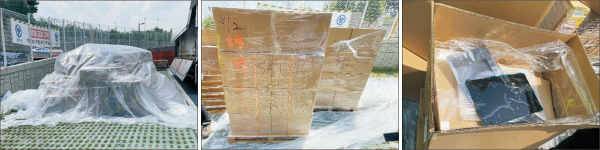
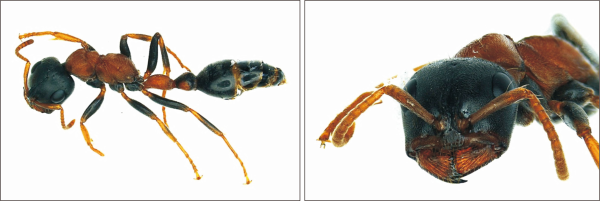
In August 2024, an unidentified ant specimen was discovered at a logistics center in Daewol-myeon, Icheon. The specimen was found in plastic packaging during the inspection of cargo originating from Vietnam (Figs. 1, 2). It was immediately sealed, treated with insecticides, and reported to the Invasive Species Reporting Center.
Field investigation
On August 5, 2024, the Invasive Alien Species Team of the National Institute of Ecology conducted a field investigation. Two researchers surveyed the site of discovery and the surrounding area. No additional individuals were found, and quarantine measures were completed. The collected specimens were transported to the laboratory for species identification.
DNA analysis
DNA barcoding was used to identify the collected specimens. Genomic DNA was extracted using an IVT3002 Clear-S Quick DNA Extraction Kit (INVIRUSTECH, Gwangju, Korea). Polymerase chain reaction (PCR) was performed to amplify the cytochrome c oxidase I (COI) region, and the obtained sequences were analyzed using the Basic Local Alignment Search Tool (BLAST). The sequences showed 100% identity with T. rufonigra (Bingham, 1903; Ward, 2001).
Results and Discussion
DNA sequence analysis confirmed that the collected specimen was T. rufonigra (Hymenoptera: Formicidae). This species typically nests in rotten wood and tree hollows and is known for its aggressive behavior (Bingham, 1903). It has also been reported in urban green spaces, such as parks and gardens (Ward, 2001). T. rufonigra primarily feeds on small insects, nectar, and fruits and maintains a mutualistic relationship with the aphid Aphis craccivora.
Although not classified as one of the most harmful invasive ants, T. rufonigra has been associated with allergic reactions in humans due to its sting. A notable case was recorded in Sri Lanka in 2017. Its aggressive behavior and ability to disperse through cargo highlight the need for continued vigilance against its introduction.