Introduction
Amphibians are important taxonomic group for biodiversity conservation, and they play a wide range of ecological roles worldwide (Stuart et al., 2004). Amphibians are imported for several purposes, such as research, culinary use, pets, and ornamental purposes (Schlaepfer et al., 2005; Schloegel et al., 2009). Globally, a total of 1,215 amphibian species (representing approximately 17% of all known amphibians) are traded either as captive-bred or wild-caught individuals (Hughes et al., 2021).
The recent increase in the importation of ornamental amphibians into South Korea is closely associated with the diversification of the pet industry and increased demand for rare and exotic companion animals. In addition to traditional pets such as dogs and cats, amphibians are gaining popularity among pet owners due to their distinctive morphological characteristics and relatively low maintenance requirements (Carpenter et al., 2014). In particular, many amphibian species are preferred in urban settings, because they can be housed in limited spaces and maintained under relatively simple husbandry conditions (Rowley et al., 2016).
Amphibians kept as pets may escape from captivity to the wild ecosystem or by being accidentally or deliberately released by private owner. This may contribute to an increased risk of spreading of non-native and invasive species (Measey et al., 2012; Prestridge et al., 2011). If released into the wild, these species may disrupt native ecosystems by competing with indigenous species, acting as predators or serving as vectors for pathogens (Picco & Collins, 2008). A notable concern is the chytrid fungus Batrachochytrium dendrobatidis, the causative agent of chytridiomycosis, a highly infectious disease associated with the decline in global amphibian population (Fisher & Garner, 2007; Martel et al., 2014; Nguyen et al., 2017; Schloegel et al., 2009). Given the prevalence of B. dendrobatidis worldwide, serious attention should be given to the possibility of its introduction to South Korea via amphibian imports.
To mitigate such risks, the South Korean government has designated 57 amphibian species as “species of concern” under the national invasive species monitoring and control framework (ME, 2024). Aside from the partial data derived from online pet store inventories (Koo et al., 2020), comprehensive information on the importation status of ornamental amphibians remains scarce. Hence, there is an urgent need for a systematic investigation on the current status of exotic amphibian imports and their potential ecological implications.
Therefore, this study aimed to examine the import trends of ornamental amphibians in South Korea and contribute to the revision and update of the national inventory of alien amphibian species introduced via the pet trade.
Case Report
To examine the import status of pet amphibians in Korea from 2023 to 2024, the import (and export) quarantine statistics provided by the National Fishery Products Quality Management Service (NFQS, 2025) were used. As quarantine measures for imported amphibians have been enforced in Korea beginning in 2023, data from 2023 to 2024 were extracted and analyzed (MOF, 2022).
Taxonomic classification and international conservation status (e.g., endangered species) of imported amphibians were determined using the Global Biodiversity Information Facility (GBIF) and Convention on International Trade in Endangered Species of Wild Fauna and Flora (CITES) databases (CITES, 2025; GBIF, 2025).
Discussion
Status of amphibian imports to South Korea
A total of 167 species of pet amphibians were imported into Korea, accounting for 13.7% of the 1,215 amphibian species traded internationally (Hughes et al., 2021). Among the 22,572 individual amphibians imported, the order Anura accounted for the highest number with 126 species and 14,245 individuals, followed by Caudata with 39 species and 8,290 individuals, and then Gymnophiona with 2 species and 37 individuals (Table 1, Supplementary Table 1).
There has been a 48.2% increase in the number of Anura species compared to the 85 sold through domestic online pet shops, and a 5.4% increase compared to the 37 Caudata species previously recorded (Koo et al., 2020).
The number of imported species decreased from 118 species (14,726 individuals) in 2023 to 98 species (7,846 individuals) in 2024, indicating a 14.0% reduction in species and a 46.7% reduction in the number of individuals (Table 1). Additionally, Anura decreased slightly in species diversity from 84 species in 2023 to 82 species in 2024 (2.4% decrease), but the number of individuals increased by 1.9% from 7,054 to 7,191.
The overall decline in amphibian imports in 2024 compared to 2023 is primarily attributed to a significant reduction in Caudata, which reduced by 50.0% in species and 91.4% in the number of individuals (Table 1). It is presumed that the sharp decline in Caudata imports compared to Anura imports may be due to the more demanding requirements for maintaining their captive environments, such as precise humidity and temperature control; however, it is difficult to draw definitive conclusions based on only two years of data.
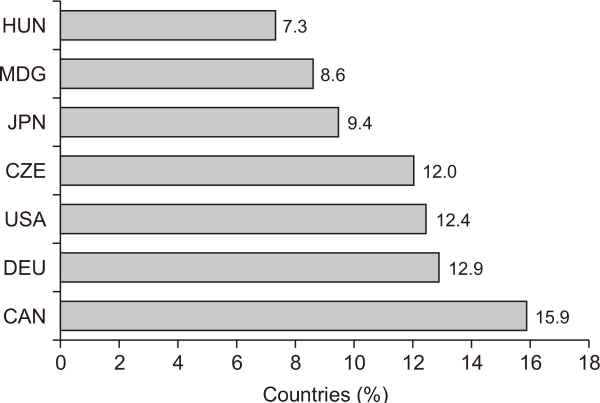
The ornamental amphibians imported into Korea originated from 14 countries: Canada, Germany, the United States, the Czech Republic, Japan, Madagascar, Hungary, Malaysia, Taiwan, China (Hong Kong), Peru, Togo, Indonesia, and Colombia. Among these countries, Canada was the leading source, exporting 37 species to Korea, followed by Germany (30 species), the United States (29 species), the Czech Republic (28 species), Japan (22 species), Madagascar (20 species), and Hungary (17 species). These seven countries collectively accounted for 78.5% of the total amphibian species imported into Korea (Fig. 1).
Major species
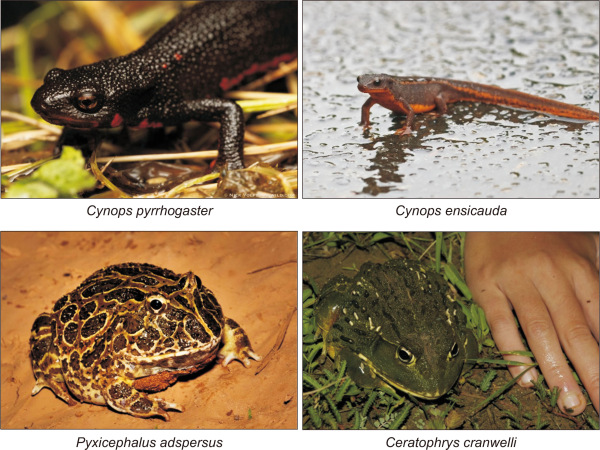
Cynops pyrrhogaster (2,238 individuals) was the most frequently imported species among the imported amphibians, followed by Cynops ensicauda (2,207 individuals), Ceratophrys cranwelli (1,894 individuals), Cynops orientalis (1,605 individuals), Hymenochirus boettgeri (1,200 individuals), and then Pyxicephalus adspersus (1,130 individuals). Over 1,000 individuals were imported for each of these six species (three from the order Caudata and three from the order Anura; Fig. 2, Supplementary Table 1; GBIF, 2024a; 2024b; 2024c; 2024d).
Of the total amphibian species imported, 47 species (28.1%) were listed as internationally threatened species under the CITES, and this is a substantial increase of 80.8% compared to 2019 (Koo et al., 2020). These included 43 species from the order Anura and 4 species from the order Caudata (Supplementary Table 1). All of these species were categorized under CITES Appendix II, and they include species that are not currently threatened with extinction but may become so unless international trade is strictly regulated (CITES, 2025). Notably, the family Dendrobatidae (poison dart frogs), with 30 species, has the highest number of members in the order Anura. These frogs are generally small in size and are highly popular in the international pet trade due to their striking coloration and fascinating behavior (Gorzula, 1996; Kaczmarski & Kolenda, 2018; Prestridge et al., 2011; Ruland & Jeschke, 2017). Pet amphibians may escape from enclosures or be intentionally or accidentally released into the natural environment by private owners. Although most imported species originate from equatorial and tropical rainforest regions, such as Brazil, Colombia, Peru, and Madagascar, and are less likely to establish populations in the temperate ecosystems of Korea, their introduction could still lead to ecological disturbances through competition with native species for food and habitat or transmission of pathogens (Picco & Collins, 2008). Of a particular concern is the global amphibian trade, which has been identified as a major driver of the spread of infectious diseases caused by B. dendrobatidis and Batrachochytrium salamandrivorans, posing serious threats to both wild and captive populations (Fisher & Garner, 2007; Martel et al., 2014; Nguyen et al., 2017).
All imported amphibians have the potential to become invasive alien species, similar to Lithobates catesbeianus, highlighting the importance of continuous management to prevent their release into natural ecosystems. It is also essential to strengthen both online and offline surveillance systems to detect and deter the illegal trade of such species (Koo et al., 2020). The first step in this management effort is to maintain an up-to-date list of introduced alien species. This list can be used to revise both the voluntary import restriction list (i.e., white list) and the current inventory of 25 alien amphibian species (NIE, 2021), thereby supporting targeted monitoring to assess the potential establishment and spread of these species within Korea’s ecosystems. Furthermore, it can serve as a valuable resource for monitoring the trade of internationally threatened species and for facilitating global cooperation in managing invasive alien species.
Author Contributions
Study design: Youngjun Park; Data collection: Youngjun Park, Doyoung Chae, and Mingyo Jeong; Analysis and manuscript preparation: Youngjun Park.
References
Convention on International Trade in Endangered Species of Wild Fauna and Flora (CITES). (2025). Checklist of CITES species. CITES. Retrieved March 29, 2025 from https://checklist.cites.org/#/en..
Global Biodiversity Information Facility (GBIF). (2024a). Ceratophrys cranwelli Barrio, 1980. GBIF. Retrieved March 26, 2025 from https://www.gbif.org/occurrence/4516530821..
Global Biodiversity Information Facility (GBIF). (2024b). Cynops ensicauda subsp. ensicauda (Hallowell, 1861). GBIF. Retrieved March 26, 2025 from https://www.gbif.org/occurrence/4528063723..
Global Biodiversity Information Facility (GBIF). (2024c). Cynops pyrrhogaster (Boie, 1826). GBIF. Retrieved March 26, 2025 from https://www.gbif.org/occurrence/4901544678..
Global Biodiversity Information Facility (GBIF). (2024d). Pyxicephalus adspersus Tschudi, 1838. GBIF. Retrieved March 26, 2025 from https://www.gbif.org/occurrence/4510428528..
Global Biodiversity Information Facility (GBIF). (2025). Free and open access to biodiversity data. GBIF. Retrieved March 29, 2025 from https://www.gbif.org/..
Ministry of Environment (ME). (2024). New designation of 2 species of invasive species and 150 species of alert alien species. ME. Retrieved March 26, 2025 from https://www.me.go.kr/home/web/board/read.do?menuId=10525&boardMasterId=1&boardCategoryId=39&boardId=1705320..
Ministry of Oceans and Fisheries (MOF). (2022). Amphibian quarantine effective January 1, 2023. MOF. Retrieved March 26, 2025 from https://www.mof.go.kr/doc/ko/selectDoc.do?docSeq=48347&menuSeq=971&bbsSeq=10..
National Fishery Products Quality Management Service (NFQS). (2025). Import (export) quarantine statistics. NFQS. Retrieved March 28, 2025 from https://www.nfqs.go.kr/hpmg/data/actionExportQuarantineStatisticsForm.do?menuId=M0000225..
Picco, A.M., and Collins, J.P. (2008). Amphibian commerce as a likely source of pathogen pollution. Conservation Biology: the Journal of the Society for Conservation Biology, 22, 1582-1589. https://doi.org/10.1111/j.1523-1739.2008.01025.x