Introduction
Scotinophara lurida (Burmeister, 1834) (common name: black bug; Pentatomidae, Hemiptera) is distributed throughout Southeast Asia, including Sri Lanka, India, and the Philippines, as well as in China, Taiwan, and Japan (Hasegawa, 1971; Lee et al., 2001; Pathak & Khan, 1994). In Korea, S. lurida were first reported in an insect faunistic survey in Osan, Gyeonggi-do, from 1956 to 1958 (Koo, 1966). The morphological characteristics of S. lurida are as follows (Fig. 1): 1) body length of 8-10 mm, predominantly black but occasionally dark brown; 2) a distinct and strong anterolateral spine on the anterior angle of the pronotum; and 3) a tongue shaped scutellum that nearly reaches the end of the abdomen (Barrion et al., 2007; Lee et al., 2001).
S. lurida is a phytophagous insect that sucks sap by inserting needle-shaped mouthparts into the stems of leaves. Fourteen plant species are known as host plants of this species (Fernando, 1960; Kuwana, 1929; Pathak & Khan, 1994). In Korea, nine species have been reported: Oryza sativa, Hordeum vulgare var. hexastichon, Triticum aestivum, Zea mays, Echinochloa utilis, Sagittaria trifolia, Cyperus serotinus, Scirpus triqueter, and Eleocharis kuroguwai (Lee et al., 2001; 2004). S. lurida has been known as a major pest of rice since the large-scale outbreaks in the 2000s (Choi et al., 2020). S. lurida has a single generation per year. Adults spend the winter under fallen leaves, weeds, rocks, and other covers and move to rice paddy fields around June after rice transplantation. The peak period of occurrence is from June to July, during which mating takes place. From July to August, each female lays approximately 30 eggs in the form of egg masses lined up on the stems of rice (Choi et al., 2020; Lee et al., 2001; 2004). Laid eggs hatch in mid-July, emerge as adults around mid-August, and then move to overwintering sites during the rice harvest season (Choi et al., 2020; Lee et al., 2004; 2024a).
Recently, in Korea, the occurrence of S. lurida has increased in eco-friendly paddy fields. For example, the occurrence area of S. lurida in an eco-friendly rice complex increased from 21,118 ha in 2017 to 33,363 ha in 2019. In Jeollanam-do, the area increased by more than 63%, from 9,316 ha in 2017 to 15,191 ha in 2019 (Lee, 2022; RDA, 2024; Yonhapnews Agency, 2019). The damage to young rice after transplantation caused by S. lurida includes yellowing and wilting of leaves, and in severe cases, withering of the stem. In the heading stage, damage results in abnormal rice ear maturation, reducing both quantity and quality due to stubby or spotted grains (Krishnaiah et al., 2007; Lee et al., 2024a).
In eco-friendly paddy fields, eco-friendly agents such as sophora extracts or neem oil have been used for controlling S. lurida; however, their effects is limited due to the behavioral characteristics of S. lurida, such as their sensitivity to vibrations or noises in the surrounding environment and their tendency to hide near rice roots (Choi et al., 2020; Lee et al., 2024a). In addition, the occurrence period of S. lurida overlaps with the rainy season in Korea, further reducing the effects of the agents due to the dilution by rain. This has led to poor control and possible agent resistance development (Choi et al., 2020).
Therefore, the goals of this study were to 1) investigate the seasonal occurrence of S. lurida in an eco-friendly rice paddy field, 2) analyze its occurrence patterns, and 3) compare the pattern with recommended control periods. Based on the findings, we propose a control period for S. lurida.
Materials and Methods
Selection and landscape of monitoring areas
The monitoring areas were selected by considering varieties of rice certified by the local government, such as ‘Haiami rice’ or ‘Baeksemi rice,’ and recent outbreak patterns of S. lurida. Recent outbreak patterns show that the occurrence rates suddenly increased in Jeollanam-do, Korea (Yonhapnews Agency, 2019), starting from eco-friendly complexes of Hwayang-myeon in Yeosu-si cultivating ‘Haiami rice’ and occurring in the complexes of Seokgok-myeon in Gokseong-gun cultivating ‘Baeksemi rice.’ Therefore, we selected and surveyed eco-friendly rice paddy fields in two areas recommended by the rice agricultural officers of the local governments of Gokseong and Yeosu (Fig. 2). Both areas cultivated the same rice variety, developed from variety ‘Golden Queen,’ and are surrounded by forest and low mountains (Fig. 2).
Monitoring methods and periods
A survey of the occurrence patterns of S. lurida was conducted using modified methods based on the monitoring methods for emergency crop pests suggested by the National Institute of Agricultural Sciences, Rural Development Administration (RDA, 2018). At each site, 30 rice bundles of rice were randomly selected along the ridges of a paddy field. S. lurida occurrence was monitored by counting the number of individual bugs in each bundle. This process was repeated three times. The survey was conducted from June, when rice transplanting was completed, to October, when the rice harvest was completed. We additionally monitored the weather and temperature at the survey sites by considering the variables for the differences in counting individuals according to the survey period (Table 1). The weather was described as either sunny, cloudy, or rainy based on visual observation. The average temperature in regions, including the survey site, was obtained from the Korea Meteorological Administration (KMA, 2022). However, temperature data for Gokseong-gun in Jeollanam-do were unavailable; therefore, we obtained data from Suncheon-si, a city neighboring Gokseong-gun. Occurrence pattern analysis was conducted using the sum of the detected individuals from each investigation, and occurrence graphs were estimated based on the sum of the detected individuals from each monitoring time using Microsoft Excel (Microsoft, Redmond, WA, USA).
Results and Discussion
Monitoring of Scotinophara lurida in eco-friendly rice paddy fields
S. lurida was found to complete one generation per year in the monitored rice paddy fields. Both overwintering and emerging adults that hatched from eggs laid by the overwintering generation were observed. The first generation was the overwintering generation, which migrated to the paddy fields during the rice-transplanting period, while the second generation was the emerging generation, which moved to overwintering sites during the rice-harvest period.
The detection rate of the first generation was higher than that of the second generation. This may have been caused by the survey method of monitoring along the ridge of a paddy field. When the first generation moved from the overwintering sites to paddy fields, young rice was transplanted into paddy fields filled with water. Therefore, first-generation individuals were mostly found at the edges of the paddy field. However, second-generation individuals may have moved into the middle of the paddy field because the leaves of the grown rice were in contact.
The occurrence patterns were analyzed for each survey area and year. In Haiami rice eco-friendly paddy field (Hwadong-ri, Hwayang-myeon, Yeosu-si, Jeollanam-do; Fig. 3A), S. lurida were first detected in 2023 on June 8, two weeks after rice transplanting, and in 2024, on June 21. The peak occurrence in 2023 was on July 13, seven weeks after rice transplanting, at 153 individuals, and in 2024 was on July 25, seven weeks after rice transplanting, at 105 individuals. The point of decline in the first generation in 2023 was around July 27, nine weeks after transplantation, and in 2024 was around August 2, the eighth week after transplantation. These results indicate that the population of the first generation was higher in 2023 than in 2024.
Second-generation adults were first observed in 2023, 12 weeks after transplantation (August 17) and were mixed with remaining first-generation adults. In 2024, the second generation was detected 11 weeks after transplantation (August 22). The population of the second generation peaked around September 1 (14 weeks after transplanting) in 2023 and August 29 (12 weeks after transplanting) in 2024. Subsequently, steady declines in individuals were observed, indicating that the second generation moved to overwintering sites.
In the Baeksemi rice eco-friendly paddy fields (Onsu-ri, Seokgok-myeon, Gokseong-gun, Jeollanam-do; Fig. 3B), S. lurida was first detected on June 30 in 2023, the fifth week after transplanting, and on June 27 in 2024. The peak occurrence was on July 6 in 2023, six weeks after transplanting, at 89 individuals, and on July 25 in 2024, seven weeks after transplanting, at 144 individuals. The peak in 2023 was approximately three weeks later than that in 2023 and was lower by 55 individuals. The point of decline in the first generation was around July 13 in 2023, seven weeks after transplanting, and around August 1 in 2024, eight weeks after transplanting. Second-generation adults were observed 11 weeks after transplantation (August 11) in 2023 and were mixed with remaining individuals of the first generation. The number of individuals suddenly decreased 13 weeks after transplantation, likely due to rain (48.8 mm) the day before (KMA, 2022), which can lead S. lurida to fall from rice leaves and hide under rice plants or surrounding weeds (Choi et al., 2020; Lee et al., 2023). In 2024, the second generation was first detected 10 weeks after transplantation (August 13). The second generation peaked around August 31 (14 weeks after transplanting) in 2023 and August 22 (11 weeks after transplanting) in 2024. Subsequently, the second generation moved to overwintering sites.
Through a comprehensive analysis of the occurrence patterns of S. lurida in 2023 and 2024, we confirmed that the first generation appeared from June 8 to June 30. These adults migrated to the paddy fields after transplantation; however, they mainly engaged in mating activities, resulting in minimal damage and impact on the growth of rice. In contrast, nymphs of the second generation that hatched from eggs mainly engaged in feeding activities for the purpose of growth (Fig. 4), resulting in significant damage and impact on the growth of rice. Indeed, rice flowers withered by feeding by S. lurida nymphs were observed around August, coinciding with their blooming (Fig. 4F).
As both monitored paddy fields cultivated the variety ‘Golden Queen’ (SEEDPIA, 2024), for comparison, it is necessary to investigate the occurrence patterns of S. lurida in eco-friendly paddy fields that cultivate different rice varieties.
Control timing of Scotinophara lurida
The timing and strategy of S. lurida control can be divided into three stages: first-generation control, second-generation control, and overwintering site control. The purpose of first-generation control is to reduce the number of individuals moving from the overwinter sites to the paddy field, thus reducing the number of S. lurida laying eggs in paddy fields. The purpose of second-generation control is to reduce the number of nymphs hatched from eggs laid by the first generation, thus reducing the number of individuals entering paddy fields the following year.
Based on the occurrence patterns of S. lurida, we consider that the first control should be implemented when first-generation individuals peak, the second control should be implemented before second-generation nymphs emerge as adults, and the overwinter site control should be implemented when the number of individuals decreases and cannot be detected in a paddy field.
For eco-friendly agriculture, control methods include cultural control methods, such as removing environments for S. lurida to hide by plowing the field or removing weeds after rice harvest, and biological control methods, such as using biological agents such as predators (celionid wasp, gryllid predator, coccinellid predator, carabid predator, nabid bug, and spider predator) and entomopathogenic fungi (Beauveria bassiana) (Pathak & Khan, 1994). In many cases, insecticides such as carbamate, organophosphorus, pyrethroids, and neonicotinoids have been used for S. lurida control via direct spraying (Lee et al., 2024b; Pathak & Khan, 1994).
Recently, plant extract spraying methods and attractants, such as pheromones, have been developed and used as an eco-friendly agricultural method to control stink bugs (Huh et al., 2008; Jang et al., 2010; Park et al., 2020). Research on pheromones for S. lurida is in progress (Seol et al., 2024). For the first and second control, eco-friendly agents based on plant extracts, such as neem oil and sophora extract, can be applied using spraying; however, this might be difficult for overwintering site control. The overwintering sites of S. lurida are mainly under fallen leaves or rocks in ridges, open fields, or low mountains adjacent to paddy fields (Choi et al., 2020; Fig. 5). Accordingly, the use of spray-type eco-friendly agents might be restricted. In contrast, the use of attractants might be more effective in controlling overwintering sites, considering the recent utility of attractants (Park et al., 2020). However, to easily control S. lurida, installation of attractants around paddy fields should be performed before S. lurida move to their overwintering sites. In conclusion, based on the results of occurrence pattern monitoring, the control of S. lurida using a combination of spray-type eco-friendly agents and attractants might be more effective than a single control method using only spray-type agents.
Author Contributions
Conceptualization: THK. Data curation: THK. Formal analysis: THK. Funding acquisition: YKS. Investigation: THK, JUS, JKJ, JJO. Project administration: THK, JJO, YKS.
Funding
This study was supported by the Regional Specialized Industry Promotion+ (R&D) (Project Code No. S3363156) of Ministry of SMEs and Startups, Korea.
Figures and Table
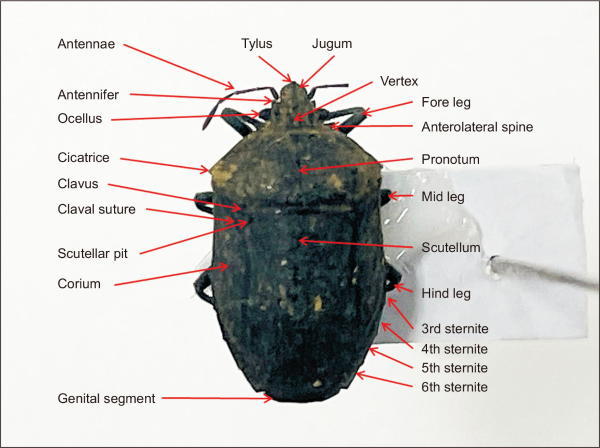
Fig. 2
Geographical location and landscape of survey area for Scotinophara lurida monitoring. (A) Hwadong-ri, Hwayang-myeon, Yeosu-si, Jeollanam-do, Korea (eco-friendly paddy field for Haiami rice). Surveyed eco-friendly paddy fields of each local site were indicated by the red boxes. (B) Onsu-ri, Seokgok-myeon, Gokseong-gun, Jeollanam-do, Korea (eco-friendly paddy field for Beaksemi rice). (C) Geographical position of surveyed location in the Korean Peninsula. (Source: satellite map ver. 2015 provided by National Geographic Information Institute under Ministry of Land, Infrastructure and Transport of Korea).
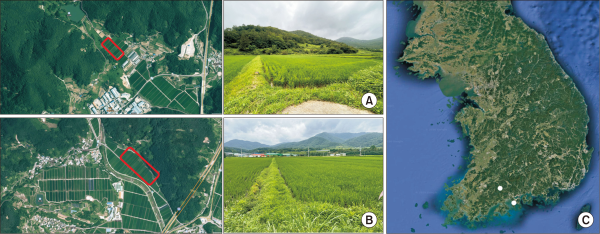
Fig. 3
Graphs for occurrence patterns of Scotinophara lurida on each monitoring site. (A) Hwadong-ri, Hwayang-myeon, Yeosu-si, Jeollanam-do, Korea (eco-friendly paddy field for Haiami rice). (B) Onsu-ri, Seokgok-myeon, Gokseong-gun, Jeollanam-do, Korea (eco-friendly paddy field for Beaksemi rice).
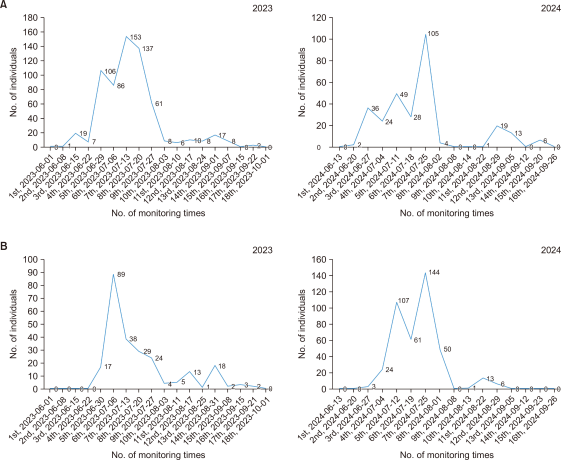
Fig. 4
Adult and nymph of Scotinophara lurida which found in Hwadong-ri, Hwayang-myeon, Yeosu-si, Jeollanam-do, Korea (eco-friendly paddy field for Haiami rice). (A) The first generation adult came into paddy field (2023. 6. 30). (B) The first generation adult indicated by red circles damaging to rice (2023. 6. 30). (C) The first generation adults mating on a rice (2023. 7. 13). (D) The second generation nymph (2023. 8. 18). (E) The second generation adult (2023. 9. 7). (F) Rice flowers indicated by red box damaged by S. lurida (2023. 9. 7).
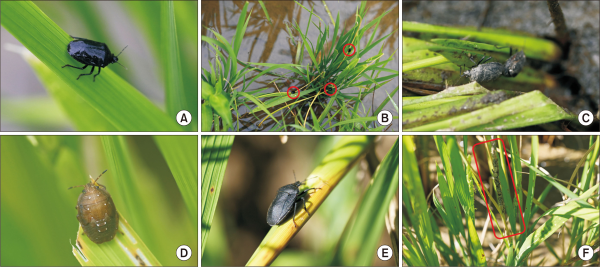
Fig. 5
Overwintering place of Scotinophara lurida. (A) Landscape on a overwintering place of S. lurida. (B) Detected adult at the overwintering place.
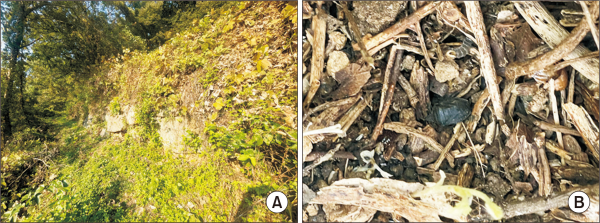
Table 1
Summary on the monitoring plan and results on Scotinophara lurida
| Survey site | A, Yeosu Hwayang-myeon | B, Gokseong Seogok-myeon | |||||||||
|---|---|---|---|---|---|---|---|---|---|---|---|
|
|
|
|
|||||||||
| Survey year | MT | MD | WMS | TMS (°C) | DI | MD | WMS | TMS (°C) | DI | ||
| 2023 | 1 | 6. 1 | - | 18.1 | 0 | 6. 1 | - | 16.5 | 0 | ||
| 2 | 6. 8 | Sunny | 20.8 | 1 | 6. 8 | Sunny | 20.5 | 0 | |||
| 3 | 6. 15 | Sunny | 21.5 | 19 | 6. 15 | Sunny | 20.5 | 0 | |||
| 4 | 6. 22 | Cloudy | 24.0 | 7 | 6. 22 | Cloudy | 22.3 | 0 | |||
| 5 | 6. 29 | Rainy | 23.5 | 106 | 6. 30 | Rainy | 23.7 | 17 | |||
| 6 | 7. 6 | Rainy | 24.3 | 86 | 7. 6 | Rainy | 24.3 | 89 | |||
| 7 | 7. 13 | Cloudy | 25.1 | 153 | 7. 13 | Cloudy | 25.2 | 38 | |||
| 8 | 7. 20 | Cloudy | 24.5 | 137 | 7. 20 | Cloudy | 25.7 | 29 | |||
| 9 | 7. 27 | Sunny | 27.3 | 61 | 7. 27 | Cloudy | 26.4 | 24 | |||
| 10 | 8. 4 | Sunny | 29.2 | 8 | 8. 3 | Sunny | 27.4 | 4 | |||
| 11 | 8. 10 | Cloudy | 24.8 | 6 | 8. 11 | Sunny | 25.3 | 5 | |||
| 12 | 8. 17 | Sunny | 26.5 | 10 | 8. 17 | Cloudy | 25.7 | 13 | |||
| 13 | 8. 24 | Rainy | 26.4 | 8 | 8. 25 | Sunny | 24.8 | 1 | |||
| 14 | 9. 1 | Sunny | 25.7 | 17 | 8. 31 | Sunny | 24.0 | 18 | |||
| 15 | 9. 7 | Sunny | 25.9 | 8 | 9. 8 | Sunny | 21.3 | 2 | |||
| 16 | 9. 15 | Rainy | 24.5 | 0 | 9. 15 | Cloudy | 22.8 | 3 | |||
| 17 | 9. 22 | Cloudy | 22.3 | 2 | 9. 21 | Cloudy | 21.0 | 2 | |||
| 18 | 10. 1 | Sunny | 20.9 | 0 | 10. 1 | Sunny | 16.5 | 0 | |||
| 2024 | 1 | 6. 13 | Sunny | 24.4 | 0 | 6. 13 | Sunny | 23.1 | 0 | ||
| 2 | 6. 21 | Cloudy | 23.6 | 2 | 6. 20 | Cloudy | 19.4 | 0 | |||
| 3 | 6. 27 | Sunny | 19.9 | 36 | 6. 27 | Cloudy | 17.2 | 3 | |||
| 4 | 7. 4 | Sunny | 25.0 | 24 | 7. 4 | Cloudy | 25.6 | 24 | |||
| 5 | 7. 11 | Sunny | 22.9 | 49 | 7. 12 | Sunny | 23.9 | 107 | |||
| 6 | 7. 18 | Rainy | 25.9 | 28 | 7. 19 | Rainy | 23.6 | 61 | |||
| 7 | 7. 25 | Rainy | 27.6 | 105 | 7. 25 | Rainy | 26.7 | 144 | |||
| 8 | 8. 2 | Cloudy | 29.1 | 4 | 8. 1 | Sunny | 26.6 | 50 | |||
| 9 | 8. 8 | Sunny | 29.4 | 0 | 8. 8 | Sunny | 26.3 | 0 | |||
| 10 | 8. 14 | Sunny | 28.9 | 0 | 8. 13 | Sunny | 25.9 | 1 | |||
| 11 | 8. 22 | Rainy | 28.7 | 1 | 8. 22 | Rainy | 26.0 | 13 | |||
| 12 | 8. 29 | Cloudy | 29.4 | 19 | 8. 29 | Sunny | 25.9 | 6 | |||
| 13 | 9. 5 | Sunny | 27.1 | 13 | 9. 5 | Sunny | 24.1 | 0 | |||
| 14 | 9. 12 | Cloudy | 28.7 | 0 | 9. 12 | Cloudy | 26.0 | 0 | |||
| 15 | 9. 20 | Rainy | 27.4 | 6 | 9. 23 | Sunny | 19.3 | 0 | |||
| 16 | 9. 26 | Cloudy | 25.0 | 0 | 9. 26 | Cloudy | 21.7 | 0 | |||