Introduction
The phylum Mollusca constitutes the second-largest animal group, after arthropods, with approximately 100,000 recognized species worldwide (MolluscaBase, 2024). Most species are marine, but some have evolved to thrive on land, with more than 6,000 species living in freshwater habitats (Lydeard & Cummings, 2019). Mollusca consists primarily of the classes Gastropoda and Bivalvia, which are groups of organisms that perform diverse ecological functions ranging from the maintenance of aquatic ecosystem stability, productivity, and biodiversity to ensuring environmental health and human well-being (Atkinson et al., 2023; Sousa et al., 2024).
In recent years, these mollusks have become popular with novice and experienced pet owners alike owing to their relatively simple rearing environment, their ability to serve as scavengers, and the wide variety of species available as pets and ornamental animals (Ng et al., 2016). In the Republic of Korea, invasive mollusks such as Pomacea spp., Neritina spp., and Melanoides tuberculate are sold through online pet stores and aquariums. In particular, in addition to intentional introductions with clear importation procedures, unintentional introductions, while attached to aquatic plants and aquarium ornaments, are common, and it has been reported that a significant proportion of invasive mollusks are introduced unintentionally (Lee et al., 2010).
The introduction of invasive mollusks into domestic aquatic ecosystems can have detrimental ecological consequences, including competition with native species, the disruption of food webs, habitat destruction, and disease transmission (Geist et al., 2025; Zannella et al., 2017). In particular, the indiscriminate release of such organisms during rearing or after death increases the likelihood of invasion into natural ecosystems, which can pose a potential biosecurity threat. Furthermore, some gastropods, such as Schistosoma spp. or Angiostrongylus spp. can infect humans when they ingest the next stage of the parasite or infected secondary hosts (Lu et al., 2018). The potential for the anthropogenic spread of these parasites has been emphasized in previous studies (Madsen & Frandsen, 1989) and has continued to be a subject of concern in recent years (Lu et al., 2018; Mastitsky et al., 2014).
There is a paucity of official statistics or systematic research on the importation of mollusks for pet and ornamental purposes in the Republic of Korea. Instead, reliance is placed on fragmented information obtained through informal channels, such as online stores and pet communities. Therefore, the aim of this study was to investigate the current status of aquatic mollusks imported into the Republic of Korea for pet and ornamental purposes, update the list of invasive mollusks introduced into the Republic of Korea, and provide a basis for future ecosystem risk assessment and biosecurity management strategies.
Case Report
The import (export) quarantine statistics of the National Fisheries Quality Management Service were used to determine the status of ornamental aquatic mollusks imported into the Republic of Korea from 2009 to 2024 (NFQS, 2025). The species taxonomy and international endangered species status for aquatic mollusks identified as imported were sourced from the Global Biodiversity Information Facility and the Convention on International Trade in Endangered Species of Wild Fauna and Flora (CITES) (CITES, 2025; GBIF, 2025).
Discussion
Status of Mollusca imports into the Republic of Korea
An analysis of aquatic mollusks imported into the Republic of Korea for ornamental purposes from 2009 to 2024 showed that 240,898 individuals, of three classes, 12 orders, 26 families, and 67 species, were imported. Of the aquatic mollusks imported, Gastropoda accounted for the largest share with 53 species (79.1%), followed by Bivalvia with 12 species and Cephalopoda with one species (Appendix 1). Of these, six Gastropoda and two Bivalvia species have been recorded on the National Species List (NIBR, 2025).
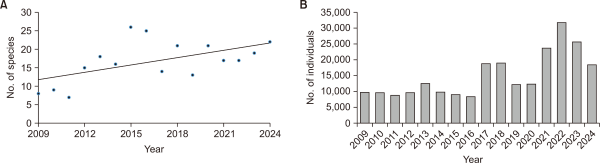
The annual fluctuations in imports have ranged from a low of seven to a high of 26, with augmentation since 2009, a modest decrease from 2016, and a resurgence after 2022 (Fig. 1A). Prior to 2016, the average number of individuals imported annually was less than 10,000. However, since 2017, it has exceeded 20,000 annually (Fig. 1B). These findings may be attributed to the fact that, in the context of pet imports, initial interest is spread across a broad spectrum of species. However, as the importation process progresses, interest gravitates toward a select few species that are more amenable to captivity and less demanding in terms of maintenance (Hausmann et al., 2023; Valdez, 2021).
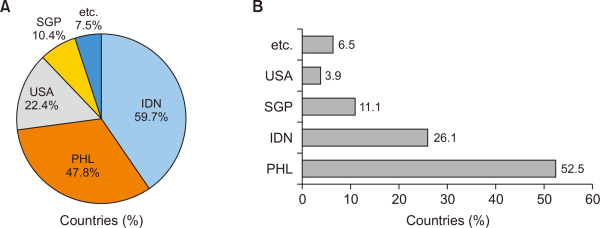
Ornamental mollusks are imported into the Republic of Korea from 15 countries, including Indonesia, the Philippines, the United States, Singapore, Palau, Vietnam, Sri Lanka, Japan, the Marshall Islands, Taiwan, the Federated States of Micronesia, Brazil, Egypt, Kenya, and Tonga. Of these, Indonesia exported the most species (40), followed by the Philippines (32), the United States (15), and Singapore (7), with species imported from the four countries accounting for approximately 92.5% of the total. In terms of the number of individuals, the Philippines exported the largest number of individuals (126,419), followed by Indonesia (62,771), Singapore (26,678), and the United States (9,435), with individuals imported from these four countries accounting for approximately 93.5% of the total (Fig. 2).
Major species
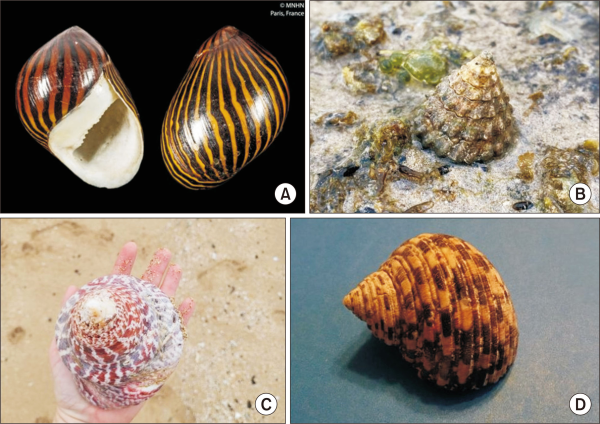
Among the imported mollusks, Vittina waigiensis accounted for the largest number of imports at 53,783, followed by Tectus fenestratus at 45,990, Rochia niloticus at 42,334, Trochus histrio at 16,880, and Turbo fluctuosus at 12,751, with Gastropoda accounting for the majority of imports (Fig. 3, Appendix 1) (GBIF, 2025b; 2025c; 2025d; 2025e). In addition, most mollusks imported were marine with 61 species, followed by estuarine with four species, and freshwater with two species (Appendix 1).
A combination of ecological, aesthetic, and management factors contributes to the preference for saltwater species over freshwater species in the ornamental mollusk market. Firstly, saltwater environments exhibit a higher level of biodiversity than freshwater environments, with more diverse ornamental mollusk species available (Gadhavi et al., 2023). In fact, saltwater snails such as Tectus, Trochus, Rochia, and Turbo have high aesthetic value as aquarium ornamental genera due to their colorful forms and unique shell patterns (Babu et al., 2011). These morphological traits are important factors in the selection of ornamental species and are thought to be major contributors to the preference for saltwater mollusks.
Seven species listed by the CITES were identified, representing 10.4% of all imports, with six Bivalvia and one Cephalopoda species. All of the species were placed in Appendix II of the CITES (CITES, 2025), a list of species that are not currently endangered but may become endangered without strict regulations on international trade (CITES, 2025). In particular, Tridacna, a genus of Bivalvia that has traditionally been overfished over the past few decades due to increased demand for their meat and shells, accounted for the most, with five species (Van Wynsberge et al., 2016).
Ecological risk
Aquatic mollusks are likely to be introduced into domestic aquatic ecosystems, both intentionally and unintentionally (Banha et al., 2019), and upon introduction, they have the potential to cause ecological harm in different ways, including competition with native species, the disruption of food webs, habitat destruction, and disease transmission (Gallardo et al., 2016). Among the aquatic mollusks imported into the Republic of Korea, freshwater species include Pomacea canaliculata, which is included in the List of 100 of the World’s Worst Invasive Alien Species of the International Union for Conservation of Nature. In some regions, this species is used for eco-friendly agricultural practice (Jeong et al., 1999; Moon et al., 1998). Regarding saltwater species, five Nassarius species and Perna viridis were identified. P. viridis is widely distributed in the Asia-Pacific region and has undergone global spread via ship ballasts, hull attachment, and aquaculture. This species is recognized as an invasive species that causes significant damage to the aquaculture industry owing to competition with numerous attached species (Gracia & Rangel-Buitrago, 2020). It is currently designated as an invasive species in the Republic of Korea, where imports are strictly controlled (Ministry of Environment, 2020). Furthermore, many popular ornamental pets are native to tropical countries. Given the prevalence of trematodiasis in these regions, which is of medical and veterinary significance, there is a pressing need to direct special attention towards species from these areas as potential vectors of zoonotic diseases (Nguyen et al., 2021; Pratumchart et al., 2019). Five Nassarius species are also known to be primary or secondary intermediate hosts for trophozoites and hookworms (Barnett & Miller, 2018; Cheng et al., 1973).
Recently, Melanoides tuberculata and Mieniplotia scabra, gastropods that are popular in the ornamental market for their scavenging and parthenogenetic abilities to control algae and organic matter, have been identified in Jukdangcheon stream (Park et al., 2024; 2025). Since they are not found on official import lists, they appear to have “hitchhiked” during the distribution of ornamental aquatic plants in aquariums (Duggan, 2010; Kwong et al., 2010). As such, it is necessary to establish a continuous online and offline surveillance system for invasive mollusks entering the Republic of Korea through various routes, in addition to the systematic management of freshwater and saltwater species by identifying their integrated status beyond the scope of management by relevant government agencies (Lee et al., 2010).
Author Contributions
Conceptualization: YP, YC. Data curation: YP, DC, MJ. Formal analysis: YP. Funding acquisition: YC. Writing – review & editing: YP, SJK.
Funding
This study was supported by the National Institute of Ecology, funded by the Ministry of Environment of the Republic of Korea (NIE-A-2025-12).