Introduction
The Himalayan Owl (Strix nivicolum) is a medium-sized owl that inhabits the forests of the Himalayas and East Asia. It was previously classified as a subspecies of the Tawny Owl (Strix aluco), which is found in Europe, based on morphological similarities and geographical continuity (Sibley & Monroe, 1993). However, due to marked differences in morphological features and vocalizations, it was reclassified as a distinct species (del Hoyo et al., 2014). The Himalayan Owl is divided into three subspecies, with the subspecies found on the Korean Peninsula referred to as ma. This subspecies is characterized by a thin, light buff facial ring, and plumage that ranges from grayish-brown to light reddish-brown (Brazil, 2009).
In South Korea, the Himalayan Owl occurs nationwide, but it is classified as a rare species (Choi, 2019). According to data from the 3rd (2006-2013) and 5th (2019-2023) National Ecosystem Survey (NES), which covered the entire country, the species exhibits an occupancy rate of less than 1%. This low occupancy rate is believed to be due to both the absence of standardized nocturnal bird survey methods (Lee, 2024) and the ecological characteristics of the Strix genus, which primarily inhabits forest areas and is difficult to detect (Kim et al., 2010; König et al., 1999). Currently, the Himalayan Owl is classified as a Class II endangered species by the Ministry of Environment (Park, 2022) and also designated as a natural monument by the Cultural Heritage Service. Additionally, it is classified as a vulnerable species in the National Biodiversity Red List (NIBR, 2019). However, its habitat is increasingly threatened by human activities, such as the artificial filling of tree cavities in large trees, which are preferred breeding sites (Park, 2022), and the growing rate of logging of dominant tree species such as pine and oak, following the easing of minimum cutting age regulations for these trees (Bang, 2018).
In environments where natural cavities are diminishing, nest boxes can provide essential breeding sites for cavity-nesting owls, which are classified as secondary cavity nesters (Saurola, 1997). For example, the Ural Owl (Strix uralensis), another member of the Strix genus, showed a marked increase in the utilization of owl nest boxes beginning in the mid-1960s (Lahti, 1972). In Kielder Forest, UK, where logging occurs approximately every 50 years, the majority of Ural Owls have been observed to breed in nest boxes (Petty & Peace, 1992). In South Korea, a report showed that Ural Owl has been breeding in nest boxes within Odaesan National Park, where they serve as a flagship species (Korea National Park Service, 2017). Similarly, the Tawny Owl is known to readily adopt artificial nest boxes (Plesnik & Dusik, 1994; Sasvári et al., 2000). However, there are no published records of nest box usage by the Himalayan Owl in major scientific databases (Web of Science, JSTOR, Google Scholar), either domestically or internationally.
This study presents the first documented case of nest box breeding by the Himalayan Owl in South Korea. The findings provide a foundational reference for future research on the breeding ecology of this species and support the development of effective conservation strategies. Moreover, this case may serve as a significant starting point to align national efforts with global biodiversity conservation objectives.
Case Report
Study area
This study was conducted in Maseo-myeon, Seocheon-gun, Chungcheongnam-do, which is located adjacent to the Geum River estuary in South Korea. The study area corresponds to a survey grid (3.8×4.6 km, with center coordinates of 36.02083335°N and 126.7291667°E) as defined by the NES (Fig. 1). Within this grid, paddy fields comprised the largest land cover type (34%), followed by coastal areas (18%), artificial areas (14%), grasslands (12%), forests (11%), and upland fields and rivers (each 5%) (available at https://egis.me.go.kr/map/map.do). Forested areas were primarily patchy and distributed at low elevations, typically below 100 m above sea level. The dominant tree species included conifers such as Japanese Black Pine (Pinus thunbergii) and Pitch Pine (Pinus rigida), as well as broad-leaved species such as Korean Chestnut (Castanea crenata), Sawtooth Oak (Quercus acutissima), and Black Locust (Robinia pseudoacacia) (available at https://map.forest.go.kr/forest/).
To protect the breeding success of the Himalayan Owl, the precise location of the nest is withheld. Disclosing this information could lead to increased visits by birdwatchers and photographers and potentially disrupt breeding activities.
Nest box installation
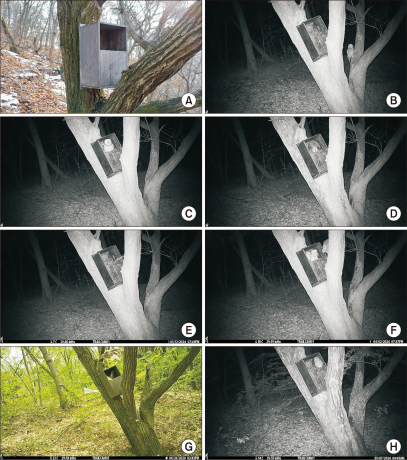
On December 28, 2023, a wooden nest box (36 cm wide, 70 cm high, and 30 cm deep, with an open entrance measuring 32 cm wide and 25 cm high) was installed on the trunk of a Korean Chestnut tree (Fig. 2A). Species belonging to the Strix genus typically begin egg-laying in early spring, around March (Tojo & Matsuoka, 2022); therefore, woodchips were placed inside the nest box to enhance thermal insulation. The installation site was situated at an elevation of 60 m on a downward slope, with the nest box entrance facing northwest. The host tree had a bifurcated trunk structure, rendering the nest box less visible from the front. To monitor potential occupancy by the Himalayan Owl, a remote sensor camera (Browning Strike Force Pro XD; Browning Trail Cameras, Ewing, MO, USA) was positioned approximately 3 m southwest of the entrance, mounted on a nearby tree. The camera was checked weekly at sunset to minimize disturbance, because the Himalayan Owl is a nocturnal species. The nest box was inspected internally only after confirming the absence of the owl.
Breeding progress
On January 31, 2024, approximately one month after the installation of the nest box, a Himalayan Owl was observed (Fig. 2B). By mid-February, two individuals, likely a breeding pair, were present. One individual was observed perched at the entrance of the nest box, emitting a rapidly repeated “whoo-whoo-whoo” call resembling a series of short hoots (Fig. 2C), which was interpreted as a signal of their intent to utilize the nest box for breeding. Starting in early March, the Himalayan Owl began entering the nest box (Fig. 2D), and by mid-March, three eggs were discovered inside. The clutch was estimated to have been completed around March 10. From that point onward, a change in flight behavior was observed: the owl began to slow its descent and spread its wings before entering the nest box (Fig. 2E), a behavior different from the earlier direct dive approach seen in early March. This behavioral shift is believed to be an adaptation to avoid breaking the eggs. During the incubation period, the presumed male was observed to either deliver food directly to the nest box (Fig. 2F) or call the incubating individual out to receive food. The incubating owl responded with a distinctive begging call, “kwek, kwek.” Approximately one month after the eggs were laid, on April 9, two of the three eggs successfully hatched. The adults continued to stay in the nest box until around day 17 post-hatching, after which they began roosting in nearby trees instead of inside the nest box. During daylight hours, the parent owls were observed to feed the chicks (Fig. 2G). This behavioral change is presumed to reflect the increased food demand as the chicks grew. On day 28 post-hatching (May 7), both chicks fledged from the nest box (Fig. 2H). In 2025, a breeding pair of Himalayan Owls returned to the site in early February, and by mid-March, three eggs had been laid, mirroring the pattern in previous year. However, none of the eggs hatched, and by April 18, the pair had abandoned the nest, with the three eggs also disappearing. Based on the footage obtained from the remote sensor camera, no external intruders were identified, and it is presumed that the incident resulted from a failure in egg development.
Discussion
This study confirmed that the Himalayan Owl, like other species in the Strix genus, is capable of utilizing nest boxes as breeding sites. The installation site was in an area with low forest distribution, where the presence of Himalayan Owls had been considered unlikely. Notably, the NES conducted in 2010, 2016, and 2021 did not record the species in this area.
The breeding of the Himalayan Owl observed shortly after nest box installation suggests two possible scenarios. First, the Himalayan Owl may have already been present in the area but was not detected due to the absence of standardized nocturnal bird survey methods in South Korea (Lee, 2024). Second, a newly independent individual, in the process of establishing a territory, may have opportunistically discovered and occupied the nest box. In the case of the Tawny Owl, younger females tend to have smaller clutch sizes and lower hatching success rates (Sasvari & Hegyi, 2002), along with reduced aggression during the breeding period (Wallin, 1987). Corroborating this, another Himalayan Owl nest observed in Seocheon had a clutch size of four eggs, all of which successfully hatched—a number higher than that observed in this study. Furthermore, the adult at that nest displayed aggressive behavior toward the observer during a pre-fledging observation, whereas no such aggressive behavior was observed at the nest monitored in this study (Lee pers. comm.).
In South Korea, the Ecological and Natural Map categorizes the national territory into Grade 1, Grade 2, Grade 3, and Separately Managed Areas based on ecological and landscape value and naturalness (Article 2 of the Natural Environment Conservation Act). Grade 1 areas are designated as absolute conservation areas. These include major habitats of endangered species, regions with outstanding ecosystems and landscape value, areas located at the geographical limits of species distribution, regions representing significant vegetation types, and areas rich in biodiversity with high conservation value (Article 34 of the Natural Environment Conservation Act). For endangered species, habitat designation follows a grid system—750 m×750 m for Endangered Class I species and 250 m×250 m for Endangered Class II species—restricted to forested areas with vegetation. For birds, which exhibit the highest mobility among endangered species groups, designation is only applied upon confirmation of breeding, typically evidenced by consistent use of a nest site (Guideline for Preparing the Ecological and Natural Map). As breeding of the Himalayan Owl was confirmed in a nest box installed within forested habitat, the site satisfies the criteria for Grade 1 designation for Endangered Class II species, qualifying the corresponding 250 m×250 m grid for protected status.
Although datasets such as the NES provide a foundation for evaluating the Ecological and Natural Map, confirmed breeding records for endangered bird species in forested areas remain extremely rare. This scarcity is largely due to the structure of national surveys, which primarily aim to determine species presence and population trends, making them ill-suited to detecting confirmed breeding events that require more prolonged, targeted monitoring.
Given that only one nest box was installed in this study, it is premature to propose standardized guidelines for enhancing the utilization of nest boxes by the Himalayan Owl. However, findings by Sacchi et al. (2004), which demonstrated increased nest box use by Tawny Owls in areas with limited natural cavities, suggest a promising approach. It is recommended that nest boxes be installed in forested areas classified as Grade 2 or 3, especially immature or afforested regions, with the potential for future elevation to Grade 1. Because Grade 1 areas restrict development activities under South Korea’s conservation laws, which may lead to conflicts over private property rights, it is advisable to prioritize public land for such installations.
Despite these limitations, this study highlights the potential role of nest box programs to support broader conservation goals at both national and global levels. Installing nest boxes for the Himalayan Owl not only facilitates the protection and study of one of the most elusive endangered species in South Korea but also contributes critical avian data that can expand the extent of Grade 1 areas on the Ecological and Natural Map. In 2022, the Conference of the Parties to the Convention on Biological Diversity (CBD) adopted the Kunming-Montreal Global Biodiversity Framework (GBF), which includes 23 global targets. Among them, Target 3 calls for at least 30% of terrestrial and marine areas to be conserved through well-connected, effectively managed protected areas (CBD, 2022). Achieving this target requires the recognition of other effective area-based conservation measures (OECMs), which support long-term, in situ biodiversity conservation outside formally protected areas (Jonas et al., 2023). Since Grade 1 areas on South Korea’s Ecological and Natural Map are prioritized for OECM designation (Heo et al., 2024), breeding records such as those provided in this study can serve as essential ecological evidence for identifying OECM-eligible areas. Ultimately, the documentation of Himalayan Owl breeding in a nest box not only supports species-specific conservation but also contributes to South Korea’s commitments to global biodiversity.
Funding
This study was supported by a grant from the National Institute of Ecology (NIE) and funded by the Ministry of Environment (MOE) of South Korea (NIE-A-2025-01).
References
Korea National Park Service (2017, Retrieved April 24, 2025) First breeding record of the endangered Ural Owl (Strix uralensis) in a nest box in Odaesan National Park from https://species.nibr.go.kr/endangeredspecies/rehome/news/news_view.jsp?&bbs_man_sno=3&search_key=&search_keyword=&page_count=5&bbs_sno=303
Figures
Fig. 1
Location of the study site in South Korea. The left panel shows the National Ecosystem Survey grid system, with the target grid highlighted in red. The right panel presents a satellite image with detailed view of the study area.
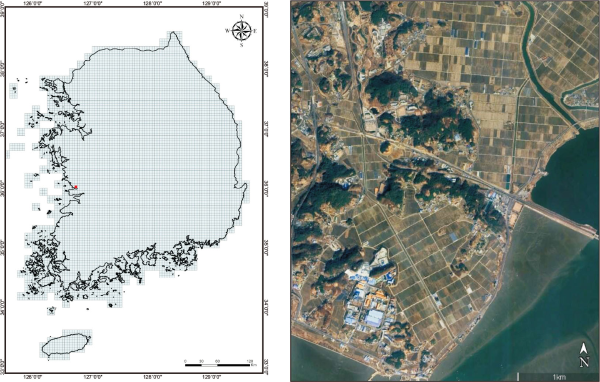
Fig. 2
Nest box installation (A) and subsequent breeding activity of Himalayan Owl recorded using a remote sensor camera (B-H). (B) First appearance near the nest box. (C) Vocalization at the entrance. (D) Entry into the nest box. (E) Adjusted landing posture post-egg laying. (F) Food delivery during incubation. (G) Daytime chick feeding after hatching. (H) Fledging from the nest box.