Introduction
The natural environment provides the essential resources for human life, such as food, clothing, and shelter, and serves as the foundation for economic activities (Moon, 2015). However, human activities aimed at increasing convenience and improving living standards have led to resource depletion and expanded environmental destruction. This has become not only a national issue but also a global one (Park & Park, 2008). Globally, urban expansion and cropland displacement have been shown to contribute to both direct and indirect forest loss, and research has confirmed that human activities can accelerate the destruction of tropical forests (Davis et al., 2020; van Vliet, 2019). In Korea, to prevent indiscriminate development of natural environments, the use of Ecological and Natural Map (ENM) is mandated in the development and environmental planning processes. The ENM is a map that classifies Korea’s natural environment based on ecological value, naturalness, and landscape value (Korea Legislation Research Institute, 2024) (Fig. 1). The grades of the ENM are categorized into Grade 1, Grade 2, Grade 3, and separate management areas, based on the Natural Environment Conservation Act and guidelines for creating the ENM. Grade 1 areas are for the conservation and restoration of natural environments, Grade 2 areas for the conservation and minimization of damage due to use and development, and Grade 3 areas for areas where systematic development and use are possible (Korea Legislation Research Institute, 2024). These grades make it easy to understand the current state of the natural environment, and they are highly significant for land development. Especially, Grade 1 areas, which are of high ecological and scenic value and function as habitats for endangered wildlife, have very high conservation value, and development in these areas is strongly discouraged to prevent damage to the environment. This has led landowners and developers to view the classification as a regulatory and restrictive measure, and it has become a common cause for objections to the ENM (Ahn et al., 2015). When Grade 1 areas are included in a proposed development site, authorities such as the national government or local governments often recommend excluding these areas from the development plan or reject the proposal. Landowners and developers then request changes to the grade of the ENM to facilitate development (Jung et al., 2017). Since it was legislated in 1998 and first announced in 2007, the ENM has been continuously revised to reflect the latest natural environmental survey data. Requests for changes in the grades of the ENM have consistently occurred since 2007 (Ahn et al., 2015; Jung et al., 2017; Oh et al., 2023). If the grade does not change, repeated requests for grade modifications are made, or efforts are made to degrade the environment in order to induce a lower grade (Jung et al., 2017; Oh et al., 2023). According to the guidelines for creating the ENM, if a natural environment is unlawfully damaged, the grade is maintained for ten years. However, no penalties are imposed for non-illegal environmental damage. Therefore, after receiving approval for forest management activities, such as forest thinning, some request grade changes based on the altered natural environment.
Research on the ENM has included studies on the economic value of Grade 1 areas (Shin & Min, 2005), complaints regarding the ENM (Ahn et al., 2015; Jung et al., 2017; Oh et al., 2023), factors influencing grade downgrades (Choi et al., 2019; Kang et al., 2023), and the status of Grade 1 areas in the ENM (Yoon et al., 2024). Additionally, while some studies have explored the impact of artificial damage on the ENM grades (Choi et al., 2019), this study have only compared data before and after the regular assessments, and no studies have examined the impact of forest management on objections. This study aims to investigate the influence of forest management on objections by analyzing cases of objections filed after forest management activities.
Materials and Methods
We analyzed objections cases submitted to the National Institute of Ecology from 2014 to 2024. All submissions—including approved, withdrawn, and rejected cases—were considered. Specific analyses included:
Objections trends: To examine the cases of objections filed after forest management, the number of objections received over the past 10 years and the number of those related to forest management were reviewed. The distribution of all objection areas and the areas where forest management was identified were analyzed. The analysis of objections cases included all submissions, including those processed normally, withdrawn, or rejected.
Grade changes: Comparison of ENM grades before and after forest management in objection areas using ArcGIS-based spatial analysis (ArcGIS 10.8.; ESRI, Redlands, CA, USA). However, objections regarding cancellation, rejection, and the designation or removal of separate management zones were not included in the area comparison analysis, as they are unrelated to changes in grade.
Results
Trends in objections
The total number of objections filed over the 11-year period from 2014 to 2024 was found to be 958. The highest number of objections was recorded in 2018 with 177 cases, followed by 131 cases in 2021, 107 cases in 2019, 91 cases in 2022, 85 cases in 2017, 82 cases in 2020, 76 cases in 2023, 64 cases in 2024, 52 cases in 2014, 51 cases in 2016, and 42 cases in 2015. From 2014 to 2021, the number of objections showed a gradual increase, but from 2021, a decreasing trend was observed. During the same period, 178 objections related to forest management were identified. The highest number of these was recorded in 2019 with 32 cases, followed by 24 cases in 2018, 21 cases in both 2020 and 2021, 15 cases in both 2017 and 2024, 13 cases in both 2022 and 2023, 12 cases in 2016, 7 cases in 2014, and 5 cases in 2015 (Table 1). An analysis of objection cases related to confirmed forest management by region revealed the following distribution: 53 cases in Gangwon Special Self-governing Province, 31 in Gyeonggi-do, 30 in Gyeongsangnam-do, 21 in Chungcheongnam-do, 17 in Gyeongsangbuk-do, 9 in Jeonbuk Special Self-governing Province, 5 in Ulsan, 4 in Jeollanam-do, 4 in Busan, 3 in Chungcheongbuk-do, and 1 in Incheon (Table 2).
Types of forest management
The forest management types were classified into five categories. Clear-cutting included areas where only partial clear-cutting was carried out within the objection regions. Among the types, clear-cutting accounted for the highest proportion with 117 cases, followed by thinning with 42 cases, pest control with 13 cases, pruning with 4 cases, and others with 2 cases (Table 3).
Grade changes
The total area processed for objections filed between 2014 and 2024 was found to be 106,873,300 m2. The changes in area by ENM grade before and after the objections were as follows: Grade 1-95,806,391 m2, Grade 2-8,208,041 m2, and Grade 3-2,858,868 m2 before, and Grade 1-27,223,061 m2, Grade 2-50,146,706 m2, and Grade 3-29,503,533 m2 after. The area of Grade 1 decreased by 68,583,330 m2, while Grade 2 increased by 41,938,665 m2, and Grade 3 increased by 26,644,665 m2. The area with confirmed forest management was 33,381,020 m2. The changes in area by grade in forest management areas were as follows: Grade 1-33,381,020 m2, Grade 2-3,154,663 m2, and Grade 3-314,507 m2 before, and Grade 1-10,645,143 m2, Grade 2-14,377,886 m2, and Grade 3-11,827,160 m2 after. The area of Grade 1 decreased by 22,735,877 m2, while Grade 2 increased by 11,223,223 m2, and Grade 3 increased by 11,512,653 m2 (Table 4). An analysis of changes in Grade 1 area by administrative region indicates that Gangwon Special Self-governing Province experienced the largest decrease, with a reduction of 11,411,752 m2. This was followed by Gyeongsangnam-do (2,606,440 m2), Gyeonggi-do (2,334,458 m2), Gyeongsangbuk-do (2,025,939 m2), Ulsan (1,732,659 m2), Chungcheongnam-do (1,006,512 m2), Busan (681,065 m2), Chungcheongbuk-do (353,854 m2), Jeollanam-do (313,335 m2), Jeonbuk Special Self-governing Province (267,871 m2), and Incheon (1,990 m2) (Table 2).
Forest management and changes in Ecological and Natural Map grades
The areas with confirmed forest management accounted for 18.58% of the total objections filed. The area of objections related to forest management made up 31.23% of the total area of objections. Examining the changes in area by ENM grade, areas with forest management contributed to 33.15% of the decrease in Grade 1 area, 26.76% of the increase in Grade 2 area, and 43.21% of the increase in Grade 3 area.
Discussion
The ENM is used in environmental policies of the government and local authorities, as well as in environmental impact assessments for land development (Korea Legislation Research Institute, 2024). Specifically, administrative agencies use the ENM grades as a criterion for granting development permits, effectively making the grades a form of regulation. As a result, objections to the ENM are primarily filed for the purpose of land development (Ahn et al., 2015; Jung et al., 2017; Oh et al., 2023).
According to the results of this study, the number of objections to the ENM has gradually decreased, but objections after forest management practices have remained consistent. These cases accounted for 18.58% of the total objections, and forest management accounted for 43.21% of the increase in Grade 3 areas, indicating that forest management has a significant impact on the increase in Grade 3 areas. Regionally, a relatively high number of objections following forest management were observed in Gangwon Special Self-governing Province, which has a high proportion of Grade 1 distribution, as well as in Gyeonggi-do and Gyeongsangnam-do, where land development pressure is high (Table 2).
The Forest Resources Development and Management Act defines forest management as a project aimed at maintaining, developing, or restoring the functions of forests (Korea Law Information Center, 2023). Forest resource management is considered a critical undertaking to create ecologically stable and disaster-resistant economic forests (Jang et al., 2008; Woo et al., 2012).
However, in cases where the desired grade changes are not achieved through objections to the ENM, there have been instances where objections are filed again after forest management, such as logging (Oh et al., 2023). The primary goal of forest management is to promote healthy forest ecosystems, and ENM grades are not considered when implementing such activities. According to the Natural Environment Conservation Act, the ENM is intended to be used in development planning where environmental degradation is anticipated. Therefore, forest management does not fall within the scope of ENM applications. However, there have been confirmed attempts to exploit this legal loophole to intentionally lower ENM grades. The following process was identified through several cases (National Institute of Ecology, 2020; 2023) (Figs. 2, 3): First, forest management is carried out after obtaining approval for forest management. Second, objections to the ENM are filed to attempt a grade change. Third, once the grade change is completed, development projects, such as environmental impact assessments, are initiated. In particular, if the development area is below the minimum threshold for environmental impact assessment (e.g., an area of 30,000 m2 or less), the downgrade of the ENM rating due to forest management may lead directly to development without undergoing an environmental impact assessment review. It appears that forest management is being used as a means to induce grade downgrades in the ENM.
Conclusion
Due to the identified issue of ENM grade downgrading caused by forest management projects, the Ministry of Environment amended relevant legislation in September 2024 (Korea Law Information Center, 2024). In areas where forest management has been implemented, ENM grade will now be based on pre-management survey data, without reflecting new changes in the natural environment for a period of five years. However, under the current grading criteria of the ENM, vegetation older than 30 years, with high naturalness, is classified as Grade 1 (Korea Law Information Center, 2024). It is judged that five years is insufficient time for forests disturbed by forest management to recover to their previous state. An analysis of future objection cases is necessary to evaluate the effectiveness of the recent legal amendments, and in-depth research is required to ensure that the forest management and ENM system are operated in alignment with their original objectives.
Author Contributions
Data curation: WO. Funding acquisition: WO. Methodology: WO. Software: HYY. Supervision: WO. Visualization: HYY. Writing – original draft: WO. Writing – review & editing: HYY, JC.
Funding
This work was supported by a grant from the National Institute of Ecology (NIE), funded by the Ministry of Environment (MOE) of the Republic of Korea (NIE-A-2025-03).
References
Korea Law Information Center. (2023). Creation and Management of ForestResources Act. Retrieved Aug 20, 2025 from https://www.law.go.kr/LSW/eng/engLsSc.do?menuId=2§ion=lawNm&query=%EC%82%B0%EB%A6%BC%EC%9E%90%EC%9B%90%EB%B2%95&x=0&y=0#liBgcolor0.
Korea Law Information Center. (2024). Ministry of Environment Directive No. 753 (2024.9.11) "Guidelines for Preparing the Ecological and Natural Map". Retrieved Aug 20, 2025 from https://www.law.go.kr/%ED%96%89%EC%A0%95%EA%B7%9C%EC%B9%99/%EC%83%9D%ED%83%9C%C2%B7%EC%9E%90%EC%97%B0%EB%8F%84%EC%9E%91%EC%84%B1%EC%A7%80%EC%B9%A8/(753,20240911).
Korea Legislation Research Institute. (2024). Natural Environment Conservation Act. Retrieved Aug 20, 2025 from https://elaw.klri.re.kr/kor_service/lawView.do?hseq=64575&lang=KOR.
National Institute of Ecology. (2020). Public notice for national viewing of partial revisions and supplements to the ecological and natural map (Announcement No. 2020-9). Retrieved Aug 20, 2025 from https://www.nie.re.kr/nie/bbs/BMSR00038/view.do?boardId=2870297&menuNo=200099.
National Institute of Ecology. (2023). Public notice for national viewing of partial revisions and supplements to the ecological and natural map (AnnouncementNo. 2023-149). Retrieved Aug 20, 2025 from https://www.nie.re.kr/nie/bbs/BMSR00038/view.do?boardId=695963655&menuNo=200099.
Figures and Tables
Fig. 1
ENM of Korea (green: ENM 1st Grade, light green: ENM 2nd Grade, white: ENM 3rd Grade, orange: separate management areas). ENM, Ecological and Natural Map.
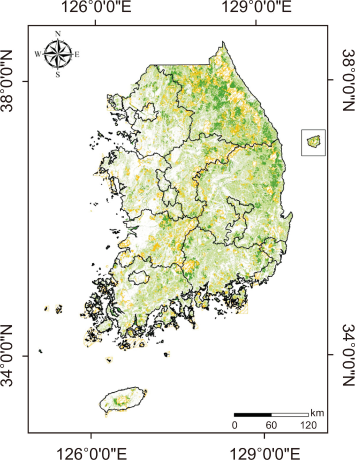
Fig. 2
Changes ENM grades after forest management (case area: Samcheok). (A) Before objections to the ENM. (B) After objections to the ENM. (C) Forest management implementation site. In this area, an environmental impact assessment for resource extraction was approved following the change in the ENM grade. Source: National Institute of Ecology (2020). ENM, Ecological and Natural Map.
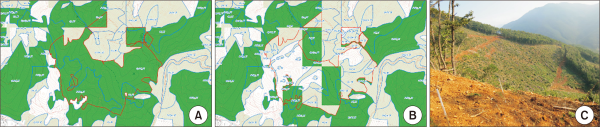
Fig. 3
Changes in ENM grades after forest management (case area: Mungyeong). (A) Before objections to the ENM. (B) After objections to the ENM. (C) Forest management implementation site. In this area, an environmental impact assessment for cable car development was approved following the change in the ENM grade. Source: National Institute of Ecology (2023). ENM, Ecological and Natural Map.
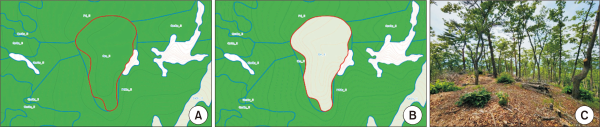
Table 1
Annual number of cases to total objections and objection after forest management
| Year | Total case | Forest management case |
|---|---|---|
| 2014 | 52 | 7 |
| 2015 | 42 | 5 |
| 2016 | 51 | 12 |
| 2017 | 85 | 15 |
| 2018 | 177 | 24 |
| 2019 | 107 | 32 |
| 2020 | 82 | 21 |
| 2021 | 131 | 21 |
| 2022 | 91 | 13 |
| 2023 | 76 | 13 |
| 2024 | 64 | 15 |
Table 2
Number of objections by administrative district and changes in ENM grades following forest managment
| Cases | Before objection | After objection | ||||||
|---|---|---|---|---|---|---|---|---|
|
|
|
|||||||
| 1st area (m2) |
2nd area (m2) |
3rd area (m2) |
1st area (m2) |
2nd area (m2) |
3rd area (m2) |
|||
| Gangwon Special Self-governing Province | 53 | 20,101,590 | 1,642,526 | 61,076 | 8,689,838 | 7,379,425 | 5,735,929 | |
| Gyeonggi-do | 31 | 3,133,403 | 298,762 | 48,131 | 798,945 | 1,056,053 | 1,625,298 | |
| Gyeongsangnam-do | 30 | 2,894,006 | 383,165 | 184,437 | 287,566 | 2,454,066 | 719,976 | |
| Chungcheongnam-do | 21 | 1,094,850 | 105,735 | 4,052 | 88,338 | 530,242 | 586,057 | |
| Gyeongsangbuk-do | 17 | 2,663,654 | 565,450 | 2,644 | 637,715 | 329,442 | 2,264,591 | |
| Jeonbuk Special Self-governing Province | 9 | 301,222 | 2,971 | 7,655 | 33,351 | 136,615 | 141,882 | |
| Ulsan | 5 | 1,732,659 | 49,250 | 49 | 0 | 1,689,907 | 92,051 | |
| Jeollanam-do | 4 | 333,646 | 106,804 | 2,597 | 20,311 | 81,724 | 341,012 | |
| Busan | 4 | 760,475 | 0 | 3,836 | 79,410 | 529,649 | 155,252 | |
| Chungcheongbuk-do | 3 | 363,524 | 0 | 30 | 9,670 | 190,762 | 163,122 | |
| Incheon | 1 | 1,990 | 0 | 0 | 0 | 0 | 1,990 | |
Table 3
Number of cases by forest management types
| Clear-cutting | Thinning | Pests and disease management | Pruning | Ohter | |
|---|---|---|---|---|---|
| Number of case | 117 | 42 | 13 | 4 | 2 |