Introduction
Global economic growth and aviation industry expansion have accelerated the global spread of alien species, posing a serious threat to biodiversity conservation (Hulme, 2009; Spear et al., 2013). Owing to their high ecological adaptability, certain alien plants successfully establish populations in new environments and often outcompete native species, thereby altering community structures and destabilizing ecosystems (Diez et al., 2012). Numerous alien plants have been introduced in Korea, exerting both direct and indirect ecological impacts.
Coreopsis lanceolata is one of the most widely distributed alien plants in Korea. Its showy yellow flowers and extended flowering period have led to frequent use in landscaping by individuals, municipalities, and public institutions. However, naturalized populations outside of intentional planting sites have been increasingly observed (National Institute of Ecology, 2023). The National Institute of Ecology has classified C. lanceolata as a Level 2 invasive species due to its high potential for widespread expansion. Although the Ministry of Environment issued a recommendation against its planting, cultivation has continued nationwide, expanding its occupied area.
According to research conducted in China, C. lanceolata thrives in various disturbed sites, such as roadsides, farmland margins, and fallow lands, and its strong clonal growth confers high environmental adaptability (Zeng et al., 2012). In some regions, this species has already gained a competitive advantage over native plants, forming communities and exhibiting large-scale expansion.
In Japan, C. lanceolata competes with native riparian vegetation for light and space (Saito & Okubo, 2013). Owing to its ecological characteristics and invasive potential, C. lanceolata was designated as an Invasive Alien Species under the Invasive Alien Species Act in February 2006. Consequently, its cultivation, storage, transportation, and importation have been restricted, and the National Institute for Land and Infrastructure Management (2011), under the Ministry of Land, Infrastructure, Transport and Tourism, issued a removal and control manual.
In Korea, C. lanceolata is often confused with Coreopsis basalis, an annual herb native to North America, owing to their similar morphologies. However, their ecological traits differ markedly; while C. lanceolata is a perennial with a strong reproductive capacity and prolific seed production, which confer high invasive potential (Arifin & Okamoto, 2023; Folgate & Scheiner, 1992), C. basalis poses a relatively low ecological risk. Despite these differences, both species are distributed in Korea with the same label “Geumgyegook (C. basalis),” leading to frequent mislabeling and misplanting of C. lanceolata as C. basalis.
In this study, we aimed to identify the root causes of persistent coreopsis misidentification. To this end, we examined the taxonomic units used during the seed importation process and investigated commercial seed distribution records. In addition, we subjected seedlings grown from seeds marketed domestically as C. basalis to rbcL and matK sequence analyses and compared the results with reference sequences of C. basalis and C. lanceolata in the National Center for Biotechnology Information (NCBI) GenBank and National Institute of Biological Resources (NIBR) databases.
Through these approaches, we sought to elucidate the underlying factors driving the misidentification of C. lanceolata as C. basalis and provide scientific verification of species identity for seeds mislabeled and distributed as C. basalis in Korea.
Materials and Methods
To verify whether C. lanceolata was misidentified as C. basalis, we first examined the seed distribution records from the Korea Seed & Variety Service (KSVS). Using the “Production, Import, and Sales Notification of Varieties” function within the KSVS seed distribution-management system ( https://www.seed.go.kr/seed/index.do), we retrieved the declaration records for both species. This integrated national platform records all notifications related to the importation and production of horticultural, floricultural, crop, fruit, and genetically modified organism seeds. In the present study, we used these data to confirm the official distribution of C. basalis and C. lanceolata seeds.
For molecular verification, seeds labeled as C. basalis were purchased from ten different specialized seed vendors, all operating online. All purchased seed packages were labeled with the identical product name “Geumgyegook (C. basalis).” Germination was conducted in sterilized Petri dishes lined with sterile cotton that was moistened with distilled water. The dishes were evenly seeded and placed in a growth chamber under controlled conditions of 25°C, a constant relative humidity, and an 8 hours photoperiod. Young seedlings obtained 7-10 days after germination were used as the experimental material.
Genomic DNA was extracted from ten leaf samples using the Clear-S™ Quick DNA Extraction Kit (InvirusTech, Gwangju, Korea), following the manufacturer’s instructions. The extracted DNA (20 ng) was used as a template for polymerase chain reaction (PCR) amplification of rbcL and matK. The rbcL gene was amplified using the primers rbcL-F (5’-ATGTCACCACAAACAGAAAC-3’) and rbcL-R (5’-TCGCATGTACCYGCAGTTGC-3’). The PCR reactions were performed with a C1000 Touch™ Thermal Cycler (Bio-Rad, Hercules, CA, USA) under the following conditions: an initial denaturation at 95°C for 10 minutes, followed by 35 cycles of denaturation at 95°C for 30 seconds, annealing at 55°C for 30 seconds, and extension at 72°C for 1 minute, with a final extension at 72°C for 5 minutes. For matK amplification, we used the primers MatK-1RKIM-f (5’-ACCCAGTCCATCTGGAAATCTTGGTTC-3’) and MatK-3FKIM-r (5’-CGTACAGTACTTTTGTGTTTACGAG-3’) (Shaikhali et al., 2008) under similar conditions, with minor optimization as needed. The PCR products were confirmed through electrophoresis using 1.5% agarose gels and visualized under UV illumination. The amplified products were purified and subjected to Sanger sequencing (Bionics, Seoul, Korea).
The Consortium for the Barcode of Life Plant Working Group recommends rbcL and matK as standard DNA barcodes for plants (CBOL Plant Working Group, 2009); thus, both markers were analyzed in this study. However, rbcL, which evolves relatively slowly, was used primarily as a reference for cross-comparison with rbcL sequences of C. basalis and C. lanceolata available in the NCBI GenBank and NIBR databases. In contrast, matK, which exhibits higher variability, was used as the primary marker for species-level discrimination.
Sequence alignments were performed using the ClustalW algorithm in MEGA12 (Kumar et al., 2024). Phylogenetic analyses were conducted using the maximum likelihood method in MEGA12 by applying the general time-reversible substitution model. Rate heterogeneity was modeled using a discrete gamma distribution with five categories (+G), assuming no invariant sites (+I=0.00%). Gamma distribution parameters were set to 0.0479 for rbcL and 200.0000 for matK.
We analyzed 533 bp of rbcL (including codon positions 1, 2, and 3 along with non-coding regions) and 657 bp of matK sequences. Initial trees were generated from distance matrices using the neighbor-joining method (Saitou & Nei, 1987), and branch support was assessed using 1,000 bootstrap replications (Felsenstein, 1985).
Results and Discussion
Distribution and importation status of Coreopsis basalis and Coreopsis lanceolata seeds
Under the Seed Industry Act of Korea, any party intending to produce, import, or sell seeds of registered plant varieties must submit an application to the KSVS, including the official varietal name and seed samples. A review of the KSVS “Notification of Production, Import, and Sale of Varieties” database revealed no records registered under the species name C. lanceolata and only eight cases registered under the name C. basalis (Table 1). In contrast, imports listed under the generic designation “Coreopsis spp.” amounted to 69 cases between 1999 and 2025.
These results indicate that seed imports were more commonly reported at the genus level than at the species level. Consequently, a substantial proportion of seeds distributed under the Korean vernacular name “Geumgyegook” may have actually been “Keungeumgyegook (C. lanceolata)” seeds. Notably, Coreopsis spp. are taxonomically diverse, comprising 30 species, 18 varieties, and 4 forms (52 taxa in total) in eastern North America (Sherff, 1955; Smith, 1976) and over 130 taxa worldwide. Despite this diversity, seed importation and distribution in Korea have only been managed at the genus level, underscoring a systemic deficiency that may contribute to frequent misidentification at the species level.
Hulme (2009) highlighted pathway management as a central principle for controlling invasive species. The present findings indicate possible deficiencies in pathway management within Korea’s current institutional framework. Thus, the persistent misidentification of C. lanceolata as C. basalis may be rooted in the structural weaknesses of the regulatory system.
Genetic analysis of Coreopsis basalis
To verify whether the seeds distributed under the Korean vernacular name “Geumgyegook (C. basalis)” were indeed C. basalis, seeds were purchased from ten specialized seed retailers across Korea, each representing a different distributor (Table 2).
The purchased seeds were germinated under controlled conditions, and young seedlings were obtained for use as the experimental material. Subsequently, molecular phylogenetic analyses were performed to assess the genetic relationships between the collected samples. All seed lots used in this study were explicitly labeled on product packaging and sales information at the time of purchase as “Korean name: Geumgyegook, Scientific name: C. basalis.” Therefore, genetic analyses were performed exclusively on seeds sold under this specific designation.
Genetic analyses were conducted using the chloroplast genes rbcL and matK. For the rbcL locus, 10 sequences were obtained from the seedlings. In addition, seven sequences of C. lanceolata were retrieved from GenBank, and four sequences of C. lanceolata were obtained from the NIBR database. To include congeneric and related taxa, the dataset also included one sequence of C. basalis, two sequences of Coreopsis tinctoria, and one sequence of Helianthus annuus (Asteraceae), with the latter serving as the outgroup. In total, 25 rbcL sequences were used for phylogenetic analysis.
For the matK locus, eight sequences were obtained from the seedlings, while four C. lanceolata sequences were retrieved from GenBank, and one C. lanceolata sequence was obtained from the NIBR database. The dataset was further supplemented with one sequence of C. basalis, two sequences of C. tinctoria, and one sequence of H. annuus (outgroup). In total, 17 matK sequences were analyzed for phylogenetic reconstruction (Table 3).
Phylogenetic analysis based on rbcL
Phylogenetic analysis using the rbcL locus revealed no discriminatory power among the examined sequences (Fig. 1). This finding indicates that rbcL is not an appropriate marker for resolving relationships among Coreopsis spp. These results are consistent with those of previous studies (CBOL Plant Working Group, 2009; Hollingsworth et al., 2009), which demonstrated that while rbcL is suitable for phylogenetic inference at the genus or family level, it has limited resolution for distinguishing closely related species (Leaks et al., 2025).
Phylogenetic analysis based on matK
Phylogenetic analysis using the matK locus revealed that the eight sequences obtained from the seedlings were clustered within the same clade as C. lanceolata accessions from China available in GenBank (Fig. 2). This result indicates that the seeds currently distributed and sold in Korea under the name “Geumgyegook (C. basalis)” are in fact derived from Chinese populations of C. lanceolata.
Although the analyzed species did not form distinct monophyletic groups but rather exhibited non-monophyly within a single clade, indicating the need for further phylogenetic studies, the shared population structure of C. lanceolata was nevertheless clearly identifiable.
These findings demonstrate that seeds imported under the genus-level designation “Coreopsis spp.” were subsequently packaged and sold under the species-level name “C. basalis.” However, genetic evidence confirmed that these seeds were actually C. lanceolata. As a result, plants cultivated nationwide under the name “Geumgyegook (C. basalis)” are actually misidentified populations of “Keungeumgyegook (C. lanceolata).”
Future efforts to obtain accurate genetic information for C. basalis, coupled with expanded phylogenetic research within Coreopsis spp., are required to clarify the taxonomic relationships among the species currently cultivated in Korea.
Causes and ecological implications of misidentification
In this study, we determined that the persistent misidentification of C. lanceolata as C. basalis originated from the import reporting system, in which species-level verification was omitted. This issue is not merely taxonomic; it also has serious implications for ecosystem management and invasive species policies.
First, the practice of importing seeds under genus-level designations has resulted in nationwide planting of C. lanceolata under the name C. basalis, thereby increasing the potential for ecological disturbance. Notably, C. lanceolata possesses traits such as an extended flowering period and a high reproductive capacity, which may enable it to outcompete native flora (Diez et al., 2012; National Institute of Ecology, 2023).
Second, repeated large-scale introductions can enhance genetic diversity and, consequently, increase the invasive potential of alien species. The repeated importation of Chinese C. lanceolata lineages, as confirmed in the present study, poses a potential risk that may accelerate local adaptation and expansion in Korea.
Third, although Coreopsis spp. have high ornamental value and are widely favored for landscaping (Hind et al., 2023), the absence of accurate species-level identification creates systemic blind spots in invasive species management.
Conclusion
This study provides scientific evidence that the persistent misidentification of C. lanceolata as C. basalis arises not from simple taxonomic errors but rather from systemic limitations in the regulatory framework. Because genus-level declarations are permitted at the import stage, C. lanceolata is erroneously distributed nationwide under the name C. basalis, thereby creating a major pathway for the spread of this alien species. Through DNA barcode analyses, we confirmed that commercial seeds sold as “Geumgyegook (C. basalis)” in Korea were in fact Chinese lineages of “Keungeumgyegook (C. lanceolata).”
Accordingly, we recommend the following measures:
1. Mandatory species-level verification and DNA barcode-based quarantine for seeds of alien plants designated as ecosystem-disturbing species, potentially harmful species, species under import alert, or species ranked at Level 2 or higher in ecological risk assessments.
2. Revision of the seed importation reporting system in coordination with the KSVS to ensure species-level accuracy for alien plant seeds.
3. Nationwide reassessment of Coreopsis spp. distribution to clarify the current extent of misidentified plantings.
These measures are essential not only for regulating the importation and distribution of alien plants but also for fundamentally improving Korea’s broader system of alien species management, thereby contributing to long-term ecological stability.
Author Contributions
Conceptualization: KHP. Data curation: KHP, IJA. Formal analysis: KHP, IJA. Funding acquisition: KHP. Investigation: KHP, IJA. Methodology: KHP. Project administration: KHP. Resources: KHP. Software: IJA. Supervision: KHP. Validation: KHP. Visualization: KHP, IJA. Writing – original draft: KHP. Writing – review & editing: KHP.
Funding
This study was supported by the National Institute of Ecology, funded by the Ministry of Environment of the Republic of Korea (NIE-A-2025-08).
Figures and Tables
Fig. 1
A maximum likelihood phylogenetic tree was reconstructed based on the rcbL gene sequences of Helianthus annuus (Asteraceae) and Coreopsis spp.
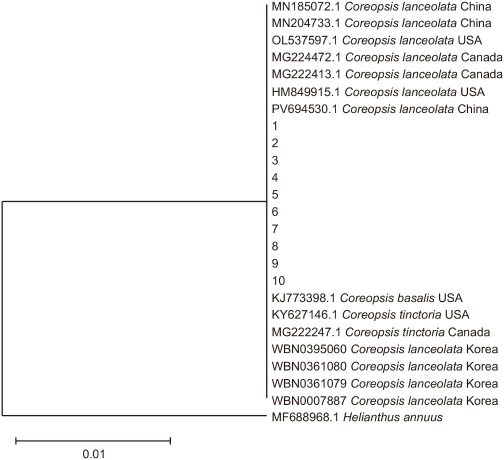
Fig. 2
Maximum likelihood phylogenetic tree was reconstructed based on the matK gene sequences of Helianthus annuus (Asteraceae) and Coreopsis spp.
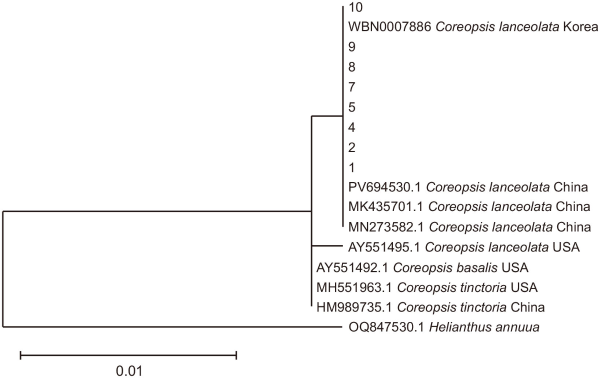
Table 1
Search results from the Korea Seed & Variety Service “Notification of Production, Import, and Sale of Varieties” (Coreopsis basalis)
| Certificate number | Seed name | Certificate number | Seed name | Certificate number | Seed name | Certificate number | Seed name |
|---|---|---|---|---|---|---|---|
| 04-0218-1999-1 | Geumgyegook.spp. (Coreopsis spp.) | 04-0218-2009-1 | Geumgyegook.spp. (Coreopsis spp.) | 04-0218-2013-2 | Geumgyegook.spp. (Coreopsis spp.) | 04-1019-2017-1 | Geumgyegook.spp. (Coreopsis spp.) |
| 04-0218-1999-2 | Geumgyegook.spp. (Coreopsis spp.) | 04-0218-2009-2 | Geumgyegook.spp. (Coreopsis spp.) | 04-0218-2014-1 | Geumgyegook.spp. (Coreopsis spp.) | 04-1019-2018-1 | Geumgyegook.spp. (Coreopsis spp.) |
| 04-0218-1999-3 | Geumgyegook.spp. (Coreopsis spp.) | 04-0218-2009-3 | Geumgyegook.spp. (Coreopsis spp.) | 04-0218-2014-10 | Geumgyegook.spp. (Coreopsis spp.) | 04-1019-2021-1 | Geumgyegook.spp. (Coreopsis spp.) |
| 04-0218-1999-4 | Geumgyegook.spp. (Coreopsis spp.) | 04-0218-2009-4 | Geumgyegook.spp. (Coreopsis spp.) | 04-0218-2014-11 | Geumgyegook.spp. (Coreopsis spp.) | 04-1019-2022-1 | Geumgyegook.spp. (Coreopsis spp.) |
| 04-0218-1999-5 | Geumgyegook.spp. (Coreopsis spp.) | 04-0218-2009-5 | Geumgyegook.spp. (Coreopsis spp.) | 04-0218-2014-12 | Geumgyegook.spp. (Coreopsis spp.) | 04-1019-2022-2 | Geumgyegook.spp. (Coreopsis spp.) |
| 04-0218-2004-1 | Geumgyegook.spp. (Coreopsis spp.) | 04-0218-2009-6 | Geumgyegook.spp. (Coreopsis spp.) | 04-0218-2014-2 | Geumgyegook.spp. (Coreopsis spp.) | 04-1019-2022-3 | Geumgyegook.spp. (Coreopsis spp.) |
| 04-0218-2004-2 | Geumgyegook.spp. (Coreopsis spp.) | 04-0218-2009-7 | Geumgyegook.spp. (Coreopsis spp.) | 04-0218-2014-3 | Geumgyegook.spp. (Coreopsis spp.) | 04-1019-2025-1 | Geumgyegook.spp. (Coreopsis spp.) |
| 04-0218-2004-3 | Geumgyegook.spp. (Coreopsis spp.) | 04-0218-2010-1 | Geumgyegook.spp. (Coreopsis spp.) | 04-0218-2014-4 | Geumgyegook.spp. (Coreopsis spp.) | 04-1020-2017-1 | Geumgyegook (Coreopsis basalis) |
| 04-0218-2004-4 | Geumgyegook.spp. (Coreopsis spp.) | 04-0218-2010-2 | Geumgyegook.spp. (Coreopsis spp.) | 04-0218-2014-5 | Geumgyegook.spp. (Coreopsis spp.) | 04-1020-2018-1 | Geumgyegook (Coreopsis basalis) |
| 04-0218-2005-1 | Geumgyegook.spp. (Coreopsis spp.) | 04-0218-2010-3 | Geumgyegook.spp. (Coreopsis spp.) | 04-0218-2014-6 | Geumgyegook.spp. (Coreopsis spp.) | 04-1020-2020-1 | Geumgyegook (Coreopsis basalis) |
| 04-0218-2005-2 | Geumgyegook.spp. (Coreopsis spp.) | 04-0218-2010-4 | Geumgyegook.spp. (Coreopsis spp.) | 04-0218-2014-7 | Geumgyegook.spp. (Coreopsis spp.) | 04-1020-2021-1 | Geumgyegook (Coreopsis basalis) |
| 04-0218-2005-3 | Geumgyegook.spp. (Coreopsis spp.) | 04-0218-2010-5 | Geumgyegook.spp. (Coreopsis spp.) | 04-0218-2014-8 | Geumgyegook.spp. (Coreopsis spp.) | 04-1020-2021-2 | Geumgyegook (Coreopsis basalis) |
| 04-0218-2005-4 | Geumgyegook.spp. (Coreopsis spp.) | 04-0218-2011-1 | Geumgyegook.spp. (Coreopsis spp.) | 04-0218-2014-9 | Geumgyegook.spp. (Coreopsis spp.) | 04-1020-2021-3 | Geumgyegook (Coreopsis basalis) |
| 04-0218-2005-5 | Geumgyegook.spp. (Coreopsis spp.) | 04-0218-2011-2 | Geumgyegook.spp. (Coreopsis spp.) | 04-0218-2015-1 | Geumgyegook.spp. (Coreopsis spp.) | 04-1020-2022-1 | Geumgyegook (Coreopsis basalis) |
| 04-0218-2006-1 | Geumgyegook.spp. (Coreopsis spp.) | 04-0218-2012-1 | Geumgyegook.spp. (Coreopsis spp.) | 04-0218-2015-2 | Geumgyegook.spp. (Coreopsis spp.) | 04-1020-2023-1 | Geumgyegook (Coreopsis basalis) |
| 04-0218-2006-2 | Geumgyegook.spp. (Coreopsis spp.) | 04-0218-2012-2 | Geumgyegook.spp. (Coreopsis spp.) | 04-0218-2015-3 | Geumgyegook.spp. (Coreopsis spp.) | - | |
| 04-0218-2007-1 | Geumgyegook.spp. (Coreopsis spp.) | 04-0218-2012-3 | Geumgyegook.spp. (Coreopsis spp.) | 04-0218-2015-4 | Geumgyegook.spp. (Coreopsis spp.) | - | |
| 04-0218-2007-2 | Geumgyegook.spp. (Coreopsis spp.) | 04-0218-2013-1 | Geumgyegook.spp. (Coreopsis spp.) | 04-0218-2016-1 | Geumgyegook.spp. (Coreopsis spp.) | - | |
Table 2
Purchased Coreopsis basalis seed list
| No. | Seed provider | Seed name | No. | Seed provider | Seed name |
|---|---|---|---|---|---|
| 1 | Gapjone | Geumgyegook | 6 | Hannong Mart | Geumgyegook |
| 2 | Garamwon | Geumgyegook | 7 | Seedling of Dongkook | Geumgyegook |
| 3 | Namheung Garden | Geumgyegook | 8 | On Seed | Geumgyegook |
| 4 | Market of Sandeul | Geumgyegook | 9 | Korea Falm | Geumgyegook |
| 5 | Joojoo Seed | Geumgyegook | 10 | World Seed Mall | Geumgyegook |
Table 3
Sample information and sequence identifiers (GenBank accession numbers and NIBR numbers) used in this study
| Species | Gene region | Sequence identifiers | Source |
|---|---|---|---|
| Coreopsis lanceolata | matK | AY551495.1, MN273582.1, MK435701.1, PV694530.1/WBN0007886 | GenBank/NIBR |
| rbcL | MN185072.1, MN204733.1, OL537597.1, MG224472.1, MG222413.1, HM849915.1, PV694530.1/WBN0395060, WBN0361080, WBN0361079, WBN0007887 | GenBank/NIBR | |
| Coreopsis basalis | matK | AY551492.1 | GenBank |
| rbcL | KJ773398.1 | GenBank | |
| Coreopsis tinctoria | matK | MH551963.1, HM989735.1 | GenBank |
| rbcL | KY627146.1, MG222247.1 | GenBank | |
| Helianthus annuus | matK | OQ847530.1 | GenBank |
| rbcL | MF688968.1 | GenBank |