Introduction
The family Atyidae comprises 46 genera and over 500 species distributed worldwide, with an average of 8 new species proposed annually over the past 11 years (Bernardes, 2024). While some species inhabit estuarine and coastal habitats, the majority are strictly freshwater species (De Grave et al., 2008; De Grave & Fransen, 2011), inhabiting bodies of water, including lakes, rivers, and aquatic habitats within caves on all continents except for Antarctica. However, they are predominantly distributed in tropical regions (De Grave et al., 2008; 2015). They also play an important role as consumers in the food web of ecosystems by reducing sediment, increasing algae production, and decomposing leaves (Crowl et al., 2001).
Ornamental Atyidae, comprising the genera Caridina and Neocaridina, has gained popularity among aquarium enthusiasts due to its vibrant coloration and relatively easy breeding characteristics. They are utilized for ornamental purposes and as a means of maintaining aquatic plant health (Englund & Cai, 1999; Patoka et al., 2016). Neocaridina davidi (Bouvier, 1904), more commonly referred to as the cherry shrimp, and Neocaridina denticulate (De Haan, 1844) are available for purchase in Korea through both online and offline channels, primarily through aquarium stores. These shrimp exhibit a broad spectrum of color variations, including red, yellow, orange, and blue (Greenfis, 2025). Additionally, continuous crossbreeding is conducted to obtain varieties of different colors (Levitt-Barmats et al., 2019).
The international import and distribution of these organisms is not merely a matter of economic activity. Such activities can cause various biological and ecological problems, including ecosystem disruption, introduction of pathogens, competition with native species, and genetic disruption (hybridization) (Šidagytė et al., 2017; Twardochleb et al., 2013; Zhang et al., 2019). Animals that are traded for ornamental purposes are kept in indoor aquariums and released into gardens and urban ponds (Hassall, 2014; Patoka et al., 2017). N. davidi, indigenous to Korea, China, and Vietnam (Cai, 1996; Wowor et al., 2004), is considered an invasive species in the United States and Japan due to its tolerance to a wide range of water quality and temperature conditions (Englund & Cai, 1999; Klotz et al., 2013; Niwa, 2010). Only three invasive Atyidae species are listed in South Korea (NIE, 2021), and there is a lack of basic data on import status and other related information. This poses challenges for the effective assessment of their potential risks and the establishment of management policies due to issues such as errors in species identification of imported individuals, inadequacies in field guides and databases, and information asymmetry between distributors and consumers (Keller et al., 2008).
Accordingly, the aims of this study were to investigate the current status of ornamental Atyidae imported into Korea and, based on this, update the list of invasive Atyidae that are likely to be introduced into the domestic ecosystem. This will provide basic data for future ecological risk assessment and biological security management strategies.
Case Report
The import/export quarantine statistics of the National Fishery Products Quality Management Service (NFQS) were used to determine the import status of ornamental Atyidae into South Korea from 2008 to 2024 (National Fishery Products Quality Management Service, 2025). The species information on aquatic mollusks whose import has been verified was obtained from the Global Biodiversity Information Facility (GBIF), the International Union for Conservation of Nature and Natural Resources (IUCN), and the Convention on International Trade in Endangered Species of Wild Fauna and Flora (CITES) (CITES, 2025; Global Biodiversity Information Facility, 2025; IUCN, 2025).
Discussion
Status of Atyidae imports into the Republic of Korea
A total of 26,141,659 Atyidae individuals belonging to 6 genera and 37 species were imported into South Korea for ornamental purposes from 2008 to 2024. The genus Caridina accounted for the majority in terms of the number of species (28 species; 75.7%), and the genus Neocaridina accounted for the majority in terms of the number of individuals (18,503,495 individuals; 70.8%) (Appendix 1). Among these, Caridina multidentata and Paratya compressa were identified as species documented in the National Species List (NIBR, 2025).
The annual fluctuations in imports have fluctuated between a low of 2 and a high of 24, rising steadily since 2008, dipping modestly from 2014, and rebounding after 2022 (Fig. 1A). The number of imported individuals was less than 1,000,000 prior to 2015 but has continued to increase, exceeding 1,000,000 since 2016 (Fig. 1B). These findings may be attributed to the fact that, in the context of pet imports, initial interest is spread across a broad spectrum of species. However, as the importation process progresses, interest gravitates toward a select few species that are more amenable to captivity and less demanding in terms of maintenance (Hausmann et al., 2023; Valdez, 2021).
Ornamental Atyidae is imported into South Korea from a total of 13 countries, i.e., Indonesia, the Philippines, the United States, Singapore, Vietnam, Sri Lanka, Taiwan, Nigeria, Germany, Malaysia, India, China, and Thailand. Of these, Indonesia exported the most species (30), followed by Taiwan (13), Singapore (10), and China (7), with species imported from these four countries accounting for about 91.9% (34 species) of the total. In terms of the number of individuals, Taiwan exported the highest number at 16,415,461 individuals, followed by Indonesia (5,148,325 individuals) and Thailand (4,250,035 individuals). The number of individuals imported from these three countries accounted for approximately 98.7% of the total (Fig. 2B).
Major species
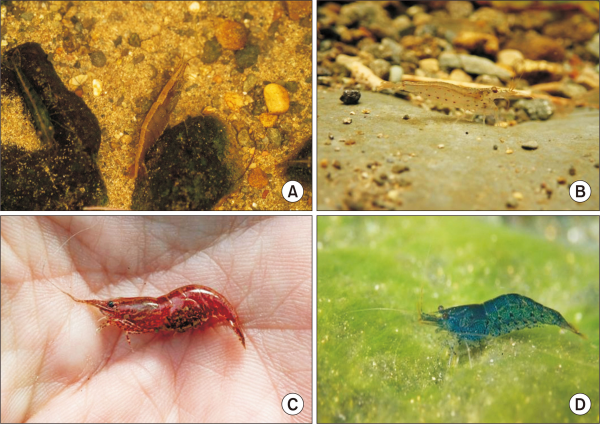
Among the imported species of Atyidae, Neocaridina heteropoda was the most prevalent, with a total of 9,879,643 individuals. This was followed by Neocaridina demticulata, which accounted for 4,968,114 individuals, C. multidentata (4,326,826 individuals), N. davidi (3,376,543 individuals), and Caridina cantonensis (2,093,899 individuals). These five species collectively constituted 94.3% of the total imported individuals (Fig. 3, Appendix 1) (Cheng, 2025; MSOne, 2025; Watanabe, 2025; Whispers of Aqua, 2025). Atyidae species are commonly farmed for the aquarium trade and have gained popularity as ornamental species due to their diverse coloration, which includes yellow, blue, red, white, and transparent (Kusmintarsih et al., 2025). These species hold economic value in both the aquaculture and aquarium sectors (Hung et al., 1993).
None of the imported Atyidae species was classified as endangered under the Convention on International Trade in Endangered Species of Wild Fauna and Flora (CITES). However, six species were identified as critically endangered (CR) and two as endangered (EN) in the IUCN Red List assessment, indicating an extremely high likelihood of extinction in the wild (IUCN, 2025). All eight species classified as CR and EN belong to the genus Caridina (Appendix 1).
Ecological risk
Among the ornamental Atyidae, N. davidi is regarded as an invasive species in the United States and Japan due to its capacity to tolerate a broad spectrum of water qualities and temperatures (Englund & Cai, 1999; Klotz et al., 2013; Niwa, 2010). Recent findings have also documented its presence in the Rhine River drainage system in Germany (Klotz et al., 2013). Ornamental Atyidae exhibit a high degree of susceptibility to external parasites that can lead to disease and mortality (Klotz et al., 2013). Ciliates are the most well-known pathogenic protozoan ectoparasites, which can rapidly spread among ornamental shrimp hosts and cause significant losses in shrimp under aquaculture conditions (Patoka et al., 2016). Furthermore, slight variations within populations resulting from the hybridization of the Atyidae species have led to the classification of Neocaridina denticulata sinensis and Neocaridina denticulata denticulata as native species (Cai, 1996; Hung et al., 1993; Oh et al., 2003; Shih & Cai, 2007), making it difficult to determine whether they are native or introduced species.
There have been no reported cases of ecological harm, such as competition with native species, disruption of food webs, habitat destruction, or disease transmission, caused by their introduction into ecosystems to date. However, implementing preventive measures against intentional and unintentional escape from aquariums, which are in the early stages of introduction, is essential given the potential for alien crustaceans to increase predation on native species or introduce new diseases or pathogens, thereby posing a threat to native species (Kusmintarsih et al., 2025). In addition, given that the major exporting countries of Atyidae are located in Southeast Asia, including Taiwan, Indonesia, and Thailand, the species’ ability to survive in artificially modified aquatic environments with heated effluent inflows, such as Jukdang Stream in the Republic of Korea, highlights the need for comprehensive surveys of rivers affected by heated discharges to assess its current distribution and potential spread (Park et al., 2025).
Author Contributions
Conceptualization: YP. Data curation: YP, DC, MJ. Formal analysis: YP. Funding acquisition: YP. Writing – original draft: YP. Writing-review & editing: YP.
Funding
This study was supported by the National Institute of Ecology, funded by the Ministry of Environment of the Republic of Korea (NIE-A-2025-12).
References
Cheng, H.T. (2025). Caridina cantonensis Yü, 1938. Global Biodiversity Information Facility. Retrieved Jun 24, 2025 from https://www.gbif.org/occurrence/3333419693.
Convention on International Trade in Endangered Species of Wild Fauna and Flora (CITES). (2025). Checklist of CITES species. Retrieved Jun 30, 2025 from https://checklist.cites.org/#/en.
Global Biodiversity Information Facility. (2025). Free and open access to biodiversity data. Retrieved Jun 30, 2025 from https://www.gbif.org/.
Greenfish. (2025). NeoCaridina Denticulata Var. Retrieved Jun 29, 2025 from https://www.greenfish.co.kr/m/product.html?branduid=2899&xcode=019&mcode=011&scode=&type=Y&sort=regdate&cur_code=019011&search=&GfDT=amp3UF4%3D.
International Union for Conservation of Nature and Natural Resources (IUCN). (2025). The IUCN red list of threatened species. Retrieved Jun 30, 2025 from https://www.iucnredlist.org/.
MSOne. (2025). Neocaridina davidi (Bouvier, 1904). Global Biodiversity Information Facility. Retrieved Jun 24, 2025 from https://www.gbif.org/occurrence/5167703573.
National Fishery Products Quality Management Service. (2025). Import (export) quarantine statistics. Retrieved Jun 20, 2025 from https://www.nfqs.go.kr/hpmg/data/actionExportQuarantineStatisticsForm.do?menuId=M0000225.
National Institute of Biological Resources (NIBR). (2025). The Biodiversity of the Korean Peninsula. Retrieved Jun 30 2025 from https://species.nibr.go.kr/nibrStats/statDownPage.do?artNo=1839.
Patoka, J., Bláha, M., Kalous, L., and Kouba, A. (2017). Irresponsible vendors: non‐native, invasive and threatened animals offered for garden pond stocking. Aquatic Conservation: Marine and Freshwater Ecosystems, 27, 692-697. https://doi.org/10.1002/aqc.2719
Watanabe, H. (2025). Neocaridina denticulata (De Haan, 1844). Global Biodiversity Information Facility. Retrieved Jun 24, 2025 from https://www.gbif.org/occurrence/4852681906.
Whispers of Aqua. (2025). Caridina multidentata Stimpson, 1860. Global Biodiversity Information Facility. Retrieved Jun 24, 2025 from https://www.gbif.org/occurrence/5063076546.
Figures
Fig. 1
Annual import status of ornamental Atyidae. (A) Number of species, (B) number of individuals.
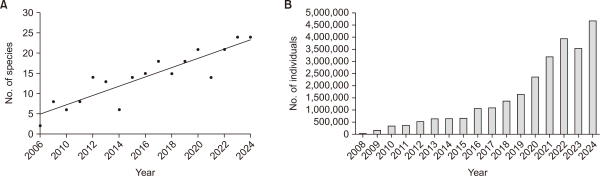
Fig. 2
Major importing countries of ornamental Atyidae. (A) Percentage of species, (B) percentage of individuals. IDN, Indonesia; TWN, Taiwan; SGP, Singapore; CHN, China; THA, Thailand.
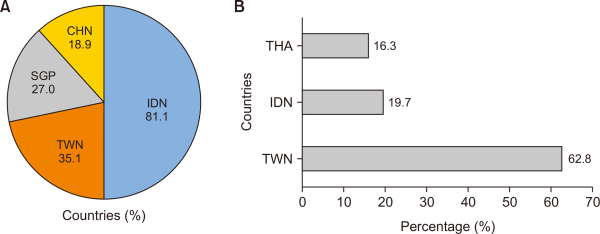
Fig. 3
Major imported species of ornamental Atyidae photos licensed under CC BY-NC 4.0 via Global Biodiversity Information Facility (Source: Cheng, 2025; MSOne, 2025; Watanabe, 2025; Whispers of Aqua, 2025). (A) Neocaridina denticulata, (B) Caridina multidentata, (C) Neocaridina davidi, (D) Caridina cantonensis.