Introduction
The Convention on International Trade in Endangered Species of Wild Fauna and Flora (CITES) is a system designed to protect wild animals and plants that are under threat of extinction due to illegal or excessive international trade (Convention on International Trade in Endangered Species Wild Fauna and Flora, 2025; Raymakers, 2006). Its aim is to curb the disorderly collection and capture of these species from their habitats. CITES consists of three appendices. Appendix I permits trade only for exhibition, scientific research, or medical research purposes. Appendix II permits international trade for commercial, scientific, or research purposes, but with regulations in place. Appendix III is similar to Appendix II, but requires an export permit and proof of origin, issued by the country of origin (Convention on International Trade in Endangered Species Wild Fauna and Flora, 2025). A total of 1,190 species and 12 subspecies of reptiles are designated as internationally endangered. Excluding the 105 species and 4 subspecies listed under Appendix I, commercial trade is permitted for all others (Convention on International Trade in Endangered Species Wild Fauna and Flora, 2025).
The order Crocodylia comprises three families, nine genera and 27 species, most of which are listed under CITES Appendices I or II. Crocodilians imported into South Korea are primarily for exhibition purposes (Convention on International Trade in Endangered Species Wild Fauna and Flora, 2025).
The genus Crocodylus, which includes the saltwater crocodile (Crocodylus porosus), contains 13 species, the largest number within the order. C. porosus is listed on Appendix I and II of the International Endangered Species List (Convention on International Trade in Endangered Species Wild Fauna and Flora, 2025). Its native range includes countries in the South Pacific such as Australia, Bangladesh, Indonesia, Papua New Guinea, and Vietnam (Webb et al., 2018). As C. porosus capable of migrating over 1,000 km, it is also found in brackish waters. Males can grow up to 7 meters in total length (TL) and weigh up to 1,100 kg, while females reach a maximum length of 3.4 meters (Webb et al., 2018).
C. porosus strongly recognize humans as prey and are fast and agile. In East Nusa Tenggara, Indonesia, hundreds of human attacks by C. porosus occur annually (Sideleau et al., 2021). In Australia, 102 saltwater crocodile attacks were reported between 1971 and 2013 (Manolis & Webb, 2013). Therefore, if they were to be introduced into the wild domestically, they could cause serious human casualties.
To date, no crocodiles have been found in the wild within the country. Only 2 newses were released in 2023 reporting a sighting of a crocodile approximately 1 meter in length in Yeongju, Gyeongsangbuk-do (JoongAng Ilbo, June, 27, 2023). Additionally, a report of a crocodile sighting in Sancheong was confirmed based on a private tip, but no actual individual was identified during subsequent investigations. Later, in 2024, a dead carcass of C. porosus was newly observed in Sacheon, Gyeongsangnam-do, via an individual’s social media.
Therefore, in the present study aims to provide the first discovery report on the C. porosus found in Sacheon and to identify additional habitats in Sancheong, Gyeongsangnam-do, where crocodiles have been sighted before the discovery site. Furthermore, we conducted to investigate the current situation of C. porosus and other introduced crocodilian species, and to evaluate the management of endangered species.
Case Report
On 1 August 2024, a report was confirmed via personal social networking services of C. porosus being discovered in Seopo-myeon, Sacheon-si, Gyeongsangnam-do (35°02’18”N 127°58’07”E). On 8 August, we contacted the YouTuber to request the location of the discovery and a sample of C. porosus (Fig. 1A).
The specimen was examined morphologically, and genetic analysis was performed to achieve a more accurate species identification. The specimen was identified visually, and their total body length and tail length were measured. Genetic analysis of tongue muscle tissue was performed to achieve a more accurate species identification. The mitochondrial DNA (mtDNA) COI gene was amplified for species identification. DNA extraction was performed using the Clear-STM Quick DNA Extraction Kit (IVT3002) from INVIRUSTECH (Gwangju, Korea). Polymerase chain reaction (PCR) amplification of mtDNA COI was performed using primers from Gani et al. (2023) with Elpisbio’s (Daejeon, Korea) EzPCR™ HS 5X Master Mix (Table 1). The thermal cycling conditions consisted of 35 cycles: initial denaturation at 94°C for 5 minutes, followed by denaturation at 94°C for 15 seconds, annealing at 58°C for 45 seconds, extension at 72°C for 50 seconds, and a final extension at 72°C for 4 minutes. The resulting sequences were compared to GenBank data using the BlastN algorithm provided by the National Center for Biotechnology Information.
To identify additional habitats, water samples were collected from three locations (35°17’26.49”N 127°57’ 55.55”E; 35°17’2.03”N 127°57’39.78”E; 35°16’41.94”N 127°57’46.46”E) along the Namgang River in Sancheong, Gyeongsangnam-do, where crocodiles were reported sighted, and environmental DNA analysis was conducted (Fig. 1B). Due to, the Nam River is a waterway over 200 meters wide with strong currents and deep water, making it difficult to access. Consequently, identifying suitable sampling points was challenging, and sampling was primarily conducted at accessible locations. At each site, 1 L of water was collected and homogenized. Of this, 1 L was filtered through a 0.45 μm filter for DNA extraction. Subsequently, the mtDNA ND4 gene was amplified following the analysis method of Rose et al. (2020), and digital qPCR was performed a total of three times (Table 1).
To confirm the status of C. porosus introduced domestically, the import history of saltwater crocodiles into South Korea from 1982 to 2023 was investigated. The importing countries, number of individuals, source and import purposes were identified (CITES Secretariat & UNEP-WCMC, 2022).
Discussion
The crocodile was found dead on a two-lane road next to farmland (Fig. 1A). The individual was relatively clean, except for an injury to its left side. It was found on an asphalt road running parallel to the Gonnyangcheon Stream, approximately 530 metres from the stream in a straight line. The stream is a brackish estuary connected to the sea, meeting the ocean at its southernmost point 700 metres away. The presence of two ridges and the absence of a hump on the snout revealed that the carcass was that of a C. porosus (Lafleur et al., 1995). The TL of C. porosus was 70.40 cm, with a tail length of 54.23 cm. After reporting the carcass to the Ministry of Environment, it was prepared as a specimen and is currently being stored by the Invasive Alien Species Team at the National Institute of Ecology.
Further genetic analysis of the partial COI gene (694 bp) was identical to that of C. porosus (HQ595046) and showed high sequence similarity with other C. porosus accessions (≥99.70%; DQ273698, NC_008143; Table 2). Therefore the final identification of C. porosus was confirmed. The environmental DNA analysis using mtDNA COI revealed no evidence of crocodile presence in samples collected from the Namgang River in Sancheong, where crocodiles have been reported. This likely indicates either extremely low residual DNA levels due to the Namgang being a flowing water area, or a significantly low probability of crocodile habitation. However, limitations exist in the present study, such as the restricted sampling areas analyzed. Therefore, it is deemed necessary to conduct future studies to enhance detection sensitivity, including repeated surveys, increasing sample size and replication numbers, and evaluating detection limits (LOD/LOQ). Furthermore, since eDNA surveys were not conducted in Sacheon, where C. porosus have been confirmed, additional analysis in waterways and rivers within the discovery site is required in the future.
To determine the import status of crocodilians introduced into South Korea, we examined the species imported from 1982 to 2023, their countries of origin and import, and purpose and source. The results confirmed that a total of 12 species and three subspecies of internationally endangered crocodilians, a total 5,687 individuals, were imported into the South Korean market. Of the 20 species confirmed as being on the endangered species list, 60% had import records, primarily for commercial purposes. Of these, C. porosus was imported, between 1997 and 2020 from Malaysia, Thailand, and Spain with 50 individuals in total (Table 3). The imported C. porosus originated from Australia and Papua New Guinea, and were confirmed to be either wild-caught animals, animals bred for commercial purposes as defined in Appendix I, or eggs or larvae collected from the wild. C. porosus primarily imported for exhibition purposes (circus, travelling exhibition, commercial or zoo) and no record of it being imported for private breeding (CITES Secretariat & UNEP-WCMC, 2022).
C. porosus are ferocious predators known for their agility and speed, exhibiting aggressive behavior immediately after hatching (Brien et al., 2013). They have been confirmed to cause serious injuries to humans in Australia, Indonesia, East Timor, and Sri Lanka (Amarasinghe et al., 2015; Manolis & Webb, 2013; Sideleau et al., 2016; 2021), with a high mortality rate reaching up to 82.2% (Sideleau et al., 2016). Should this apex predator be introduced into domestic ecosystems, the potential negative impacts on human beings and the ripple effects on aquatic ecosystems are anticipated to be severe. Furthermore, control efforts are expected to present significant challenges.
Considering that the C. porosus discovered in Sacheon was a juvenile, it could have been an illegally smuggled individual or one bred in captivity. In fact, in 2024, a case was uncovered where approximately 1,800 live reptiles, including Varanus komodoensis, were being smuggled (Yonhap News, November 14, 2024), and another case in the same year where individuals attempted to illegally smuggle Caimaninae and Anaconda (MBC, August 4, 2021). Additionally, abandonment of internationally endangered species continues to occur, such as the 2025 Yangyang Python regius abandonment (KBS, June 24, 2025), the 2023 abandonment of a Testudo horsfieldii and Varanus exanthematicus confirmed in Hongseong and Yesan (Newsis, October 4, 2023), and the abandoned P. regius found in Jeju in 2020 (YTN, November 18, 2020), abandonment of internationally endangered species continues to occur.
Consumption of exotic animals is increasing annually (Baek et al., 2023), and it has been confirmed that approximately 60 species (43.2%) of reptiles distributed domestically each year correspond to internationally endangered species (Ministry of Environment, 2020).
As of 2022 according to the 「Wildlife Protection and Management Act」, all Crocodylia species require breeding facility registration and artificial propagation permits, which makes private breeding practically impossible. These strengthened legal regulations are measures to restrict indiscriminate breeding and prevent the increase of individuals within the country. The 「Wildlife Protection and Management Act」 stipulates that illegally possessing or distributing internationally endangered species is punishable by up to three years imprisonment or a fine not exceeding thirty million won. It is deemed necessary to more widely publicize these legal sanctions and designate a grace period for voluntarily registering internationally endangered species held illegally to encourage voluntary compliance. In addition to these legal restrictions, it is deemed necessary to continuously monitor invasive species entering the country, and it is judged that broader data collection utilizing citizen science and similar approaches will be required.
Author Contributions
Conceptualization: HB, JA. Data curation: HB, JA, BJ, MC. Formal analysis: HB. Funding acquisition: JA. Investigation: HB, JA. Methodology: HB. Project administratiom: HB. Resources: JA. Software: HB, MC. Supervision: HB. Validation: HB. Visualization: BJ, MC. Writing – original draft: HB. Writing – review & editing: HB, JA, BJ, MC.
Funding
This work was supported by a grant from the National Institute of Ecology’s Invasive Alien Species Team NIE-A-2025-08 and NIE-C-2025-32.
References
Convention on International Trade in Endangered Species Wild Fauna and Flora. (2025). Appendices I, II and III. Retrieved Aug 26, 2025 from https://cites.org/eng/app/appendices.php.
Manolis, S.C., and Webb, G.J.W. (2013). Assessment of saltwater crocodile (Crocodylus porosus) attacks in Australia (1971-2013): implications for management. Paper presented at World Crocodile Conference, 22nd Working Meeting of the Crocodile Specialist Group of the Species Survival Commission of the IUCN, Negombo, Sri Lanka.
Ministry of Environment. (2020). Study to develop a wildlife sale and private ownership management plan. Retrieved Aug 26, 2025 from https://ecopi.co.kr/index.php?mid=board_NtgR13&page=2&document_srl=80008&m=0.
Figure and Tables
Fig. 1
The present study's research sites. (A) The location where Crocodylus porosus carcass was discovered in Sacheon, Gyeongsangnam-do. (B) Location for collecting environmental samples to confirm additional habitats in Sancheong, Gyeongsangnam-do. Red circles: eDNA sampling points; yellow stars: observed point.
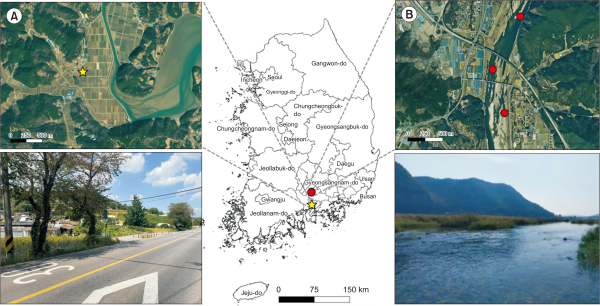
Table 1
Primers used for DNA amplification
| Maker | Primer name | Primer sequence (5’→3’) |
|---|---|---|
| partial COI | COIf | CCTGCAGGAGGAGGAGAYCC |
| COIa | AGTATAAGCGTCTGGGTAGTC | |
| eDNA | Croc_ND4 Gene_F | CCCTTCTAATCGCACTTCTATGG |
| Proving | TET-TGCGTCTATTACACTCTTACAGCTACTCCC-IDQ | |
| Croc_ND4 Gene_R | GCGTGTTTGTTCAGAATCTTAGG |
Table 2
COI BlastN search results for the COI gene sequence isolated from the crocodile found in the present study
| Description | Identity (%) | Accession |
|---|---|---|
| Crocodylus porosus voucher Cpo1 cytochrome c oxidase subunit I gene, partial cds; mitochondrial | 100.00 | HQ595046 |
| Crocodylus porosus mitochondrion, complete genome | 99.70 | DQ273698 |
| Crocodylus porosus mitochondrion, complete genome | 99.70 | NC_008143 |
Table 3
Status of live Crocodylus porosus imports into South Korea from 1982 to 2023 (year, number of individuals, exports countries, origin, purpose, source)
| Species | Year | No. individuals | Exports | Origin | Purpose | Source |
|---|---|---|---|---|---|---|
| C. porosus | 1997 | 3 | MY | Q | W | |
| 2001 | 7 | TH | T | D | ||
| 2002 | 20 | TH | Z | D | ||
| 2003 | 10 | TH | T | D | ||
| 2016 | 4 | TH | AU | T, Z | D | |
| 2020 | 6 | ES | PG | T | R, C |
MY, Malaysia; TH, Thailand; ES, Spain; AU, Australia; PG, Papua New Guinea; Q, circus or travelling exhibition; T, commercial; Z, zoo; W, specimens taken from the wild; D, Appendix-I animals bred in captivity for commercial purposes; R, ranched specimens: specimens of animals reared in a controlled environment, taken as eggs or juveniles from the wild; where they would otherwise have had a very low probability of surviving to adulthood; C, animals bred in captivity.