Introduction
Osteoglossiformes, meaning “bony tongue” in Greek, is a relatively primitive order of teleost fishes (Greenwood & Wilson, 1998). All extant species inhabit freshwater bodies across tropical and subtropical regions worldwide (Greenwood & Wilson, 1998). Globally, Osteoglossiformes comprises 241 species in five families, and two species are listed under Cites: Scleropages formosus in Appendix I and Arapaima gigas in Appendix II (CITES, 2025; Nelson et al., 2016). Most species are large (in body length) and carnivorous, marking them highly valued in the ornamental fish market (Nelson et al., 2016), and the market for large ornamental fish is rapidly expanding (França et al., 2017; Garcia et al., 2014).
Representative species include A. gigas, Chitala ornate, Osteoglossum bicirrhosum, and S. formosus. Species belonging to the genera Arapaima and Chitala have been reported as invasive in several countries (Camacho & Taniegra, 2021; Miranda-Chumacero et al., 2012). Invasive species may cause population declines or even extinctions of native fauna through predation, competition for resources, habitat alteration (Forneck et al., 2016), or the introduction of novel pathogens (Putra et al., 2018). One of the major pathways for the introduction of non-native species is the global pet trade (Early et al., 2016; Novák et al., 2020). Freshwater organisms kept as pets for ornamental purposes have been known to escape or been intentionally or accidentally released from aquaria (Marková et al., 2020).
However, the 2014 non-native species list included only 15 species of Osteoglossiformes, and information on their import status or countries of origin is unavailable (Bang et al., 2014; NIE, 2021). Systematic management and assessment of ornamental fish that may pose potential biosecurity threats are required; therefore, securing baseline data on ornamental fish being imported into Korea is essential.
Accordingly, this study aims to investigate the import records of ornamental Osteoglossiformes into Korea, update the list of non-native fish species, and provide baseline data for future ecological risk assessments and biosecurity management strategies.
Case Report
To examine the import status of ornamental freshwater aquatic animals we used import/export quarantine statistics from the National Fishery Products Quality Management Service (NFQS, 2025) of Korea from 2009 to 2024 and analyzed the import status of legally confirmed imported ornamental freshwater aquatic animals. The taxonomic classification of imported Osteoglossiformes, and whether they are considered internationally threatened species, were obtained from Global Core Biodata Resource and Convention on International Trade in Endangered Species of Wild Fauna and Flora (CITES, 2025; GBIF, 2025) databases.
Discussion
Status of Osteoglossiformes imports into the Republic of Korea
An analysis of ornamental Osteoglossiformes imported into Korea from 2009 to 2024 revealed that a total of 175,797 individuals representing 42 species across six families have been imported. Among the imported Osteoglossiformes, Mormyridae constituted the largest share with 25 species (59.5%), followed by Notopteridae (eight species), Osteoglossidae (five species), Arapaimidae (two species), and Gymnarchidae and Pantodontidae (one species each) (Appendix 1). Osteoglossiformes are not recorded in the National Species List of Korea (NIBR, 2025), while the 2014 non-native species list included 15 species: six Notopteridae, five Osteoglossidae, two Arapaimidae, and one Gymnarchidae, and one Pantodontidae (Bang et al., 2014; NIE, 2021).
Examining the data by year, the average number of species imported per year was 19.9±2.9. Since imports were confirmed in 2009, the number of species has continuously increased, except for a slight decrease between 2018 and 2019 (Fig. 1A). The average number of individuals imported per year was 6,746.0±2,400.9, and except in 2021, annual imports never exceeded 10,000 individuals (Fig. 1B). Large-bodied species were previously sold only in aquarium shops, but with the growing popularity of online media and e-commerce, their potential market appears to be expanding (Magalhães et al., 2017).
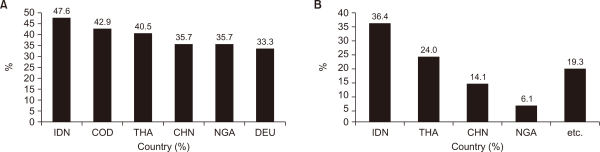
A total of 16 countries exported ornamental Osteoglossiformes to Korea: Indonesia, Congo, Thailand, China, Nigeria, Germany, Singapore, Taiwan, Guinea, Malaysia, Colombia, Peru, India, Japan, Kenya, and Vietnam (Appendix 1). Among these countries, Indonesia accounted for the largest number of species exported (20), followed by Congo (18), Thailand (17), China and Nigeria (15), and Germany (14). Collectively, these top five countries accounted for more than 30% of all imported species (Fig. 2A). By the number of individuals imported, Indonesia led with 64,008 (36.4%), followed by Thailand with 42,236 (24.0%), China with 24,872 (14.1%), and Nigeria with 10,750 (6.1%); collectively, these four countries accounted for 80.6% of all imported individuals (Fig. 2B).
Major species
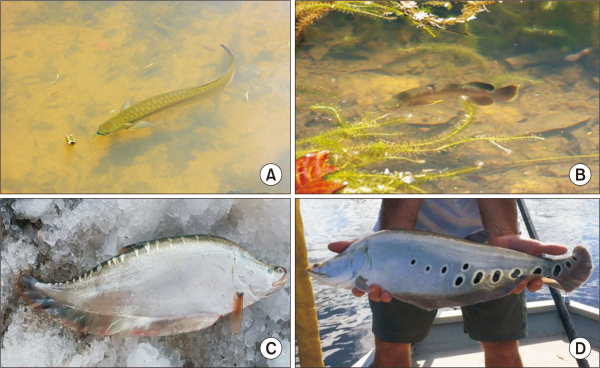
Among imported Osteoglossiformes, O. bicirrhosum recorded the highest number of imports (66,921 individuals; 38.1%), followed by Chitala chitala (22,763; 12.9%), Chitala ornata (15,512; 8.8%), S. formosus (13,869; 7.9%), Gnathonemus petersii (10,344; 5.9%), and Mormyrus longirostris (10,256; 5.8%). These six species together accounted for 79.4% of the total imported individuals (Fig. 3, Appendix 1) (Han, 2022; Leela123_nunna, 2022; Tong, 2021; Wingedg2, 2017). Two of the imported species (4.7%) were identified as internationally threatened under CITES (Appendix 1). S. formosus has been continuously imported since 2009 despite being listed in CITES Appendix I, which includes species threatened with extinction for which international commercial trade is generally prohibited. A. gigas has also been continuously imported since 2010 and is listed in Appendix II, which covers species not necessarily currently threatened with extinction but whose trade must be regulated to prevent unsustainable exploitation. Under the CITES permitting system, Appendix I specimens may be traded only under exceptional, non-commercial circumstances and require both export and import permits, whereas Appendix II specimens require an export permit (or re-export certificate) issued by the exporting country following verification of legal acquisition and a non-detriment finding (CITES, 2025).
In the ornamental trade of large fish species, O. bicirrhosum and S. formosus are highly popular among collectors, not only for their size (up to 90 cm or more), varied coloration, shiny scales, and other external traits, but also because they are regarded as symbols of luck and wealth, which contributes to their high market value (Yue et al., 2020).
Ecological risk
Among the Osteoglossiformes, which are mostly carnivorous and large-bodied, the imported species A. gigas and C. ornata have already been reported as invasive in certain countries (Camacho & Taniegra, 2021; Miranda-Chumacero et al., 2012).
A. gigas, known as the pirarucu, is the largest and most iconic freshwater fish of the South American Amazon, and can reach up to 4 m in length and 200 kg in weight (Castello et al., 2009; Hrbek et al., 2005; U.S. Fish & Wildlife Service, 2022). It has been heavily exploited as a food source over a long period and is currently listed under CITES Appendix II (CITES, 2025; Hrbek et al., 2007). While climate constraints (minimum lethal temperature, 16°C) may limit the establishment and spread of A. gigas, its populations have been confirmed in Peru and Bolivia following its introduction to these regions. In northern Bolivia, declines in native fish populations, including many species of high commercial value, have been reported (Van Damme, 2006). C. ornata is also native to the Mekong and Chao Phraya river basins in Southeast Asia and is a large predatory species reaching up to 1 m in length (U.S. Fish & Wildlife Service, 2017). In Laguna de Bay, Philippines, a typhoon in 2009 led to the escape of numerous animals from aquaculture facilities. After this event, C. ornata rapidly spread and reached approximately 40% of the total catch within two years, causing severe damage to both native and farmed fish species (U.S. Fish & Wildlife Service, 2017).
These large carnivorous species have few natural predators in recipient habitats. By competing with or directly preying on native fish, they can contribute to declines in native fish populations. The primary pathway for the introduction of such non-native species is the international pet trade (Early et al., 2016; Novák et al., 2020), and freshwater animals kept for ornamental purposes have been known to escape or be intentionally/accidentally released from aquaria (Marková et al., 2020). In Korea, the presence of the gastropods Melanoides tuberculata and Mieniplotia scabra—popular in the ornamental trade as “clean-up” organisms that help control algae and organic matter and capable of parthenogenetic reproduction—has recently been confirmed in the Jukdang Stream (Park et al., 2024; Park et al., 2025). These species have a high potential to establish in rivers and lakes within tropical and subtropical regions; in Korea, they may also establish in rivers sections influenced by warm-water discharge, underscoring the need for long-term monitoring (Park et al., 2024).
Author Contributions
Conceptualization: YP. Data curation: YP, DC, MJ. Formal analysis: YP. Funding acquisition: YC. Writing – original draft: YP, YC. Writing – review & editing: YP, YC.
Conflict of Interest
Youngho Cho is an editorial board members of the journal, but was not involved in the review process of this manuscript. Otherwise, the authors declare that they have no competing interests.
Funding
This study was supported by the National Institute of Ecology, funded by the Ministry of Environment of the Republic of Korea (NIE-A-2026-12).
Figures
Fig. 1
Annual import status of ornamental Osteoglossiformes. (A) Number of species, (B) number of individuals.
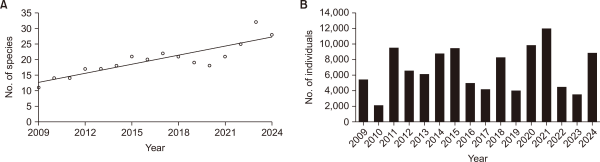
Fig. 2
Major imported species of ornamental Osteoglossiformes. Photos licensed under CC BY-NC 4.0 via GBIF: (A) Osteoglossum bicirrhosum (Tong, 2021); (B) Scleropages formosus (Han, 2022); (C) Chitala chitala (Leela123_nunna, 2022); (D) Chitala ornata (Wingedg2, 2017).