
- P-ISSN 1225-0163
- E-ISSN 2288-8985



Additive Manufacturing is a new innovative way to create parts in multiple layers and allows for the production of complex geometries along with highly customisable components for use in various industries; aerospace, automotive, biomedical, and defence. The popular methods of AM is Fused Deposition Modelling (FDM) due to its practical and cost-effective nature. FDM uses extruded thermoplastic filament to make 3D parts out of a wide range of materials such as Polylactic Acid (PLA) and Acrylonitrile Butadiene Styrene (ABS) with great design freedom. Despite the popularity/ease of use of FDM, there continue to be hurdles to overcome for achieving uniform surface roughness and dimensional accuracy, which are instrumental to functional performance and the industrial acceptance of printed parts. The purpose of this research is to analyse how ironing impacts the surface finish of 3D printed PLA samples using Fused Deposition Modelling (FDM). The research will utilise a RSM based design of experiment (DOE) methodology to prepare 20 samples and the specimens will be manufactured by varying the print speed, layer thickness, and amount of infill during the print process. From surface roughness analysis, it is observed that surface finish enhanced significantly with ironing process by reducing Ra from 3.527 µm to 2.098 µm with an improvement of 40.52 % at 0.13 mm layer thickness. The significant smoothing effect is identified by ironing since average roughness was reduced from 6.000 µm to 4.310 µm. The surface quality improvement is due to the combined heat, pressure, and material redistribution from the ironing processes.
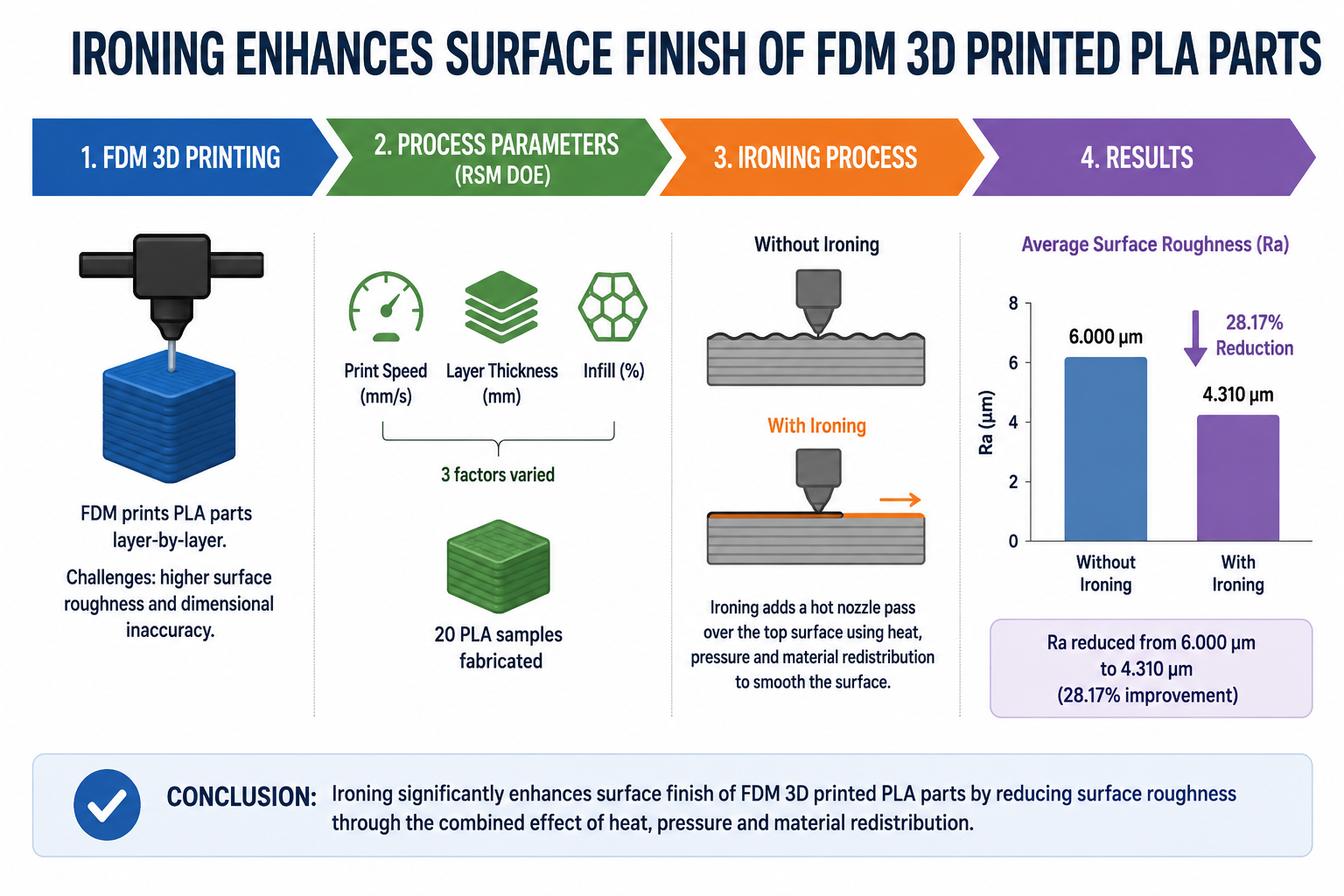
.png "AST-2026-021_R1_P_Graphical Abstract_001 (1).png")







This website recommended the use the Chrome browser for journal website.