

- P-ISSN2287-9099
- E-ISSN2287-4577
- SCOPUS, KCI

Factors Influencing the Use of Recommendation Systems for Elderly Research in Thailand


Wirapong Chansanam (Department of Information Science, Faculty of Humanities and Social Sciences, Khon Kaen University, Khon Kaen, Thailand)

Abstract
This study examines factors influencing the use of recommendation systems for elderly research in Thailand through a quantitative research design. The target population comprises researchers experienced in elderly studies from 2012 to 2022, totaling 348 participants. Data were collected via a validated questionnaire (Cronbach’s alpha=0.955). Employing an extended the Unified Theory of Acceptance and Use of Technology 2 model, the study investigates system use behavior (SUB) based on seven core factors: Performance expectancy (PEF), effort expectancy (EFF), social influence, personal innovativeness (INN), hedonic motivation (MOT), facilitating conditions (FAC), and intention behavior (IBV), alongside three additional factors—system quality (SQU), information quality (IQU), and trust. Multiple correlation and regression analyses reveal statistically significant influences (p<0.05) from eight factors. SQU, PEF, EFF, MOT, FAC, and IBV positively influence SUB. Conversely, IQU and INN negatively affect system usage. The predictive model is expressed as: SUB=1.195+0.116 (SQU)-0.268 (IQU)+0.134 (PEF)+0.181 (EFF)-0.406 (INN)+0.137 (MOT)+0.097 (FAC)+0.866 (IBV). These findings underscore the importance of optimizing system features and recognizing the distinct needs and expectations of elderly research communities to enhance the effectiveness of these recommendation systems.
- keywords
- elderly research, influencing factors, Unified Theory of Acceptance and Use of Technology 2 model, multiple regression analysis, system use behavior, Thailand
1. INTRODUCTION
1.1. Challenges in Accessing and Organizing Elderly Research
Research is an important tool used in various aspects of national development. It is key to the process of discovering new areas of knowledge through systematic research, analysis, or experimentation using equipment or methods. This can uncover facts or principles to use in setting rules, theories, or guidelines for practice, as well as leading to the discovery of facts and leading to guidelines for problem solving and development (Babbie, 2021). Promoting guidelines for the development of research on gerontology is important and attractive in the current era. This makes it possible to know the knowledge that researchers have already studied, and to build on previous knowledge to develop new knowledge. It can also be used to develop important innovations that are consistent with the problems and needs of the country, and to allocate budgets to support research efficiently. There has been a great deal of research on the elderly published in various databases, and so it is difficult to access the knowledge within the research results to use them for benefit. Therefore, it is necessary to use tools to analyze this enormous amount of research data.
In addition, Thailand has entered an aging society since 2021. It appears that the population aged 60 years and above has increased by 32 percent. It is predicted that in 2040 Thailand will have an elderly population (60 years and over) of up to 32.1 percent (Department of Older Persons, the Ministry of Social Development and Human Security, 2021). This is a key challenge in that Thailand needs to recognize the relationship between longer life expectancy and better health. This is considered an extremely important opportunity for the country’s economic and social development (Britz, 2007; Klarin, 2018). Entering an aging society is a challenge for Thailand, focusing on research for an aging society to develop policies for people of all ages to have a good quality of life. This can lead to a valuable life on their own by creating a mechanism that facilitates living together happily and welcomes an aging society, encouraging the elderly to have good health and be self-reliant. Developing integrated research that reflects the values of the elderly can create technology and innovation-assisted living for the elderly and disabled, so as to be able to live a quality life according to international standards (Artsanthia & Pomthong, 2018).
1.2. The Imperative of Research
An investigation into research information regarding the elderly was conducted using the Thai National Research Repository (TNRR) of the Office of the Science Promotion Board for Research and Innovation and the Thailand Library Network System over the past decade, from 2012 to 2022. This search yielded a total of 957 items. Upon analyzing this data, it was observed that some research entries contained only abstract documents, while others included full document files. Consequently, themes or critical points of the research focus on the elderly for researchers and searchers. As a result, the search returns results with unrelated content or research details. Therefore, there is a lack of reliability in accessing information in research (Bobadilla et al., 2009; Stair & Reynolds, 2012). In addition, it was found that the information in research document files appearing in the information system was diverse and scattered. It is difficult to collect knowledge and there is still duplicate storage. As a result, searching or accessing information is not efficient. There are obstacles to the use of research information on the elderly. It was also found that in storing research information in the system, there is still a lack of in-depth content relationship analysis. As a result, the search becomes more complicated. It is difficult to use the information system and at the same time, it also reflects the quality of research information system development (Deldjoo et al., 2018; 2020). The current information search system for research on the elderly has revealed that there has not yet been a knowledge organization process for collecting, creating, organizing, storing, and disseminating in-depth research knowledge on the elderly. To support ease of access to research information and ease of use of information systems while reducing duplication, the problem of the distribution of a large amount of information can be solved by linking research data on the elderly in the same or related fields by organizing knowledge systems (Hjørland, 1994). This can also be applied to information systems for organizing collections, document classification, and information extraction as well (Noy & McGuinness, 2001).
1.3. The Unified Theory of Acceptance and Use of Technology
Recommendation systems are the most widely used information systems today. These are systems that use user behavior data to process and present information that is expected to best meet the needs of users, so that users can decide on the information that the system has presented to them. The information advisory system format has the characteristics of providing proactive services that automatically present the information that users need. This is different from passive information search, where users only access information when they have a need for it (Ghauth & Abdullah, 2010). The recommendation system has limitations in recommending information (Bjelica, 2010; Bobadilla et al., 2009; 2010). It is only up to users with personal information in the system to be able to recommend information that is most relevant to their needs. Today, recommendation systems are increasingly being used in applications such as the web (Göksedef & Gündüz-Öğüdücü, 2010; Ochi et al., 2010); e-learning books (Bobadilla et al., 2009; Salehi & Kmalabadi, 2012); tourism (Isinkaye et al., 2015; Lorenzi et al., 2011); movies (Bobadilla et al., 2010); music (Yang et al., 2020); e-commerce, news, specialized research resources (Porcel et al., 2009); television programs (Bjelica, 2010; Shin & Woo, 2009), etc.
Therefore, it is very necessary to study the factors influencing the use of the recommendation systems in Thailand, because it is the first step in the principles of system development to know the behavior and needs of system users, and to know important factors that are related to the use of the system to provide research advice on the elderly in Thailand. Using the system to analyze and design quality recommendations is consistent with and responds to the needs of specific user groups. Various theoretical models have been created. To predict the acceptance and use of technology, the Unified Theory of Acceptance and Use of Technology (UTAUT), is a framework developed by Venkatesh et al. (2003). To predict technology adoption for organizations, UTAUT was developed based on the integration of eight previously unique structural models: Theory of Reasoned Action (Ajzen, 1991; 2011; Ajzen & Fishbein, 1975; 1980; 2005), Technology Acceptance Model (Davis, 1986; 1989; Davis et al., 1989; Davis & Venkatesh, 1996), Motivational Model (Davis, 1993), Theory of Planned Behavior (Ajzen, 1991; Ajzen & Fishbein, 1980), Combined Technology Acceptance Model and Theory of Planned Behavior (Taylor & Todd, 1995), Model of Personal Computer Utilization (Thompson et al., 1991), Innovation Diffusion Theory (Moore & Benbasat, 1991), and Social Cognitive Theory (Compeau et al., 1999).
Venkatesh et al. (2012; 2016) presented UTAUT with four main factors that influence the intention and use of information technology. The first factor is performance expectancy (PEF), which is the degree to which a person believes that using the system will help them gain profit in their career. The second factor, effort expectancy (EFF), is the level of ease involved in using the system. The third factor, facilitating conditions (FAC), is the degree to which individuals believe they have the organizational and technical infrastructure to support use of the system. The fourth factor is social influence (SOC), which is the degree to which individuals perceive that SOC influences the use of the new system. Despite the widespread acceptance and popularity of UTAUT, Venkatesh et al. (2003; 2012; 2016) reviewed the importance of changing user behavior. Therefore, we improved and added three main factors to UTAUT, namely hedonic motivation (MOT), price value, and habit. To expand UTAUT to Unified Theory of Acceptance and Use of Technology 2 (UTAUT2) and by comparing UTAUT with UTAUT2, it was found that a key result of this improvement was the explained variance in behavioral intentions (56 percent to 74 percent) and technology use (40 percent to 52 percent) (Chang, 2012; Chauhan, 2015; Van Droogenbroeck & Van Hove, 2021).
While numerous studies on elderly populations have emerged, the effective use of this extensive body of knowledge remains challenging due to the lack of well-organized systems to facilitate research access. Given Thailand’s rapid transition into an aging society—projected to reach over 32% of the elderly by 2040—there is an urgent need to develop efficient recommendation systems tailored explicitly for elderly research. Current systems often provide fragmented, incomplete, or irrelevant results, undermining research productivity. Thus, understanding the determinants influencing the adoption of such recommendation systems is essential.
The primary objective of this study is to investigate and analyze factors influencing the use of recommendation systems among researchers specializing in elderly studies in Thailand. Specifically, this study aims to 1) Identify key factors from the UTAUT2 and additional variables—system quality (SQU), information quality (IQU), and trust (TRS)—that influence researchers’ system use behavior (SUB); 2) Determine each factor’s relative significance in predicting the use of recommendation systems for elderly research; and 3) Provide practical recommendations for system designers and developers to enhance system effectiveness, usability, and adoption among Thai researchers.
By clearly addressing these objectives, the study aims to guide the development of tailored recommendation systems, enhancing their relevance, user-friendliness, and overall effectiveness in supporting elderly research in Thailand.
Developing recommendation systems for elderly research in Thailand presents a significant challenge due to the specialized needs of researchers and stakeholders focused on aging-related issues. These systems must deliver highly accurate, relevant, and user-specific information, differentiating themselves from existing research databases which lack a dedicated focus on elderly studies. Additionally, current systems have limitations that hinder efficient data use and presentation. Therefore, understanding the factors influencing the adoption of recommendation systems is essential for designing features that support the advancement of elderly research, assist in formulating research questions, build upon existing studies, leverage previous findings, and optimize research funding management. This research aims to identify and analyze the factors that influence the effective utilization of recommendation systems in elderly research within Thailand. By exploring key determinants, the study seeks to provide insights that will enhance the design and functionality of such systems. Utilizing the UTAUT2 theoretical framework, this study will investigate the factors influencing system use in this context. The findings are expected to guide the development of systems that are specifically tailored to meet the needs of elderly research and to assess how these factors can improve the system’s usability and responsiveness, ensuring it addresses the unique needs of researchers and stakeholders focused on elderly issues in Thailand.
2. LITERATURE REVIEW
In Thailand, the elderly research consultation system is an effective platform for supporting elderly-focused research. This study aims to examine factors influencing the adoption of this system, using the UTAUT2 framework developed by Venkatesh et al. (2012; 2016) and Bile Hassan et al. (2022), to identify key determinants affecting SUB among researchers experienced in elderly studies from 2012 to 2022. Eight factors are investigated: PEF, EFF, SOC, personal innovativeness (INN), satisfaction motivation, FAC, system use intention, and SUB. Additionally, SQU, IQU, and TRS factors highlight the critical factors influencing acceptance, which can guide the development of a comprehensive, effective consultation system for elderly research.
In summary, this research employs the concepts and theoretical framework of UTAUT2 (Bile Hassan et al., 2022; Venkatesh et al., 2012; 2016) to investigate the factors influencing the utilization of recommendation systems for the elderly in Thailand. The study focuses on researchers with experience in elderly-related research conducted in Thailand between 2012 and 2022. By extracting relevant factors from previous studies that impact SUB, eight key factors are identified: PEF, EFF, SOC, INN, MOT, FAC, intention behavior (IBV), and SUB. Additionally, three more factors are incorporated: SQU, IQU, and TRS. This comprehensive framework aims to confirm the significance of these the factors influencing the use of recommendation systems for the elderly research in Thailand, ultimately contributing to the development of an effective and holistic recommendation system for elderly research in Thailand tailored to the needs of this demographic. Upon conducting a comprehensive literature review of prior studies, the significance of each identified factor will now be delineated in detail, as follows:
2.1. System Quality (SQU)
In the context of the UTAUT, SQU plays an important role in determining the acceptance and continued use of technology systems, especially in educational environments. SQU refers to a system that is efficient in its functioning. No error occurred and there is a quick response. This helps users feel that the technology is easy to use and hassle-free. Having a high SQU helps the technology run smoothly. There are no frequent errors, it is easy to use, and it meets the expectations and needs of users. This factor is important because it directly affects users’ perceptions and readiness to accept and use the technology (DeLone & McLean, 1992; Venkatesh et al., 2003; 2016).
2.2. Information Quality (IQU)
IQU in the UTAUT model refers to the relevance, accuracy, and completeness of the information provided by the system. This affects acceptance and continued use by users. IQU is extremely important. This is because it directly affects users’ perceptions of the usefulness and ease of use of the system. This is a key component of the UTAUT model. A recent study by Balkaya and Akkucuk (2021) extends this idea by introducing IQU as a key factor in the acceptance and use of e-learning technology. It is found that high IQU helps in increasing the learning experience of students and increases their willingness to use the system continuously. This study suggests that information obtained from e-learning platforms is viewed as reliable and useful. This will help reinforce the user’s intention to use. Several studies focusing on the adoption of learning management systems in higher education have highlighted that IQU, combined with factors such as SQU and service quality, plays an important role in creating user satisfaction and the intention to continue using the system. These studies emphasize that high IQU leads to better decision making and more effective learning outcomes (Dwivedi et al., 2011; 2019; 2020). The study shows that combining IQU with the UTAUT model can provide a more comprehensive understanding of technology adoption and usage behavior. This is especially true in educational environments where accurate and relevant information is important.
2.3. Trust (TRS)
TRS is the belief and confidence of users in service providers and platform integrity, security, and reliability (Aduba et al., 2023; Chandra et al., 2010). Users trusting systems tend to show willingness to use that service or system. For example, research by Okello Candiya Bongomin and Ntayi (2020a; 2020b) on the use of financial services on mobile applications indicates that TRS is an important forecaster of Fintech service use. Users who TRS the protection and respect of their privacy and finances tend to express intentions to use Fintech platforms (Chauhan, 2015; Okello Candiya Bongomin & Ntayi, 2020a; 2020b). Increased system usage and TRS can be promoted by privacy policies, data management, and security practices transparently and clearly communicated by service providers (Bajunaied et al., 2023; Jevsikova et al., 2021). TRS can be greatly influenced by peer recommendations, ratings, and reviews leading to the user’s intention to receive and use the system (Laksamana et al., 2023; Zarifis & Cheng, 2022). Building and maintaining TRS is important for system operators who want to promote adoption and long-term use among users (Savitha et al., 2022).
2.4. Performance Expectancy (PEF)
PEF refers to users’ perceptions of how goals or tasks can be achieved or performed with a specific system or technology (Venkatesh et al., 2012) and users’ beliefs that their work will be made easier or more efficient using technology (de Blanes Sebastián et al., 2023; Martinez & McAndrews, 2023). Belief in improved efficiency or productivity through technology results in more probable adoption and use (Bajunaied et al., 2023). Widespread technology use and adoption requires an optimized user experience of expected performance (Savitha et al., 2022). When individuals perceive that technology has made transactions easier, provides comfort, and increases work efficiency, this will result in a greater tendency to use that specific technology or system (Al nawayseh, 2020; Arner et al., 2020; Senyo & Osabutey, 2020). The strong relationship between technology adoption and performance expectations has been identified by previous studies.
2.5. Effort Expectancy (EFF)
EFF is the difficulty or ease of use of a system or technology as perceived by a user (Bajunaied et al., 2023; Venkatesh et al., 2012). Factors affecting effort expectations include perceived ease of interaction learning, the user interface, the complexity of tasks, and user friendliness (Gansser & Reich, 2021; Tamilmani et al., 2021). For example, behavioral intention to use mobile money services is significantly influenced by effort expectation (Senyo & Osabutey, 2020). A study by Liébana-Cabanillas et al. (2021) on the implementation of mobile banking in Spain found adopting Fintech services is encouraged by awareness of low-effort requirements and users feeling comfortable. A consistent relationship has been found between technology adoption and effort expectations for financial transactions of easy to use mobile payment applications (Martinez & McAndrews, 2023; Savitha et al., 2022; Zaid Kilani et al., 2023).
2.6. Social Influence (SOC)
SOC refers to how an individual’s decision to use and adopt technology is affected by social factors and others’ opinions (Isinkaye et al., 2015), especially when influential people or groups in their social networks support its use (Zaid Kilani et al., 2023). There is an important element to it: Subjective norms, which is a person’s perception of social pressure to use or not use technology. Social factors include the influence of family, friends, and co-workers on a person’s use of technology. Image is the perception that the use of technology will increase one’s status or image in a social group. In UTAUT2, SOC is one of the determinants that affects both IBV and SUB. The theory states that if people believe that important people think they should use technology, individuals are more likely to intend to use and subsequently use the technology (Chauhan, 2015; Venkatesh et al., 2003; 2012; 2016).
2.7. Personal Innovativeness (INN)
This is a person’s enjoyment or happiness from using technology (Dzandu et al., 2022; Venkatesh et al., 2012). Social interaction, enjoyment, or entertainment happiness motivates technology in addition to utilitarian purposes (George & Sunny, 2021; 2023). Gamification increases application use happiness (Yang et al., 2020), positively affecting intention to adopt. While the main goal of stock trading applications is about investment, being fun and entertaining also increases adoption (Lee et al., 2022; Şenol & Onay, 2023). Research therefore emphasizes that MOT, happiness, and enjoyment can significantly affect a person’s intention to use technology services.
2.8. Hedonic Motivation (MOT)
MOT, in the context of the UTAUT2 model, concerns how technology use affects users regarding satisfaction and enjoyment. It is an important element that helps explain the adoption and use of technology in a consumer context. MOT has been added to UTAUT2 to better cover factors influencing technology use behavior in daily life (Savitha et al., 2022; Venkatesh et al., 2012). Behavioral Intention (intention to use) is directly affected by MOT. If the user feels fun or satisfied in using technology, they are more likely to be intent on using technology to increase user satisfaction. Technology that provides a satisfying or fun experience is more likely to be accepted and used. Users who enjoy using technology tend to be more satisfied, and may become long-term users who become ingrained toward automatic behaviors which a person repeatedly performs. It is a habit to respond to specific signals or contexts (George & Sunny, 2023; Venkatesh et al., 2012).
2.9. Facilitating Conditions (FAC)
Individuals’ available infrastructure, support, and resources to effectively use a particular technology are represented by FAC (Bajunaied et al., 2023; Venkatesh et al., 2012). For the general public to use technology, it needs to have facilities such as having a mobile device to sign up for applications, and the ability to use mobile devices effectively (Abu-Taieh et al., 2022; Alalwan et al., 2018). Therefore, the existence or availability of a facility can influence interest and adoption of a particular technology or system (Aduba et al., 2023; Arner et al., 2020; Bajunaied et al., 2023).
2.10. Intention Behavior (IBV)
Intentional behavior, also known as “Intention Behavior,” as defined in the UTAUT model, plays a very important role. This factor represents a person’s motivation or intention to use technology. This is an important indicator that indicates whether users will actually use the technology or not. In the UTAUT model, there are many factors that influence attentional behavior: PEF; belief that performance is benefitted by technology use; EFF; technology ease of use; SOC; how people’s beliefs in technology use affects individual perceptions; FAC; and belief in technical and organizational infrastructure support for technology.
There are many other factors that researchers have introduced by extending the UTAUT model for adoption of specific technologies. Similarly, studies on the use of electronic payment systems in Serbia highlight that performance expectations and effort expectations have a significant impact on users’ intentions to adopt these systems (Gansser & Reich, 2021; Tomić et al., 2023). Moreover, research on e-learning systems in developing countries has confirmed that performance expectations and effort expectations are important factors in predicting students’ intentions to use these systems (Dwivedi et al., 2011; 2019; 2020). Attentional behavior is important because it directly influences the actual use of technology. Studies show that high performance expectations, ease of use, positive SOC, and strong supportive conditions can significantly increase the likelihood of technology acceptance and use.
This study conducted a comprehensive review of relevant literature and research to identify factors influencing the utilization of recommendation systems for elderly research in Thailand. By systematically gathering and analyzing data from diverse sources, the study aims to elucidate user needs and expectations, thereby enhancing the effectiveness of these systems. The key factors in Table 1 (Abu-Taieh et al., 2022; Aduba et al., 2023; Al nawayseh, 2020; Alalwan et al., 2018; Arner et al., 2020; Bajunaied et al., 2023; Balkaya & Akkucuk, 2021; Bile Hassan et al., 2022; Chandra et al., 2010; Chang, 2012; Chauhan, 2015; de Blanes Sebastián et al., 2023; DeLone & McLean, 1992; Dwivedi et al., 2011; 2019; 2020; Dzandu et al., 2022; Gansser & Reich, 2021; George & Sunny, 2021; 2023; Isinkaye et al., 2015; Jevsikova et al., 2021; Laksamana et al., 2023; Lee et al., 2022; Martinez & McAndrews, 2023; Okello Candiya Bongomin & Ntayi, 2020a; 2020b; Savitha et al., 2020; Savitha et al., 2022; Senyo & Osabutey, 2020; Şenol & Onay, 2023; Tamilmani et al., 2021; Tanu Wijaya et al., 2020; Tomić et al., 2023; Venkatesh et al., 2003; 2012; 2016; Yang et al., 2020; Zaid Kilani et al., 2023; Zarifis & Cheng, 2022) offer critical insights into user requirements to improve the performance and relevance of recommendation systems for research targeting the elderly population in Thailand.
Table 1
Construction factors for using recommendation systems in elderly research in Thailand
3. OBJECTIVES
This research aims to identify and analyze the factors influencing the use of recommendation systems for research on the elderly in Thailand. It seeks to explore key factors essential for researchers’ effective and comprehensive utilization of these systems. The study integrates the UTAUT2 theoretical framework to investigate determinants of system usage in this specific context. Findings from this research will help guide the development and direction of recommendation systems tailored to elderly research in Thailand. Additionally, the study aims to assess how these factors can enhance the functionality and usability of the system, ensuring it meets the unique needs of researchers and stakeholders focused on elderly issues.
4. METHODOLOGY
Factors influencing the adoption and utilization of recommendation systems for research focusing on the elderly population in Thailand were systematically investigated using a quantitative research design. The target population comprised 623 researchers specializing in elderly-focused research, identified through the TNRR (National Research Council of Thailand, n.d.). Following the guidelines of Hair et al. (2014), a sample of more than 20 times the study variables was considered necessary. With 11 variables in the study, the minimum required sample size was 220. However, 348 researchers participated, exceeding the minimum and ensuring the sample size met adequacy standards, thereby enhancing the study’s validity. Furthermore, all participants submitted fully completed questionnaires, resulting in a 100% response rate.
Data were collected from January 1 to March 31, 2024, using a structured online questionnaire distributed to researchers and academics engaged in relevant elderly research over the past decade (2013-2023). Researchers were contacted via email and online channels, with formal permission requests submitted to those affiliated with various institutions. During data collection, the researchers ensured that respondents were not subjected to any discomfort, coercion, or undue pressure.
The UTAUT2 model (Venkatesh et al., 2012) underpinned the study’s conceptual framework, supplemented by additional factors from validated research to offer a comprehensive view of factors influencing system adoption. The final model included the variables: SQU, IQU, TRS, PEF, EFF, SOC, INN, MOT, FAC, and IBV. This framework guided the development of a customized questionnaire following Rovinelli and Hambleton (1976)’s criteria for content validity, assessed using the item-objective consistency (IOC) index. Each item attained an IOC score between 0.6 and 1.0, demonstrating satisfactory alignment with research objectives. A panel of three content experts rigorously reviewed the questionnaire, providing refinement recommendations.
A pilot test was conducted with 30 respondents to ensure reliability. It yielded a Cronbach’s alpha coefficient of 0.995 (Cortina, 1993; Ursachi et al., 2015), affirming the questionnaire’s suitability for reliable data collection. Ethics approval was obtained from the Human Research Committee of Khon Kaen University (Approval No. HE663125), following institutional standards. Additional permissions were secured through official letters from the Faculty of Humanities and Social Sciences, Khon Kaen University, and the Office of the Science Promotion Commission Research and Innovation.
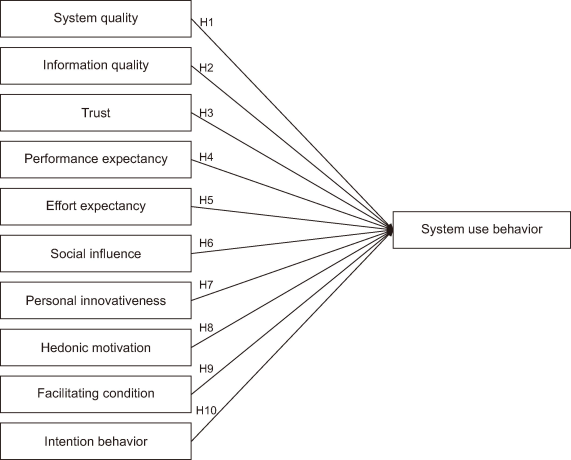
Data analysis involved calculating means, conducting correlation and multiple regression analyses, and developing prediction equations using IBM SPSS Statistics 28.0 (IBM Co., Armonk, NY, USA) and Python 3.11.12 (Python Software, Beaverton, OR, USA). This approach assumed interrelationships among the various influencing factors, intending to accurately predict SUB. Table 2 clarifies each independent variable’s role and connection to the study, addressing the reviewer’s feedback by providing transparency in the variables analyzed for correlation and regression. Through a rigorous process encompassing sampling, ethical compliance, and detailed data analysis, valuable insights regarding factors affecting adoption of elderly research recommendation systems in Thailand are shown in Fig. 1 (Hair et al., 2014).

Table 2
Independent variables and their characteristics
| Variable name | Abbreviation | Description | Relevance to study |
|---|---|---|---|
| System quality | SQU | Measures the efficiency, stability, and user-friendliness of the system | Ensures that the system meets users’ needs with minimal issues |
| Information quality | IQU | Assesses the relevance, accuracy, and completeness of information provided by the system | Evaluates the value of content for users, influencing system adoption |
| Trust | TRS | Confidence in the system’s reliability, security, and data privacy | Determines users’ willingness to adopt based on security concerns |
| Performance expectancy | PEF | Users’ belief that using the system will enhance their research productivity | Drives motivation for adoption due to anticipated benefits |
| Effort expectancy | EFF | Ease of use and learnability of the system | Lower effort expectations can lead to higher adoption rates |
| Social influence | SOC | Influence of colleagues or societal norms on users’ decisions to adopt the system | Reflects the effect of peer pressure or trends on adoption behavior |
| Personal innovativeness | INN | Users’ willingness to try new technologies | Indicates openness to adopting novel systems |
| Hedonic motivation | MOT | The enjoyment or satisfaction derived from using the system | Positively impacts adoption if users find the system engaging |
| Facilitating conditions | FAC | Availability of resources and support for system use | Ensures users have access to necessary resources, impacting adoption |
| Intention behavior | IBV | Users’ intent or planned behavior to use the system | Directly predicts the likelihood of actual system use |
Hypotheses of the study
-
H1: SQU has a statistically significant influence on the use of recommendation systems for elderly research in Thailand.
-
H2: IQU has a statistically significant influence on the use of recommendation systems for elderly research in Thailand.
-
H3: TRS has a statistically significant influence on the use of recommendation systems for elderly research in Thailand.
-
H4: PEF has a statistically significant influence on the use of recommendation systems for elderly research in Thailand.
-
H5: EFF has a statistically significant influence on the use of recommendation systems for elderly research in Thailand.
-
H6: SOC has a statistically significant influence on the use of recommendation systems for elderly research in Thailand.
-
H7: INN has a statistically significant influence on the use of recommendation systems for elderly research in Thailand.
-
H8: MOT has a statistically significant influence on the use of recommendation systems for elderly research in Thailand.
-
H9: FAC has a statistically significant influence on the use of recommendation systems for elderly research in Thailand.
-
H10: IBV has a statistically significant influence on the use of recommendation systems for elderly research in Thailand (Fig. 2).
5. RESULTS
The assessment of Cronbach’s alpha is a critical process for evaluating the internal consistency of a measurement tool, focusing on the coherence among items in a questionnaire or tool designed to measure the same construct. Cronbach’s alpha helps to confirm the reliability of the measurement tool and is crucial for ensuring the accuracy of the collected data. The analysis reveals consistently high Cronbach’s alpha values (α≈0.953-0.955), indicating excellent internal consistency reliability of the scale (Cortina, 1993; Tavakol & Dennick, 2011). The minimal variation in these values upon individual item deletion suggests a uniform contribution of all items to the scale’s reliability. Corrected item-total correlations exhibit a range of 0.37 to 0.74, with the majority of items demonstrating moderately strong to strong correlations with the total scale, further supporting the scale’s internal consistency (Field, 2022; Ursachi et al., 2015). The presence of diverse item code prefixes (e.g., SQU, IQU, TRS, PEF) implies a multidimensional scale structure, potentially comprising several subscales or factors (DeVellis & Thorpe, 2021). This Item-Total Statistics output provides valuable insights for assessing the reliability and internal consistency of the multi-item scale, facilitating the identification of potentially problematic items that may not significantly contribute to the overall scale measurement (Pallant, 2020). Nevertheless, a literature review and expert judgment support the continued use of these items, as outlined in Table 3.
Table 3
Analysis results of Cronbach’s alpha
| Constructs | Factor number | Reliability |
|---|---|---|
| System quality (SQU) | ||
| 1. The recommendation systems for elderly research in Thailand must be stable | SQU1 | 0.955 |
| 2. The recommendation systems for elderly research in Thailand must have a responsive feature between the system and the user | SQU2 | 0.955 |
| 3. The recommendation systems for elderly research in Thailand must be user-friendly | SQU3 | 0.955 |
| 4. The recommendation systems for elderly research in Thailand must have a clear and simple navigation menu | SQU4 | 0.955 |
| Information quality (IQU) | ||
| 1. The recommendation systems for elderly research in Thailand can provide information and research content on the elderly that meets the specific needs of users | IQU1 | 0.955 |
| 2. The recommendation systems for elderly research in Thailand can provide accurate, comprehensive, and complete research information on the elderly to users | IQU2 | 0.955 |
| 3. The recommendation systems for elderly research in Thailand can provide reliable research information on the elderly to users | IQU3 | 0.955 |
| 4. The recommendation systems for elderly research in Thailand can provide users with up-to-date research information and content on the elderly | IQU4 | 0.954 |
| 5. The recommendation systems for elderly research in Thailand can provide easy-to-understand research information and content on the elderly | IQU5 | 0.954 |
| Trust (TRS) | ||
| 1. I have confidence in the reliability of the recommendation systems for elderly research in Thailand | TRS1 | 0.955 |
| 2. I have confidence in the recommendation systems for elderly research in Thailand | TRS2 | 0.954 |
| 3. I am confident in the system’s security measures to protect the research data and access for the elderly | TRS3 | 0.954 |
| 4. I am confident that the recommendation systems for elderly research in Thailand will empower users to successfully develop their research on aging | TRS4 | 0.954 |
| Performance expectancy (PEF) | ||
| 1. The recommendation systems for elderly research in Thailand are expected to provide support for research | PEF1 | 0.954 |
| 2. The recommendation systems for elderly research in Thailand are expected to expand research opportunities | PEF2 | 0.954 |
| 3. The recommendation systems for elderly research in Thailand are expected to anticipate speeding up research timelines | PEF3 | 0.954 |
| 4. The recommendation systems for elderly research in Thailand are expected to enhance research efficiency | PEF4 | 0.954 |
| Effort expectancy (EFF) | ||
| 1. Learning how to use the recommendation systems for elderly research in Thailand is very easy | EFF1 | 0.954 |
| 2. The recommendation systems for elderly research in Thailand will provide clear and easy-to-understand interactions for the elderly research recommendation system | EFF2 | 0.955 |
| 3. My experience makes using the recommendation systems for elderly research in Thailand straightforward | EFF3 | 0.954 |
| 4. I am confident that I can easily use the recommendation systems for elderly research in Thailand | EFF4 | 0.954 |
| Social influence (SOC) | ||
| 1. The recommendation systems for elderly research should be implemented in Thailand | SOC1 | 0.953 |
| 2. I am interested in piloting the recommendation systems for elderly research in Thailand | SOC2 | 0.954 |
| 3. I believe that the recommendation systems for elderly research in Thailand will contribute to the advancement of research | SOC3 | 0.954 |
| 4. I will consider using the recommendation systems for elderly research in Thailand once they become more widely adopted | SOC4 | 0.954 |
| Personal innovativeness (INN) | ||
| 1. I am eager to learn about new information technologies and will find ways to implement them effectively | INN1 | 0.954 |
| 2. I am a pioneer when it comes to adopting new information technologies in the workplace | INN2 | 0.955 |
| 3. I am interested in and enjoy trying out new information technologies | INN3 | 0.955 |
| Hedonic motivation (MOT) | ||
| 1. The recommendation systems for elderly research in Thailand can reduce anxiety and stress associated with research development | MOT1 | 0.954 |
| 2. The recommendation systems for elderly research in Thailand can reduce obstacles and challenges in research development | MOT2 | 0.954 |
| 3. The recommendation systems for elderly research in Thailand allows me to enjoy the research development process | MOT3 | 0.955 |
| Facilitating conditions (FAC) | ||
| 1. There are essential resources available for utilizing the recommendation systems for elderly research in Thailand | FAC1 | 0.954 |
| 2. There is full access to the necessary hardware, software, and services to utilize the recommendation systems for elderly research in Thailand | FAC2 | 0.954 |
| 3. There is sufficient funding to implement the recommendation systems for elderly research in Thailand | FAC3 | 0.955 |
| 4. There is sufficient and adequate knowledge to utilize the recommendation systems for elderly research in Thailand | FAC4 | 0.955 |
| Intention behavior (IBV) | ||
| 1. I intend to use the recommendation systems for elderly research in Thailand in the future | IBV1 | 0.954 |
| 2. I anticipate using the recommendation systems for elderly research in Thailand the future | IBV2 | 0.954 |
| 3. I have a plan to use the recommendation systems for elderly research in Thailand in the future | IBV3 | 0.954 |
| 4. I would recommend other researchers to use the recommendation systems for elderly research in Thailand | IBV4 | 0.953 |
| System use behavior (SUB) | ||
| 1. I am certain that I will use the recommendation systems for elderly research in Thailand on a regular basis | SUB1 | 0.954 |
| 2. I am confident that I will definitely use the recommendation systems for elderly research in Thailand once it is fully developed and ready for use | SUB2 | 0.954 |
| 3. I will use the recommendation systems for elderly research in Thailand as my primary database for developing research on the elderly | SUB3 | 0.955 |
| 4. There is a high likelihood of using the recommendation systems for elderly research in Thailand | SUB4 | 0.954 |
Correlation analysis was used to assess the existence of heterogeneity in independent variables within the research model by examining the Pearson correlation coefficient. The correlation matrix measures the independence of every independent variable with a tolerance test value that must be greater than 0.2 and closer to 1. This means that the independent variable has a low relationship with other independent variables; but if the value is close to 0, it means that the independent variable has a high relationship with other independent variables. If the value is lower than 0.2, then there is a problem with severe multicollinearity tolerance (Detthamrong et al., 2024). This research has a value greater than 0.2 for every variable. Although the general guideline suggests that a variance inflation factor (VIF) value should be greater than 10, it is only a rule of thumb and not a strict requirement. High VIF values indicate strong correlations between variables, which may affect parameter estimates. In this study, all VIF values are below 10 (Gujarati & Porter, 2009; Miles, 2014; Stoltzfus, 2011), suggesting no significant multicollinearity.
As the results of the analysis are presented in Table 4 and Fig. 3, it was found that the highest correlation coefficient of the variables between IQU and SOC was 0.66, with statistical significance at the 0.01 level. The coefficient meets the accepted criteria of not exceeding 0.80, which clearly confirms that the results of this analysis are not multicollinearity. Therefore, the research results can be trusted (Gujarati & Porter, 2009).
Fig. 3
Correlation analyses matrix graph (source: authors, using Python in Colab). PEF, performance expectancy; EFF, effort expectancy; IQU, information quality; SOC, social influence; INN, personal innovativeness; MOT, hedonic motivation; FAC, facilitating conditions; IBV, intention behavior; SUB, system use behavior; SQU, system quality; TRS, trust.
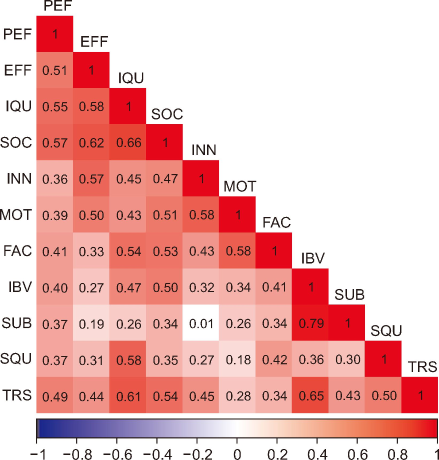
Table 4
Correlation analyses matrix
| Variables | SQU | IQU | TRS | PEF | EFF | SOC | INN | MOT | FAC | IBV | SUB | Tolerance | VIF |
|---|---|---|---|---|---|---|---|---|---|---|---|---|---|
| x̄ | 4.600 | 4.710 | 4.540 | 4.590 | 4.540 | 4.500 | 4.130 | 4.200 | 4.410 | 4.240 | |||
| S.D. | 0.440 | 0.333 | 0.398 | 0.449 | 0.467 | 0.485 | 0.667 | 0.648 | 0.499 | 0.624 | |||
| SQU | 0.579 | 0.504 | 0.372 | 0.310 | 0.350 | 0.268 | 0.182 | 0.419 | 0.355 | 0.295 | 0.540 | 1.853 | |
| IQU | 0.606 | 0.547 | 0.585 | 0.661 | 0.446 | 0.430 | 0.536 | 0.470 | 0.258 | 0.318 | 3.145 | ||
| TRS | 0.494 | 0.436 | 0.544 | 0.450 | 0.280 | 0.343 | 0.647 | 0.428 | 0.369 | 2.708 | |||
| PEF | 0.513 | 0.567 | 0.357 | 0.389 | 0.406 | 0.403 | 0.371 | 0.532 | 1.880 | ||||
| EFF | 0.617 | 0.569 | 0.504 | 0.330 | 0.275 | 0.187 | 0.411 | 2.430 | |||||
| SOC | 0.467 | 0.513 | 0.527 | 0.501 | 0.341 | 0.359 | 2.784 | ||||||
| INN | 0.585 | 0.428 | 0.319 | 0.013 | 0.524 | 1.907 | |||||||
| MOT | 0.585 | 0.344 | 0.264 | 0.449 | 2.226 | ||||||||
| FAC | 0.409 | 0.335 | 0.484 | 2.066 | |||||||||
| IBV | 0.793 | 0.492 | 2.031 | ||||||||||
| SUB |
S.D., standard deviation; SQU, system quality; IQU, information quality; TRS, trust; PEF, performance expectancy; EFF, effort expectancy; SOC, social influence; INN, personal innovativeness; MOT, hedonic motivation; FAC, facilitating conditions; IBV, intention behavior; SUB, system use behavior; VIF, variance inflation factor.
The regression results presented in Table 5 offer valuable insights into the predictive impact of each factor on SUB in the context of recommendation systems for elderly research in Thailand. These findings highlight each variable’s relative contribution and significance in shaping user engagement and system adoption within this specific research framework. The regression model has an R-squared value of 0.757, indicating that approximately 75.7% of the variance in SUB can be explained by the model, which includes the key variables: SQU, IQU, TRS, PEF, EFF, SOC, INN, MOT, FAC, and IBV. Key findings from the regression analysis are as follows:
-
IBV (β=0.866, p<0.05): This factor has the highest positive coefficient, indicating it is the most significant predictor of SUB. This suggests that users’ intention to use the system strongly influences their actual use behavior.
-
INN (β=-0.406, p<0.05): This factor has a negative coefficient, suggesting that higher levels of INN are associated with a decrease in SUB. This finding may indicate that highly innovative users are less dependent on the system for their research, possibly preferring alternative resources.
-
EFF (β=0.181, p<0.05): The positive coefficient suggests that when users find the system easy to use, their likelihood of engaging with it increases.
-
PEF (β=0.134, p<0.05): This positive influence reflects that the more users perceive the system as beneficial to their research performance, the more likely they are to use it.
-
MOT (β=0.137, p<0.05): This factor indicates that enjoyment or satisfaction derived from using the system positively contributes to SUB.
-
SQU (β=0.116, p<0.05): SQU positively influences SUB, underscoring that a reliable, responsive, and user-friendly system is crucial for encouraging usage.
-
IQU (β=-0.268, p<0.05): Interestingly, this factor negatively impacts SUB, suggesting that perceived IQU may not meet users’ specific needs, thereby decreasing engagement with the system.
-
FAC (β=0.097, p<0.05): This positive effect implies that when adequate resources and support are available, users are more likely to adopt the system.
Table 5
Multiple linear regression analysis
| Model | System use behavior | t | p-value | |
|---|---|---|---|---|
| β | Standard error | |||
| Intercept | 1.195 | 0.305 | 3.919 | 0.001a) |
| System quality | 0.116 | 0.059 | 2.943 | 0.004a) |
| Information quality | -0.268 | 0.100 | -5.349 | 0.001a) |
| Trust | -0.030 | 0.080 | -0.618 | 0.534 |
| Performance expectancy | 0.134 | 0.058 | 3.393 | 0.001a) |
| Effort expectancy | 0.181 | 0.065 | 3.982 | 0.001a) |
| Social influence | -0.059 | 0.066 | -1.237 | 0.217 |
| Personal innovativeness | -0.406 | 0.042 | -9.702 | 0.001a) |
| Hedonic motivation | 0.137 | 0.045 | 3.095 | 0.002a) |
| Facilitating conditions | 0.097 | 0.057 | 2.256 | 0.025a) |
| Intention behavior | 0.866 | 0.044 | 20.695 | 0.001a) |
| R2=0.766, adj R2=0.757, SEest=0.327, F=86.085 | ||||
TRS and SOC did not significantly affect SUB, suggesting that these elements may not be critical drivers in the system’s adoption for this user group.
In summary, the regression model provides predictive insights into each factor’s contribution to SUB, highlighting the importance of IBV, SQU, and ease of use as primary drivers. Factors like INN and IQU negatively influence usage, requiring further exploration.
In Table 5, SQU, PEF, EFF, MOT, FAC, and IBV showed positive relationships. IQU and INN showed a negative relationship. All variables demonstrated statistical significance at the 0.05 level, except for TRS (β=-0.030, p=0.080) and SOC (β=-0.059, p=0.217), and so for Thailand elderly research social factors (e.g. societal trends or peer influence) appear to have little impact on decisions to use the recommendation system. Based on the findings of this research, it is evident that there is no significant relationship between TRS and SOC and the utilization of the recommendation systems for elderly research in Thailand. This suggests that these two variables do not impact this demographic’s adoption and use of such systems. Conversely, the study identifies several factors that are crucial in influencing the use of the recommendation systems for elderly research in Thailand. These factors include SQU, PEF, EFF, MOT, FAC, IBV, IQU, and INN. These elements collectively contribute significantly to the effectiveness and acceptance of the recommendation systems in the specified context.
The results of the multiple regression analysis support the idea that eight factors: SQU, PEF, EFF, MOT, FAC, IBV, IQU, and INN are important factors influencing the use of recommendation systems for elderly research in Thailand. The results of this study highlight that these identified factors play an important role in optimizing the use of the geriatric recommendation systems for elderly research in Thailand. Additionally, these factors serve as reliable indicators for predicting future participation in the use of recommendation systems for elderly research in Thailand.
Equations for predicting the factors influencing the use of the recommendation systems for elderly research in Thailand can be defined as follows:
-
SUB=1.195+0.116 (SQU)-0.268 (IQU)+0.134 (PEF)+0.181 (EFF)-0.406 (INN)+0.137 (MOT)+0.097 (FAC)+0.866 (IBV)
-
where:
-
SUB=system use behavior
-
SQU=system quality
-
IQU=information quality
-
PEF=performance expectancy
-
EFF=effort expectancy
-
INN=personal innovativeness
-
MOT=hedonic motivation
-
FAC=facilitating conditions
-
IBV=intention behavior
The above equation offers valuable insights into the defining factors of this research to reflect the impact on the use of recommendation systems for elderly research in Thailand. It represents the positive impact of six factors: SQU, PEF, EFF, MOT, FAC, and IBV. It shows the negative impact of two factors: IQU and INN. From the results of this research, it can be inferred that the above eight factors are important factors that play an important role in the phenomenon of using recommendation systems for elderly research in Thailand. Moreover, the obtained equations serve as a prediction tool. This allows researcher to estimate and predict how likely individuals or users are to make use of the recommendation systems for elderly research in Thailand, based on SQU, PEF, EFF, MOT, FAC, IBV, IQU, and INN. This prediction model improves understanding of the interplay between individual behavior and the use of research guidance systems on the elderly in Thailand, by presenting predictions about actual use and planning strategies for the effective use of recommendation systems for elderly research in Thailand.
6. DISCUSSION
The findings of the study on factors influencing the use of recommendation systems for elderly research in Thailand provide crucial insights into the factors that affect the acceptance and utilization of recommendation systems in elderly research in Thailand, using a quality-validated dataset from 348 researchers experienced in elderly research from 2012 to 2022. Drawing on the UTAUT2 framework and extending it with variables relevant to this research, multiple regression analysis indicated an intercept of 1.195 and an R2 of 0.757, explaining 75.70% of the variance in system use. Statistically significant influences were observed in several key factors. SQU, which emphasizes stability, responsiveness, and user-friendliness, had a positive effect (β=0.116), supporting findings from Baabdullah et al. (2019), Ramkumar et al. (2019), and Rafique et al. (2020), who identified SQU as pivotal for usability and engagement.
Similarly, the study found that IQU and INN have a negative impact on SUB, contradicting traditional expectations of their effects. IQU negatively correlated with system usage (β=-0.268, p<0.05). This suggests an incongruence between system-delivered information and the specialized needs of senior researchers, implying that the information might be perceived as either too general, redundant, or not adequately customized to their specific research questions. Such misalignment can lead to user dissatisfaction and decreased system engagement. Therefore, system developers must prioritize the optimization of information relevance, accessibility, and clarity rather than merely adding more information or complexity, as noted by Abu-Taieh et al. (2022) and Alassafi (2022). While comprehensive and accurate information is generally advantageous, excessive detail or complexity may hinder users’ ability to swiftly access information in time-sensitive situations, which can reduce overall system usage (Zwain, 2019). Hence, designers should focus on presenting relevant and easily interpretable information to meet users’ specific demands effectively.
Further, PEF (β=0.134) positively impacted system adoption, consistent with Venkatesh et al. (2003; 2016), Yang et al. (2020), and Jevsikova et al. (2021), underscoring that users expect technology to enhance research efficiency. EFF (β=0.181), indicating ease of system use, aligns with Jevsikova et al. (2021) and Tanu Wijaya et al. (2020), reinforcing that accessible and clear interfaces support user engagement. Interestingly, INN negatively impacted system usage (β=-0.406), as more innovative users seek systems with advanced features beyond those offered, as supported by Yang et al. (2020) and Jevsikova et al. (2021). This aligns with studies on smart meter adoption, which show that high innovativeness leads to higher expectations. If systems fail to meet these expectations, it results in dissatisfaction and reduced usage intention. Thus, system development should address the needs of users with high INN (Alkawsi et al., 2021). MOT (β=0.137), associated with enjoyment and reduced stress, had a positive influence, as previously noted by Jevsikova et al. (2021). Additionally, FAC (β=0.097), representing available resources, were significant, confirming findings from adequate infrastructure is crucial for system adoption. IBV (β=0.866) emerged as a robust predictor, affirming that users’ future use of the system is strongly tied to perceived benefits, aligning with Davis (1986; 1989) and Dwivedi et al. (2019).
SOC (β=-0.059) and TRS (β=-0.030) were, however, not significant, conflicting with Dirsehan and Can (2020) and Alalwan et al. (2018) finding these elements important in technology acceptance. TRS may be related to other factors such as SQU. SOC may be affected by Chang (2012)’s and Zarifis and Cheng (2022)’s suggestion that Thailand’s individual benefit outweighs peer influence. In elderly research contexts a system effectiveness approach, focusing on FAC, PEF, and SQU would appear to better suit Thailand researchers.
Contrary to expectations, SOC had no significant effect on system usage in this study (β=-0.059, p>0.05). While previous literature (Chauhan, 2015; Venkatesh et al., 2012) commonly identifies SOC as a significant determinant of technology adoption, this finding suggests that researchers in elderly studies in Thailand may place greater emphasis on individual needs, personal efficiency, and convenience rather than external social pressures. Given the specialized nature of elderly research and the professional autonomy typical of this research community, SOC or peer pressure might be less impactful than individual performance-related factors or usability considerations.
The absence of a significant effect of SOC aligns with the notion that researchers in elderly-related fields in Thailand may rely more heavily on personal judgment or direct experience rather than external peer opinions or societal trends. Given the specialized nature of elderly research, users may value practical functionality over social validation when adopting such recommendation systems.
These insights highlight the factors that influence the adoption of recommendation systems tailored to the needs of elderly research in Thailand. Recognizing the unique sociocultural landscape, this system addresses essential factors—SQU, Performance Expectation, Effort Expectation, MOT, FAC, IBV, IQU, and INN—that shape the effectiveness and acceptance of such a system among Thai researchers. Cultural context and family dynamics are central to understanding elderly care in Thailand, where traditional family caregiving roles are being reshaped by urbanization and changes in family structures. Thus, sustainable community or institutional care models are increasingly essential.
The research recommends incorporating these evolving caregiving trends into advisory systems to support researchers in evaluating new care models. The health and long-term care needs of Thailand’s elderly, who frequently face chronic conditions and disabilities, necessitate community-based, long-term care solutions. The findings emphasize the need for systems that allow researchers to assess these care models’ adaptability and effectiveness, aligning with the complex health profiles typical of an aging population. Economic security is another pressing issue, as many Thai elderly lack adequate retirement savings, compelling some to continue working. Addressing this, the recommendation system can facilitate research into the economic factors affecting the financial stability and workforce participation of the elderly, which could inform policy solutions promoting economic security for the aging population. Finally, policy and social support systems, particularly through government initiatives like Thailand’s National Plan for Older Persons, are crucial in this rapidly aging society. This research underscores the importance of integrating tools within the advisory system to evaluate the efficacy of existing policies and identify areas for policy innovation. The findings underscore the importance of culturally and contextually adapted recommendation systems for research to optimize participation and effectiveness. This ultimately contributes to a more comprehensive understanding and support of elderly care in Thailand.
Limitations of the study should be acknowledged, as while this study provides meaningful insights into the factors influencing the adoption of recommendation systems for elderly research in Thailand, several limitations should be noted.
First, the study utilized a cross-sectional design, limiting causal inferences. Future longitudinal studies could validate these findings by tracking changes over time.
Second, the sampling approach, targeting researchers experienced in elderly-focused research between 2012 and 2022, may introduce sampling biases, thus affecting the generalizability of the results. Expanding the sample to include diverse user groups or researchers from different contexts would enhance generalizability.
Third, the research did not explicitly consider cultural and contextual factors specific to Thailand’s aging society, which could significantly influence SUB. Further qualitative or mixed-method studies incorporating cultural analyses could address this gap.
Fourth, data were collected through self-reported questionnaires, introducing potential biases related to social desirability and subjective perceptions. Triangulating self-report data with objective measures or behavioral analytics could strengthen future research.
Fifth, the short data collection period (January-March 2024) could limit understanding of temporal or seasonal variations in system usage. Extending the data collection period across different timeframes could provide a more comprehensive view.
Finally, the study’s findings may not be generalizable beyond researchers specializing in elderly studies in Thailand. Additional studies across diverse research contexts and geographical locations could enhance the external validity of these results.
These limitations offer future research opportunities to refine and deepen understanding of technology adoption in elderly-focused research systems.
7. CONCLUSION
This study offers important insights into the factors influencing the adoption of recommendation systems for elderly research in Thailand. The findings identify eight key factors that significantly affect the acceptance of these systems: SQU, PEF, EFF, MOT, FAC, IBV, IQU, and INN. These factors are critical in determining the participation and engagement with recommendation systems for elderly research in Thailand in this research population. In addition, the results of the study show insights into the behavior of demand for the recommendation systems for elderly research in Thailand, leading to joint analysis and system design, in order to be able to develop such a system in line with the needs of users and achieve maximum efficiency from this population. It is also an important starting point for examining the importance of factors in using recommendation systems for elderly research in Thailand: SQU, PEF, EFF, MOT, FAC, IBV, IQU, and INN towards the behavior of using the SUB regarding the elderly in Thailand. It also considers academic and research participation in adding to the body of knowledge and helping to confirm insights in areas that have not been studied before.
Specifically, the prediction equation part of this study will be a practical tool for understanding and predicting the pattern of factors influencing the adoption of recommendation system on the elderly in Thailand. These findings highlight the importance of SQU, PEF, EFF, MOT, FAC, IBV, IQU, and INN. As a catalyst for the adoption of recommendation systems, this study provides valuable insights into strategies for promoting the development and effective utilization of these systems in elderly research within the Thai academic and research community.
REFERENCES
, , (2023) Does Fintech penetration drive financial development? Evidence from panel analysis of emerging and developing economies Borsa Istanbul Review, 23, 1078-1097 https://doi.org/10.1016/j.bir.2023.06.001.
(1991) The theory of planned behavior Organizational Behavior and Human Decision Processes, 50, 179-211 https://doi.org/10.1016/0749-5978(91)90020-T.
(2011) The theory of planned behaviour: Reactions and reflections Psychology & Health, 26, 1113-1127 https://doi.org/10.1080/08870446.2011.613995.
, (1975) A Bayesian analysis of attribution processes Psychological Bulletin, 82, 261-277 https://doi.org/10.1037/h0076477.
, (1980) Understanding attitudes and predicting social behavior Prentice-Hall https://search.worldcat.org/ko/title/5726878
, , , , (2005) The handbook of attitudes Lawrence Erlbaum Associates Publishers The influence of attitudes on behavior, pp. 173-221, https://awspntest.apa.org/record/2005-04648-005
, , , , (2018) Examining adoption of mobile internet in Saudi Arabia: Extending TAM with perceived enjoyment, innovativeness and trust Technology in Society, 55, 100-110 https://doi.org/10.1016/j.techsoc.2018.06.007.
(2022) E-learning intention material using TAM: A case study Materials Today: Proceedings, 61, 873-877 https://doi.org/10.1016/j.matpr.2021.09.457. Article Id (pmcid)
, , (2021) The moderating role of personal innovativeness and users experience in accepting the smart meter technology Applied Sciences, 11, 3297 https://www.mdpi.com/2076-3417/11/8/3297.
Al nawayseh, M. K. (2020). Fintech in COVID-19 and beyond: What factors are affecting customers' choice of Fintech applications? Journal of Open Innovation: Technology, Market, and Complexity, 6(4), 153. https://doi.org/10.3390/joitmc6040153
, , , (2020) Sustainability, Fintech and financial inclusion European Business Organization Law Review, 21, 7-35 https://doi.org/10.1007/s40804-020-00183-y.
Artsanthia, J., & Pomthong, R. (2018). [The trend of elderly care in 21st century: Challenging in nursing care]. Journal of The Royal Thai Army Nurses, 19(1), 39-46. Thai. https://he01.tci-thaijo.org/index.php/JRTAN/article/view/121906
, , , , (2019) Consumer use of mobile banking (M-Banking) in Saudi Arabia: Towards an integrated model International Journal of Information Management, 44, 38-52 https://doi.org/10.1016/j.ijinfomgt.2018.09.002.
Babbie, E. R. (2021). The practice of social research (15th ed.). Cengage. https://www.cengageasia.com/title/default/detail?isbn=9780357360767
Bajunaied, K., Hussin, N., & Kamarudin, S. (2023). Behavioral intention to adopt Fintech services: An extension of unified theory of acceptance and use of technology. Journal of Open Innovation: Technology, Market, and Complexity, 9(1), 100010. https://doi.org/10.1016/j.joitmc.2023.100010
, (2021) Adoption and use of learning management systems in education: The role of playfulness and self-management Sustainability, 13, 1127 https://www.mdpi.com/2071-1050/13/3/1127.
, , , (2022) Extending the UTAUT2 model with a privacy calculus model to enhance the adoption of a health information application in Malaysia Informatics, 9, 31 https://www.mdpi.com/2227-9709/9/2/31.
(2010) Towards TV recommender system: Experiments with user modeling IEEE Transactions on Consumer Electronics, 56, 1763-1769 https://doi.org/10.1109/TCE.2010.5606323.
, , (2010) A new collaborative filtering metric that improves the behavior of recommender systems Knowledge-Based Systems, 23, 520-528 https://doi.org/10.1016/j.knosys.2010.03.009.
, , (2009) Collaborative filtering adapted to recommender systems of e-learning Knowledge-Based Systems, 22, 261-265 https://doi.org/10.1016/j.knosys.2009.01.008.
Britz, M. (2007). Translating EU civil protection in the Nordic states - Towards a theoretical understanding of the creation of European crisis management capacities. Paper presented at the European Union Studies Association's Tenth Biennial International Conference, Montreal, Canada. https://aei.pitt.edu/7714/
, , (2010) Evaluating the role of trust in consumer adoption of mobile payment systems: An empirical analysis Communications of the Association for Information Systems, 27, 561-588 https://doi.org/10.17705/1CAIS.02729.
(2012) UTAUT and UTAUT 2: A review and agenda for future research Journal The Winners, 13, 10-114 https://doi.org/10.21512/tw.v13i2.656.
(2015) Acceptance of mobile money by poor citizens of India: Integrating trust into the technology acceptance model Info, 17, 58-68 https://doi.org/10.1108/info-02-2015-0018.
, , (1999) Social cognitive theory and individual reactions to computing technology: A longitudinal study MIS Quarterly, 23, 145-158 https://doi.org/10.2307/249749.
(1993) What is coefficient alpha? An examination of theory and applications Journal of Applied Psychology, 78, 98-104 https://doi.org/10.1037/0021-9010.78.1.98.
Davis, F. D. (1986). A technology acceptance model for empirically testing new end-user information systems : Theory and results. (Unpublished doctoral dissertation). Massachusetts Institute of Technology. Cambridge, MA, USA. http://hdl.handle.net/1721.1/15192
(1989) Perceived usefulness, perceived ease of use, and user acceptance of information technology MIS Quarterly, 13, 319-340 https://doi.org/10.2307/249008.
(1993) User acceptance of information technology: System characteristics, user perceptions and behavioral impacts International Journal of Man-Machine Studies, 38, 475-487 https://doi.org/10.1006/imms.1993.1022.
, , (1989) User acceptance of computer technology: A comparison of two theoretical models Management Science, 35, 982-1003 https://doi.org/10.1287/mnsc.35.8.982.
, (1996) A critical assessment of potential measurement biases in the technology acceptance model: Three experiments International Journal of Human-Computer Studies, 45, 19-45 https://doi.org/10.1006/ijhc.1996.0040.
, , (2023) What are the leading factors for using Spanish peer-to-peer mobile payment platform Bizum? The applied analysis of the UTAUT2 model Technological Forecasting and Social Change, 187, 122235 https://doi.org/10.1016/j.techfore.2022.122235.
, , , (2020) Recommender systems leveraging multimedia content ACM Computing Surveys, 53, Article 106 https://doi.org/10.1145/3407190.
, (1992) Information systems success: The quest for the dependent variable Information Systems Research, 3, 60-95 https://doi.org/10.1287/isre.3.1.60.
Department of Older Persons, the Ministry of Social Development and Human Security. (2021). 20-Year strategy of the Department of Older Persons Affairs. https://www.dop.go.th/download/knowledge/th1539326153-138_0.pdf
, , , , (2024) Factors influencing employee retirement financial planning: Evidence from Thai higher education institutions Emerging Science Journal, 8, 1366-1384 https://doi.org/10.28991/ESJ-2024-08-04-08.
DeVellis, R. F., & Thorpe, C. T. (2021). Scale development : Theory and applications (5th ed.). Sage. https://public.ebookcentral.proquest.com/choice/PublicFullRecord.aspx?p=7106417
, (2020) Examination of trust and sustainability concerns in autonomous vehicle adoption Technology in Society, 63, 101361 https://doi.org/10.1016/j.techsoc.2020.101361.
, , , , , , , , (2011) Proceedings of the IFIP WG 8.6 International Working Conference: Governance and Sustainability in Information Systems. Managing the Transfer and Diffusion of IT Springer A meta-analysis of the Unified Theory of Acceptance and Use of Technology (UTAUT), pp. 155-170, https://doi.org/10.1007/978-3-642-24148-2_10
, , , , (2019) Re-examining the Unified Theory of Acceptance and Use of Technology (UTAUT): Towards a revised theoretical model Information Systems Frontiers, 21, 719-734 https://doi.org/10.1007/s10796-017-9774-y.
, , , (2020) A meta-analysis based modified Unified Theory of Acceptance and Use of Technology (meta-UTAUT): A review of emerging literature Current Opinion in Psychology, 36, 13-18 https://doi.org/10.1016/j.copsyc.2020.03.008.
, , (2022) Gamification of mobile money payment for generating customer value in emerging economies: The social impact theory perspective Technological Forecasting and Social Change, 185, 122049 https://doi.org/10.1016/j.techfore.2022.122049.
Field, A. (2022). An adventure in statistics: The reality enigma (2nd ed.). Sage. https://uk.sagepub.com/en-gb/eur/an-adventure-in-statistics/book275264
, (2021) A new acceptance model for artificial intelligence with extensions to UTAUT2: An empirical study in three segments of application Technology in Society, 65, 101535 https://doi.org/10.1016/j.techsoc.2021.101535.
, (2021) Developing a research model for mobile wallet adoption and usage IIM Kozhikode Society & Management Review, 10, 82-98 https://doi.org/10.1177/2277975220965354.
, (2023) Why do people continue using mobile wallets? An empirical analysis amid COVID-19 pandemic Journal of Financial Services Marketing, 28, 807-821 https://doi.org/10.1057/s41264-022-00174-9. Article Id (pmcid)
, (2010) Learning materials recommendation using good learners' ratings and content-based filtering Educational Technology Research and Development, 58, 711-727 https://doi.org/10.1007/s11423-010-9155-4.
, (2009) Basic econometrics McGraw-Hill https://search.worldcat.org/ko/title/226356768
, (2010) Combination of web page recommender systems Expert Systems with Applications, 37, 2911-2922 https://doi.org/10.1016/j.eswa.2009.09.046.
Hair, J. F., Black, W. C., Babin, B. J., & Anderson, R. E. (2014). Multivariate data analysis (7th ed.). Pearson Education Limited. https://search.worldcat.org/ko/title/871482320
Hjørland, B. (1994). Nine principles of knowledge organization. https://repository.arizona.edu/handle/10150/105798
, , (2015) Recommendation systems: Principles, methods and evaluation Egyptian Informatics Journal, 16, 261-273 https://doi.org/10.1016/j.eij.2015.06.005.
, , , , (2021) Acceptance of distance learning technologies by teachers: Determining factors and emergency state influence Informatica, 32, 517-542 https://doi.org/10.15388/21-INFOR459.
(2018) The concept of sustainable development: From its beginning to the contemporary issues Zagreb International Review of Economics and Business, 21, 67-94 https://doi.org/10.2478/zireb-2018-0005.
, , (2023) Determining factors of continuance intention in mobile payment: Fintech industry perspective Asia Pacific Journal of Marketing and Logistics, 35, 1699-1718 https://doi.org/10.1108/APJML-11-2021-0851.
, , (2022) Understanding public perceptions and intentions to adopt traditional versus emerging investment platforms: The effect of message framing and regulatory focus theory on the technology acceptance model Telematics and Informatics Reports, 8, 100024 https://doi.org/10.1016/j.teler.2022.100024.
, , (2021) Exploring the determinants of intention to use P2P mobile payment in Spain Information Systems Management, 38, 165-180 https://doi.org/10.1080/10580530.2020.1818897.
, , , (2011) Improving recommendations through an assumption-based multiagent approach: An application in the tourism domain Expert Systems with Applications, 38, 14703-14714 https://doi.org/10.1016/j.eswa.2011.05.010.
, (2023) Investigating U.S. consumers' mobile pay through UTAUT2 and generational cohort theory: An analysis of mobile pay in pandemic times Telematics and Informatics Reports, 11, 100076 https://doi.org/10.1016/j.teler.2023.100076.
, (1991) Development of an instrument to measure the perceptions of adopting an information technology innovation Information Systems Research, 2, 192-222 https://doi.org/10.1287/isre.2.3.192.
National Research Council of Thailand (n.d.). Thai National Research Repository. https://tnrr.nriis.go.th/#/
Noy, N. F., & McGuinness, D. L. (2001). Ontology development 101: A guide to creating your first ontology. https://protege.stanford.edu/publications/ontology_development/ontology101-noy-mcguinness.html
, , , (2010) Predictors of user perceptions of web recommender systems: How the basis for generating experience and search product recommendations affects user responses International Journal of Human-Computer Studies, 68, 472-482 https://doi.org/10.1016/j.ijhcs.2009.10.005.
Okello Candiya Bongomin, G., & Ntayi, J. M. (2020a). Mobile money adoption and usage and financial inclusion: Mediating effect of digital consumer protection. Digital Policy, Regulation and Governance, 22(3), 157-176. https://doi.org/10.1108/DPRG-01-2019-0005
, (2020b) Trust: Mediator between mobile money adoption and usage and financial inclusion Social Responsibility Journal, 16, 1215-1237 https://doi.org/10.1108/SRJ-01-2019-0011.
Pallant, J. (2020). SPSS survival manual: A step by step guide to data analysis using IBM SPSS (7th ed.). Routledge. https://doi.org/10.4324/9781003117452
, , (2009) A multi-disciplinar recommender system to advice research resources in university digital libraries Expert Systems with Applications: An International Journal, 36, 12520-12528 https://doi.org/10.1016/j.eswa.2009.04.038.
, , , , (2020) Investigating the acceptance of mobile library applications with an extended technology acceptance model (TAM) Computers & Education, 145, 103732 https://doi.org/10.1016/j.compedu.2019.103732.
, , , (2019) Q-TAM: A quality technology acceptance model for predicting organizational buyers' continuance intentions for e-procurement services International Journal of Production Economics, 216, 333-348 https://doi.org/10.1016/j.ijpe.2019.06.003.
Rovinelli, R. J., & Hambleton, R. K. (1976). On the use of content specialists in the assessment of criterion-referenced test item validity. https://files.eric.ed.gov/fulltext/ED121845.pdf
, (2012) A hybrid attribute-based recommender system for e-learning material recommendation IERI Procedia, 2, 565-570 https://doi.org/10.1016/j.ieri.2012.06.135.
Savitha, B., Hawaldar, I. T., & Kumar K, N. (2022). Continuance intentions to use Fintech peer-to-peer payments apps in India. Heliyon, 8(11), e11654. https://doi.org/10.1016/j.heliyon.2022.e11654 Article Id (pmcid)
, (2020) Unearthing antecedents to financial inclusion through Fintech innovations Technovation, 98, 102155 https://doi.org/10.1016/j.technovation.2020.102155.
, (2009) Socially aware TV program recommender for multiple viewers IEEE Transactions on Consumer Electronics, 55, 927-932 https://doi.org/10.1109/TCE.2009.5174476.
Stair, R. M., & Reynolds, G. W. (2012). Fundamentals of information systems (6th ed.). Course Technology/Cengage Learning. https://search.worldcat.org/ko/title/665137821
(2011) Logistic regression: A brief primer Academic Emergency Medicine, 18, 1099-1104 https://doi.org/10.1111/j.1553-2712.2011.01185.x.
, (2023) Impact of gamification on mitigating behavioral biases of investors Journal of Behavioral and Experimental Finance, 37, 100772 https://doi.org/10.1016/j.jbef.2022.100772.
, , , (2021) The extended Unified Theory of Acceptance and Use of Technology (UTAUT2): A systematic literature review and theory evaluation International Journal of Information Management, 57, 102269 https://doi.org/10.1016/j.ijinfomgt.2020.102269.
, , (2020) Using Hawgent dynamic mathematic software in teaching trigonometry International Journal of Emerging Technologies in Learning (iJET), 15, 215-222 https://doi.org/10.3991/ijet.v15i10.13099.
, (2011) Making sense of Cronbach's alpha International Journal of Medical Education, 2, 53-55 https://doi.org/10.5116/ijme.4dfb.8dfd. Article Id (pmcid)
, (1995) Assessing IT usage: The role of prior experience MIS Quarterly, 19, 561-570 https://doi.org/10.2307/249633.
, , (1991) Personal computing: Toward a conceptual model of utilization MIS Quarterly, 15, 125-143 https://doi.org/10.2307/249443.
, , (2023) Using the UTAUT model to analyze user intention to accept electronic payment systems in Serbia Portuguese Economic Journal, 22, 251-270 https://doi.org/10.1007/s10258-022-00210-5. Article Id (pmcid)
, , (2015) How reliable are measurement scales? External factors with indirect influence on reliability estimators Procedia Economics and Finance, 20, 679-686 https://doi.org/10.1016/S2212-5671(15)00123-9.
, (2021) Adoption and usage of e-grocery shopping: A context-specific UTAUT2 model Sustainability, 13, 4144 https://www.mdpi.com/2071-1050/13/8/4144.
, , , (2003) User acceptance of information technology: Toward a unified view MIS Quarterly, 27, 425-478 https://doi.org/10.2307/30036540.
, , (2012) Consumer acceptance and use of information technology: Extending the unified theory of acceptance and use of technology MIS Quarterly, 36, 157-178 https://doi.org/10.2307/41410412.
, , (2016) Unified theory of acceptance and use of technology: A synthesis and the road ahead Journal of the Association for Information Systems, 17, 328-376 https://doi.org/10.17705/1jais.00428.
, , , (2020) Instructors' gestures enhance their teaching experience and performance while recording video lectures Journal of Computer Assisted Learning, 36, 189-198 https://doi.org/10.1111/jcal.12397.
Zaid Kilani, A. A. H., Kakeesh, D. F., Al-Weshah, G. A., & Al-Debei, M. M. (2023). Consumer post-adoption of e-wallet: An extended UTAUT2 perspective with trust. Journal of Open Innovation: Technology, Market, and Complexity, 9(3), 100113. https://doi.org/10.1016/j.joitmc.2023.100113
, (2022) A model of trust in Fintech and trust in Insurtech: How artificial intelligence and the context influence it Journal of Behavioral and Experimental Finance, 36, 100739 https://doi.org/10.1016/j.jbef.2022.100739.
(2019) Technological innovativeness and information quality as neoteric predictors of users' acceptance of learning management system Interactive Technology and Smart Education, 16, 239-254 https://doi.org/10.1108/ITSE-09-2018-0065.
- Received
- 2024-08-06
- Revised
- 2025-03-10
- Accepted
- 2025-03-12
- Published
- 2025-06-30
- Downloaded
- Viewed
- 0KCI Citations
- 0WOS Citations