

- P-ISSN 1225-0163
- E-ISSN 2288-8985



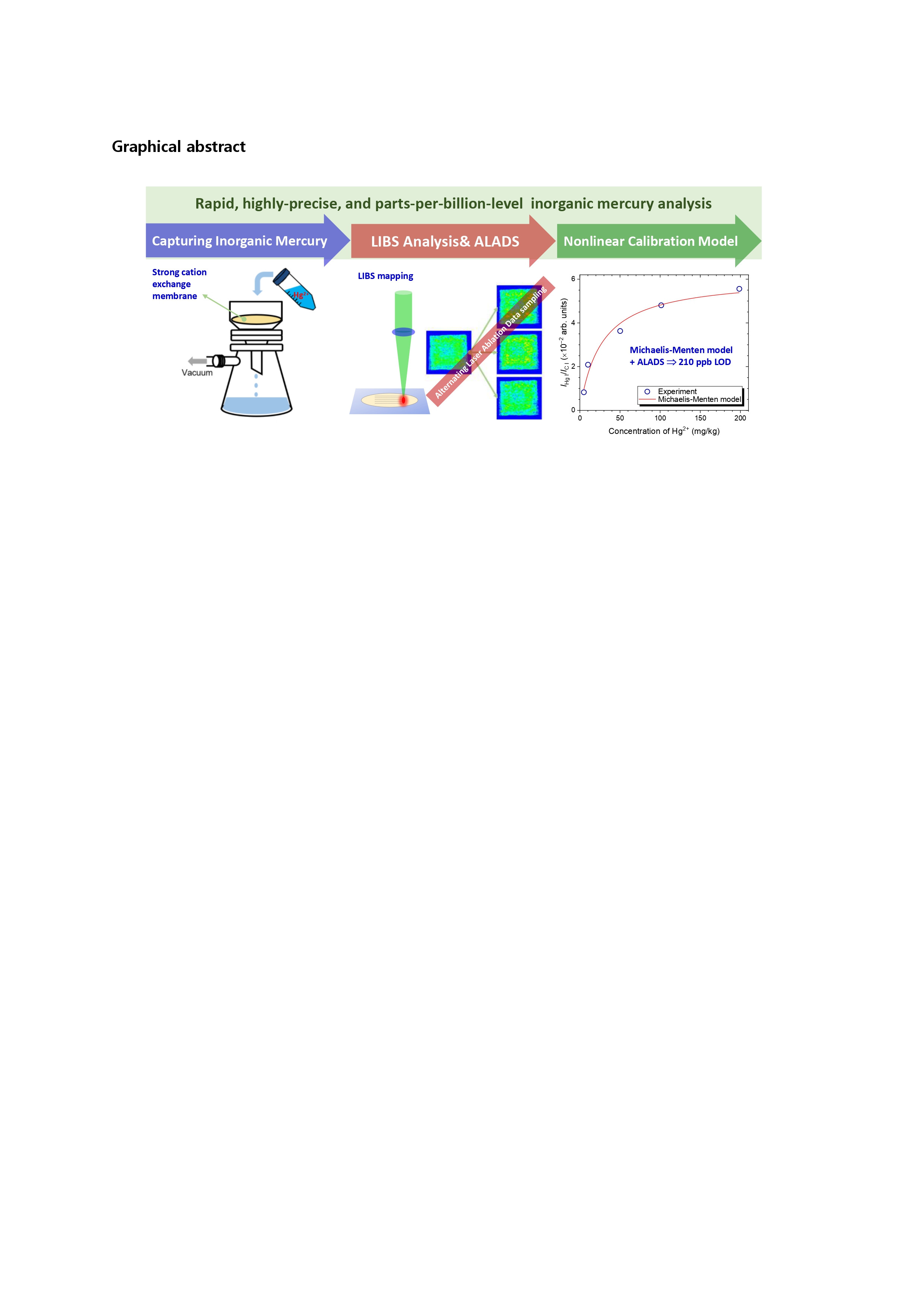
A high-precision method for quantifying inorganic Hg²⁺ in water was developed by combining strong cation-exchange (SCX) membrane preconcentration with alternating laser-ablation data sampling (ALADS) in laser-induced breakdown spectroscopy (LIBS). Although SCX membranes efficiently captured Hg²⁺, millimeter scale inhomogeneity of the deposited analyte limited precision when using conventional sampling schemes. ALADS effectively distributed this inhomogeneity across measurement groups, reducing relative standard deviations by almost an order of magnitude. Because the Hg I 253.652 nm resonance line experiences strong self-absorption, the calibration curve exhibited nonlinear saturation behavior. Among three nonlinear models evaluated, the Michaelis–Menten function provided the most accurate and physically meaningful fit. Using ALADS-enhanced precision and the Hg/C intensity ratio, a limit of detection (LOD) of 0.21 mg/kg was achieved—representing a six-fold improvement over analysis without ALADS. Recovery experiments using standard solutions, NIST water CRM, and fortified purified-water samples confirmed the accuracy and matrix tolerance of the approach. While the present configuration provides a practical LOD near 0.2 mg/kg, additional solution-volume preconcentration could extend sensitivity toward the low-ppm or sub-ppm range, enabling applications such as rapid screening of industrial effluents and on-site verification of water-treatment performance.






This website recommended the use the Chrome browser for journal website.