
- P-ISSN 1225-0163
- E-ISSN 2288-8985



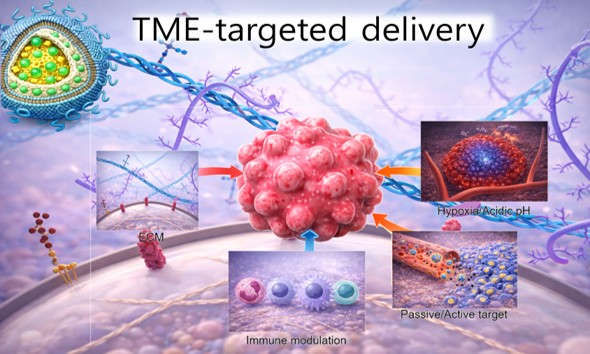
Nanotherapeutics are reshaping cancer management by enabling targeted delivery that integrates selective tumor localization, controlled activation, and diagnostic feedback within a single platform. This review organizes cancer nanotherapeutics from a delivery-first perspective across the full delivery cascade circulation stability, tumor access and retention, intratumoral penetration, cellular internalization, and intracellular trafficking highlighting why fixed nanoparticle properties rarely satisfy all stages simultaneously. We summarize design strategies that reconcile these trade-offs through multistage and stimuli-responsive transitions triggered by endogenous cues or externally applied energy. The tumor microenvironment (TME) is then framed as both a transport barrier and an actionable target, emphasizing delivery programs that remodel or exploit extracellular matrix constraints, hypoxia/acidosis, vascular abnormalities, immune regulation, and tumor-associated communication pathways, including biomimetic and exosome-inspired carriers. We further discuss targeted delivery enabled theranostics, where imaging functions as a quantitative readout of localization, activation, and response dynamics, thereby guiding treatment timing and adaptation. Finally, we integrate therapeutic modalities chemotherapy delivery, catalytic reactive oxygen species-based therapies, energy-activated phototherapy and ultrasound-enabled approaches, and immunotherapy coupling into a mechanistic “combination logic” that is dictated by delivery barriers and TME vulnerabilities. Collectively, this review provides a unified blueprint for designing nanotherapeutics that couple targeted delivery-based diagnosis and treatment to improve precision and therapeutic efficacy.







This website recommended the use the Chrome browser for journal website.