

- P-ISSN2287-9099
- E-ISSN2287-4577
- SCOPUS, KCI

Cross-Platform Content Distribution Behavior: A Qualitative Analysis of YouTube Creators’ Video Content on the Chinese Video Streaming Service Bilibili


Katrin Scheibe (Department of Information Science, Heinrich Heine University Düsseldorf, Düsseldorf, Germany)
Franziska Zimmer (Graduate School of Information Science and Technology, Social ICT Research Center, The University of Tokyo, Tokyo, Japan)

Abstract
This study investigates the practices of Western YouTube content creators’ cross-posting behavior, i.e., uploading their content on Bilibili—a Chinese video-sharing platform. A qualitative content analysis is employed to analyze videos of 14 popular YouTubers to compare the content of videos posted on both platforms. The findings indicate that the content differs for both platforms, possibly to accommodate Chinese viewers. The results show that Western YouTubers have made multiple changes to their original content before reuploading them to Bilibili, including the addition of Chinese subtitles, cut-out sponsorship content, shorter and translated descriptions, altered thumbnails, and exclusive content for Bilibili. The results also show a less frequent uploading schedule on Bilibili than on YouTube. While existing studies have explored content creators’ cross-posting behavior within the same social media ecosystem, the study significantly contributes to advancing our understanding of online creators’ content distribution practices across platforms in different cultural domains, especially in a Chinese-Western context.
- keywords
- Bilibili, China, cross-platform, video content, Western, YouTubers
1. INTRODUCTION
Due to cultural, legislative, and regulatory differences, widely used Western websites—i.e., in North America and Europe (Rieder et al., 2023)—such as YouTube and Facebook are not universally accessible, with China being a notable example. On the other hand, China has developed their own social media platforms that are equivalent to ones in the West, such as Bilibili. Bilibili is the largest video-sharing platform in China, with content generated and shared mainly by Chinese content creators across various categories such as games, news, music, and animation (Zheng et al., 2023), similar to those uploaded on the video-sharing platform YouTube. While video sharing is Bilibili’s main function, it also has unique technical functions for user engagement compared to YouTube. For example, “Danmaku” allows users to input comments at specific timestamps on a video and let them move across the screen for other viewers to see asynchronously or synchronously, making those comments part of the video viewing experience (Zhang & Scheibe, 2023). As of the second quarter of 2024, Bilibili has gained over 102 million average daily active users in China (Thomala, 2025).
1.1. Cross-Posting as a Growing Trend
While Bilibili is the main video platform in China, content creators producing videos (professionally) for YouTube, called YouTubers, have recently also started to post their content on Bilibili. This practice of distributing (user-generated) content is called cross-posting, e.g., the same videos can be separately uploaded on TikTok, Instagram Reels, and YouTube Shorts (Abidin, 2020; Thomas et al., 2022). Cross-posting has become frequent, and professional users such as major companies, politicians, celebrities, or public institutions apply these practices for varying purposes, e.g., on Facebook and Twitter (Farahbakhsh et al., 2016). One of the goals of cross-posting is to significantly increase audience engagement. For instance, audience feedback varies widely depending on the platform, indicating that even identical content from the same brand will receive different reactions based on the platform used, which was discovered in studies involving YouTube, Facebook, and Twitter (Roma & Aloini, 2019; Smith et al., 2012). Smith et al. (2012) noted that the audience of a popular brand’s YouTube account generally exhibits a more positive sentiment than compared to its respective Facebook and Twitter accounts. This difference may be attributed to the distinct features of the platforms, where Facebook and Twitter encourage conversation and link-sharing more than YouTube.
1.2. Creator Ecology and Platform Adaptation
Cross-posting on several platforms is an important aspect of the “creator ecology.” Posting user-generated content, prioritizing platforms, synchronizing content across various platforms, and managing the audience are crucial practices of this ecology (Ma et al., 2023). However, producing content for several platforms can be time intensive, where the content needs to be adapted to various features, also keeping in mind creator tools, recommendations, and monetization algorithms. Ma et al. (2023)’s findings indicate that adapting strategies for the right platform is important in order to find a balance between selective labor and excessive labor. Levina and Arriaga (2014)’s argument supports the idea that different social media platforms offer various forms of capital, influencing creators’ behaviors when cross-posting.
Considering this for our study, given the disparities between YouTube and Bilibili in terms of user base and interface elements, it is conceivable that YouTubers adapt their content and strategies for cross-posting on Bilibili. For example, Zhang and Scheibe (2023) noted that YouTubers often edit textual elements and video outros to suit the Bilibili audience, though their study was limited to two creators.
1.3. Regional Differences in Platform Features
Not only might the behavior of users differ between the platforms, but the functionalities of the platforms vary as well. The literature indicates that even social media platforms within the same category may be implemented very differently depending on the region of the world. For example, live streaming services illustrate this regional divergence well. In Western markets, live streaming services generally employ fewer gamification elements, such as leaderboards and virtual gifts, compared to their counterparts in China. In China, live streaming services widely utilize a broad array of gamification features to cater to the diverse tastes of their cultural market (Zimmer et al., 2020). Even though the content disparity between the two markets of live streaming services was not analyzed, it is striking that different cultures might prefer distinct aspects within specific services.
However, the literature does not investigate cross-cultural cross-posting activities in greater detail yet, which our study aims to do. Where the content is posted to platforms accessible in the West, such as from Facebook to Twitter, cross-posting content from YouTube to platforms such as Bilibili in China remains mainly unexplored. The first research approaches note adjustments made by Chinese creators when cross-posting from Chinese to Western platforms to enhance visibility (Meng & Nansen, 2022), but the specifics of these adjustments were not identified.
1.4. Research Objectives and Contributions
Given this research gap, the current study builds on Zhang and Scheibe (2023)’s work by examining a broader range of YouTubers. Zhang and Scheibe (2023) found that YouTubers adapted their content for Bilibili, including editing textual elements and the video “outro.” However, the research only drew results from two YouTubers, which resulted in narrow outcomes. Therefore, building upon Zhang and Scheibe (2023), this new research aims to investigate a wider range of YouTubers, paying special attention to the content that has been cross-posted as well as the uploading schedules of the creators, keeping in mind the creators’ workload (Ma et al., 2023).
Considering the significant differences between Bilibili and YouTube in platform features and primary viewer bases, this study seeks to deepen our understanding of the interplay between culture and platforms. Specifically, it focuses on the challenges and dynamics of distributing content across multiple platforms, with an emphasis on the Chinese-Western perspective. This study adheres to the categorization of “Western” similar to Rieder et al. (2023), focusing on the creator economy in regions including North America, Europe, and Oceania.
Owing to these observations and considerations, the research question (RQ) is:
RQ: What differences can be observed between the content cross-posted by YouTubers from YouTube on Bilibili?
This study makes multiple original and significant contributions to knowledge and practices. First, the study contributes to the existing literature on multi-platform content creation and a new understanding of online content creators’ evolving practices to adapt to platforms of multiple ecosystems. Second, the findings can be developed into new practical guides for Western YouTubers or other content creators who wish to cross-post their content to BiliBili as a platform in a different social media system domain to reach Chinese audiences and broaden their viewer bases. Third, the findings could also provide significant and valuable insight for Bilibili, with the potential to develop guidance and support for content creators outside China to build their channels or cross-post their content on the platform.
In the following section, the methods for the analysis of comparing YouTubers’ cross-posting behaviors are explained in detail. This is followed by the qualitative results and finishes with a discussion of the results.
2. METHODS
A qualitative content analysis, a method commonly used for in-depth analysis of visual media content (Baxter et al., 1985; Bell, 2004; Griffith & Papacharissi, 2009), including YouTube content (Tarnovskaya, 2017; Zhang & Lee, 2023), was conducted. This approach enabled a detailed comparison of cross-posted content on YouTube and Bilibili to identify consistent patterns and common themes (Patton, 2002; Zhang & Wildemuth, 2016) related to content differences. Content analysis is a suitable method to compare the similarity of video content in such detail. To select the YouTube content creators, two rigorous steps were implemented. First, a list of top content creators was identified based on various rankings, top lists, and related news reports (Borak, 2020; Chi, 2023; Pan, 2023; Thakran, 2023). Second, the YouTubers on that list who also have official Bilibili channels were identified by searching the same YouTubers’ channel names on Bilibili. For the analysis, the videos of YouTube content creators who have set their YouTube location to a country in the Western region and also have an official account on both platforms, YouTube and Bilibili, were considered. All identified YouTubers who also have a Bilibili account were included in the analysis, resulting in a number of 14 Western YouTubers in total. We were not able to identify other Western YouTubers who also upload their content to Bilibili.
A combination of a directed and conventional approach was carefully applied for the qualitative content analysis. The directed approach allows us to code YouTubers’ content using a pre-developed coding scheme based on the findings of our earlier research (Zhang & Scheibe, 2023). Here, the content categories were developed by viewing different cross-platform videos on YouTube and Bilibili and comparing their differences and similarities, respectively. The conventional research method allows us to further identify potential differences and patterns between the YouTube and Bilibili uploads beyond the pre-existing codes that may not have been captured in prior studies (Hsieh & Shannon, 2005). Table 1 shows all the codes and categories generated from the analysis. Concerning the subtitle category, in China there are groups of subtitlers who are usually responsible for providing translations and subtitles for content posted on online platforms but in foreign languages. This is also true for Bilibili videos, where these communities or groups collaborate with YouTube creators to translate their work and add their names to the video outro as a form of credit and recognition.
Table 1
Overview of categories and descriptions for content analysis of YouTubers’ cross-posting behavior
| Category | Description |
|---|---|
| On-screen texts | Textual elements appearing directly on the video screen including captions, labels, titles, and other pertinent information displayed within the video |
| Subtitles | These are text-based translations or transcriptions of spoken dialogue in videos, assisting viewers in understanding the content, particularly if it is in a foreign language or if there are audio challenges |
| Thumbnail design | Thumbnails are small images representing the video, serving as previews before viewers click to watch |
| Intro design | The video intro, the opening segment, establishes the content’s tone, often featuring branding elements, music, and visuals that introduce the channel or topic |
| Outro design | The video outro, appearing at the end of the content, typically includes calls to action (like subscribing or visiting a website) and may feature related videos, end screens, and contributors |
| Advertisements | Advertisements within the video content can be pre-roll (before the video starts), mid-roll (during the video), or post-roll (after the video ends) |
| Video content | This refers to the main body of the video—the actual content being shared with the viewers |
| Watermarking | Watermarks, which are semi-transparent logos or text, are placed on the video to identify the creator or brand and help deter unauthorized content use |
| Video description | The video description, located below the video, provides additional context, links, and relevant information about the content |
The data collection of videos was carried out on November 14, 2023. The content of the same videos uploaded by YouTube creators on YouTube and Bilibili was thoroughly watched and analyzed by two researchers (coders) independently during a period of about five weeks, starting November 15, 2023, until December 23, 2023. The researchers were trained with a small dataset beforehand. The videos considered for this analysis are the creators’ most viewed ones on Bilibili that were available on YouTube, the first videos that were uploaded to Bilibili and were available on YouTube, and the latest ones on Bilibili that were also available on YouTube. Analyzing the most-viewed videos offers insights into popular content, while the first and latest uploads capture changes in cross-platform posting behavior over time. In total, the content of 14 YouTube creators and 82 videos were evaluated (Table 2). All in all, six videos were analyzed per content creator, with three videos on each platform, excepting the channel Rachel’s English, as its first video and most watched video on Bilibili are the same. Additionally, the video uploading schedule was reviewed by monitoring the uploading date of the same videos on both platforms. This allowed us to get an impression of the YouTube creators’ video-uploading behavior. Furthermore, the channels were checked for content that has solely been uploaded to one of the platforms (exclusive content). The data of the observation were noted in a checklist and table for coders; however, the coders have always added further details about the video content changes and similarities observed. The results of the analysis were discussed and agreed on during meetings of the two coders after each coder decided on the applicable categories independently.
Table 2
Overview of YouTube creators channel names, the creator’s location, video genre(s), and number of exclusive videos on Bilibili
| YouTube name | Bilibili name | Location | Genre | Exclusive videos on Bilibili |
|---|---|---|---|---|
| PattyCake Productions | PattyCake官方频道 | USA | Entertainment, music | 3 |
| Alan Becker | 火柴人AlanBecker | USA | Animation, comedy | 1 |
| Viva La Dirt League | 土团联盟VLDL | New Zealand | Entertainment | 1 |
| Pamela Reif | 帕梅拉PamelaReif | Germany | Fitness | 12 |
| Life of Boris | 鲍里斯的日常 | Estonia | Life, gaming, comedy | 1 |
| Rob Landes | RobLandesMusic | USA | Music | 6 |
| Veritasium | Veritasium真理元素 | USA | Science | 0 |
| CaptainSparklez | MC火花队长_官方账号a) | USA | Gaming | 1 |
| Donut | Donut_Media | USA | Automotive | 2 |
| Rachel’s English | 瑞秋英语Rachel | USA | Education | 3 |
| GaryVee | GaryVee加里维纳查克 | USA | Motivation, entrepreneurship | 1 |
| BRIGHT SIDE | BrightSide亮生活 | Cyprus | Knowledge | 0 |
| Linus Tech Tips | LinusTechTips | Canada | Technology | 0 |
| NikkieTutorials | NikkieTutorials | The Netherlands | Beauty | 3 |
3. RESULTS
3.1. On-Screen Texts
On-screen texts refer to text incorporated into the video by YouTubers as part of their video content (Table 3). We observed that when cross-posting YouTube content to Bilibili, some YouTubers tend to add Chinese on-screen texts to their videos. There are two forms of Chinese on-screen texts. The first type is Chinese text used as a translation of the original English text. For example, in Pamela Reif’s workout videos, she replaced the workout movement names with Chinese translations from the original English text (Fig. 1). Instead of replacing English with Chinese, Life of Boris directly adds Chinese translation alongside the English on-screen text. Apart from translation, there are also additional Chinese on-screen texts added to the video; these texts are normally added by Chinese subtitler groups. They partner with YouTubers to translate their videos, add subtitles, and include their group members’ usernames on the video as a form of promotion and credit for their work, separate from the main video.
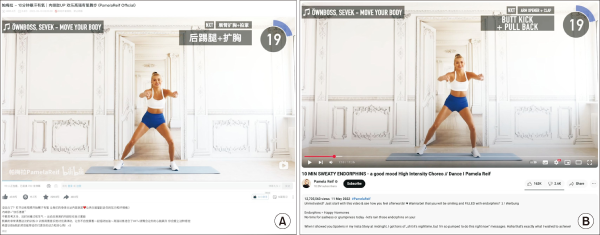
Table 3
Overview of the differences between cross-posted video content on Bilibili and originals on YouTube
| Category | Cross-posted content on Bilibili | YouTube originals |
|---|---|---|
| On-screen texts | Chinese on-screen texts | Original English on-screen texts |
| Subtitles | Embedded Chinese subtitles | English or multi-language captions |
| Thumbnail design | Original/altered images and Chinese texts | Original images and English texts |
| Intro design |
Cut or shortened intro from the originals Chinese intro replacing the original intro Intro made by subtitler groups |
Uncut original intros |
| Outro design |
Bilibili engagement metrics-oriented outro design Cut or shortened original outros Subtitler added outro for credits |
YouTube engagement metrics-oriented outro design Uncut original outros |
| Advertisements | No interruptive ads | Interruptive ads |
| Video content |
Adjusted original content (cut or shortened) Revamped/replaced original content |
Original content |
| Watermarking | Embedded with consistent Bilibili-branded watermarking | Diverse/personalized watermarking or no watermarking |
| Video description |
Chinese video description Shorter or no video description Chinese/Bilibili viewer-oriented video description |
English video description Long video description YouTube viewer-oriented video description |
There are also cases where YouTubers did not translate or add additional on-screen texts to their videos. Some are due to the original videos not having on-screen texts in the first place, while others may do so based on the nature of their video. For example, Rachel’s English tends to show various English words on-screen for the English learners in her original video, but there is no Chinese translation added to these words in the BiliBili version of the video since there are already Chinese subtitles added to it. Some videos do not initially have on-screen text, like Alan Becker’s animation videos. Overall, a variety of practices regarding on-screen text when cross-posting to Bilibili were found, but adding Chinese texts is among them when YouTubers cross-post their content to Bilibili.
3.2. Subtitles
There is a common pattern across the practices of YouTubers in which they added Chinese subtitles (Table 3) to the cross-posted videos on Bilibili. Some of these subtitles are Chinese-only, but others are a combination of Chinese and English subtitles on top of each other to make the videos more accessible to Chinese viewers. Although some YouTubers include Chinese and other languages as YouTube captions, on Bilibili these subtitles are embedded into the video content and cannot be turned off through the platform’s interface. Not only subtitles are added, but YouTubers also change their video titles from English to Chinese or add Chinese titles in addition to English titles. Only a few YouTubers in our analysis did not add Chinese subtitles. For example, the latest video by CaptainSparklez does not have Chinese subtitles, but has Chinese captions generated by the artificial intelligence (AI) function on Bilibili. However, this video has significantly fewer views on Bilibili (over 1,000 views) compared to the original YouTube version (over 80,000 views). Some videos do not have subtitles in their original format, such as animation videos by Alan Becker. However, overwhelmingly in our analysis, when YouTubers cross-post their video to Bilibili, if there are dialogs in the originals, Chinese subtitles are added to the cross-posted content.
3.3. Thumbnail Design
Two types of differences were spotted in the thumbnail design (Table 3) between the original YouTube videos and the ones cross-posted to Bilibili. The first difference involves changes to the text on the thumbnails. If the original YouTube thumbnail is a combination of a premade image and English text, the thumbnail for the cross-posted video on Bilibili consists of the same image but replaces the English text with Chinese text. The second difference is the alternation of the image design and sometimes the text, meaning that in addition to changing English texts to Chinese, the image used for the thumbnail is also changed. For example, Pattycake simplified one of their original YouTube music video thumbnails when posting it on Bilibili. Viva La Dirt League, while switching their thumbnail texts from English to Chinese, also changed the thumbnail image. Rachel’s English also followed a similar practice, with a different design and color scheme used for her Bilibili cross-posted video in comparison to the YouTube original. YouTubers who do not make any changes to the thumbnail design were also spotted.
3.4. Intro Design
Most of the videos that were analyzed either do not have an intro or have no changes in the intro (Table 3) between Bilibili and YouTube. However, a few YouTubers did alter their intro design for their Bilibili versions. These changes fall into three categories. The first is cutting out part of the original video intro in the Bilibili version. This has happened on two occasions. One is when there is information about the sponsors added to the intro, which may not be available for Chinese viewers. For example, the videos from Rob Landes and Linus Tech Tips both have sponsor messages cut out from the original video when posted to Bilibili. Another alteration is a shortened version of the intro, which happens in some of the Bright Side videos. The second kind of change is similar to subtitling and on-screen texts, which is replacing English texts in the YouTube intro with Chinese text for accessibility, which is specifically present in Pamela Reif’s workout videos. The final kind of change is usually made by the subtitlers when translating the cross-posted videos for YouTubers, who add the group members’ names to the intro as a form of credit.
3.5. Outro Design
Similar to the intro design, changes made to the outro design (Table 3) were also detected. Some YouTubers replace the YouTube-style outro with a more Bilibili-oriented one. YouTube-style outros are designed to accommodate the interface of YouTube and its engagement metrics. For example, creators use graphics and text at the end of the video to encourage viewers to subscribe to the YouTube channel or like the video. When cross-posting the videos, YouTubers tend to replace the ending with one that accommodates more to the Bilibili platform design. For instance, instead of asking viewers to subscribe to their YouTube channel like in the original video, Viva La Dirt League asks viewers to “give coins,” “add the video to favorites,” and “give thumbs up” to the video, which are all part of the engagement metrics design on Bilibili. Similarly, GaryVee shared his Chinese social media site logos at the end of his video on Bilibili, instead of asking for YouTube subscribers as shown in his original YouTube video. As with the intro design, some YouTubers also cut out sponsorship information or promotional content from the outro in the Bilibili version if it does not apply to Chinese viewers. For example, the YouTube channel Donut cut out the part where they are promoting merchandise in the outro of the Bilibili video version. The final difference made is the addition of the subtitlers’ information. Sometimes on Bilibili, the subtitler groups who are responsible for translating YouTubers’ content on Bilibili will add their name to the video outro as a form of credit and recognition. In addition, just like with the intro, there are also YouTubers who made no changes to the outro.
3.6. Advertisements
There are two types of advertisements (ads) (Table 3) that were found in this analysis: Those added by the platform and the ads incorporated by the YouTubers. When it comes to ads included by the platforms, all of the YouTubers’ original videos on YouTube have ads (unless with Premium subscription), which interrupt the video during video consumption, except for “YouTube Shorts.” However, in the videos cross-posted on Bilibili, there are no interruptive ads. This may be due to the design differences between the two platforms. The ads added by YouTubers as part of their videos are mainly sponsorship and merchandise promotion. In this analysis, YouTubers tend to cut out the sponsorship and self-branding content from the original video when they cross-post it on Bilibili, e.g., if the promotion is not available in China. At the end of Pamela Reif’s YouTube workout videos, she usually promotes her workout music playlist available on the music streaming service “Spotify.” However, in the Bilibili video versions, such a promotion is removed, perhaps because Spotify is not available in China, along with some other social media sites.
3.7. Video Content
Video content refers to the main content delivered to the audience (Table 3). The results show that when cross-posting the original videos to Bilibili, sometimes a few minutes of the content in the original YouTube video will be adjusted for the Bilibili version. The first kind of adjustment is cutting out original content, especially the related promotions and sponsorship content that may not be meant to target Chinese audiences. YouTuber Veritasium also goes further by replacing the original sponsorship part of the video with a promotional video filmed by one of the Chinese subtitler group members, in which she recommends different YouTubers that they are collaborating with on Bilibili. As for other promotions, NikkieTutorials removed the giveaway and rewards promotion about her self-branded makeup palette, Donut has cut out their merchandise content, and Pamela Reif removed her Spotify playlist promotion from the original YouTube video. The second kind of content change is a larger-scale revamp of the cross-posted version, which is specifically done by Bright Side and GaryVee. All the Bright Side videos uploaded on Bilibili are fully converted to Chinese, which includes audio voice-over and Chinese text, different from their original YouTube videos, which are all in English. As for GaryVee, one of his short videos was turned into an animation on Bilibili with the original audio from the YouTube version. While the practice of removing content may be more related to avoiding confusion and misunderstanding, the revamped practice seems to be more tailored towards Chinese viewers. However, there are videos with no content changes at all.
3.8. Watermarking
Watermarking is a feature on Bilibili as a form of copyright protection that creators can add directly when uploading videos (Table 3). The watermark usually consists of the Bilibili logo and the Bilibili channel name (Fig. 1). Only a few YouTubers’ videos on Bilibili do not have this kind of watermarking. In terms of the original video, the practice varies. Some YouTubers have their own watermark on their YouTube videos while others do not, although YouTube also offers the watermark feature. The consistent use of watermarks on Bilibili may be because Bilibili users tend to pirate and re-upload YouTubers’ videos on Bilibili without consent and permission. This has been mentioned by Linus Tech Tips in one of their streams (Linus Tech Tips, 2019). Overall, watermarking on Bilibili is a common practice for most YouTubers in comparison to their content on YouTube.
3.9. Video Descriptions
As for video descriptions (Table 3), there are prominent differences between the descriptions under the original video and the ones on Bilibili. The first difference is related to language, where the YouTube video descriptions are in English (with some appearing to be in other languages based on the YouTube region), and the Bilibili descriptions are in Chinese (Fig. 1) or both, English and Chinese combined. When it comes to the content of the description, YouTube descriptions are usually longer, with not only descriptions of the main content of the video but also with more promotion added, such as the YouTubers’ social media links, other streaming platforms, and merchandise shops. The descriptions on Bilibili, however, are generally short. This sometimes may be because Chinese sentences and paragraphs may appear shorter than English texts, due to the nature of the language, but the analysis showed that those descriptions usually only contain information about the video content, with occasional inclusion of some credits such as production teams and subtitle groups.
Some YouTubers on Bilibili also have unique interactions with Bilibili viewers which YouTube descriptions do not have. For example, Pamela Reif indicates she hopes her Chinese is okay for the Bilibili viewers. Rachel’s English especially addresses viewers in Chinese in one of her video descriptions on Bilibili, indicating how she is pleased that so many Chinese students like her English learning videos. Some YouTubers, such as Life of Boris, also include a link to the original YouTube video in the Bilibili description, possibly as copyright protection. The subtitler group that helped to translate some YouTubers’ videos also included their information in some descriptions as well, either as credits or for promotion. In addition, some of the videos on Bilibili do not have any descriptions, which is specifically observable in, for example, Viva La Dirt League’s newer videos.
3.10. Exclusive Content
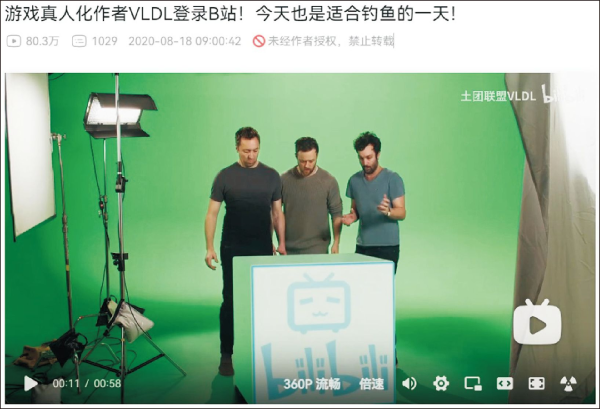
As shown in Table 2, out of 14 YouTubers, 11 of them offer exclusive content that is only available on Bilibili. One common format is introduction videos in which YouTubers introduce themselves to the Bilibili viewers and welcome the viewers to their Bilibili channels. These videos can be purely introductory, such as the one produced by Viva La Dirt League and NikkieTutorials, with the sole purpose of introducing themselves to viewers (Fig. 2). Alternatively, the videos can combine introductions with cross-posted YouTube content. For example, Alan Becker’s introduction video starts with him saying “hello” to the viewers in Chinese, with a few self-introductions in English, followed by an animation he uploaded on YouTube before. Another form of exclusive content is videos specifically made for Chinese viewers. Rachel’s English uploaded videos of her reacting to Chinese celebrities speaking English. Donut made a video for “520” day, which is a day that is similar to Valentine’s Day in China due to the Chinese pronunciation of “520” being similar to “I love you” in Chinese. NikkieTutorials created question-and-answer (Q&A) videos for Bilibili viewers to answer fan questions, along with her Chinese New Year video. Rob Landes created an AI-generated Chinese voice-over video, along with some newly created videos made from old YouTube videos for the Bilibili channel. He also shared videos from the official Bilibili channel in which he performed at Bilibili music festivals.
However, among all the YouTubers, Pamela Reif has the largest number of exclusive videos on Bilibili (12 videos). These videos are tied to her visit to China in 2023 and her various partnerships with Chinese brands. For example, she has videos collaborating with Chinese celebrities; workout videos integrating Chinese music, martial arts, and workout therapy concepts; videos sponsored by Chinese brands “Huawei” and “Jingdone”; and her food and beauty brand promotions. In comparison to other YouTubers, it seems Pamela Reif’s exclusive practice on Bilibili is beyond cross-posting, but forms a deeper integration within the Chinese streaming and online influencer economy (“wanghong” 网红 economy) and ecosystem. Another exception is Linus Tech Tips. While they do not have content that is only available on Bilibili, several of their technology reviews involve Chinese products. On YouTube, they also live streamed their opening of the Bilibili “play button,” a reward like the YouTube “play button,” acknowledging the accumulation of a certain number of subscribers or fan base on YouTube and Bilibili. The recording of the stream is also available on their Bilibili channel. Overall, the results showed that most of the analyzed YouTubers create exclusive content on Bilibili.
3.11. Uploading Schedule
Finally, when it comes to uploading schedules, a general pattern emerged in which the uploading schedule of the Bilibili video version is usually behind the original YouTube video. This may be due to the amount of post-production and editing that needs to be done before the content is cross-posted to Bilibili. Two videos from Alan Becker are on the same schedule as the Bilibili upload, maybe because they are animation videos, only having moving images and sound without dialog, therefore not needing further post-production for Bilibili.
4. DISCUSSION
This is one of the first studies that explored the cross-cultural cross-content posting of Western YouTubers on the Chinese video-sharing platform Bilibili. A content analysis was employed, investigating the behavior of 14 famous YouTubers, based on the number of subscribers. The results overall are in line with and consolidate a previous analysis of two YouTubers (Zhang & Scheibe, 2023). With more video samples analyzed and focusing on the video content as well as the uploading schedule of the creators, extensive and new findings have emerged.
Concerning the research question of what differences can be observed between the content cross-posted by YouTubers from YouTube on Bilibili, the analysis reveals multiple differences in the cross-posted content (Table 3). Most of these changes involve YouTubers adding Chinese translations and expressions to their videos, including on-screen text, subtitles, text within the thumbnail design, video descriptions, intro and outro text, and Chinese voiceovers. Reasons for this might include an intention to adapt the content for Chinese viewers by overcoming language and communication barriers.
The YouTubers studied made their content more accessible to Bilibili audiences, including Bilibili platform features and China’s overall social media landscape. This includes cutting out sponsorship content and relevant promotions that may not be available in China; replacing YouTube-style promotions (e.g., “like and subscribe”) with the ones that accommodate Bilibili’s features (e.g., “give coins,” and “thumbs up”); and promoting their Chinese social media platforms like “Weibo.”
The Chinese subtitler groups that collaborated with YouTubers to translate the videos have played an important role in the shaping of YouTubers’ cross-posted content. This includes adding their promotional details (e.g., credits, descriptions) to YouTubers’ videos, or even adding their own content on top of the original video.
In addition, due to the platform design, there seem to be no interruptive ads on Bilibili in comparison to ads on YouTube (without Premium subscription). Finally, we found watermarking as a form of copyright protection as a common practice for YouTubers who cross-post to Bilibili.
Our results have the following significant contributions and implications.
We have significantly expanded the literature concerning cross-platform distribution of user-generated content. Previous researchers (Roma & Aloini, 2019; Smith et al., 2012) unveiled that due to the feature differences across multiple platforms including Facebook, Twitter, and YouTube, user-generated brand-related content and audience response to that content are diverse. Our study further unveils that when users cross-post their content to platforms in different cultural domains including from YouTube to Bilibili, creators tend to alter the original video content to make it conform to the platforms’ viewer bases, or remove certain content that may be irrelevant.
The results also expand our understanding of the creator-ecology. Previous research has stated that content synchronization based on platform features by cross-posting content to multiple social media platforms through proper editing is an important practice in establishing a creator ecology (Ma et al., 2023). While our study indicates that certain editing has been done by YouTubers when cross-posting, it reveals that creators are aware of how adapting the content to Bilibili’s Chinese viewers is an important aspect. By adding Chinese translations, expressions (e.g., subtitles, on-screen texts, descriptions) and exclusive content (Table 2, Fig. 2), YouTubers are not only attempting to make the content accessible for Chinese viewers but also form a connection with them.
Some YouTubers may also go further to form a deeper connection with their Chinese viewer bases with extensive strategies beyond merely cross-posting. This is specifically visible in Pamela Reif’s case (Fig. 1). In our findings, she not only posted YouTube and exclusive content on Bilibili but also held her China tour in 2023, with fan meet-up events and visits to top Chinese platform companies, including RedNote (XiaoHongShu) (Pan, 2023). She also formed partnerships with various top Chinese brands to produce more sponsored content. As of May 2024, her Bilibili followers (over 12 million in China) even surpassed her YouTuber subscribers (over 9 million worldwide), making her one of the most successful YouTubers on Bilibili in our analysis.
We argue this goes beyond merely synchronizing content between YouTube and Bilibili to maintain the creator ecology. Instead, this might be an attempt at “platform migration,” which was a term used by Meng and Nansen (2022) when they explored Chinese video creators’ cross-posting activities between Chinese (e.g., Bilibili) and Western platforms (e.g., YouTube). They found that platform migration of Chinese creators involves not only sharing content across multiple social media platforms, but also intent to “adopt multiple platforms and make tailored content for each platform with considerations of targeted audience, platform features, and cultures” (p. 31). While Meng and Nansen (2022) mainly explored the platform migration practices of Chinese creators, our study argues that such a practice also occurs with Western YouTubers who are cross-posting to Chinese platforms, with tailored content creation strategies for Chinese platform audiences, features, and cultural landscapes.
Finally, YouTubers’ extensive use of watermarks on Bilibili and the absence of interruptive ads were due to Bilibili’s features, including its watermarking function, its copyright issues, and its way of approaching advertising. The platform’s features play an important role in affecting YouTubers’ cross-posting behaviors to maintain their capital gain (Levina & Arriaga, 2014), even when they post to a different cultural domain.
The above results combined suggest that platforms in diverse cultural contexts are not only designed with varying (gamification) elements tailored to their respective user demographics (Zimmer et al., 2020), but also create distinctions in the cross-posting behavior of content creators and the content they deliver to their audiences as well.
5. CONCLUSION AND OUTLOOK
Overall, the results offer new insights suggesting that YouTubers need cultural adaptation, platform-specific customization, and copyright protection when cross-posting content for a global audience. This is particularly important for platforms like Bilibili, which operates in a distinct cultural domain and serves viewers with limited or no access to YouTube due to regional restrictions.
The research significantly contributes to the existing literature on multi-platform content creation by focusing on YouTubers’ cross-posting practices in a Western and Chinese context. The research also contributes to further understanding of online content creators’ evolving practices to adapt to platforms of multiple ecosystems for maximized audience reach in a globally connected world.
Our findings can be further developed into new practical recommendations for YouTubers or other content creators who wish to cross-post their content to Bilibili to reach Chinese viewers. For instance, the findings illustrate the importance of cultural and linguistic adaptation in fostering cross-cultural communication. Western YouTubers use Chinese translations, expressions, and culturally relevant content to connect with Chinese audiences by further uploading exclusive content, bridging linguistic and cultural gaps. Therefore, Western content creators looking to expand into culturally distinct markets must employ strategies that go beyond mere translation, tailoring their content to resonate with the audience’s cultural expectations. Content creators and marketers should also analyze platform-specific features and user preferences when designing strategies for cross-platform distribution to ensure relevance and effectiveness.
Furthermore, the findings could also potentially help Bilibili to develop guidance for content creators outside China to build their channels or cross-post their content on the platform and offer related support. For example, using Chinese subtitling was found to be a common practice by the YouTubers analyzed to add to the accessibility of their videos among Chinese viewers. While we found those YouTubers commonly hire Chinese subtitling groups or use the AI translating function on Bilibili, Bilibili could further implement personalized support or guidance on translating videos for those content creators to suit Chinese viewers’ needs and contribute to the accessibility of their videos. Finally, future research on the creator ecology should consider cross-platform and cross-cultural dynamics as key factors in the evolution of creators’ strategies.
However, this research has some limitations. First, some of the YouTubers we analyzed have stopped uploading on Bilibili, e.g., NikkieTutorial’s last upload was in 2020. While those YouTubers’ practices on Bilibili are still valid during the time they were active, future research can look at YouTubers who are more consistently active on the Bilibili platform. Second, the research has used content analysis to investigate YouTubers’ behaviors on Bilibili, and while the method allows us to observe them in their natural state, future research can implement interviews to investigate in detail the reasons behind their practices on Bilibili, for example how they approach the translation of videos with subtitler groups.
REFERENCES
(2020) Mapping internet celebrity on TikTok: Exploring attention economies and visibility labours Cultural Science, 12, 77-103 https://doi.org/10.5334/csci.140.
, , , , (1985) A content analysis of music videos Journal of Broadcasting & Electronic Media, 29, 333-340 https://doi.org/10.1080/08838158509386589.
, , (2004) Content analysis of visual images Sage Content analysis of visual images, pp. 10-34, https://doi.org/10.4135/9780857020062
Borak, M. (2020). YouTube stars are flocking to Chinese counterpart Bilibili, once known for its anime. https://www.scmp.com/abacus/culture/article/3096294/youtube-stars-are-flocking-chinese-counterpart-bilibili-once-known?module=perpetual_scroll_0&pgtype=article&campaign=3096294
Chi, C. (2023). 150+ best YouTube channels in every category. Retrieved November 10, 2023, from https://blog.hubspot.com/marketing/best-youtube-channels
, , (2016) Characterization of cross-posting activity for professional users across Facebook, Twitter and Google+ Social Network Analysis and Mining, 6, 33 https://doi.org/10.1007/s13278-016-0336-y.
, (2009) Looking for you: An analysis of video blogs https://doi.org/10.5210/fm.v15i1.2769.
, (2005) Three approaches to qualitative content analysis Qualitative Health Research, 15, 1277-1288 https://doi.org/10.1177/1049732305276687.
, (2014) Distinction and status production on user-generated content platforms: Using Bourdieu's theory of cultural production to understand social dynamics in online fields Information Systems Research, 25, 468-488 https://ssrn.com/abstract=2656283.
Linus Tech Tips (2019). Real play button vs CHINESE CLONE. https://www.youtube.com/watch?v=_OfpyONaBQw
, , , , , , , , , , (2023, April 19) Proceedings of the 2023 CHI Conference on Human Factors in Computing Systems Association for Computing Machinery Multi-platform content creation: The configuration of creator ecology through platform prioritization, content synchronization, and audience management, pp. 1-19, https://doi.org/10.1145/3544548.3581106
, (2022) Chinese video creator identities - A cross-platform social media perspective Platform: Journal of Media and Communication, 9, 24-42 https://www.semanticscholar.org/paper/Chinese-Video-Creator-Identities-%E2%80%93-A-Cross-Platform-Meng-Nansen/b8d84861795b86910b1dbf2dd5df179c8c6e0cce.
Pan, H. S. (2023). Influencer success in China: Lessons from Pamela Reif. https://www.linkedin.com/pulse/influencer-success-china-lessons-from-pamela-reif-harriet-shuyi-pan-wyyqc
Patton, M. Q. (2002). Qualitative research and evaluation methods (3rd ed.). Sage. https://search.worldcat.org/ko/title/47844738
Rieder, B., Borra, E., Coromina, Ò., & Matamoros-Fernández, A. (2023). Making a living in the creator economy: A large-scale study of linking on YouTube. Social Media + Society, 9(2), 20563051231180628. https://doi.org/10.1177/20563051231180628
, (2019) How does brand-related user-generated content differ across social media? Evidence reloaded Journal of Business Research, 96, 322-339 https://doi.org/10.1016/j.jbusres.2018.11.055.
, , (2012) How does brand-related user-generated content differ across YouTube, Facebook, and Twitter? Journal of Interactive Marketing, 26, 102-113 https://doi.org/10.1016/j.intmar.2012.01.002.
(2017) Reinventing personal branding: Building a personal brand through content on YouTube Journal of International Business Research and Marketing, 3, 29-35 http://doi.org/10.18775/jibrm.1849-8558.2015.31.3005.
Thakran, S. (2023). List of 417 best YouTube channels in every category for 2023. Retrieved November 10, 2023, from https://tubeauthority.com/best-youtube-channels
Thomala, L. L. (2025). Average number of daily active users of Bilibili Inc. from 1st quarter 2022 to 4th quarter 2024. https://www.statista.com/statistics/1080104/china-bilibili-video-app-daily-active-users/
, , , , , , , , , , , (2022, April 28) Proceedings of the 2022 CHI Conference on Human Factors in Computing Systems Association for Computing Machinery "It's common and a part of being a content creator": Understanding how creators experience and cope with hate and harassment online, pp. 1-15, https://doi.org/10.1145/3491102.3501879
Zhang, H., & Lee, J. (2023). Exploring audience engagement in YouTube vlogs through consumer engagement theory: The case of U.K. beauty vlogger Zoe Sugg. First Monday, 28(4). https://doi.org/10.5210/fm.v28i4.11822
, , , , , (2023, July 9) Proceedings of the HCI International 2023 Posters Springer Multi-platform distribution of video content: An analysis of video content cross-posted by YouTubers on Bilibili, pp. 149-156, https://doi.org/10.1007/978-3-031-36001-5_20
, , (2016) Applications of social research methods to questions in information and library science Bloomsbury Publishing Qualitative analysis of content, pp. 318-329, https://www.bloomsbury.com/us/applications-of-social-research-methods-to-questions-in-information-and-library-science-9781440839047/
, , , (2023) Reconceptualizing translation and translators in the digital age: YouTube comment translation on China's Bilibili Translation Studies, 16, 297-316 https://doi.org/10.1080/14781700.2023.2205423.
, , , (2020) Social computing and social media. design, ethics, user behavior, and social network analysis. Lecture notes in computer science (12194) Springer Gamification elements on social live streaming service mobile applications, pp. 184-197, https://shura.shu.ac.uk/id/eprint/26134
- Received
- 2024-10-25
- Revised
- 2024-12-18
- Accepted
- 2025-01-19
- Published
- 2025-06-30
- Downloaded
- Viewed
- 0KCI Citations
- 0WOS Citations