

- P-ISSN2287-9099
- E-ISSN2287-4577
- SCOPUS, KCI
 ISSN : 2287-9099
Extending the Diffusion of Innovation Theory: Smong as a Community-Driven Social Innovation in Disaster Communication


Atwar Bajari (Faculty of Communication, Padjadjaran University, West Java, Indonesia)
Jenny Ratna Suminar (Faculty of Communication, Padjadjaran University, West Java, Indonesia)
Nindi Aristi (Faculty of Communication, Padjadjaran University, West Java, Indonesia)

Abstract
This study examines smong, an indigenous oral tradition from Simeulue Island, Indonesia, as a model of community-driven disaster communication. Drawing on Rogers’ Diffusion of Innovation (DOI) theory, it investigates how smong originates from the collective memory of the 1907 tsunami. It functions as a non-technological social innovation transmitted across generations through storytelling, rituals, education, and digital media. Using qualitative communication ethnography, data were collected through interviews, participant observation, and document analysis involving 35 participants across four subdistricts. NVivo-based thematic analysis identified six coding categories, including innovation stages, communication channels, and actor roles. Findings reveal that smong diffusion follows a four stage process: innovation, transmission, adoption, and institutionalization. Kinship networks, emotional trust, and cultural performances sustain knowledge continuity. Unlike top-down early warning systems, smong demonstrates a bottom-up diffusion ecology that transforms trauma into resilience through moral communication and shared memory. The study extends DOI theory by situating it within oral cultural innovation, emphasizing that innovation may emerge from lived experience and social trust rather than technology. The proposed smong diffusion model offers both theoretical and policy implications for integrating indigenous knowledge into community-based disaster risk reduction.
- keywords
- smong, indigenous knowledge, diffusion of innovation, disaster communication, social innovation, community resilience
1. INTRODUCTION
What factors determine survival in the context of disasters? Is it the presence of advanced warning systems or the availability of information that is trusted, timely, and acted upon? As the frequency and complexity of disasters continue to escalate, assumptions regarding the superiority of formal communication systems warrant closer scrutiny (Palen et al., 2010; Song et al., 2022). It is tempting to assume that high-tech solutions and institutional mechanisms are invariably the most effective tools in crisis situations; however, empirical evidence from disaster-prone regions suggests otherwise (Ayuningtyas et al., 2021). Communities worldwide have long depended on informal and intergenerationally transmitted knowledge for survival. These localized forms of communication often arise not from protocols but from memory, storytelling, and instinctive responses (Mawson, 2005; Norris & Stevens, 2007).
In this context, information dissemination plays a crucial role in disaster management, particularly in facilitating timely decisions, reducing panic, and enhancing community preparedness. However, not all circulating information is accurate or reliable. The spread of false rumors and misinformation can obstruct public access to credible sources, exacerbate confusion, and lead to widespread public panic, thereby increasing vulnerability in emergency contexts (Matar et al., 2016; Olanrewaju & Ahmad, 2017; Sutton et al., 2008; Vieweg et al., 2010; Wang & Zhuang, 2018). Conversely, timely and accurate dissemination of information, whether through formal systems or informal community networks, can significantly mitigate disaster risk. For instance, during the 2004 tsunami threat in India, thousands of lives were saved due to the effectiveness of early warning dissemination (McAdoo et al., 2006; Zhang et al., 2016). Similarly, the integration of social media platforms, such as Twitter, into emergency broadcast services (e.g., the ‘Twitcident’ during the 2012 fires in France) illustrates the evolving utility of spatiotemporal information tracking during crises (Abel et al., 2012).
Beyond modern technological advancements, it is increasingly recognized that indigenous knowledge systems also play an essential role in community-based disaster mitigation. In Indonesia, a country characterized by immense cultural diversity and long oral traditions, the transmission of ancestral knowledge has helped protect communities from recurring disasters (Fakhriati et al., 2023). Indigenous knowledge systems are embedded in social practices, language, and memory, often passed down through generations via storytelling, proverbs, rituals, and songs. These systems are not only cultural assets but also strategic resources for disaster preparedness and early warning.
Indonesia is one of the most disaster-prone countries in the world due to its geographical location at the convergence of three major tectonic plates: the Indo-Australian, Eurasian, and Pacific plates. Situated along the Pacific Ring of Fire, Indonesia experiences frequent earthquakes, volcanic eruptions, and tsunamis (Agustine Nuriman & Hidayat, 2025; Fakhriati et al., 2023; Onrizal et al., 2020; Simkin et al., 2006). Between 2000 and 2019, Indonesia ranked among the top ten countries with the highest frequency of disaster events, with approximately 30% being geophysical, 65% hydrological, and the remainder meteorological or climatological (United Nations Office for Disarmament Affairs, 2020). Earthquakes and tsunamis have contributed to nearly 58% of global disaster-related fatalities in the last two decades, with the 2004 Indian Ocean earthquake and tsunami one of the deadliest in history, claiming 226,408 lives (United Nations Office for Disarmament Affairs, 2020; United Nations Office for Disaster Risk Reduction [UNISDR], 2015).
Simeulue Island, located off the western coast of Aceh Province, was among the regions closest to the epicenter of the 2004 earthquake. Remarkably, despite its proximity to the disaster, the island reported only seven tsunami-related deaths out of a population of 78,128 (Gadeng et al., 2018; McAdoo et al., 2006; Sutton et al., 2021). This low fatality rate has drawn international attention and has been widely attributed to the community’s adherence to an indigenous oral tradition known as smong.
Derived from the Devayan language, smong means “tidal wave” or “tsunami.” It refers to a cultural narrative that was born from the traumatic memory of the 1907 tsunami event. On January 4, 1907, a magnitude 7.6 earthquake triggered a devastating tsunami that killed over half of Simeulue’s population (Rahman et al., 2018; Sanny, 2007). In the aftermath, survivors began transmitting their experiences and disaster preparedness advice to younger generations through oral storytelling. The core message of smong is both simple and life-saving: If a strong earthquake occurs and the sea recedes, immediately flee to higher ground. These intergenerational narratives became deeply embedded in the community’s memory and were activated again in 2004, directly influencing evacuation behavior and saving lives.
The case of smong provides a powerful counter-example to the widespread failures of early warning systems in 2004, which were largely absent or inaccessible in many parts of Indonesia. While digital systems failed to communicate risk in time, Simeulue’s community responded effectively based on ancestral knowledge. This highlights the importance of localized and culturally embedded communication mechanisms in disaster risk reduction (DRR) (Martin et al., 2019; Rahman & Munadi, 2019; Rahman et al., 2017; Syafwina, 2014).
The 2015-2030 Sendai Framework for Disaster Risk Reduction (SFDRR) acknowledges this by explicitly emphasizing the need to integrate indigenous knowledge into disaster preparedness strategies and scientific risk assessments. Similarly, international policy frameworks such as the 2030 Agenda for Sustainable Development, the Paris Agreement, and the New Urban Agenda underscore the importance of community-based knowledge systems in building disaster resilience (de Silva et al., 2021; UNISDR, 2015).
Despite growing academic and policy attention to indigenous knowledge, limited research has examined how such knowledge is actually disseminated and sustained, particularly within the context of disaster communication. Much of the existing literature emphasizes the cultural or moral significance of local wisdom but rarely interrogates the communication processes, diffusion patterns, and intergenerational mechanisms through which it functions as actionable disaster information. While previous studies have analyzed indigenous knowledge in governance (Budiana et al., 2020) or sustainable agriculture (Terdoo & Obande, 2024), few have explored how a localized knowledge system such as smong is transmitted across generations, mediated through cultural and institutional channels, and internalized by diverse age groups as part of disaster preparedness behavior.
This study aims to examine smong as a community-driven disaster knowledge system in Simeulue, Indonesia. It examines how smong is communicated, adopted, and maintained within the community’s disaster mitigation strategies, particularly for earthquake and tsunami preparedness. The research analyzes the multi-channel dissemination of smong to understand how these layers interact to preserve and renew indigenous knowledge.
To frame this inquiry, the study applies Diffusion of Innovation (DOI) theory by Rogers (1983; 2003) as a conceptual lens for understanding how smong, although rooted in a century-old event, functions as a living social innovation that continues to shape collective behavior. The DOI framework allows an analysis of how smong diffuses through interpersonal, cultural, and institutional networks, how its attributes (relative advantage, compatibility, complexity, trialability, and observability) are perceived, and how different actor groups (innovators, early adopters, majority, laggards) engage with its message over time.
By situating smong within this theoretical framework, the study contributes to advancing the discourse on indigenous knowledge diffusion and disaster communication. It demonstrates that locally embedded narratives can serve as effective, sustainable, and culturally resonant tools for DRR. In light of the increasing frequency of climate-related and geophysical hazards, the smong Diffusion Model offers valuable insight not only for Simeulue but also for other island and coastal communities seeking to integrate cultural knowledge with modern communication strategies for resilience and preparedness.
2. LITERATURE REVIEW
To better understand how ideas and practices spread in a social system, this study draws on the DOI theory, a foundational model introduced by Rogers (1983; 2003). Rogers defines diffusion as “the process by which (1) an innovation (2) is communicated through certain channels (3) over time (4) among members of a social system.” This model has been widely used across disciplines from agriculture and medicine to education and disaster preparedness to explain how new ideas, technologies, or behaviors are adopted, adapted, or rejected by different groups (Lundblad, 2003; Valente & Davis, 1999).
In this theoretical framework, innovation refers to any idea, practice, or object that is perceived as new by individuals or groups. In the case of Simeulue Island, the smong narrative, though historically rooted, is perceived as an innovation because it introduced a new behavioral response to earthquakes and tsunami phenomena following the catastrophic 1907 event. According to Rogers, five attributes determine the rate and extent of an innovation’s adoption: relative advantage, compatibility, complexity, trialability, and observability. Smong demonstrates high compatibility with local values, low complexity (easy to understand), and strong observability (its life-saving effect was evident during the 2004 tsunami). These attributes enhance their credibility and transmissibility within the community.
Rogers also categorized adopters into five segments—innovators, early adopters, early majority, late majority, and laggards based on their willingness and speed to adopt innovations. In the context of smong, the initial survivors of the 1907 tsunami may be considered innovators, having introduced behavioral knowledge; respected elders and cultural actors who formalized and disseminated the narratives function as early adopters. Meanwhile, later generations who internalized the knowledge through oral stories, formal education, or cultural performances such as nandong smong (a traditional chant from Simeulue) represent the early and late majority. Interestingly, some Simeulue informants admitted to initially doubting the stories until they witnessed their practical effects, suggesting that the innovation’s adoption involves not just social transmission but also experiential confirmation.
However, most applications of diffusion theory have focused on modern innovations (e.g., mobile apps and agricultural tools) and formalized systems. The current study extends this theory by applying it to an oral, community-based, indigenous knowledge system. Unlike commercial innovations, smong is not promoted by mass media, governments, or corporate actors, but by parents, grandparents, teachers, and storytellers within a kinship-based social system. The success of this diffusion lies in its cultural resonance, emotional salience, and repeated intergenerational reinforcement rather than top-down campaigns or formal incentives.
Despite the diffusion model’s applicability, few studies have specifically explored indigenous knowledge as an innovation in disaster communication. Much of the literature focuses on indigenous knowledge as environmental memory (Berkes, 2008), ecological adaptation (Shaw et al., 2008), and resource management (Hiwasaki et al., 2014). However, relatively few studies have assessed this through the lens of communication and information flow. An exception is the work of Wang et al. (2019), who demonstrated that integrating indigenous and scientific knowledge can enhance community-based DRR. Similarly, Syafwina (2014) and Rahman et al. (2017; 2018) have argued that oral histories, such as smong, can function as effective early warning systems when embedded in everyday language, values, and decision-making routines.
While previous studies such as Rahman et al. (2017) and Syafwina (2014) have explored smong primarily as a form of local wisdom or cultural heritage, this study advances the discussion by theoretically extending Rogers (2003)’s DOI model to the domain of oral cultural innovation. Earlier works focused on what smong represents regarding moral values, indigenous knowledge, and survival messages, but not on how it diffuses, evolves, and becomes institutionalized as a communicative system. Conceptually, this constitutes a theoretical advancement: It reframes diffusion not as a linear transfer of information, but as a performative and cyclical process where storytelling, ritual, and intergenerational memory act as diffusion mechanisms. This reconceptualization extends DOI theory beyond its technological origins, offering a culturally grounded model for understanding how indigenous communities generate and perpetuate disaster knowledge through narrative and collective experience.
3. METHOD
This study uses qualitative research methods with a communication ethnography approach. Communication ethnography is rooted in the ethnographic tradition with a focus on communication practices (Duranti, 1997; Hymes, 1962; Saville-Troike, 2003). While general ethnography focuses on the entirety of human behavior, communication ethnography concentrates on communicative behavior in specific cultural contexts. Given the aim of understanding how disaster knowledge, such as smong, is transmitted orally and culturally across generations, this approach allows the researcher to capture both the symbolic content and the lived, situational contexts in which such narratives are enacted and shared. The central research objective was to investigate the intergenerational dissemination of smong as a form of indigenous disaster-mitigation knowledge. This includes examining who the key transmitters of knowledge are, what communicative formats are used (e.g., oral stories, songs, school curricula), and how meaning is negotiated across generations and platforms.
Participants for this study were selected using snowball sampling method. This technique aims to identify rich, information-laden cases through referrals from one or more initial participants (Creswell, 2013; Neuman, 2014). The process began with key informants, elders and cultural actors, who were known in the community for their deep knowledge of smong and its historical context. They then recommended other individuals, creating a referral chain that allowed the researcher to access both direct and indirect recipients of the smong narrative across generational lines. The inclusion criteria were broad and encompassed both native residents and long-term migrants living on Simeulue Island, aged 11-75 years. A total of 35 individuals participated in this study. The participants included individuals with lived experience of the 2004 tsunami, as well as younger generations who had only encountered smong as inherited knowledge.
In-depth interviews were conducted with all participants to explore how smong narratives are transmitted, received, remembered and enacted. The interviews were semi-structured to allow for depth and flexibility, and they included questions on personal experiences with disasters, family storytelling practices, community rituals, school lessons, and perceptions of risk. The interviews were conducted in Indonesian and supplemented with local languages where relevant, with translators assisting when required.
Fieldwork also involved participant observation within various local contexts in the Simeulue speech community. Field visits were conducted between 2023 and 2024, with each stay lasting between two and five weeks. The initial phase of the research focused on establishing rapport with community gatekeepers, followed by immersive stays in local households. This approach enabled the naturalistic observation of everyday communication practices, including intergenerational conversations, lullabies, storytelling moments, rituals, school activities, and cultural performances. Observations were carried out across four subdistricts: Simeulue Timur, Teupah Selatan, Teupah Barat, and Alafan. The areas selected based on the highest level of seismic hazards are Teupah Barat and Alafan, and the areas with the lowest level of seismic hazards are Simeulue Timur and Teupah Selatan.
The data analysis uses qualitative analysis software Nvivo 12 (Lumivero, Denver, CO, USA) and involved several interpretive steps. All interview transcripts, field notes, and observation records were reviewed holistically to identify recurring patterns and categories. Codes were developed inductively based on the content, while also being informed by the theoretical lens of the DOI (Rogers, 1983; 2003). Table 1 shows a summary of the coding themes.
Table 1
Summary of coding themes and validation techniques
| Code | Coding theme | Analytical focus |
|---|---|---|
| Oral tradition, intergenerational learning, cultural memory, moral framing | Smong as indigenous knowledge system | Understanding smong as a socially embedded knowledge structure |
| Collective memory creation, oral transmission, behavioral internalization, policy integration | Process (innovation → transmission → adoption → institutionalization) | Mapping the stage diffusion model |
| Interpersonal communication, homophily, opinion leaders, hybrid diffusion (oral+digital) | Communication channels and trust networks | Identifying how information flows through kinship, ritual, education, and digital media |
| Evacuation behavior, low linguistic complexity, school drills, visible survival outcomes | Social innovation attributes (Rogers’ five attributes) | Evaluating how relative advantage, compatibility, complexity, trialability, and observability manifest culturally |
| Collective emotion, ritual performance, pride, empathy, moral obligation | Cultural and emotional dimensions | Exploring affective and symbolic reinforcement of smong diffusion |
| Curriculum inclusion, Regional Disaster Management Agency (Badan Penanggulangan Bencana Daerah; BPBD) outreach, social media verification behavior | Institutional and Digital Integration | Examining how smong is embedded in schools, BPBD policy, and social media |
To enhance the trustworthiness of the study, multiple validation strategies were employed. Validation combined methodological triangulation (field observation+ interviews+textual analysis) with theory-based coding reliability.
Ethical research practices were followed at all stages of the study. Informed consent was obtained verbally from all participants prior to the data collection. Parental consent was obtained for participants under 18 years of age. Anonymity and confidentiality were maintained through the use of initials or pseudonyms in all the records and publications. The study also adhered to local cultural norms and took special care to ensure respectful engagement with the elders and spiritual figures in the community.
This research involves human participants and has met the standards and approval of research ethics from the Chairperson of the Research and Publication Ethics Commission Universitas Padjadjaran Bandung, Indonesia, with SK number 911/UN6.KEP/EC/2024.
4. RESULT
The findings of this study indicate the process of dissemination. The dissemination of information about smong is divided into: 1) the process of transmitting smong as disaster knowledge, 2) channels of information dissemination in the community, and 3) community actors and knowledge carriers.
4.1. The Process of Transmission of Smong as Disaster Knowledge
The smong narrative has been passed down orally from generation to generation. Typically, parents share smong stories during various everyday moments with their children. Some parents tell these stories as bedtime tales while gently rocking their children to sleep. Even today, many parents in Simeulue continue the tradition of lulling infants to sleep in cradles or hammocks, often accompanied by stories or humming. One of the stories frequently told is the smong narrative—a tale resembling a folktale but rooted in real historical events, particularly the 1907 earthquake and tsunami. These stories recount the signs of an impending tsunami and instruct what actions should be taken in response to them.
Back then, our elders, our grandmothers, used to tell us stories while rocking us to sleep. They would say, “When an earthquake hits and the sea recedes, that’s a tsunami coming.” That story has been repeated over and over until today. — Informant PN (age 38).
This quote illustrates not only the transfer of factual information but also the embedding of disaster awareness within affective and embodied caregiving routines. The bedtime setting allows the message to become emotionally encoded, making it memorable and trustworthy. This aligns with Rogers’ diffusion theory, which emphasizes the importance of interpersonal communication in familiar, high-trust environments as effective channels for innovation adoption.
The smong narrative is frequently shared during communal or everyday social activities. A particular incident often triggers storytelling. For example, according to PN (age 38), during burial preparation, young men digging a grave might unexpectedly discover sea snails or other marine objects buried inland. Elder community members witnessing the event would then recount the story of the 1907 smong, explaining how such objects were carried ashore by massive tsunami waves.
People would say, “During the tsunami, objects like these were swept inland because of the strength of the waves, which took many lives.” — Informant PN (age 38).
This form of triggered storytelling activated by visual cues or shared rituals demonstrates the contextual adaptability of the smong narrative. It also shows the use of local ecological markers (e.g., marine objects found inland) as evidence, reinforcing the story’s relevance and observability (another key trait in Rogers’ model).
Such storytelling is common in family circles. These stories are often triggered by small earthquakes, prompting community members to recall past events. As UV (age 17) noted: “Usually, when a small earthquake happens, people are reminded of previous, stronger ones that eventually led to smong.” These reminders not only retell historical events but also convey disaster preparedness. For example, NY (age 16) recalled the following: “They said, in the past, if the sea recedes, we should go up the hill, not down, to gather fish. This is because a wave will follow. Don’t be deceived.” Similarly, SK (age 44) stated the following: “Usually when there’s an earthquake, parents will begin telling their children about smong.” These quotes reflect how intergenerational oral transmission operates as a dynamic feedback mechanism: Each new event (even minor) reactivates the collective memory and reinforces behavioral scripts. This practice sustains smong not merely as passive heritage but as living knowledge continuously refreshed through context and emotion.
The transmission of smong also appears to rely heavily on homophilous trust networks, namely family units where the credibility of the speaker (parents, grandparents) directly shapes the acceptance of the message. This is consistent with Rogers’ emphasis on successful diffusion within socially similar groups. Despite its widespread presence in family life, not all households emphasize smong storytelling. While not explicitly stated by participants in this section, later findings in the study suggest that there are varying degrees of narrative retention and belief, hinting at potential generational or household-level inconsistencies in the narratives. This aspect should be further explored in future research to understand the conditions under which narrative transmission may weaken.
The cultural modality of storytelling also bears mentioning. The use of imperatives (“don’t go down to collect fish,” “run to the hills”) and vivid, sometimes poetic language (“don’t be deceived”) suggests the presence of oral-formulaic elements that support memorability and compliance. These are more than informational statements; they are emotionally coded injunctions that construct a moral geography of safety.
In summary, the transmission of smong as disaster knowledge in Simeulue relies on multiple overlapping strategies: nightly storytelling in intimate settings, triggered narrative recall during culturally significant rituals, and spontaneous reminders in response to minor seismic activity. These pathways reflect an adaptive, embodied, and emotionally resonant form of risk communication that operates outside formal systems yet persists with remarkable consistency.
4.2. Channels of Information Dissemination in the Community
The dissemination of smong narratives occurs across multiple community-based platforms and through cultural expressions. These channels, both traditional and contemporary, complement each other in reinforcing community knowledge about tsunami risk and response. Table 2 (Howaldt et al., 2021) identifies and analyzes four key thematic modes through which smong is communicated across Simeuluean society: (1) traditional oral storytelling, (2) cultural performative transmission, (3) formal institutional education, and (4) digital or media-based platforms. Each mode was examined for its communicative characteristics, trust levels, generational reach, and alignment with the DOI theory.
Table 2
Comparative analysis of smong communication channels
| Communication channel | Communication characteristics | Trust levels | Generational reach | Alignment with DOI |
|---|---|---|---|---|
| Traditional oral storytelling and interpersonal communication |
Embedded in daily conversations, family discussions, and community gatherings Highly contextual and situational (e.g., during funerals, small quakes, unusual natural events) Affective, dialogic, and narrative-based; relies on shared experience rather than formal instruction |
Very high: Rooted in kinship and homophilous networks (family, neighbors, elders). Trust is relational, built through emotional and moral credibility | Cross-generational, but strongest among older and middle-aged adults who maintain storytelling traditions | Corresponds to persuasion stage: Interpersonal and homophilous communication most effective in attitude formation. Reflects low complexity and high compatibility attributes. Represents bottom-up diffusion within DOI |
| Cultural-performative channels (nandong smong) | Formalized oral performance blending music, poetry, and collective participation. Functions as mnemonic and aesthetic medium for transmitting moral and disaster messages. Performed during cultural or commemorative events (e.g., Dec 26 tsunami day) | Moderate to high: Strong symbolic authority but limited exposure. Trust anchored in communal pride, but diluted among youth unfamiliar with traditional performances | Generational gap: Older and cultural practitioners fully aware; limited reach among youth except during formal events or school showcases | Observability and trialability through performative display. Supports re-invention and performative diffusion, continuous re-creation of innovation through ritual (Howaldt et al., 2021) |
| Formal and institutional dissemination through schools | Structured integration into lessons and simulations (e.g., Pancasila student profile strengthening project [P5] projects, geography lessons, BPBD outreach). Combination of narrative explanation and practical drills. Uses standardized terminology (replacing “tsunami” with “smong”) | Moderate: Institutional trust in teachers and BPBD, but emotional attachment weaker than familial storytelling. Depends on perceived authenticity of local content | Primarily younger generation (students), especially urban or migrant families less exposed to oral tradition. Bridges between generational and institutional learning | Represents centralized diffusion and implementation stage in DOI. Promotes trialability and formal adoption via education and drills. However, less effective in persuasion due to reduced affective context |
| Digital platforms and social media |
Information flow through the Meteorology, Climatology, and Geophysics Agency (Badan Meteorologi, Klimatologi, dan Geofisika; BMKG) official accounts, WhatsApp groups, Instagram, and Facebook Circulates videos of nandong smong, evacuation infographics, and warnings Hybrid integration of real-time data and local content |
High trust in local interpretation but moderate institutional trust in online information. Credibility reinforced when verified by elders or community leaders | Primarily youth and digitally literate groups, weaker among older adults or remote villages lacking connectivity. Potential to bridge generations through hybrid use | Corresponds to confirmation stage, used for cross-checking and reinforcement. Exemplifies hybrid diffusion model, combining mass media and interpersonal channels. Illustrates relative advantage (speed) but limited compatibility for older users |
The table above illustrates that the diffusion of smong operates through a multilayered network of oral, performative, institutional, and digital communication channels that coexist and complement one another. Traditional oral storytelling remains the most trusted and affectively grounded medium, sustained through kinship and everyday conversations that reinforce interpersonal credibility and moral responsibility. Performative expressions such as nandong smong enhance narrative observability and memorability by transforming disaster memories into collective cultural performances, although their influence among younger generations has diminished. Formal dissemination through schools represents a crucial stage of institutionalization, bridging cultural heritage with formal disaster education; however, it often lacks the emotional intimacy characteristic of oral networks. Meanwhile, digital platforms expand the accessibility and speed of disaster-related information but depend on local interpretation to maintain trust and contextual relevance.
These communication channels demonstrate that the diffusion of smong does not follow a linear trajectory but rather a layered and adaptive model in which each medium fulfills distinct functions across generations. Oral and performative communication anchor memory and identity, institutional education ensures continuity, and digital systems enhance speed and scalability. This hybrid structure reinforces Rogers (1983; 2003)’s argument that interpersonal communication and homophily remain central during the persuasion and adoption stages of diffusion, while mass and hybrid media contribute to the confirmation and reinforcement of these processes. Ultimately, the coexistence of these communicative modes underscores the resilience of smong as a living information system, one that integrates traditional authority, cultural emotion, and modern technology into a cohesive framework for sustaining indigenous knowledge in the digital age.
4.3. Community Actors and Knowledge Carriers
In the context of indigenous disaster knowledge, such as the oral transmission of smong in Simeulue, this study distinguishes between “community actors” and “knowledge carriers.” Community actors refer to individuals or institutions that play a role in disseminating, reinforcing, or institutionalizing disaster-related messages, regardless of whether they originate the content. Knowledge carriers, on the other hand, are those who possess lived or inherited knowledge of smong and actively transfer this knowledge through oral, performative, or pedagogical practices. These two categories may overlap; however, their roles and reach often differ depending on age, authority, and social proximity to the audience of the message. To identify these actors and carriers, this study explored the everyday communication practices of local communities (Rogers, 1983; 2003). Table 3 identifies and analyzes the types of actors and their roles in smong transmission, including: primary member, function in knowledge diffusion, trust and communication characteristics, and general reach.
Table 3
Actors and diffusion roles
| Actor type | Primary member | Functions in knowledge diffusion | Trust and communication characteristic | Generational reach |
|---|---|---|---|---|
| Knowledge carriers (primary) | Elders, grandparents, parents, survivors of the 1907 and 2004 tsunamis |
Serve as originators and transmitters of oral knowledge Share first-hand or inherited experiences of past tsunamis Provide authenticity and emotional credibility to the smong narrative Reinforce moral and spiritual values tied to disaster response |
Very high trust: Rooted in kinship and emotional proximity Communication is oral, affective, and situational (e.g., funerals, daily conversations) Operate through homophilous networks (family, neighbors) |
Strongest among older and middle generations; bridge to youth through family storytelling |
| Community actors (interpersonal/informal) | Family members (parents, siblings), neighbors, local storytellers, and performers (penandong) | Reinforce and circulate smong through routine interpersonal interactions. Ensure continuity through repetition in informal contexts. Adapt the narrative to current events (e.g., small quakes, funerals) |
Moderate to high trust: Based on familiarity and daily contact Communication style is interactive, narrative, and emotionally grounded Builds solidarity and shared responsibility |
Cross-generational, with focus on family-based diffusion |
| Formal community actors (institutional/educational) | Teachers, schools, local educational offices, BPBD |
Institutionalize smong through formal education (P5 projects, local curriculum, simulations) Integrate indigenous terminology into disaster outreach (“smong” instead of “tsunami”) Provide structure, reinforcement, and reach to non-familial audiences |
Moderate trust: Relies on institutional legitimacy rather than emotional bonds Communication is structured, didactic, and supported by visual materials Functions as change agents accelerating adoption |
Primarily younger generation (students) who may lack familial transmission. Acts as bridge between oral and policy-based learning |
| Government and policy actors | BPBD Simeulue, local government, disaster outreach teams, cultural offices |
Frame smong within regional DRR strategy Design outreach campaigns reflecting indigenous terminology and cultural context Target post-2004 youth for awareness and preparedness training Institutionalize community memory in public policy |
Institutional trust varies; credibility strengthened by cultural alignment. Use formal communication tools (brochures, presentations, public events) |
Younger generation and non-local residents (e.g., migrants, urban students) |
| Emerging co-carriers (youth) | Students |
Receive smong knowledge through schools and families Occasionally re-perform narratives in cultural or school events Limited active transmission beyond assigned contexts |
Developing trust networks; dependent on intergenerational reinforcement Compete with digital and entertainment media for attention. Possess potential to digitize or reinterpret smong |
Young generation (10-20 years old); potential future transmitters |
In summary, the ecosystem of smong knowledge in Simeulue is sustained by a diverse and interacting network of actors: elders, parents, teachers, and government agencies, each playing a distinct role in dissemination. Their influence is shaped by relational proximity, perceived authority, communication context, and emotional resonance. This multilayered network, comprising both formal and informal agents, preserves the resilience of disaster memory even amid social transformation, migration, and technological change. The coexistence of informal and formal diffusion channels ensures that smong endures as a living information system, adaptable to evolving technologies and societal shifts while maintaining its cultural essence.
5. DISCUSSION
5.1. Smong as a Community-Driven, Non-Technological Innovation
Smong represents a distinctive case of community-driven innovation that emerged organically from collective experience rather than institutional design. After the catastrophic tsunami of 1907, the people of Simeulue transformed their collective trauma into a structured oral narrative that evolved into a behavioral guide for subsequent generations. Unlike top-down early warning systems developed by governments or scientific institutions, smong operates through a bottom-up mechanism. It embodies a form of community-based disaster risk reduction (CBDRR), emphasizing active community participation throughout all phases of the disaster cycle (Zhang & Izumi, 2024).
Smong exemplifies what scholars describe as social innovation, the collective reconfiguration of practices, values, and social relationships to address shared problems more effectively and equitably than existing solutions (Hains & Hains, 2020). In the context of DRR, smong functions not only as cultural heritage but also as a socially embedded innovation that reshapes how communities perceive, interpret, and respond to natural hazards. Its innovative nature lies not in the creation of new materials or technologies but in transforming everyday behaviors, cultural norms, and networks of trust into mechanisms for survival.
The Mentawai people also possess distinctive local wisdom for coping with natural disasters. This wisdom, rooted in lived experience, once saved many lives in Tumale, Silabu Village, during the 2010 tsunami. All the residents of Tumale survived because they used a small tuddukat, a traditional wooden percussion instrument, to warn others of the approaching waves. Traditionally, the tuddukat serves as a communication tool among tribesmen. However, its function as a tsunami early warning system (TEWS) proved limited across the Mentawai Islands. This limitation occurred because the tuddukat was not originally designed for disaster alerts and the tsunami’s travel time was extremely short, only about five to ten minutes (Zulfadrim et al., 2018). The 2010 event demonstrated that indigenous knowledge is only effective when the social and cultural systems sustaining it remain active and collective. This comparative perspective reveals that not all indigenous systems diffuse with the same durability. Smong’s persistence contrasts sharply with more situational systems such as the Mentawai tuddukat. It demonstrates that cultural embedding, memory infrastructure, and intergenerational trust are decisive factors in sustaining community-based innovations.
This contrasts with smong, which was explicitly developed as a TEWS and is continuously practiced through narrative, emotion, and institutional integration. The DOI depends not only on the characteristics of the message but also on the channels through which it is transmitted and the social structures that sustain its circulation. Howaldt et al. (2021) emphasizes that social movements and new communication forms play a central role in the diffusion of social innovation. de Oliveira et al. (2022) further argue that adoption mechanisms for non-technological innovations differ from those for technological ones: Social factors, trust, and collective perception are often more influential than rational assessments of benefit. The diffusion of social innovations thus relies on networks of trust and shared social norms.
The oral repetition of smong across generations creates a shared memory infrastructure, ensuring that knowledge persists even in the absence of technology or institutional mediation. In this sense, smong demonstrates that the diffusion of social innovations operates through cultural continuity and interpersonal trust rather than through linear channels or centralized authority. Furthermore, Simeuluean society maintains a close kinship-based social structure in which nuclear and extended families play pivotal roles in social life. These familial networks facilitate the intergenerational transmission of smong narratives and accelerate the adoption of disaster knowledge. As noted by Salih (2007), internal communication systems such as kinship, rituals, and community deliberations function as effective mechanisms for disseminating social innovations.
In this context, the role of communication channels is central to understanding why smong has remained such a resilient and adaptive knowledge system. Face-to-face communication serves as the primary channel through which smong is transmitted, as interpersonal exchanges within kinship networks provide the emotional credibility necessary for communities to internalize the narrative (Rochim et al., 2020; Rogers, 2003; Suhadah et al., 2021; Valente & Davis, 1999). In the early stages of the crisis, face-to-face interactions were more common and preferred by both rural and urban communities (Rumata, 2017). Although oral communication is intimate and trustworthy, it is also time-bound and geographically limited (Cui et al., 2020; Izumi et al., 2019). Therefore, during large-scale disasters, public panic increases, making mass broadcasting systems necessary for effective communication (Rahmi et al., 2019; Rogers, 2003). Younger generations increasingly complement ancestral narratives with digital updates from the BMKG (Badan Meteorologi, Klimatologi, dan Geofisika [Meteorology, Climatology, and Geophysics Agency]) through platforms such as WhatsApp, Twitter, and Facebook. In addition to receiving oral stories about smong, young people on Simeulue Island now use social media to access real-time disaster information, particularly regarding earthquakes and tsunamis. They also follow seismic updates from BMKG through platforms such as Twitter and Facebook.
5.2. Reinterpreting Rogers’ Diffusion of Innovation Theory
This study extends Rogers’ DOI theory by situating it within non-technological dynamics. Izumi et al. (2019) demonstrated that DRR innovations are not always associated with advanced technology. Of the ten most effective DRR innovations surveyed, six were non-technological approaches, with community-based DRR ranked as the most effective. This finding indicates that innovation does not necessarily involve tools or high technology but may instead take the form of participatory and social practices that strengthen local capacities. de Oliveira et al. (2022) similarly showed that the use of masks in Brazil represents a clear case of non-technological innovation. The mask is not a technological product but a social innovation designed to prevent future risks. While Rogers (2003) originally conceptualized innovation diffusion to explain the spread of new technologies, products, and formal practices, this study adapts that framework to examine how indigenous oral knowledge functions within cultural, emotional, and moral systems.
In the case of smong, diffusion occurs not through institutional mechanisms, mass media campaigns, or economic incentives but through affective, kinship-based, and culturally embedded communication channels. Smong, as an indigenous disaster narrative, functions as a social innovation rooted in collective memory and sustained through ritualized oral performance. The diffusion process in this context shows that innovation does not necessarily require technological mediation; rather, it may emerge from lived experience and moral communication within a social system. Similar to the findings of de Oliveira et al. (2022), the practice of mask-wearing functions not merely as a medical measure but as a form of social innovation that reshapes behavior through shared norms and trust.
Rogers (1983; 2003) identifies five key attributes that influence the adoption of innovations: relative advantage, compatibility, complexity, trialability, and observability. In the case of smong, these attributes manifest in distinct cultural forms.
5.2.1. Relative Advantage
Relative advantage refers to the perceived superiority of an innovation compared to existing alternatives. Smong provides a faster and more reliable response mechanism than the TEWS and the Meteorological Climatological Early Warning System, both of which rely on centralized and technology-dependent dissemination. During the 2004 tsunami, Simeulue recorded a significantly lower number of casualties than other affected regions. This outcome was attributed to the community’s adherence to smong values. Informants consistently emphasized how the “simple words of the elders,” such as smong or naik air (“the water is rising”), were transformed into life-saving instructions. Residents noted that alerts from TEWS often arrived several minutes after seismic events, whereas Simeulue inhabitants initiated self-evacuation within seconds after recognizing natural cues. This immediacy illustrates the practical advantage of community-based communication rooted in lived experience.
5.2.2. Compatibility
Compatibility is strongly evident in the smong tradition. The smong narrative aligns closely with the values, experiences, and needs of the Simeulue community. A deep local understanding of natural phenomena, transmitted through oral traditions, makes the smong story inherently compatible with local belief systems. Its grounding in the collective memory of the 1907 and 2004 tsunamis enhances its cultural relevance and credibility. The story’s proven contribution to community survival during the 2004 disaster reinforces its social legitimacy.
The shared experience of living in a seismically active region further strengthens trust in the smong narrative. Data from BMKG Aceh Besar (2025) recorded 116 earthquakes in Simeulue throughout 2024, with magnitudes ranging from 2.1 to 4.9 on the moment magnitude scale (Mw). This frequent seismic activity underscores the community’s ongoing need for practical disaster knowledge, particularly concerning earthquakes and tsunamis. Compatibility is also reflected in everyday practices and religious interpretations. The Simeulue community does not perceive disasters as divine punishment; rather, they interpret the 2004 tsunami and the subsequent major earthquake in March 2005 as expressions of God’s love. Despite the loss of property and family members, this compassionate worldview endures. The narrative’s alignment with both scientific cues and spiritual values enhances its legitimacy and transmission across generations.
5.2.3. Complexity
The smong innovation is characterized by low complexity. Its messages are easy to understand and apply. The story is transmitted orally from generation to generation in the local language. The term smong, which refers to a tsunami or tidal wave, is a native Simeulue word. The narrative recounts the 1907 smong event and its consequences, identifies natural warning signs (e.g., strong earthquakes and receding seawater), and delivers explicit mitigation messages such as “immediately flee to higher ground.” These messages are expressed in simple language accessible to all age groups (Rahman et al., 2022; 2024). Informants frequently emphasized that the clarity and simplicity of these instructions enabled people to act without hesitation. Additionally, the island’s topography characterized by hills located near the coast makes the prescribed action of seeking higher ground both understandable and feasible (Badan Nasional Penanggulangan Bencana [BNPB], 2017; Yogaswara & Yulianto, 2005).
5.2.4. Trialability
Trialability is evident in disaster simulations organized by schools and BPBD (Badan Penanggulangan Bencana Daerah [Regional Disaster Management Agency]), where students practice evacuation routes based on smong principles. BPBD even uses the term smong instead of tsunami when conducting awareness campaigns on evacuation procedures. The agency also shares the smong story with younger generations. Evacuation drills integrate the core smong value, “when a strong earthquake occurs and the sea recedes, immediately move to higher ground” with modern evacuation practices. This demonstrates a collaborative approach that bridges structural and cultural strategies. These community drills show how an oral narrative can be operationalized as a practical preparedness tool (Fontanella Pisa, 2024).
5.2.5. Observability
The benefits of adopting smong are clearly observable through survival narratives and expressions of cultural pride. The near-total survival of Simeulue’s residents during the 2004 tsunami serves as tangible evidence of the innovation’s effectiveness. Almost every household possesses eyewitness accounts that function as social proof, reinforcing collective trust in the efficacy of smong. Moreover, community murals, digital posters, and YouTube videos of nandong smong performances visually and publicly preserve the heritage and demonstrate the continued effectiveness of smong as a living tradition.
The diffusion of smong represents a significant extension of Rogers’ DOI theory by demonstrating that innovation can emerge from social and moral communication rather than technological advancement. Each of Rogers’ five attributes manifests distinctively within the Simeulue context: strong congruence with local values, low linguistic complexity, observable outcomes through collective survival, and clear opportunities for trial through school- and community-based evacuation drills. Most importantly, the relative advantage of smong lies not in technological precision but in immediacy, interpersonal trust, and collective responsibility.
5.3. Diffusion of DRR Innovations Based on Indigenous Knowledge
Smong demonstrates that innovation in DRR can emerge from bottom-up knowledge production, created, practiced, and sustained by communities themselves. This finding aligns with the SFDRR 2015-2030, which explicitly calls for integrating local and scientific knowledge in disaster risk management, policy development, and implementation. The framework also recognizes the vital contribution of indigenous peoples’ experiences to the design and operation of early warning systems (UNESDOC, 2019). Furthermore, smong supports the achievement of the Sustainable Development Goals (SDGs), particularly SDG 11 (Sustainable Cities and Communities) and SDG 13 (Climate Action), by strengthening local capacities to anticipate, respond to, and recover from disasters through culturally grounded mechanisms (United Nations, 2025). Indonesia’s DRR policy framework has increasingly recognized the use of indigenous knowledge as an effective component of risk communication (Asian Disaster Preparedness Center, & United Nations Office for Disaster Risk Reduction, 2021). Although this recognition is reflected in practice and policy discourse, it has not yet been explicitly articulated in the National Disaster Management Agency (BNPB) Regulation No. 1 of 2025 concerning the National Disaster Management Master Plan 2025-2029.
This study proposes a smong diffusion model that explains how disaster knowledge rooted in community experience evolves into an institutionalized disaster communication system. The process consists of four stages: innovation, transmission, adoption, and institutionalization (Fig. 1). These stages illustrate the dynamic transformation of smong from an oral narrative into a structured, community-based DRR model. The model bridges the conceptual gap between Rogers’ DOI theory (Rogers, 1983; 2003) and contemporary frameworks of socially embedded innovation (Roysen et al., 2024). It highlights cultural innovations that diffuse not through mass media, but through kinship, shared memory, and moral communication within the community.
Fig. 1
The smong diffusion model. BPBD, Badan Penanggulangan Bencana Daerah (Curriculum inclusion, Regional Disaster Management Agency); DRR, disaster risk reduction.
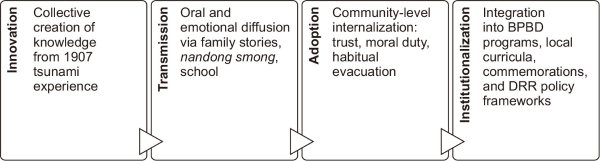
The first stage is innovation. This stage marks the origin of smong as a social innovation that emerged from the collective trauma and ecological observations of the Simeulue community. After the 1907 tsunami, survivors on the island transformed their experiences into a moral narrative that encoded evacuation instructions for future earthquakes and tsunamis. Unlike technological innovations, smong does not originate from scientific research or institutional design. It represents a bottom-up innovation developed through communal reflection and shared storytelling.
The second stage is transmission. The diffusion of smong does not occur through institutional media but through affective communication networks. Transmission takes place via family storytelling, bedtime narratives, nandong smong performances, and even inclusion in school materials and programs organized by the BPBD. This demonstrates that disaster knowledge circulates through trusted interpersonal channels and carries emotional resonance. This process aligns with Howaldt et al. (2021)’s concept of performative diffusion, in which innovations are continuously reproduced within networks of social practice. In Simeulue, families function as the primary diffusion nodes, followed by neighborhoods, schools, mosques, and cultural gatherings. Each act of retelling is not merely the transmission of information but a re-enactment of the innovation itself, embedding it more deeply into the community’s social fabric. Smong attains resilience not only through repetition but also through re-enactment, a process through which innovation becomes a living component of social identity.
The third stage is adoption, marking the transformation of shared beliefs into habitual behavior. Community trust in ancestral narratives, reinforced by elders and religious leaders, legitimizes smong as a binding social norm. Unlike efficiency-driven technological adoption, the adoption of smong is sustained through trust-based diffusion (de Oliveira et al., 2022). This stage represents the social consolidation of knowledge into collective responsibility, where remembering becomes synonymous with survival.
The fourth stage is institutionalization, referring to the integration of smong within formal structures such as disaster mitigation outreach, education, and cultural identity. Following the 2004 tsunami, local and national institutions recognized smong as an exemplary CBDRR model. The Simeulue BPBD incorporated smong terminology into evacuation training, while schools integrated smong narratives into local curricula and simulation exercises. Cultural organizations institutionalized nandong smong performances at annual commemorative events, and local communities adopted the term smong as a substitute for “tsunami.” Institutionalization transformed smong from an oral heritage into a policy-relevant knowledge system. However, it also presents new challenges: the risk of heritagization, where lived practices become mere symbolic artifacts, and the need to preserve emotional authenticity amid bureaucratic adaptation. To remain effective, institutionalized smong must retain its performative dimensions: ritual, narrative, and local ownership, while being adapted for formal disaster education and national DRR strategies.
The smong diffusion model asserts that indigenous knowledge follows a distinct cultural logic that differs from technological innovation. The process is cyclical and performative: Innovations emerge from lived experience, are transmitted through trust, adopted through shared identity, and institutionalized through recognition and education. This model contributes both theoretically and practically. Theoretically, it extends Rogers’ diffusion framework into the realm of social and cultural innovation, emphasizing emotional communication, kinship networks, and performative embodiment. Practically, the model offers a framework for integrating indigenous knowledge into DRR policies. It demonstrates how indigenous knowledge such as smong can evolve from an oral tradition into a governance culture without losing its communal essence. As a living innovation model, smong underscores that resilience is cultivated not only through infrastructure or technology but also through the enduring power of shared narratives and collective memory.
6. CONCLUSION
This study demonstrates that smong is a form of community-based social innovation that emerged organically from the lived experiences of the Simeulue community. It extends Rogers’ DOI theory by showing that innovation can originate not only from technology but also from moral communication, kinship, and shared memory. The proposed diffusion model consists of four stages: innovation, transmission, adoption, and institutionalization, which together illustrate how oral knowledge evolves into an embedded disaster communication system.
The findings confirm that indigenous knowledge remains effective only when its cultural and social ecosystems are vibrant and collective. Smong exemplifies a living risk communication mechanism that transforms cultural memory into actionable resilience. Globally, this case offers a model for integrating local and scientific knowledge into CBDRR, consistent with the SFDRR 2015-2030 and SDGs 11 (Sustainable Cities and Communities) and 13 (Climate Action). In the digital era, smong can coexist with modern, information-based TEWS. Creative digital preservation initiatives and sustained community participation are essential to ensuring its continuity. Preserving smong is therefore vital, not only as cultural heritage but also as a living system of social intelligence that technology alone cannot replicate.
This study contributes to the broader field of information science by expanding theoretical and practical understandings of how knowledge is created, communicated, and institutionalized in non-technological, community-based contexts. Through the case of smong in Simeulue, this research reframes indigenous knowledge as an information system; a dynamic, socially embedded system that manages, preserves, and disseminates knowledge for survival.
ACKNOWLEDGEMENTS
This research was supported by a grant from the National Library of Indonesia. The funding was used to support data collection activities. The authors express their sincere appreciation for the trust and support extended to this research. The authors gratefully acknowledge the anonymous reviewers for their thoughtful feedback, which substantially improved the quality of the manuscript. The authors also acknowledge the use of ChatGPT (OpenAI, GPT-5) for language support, editorial assistance, and proofreading during manuscript preparation.
REFERENCES
, , , , , , , , , Proceedings of the 21st International Conference on World Wide Web Association for Computing Machinery Twitcident: Fighting fire with information from social web streams, pp. 305-308, https://doi.org/10.1145/2187980.2188035Article Id (pmcid)
, (2025) Risk communication strategies in the tourism industry in disaster prone areas IOP Conference Series: Earth and Environmental Science, 1438, 012028 https://doi.org/10.1088/1755-1315/1438/1/012028.
Asian Disaster Preparedness Center, & United Nations Office for Disaster Risk Reduction (2021) Disaster risk reduction in Indonesia: Status report 2020 https://reliefweb.int/report/indonesia/disaster-risk-reduction-indonesia-status-report-2020
, , , , (2021) Disaster preparedness and mitigation in Indonesia: A narrative review Iranian Journal of Public Health, 50, 1536-1546 https://doi.org/10.18502/ijph.v50i8.6799. Article Id (pmcid)
, , (2020) Dissemination of information and sources of literacy in adopting local values on government administration Library Philosophy and Practice, 3983 https://digitalcommons.unl.edu/libphilprac/3983/.
, , , (2020) Modeling the dynamics of information dissemination under disaster Physica A: Statistical Mechanics and its Applications, 537, 122822 https://doi.org/10.1016/j.physa.2019.122822.
, , , (2022) Adoption of non-technological health innovations: The case of mask use during the COVID-19 pandemic in Brazil Brazilian Administration Review, 19, e210108 https://doi.org/10.1590/1807-7692bar2022210108.
, , , , , , (2023) Making peace with disaster: A study of earthquake disaster communication through manuscripts and oral traditions Progress in Disaster Science, 18, 100287 https://doi.org/10.1016/j.pdisas.2023.100287.
(2024) Understanding memory transmission in disaster risk reduction practices: A case study from Japan International Journal of Disaster Risk Reduction, 100, 104112 https://doi.org/10.1016/j.ijdrr.2023.104112.
, , (2018) smong IOP Conference Series: Earth and Environmental Science, 145, 012041 https://doi.org/10.1088/1755-1315/145/1/012041.
, (2020) Community reaction towards social innovation: A discussion of Rogers' diffusion of innovations theory in consideration of community emotional response Journal of International Agricultural and Extension Education, 27, 34-46 https://doi.org/10.5191/jiaee.2020.27103.
, , , (2014) Process for integrating local and indigenous knowledge with science for hydro-meteorological disaster risk reduction and climate change adaptation in coastal and small island communities International Journal of Disaster Risk Reduction, 10, 15-27 https://doi.org/10.1016/j.ijdrr.2014.07.007.
, , , , , (2021) [Handbook of innovation research: Social science perspectives] Springer Fachmedien Wiesbaden. German [Diffusion of innovation], pp. 103-119, https://doi.org/10.1007/978-3-658-17668-6_8
, , , , (2019) Disaster risk reduction and innovations Progress in Disaster Science, 2, 100033 https://doi.org/10.1016/j.pdisas.2019.100033.
(2003) A review and critique of Roger's diffusion of innovation theory as it applies to organizations Organization Development Journal, 21, 50-64 https://www.proquest.com/openview/1bb9b3b3787cd3ebb633a0d2a9f1a397/1?pq-origsite=gscholar&cbl=36482.
, , , , , , (2019) Reassessment of the 1907 Sumatra "tsunami earthquake" based on macroseismic, seismological, and tsunami observations, and modeling Pure and Applied Geophysics, 176, 2831-2868 https://doi.org/10.1007/s00024-019-02134-2.
(2005) Understanding mass panic and other collective responses to threat and disaster Psychiatry: Interpersonal and Biological Processes, 68, 95-113 https://doi.org/10.1521/psyc.2005.68.2.95.
, , , (2006) Smong Earthquake Spectra, 22, 661-669 https://doi.org/10.1193/1.2204966.
, (2007) Community resilience and the principles of mass trauma intervention Psychiatry: Interpersonal and Biological Processes, 70, 320-328 https://doi.org/10.1521/psyc.2007.70.4.320.
, (2017) Examining the information dissemination process on social media during the Malaysia 2014 floods using social network analysis (SNA) Journal of Information and Communication Technology, 17, 141-166 https://doi.org/10.32890/jict2018.17.1.8248.
, , (2020) Mitigation and adaptation on tsunami catastrophes in Indonesia through education and geodetic networks AIP Conference Proceedings, 2221, 050004 https://doi.org/10.1063/5.0003013.
, (2019) smong IOP Conference Series: Earth and Environmental Science, 273, 012040 https://doi.org/10.1088/1755-1315/273/1/012040.
, , , (2024) smong Asia-Pacific Journal of Regional Science, 8, 943-970 https://doi.org/10.1007/s41685-024-00346-6.
, , (2017) smong IOP Conference Series: Earth and Environmental Science, 56, 012018 https://doi.org/10.1088/1755-1315/56/1/012018.
, , (2018) smong International Journal of Disaster Risk Reduction, 29, 13-23 https://doi.org/10.1016/j.ijdrr.2017.07.015.
, , , , (2022) Smong E3S Web of Conferences, 340, 03010 https://doi.org/10.1051/e3sconf/202234003010.
, , (2019) An analysis of natural disaster-related information-seeking behavior using temporal stages Journal of the Association for Information Science and Technology, 70, 715-728 https://doi.org/10.1002/asi.24155.
, , , (2020) Community-based disaster communication management Malaysian Journal of Communication, 36, 339-350 https://doi.org/10.17576/JKMJC-2020-3604-21.
, , , , (2024) Rethinking the diffusion of grassroots innovations: An embedding framework Technological Forecasting and Social Change, 200, 123156 https://doi.org/10.1016/j.techfore.2023.123156.
(2017) The public information compliance and dissemination among urban and rural society Jurnal Penelitian Komunikasi, 20, 91-106 https://www.researchgate.net/publication/318676619_Perilaku_Pemenuhan_dan_Penyebaran_Informasi_Publik_Bagi_Masyarakat_Kota_dan_Desa.
(2007) Diffusion of innovations and indigenous cultures: A step towards adaptability International Journal of Agricultural Resources, Governance and Ecology, 6, 600-611 https://doi.org/10.1504/IJARGE.2007.014793.
, , , , , , , , , , , (2008) Neurodevelopmental trajectories of the human cerebral cortex The Journal of Neuroscience, 28, 3586-3594 https://doi.org/10.1523/JNEUROSCI.5309-07.2008. Article Id (pmcid)
, , , , , (2006) This dynamic planet: World map of volcanoes, earthquakes, impact craters and plate tectonics https://doi.org/10.3133/i2800
, , , , , , , , , , , (2022) Big data and emergency management: Concepts, methodologies, and applications IEEE Transactions on Big Data, 8, 397-419 https://doi.org/10.1109/TBDATA.2020.2972871.
, , , (2021) A shift in information dissemination methods in a cultural ritual amid the COVID-19 pandemic Journal of Information Science Theory and Practice, 9, 50-62 https://doi.org/10.1633/JISTaP.2021.9.4.4.
, , , , (2021) Nandong smong International Journal of Disaster Risk Reduction, 65, 102527 https://doi.org/10.1016/j.ijdrr.2021.102527.
, (2024) Dissemination of information resources on indigenous knowledge for sustainable agricultural development in Benue State Omanarp International Journal of Library and Information Science, 1, 41-52 https://acadrespub.com/index.php/oijlis/article/view/15.
UNESDOC (2019) Limitations and challenges of early warning systems, case study: Palu-Donggala Tsunami, 28 September 2018 https://unesdoc.unesco.org/ark:/48223/pf0000371083/
United Nations (2025) The sustainable development goals report 2025 https://unstats.un.org/sdgs/report/2025/#
United Nations Office for Disarmament Affairs (2020) Human cost of disasters https://doi.org/10.18356/79b92774-en
United Nations Office for Disaster Risk Reduction (2015) Sendai framework for disaster risk reduction 2015-2030 https://www.undrr.org/publication/sendai-framework-disaster-risk-reduction-2015-2030
, (1999) Accelerating the diffusion of innovations using opinion leaders The ANNALS of the American Academy of Political and Social Science, 566, 55-67 https://doi.org/10.1177/000271629956600105.
, , , , , , , , (2010) Proceedings of the SIGCHI Conference on Human Factors in Computing Systems Association for Computing Machinery Microblogging during two natural hazards events: What twitter may contribute to situational awareness, pp. 1079-1088, https://doi.org/10.1145/1753326.1753486
, (2018) Rumor response, debunking response, and decision makings of misinformed Twitter users during disasters Natural Hazards, 93, 1145-1162 https://doi.org/10.1007/s11069-018-3344-6.
, , , , , , , (2019) The role of indigenous knowledge in integrating scientific and indigenous knowledge for community-based disaster risk reduction: A case of Haikou Village in Ningxia, China International Journal of Disaster Risk Reduction, 41, 101309 https://doi.org/10.1016/j.ijdrr.2019.101309.
, , (2016) Comprehensive analysis of information dissemination in disasters Physica A: Statistical Mechanics and its Applications, 462, 846-857 https://doi.org/10.1016/j.physa.2016.06.043.
, (2024) The role of disaster memorial facilities in disaster risk reduction: Experiences from the Tohoku region in Japan Sustainability, 16, 8045 https://www.mdpi.com/2071-1050/16/18/8045.
, , (2018) The implementation of local wisdom in reducing natural disaster risk: A case study from West Sumatera IOP Conference Series: Earth and Environmental Science, 106, 012008 https://doi.org/10.1088/1755-1315/106/1/012008.
- Received
- 2025-07-26
- Revised
- 2025-11-06
- Accepted
- 2025-11-30
- Published
- 2026-03-30
- Downloaded
- Viewed
- 0KCI Citations
- 0WOS Citations