

- P-ISSN2287-9099
- E-ISSN2287-4577
- SCOPUS, KCI

Voices from the Margin: Examining Digital Heritage through Madurese Poetry Independent Archival Initiatives


Syifa Adiba (Independent Researcher in Digital Humanities Field, Daejeon, Korea)

Abstract
Madurese poetry, often published in regional newspapers and written in the local language, represents a vital yet overlooked facet of Indonesia’s literary heritage. Despite its cultural and historical significance, this body of work remains vulnerable to disappearance due to limited archiving infrastructures and the marginalization of regional voices within national narratives. This study investigates how independent archival initiatives, particularly the community-driven efforts of Arsip Puisi Penyair Madura and Arsip Prosa Madura, contribute to preserving and reviving the Madurese literary heritage. Using semi-structured interviews with two key informants and document and content analysis of community-managed digital platforms, this study examines how poets, readers, and community organizers understand the role of archives, their relationship with libraries, and the potential of digital technologies for preservation. The findings suggest that inclusive, participatory archiving models can bridge the gap between libraries and marginalized communities. This paper advocates for stronger collaborations between formal institutions and grassroots archives, urging libraries to embrace their role not only as repositories of knowledge but as active participants in cultural justice and heritage sustainability.
- keywords
- Madurese poetry, digital heritage, independent archives, cultural preservation, community collaboration
1. INTRODUCTION
Poetry has long served as a medium for cultural memory, resistance, and self-expression, particularly among marginalized communities whose voices are often underrepresented in formal archives. In Indonesia, poetry in the form of classical and contemporary styles has played an essential role in the voicing of Indonesian culture, history, and identity (Shaleh & Qurtuby, 2020). Despite the literary heritage being richly diverse, regional literary works such as Madurese poetry are rarely acknowledged in mainstream cultural policy or library collection development.
The Madurese people, predominantly residing in the island of Madura and parts of East Java, possess a vibrant oral and written tradition that blends folklore, resistance narratives, and Islamic values. Within Madurese communities, poetry functions as a key medium for cultural transmission, conveying moral instruction, historical memory, and collective identity across generations, particularly in contexts where oral and informal learning remains central. Madurese-language poetry serves as a fundamental pedagogical instrument within the pesantren (Islamic boarding school) milieu, facilitating the transmission of Islamic values and localized epistemologies across communal spheres. This literary form is deeply integrated into the educational fabric of these traditional institutions (Johns, 1979). Utilizing the nadham (rhymed prose) format, Madurese poetry is strategically employed to instruct specialized disciplines, thereby assisting in the cognitive retention of complex subjects such as Fiqh (jurisprudence) and Akidah (theology). The inherent melodic and rhythmic cadence of the nazam enhances mnemonic capabilities and conceptual comprehension. Furthermore, poetry is recognized as a versatile medium for da’wah (proselytization), as religious practitioners frequently leverage these poetic structures to articulate moral imperatives and spiritual values to their congregations (Johns, 1979).
The scholarly contributions of Badrus Shaleh, as referenced within this analysis, exemplify a dedicated commitment to the preservation of indigenous Madurese wisdom, utilizing poetic expression as an epistemological gateway. This investigation adopted an ethnographic methodology to foster an authentic engagement with the lived experiences and internal perspectives of the community participants (Shaleh & Qurtuby, 2020). Nevertheless, this reliance on specific scholarly works underscores a broader lacuna within formal academia, suggesting that Madurese poetry has yet to be fully integrated into mainstream literary historiography or wider digital humanities research.
The erosion of this poetic tradition therefore carries broader national implications, as it entails the loss of linguistic diversity, localized epistemologies, and region-specific modes of remembering that contribute to Indonesia’s plural cultural heritage (Anderson, 2006). Yet, most of this creative output remains scattered across ephemeral media such as local newspapers or personal manuscripts, making preservation efforts exceedingly difficult. Despite Indonesia’s wealth of intangible cultural heritage, much of its regional literary output is beyond the scope of the institutional radar. The National Library and university collections tend to prioritize canonical Indonesian literature, while literary works in local languages such as Madurese are marginalized or deemed peripheral. This forsaking raises serious concerns about linguistic justice, cultural equity, and the inclusive responsibilities of heritage institutions.
During the preceding decade, community-based archival initiatives have materialized as a response to the aforementioned lacunae within established archival collections. A notable exemplar of such endeavors, Arsip Puisi Penyair Madura (Archive of Madurese Poets’ Poetry, abbreviated as APPM), was established by Madurese literary figures and cultural advocates who harbored concerns regarding the progressive effacement of their indigenous literary heritage. Concurrently, Arsip Prosa Madura (the Madurese Prose Archive, abbreviated as APM) has concentrated its efforts on the compilation of prose collections, thereby establishing a complementary repository of indigenous narratives. These autonomous archives, despite facing constraints pertaining to financial resources and infrastructural development, have nonetheless pioneered inventive methodologies for grassroots digitization, predominantly relying upon communal contributions and readily accessible digital tools.
Concurrently, academic discourse concerning decolonial archiving has experienced significant growth, largely driven by critical examinations of the inherent Eurocentric and centralized biases prevalent within established archival institutions. Prominent scholars, including Caswell et al. (2016) and Flinn et al. (2009), advocate for the adoption of a participatory and justice-oriented archival paradigm. This paradigm is posited to validate indigenous knowledge systems, foster community-led authorship, and fundamentally redefine the parameters of legitimate archival practice. The application of these conceptual frameworks to the Madurese context necessitates an introspection into the mechanisms through which independent archives contest prevailing archival power structures and reconfigure the domain of cultural preservation.
This study aims to explore the dynamics between independent archival initiatives and formal institutions, with a focus on how digital tools can enhance the preservation and accessibility of Madurese poetry. It seeks to answer the following questions: (1) What motivates community actors to archive Madurese poetry? (2) How do these actors perceive the role of libraries in supporting or ignoring their work? (3) What challenges and opportunities emerge in bridging independent archives with institutional infrastructures? This research is intended to contribute to the broader discourse on inclusive digital heritage by highlighting the intersections between poetry, identity, memory, and archival justice.
2. LITERATURE REVIEW
This research is situated within a broader scholarly discourse, engaging with several pivotal themes that critically inform its analytical framework: community archiving and the principles of archival justice, digital heritage and the implementation of participatory technologies, the imperative for preserving regional and vernacular literary traditions, the intersection of gender and authorship within independent literary production, and the ethical considerations inherent in collaborative archival methodologies.
2.1. Archival Justice and Participatory Documentation as Analytical Lens
Over recent years, scholarly discourse has increasingly focused on the pivotal role of community archives in fostering the democratization of memory and rectifying lacunae in representation within established archival institutions. Caswell et al. (2016) contend that archives ought not to function solely as inert repositories but rather as proactive facilitators of social justice, particularly when interacting with historically marginalized populations. This theoretical positioning shapes the analysis in three ways: first, by examining how Madurese poetry is positioned as legitimate cultural knowledge rather than folkloric curiosity; second, by investigating community autonomy in decisions about representation and access; and third, by understanding grassroots documentation as resistance to Jakarta-centric institutional paradigms (Flinn et al., 2009). Independent initiatives such as Irama Nusantara and the Indonesian Visual Art Archive offer important precedents for community-led documentation in Indonesia (Mrázek, 2018). These models illuminate how regional communities develop autonomous systems that challenge centralized narratives. Participatory archival frameworks (Bastian & Alexander, 2009) further enhance our comprehension of the ways in which community constituents influence the development of collections and the provision of access. This paradigm challenges conventional models wherein professional archivists serve as gatekeepers, thereby unveiling collaborative strategies that empower communities to govern the documentation of their own narratives (Gilliland et al., 2016).
The examination of archival websites, social media interactions, and event documentation seeks to identify these participatory mechanisms as they are realized in practice. In the context of Indonesia, the phenomena of archival marginalization are particularly evident. The centralization of cultural policy during the New Order regime (1966-1998) engendered enduring infrastructural biases, whereby national memory institutions located in Jakarta were consistently favored over regional archival endeavors (Ricklefs, 2008; Sunjayadi, 2012). This historical legacy continues to influence current archival environments, in which regional literary traditions encompassing languages such as Madurese, Sundanese, Javanese, and other indigenous tongues persistently remain underrepresented in national collections. Overall, community archives, including those scrutinized in this analysis, act not solely as instruments for conservation but also as conscious statements of opposition to overarching cultural control, upholding the legitimacy of local knowledge paradigms within a national landscape that has routinely marginalized them.
2.2. Digital Heritage Practices and Regional Literary Preservation
The concept of “heritage 2.0” (Giaccardi, 2012) frames the examination of digital archival platforms, positioning digital media as catalysts for co-creation and participatory documentation. The adoption of accessible platforms such as Instagram, WordPress, and community websites by Madurese archival initiatives exemplifies this democratization, allowing grassroots organizations to circumvent traditional gatekeeping while establishing direct audience connections (Huvila, 2008). However, concerns about “platform fragility” and dependency on commercial infrastructure remain relevant (Bastian, 2003; Ketelaar, 2001). The content analysis of digitized poems, social media communications, and metadata practices illuminates how community archives navigate tensions between accessibility and long-term sustainability, a balance that requires ongoing negotiation and adaptation.
The conspicuous lack of Madurese poetry in prominent Indonesian literary compilations and historical narratives (Kratz, 1996; Sudarmoko, 2021) offers critical contextual understanding. Academic examinations of the formation of the Indonesian literary canon reveal how institutional frameworks have prioritized publications originating in Jakarta that adhere to national literary criteria, consequently sidelining regional voices that utilize indigenous languages (Foulcher, 1990). Contemporary scholarship contests these established hierarchies by illuminating the complexity and richness inherent in regional literary customs (Hellwig, 1994). We perceive community-driven archival initiatives as intentional actions within literary historiography, shaped by recent advocacy for the incorporation of vernacular languages (Jaizul & Lestari, 2025). The notion of “born-digital heritage,” cultural materials existing exclusively in digital formats (Duranti & Rogers, 2012), shapes our analytical approach to social media content and online publications. We examine how archivists blend traditional Madurese literary practices with digital affordances, creating what Miller and Slater (2000) term “digital vernaculars” that reflect processes of cultural translation and technological adaptation. This negotiation holds particular importance within the Indonesian milieu, where the proliferation of digital media has occurred alongside disparate levels of access, governance, and utilization across various regions. For community archives functioning in Madura, the utilization of user-friendly platforms such as Instagram and TikTok thus signifies not merely a technological selection but a pragmatic adaptation to these circumstances. In this context, leveraging the framework of data colonialism (Couldry & Mejias, 2019), these practices can be interpreted as endeavors to reclaim representational control within platform ecosystems that concurrently commodify cultural production.
2.3. Ethical Framework for Community Engagement
The “radical empathy” paradigm delineated by Caswell and Cifor (2016) directs the ethical considerations in this research, emphasizing the importance of relationality, informed consent, and acknowledgment of emotional labor during the processes of data collection and analysis. This perspective necessitates continuous reflexivity concerning the power dynamics that exist between researchers and community participants (Gilliland, 2014), particularly when investigating marginalized cultural practices. Indigenous data sovereignty principles (Carroll et al., 2020) underpin our protocols, aimed at honoring community ownership of cultural artifacts. Our choice to anonymize the identities of informants and aggregate interview outcomes embodies this commitment, thereby ensuring that archival practitioners maintain authority over the representation of their contributions. In the cases where perspectives notably diverge, we analytically separate contributions while upholding confidentiality.
Contemporary scholarship regarding collaborations between Indonesian institutions and communities indicates that effective partnerships necessitate cultural awareness, ongoing trust development, and an openness to reevaluating traditional archival methodologies (Hasfera et al., 2023). These findings enlighten the dynamics between community archives and formal institutions, particularly in terms of co-curation opportunities and support frameworks. The notion of “archival hospitality” (Ketelaar, 2001) shapes our understanding of institutional relationships, highlighting the importance of reciprocal engagement and acknowledging that archives serve as arenas for power negotiation rather than impartial storage sites (Schwartz & Cook, 2002). We scrutinize the extent to which institutional representatives are willing to relinquish traditional gatekeeping roles, adopting distributed stewardship paradigms that recognize community expertise in the stewardship of cultural heritage. While not the central theme of this research, we acknowledge that the gendered aspects of archival labor and literary creation (Caswell & Cifor, 2016; Hatley, 2008) intersect with regional marginalization in ways that warrant further exploration, especially in light of the prevailing gender dynamics within Madurese literary contexts. This comprehensive framework positions the archiving of Madurese poetry as a vital locus for comprehending how marginalized cultural expressions can be preserved, digitized, and disseminated beyond traditional institutional confines.
2.4. Ethics and Institutional Collaboration
Ultimately, ethical considerations pertaining to collaborative endeavors remain pivotal within the domain of community archiving. As articulated by Caswell and Cifor (2016) in their exposition of the “radical empathy” framework, institutional-community partnerships necessitate the prioritization of relationality, informed consent, and the acknowledgement of emotional labor. Within the Indonesian context, Hasfera et al. (2023) have delineated a multifaceted scenario wherein libraries are progressively recognizing their imperative role in the preservation of indigenous heritage; however, successful collaboration mandates profound cultural sensitivity, the cultivation of enduring trust, and a fundamental re-evaluation of established archival practices. These instances underscore the paramount significance of co-curation and trust-building during engagement with community-owned cultural materials. By synthesizing insights derived from these five distinct scholarly trajectories, the present investigation positions the archiving of Madurese poetry as a critical locus for comprehending the mechanisms by which marginalized cultural production can be sustained, digitized, and disseminated beyond conventional institutional boundaries.
The implementation of ethical archival practices requires sustained attention to power dynamics that characterize relationships between formal institutions and community-based initiatives (Gilliland, 2014). Indigenous data sovereignty frameworks, as developed by Carroll et al. (2020), provide essential guidance for establishing collaborative protocols that respect community ownership and control over cultural heritage materials. These frameworks emphasize the importance of community-defined research priorities, benefit-sharing agreements, and the recognition of indigenous intellectual property rights that extend beyond conventional copyright protections.
Moreover, the concept of “archival hospitality,” introduced by Derrida and Prenowitz (1995) and further developed by archival scholars such as Ketelaar (2001), offers a theoretical foundation for reimagining institutional relationships with marginalized communities. This framework emphasizes reciprocal engagement, cultural humility, and the recognition that archives are not neutral spaces but sites of ongoing power negotiation (Schwartz & Cook, 2002). Successful collaboration thus requires institutional willingness to cede traditional gatekeeping authority and embrace more distributed models of archival stewardship that acknowledge community expertise in managing their own cultural heritage.
The sustainability of ethical collaborations depends upon establishing transparent governance structures that ensure equitable participation in decision-making processes while maintaining accountability to community stakeholders (Stevens et al., 2010). By synthesizing insights derived from these five distinct scholarly trajectories, the present investigation highlights the archiving of Madurese poetry as a practical site for understanding how marginalized cultural practices can be sustained and digitized outside traditional archives.
3. METHODS
This study utilized a qualitative research methodology, drawing upon ethnographic and participatory frameworks. Its primary objective was to ascertain the underlying motivations, prevalent challenges, and future aspirations of community-based archival practitioners within the Madura region, alongside an examination of the interface between their endeavors and established archival institutions, such as libraries. Data acquisition was primarily facilitated through two distinct methods: semi-structured interviews and systematic content analysis of digital platforms, including Instagram and community-managed archival websites. The specific platform and materials analyzed include:
-
APPM website (www.arsippenyairmadura.com), which was accessible during the initial phase of data collection but was no longer available at the time of revision (last accessed July 2025; see Fig. 1 for the archival platform’s interface).
-
APPM Instagram account @arsippuisi_penyairmadura serving as a primary digital outreach channel (Fig. 2).
-
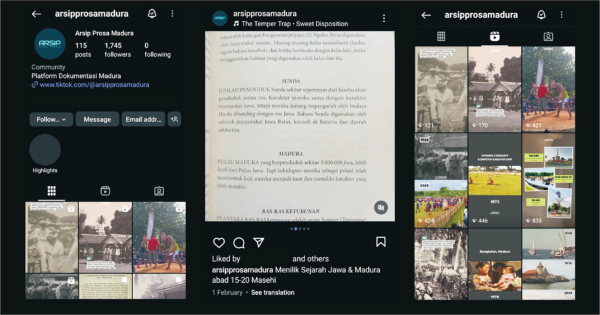
APM Instagram account @arsipprosamadura utilized for community-driven content distribution (Fig. 3).
-
APM TikTok account (www.tiktok.com/@arsipprosamadura).
-
Digitized poems originally sourced from regional newspapers such as Radar Madura via the APPM website.
-
Documentation of literary events and community activities shared through these platforms (e.g., photographs, event posters, and announcements).
Fig. 1
Arsip Puisi Penyair Madura (Archive of Madurese Poets’ Poetry) website screenshot; reproduced with permission.
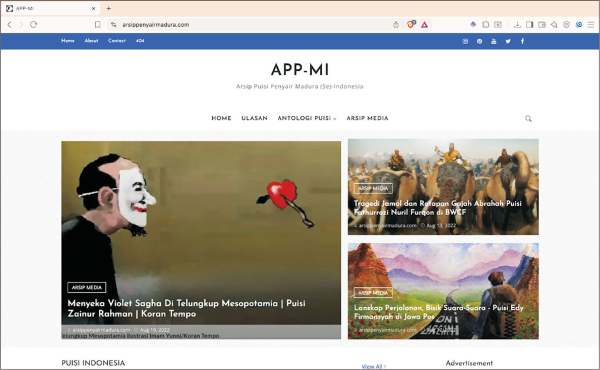
Fig. 2
Arsip Puisi Penyair Madura (Archive of Madurese Poets’ Poetry) Instagram screenshot collage; reproduced with permission.
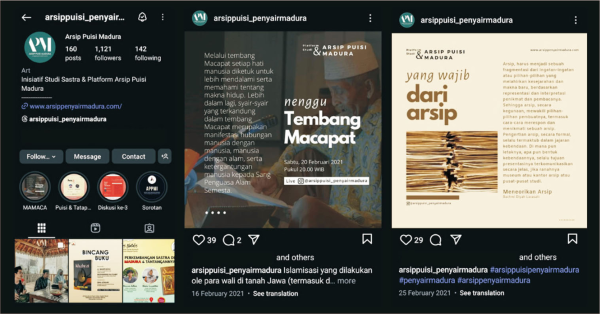
Fig. 3
Arsip Prosa Madura (the Madurese Prose Archive) Instagram screenshot collage; reproduced with permission.
Two key informants were meticulously selected via purposive sampling for interview participation. These informants were selected because they served as founders and primary coordinators of the respective archival initiatives, possessing decision-making authority and long-term involvement in collection, curation, and community engagement activities. Despite the limitation in the number of informants, this study does not aim for statistical generalization; rather, it underscores the concepts of transferability and analytical generalization (Yin & Campbell, 2018). The extensive expertise and thorough familiarity of these stakeholders enable the acquisition of nuanced, context-dependent insights that characterize qualitative case study analyses. These insights are not designed to epitomize all archival endeavors; rather, they shed light on broader dynamics such as community-driven preservation, utilization of digital platforms, and institutional marginalization that may be pertinent to analogous community archives, particularly those functioning within minority-language or Global South frameworks (Lincoln & Guba, 1985). The interviews were structured around an open-ended questionnaire, designed to elicit insights into pertinent themes, including perceptions of literary heritage, the integration of digital technologies, collaborative community engagement, and the efficacy of institutional support mechanisms. For privacy reasons, we combined the results of the interviews in the “Results and Discussion” section without mentioning specific informants. Some informants’ information supported and reinforced each other’s replies, except for cases where we separated them in the writing.
We also combined the results of these interviews with the theory of reinforcement. Complementary to the interview process, an analysis of archival documents was undertaken. The materials analyzed included: (1) digitized Madurese poems previously published in regional newspapers and literary anthologies; (2) content from archival websites managed by the initiatives; (3) social media posts published on Instagram; and (4) documentation of literary events and community activities. These sources offered valuable perspectives on archival methodologies, criteria for content selection, strategies for dissemination, and the formulation of informal metadata. These documents encompassed digitized poetic works previously published in newspapers, social media communications originating from independent archives, comprehensive event documentation, and instances of informal metadata practices. These diverse sources afforded critical insights into the operational modalities of community archives, the methodologies employed for content categorization and dissemination, and the intricate interplay of these materials within the broader cultural ecosystem.
The collected data underwent systematic coding and thematic analysis, employing Braun and Clarke (2006)’s six-step method. Thematic development proceeded inductively, with particular emphasis placed on identifying recurring patterns across the varied perspectives of different stakeholders. Ethical considerations, encompassing informed consent, cultural sensitivity, and due recognition of intellectual contributions from community members, were rigorously observed throughout the research process. This study did not require formal institutional ethical approval. Verbal informed consent was obtained from all participants, and identifying information has been anonymized.
4. RESULTS AND DISCUSSION
Following data collection and analysis, four principal themes emerged regarding community efforts and perspectives on Madurese poetry archiving. These themes illuminate the motivations, challenges, and prospective pathways for collaboration between grassroots and institutional stakeholders. Each subsequent subsection delineates and examines these findings systematically. The study examined two independent archival initiatives: APPM and APM. While administered by distinct entities, both archives operate under a shared institutional vision. APPM is currently classified as dormant due to the cessation of content publication on its website platform and the redirection of its archivists toward alternative professional endeavors. Conversely, APM maintains operational continuity through active engagement on social media platforms, including Instagram and TikTok.
4.1. Motivations Behind Independent Archiving
APPM and APM demonstrate distinct motivational frameworks for conducting independent archival work. Despite their initial interconnection and the archivists’ mutual acquaintance during the formative period, their respective endeavors subsequently diverged due to fundamental differences in the documentary formats they seek to preserve and disseminate. These motivations emerged clearly across interviews and internal documentation collected between July 29 (with APPM informant, in person) and August 5, 2023 (with APM informant, in person).
The establishment of APPM was precipitated by three principal factors. First, the intrinsic passion and personal commitment of the participating individuals served as a primary catalyst. Many of the key figures behind these initiatives are native to Madura and have been intellectually and emotionally shaped by literary environments such as pesantren (Islamic boarding schools), where exposure to classical and contemporary poetry is common. Their intimate familiarity with Madurese language, poetic forms, and cultural idioms cultivated a strong sense of obligation to safeguard these literary expressions from oblivion. As one archivist explained, “We grew up with these poems. They are part of how we understand ourselves. If we do not archive them, they will slowly disappear” (Informant 1, APPM). Their actions reflect what Flinn (2010) terms “archival activism,” wherein personal identity and cultural memory become catalysts for collective preservation.
Second, the initiatives sought to contest persistent stereotypes associated with Madurese identity. The archivists articulated concerns over reductive and often stigmatizing representations of Madurese communities, which were often characterized narrowly as involvement in violence, parochialism, or religiosity. According to one participant, “When people talk about Madura online, it is often negative. But we have literature, we have intellectual traditions. That side is rarely shown” (Informant 1, APPM). The emergence and documentation of Madurese literary works, particularly poetry, was deemed an appropriate mechanism through which to contest these reductive representations. By foregrounding literary production as a medium of cultural sophistication and nuance, these archives aim to reframe public discourse about Madura. The act of collecting and disseminating Madurese poetry thus becomes a form of representational resistance, a challenge to dominant narratives that marginalize regional cultural output (Caswell, 2014; Ketelaar, 2001).
Third, scholarly demand also constituted a pivotal factor. A burgeoning interest has been observed among researchers and educators concerning the epistemic dimensions inherent in Madurese poetry, given its encapsulation of the cognitive worldviews, moral philosophies, and historical memory pertinent to its communities. Nevertheless, the disparate and ephemeral character of these textual artifacts, frequently disseminated within short-lived local periodicals or confined to personal manuscripts, posed significant access barriers. As noted by the archivist, “Students and researchers often asked where they could find Madurese poems. There was no single place. Everything was fragmented” (Informant 1, APPM). Consequently, archivists undertook the development of specialized digital platforms designed to centralize these materials, thereby not only facilitating academic inquiry but also broadening public accessibility. These platforms fulfill a dual function: serving both as preservation tools and as pedagogical resources.
In the case of APM, the project similarly emerged from a critical awareness of the misrepresentation of Madurese identity in mainstream media, particularly on social platforms. The curators observed that digital portrayals often reinforce pejorative stereotypes, prompting them to utilize the same platforms, such as Instagram, as counter-archives. As stated by the APM archivist, “If social media is used to spread stereotypes, we can also use it to spread knowledge. It depends on how we use the platform” (Informant 2, APM). Their strategic engagement with digital media serves as a form of narrative reclamation and knowledge intervention, contributing to what Giaccardi (2012) calls “participatory heritage,” where communities curate their own representations and histories.
Moreover, the initiative aims to address informational lacunae surrounding Madurese cultural and social history. By documenting oral histories, personal testimonies, and literary texts, the archive contributes to the reconstruction of underrepresented narratives that are often omitted from official historiographies. As one informant emphasized, “There are many stories about Madura that are never archived in official history. We want to record them before they are forgotten” (Informant 2, APM). In doing so, the archivists position their work within broader frameworks of cultural rights and epistemic justice, aligning with recent scholarship that views community archives not simply as repositories of memory but as instruments of counter-hegemonic knowledge production (Bastian, 2003; Caswell & Cifor, 2016).
4.2. Institutional Disconnect and Community Perception
The marginalization of Madurese literary heritage within Indonesia’s formal cultural institutions reflects broader patterns of centralized knowledge production that privilege metropolitan perspectives over regional expressions. As argued by Foulcher (1990), national cultural institutions in Indonesia have historically demonstrated limited engagement with regional literature, particularly works published outside Jakarta or written in local languages. This institutional neglect extends to funding mechanisms, where cultural preservation grants typically require bureaucratic processes and institutional affiliations that effectively exclude grassroots initiatives. The absence of dedicated personnel with expertise in regional languages and literatures further compounds these challenges, creating systemic barriers that render Madurese cultural production invisible within official archival landscapes.
Interview data corroborate this structural condition. Participants consistently described unsuccessful attempts to seek institutional support. As one archivist explained, “We have tried to approach local institutions, but there has never been any concrete support for literary archiving. It is simply not considered a priority” (Informant 1, APPM). Another participant added, “Archiving poetry is seen as something that has no economic value, so it is often ignored in policy discussions” (Informant 2, APM). These accounts indicate that archival work related to regional literature is frequently perceived as culturally marginal and economically unviable.
The sustained institutional disregard for Madurese literary traditions has engendered profound skepticism within community spheres concerning the preparedness or capability of official institutions to serve as reliable custodians of regional heritage. Governmental priorities predominantly converge upon nature-based tourism, affording negligible acknowledgment to intangible cultural contributions, such as poetic works or autonomous archival endeavors. Archivists affiliated with APPM and APM articulate considerable dissatisfaction regarding the paucity of financial endorsement and policy integration, observing that their preservation efforts remain peripheral to official policy and devoid of commercial incentive. Drawing on Stevens et al. (2010), this institutional oversight can be understood as being perceived by community members as encouraging a turn toward cultural self-determination, whereby autonomous archiving is regarded as both an imperative and a symbolic act of resistance against centralized cultural authority. As articulated by one archivist, “If we wait for institutions to take care of our literature, nothing will happen. So we decided to do it ourselves” (Informant 1, APPM). Public contestations regarding APPM’s selection criteria further exemplify this dynamic; notwithstanding its volunteer-driven nature, the archive has been subjected to scrutiny for perceived omissions, thereby highlighting the intricate expectations imposed upon grassroots initiatives. Nevertheless, both APM and APPM maintain their dedication to their stated mission, prioritizing transparency and accessibility over institutional validation. Their concerted efforts parallel broader movements of regional cultural affirmation that repudiate Jakarta-centric narratives and advocate for locally governed memory practices.
The imperative of archival legitimacy frequently arises as a pivotal consideration for community-driven undertakings operating beyond established institutional paradigms, thereby necessitating the development of alternative validation models that critically interrogate conventional conceptualizations of professional competence and institutional prerogative. Both APPM and APM have cultivated their credibility through communal acknowledgement, engagement with scholars, and observed audience interaction on digital platforms, rather than through formal institutional endorsement. This phenomenon reflects what Bastian (2003) characterizes as an affective legitimacy, grounded in cultural resonance rather than bureaucratic sanction. These archival endeavors exemplify alternative benchmarks for archival practice, prioritizing cultural authenticity, communal accessibility, and grassroots involvement over formal professional qualifications and institutional affiliation. The inherent tension between amateur and professional archival standards is particularly accentuated within digital milieus, wherein technical proficiency and cultural acumen may command greater esteem than conventional archival pedagogy.
Historical attempts at collaboration between community archives and formal institutions have been characterized by structural incongruity and unbalanced power dynamics that ultimately undermined sustainable partnership models. Documentation reveals multiple instances where community archivists reached out to cultural institutions and university libraries seeking support or collaboration, only to encounter bureaucratic neglect or proposals that would subsume community initiatives under institutional control. One participant recalled, “There was interest, but the condition was that the archive would be managed under their institutional framework. We were not comfortable with losing control over our own materials” (Informant 2, APM). These experiences reflect broader tension concerning intellectual property, community consent, and cultural representation that reflect broader colonial legacies within Indonesian institutional structures (Reid, 2010). For many community archivists, the preservation of autonomy outweighs the pursuit of formal recognition. As another informant emphasized, “We prefer to remain independent rather than hand over our work and lose the spirit behind it” (Informant 1, APPM).
The adoption of digital platforms by community archives constitutes a strategic bypass of conventional institutional gatekeeping protocols, thereby facilitating unmediated interaction with diverse audiences while preserving cultural sovereignty and editorial prerogative. The selection between web-based repositories, herein referred to as Archival Platform Models, and social media platforms, designated as Archival Presence Models, signifies divergent epistemologies concerning accessibility, longevity, and audience participation. Each methodology presents distinct benefits for the community-directed dissemination of cultural heritage (Giaccardi, 2012). Digital technologies empower community archives to establish alternative organizational frameworks that operate in accordance with community-articulated standards rather than adhering to established professional archival methodologies, consequently fostering parallel systems of cultural conservation that contest the hegemonic influence of formal institutions. This process of digital disintermediation enables communities to circumvent traditional publishing houses, libraries, and museums, concurrently forging direct relationships with scholars, pedagogues, and cultural aficionados who prioritize authentic regional perspectives over institutionally mediated representations. In relation to the second research question, these results reveal a persistent institutional disconnect that fosters skepticism among community archivists while simultaneously encouraging autonomous cultural preservation strategies.
4.3. Digital Tools as Enablers of Grassroots Innovation
Both APPM and APM operate on a voluntary, non-remunerative basis. As such, their archival strategies prioritize cost-effective and accessible digital platforms, with social media emerging as the preferred medium due to its free availability and wide reach. For these community-based archivists, such platforms offer both functional and logistical advantages, enabling them to engage in preservation activities despite limited financial resources. As one archivist explained, “This is purely voluntary work. We don’t receive funding, so we rely on platforms that are free and easy to use” (Informant 1, APPM).
The APPM primarily acquires materials through digital sources, including online literary websites that feature Madurese poets, digital newspaper archives, and literary groups hosted on Facebook. Poems identified through these channels are manually transcribed and annotated with relevant metadata such as the date of publication and the source of origin. When poems are obtained from digital websites, archivists may enhance them with contextual illustrations while ensuring appropriate citation. In cases where the original format is a scanned newspaper or photographic documentation, the poem is retyped to ensure digital legibility and long-term access. As described by the archivist, “If we find a poem in an old newspaper scan, we retype it manually so it can be read clearly online” (Informant 1, APPM).
In terms of selection criteria, the APPM limits its archival scope to poems that have been previously published in print newspapers or poetry anthologies. The exclusion of unpublished manuscripts or magazine content is informed by a curatorial rationale: the belief that publication through formal media channels typically entails an editorial or peer-review process, thus serving as a proxy indicator of literary quality and cultural significance. As the archivist noted, “We only archive poems that have already been published in newspapers or books. That way, there has been an editorial process” (Informant 1, APPM).
Conversely, APM has adopted a more public-facing dissemination strategy, favoring platforms such as TikTok and Instagram. This choice is informed by two principal considerations. First, these platforms offer the potential for enhanced visibility and circulation, enabling Madurese narratives to be disseminated beyond localized audiences. As the archivist explained, “If we want people outside Madura to see our stories, we have to use platforms like Instagram and TikTok” (Informant 2, APM). In doing so, APM aims to challenge and subvert prevailing stereotypes of Madurese identity that often circulate on mainstream social media. According to the archivists, the use of algorithm-driven platforms enhances the capacity of these initiatives to reach audiences beyond the island of Madura, including diaspora communities and broader Indonesian publics. As the informant emphasized, “After posting, we received responses from people outside the island. That shows the reach is much wider” (Informant 2, APM).
Second, the audiovisual affordances of TikTok and Instagram offer dynamic and engaging modes of presentation. By incorporating photos, animations, and short-form video content, APM is able to communicate complex historical and cultural themes in a manner that is both accessible and contextually resonant. As articulated by the archivist, “Through short videos, we can explain history and literature in a way that feels closer to young audiences” (Informant 2, APM). These creative strategies not only increase user engagement but also provide an alternative pedagogical model for the transmission of regional knowledge. Ultimately, the strategic adoption of digital tools by both APPM and APM illustrates how community archives can innovate beyond the limitations of formal institutions to ensure the survival and accessibility of local cultural heritage. These practices show a broader transformation in archival logic, which shifted from static, institution-centered repositories toward more fluid, interactive, and community-responsive platforms. The success of these digital efforts underscores the need to recognize grassroots digital literacy not merely as a coping strategy but as a form of creative agency.
4.4. Pathways Toward Collaboration
Although APPM is no longer active, its initial efforts exemplify the potential of grassroots literary archiving to foster community engagement and build collaborative networks. During its formative period, APPM archivists conducted outreach trips across various districts in Madura, introducing APPM as an independent archival initiative. These field visits were instrumental in mapping the literary landscape of the region. As one archivist recalled, “We visited several districts to introduce the archive and meet local writers directly” (Informant 1, APPM). They facilitated encounters with numerous local literary communities, which not only offered insights into the circulation of Madurese poetry but also contributed directly to the identification and collection of archival materials. As one participant observed, “From those meetings, we discovered many poems and writers we had not known before” (Informant 1, APPM). The archivists noted that APPM’s presence was acknowledged through invitations to participate in literary events, signaling early forms of institutional and community recognition: “We were invited to several literary events, which showed that people recognized our work” (Informant 1, APPM).
In contrast, APM remains active and continues to expand its scope. The current archivist has expressed strong interest in fostering inter-community collaborations and participating in broader cultural platforms, including regional festivals. One of the aspirations articulated by the archivist involves documenting a “travel journal” that narrates the diverse cultural and historical dimensions of Madura. As expressed in the interview, “I want to create a kind of travel journal about Madura, telling stories about its culture, history, and people” (Informant 2, APM). This vision aligns with broader trends in cultural heritage work, which emphasize storytelling, mobility, and lived experience as vital components of community archiving.
A relevant point of reference is the Festival Kesenian Yogyakarta (Yogyakarta Art Festival, or abbreviated as FKY), an annual cultural event that brings together artists, community organizers, and independent initiatives from across Indonesia. FKY provides a decentralized, inclusive platform for showcasing regional art forms, including literature, oral traditions, and digital media. Its emphasis on inter-community collaboration and participatory formats offers a compelling model for how independent archives like APM might engage with wider audiences. By participating in such festivals, APM was able to situate Madurese literature within a national cultural dialogue, enhance the visibility of its archival efforts, and form symbiotic partnerships with other archival and artistic collectives. As the APM archivist expressed when discussing future plans, “We hope to join cultural festivals so Madurese literature can be part of a wider national conversation” (Informant 2, APM).
In this light, the potential for collaboration between APM and platforms such as FKY points to a promising trajectory. These alliances not only broaden the reach and sustainability of community archives but also contribute to a more pluralistic and decentralized national memory infrastructure. Building such pathways requires strategic alignment, institutional openness, and a shared commitment to cultural equity, values that resonate with the ethos of both APM and community-based festivals like FKY. Addressing the third research question, the present study finds that while structural and bureaucratic barriers hinder formal collaboration, digital platforms and cultural festivals present viable opportunities for bridging independent archives with broader institutional infrastructures. As one informant reflected, “Even if institutions are difficult to approach, digital platforms and festivals give us space to collaborate on our own terms” (Informant 2, APM).
4.5. Limitation
This research encompasses several constraints that merit recognition. Initially, the investigation was based on interviews conducted with merely two principal informants. Although both individuals were chosen for their crucial roles in establishing and overseeing the archival initiatives, their viewpoints may not comprehensively reflect the range of opinions present within the wider Madurese literary community. Moreover, the research depends on accessible digital records and publicly available online resources, which may not encompass the entirety of archival materials or offline methodologies. Certain materials might have been lost, remain unpublished, or were unavailable during the period of analysis. Lastly, as a qualitative case study concentrating on two community archives, the results are not designed to be extrapolated to all regional literary archives in Indonesia. Instead, they provide contextually specific insights into grassroots archival methodologies and institutional dynamics within the Madurese cultural framework.
5. CONCLUSION
This study has examined the emergence, practices, and institutional dynamics of two community archive initiatives, namely APPM and APM, that work to preserve Madurese literary heritage. Through qualitative analysis of interviews and content analysis, the research reveals several key findings. First, both archives exemplify grassroots responses to institutional neglect, mobilized by a combination of cultural attachment, scholarly necessity, and a desire to counter misrepresentations of Madurese identity. Their motivations are deeply attached to personal and collective commitments towards cultural self-determination, which aligns with broader frameworks of archival activism and community-led heritage work.
Second, the study highlights how digital platforms serve as critical enablers for these archives. While APPM prefers curated repository-style models, APM adopts a participatory and public-facing strategy through TikTok and Instagram. These divergent approaches reflect different epistemologies of access, legitimacy, and audience engagement. Importantly, both demonstrate how digital tools can bypass institutional gatekeeping and facilitate affective, culturally resonant forms of memory work.
Third, the findings underscore the deep skepticism toward formal institutions and the pervasive sense of exclusion experienced by community archivists. This disconnect points to structural challenges in Indonesia’s cultural infrastructure, where regional literary production is often marginalized within Jakarta-centric policy frameworks. Despite these barriers, APPM and APM have cultivated alternative models of archival legitimacy based on community validation, digital visibility, and scholarly use, thus redefining archival standards from the margins.
Lastly, the study explores possibilities for collaboration, especially through decentralized platforms such as the FKY, which can act as bridges between independent initiatives and broader cultural networks. These forms of alliance-building are essential for fostering cultural equity and expanding the reach of grassroots archives. The insights gained from APPM and APM indicate multiple avenues that require additional academic exploration. Subsequent inquiries should investigate the processes through which community archives manage transitions from active to dormant status, as evidenced by APPM’s progression towards inactivity, prompting broader inquiries regarding the sustainability of volunteer-led initiatives and the significance of institutional support in averting archival discontinuity. Moreover, the gendered aspects of Madurese literary creation demand a more comprehensive examination, especially considering the male dominance observed within both archival and literary spheres as highlighted in this discourse. Additionally, the involvement of Madurese diaspora communities in promoting the preservation of vernacular languages underscores a largely overlooked facet that bears significant implications for understanding the extensive landscape of heritage management. This research underscores the urgent necessity for the establishment of more inclusive financial frameworks that bolster independent archival endeavors. Initiatives such as Dana Indonesiana should consider the formulation of flexible, non-bureaucratic funding pathways to more effectively endorse grassroots cultural initiatives, which are often sidelined by formal institutional requirements. Furthermore, libraries and cultural organizations ought to reevaluate their roles, transitioning from subsumptive models whereby community efforts are assimilated under institutional control towards co-stewardship paradigms that maintain community autonomy while providing infrastructural and technical support. Libraries and cultural institutions must rethink their roles, not simply as repositories, but as co-creators, facilitators, and ethical partners in community memory-making. By embracing these alternative practices, Indonesia can move toward a more inclusive and just archival future.
REFERENCES
(2003) Owning memory: How a Caribbean community lost its archives and found its history Libraries Unlimited https://doi.org/10.5040/9798400694752
, (2006) Using thematic analysis in psychology Qualitative Research in Psychology, 3(2), 77-101, https://doi.org/10.1191/1478088706qp063oa .
, , , , , , , , , , , , , (2020) The CARE principles for indigenous data governance Data Science Journal, 19(43), 1-12, https://doi.org/10.5334/dsj-2020-043 .
(2014) Seeing yourself in history The Public Historian, 36(4), 26-37, https://doi.org/10.1525/tph.2014.36.4.26 .
, , (2016) “To suddenly discover yourself existing”: Uncovering the impact of community archives The American Archivist, 79(1), 56-81, https://doi.org/10.17723/0360-9081.79.1.56 .
, (1995) Archive fever: A Freudian impression Diacritics, 25(2), 9, https://doi.org/10.2307/465144 .
, (2012) Trust in digital records: An increasingly cloudy legal area Computer Law & Security Review, 28(5), 522-531, https://doi.org/10.1016/j.clsr.2012.07.009 .
(2010) Independent community archives and community-generated content: ‘Writing, saving and sharing our histories’ Convergence: The International Journal of Research into New Media Technologies, 16(1), 39-51, https://doi.org/10.1177/1354856509347707 .
, , (2009) Whose memories, whose archives? Independent community archives, autonomy and the mainstream Archival Science, 9(1-2), 71-86, https://doi.org/10.1007/s10502-009-9105-2 .
, , (2016) Research in the archival multiverse Monash University Publishing https://doi.org/10.26530/OAPEN_628143
, , (2023) Implementation of indigenous knowledge preservation in public library: Case study in West Sumatera Literatify: Trends in Library Developments, 4(Special Issue),, 398-409, https://doi.org/10.24252/literatify.vi.43999 .
(2008) Participatory archive: Towards decentralised curation, radical user orientation, and broader contextualisation of records management Archival Science, 8(1), 15-36, https://doi.org/10.1007/s10502-008-9071-0 .
, (2025) Representation gaps in digital humanities: A case study of marginalized languages and cultures in Indonesia International Journal of Humanities, Law, and Politics, 3(2), 52-56, https://doi.org/10.46336/ijhlp.v3i2.219 .
(2001) Tacit narratives: The meanings of archives Archival Science, 1(2), 131-141, https://doi.org/10.1007/bf02435644 .
, (2000) The Internet: An ethnographic approach Routledge https://doi.org/10.4324/9781003087007
, (2002) Archives, records, and power: The making of modern memory Archival Science, 2(1-2), 1-19, https://doi.org/10.1007/bf02435628 .
, , (2010) New frameworks for community engagement in the archive sector: From handing over to handing on International Journal of Heritage Studies, 16(1-2), 59-76, https://doi.org/10.1080/13527250903441770 .
(2012) Susan Blackburn, Jakarta; sejarah 400 tahun. Translated by Gatot Triwira. Depok: Masup Jakarta, 2011, 416 pp. ISBN 978-602-96256-3-9. Price: IDR 95,000 (soft cover) Wacana, Journal of the Humanities of Indonesia, 14(1), 177, https://doi.org/10.17510/wjhi.v14i1.57 .
- Received
- 2025-12-28
- Revised
- 2026-05-01
- Accepted
- 2026-05-10
- Published
- 2026-09-30
- Downloaded
- Viewed
- 0KCI Citations
- 0WOS Citations