


- P-ISSN1229-0661
- E-ISSN1229-0661
- KCI
논문 상세
- 2026 (32권)
- 2025 (31권)
- 2024 (30권)
- 2023 (29권)
- 2022 (28권)
- 2021 (27권)
- 2020 (26권)
- 2019 (25권)
- 2018 (24권)
- 2017 (23권)
- 2016 (22권)
- 2015 (21권)
- 2014 (20권)
- 2013 (19권)
- 2012 (18권)
- 2011 (17권)
- 2010 (16권)
- 2009 (15권)
- 2008 (14권)
- 2007 (13권)
- 2006 (12권)
- 2005 (11권)
- 2004 (10권)
- 2003 (9권)
- 2002 (8권)
- 2001 (7권)
- 2000 (6권)
- 1999 (5권)
- 1998 (4권)
- 1997 (3권)
- 1995 (2권)
- 1994 (1권)
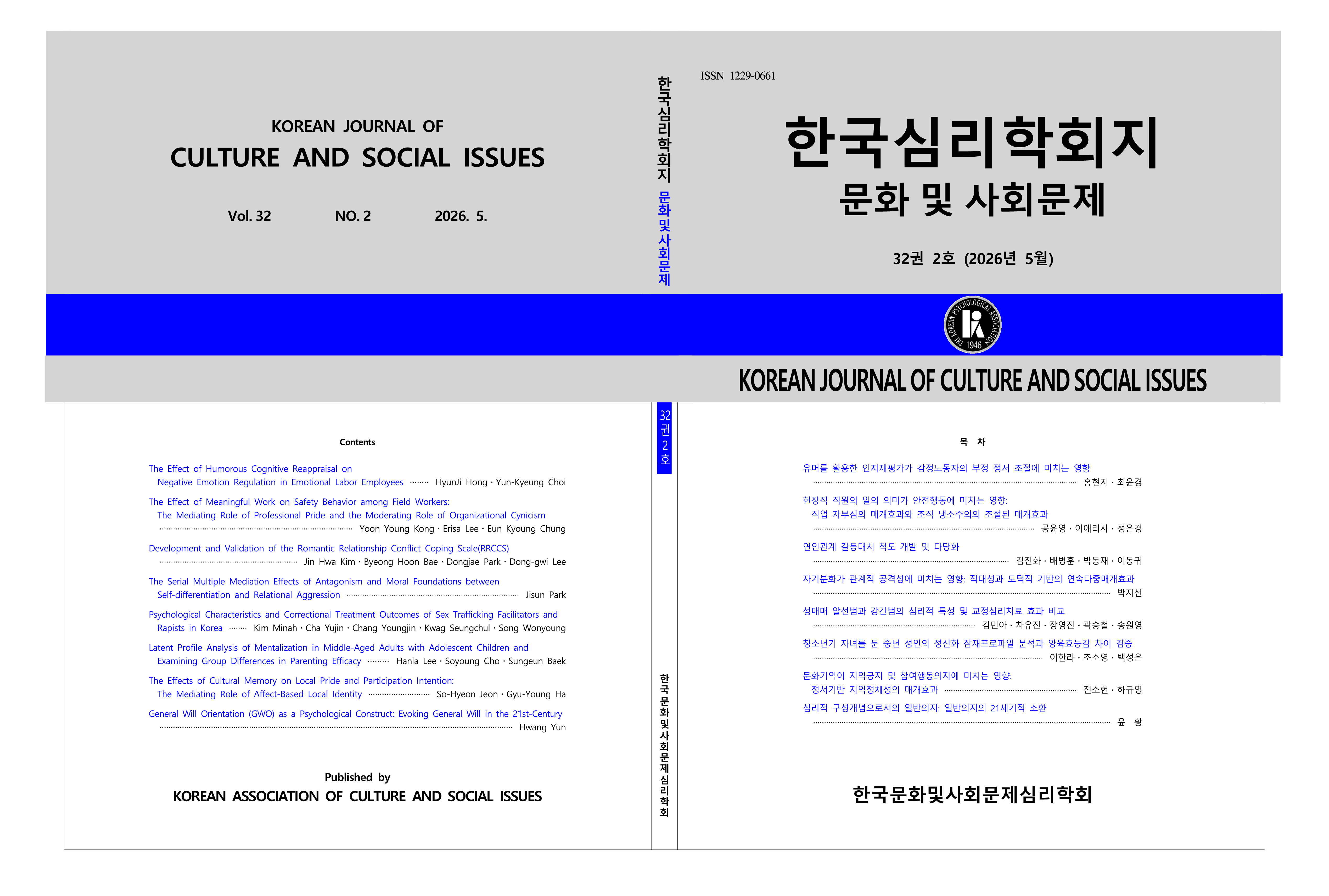
유머를 활용한 인지재평가가 감정노동자의 부정 정서 조절에 미치는 영향
The Effect of Humorous Cognitive Reappraisal on Negative Emotion Regulation in Emotional Labor Employees
최윤경 (계명대학교)

초록
본 연구의 목적은 감정노동자인 정신건강서비스 종사자들을 대상으로, 유머를 활용한 인지재평가가 업무 중 경험할 수 있는 부정 정서 조절에 미치는 영향을 검증하는 것이었다. 참가자는 정신건강서비스 종사자 40명으로, 긍정 유머 활용 재평가 집단(n=11), 부정 유머 활용 재평가 집단(n=10), 인지재평가 집단(n=9), 정서표현 억제 집단(n=10) 중 하나에 무작위로 할당되었다. 참가자들은 업무 중 경험할 수 있는 분노 유발 시나리오와 해당 상황에서의 정서 조절 방식에 대해 녹음된 음성 자극을 듣고 이를 생생하게 상상하는 비대면 훈련에 참여하였다. 처치 전후로 긍정 정서, 부정 정서, 분노 정서 및 각성가를 측정하였다. 본 연구는 처치 유형(4) × 시기(2)의 혼합설계로 분석되었으며, 긍정 정서, 부정 정서 및 분노 정서에서는 처치 유형 × 시기의 상호작용 효과가 유의하지 않았고 시기의 주효과만 유의한 것으로 나타났다. 반면, 각성가에서는 처치 유형 × 시기의 상호작용 효과가 유의하였으며, 특히 긍정 유머 활용 재평가 집단에서 처치 후 각성가가 감소하는 양상이 확인되었다. 마지막으로 본 연구의 제한점과 향후 연구를 위한 제언, 그리고 본 연구의 의의가 논의되었다.
- keywords
- 감정노동, 유머, 인지재평가, 정서 조절
Abstract
The purpose of this study was to examine the effects of humor-based cognitive reappraisal on the regulation of negative emotions experienced during work among emotional laborers, specifically for mental health service professionals. A total of 40 mental health service workers were randomly assigned to one of four conditions: positive humor-based reappraisal (n = 11), negative humor-based reappraisal (n = 10), cognitive reappraisal (n = 9), or an emotion suppression condition (n = 10). Participants completed an online imagery-based training in which they listened to audio-recorded anger-inducing work scenarios and imagined, as vividly as possible, how they would regulate their emotions in those situations according to their assigned condition. Positive affect, negative affect, anger, and arousal were assessed before and after the treatment. Data were analyzed using a 4 (treatment type) × 2 (time) mixed-design analysis of variance. For positive affect, negative affect, and anger, the interaction effects between treatment type and time were not significant, whereas the main effects of time were significant. In contrast, a significant treatment type × time interaction effect was found for arousal, with the positive humor-based reappraisal group showing a decrease in arousal following the treatment. Finally, the limitations of the study, implications for future research, and the significance of the findings are discussed.
- keywords
- emotional labor, humor, cognitive reappraisal, emotion regulation
- 투고일Received
- 2026-01-07
- 수정일Revised
- 2026-02-23
- 게재확정일Accepted
- 2026-03-13
- 출판일Published
- 2026-05-31
- 다운로드 수
- 조회수
- 0KCI 피인용수
- 0WOS 피인용수