
Korean Psychological Journal of Culture and Social Issues
- P-ISSN1229-0661
- E-ISSN1229-0661
- KCI
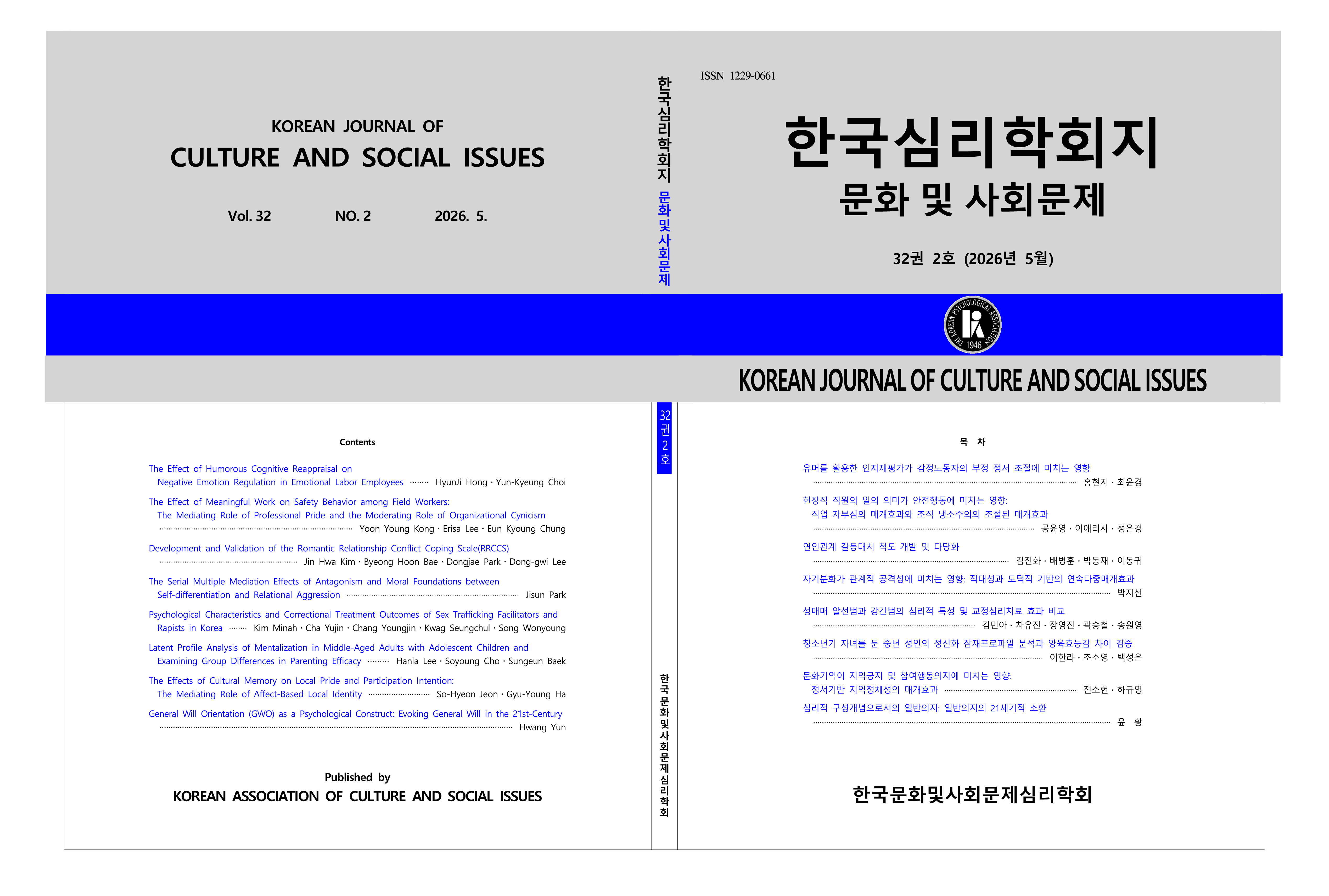
Article Contents
- 2026 (Vol.32)
- 2025 (Vol.31)
- 2024 (Vol.30)
- 2023 (Vol.29)
- 2022 (Vol.28)
- 2021 (Vol.27)
- 2020 (Vol.26)
- 2019 (Vol.25)
- 2018 (Vol.24)
- 2017 (Vol.23)
- 2016 (Vol.22)
- 2015 (Vol.21)
- 2014 (Vol.20)
- 2013 (Vol.19)
- 2012 (Vol.18)
- 2011 (Vol.17)
- 2010 (Vol.16)
- 2009 (Vol.15)
- 2008 (Vol.14)
- 2007 (Vol.13)
- 2006 (Vol.12)
- 2005 (Vol.11)
- 2004 (Vol.10)
- 2003 (Vol.9)
- 2002 (Vol.8)
- 2001 (Vol.7)
- 2000 (Vol.6)
- 1999 (Vol.5)
- 1998 (Vol.4)
- 1997 (Vol.3)
- 1995 (Vol.2)
- 1994 (Vol.1)
Development and Validation of the Romantic Relationship Conflict Coping Scale(RRCCS)

Abstract
This study aimed to develop and validate a scale measuring conflict coping behaviors in romantic relationships. An open-ended survey was conducted with 100 individuals in their 20s and 30s who had been in a romantic relationship for at least three months, yielding 269 statements. Prototype analysis and two rounds of expert content validation resulted in a 75-item preliminary scale. Exploratory structural equation modeling with 300 participants identified a final scale consisting of 32 items across six factors: positive repair, distancing, careful consideration, submission, rational coping, and expression of negativity. Especially, positive repair was interpreted as a proactive investment behavior for maintaining the relationship from the perspective of interdependence theory, whereas careful consideration reflected a cautious coping process involving both cognitive reflection and emotional processing that has not been sufficiently captured in existing scales. Each factor showed theoretically consistent correlations with existing conflict-related scales, empathy, communication, and personality traits. Criterion-related and incremental validity were supported using relationship satisfaction and stability as the criteria. A four-week test-retest reliability was also satisfactory. This study is meaningful in that it presents a Korean scale of conflict coping in romantic relationships that complements the cultural limitations of existing overseas measures and reflects contemporary communication contexts, including messenger and SNS interactions.
- keywords
- unmarried young adults, romantic relationship, conflict coping, prototype analysis, exploratory structural equation modeling
- Received
- 2026-01-07
- Revised
- 2026-02-19
- Accepted
- 2026-03-26
- Published
- 2026-05-31
- Downloaded
- Viewed
- 0KCI Citations
- 0WOS Citations