
Korean Psychological Journal of Culture and Social Issues
- P-ISSN1229-0661
- E-ISSN1229-0661
- KCI
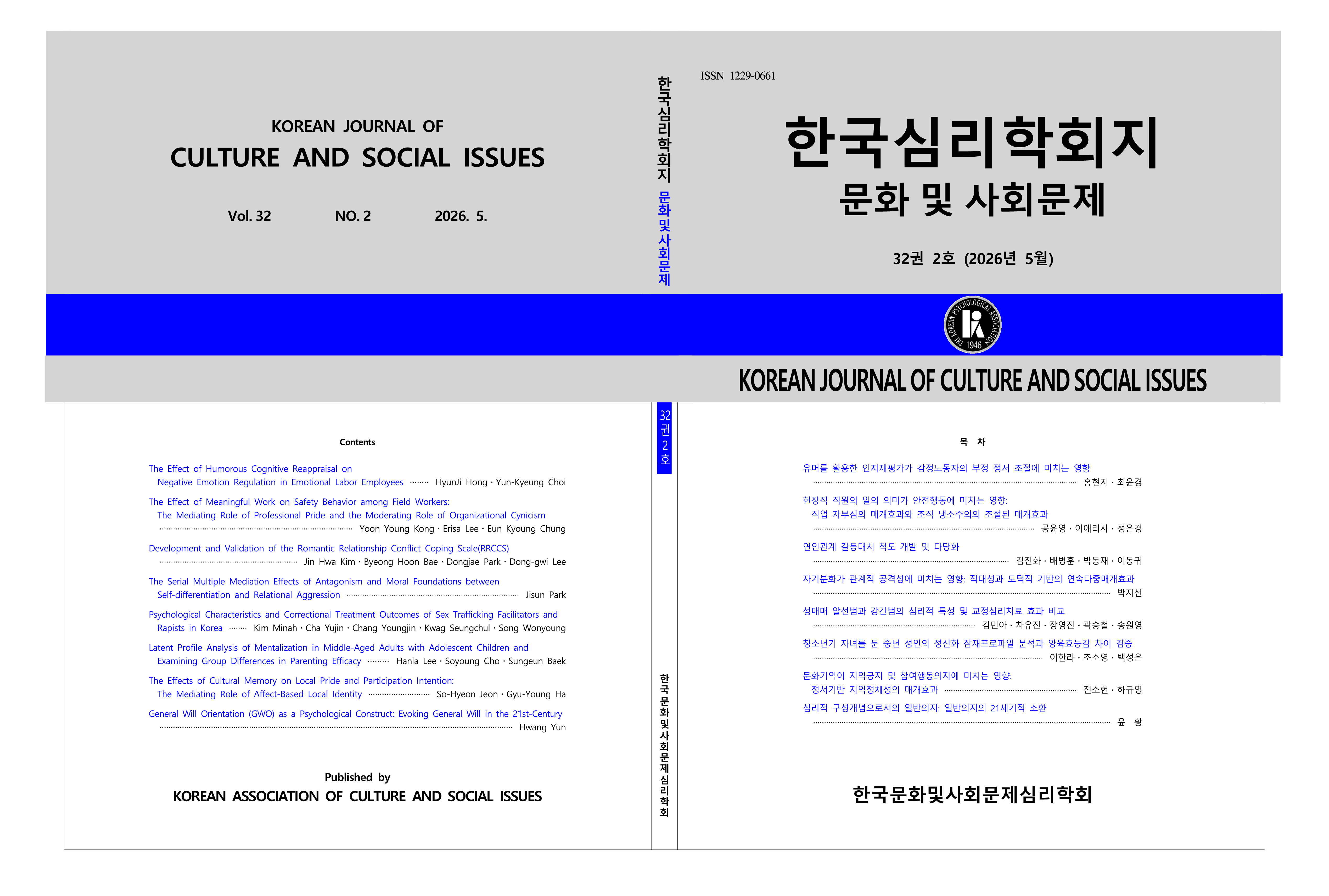
Article Contents
- 2026 (Vol.32)
- 2025 (Vol.31)
- 2024 (Vol.30)
- 2023 (Vol.29)
- 2022 (Vol.28)
- 2021 (Vol.27)
- 2020 (Vol.26)
- 2019 (Vol.25)
- 2018 (Vol.24)
- 2017 (Vol.23)
- 2016 (Vol.22)
- 2015 (Vol.21)
- 2014 (Vol.20)
- 2013 (Vol.19)
- 2012 (Vol.18)
- 2011 (Vol.17)
- 2010 (Vol.16)
- 2009 (Vol.15)
- 2008 (Vol.14)
- 2007 (Vol.13)
- 2006 (Vol.12)
- 2005 (Vol.11)
- 2004 (Vol.10)
- 2003 (Vol.9)
- 2002 (Vol.8)
- 2001 (Vol.7)
- 2000 (Vol.6)
- 1999 (Vol.5)
- 1998 (Vol.4)
- 1997 (Vol.3)
- 1995 (Vol.2)
- 1994 (Vol.1)
General Will Orientation (GWO) as a Psychological Construct: Evoking General Will in the 21st-Century

Abstract
This study theoretically reconceptualizes Rousseau's General Will—a cornerstone of 18th-century political philosophy—as a psychological construct for the 21st century. Amid an existential crisis in which Dataism supplants individual autonomy and dissolves communal bonds, this study translates Rousseau's theory of the state of nature, the bifurcation of amour de soi and amour-propre, the concept of denaturalization, and the common self (moi commun) into psychological language. Through this transposition, General Will Orientation (GWO) is proposed as a novel psychological construct comprising three subfactors: public good orientation, self-legislative agency, and emotional solidarity. This study argues that GWO is distinct from Kant's categorical imperative, Rawls's justice as fairness, Kohlberg's Stage 5 of moral development, and the VIA Classification of Character Strengths. Each framework illuminates morality from a different vantage point—autonomous legislation, procedural fairness, cognitive moral reasoning, and individual virtue—yet shares a common limitation in failing to integrate affective-motivational mechanisms with communal context. The psychological reality and measurability of GWO are demonstrated through its structural symmetry with psychopathy, representing the negative end of human morality. GWO is further positioned as an integrative alternative transcending the dichotomy between normative and virtue ethics. The infallibility of the General Will is reinterpreted not as an empirical claim but as a constitutive one, providing theoretical basis for translating a metaphysical imperative into a measurable psychological variable. GWO is anticipated to expand the scope of moral psychology with philosophical depth, serving as a psychological counterforce that safeguards human moral agency in the age of algorithmic governance.
- keywords
- Rousseau, General Will, GWO, Dataism, psychopathy
- Received
- 2026-03-12
- Revised
- 2026-05-03
- Accepted
- 2026-05-20
- Published
- 2026-05-31
- Downloaded
- Viewed
- 0KCI Citations
- 0WOS Citations