
Korean Journal of Health Psychology
- KOREAN
- P-ISSN1229-070X
- E-ISSN2713-9581
- KCI
Article Contents
- 2026 (Vol.31)
- 2025 (Vol.30)
- 2024 (Vol.29)
- 2023 (Vol.28)
- 2022 (Vol.27)
- 2021 (Vol.26)
- 2020 (Vol.25)
- 2019 (Vol.24)
- 2018 (Vol.23)
- 2017 (Vol.22)
- 2016 (Vol.21)
- 2015 (Vol.20)
- 2014 (Vol.19)
- 2013 (Vol.18)
- 2012 (Vol.17)
- 2011 (Vol.16)
- 2010 (Vol.15)
- 2009 (Vol.14)
- 2008 (Vol.13)
- 2007 (Vol.12)
- 2006 (Vol.11)
- 2005 (Vol.10)
- 2004 (Vol.9)
- 2003 (Vol.8)
- 2002 (Vol.7)
- 2001 (Vol.6)
- 2000 (Vol.5)
- 1999 (Vol.4)
- 1998 (Vol.3)
- 1997 (Vol.2)
- 1996 (Vol.1)
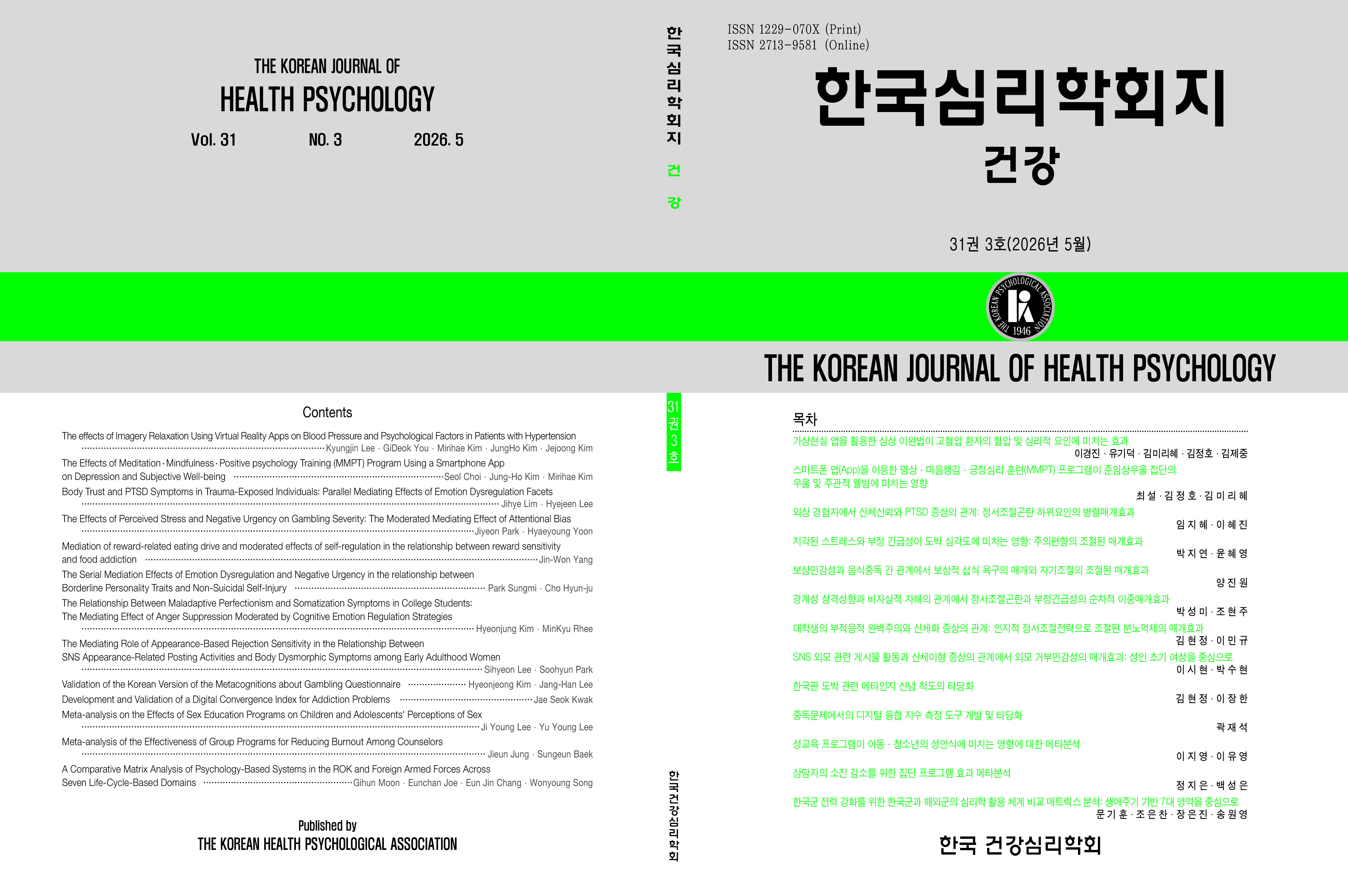
The effects of Imagery Relaxation Using Virtual Reality Apps on Blood Pressure and Psychological Factors in Patients with Hypertension
GiDeok You (Department of Psychology, Duksung Women’s University)
Mirihae Kim (Department of Psychology, Duksung Women’s University)
JungHo Kim (Department of Psychology, Duksung Women’s University)
Jejoong Kim (Department of Psychology, Duksung Women’s University)

Abstract
This study assessed the effects of relaxation training delivered through a mobile application (App) featuring a virtual beach environment on blood pressure and psychological states in patients with hypertension aged 40 to 75. Thirty participants from two hospitals in the Seocheon and Cheonan areas of Korea were randomly assigned to either a treatment group (n=15) or a waitlist control group (n=15). The treatment group received education on relaxation techniques and engaged in App-based relaxation exercises in the virtual reality environment twice daily for four weeks. All participants completed pre-test and post-test assessments. Compared to the control group, the treatment group showed a statistically significant reduction in tension levels, as measured by self-reported relaxation scales. These findings suggest that virtual reality App-based relaxation training effectively enhances relaxation in hypertensive patients, rather than merely reducing arousal.
- keywords
- Virtual reality, imagery relaxation training, hypertension, app
- Received
- 2025-10-16
- Revised
- 2025-11-19
- Accepted
- 2026-02-25
- Published
- 2026-05-30
- Downloaded
- Viewed
- 0KCI Citations
- 0WOS Citations