
Korean Journal of Health Psychology
- KOREAN
- P-ISSN1229-070X
- E-ISSN2713-9581
- KCI
Article Contents
- 2026 (Vol.31)
- 2025 (Vol.30)
- 2024 (Vol.29)
- 2023 (Vol.28)
- 2022 (Vol.27)
- 2021 (Vol.26)
- 2020 (Vol.25)
- 2019 (Vol.24)
- 2018 (Vol.23)
- 2017 (Vol.22)
- 2016 (Vol.21)
- 2015 (Vol.20)
- 2014 (Vol.19)
- 2013 (Vol.18)
- 2012 (Vol.17)
- 2011 (Vol.16)
- 2010 (Vol.15)
- 2009 (Vol.14)
- 2008 (Vol.13)
- 2007 (Vol.12)
- 2006 (Vol.11)
- 2005 (Vol.10)
- 2004 (Vol.9)
- 2003 (Vol.8)
- 2002 (Vol.7)
- 2001 (Vol.6)
- 2000 (Vol.5)
- 1999 (Vol.4)
- 1998 (Vol.3)
- 1997 (Vol.2)
- 1996 (Vol.1)
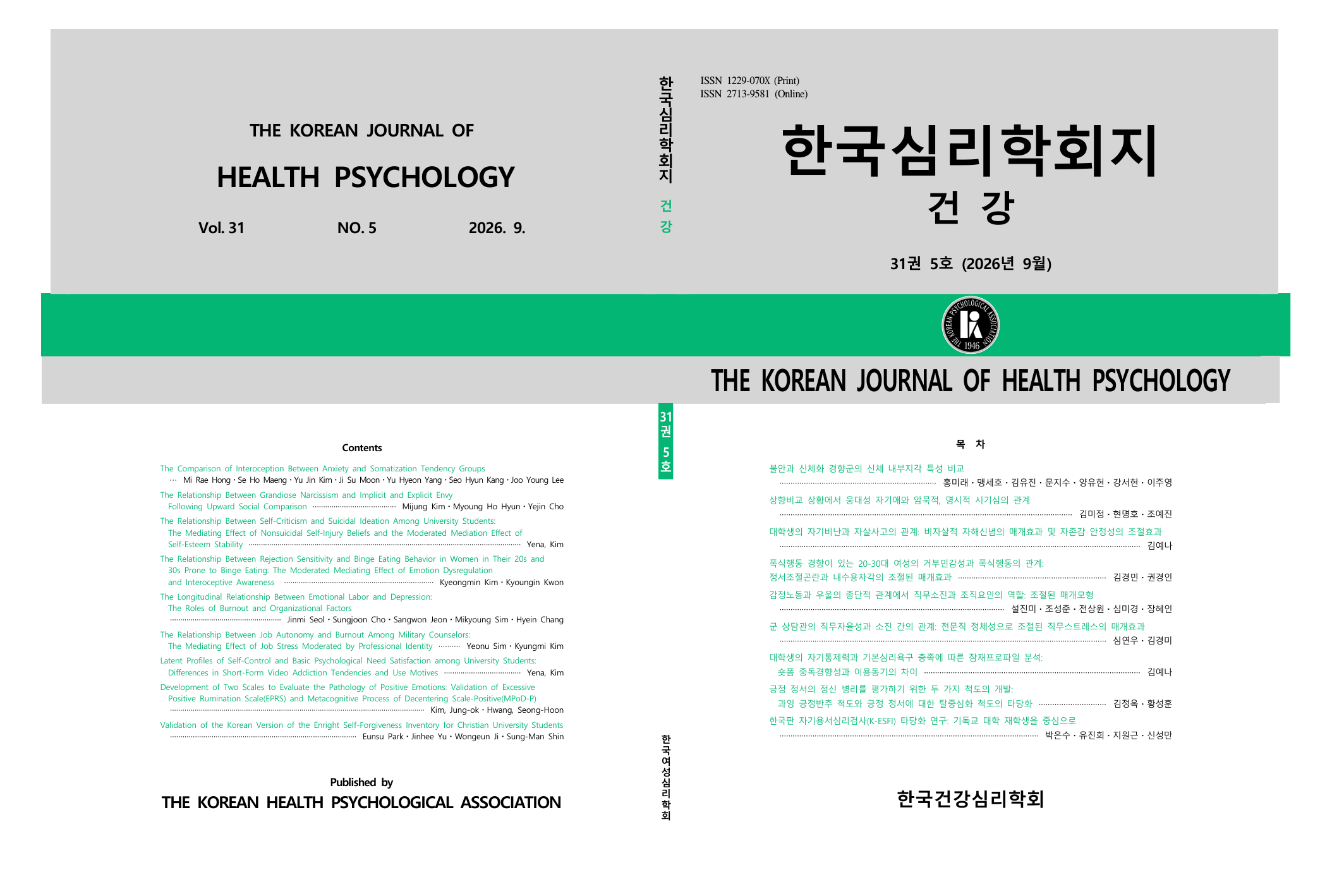
Validation of the Korean Version of the Enright Self-Forgiveness Inventory for Christian University Students
Jinhee Yu
Wongeun Ji
Sung Man Shin

Abstract
This study translated the Enright Self-Forgiveness Inventory developed by Kim et al. (2022) into Korean and examined the reliability and validity of the Korean version. With permission from the original authors, the scale was translated into Korean, back-translated, and finalized through expert review. Data were collected from 270 Christian university students in South Korea(100 men and 170 women) and were subjected to confirmatory factor analysis, reliability analysis, correlation analysis, and hierarchical regression analysis. The results were as follows. First, confirmatory factor analysis supported the bifactor model, consistent with the original scale, comprising six specific factors—positive affect, negative affect, positive behavior, negative behavior, positive cognition, and negative cognition—together with one general self-forgiveness factor. Second, the reliability analysis indicated that the Korean version of the Enright Self-Forgiveness Inventory is internally consistent. Third, its correlation and regression coefficients with measures of the Self-forgiveness Scale, the Depression Anxiety Stress Scales, the Social Desirability Scale, the Meaning in Life Questionnaire, and the Big Five Inventory provided evidence of validity. Finally, the implications and limitations of the study are discussed, along with suggestions for future research.
- keywords
- Self-Forgiveness, Validation, Enright Self-Forgiveness Inventory, bifactor model
- Received
- 2026-04-27
- Revised
- 2026-06-24
- Accepted
- 2026-08-06
- Published
- 2026-09-30
- Downloaded
- Viewed
- 0KCI Citations
- 0WOS Citations