


- ENGLISH
- P-ISSN1229-070X
- E-ISSN2713-9581
- KCI
논문 상세
- 2026 (31권)
- 2025 (30권)
- 2024 (29권)
- 2023 (28권)
- 2022 (27권)
- 2021 (26권)
- 2020 (25권)
- 2019 (24권)
- 2018 (23권)
- 2017 (22권)
- 2016 (21권)
- 2015 (20권)
- 2014 (19권)
- 2013 (18권)
- 2012 (17권)
- 2011 (16권)
- 2010 (15권)
- 2009 (14권)
- 2008 (13권)
- 2007 (12권)
- 2006 (11권)
- 2005 (10권)
- 2004 (9권)
- 2003 (8권)
- 2002 (7권)
- 2001 (6권)
- 2000 (5권)
- 1999 (4권)
- 1998 (3권)
- 1997 (2권)
- 1996 (1권)
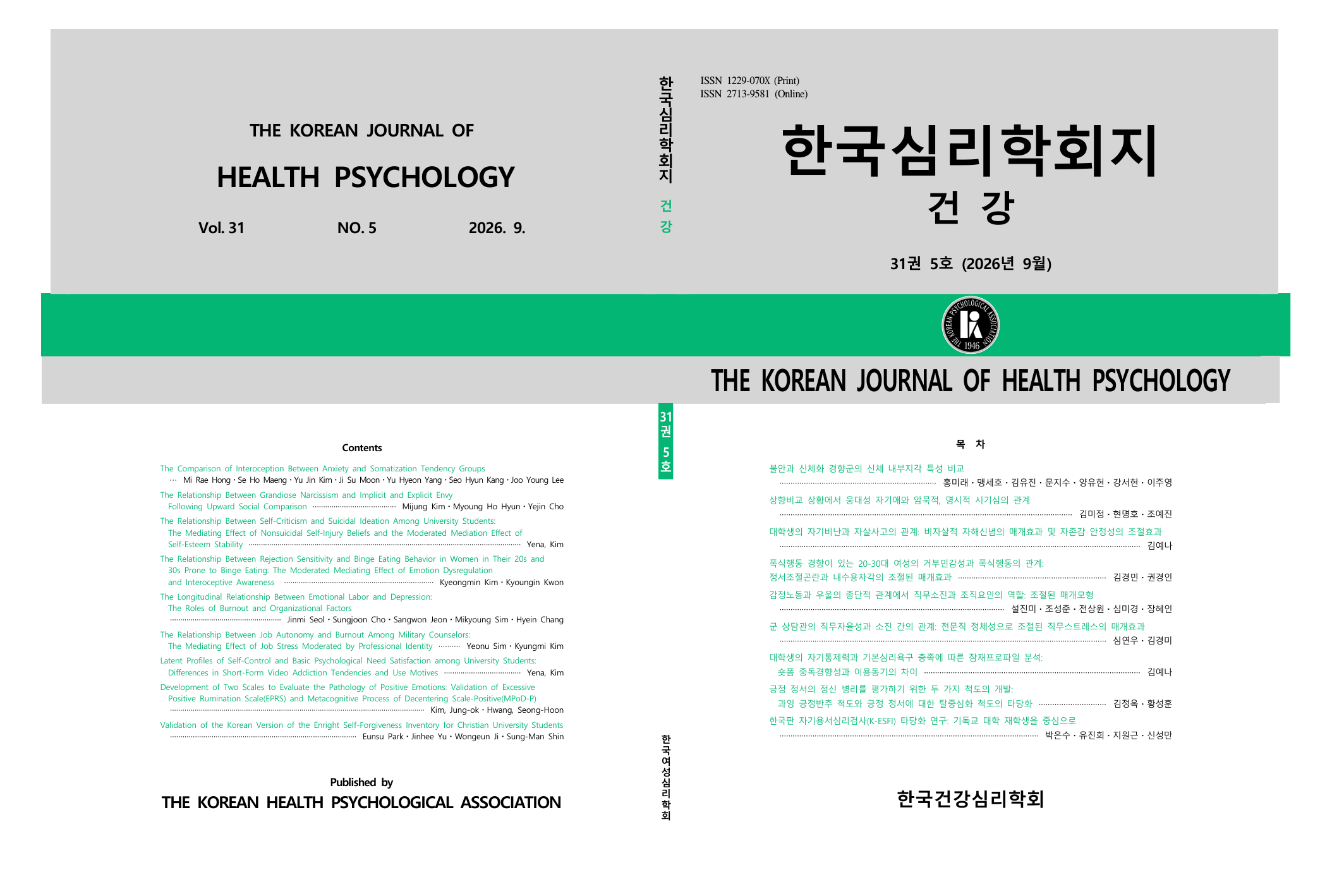
한국판 자기용서심리검사(K-ESFI) 타당화 연구: 기독교 대학 재학생을 중심으로
Validation of the Korean Version of the Enright Self-Forgiveness Inventory for Christian University Students
유진희(Jinhee Yu) (위스콘신 대학교)
지원근(Wongeun Ji) (한동대학교)
신성만(Sung Man Shin) (한동대학교)

초록
본 연구는 Kim 등(2022)이 개발한 자기용서심리검사(Enright Self-Forgiveness Inventory)를 한국어로 번역하고, 신뢰도와 타당도를 검증하는 데 목적이 있다. 이를 위해 원저자의 동의를 얻은 후, 원척도를 번역 및 역번역하였으며, 전문가를 대상으로 내용 동등성을 확인하여 최종 문항을 확정하였다. 자료분석에는 국내 기독교 대학에 재학 중인 대학생 270명(남자 100명, 여자 170명)의 데이터를 활용하여 확인적 요인분석, 신뢰도 분석, 상관분석, 위계적 회귀분석을 실시하였다. 결과는 다음과 같다. 첫째, 확인적 요인분석을 실시한 결과, 원척도와 동일하게 긍정적 정서, 부정적 정서, 긍정적 행동, 부정적 행동, 긍정적 인지, 부정적 인지의 6개 특수요인과 자기용서 일반요인으로 구성된 bifactor 모형을 확인하였다. 둘째, 자기용서심리검사의 신뢰도를 검증하여 본 척도가 신뢰롭고 타당한 척도임을 확인하였다. 셋째, 자기용서 척도, 부정적 정서 척도, 사회적 정향성 척도, 삶의 의미 척도, 성격 5요인 척도와의 상관분석 및 위계적 회귀분석을 실시하여 척도의 타당도를 확인하였다. 끝으로 이러한 결과를 중심으로 본 연구의 의의 및 제한점, 추후 연구를 위한 제언을 논의하였다.
- keywords
- 자기용서, 타당화, 자기용서심리검사, bifactor 모형
Abstract
This study translated the Enright Self-Forgiveness Inventory developed by Kim et al. (2022) into Korean and examined the reliability and validity of the Korean version. With permission from the original authors, the scale was translated into Korean, back-translated, and finalized through expert review. Data were collected from 270 Christian university students in South Korea(100 men and 170 women) and were subjected to confirmatory factor analysis, reliability analysis, correlation analysis, and hierarchical regression analysis. The results were as follows. First, confirmatory factor analysis supported the bifactor model, consistent with the original scale, comprising six specific factors—positive affect, negative affect, positive behavior, negative behavior, positive cognition, and negative cognition—together with one general self-forgiveness factor. Second, the reliability analysis indicated that the Korean version of the Enright Self-Forgiveness Inventory is internally consistent. Third, its correlation and regression coefficients with measures of the Self-forgiveness Scale, the Depression Anxiety Stress Scales, the Social Desirability Scale, the Meaning in Life Questionnaire, and the Big Five Inventory provided evidence of validity. Finally, the implications and limitations of the study are discussed, along with suggestions for future research.
- keywords
- Self-Forgiveness, Validation, Enright Self-Forgiveness Inventory, bifactor model
- 투고일Received
- 2026-04-27
- 수정일Revised
- 2026-06-24
- 게재확정일Accepted
- 2026-08-06
- 출판일Published
- 2026-09-30
- 다운로드 수
- 조회수
- 0KCI 피인용수
- 0WOS 피인용수